A One-Pot Recipe for Your Pup: Homemade Dog Food Back by Reader Request

To view the full 30-Days graphic that includes all 30 bowls, click here.

This past January, we shared a post highlighting thirty days of homemade dog food that we made for our pup, Indie, during the month of December 2022.

As much a photo collage as a visual guide on the types of food that Indie has been eating throughout her life here with us, I wanted to dispel the myth that cooking for your pup is difficult, time-consuming and complicated. It was a piece that worked in tandem with a 2018 post about the history of dog food where we also introduced how to make your own balanced meals for your dog regardless of size, age or breed.
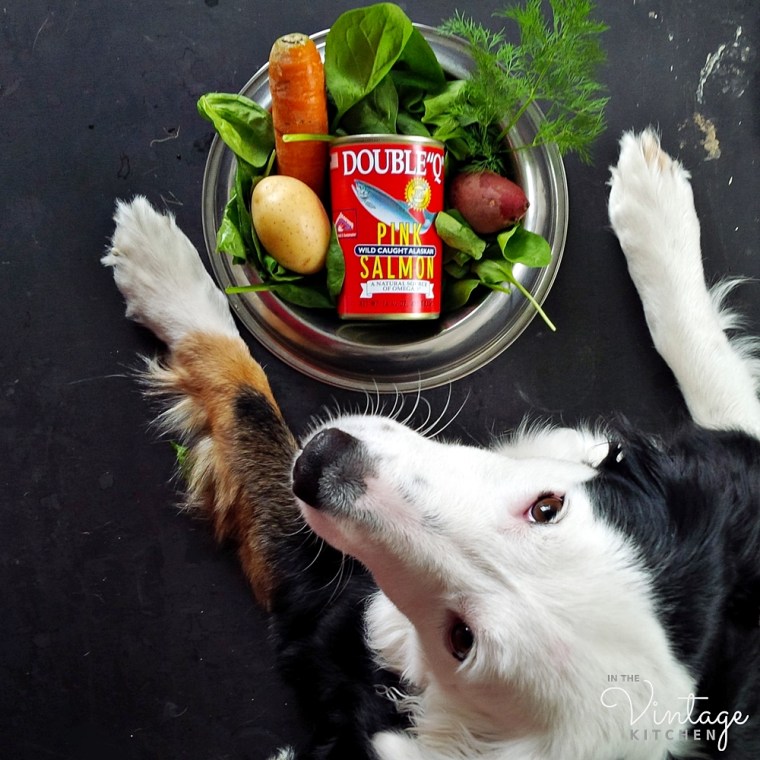
The history of dog food and how to make your own.

Both posts shared details about a large majority of the types of food Indie (and all dogs) can eat but neither contained a specific recipe. So in today’s post, as requested recently by our canine-loving readers, I’m sharing one of Indie’s most favorite meals complete with an ingredient list, step-by-step instructions and notes on scaling proportions depending on the size of your dog.
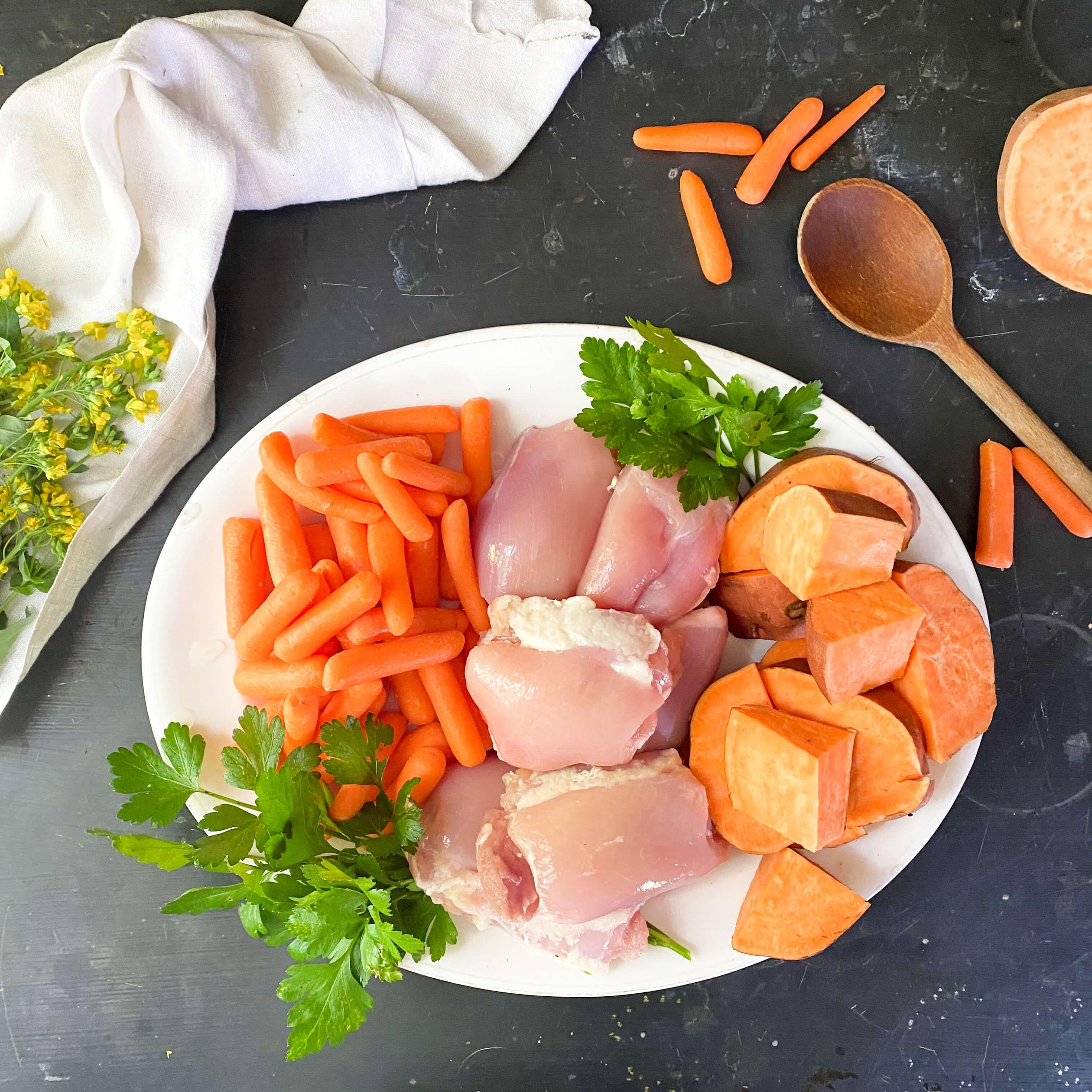
On the menu today it’s Steamed Chicken, Carrots & Sweet Potatoes – a one-pot stovetop meal that takes five minutes to prepare and one hour to cook. You can amend the recipe to make a large batch that will make up to eight meals or you can make a small batch that will provide a fresh homecooked meal for one to two days worth of dinners and breakfasts. Fridge-friendly, freezer-friendly and on-the-go-approved, if packed in an air-tight container and kept cold, this recipe can tag along on your all summer outings including picnicking, hiking, and overnight vacations. It can be reheated in the microwave or the oven if your dog likes warm food, or it can be enjoyed cold right from the fridge. You can toss in additional grains or vegetables if your pal has a big appetite, or serve it as is – a simple meat and two.

This is also a good starter recipe if you are new to the world of making homemade dog food or are introducing your pup to this new way of eating. It’s simple to make, requires just a handful of ingredients, and is easily digestible for all dogs. And just like all of Indie’s other meals, it’s 100% human friendly too. That’s the key to homemade dog food. There is not one ingredient in this recipe that you wouldn’t want to eat yourself. Let’s look…

Steamed Chicken with Carrots & Sweet Potatoes served here over a bed of green lentils.

Homemade Dog Food: Steamed Chicken with Carrots & Sweet Potatoes

This recipe makes 4-5 servings for a medium-sized dog weighing 45-50 lbs. Please see note regarding portion sizes following the recipe.

One 2-3lb package of chicken thighs, containing 4-6 thighs (Bone-in and skin-on preferred, but you can also use skinless/boneless thighs, chicken breasts or chicken tenders. We do not recommend bone-in-chicken breasts or wings though as these contain too many small bones. Please see note below.)

3 tablespoons olive oil

1 lb baby carrots

3 large sweet potatoes, skin-on and roughly chopped into large 3″ inch cubes

1 healthy pinch of sea salt

Optional: a handful of roughly chopped fresh parsley

Rinse chicken and pat dry with paper towels. Set aside. In a large stock pot, over medium-high heat, add the olive oil, making sure it coats the entire bottom of the pot. Let the oil warm up for about one minute. Add the carrots in a flat layer.

Next, add the chicken (skin side down if using bone-in thighs) …

Sprinkle the chicken with a generous pinch of sea salt. Then add the chopped sweet potatoes on top of the chicken and the fresh parsley on top of the potatoes.

Turn the heat down to medium. Cover the pot and cook for 60 minutes. Remove the pot from the heat and let it rest for 15 minutes on a cooling rack. Dinner is done!

With stew-like consistency, this dog-friendly recipe is full of comfort food flavors all bathed in a natural broth that forms when the water in the carrots and sweet potatoes mixes with the olive oil and the chicken fat. The hour-long steam makes the chicken fall off the bone and makes the vegetables so tender you can slice them with a butter knife.

If you use skin-on chicken thighs with bones you’ll get a richer-looking broth.

After the chicken has rested, remove one thigh, one cup of sweet potatoes, 1/2 cup of carrots, and 1/3 cup of broth to your dog’s bowl. Pull the chicken from the bone with a fork and then discard the bone. Because they splinter easily and can cause internal damage to organs, you never want to feed your pup any chicken bones. This is why we don’t recommend using bone-in chicken breasts which usually come with the ribs attached. The same goes for chicken wings which are made up of many small bones that can be easily missed when cutting the chicken up after it cooks.

Once you have transferred the chicken and vegetables to your pup’s bowl, slice everything into bite-sized pieces, mix it all together and let it cool to room temperature before serving.

Hands down one of Indie’s most favorite meals, Steamed Chicken with Carrots & Sweet Potatoes is a year-round pup-pleaser of a recipe and contains all sorts of nutritious vitamins and minerals. Collagen (chicken skin), beta-carotene (sweet potatoes, carrots), magnesium (sea salt), healthy fat and vitamins E & K (olive oil), and lean protein (chicken) are just a few of the beneficial vitamins and minerals wrapped up in this recipe that will help keep your dog happy and healthy.
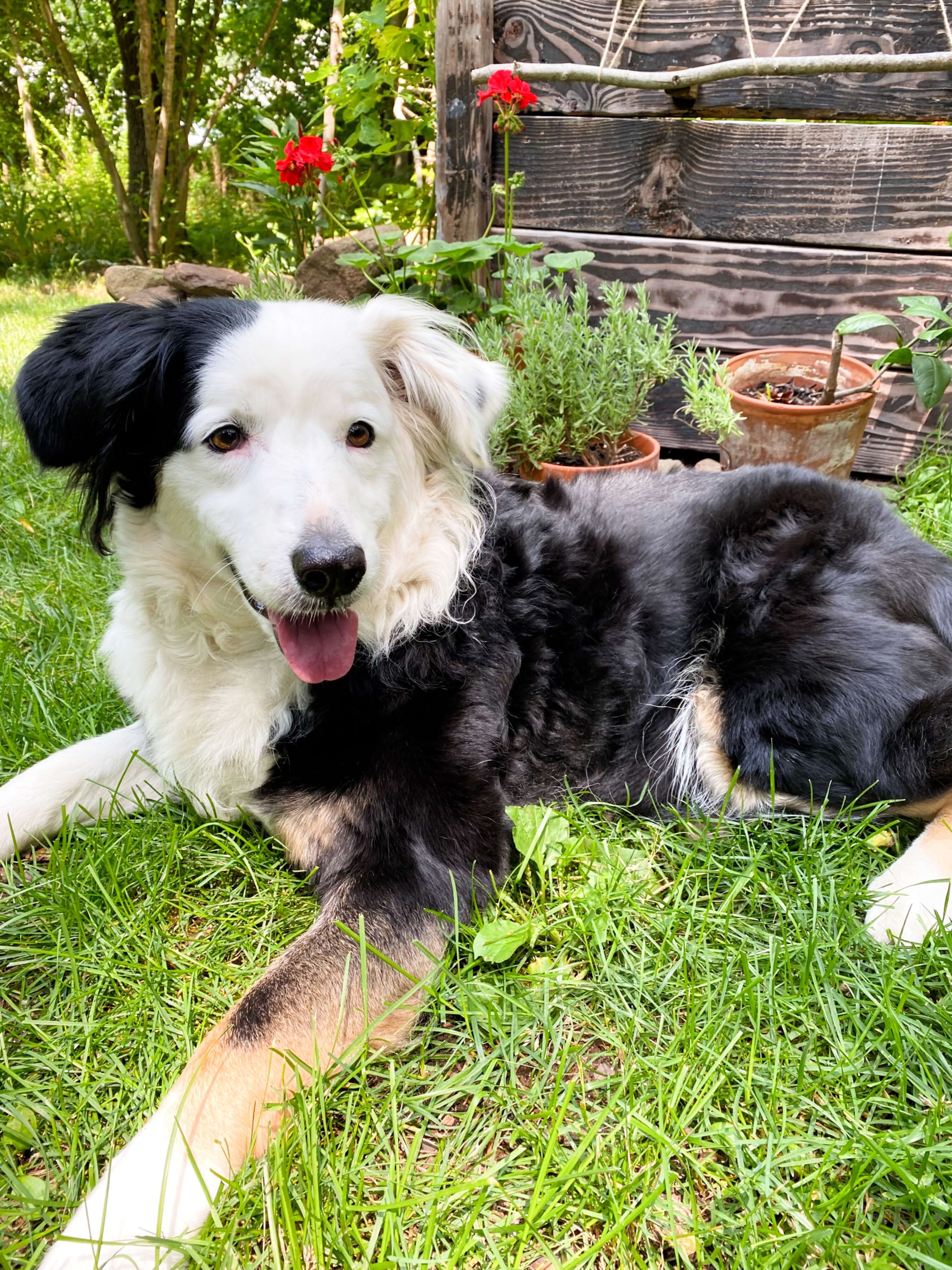
Over the 4th of July weekend, Indie celebrated her 10th birthday. Of course, we surprised her with her favorite chicken dinner. This time, in addition to the sweet potatoes and carrots we added in some chopped-up cucumbers, another summer love of hers.

For the love of homemade food and cucumbers.

That is just a little example of how carefree this chicken recipe can be. The carrots, olive oil, and the chicken itself are mainstays, but the sweet potatoes can be swapped out for butternut squash, red potatoes, broccoli, cauliflower, cabbage, pumpkin, celery, beets. Just avoid adding any onions, garlic, or citrus fruits – three types of food that also seem like they might be natural companions to this meal, but are actually toxic to dogs. If you are interested in more possibilities to add in or swap out be sure to check the lists of other approved dog-friendly foods in the previous two posts here and here.

Leftovers can be stored in an air-tight container in the fridge for up to four days. When the broth cools it transforms into a jelly-like consistency similar to aspic. Don’t be put off by its wiggly jiggly nature. It’s just the coagulation of the olive oil, broth, vegetable juices and chicken fat. Your dog will love it, so be sure to include a little bit of it with each additional serving. If you decide to make some rice or lentils to augment the chicken and vegetables that jelly will add extra flavor to the new additions.

Day Two – the wiggly jigglys!

And two final notes on year-round enjoyment of this recipe and portion sizes …

In the summer, Indie tends to eat a little less food if it’s particularly hot, so when it comes to this recipe, she’s happy most of the warm-weather months with just the chicken, sweet potato and carrot combo. But in fall, winter and spring when she is at her most active, we usually add in a few other foods too for both variety and an extra dose of go-power. Other accompaniments you might like to include are the following…

  • 3/4 cup of cooked rice, 1/2 cup of cooked lentils or 1/4 cup oatmeal
  • 1 cup of additional cooked and chopped green vegetables (broccoli, collard greens, kale, spinach, zucchini, celery, green beans or peas)

All the proportions discussed so far are based on Indie’s medium 55lb. frame. If you are making this recipe for a small breed dog like a chihuahua or a bichon, you can certainly swap out the thighs for smaller cuts like chicken tenders or thin-cut chicken breasts. If you decide to use either of those, simply adjust the cooking process by starting with the layer of carrots first after you add the olive oil, then add the chicken, salt and sweet potato layers. That way the chicken won’t get stuck to the bottom of the pot.

And on the opposite spectrum, if you have a large breed dog over 60 lbs. I’d recommend doubling the portion size of the recipe above. The nice thing about using a big stock pot is that you can fit quite a bit of food in it. I’ve made this recipe using all types of chicken cuts, and all types of quantities from 4 to 8 thighs with 2lbs of carrots and six sweet potatoes, and it still comes out great every time.

Recently I discovered the 1910 story of Bum, a stray dog in St. Joseph, Missouri who frequented the back door of several restaurants in town each day. He was such a polite and enthusiastic eater, the kitchen cooks and wait staff couldn’t help but spoil him with the finest menu selections of the day. After Bum enjoyed a delicious meal at his favorite luncheonettes, he’d trot down the street and wait patiently for his next favorite set of restaurants to open up for dinner service. Bum so charmed all the restaurant workers that he became the most beloved (and well-fed) fixture in the neighborhood.

This story reminds of Indie, who was also a stray who trotted into our backyard during our Fourth of July barbecue in 2014. Once she had her first bite of grilled chicken, she never left. And so began a now nine-year adventure of cooking for Indie, our most enthusiastic taste-tester here in the Vintage Kitchen. Julia Child was famous for saying ” People who love to eat are always the best people.” Around here, we could say the same about dogs too.
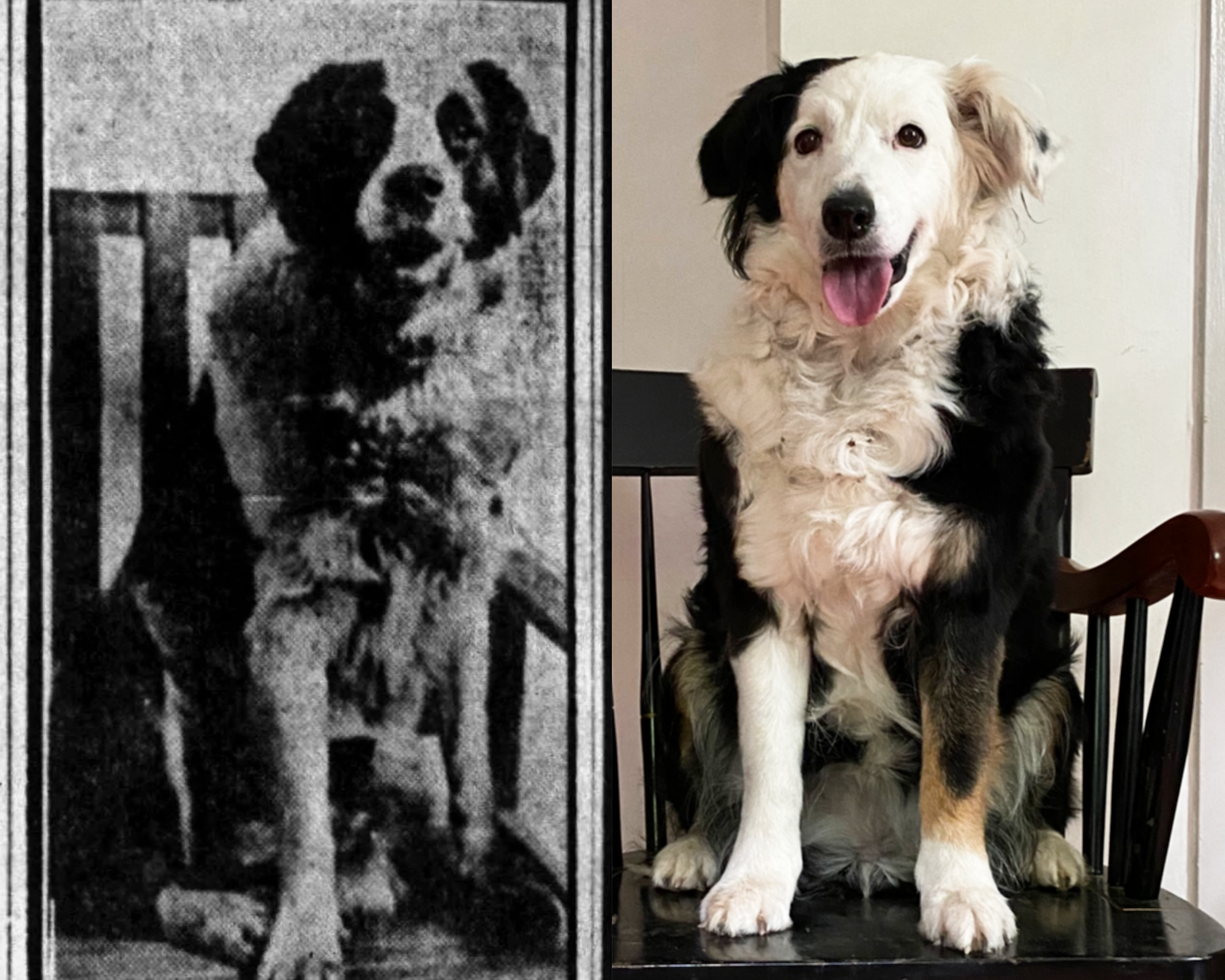
Bum in 1910. Indie in 2023. Photo of Bum courtesy of the St. Joseph News-Press (Dec. 16, 1910).

I hope this post is helpful to the readers who requested it. We are always here to answer any questions you might have so feel free to ask away should you run into any troubles. In the meantime, happy eating to your pups. I hope they love this recipe as much as Indie does!

Cheers to all the dogs out there who inspire a wealth of joy and creativity in the kitchen. And to Indie, our delight of a dinner eater from day one.

The Lost Art of Paula Peck: Egg & Mashed Potato Pizza circa 1966

In 1966, these words described her cooking… creative, imaginative, inventive, eclectic, beautifully presented, and internationally inspired. Craig Claiborne, the New York Times food editor and a beloved favorite here in the Vintage Kitchen, said “anyone who truly cares about cooking is fortunate indeed that such a talent as hers can be shared on the printed page.” James Beard called her “the finest cook I know.” Newspaper columnist Elizabeth de Sylva deemed her the “free spirit of cooking,” and food writer Gaynor Maddox labeled her “one of the most exciting, competent, and delightful guides to better dining.”

Today, here in the Vintage Kitchen, we are featuring a thoroughly modern-minded yet vintage recipe from the culinary repertoire of Paula Peck (1927-1972), who was a phenomenal but now forgotten cook popular during the mid-20th century. I use the word forgotten carefully. Since professional chefs today consider her cookbooks classics and since she still has a quiet army of devoted fans, she’s not lost to a select group, but Paula is definitely, surprisingly not part of mainstream cooking conversations like other famous names that traveled in her circle. Why is that? Was she overshadowed by bigger personalities like Julia Child or James Beard? Did her culinary prowess get dismissed over time? Her recipes simply forgotten?

In order to try to figure out why Paula Peck is not a household name today, we need to start at the beginning and explore the details of how she came to be the topic of conversation in mid-20th century kitchens.

It all started with her spouse.

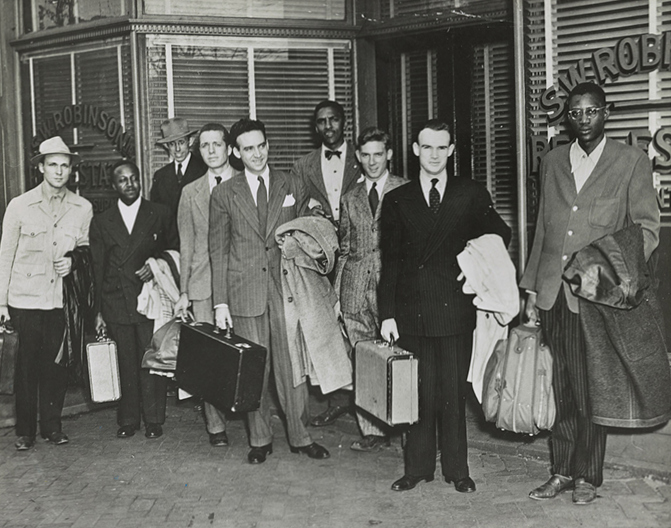
Among the many causes he supported, James Peck participated in the Freedom Rides in 1961, which protested the segregation of African Americans on public transportation. He was attacked and badly beaten for his involvement, but continued to defend the civil rights of African Americans. He is pictured here, fourth from left. Learn more about this experience in a 1979 interview here.

Paula’s husband, James Peck, known as Jim, was a newsworthy civil rights activist who worked his entire life trying to bring people together for noble and decent causes. Involved with the War Resistance League, the American Civil Liberties Union, and the Congress of Racial Equality among others, it was Jim who first inspired Paula to dive into the world of cooking after they were married in 1950. Up until that point, Paula knew little about how to create a meal. This was a bit of a tricky situation since she married a foodie. Unless she wanted to lose her husband to the local eateries of New York City night after night, she knew she was going to need to learn to cook. So as a young bride of 23, she set out on a mission to tempt her husband and his adventurous gourmet palate away from the restaurant scene, which he adored, and into the kitchen of his own home.

Paula Peck in her kitchen in December 1966. Photo: Newsday

As Paula started experimenting with food, she fell more and more and more in love with cooking. In trying to appeal to her husband’s enjoyment of international cuisine, in particular, she studied foods from all around the globe. She began collecting cookbooks, keeping track of recipes in a file box and gathering ideas about food preparation with friends. With every passing bite, Jim encouraged her explorations. Eventually, she gathered enough courage to take a cooking class with one of the country’s most celebrated gourmands, James Beard. From there, her culinary star rose bright and shiny, as the two struck up a friendship. One opportunity led to another. Paula became James’ apprentice and then his teaching partner. And then she went on to teach her own cooking classes.

Eleven years into her culinary journey, she published her first cookbook The Art of Fine Baking in 1961. After that, she was hired to work on the baking portion of the mega Time-Life Foods of the World cookbook series along with a host of respected chefs, food writers, and culinary experts. In 1966, she published a second cookbook, The Art of Good Cooking, in which she espoused the physical beauty of the kitchen, of quality ingredients, of simple equipment, of the breath-of-fresh-air joy that became her signature cooking style.

Her recipes began to appear with frequency in newspaper columns nationwide. She did live in-person cooking demonstrations for various events. She conducted interviews. The industry was achatter with news about Paula, about her recipes, about her unique approach to food. By 1970, Paula, the twenty-something girl who was not so skilled in cooking two decades earlier, arrived in the form of an accomplished, confident culinary teacher. Swathed in accolades, with nothing but a field of potential and possibility in front of her, surrounded by skilled peers and influential connections, Paula’s trajectory was on course for iconic status. And then something terrible happened. Paula died. Sadly, she was just 45.

In the 1960s, Paula circulated in the culinary world a bit differently than her comrades. Unlike most well-known cooks of her day, she wasn’t necessarily focused on age-old techniques. She questioned things. She wondered about established facts of cooking, curious if there were other ways or reasons to approach techniques beyond the traditional. She wasn’t concerned as much with how things were done, had been done, or should be done. Instead, she gave herself, and then her students, permission to experiment with food intuitively and to play around with taste, texture, and time.

Taking little bits and pieces from other cuisines, from other places and adapting them in ways that were unique and interesting, Paula worked with food from the foundation up, building a recipe like an artist builds up a scene in a painting. Taking into account, color, subject matter, texture, time, origin, flavor, and the relationship between one ingredient to another, her food was dotted with elements of surprise and flourish. It was those bits of unexpected detail that wound up setting her apart from all the gastronomes of her day. And I think it was those bits of detail that make her food still very relevant today.

Take pizza for example. Everybody knows the age-old basic pie with its flour crust, tomato sauce, a sprinkling of cheese, and perhaps a topping or two. But in Paula’s midcentury mind, the word pizza could mean something else entirely too. It could look something like this…

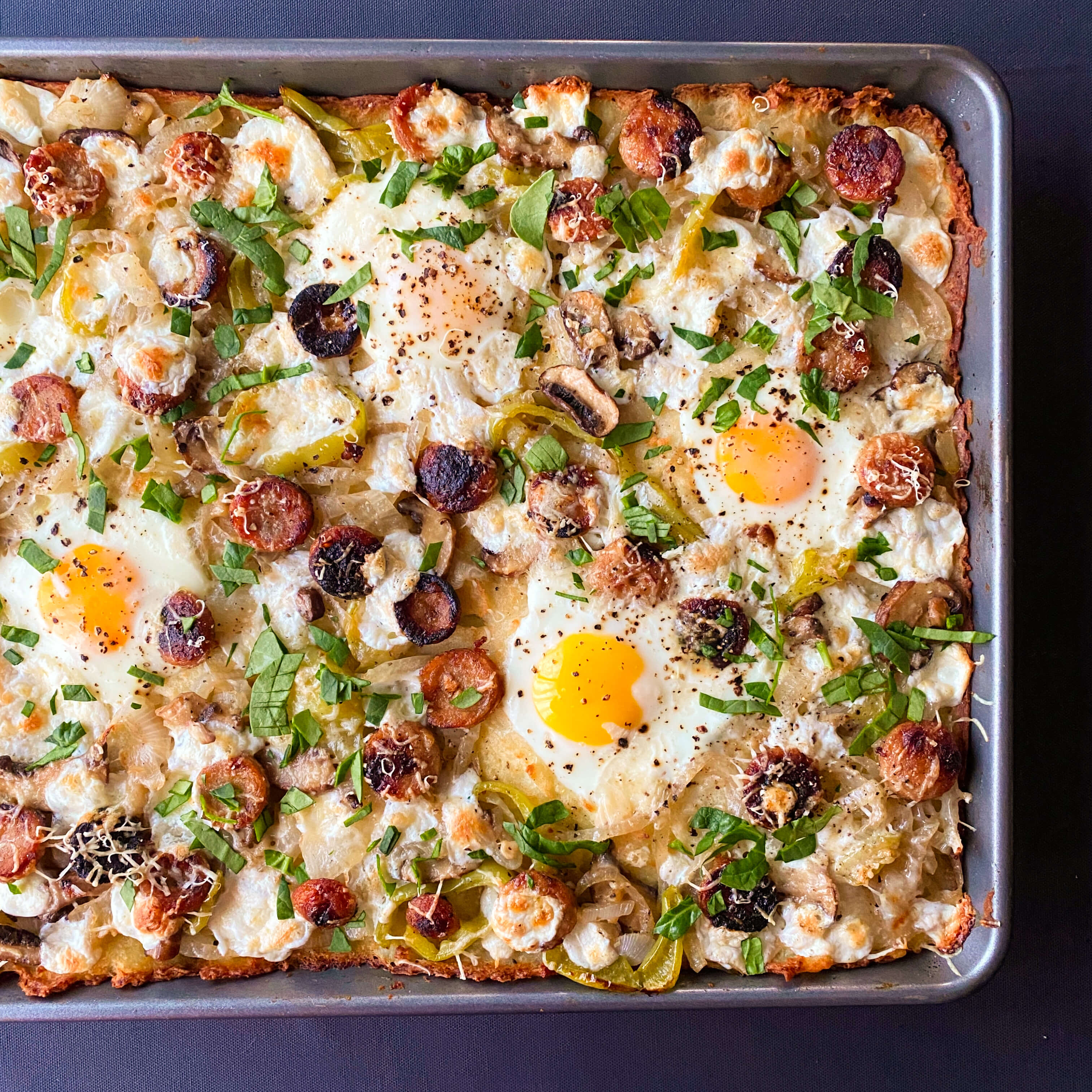
Paula Peck’s Egg & Potato Pizza

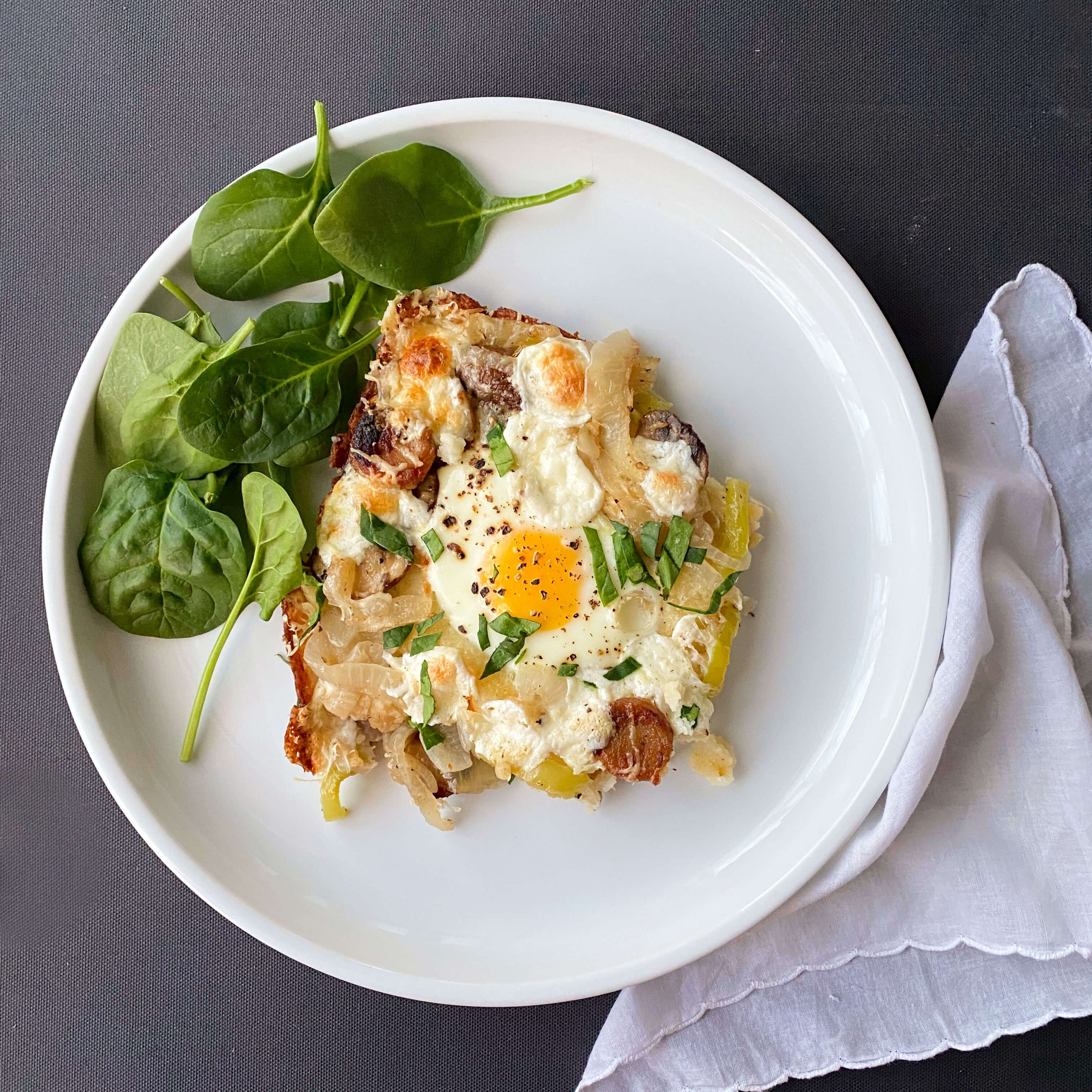
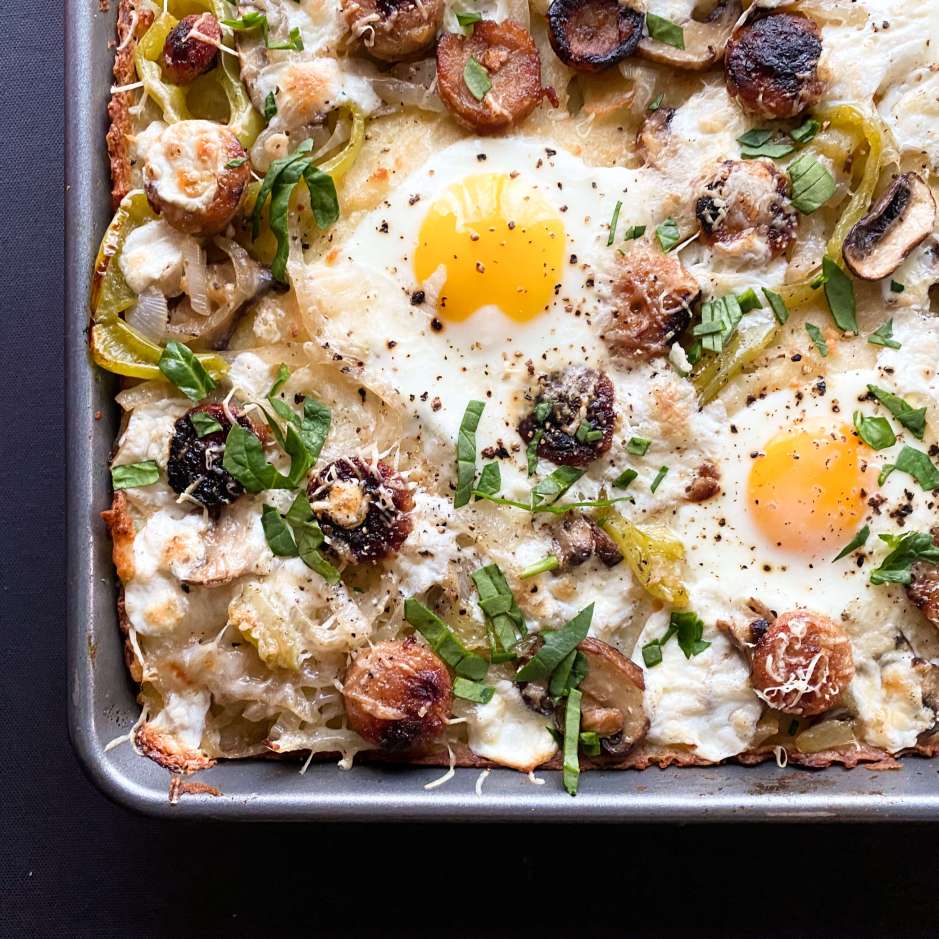
As a prime example of Paula’s creativity in the kitchen, it is her recipe for Egg & Potato Pizza from her 1966 book, The Art of Good Cooking, that is being featured here today. Using mashed potatoes as a base, sauteed onions, peppers, garlic, and mushrooms in place of a tomato sauce, and sausage and two kinds of cheese as toppers, this entire dish is polka-dotted with raw eggs and then popped into the oven for a brief bake. Surprise, whimsy, and a delicious combination of flavors are the result.

In a decade when casseroles were king of the dining table, the presentation alone of this recipe most definitely must have felt like a delightful break from the ordinary in 1960s America. More like a popular modern-day sheet pan meal than a traditional pizza, this fun-to-make any-time-of-day appropriate dish has contemporary comfort food written all over it. Made with simple ingredients and easily prepared, it feeds six people, is satisfyingly filling, and is fun to present table-side. In other words, it contains all the hallmarks of a perfect Paula dining experience.

I made this recipe as-is except I substituted chicken sausage for Italian sausage. And one thing to note before you begin… this recipe is best served immediately when it comes out of the oven. If you leave it to sit for a minute or two the eggs will continue to cook to a hard-boiled consistency and will eventually turn rubbery, if you wait to serve it much longer after that. If you like your eggs runny, cook the potatoes and toppings minus the eggs just until the cheese begins to melt (about 17 minutes) and then crack your eggs in their allotted divots and stick the whole tray back in the oven for about 3 minutes.

Paula Peck’s Egg & Potato Pizza

Serves 6

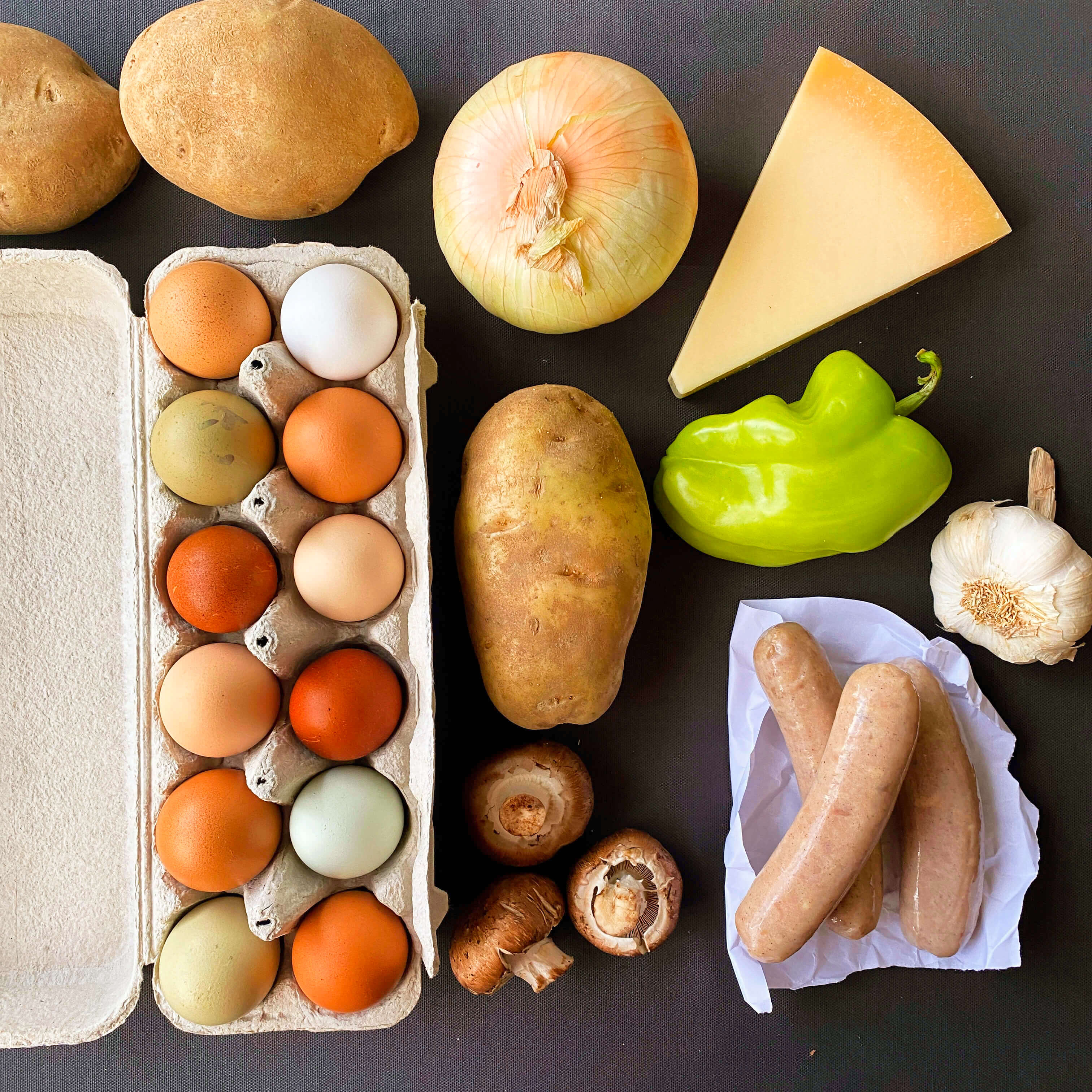
1/2 cup olive oil

3 cups well seasoned mashed potatoes

1 large onion, peeled and sliced

2 cloves garlic, minced

2 cups mushrooms

1 green pepper, seeded and sliced

4 cooked sweet or hot Italian sausages (I used maple-glazed chicken sausage)

6 eggs

1/4 cup grated Parmesan cheese

2/3 cup diced mozzarella cheese

Freshly chopped spinach for garnish (optional)

Preheat the oven to 400 degrees. Grease a large flat baking tray generously with olive oil. Spread the mashed potatoes evenly covering the entire pan. With the back of a spoon, make six indentions in the potatoes for the eggs which will be added later.

Bake the potato-lined pan in an oven for 30-40 minutes or until the potatoes seem slightly crisp on the bottom. Remove from oven.

While the potatoes are baking, slice sausages 1/4 inch thick and brown them in a pan on the stovetop. Set aside. Next, saute onion, garlic, mushrooms, and green pepper in remaining olive oil until soft.

After the potatoes have been removed from the oven, spread top of it with the sauteed mixture and sliced sausage, leaving indentations clear.

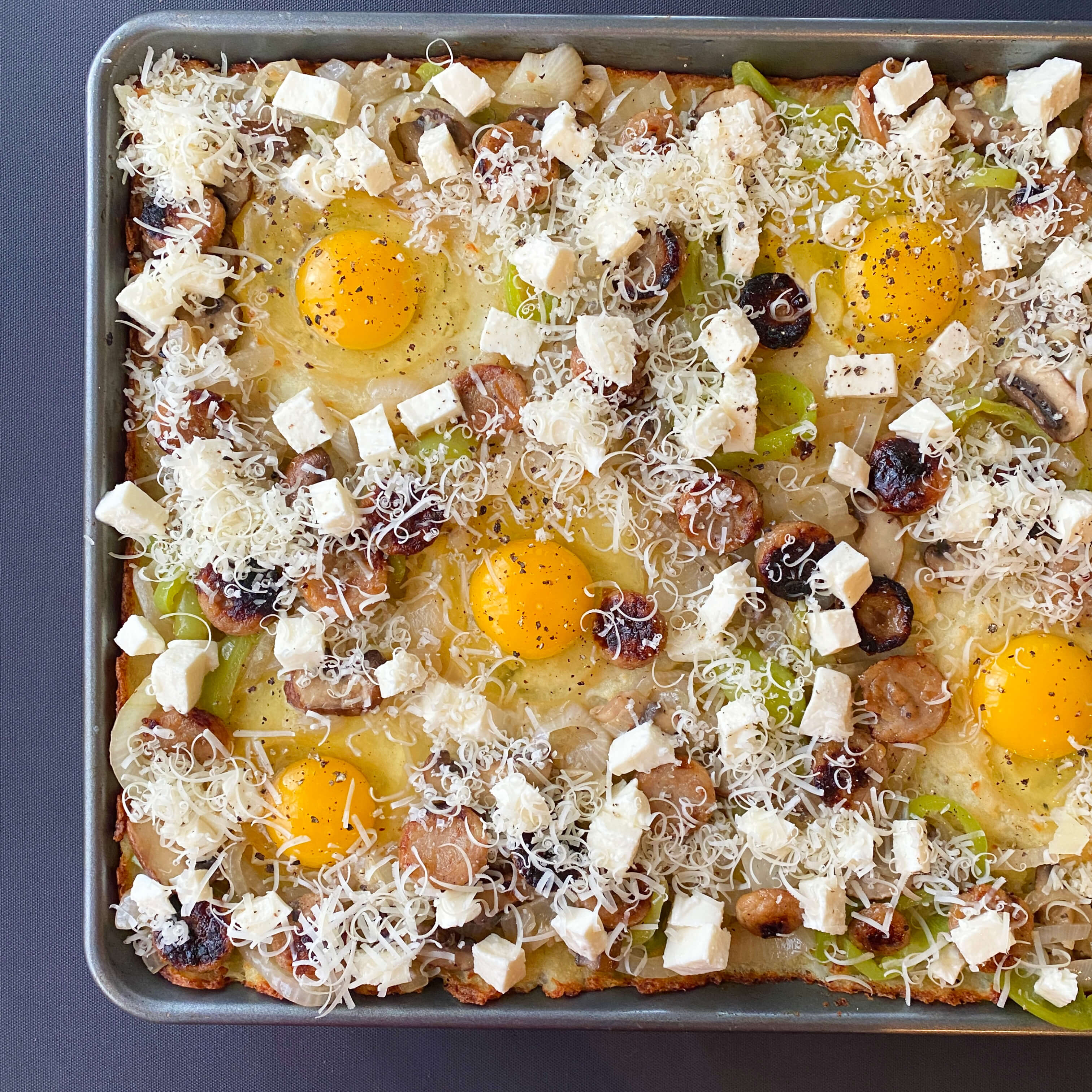
Break eggs into each of the indentations. Sprinkle with Parmesan cheese and dot with pieces of mozzarella cheese.

Return to oven. Bake for 20 minutes or until eggs are set and the cheese is bubbly.

Cut the pizza up into squares or wedges and serve immediately. Paula recommended a green salad as a side dish which is a great choice if you are making this for brunch or dinner especially.

Ideal for upcoming spring holiday breakfasts like St. Patrick’s Day, Easter or Mother’s Day, when onions and spinach are in season, this egg and potato pizza is a blank slate for your creative interpretations too. Add purple onions in place of yellow onions for additional color. Garnish with fresh herbs or scallions on top in place of spinach. Replace Italian sausage with prosciutto or smoked salmon. Serve it for breakfast, for brunch, for lunch, for dinner. Call it a pizza or a sheet pan meal or a one-dish wonder. Paula would be the first one to tell you to take this recipe and run with it till your heart is content. Interpret it as you like. That’s what cooking was all about in the Peck family kitchen.

“My belief is that tradition should not hamper us if we find a better way of doing things,” Paula wrote in 1966. Perhaps that very attitude is what has kept Paula’s recipes out of the widely circulated limelight of modern-day kitchen conversations. Instead of being stubborn, restrictive, and definitive about only one be-all-end-all way to approach food preparation, Paula encouraged exploration. She encouraged hands-on learning. And she encouraged continual education.

That type of exploration and freedom tends to breed a sense of confidence that builds over time through experience. A new cook might start out making one of Paula’s recipes exactly as she described, but then over time, feeling secure at the eventual mastery would adopt Paula’s methods of questioning and discovering. The recipe would get tweaked, augmented, adapted, enhanced. As it evolved, it would take on new forms, new ingredients, new flavors, a new identity. Attribution back to its original source, over time, would get muddied, fuzzy, forgotten, and then lost to history completely. I think that’s what happened to Paula and her creative approach.

In modern-day multi-cultural fusion cooking, in outside-of-the-box presentation, and in the pairing of unusual yet complementary flavors, I think today signs of Paula’s style of cooking are all over our culinary landscape. We just don’t realize that she was the source from which it all began. Paula Peck by name might not be on the tip of everyone’s tongue these days, but her inspiring style of cooking still is.

I hope you enjoy this recipe as much as we did. If you decide to add your own flourish to this dish please send us a message or a photo of your finished affair. We’d love to learn how Paula inspired you!

Cheers to creativity in the kitchen! And to Paula for showing us what fun cooking can be when you add a little splash of imagination.