A few weeks ago, Ms. Jeannie was contacted by Paris House in regards to doing a photo shoot for a few of their products. Sharon at PH was very complimentary of the photos in Ms. Jeannie’s Etsy shop and thought it would be fun to photograph some of the Paris House bags and clutches in similar fashion.
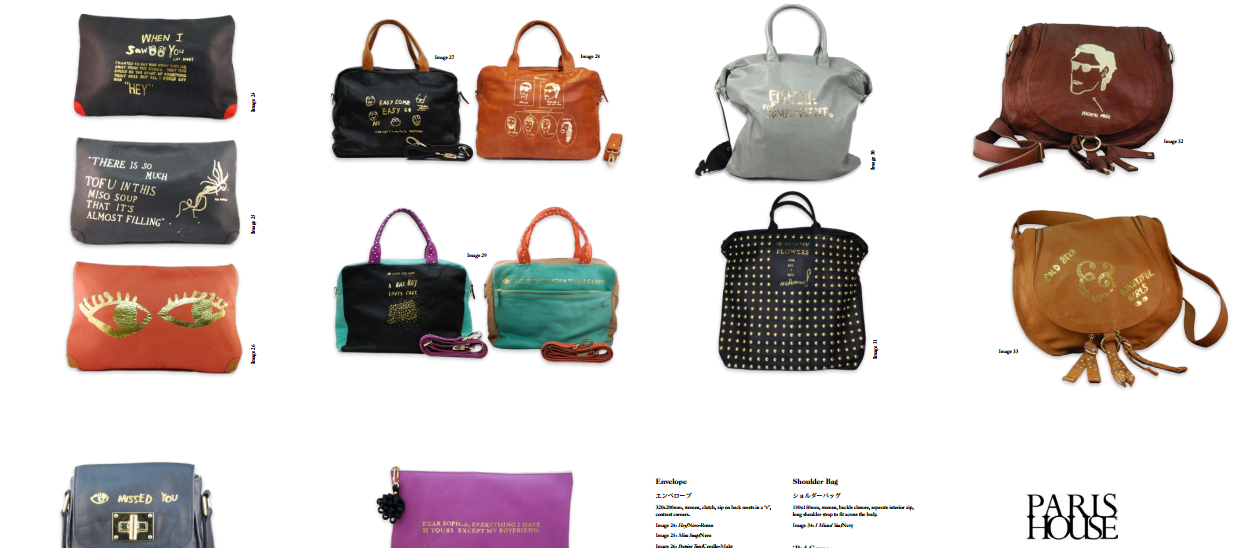
Based in New Zealand, Paris House not only offers completely original bags and accessories but also the experience of thinking outside of the proverbial conversation box. Here are some examples…
Everything is made of of the softest, plushiest leather, and they all contain gold embellishments and quirky sayings, both on the inside and outside.
This is more from the Paris House 2012 Catalog…
Photo courtesy of parishouse.co.nz
As soon as the box of bags arrived Ms. Jeannie got to work thinking about fun and creative ways to photograph these fun and creative items. Because the bags are brassy and modern with their sassy gold illustrations and because they are classically luxurious in texture, she thought that industrial type props would be a nice contrast…
Envelope clutch with weathered bricks. Click for more info.
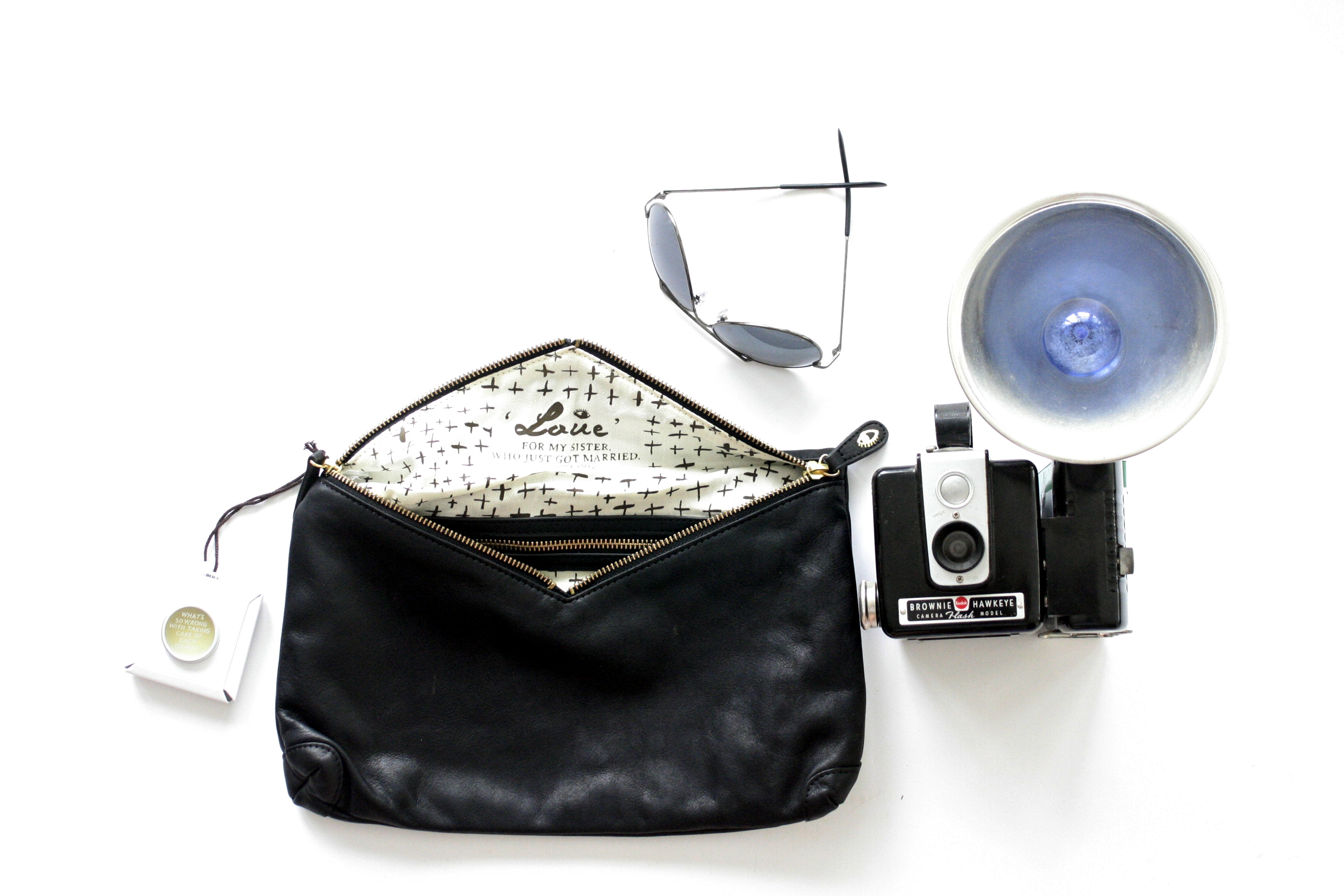
As she was photographing this clutch, Ms. Jeannie started thinking about a little story involving the eyelashes and paparazzi. So she got out her vintage Brownie camera and incorporated it into the photo shoot. It was easy for Brownie to fall in love with the golden eyed beauty.
The backside of the clutch says Peeping Tom on it!The inside of the bag says: Love to my sister who just got married.
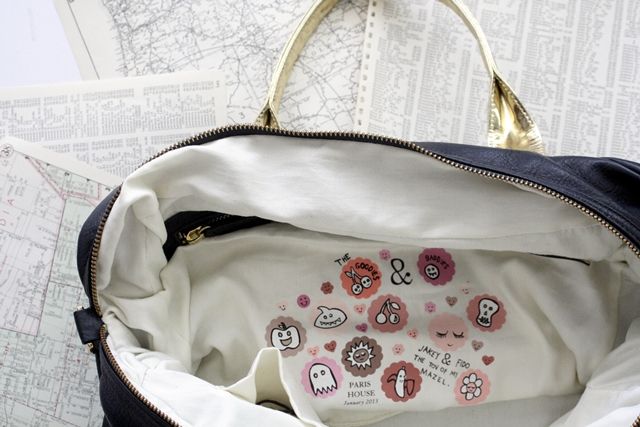
Next, Ms. Jeannie went on a little travel adventure with a weekender bag that lost his way…
The caption on this bag reads: Should this bag ever roam, smack his bum & send him home.
The inside had little illustrations that carry the fun from out to in…
Those little fruit characters really called out to Ms. Jeannie, so the next envelope clutch was all about fun with bedazzled fruits…
This bag states: Nothing tastes as good as skinny feels.
That sounds like a statement Helen Gurley Brown would have made!
It is difficult to mention Helen Gurley Brown and then right after not to mention men, so Ms. Jeannie changed gears and went to work on the Fantastic Man zipper pouch..
Underneath Fantastic Man it says kisses!
In Ms. Jeannie’s opinion, any well-read man is a fantastic man. And who was one of history’s most fantastic, most well-read men? Why none other than Hemingway of course! So here’s a nod in his direction…
Ms. Jeannie thinks Hemingway would approve of the deer antler addition.
Then of course, one cannot think about Ernest without thinking of his famous “write drunk, edit sober” quote so Ms. Jeannie carried on into a night of partying with the Two Drunken Couples zipper pouch…
On such a wildly entertaining night as this, of course, just about a billion and a half stories unfolded. So many in fact that inspiration for the Dear Sophie zippered pouch came about from stacks of stories in stacks of notebooks…
Dear Sophie, Everything I have is yours except my boyfriend.
And now Dear Sophie and her stacks of stories from the drunken night now sit on the homepage of the Paris House website…
parishouse.co.nz
As you know, Ms. Jeannie just loves everything that tells a story, and these bags do such a good job of giving you a little slice of creative inspiration. Wouldn’t it be fun to combine all these little sayings into one short story? It would be an interesting one at that! Ms. Jeannie might just have to set out on such a challenge. In the meantime, stop by the Paris House website and peruse their vast collection of fun and whimsical items here.
And, when conversation hits a lull at the next party or dinner date you attend, you can call on Dear Sophie or the drunken couple to liven things up a little bit:)
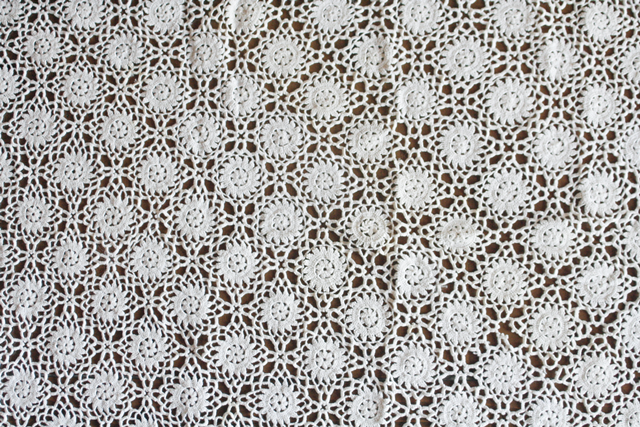
On this special day of love Ms. Jeannie was thinking of her grandmother, Dorothy Ruth, who hand crocheted the tablecloth above that Ms. Jeannie used as a backdrop for her valentine message. Dorothy loved to sew, embroider and crochet. She wasn’t a professional seamstress, although she made a lot of clothes for herself and her family, including wedding dresses for all three of her girls and clothes for her grandchildren.
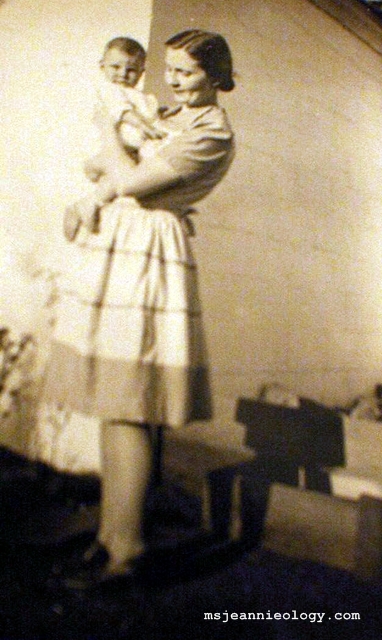
Dorothy with Ms. Jeannie’s mom as a baby.
She would never dream of calling herself an artist or a designer, even though she had so many artistic tendencies and talents. She just loved the act of sewing.
Dorothy’s husband, Philip, loved to build things, and in his spare time, he would make furniture. When Philip built a table for their living room, Dorothy loved it so much, she didn’t want to get a scratch on it. So she made this very tablecloth to protect the finish.
Now when Ms. Jeannie looks at this tablecloth she sees great reminders. She sees how one stitch leads to a circle, which leads to a flower, which leads to a pattern, which leads to a piece, which eventually leads to an entire tablecloth.
She sees how doing things that you love, however small they may seem, can lead to big things. She sees how true happiness can offer protection against the marks and scratches of life.
Protect what you make with love.
Protect what you love with what you make.
Make what you love.
That was Dorothy’s way. And in keeping, Ms. Jeannie’s special valentine message for you… May all that you love to do today, inspire and protect all whom will love it tomorrow.
The wonderfully rich colors and simple compositions of vintage photographs make stunning visual displays, if you allow yourself to think beyond the traditional picture frame.
A Guy Named Guy from msjeannieology
Ms. Jeannie likes to tuck old pictures here and there around the house, in unexpected places, so that when she happens upon them, its almost like she’s discovering them for the first time again. It is delightfully fresh decorating!
Below are some fun and creative ways to display your favorite photos (click on each photo for additional info)…
1. In a folding ruler:
In A Folding Ruler from havenvintage
2. On a metal rake…
Metal Rake from alifewelllived
3. In a mason jar…
Vintage Canning Jars from thevintaquarian
4. On an oil can…
Vintage Oil Can Collection from ThatsVintageBaby
5. In a toast rack…
Vintage Silver Toast Rack from ACreativeLifestyle
6. On a vintage receipt holder…
Vintage Receipt Holder from jollytimeone
7. On a hanger…
Metal Skirt Hanger from thisvintagething
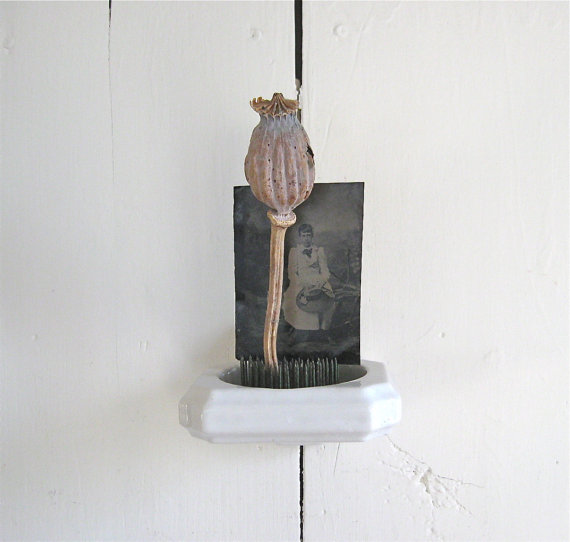
8. In a flower frog…
Industrial Flower Frog from bluebell
9. In a record holder…
Vintage Record Holder from MyraMelinda
10. On a clipboard…
Vintage White Marble Clipboard from LittleSistersSecret
11. On a purse…
Upcycled Black Alligator Handbag Wall Hanging from SassyTrashAntiques
12. On an embroidery hoop-like display board…
Round Pin Photo Memory Board from ZanaProducts
13. In an open chest…
Antique Doll Chest from LuncheonetteVintage
14. In a cup holder…
Vintage Porcelain Bathroom Fixture Cupholder from anythinggoeshere
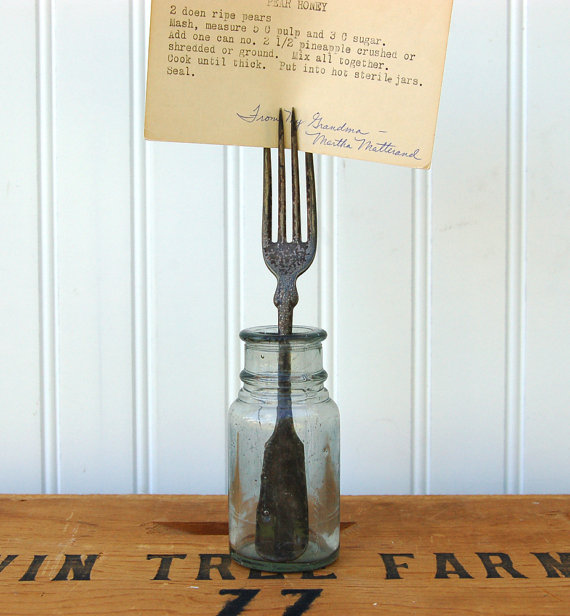
15. On a fork… (ok – this one isn’t a photo, but you get the idea)…
Farmhouse Recipe Holder from JennasBeachRetreat
If you have your own creative way of displaying vintage photographs, please share with us. Photos are welcome:)
More family heirlooms arrived in the mail yesterday!
This time the package included two family quilts. One a small pink and white baby quilt handmade by Mable Edwards in the early 1940’s…
Handmade baby quilt circa 1942
After doing some research Ms. Jeannie discovered that this type of pattern is called a Dahlia design. It is one of the most complex and challenging quilt patterns, because the skill comes in making the flowers look three dimensional. Mable must have been an excellent sewer! Here are some close up shots…
Pretty scalloped edges!Look at all that stitchery!
The second quilt is believed to have been sewn by Mable’s mother Martha Jane Brewer, who was born in Greenwood, Indiana in 1846. Martha married Albert Edwards in the 1865 and the day after their wedding they set out in covered wagon for Iowa. Imagine that for your honeymoon! Martha was a trooper though. Her and Albert set up a life for themselves in Iowa on a farm, she had 11 babies and lived to be 82.
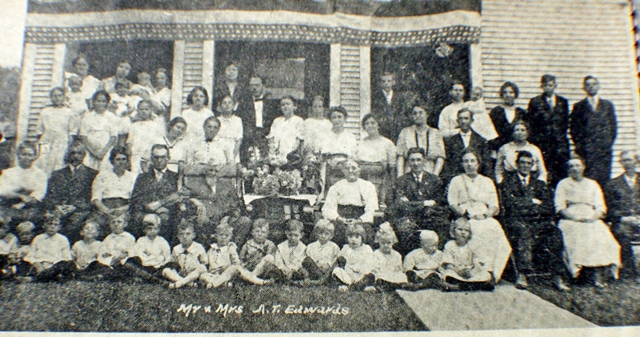
Here’s a picture of the Martha and Albert and all their kids, grand-kids and great grand-kids. This photograph was taken in August 1915 when Martha & Albert were celebrating their 50th wedding anniversary. Martha and Albert are seated in the center of the group.
Portrait of the Edwards Family of Vinton, Iowa. Taken on August 24th, 1915.
With all that activity it is hard to imagine that Martha even had time to sew! This is a picture of Martha’s quilt…
Martha’s handmade quilt circa late 1800’s
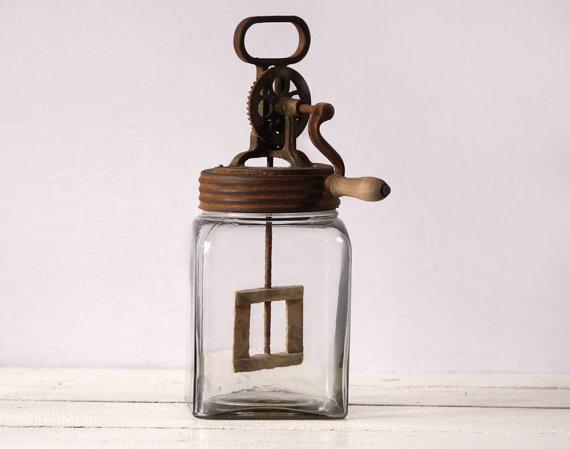
The quilt design is called Churn Dash named after the butter churn. Ms. Jeannie isn’t sure what kind of butter churn Martha used but you can see how the pattern developed from the these two churn styles found on Etsy. Check out the paddles of each…
Antique Butter Churn Pottery from TomLaurusVintage French Butter Churn from RueDesLouves
Ms. Jeannie couldn’t find any similar versions of a double churn dash style like the one Martha used, so perhaps this is a bit unusual.
Double churn dash design
The blue and white color combo was the most popular color combination used in quilts because it matched almost everything. Martha’s quilt as you can see is faded in some spots, but otherwise it is in great condition. It is large enough to cover a contemporary standard queen size bed.
According to research there are over 21 different variations of the churn dash style. It also is known as the Monkey Wrench and the Hole in the Barn Door (fun name!). Ms. Jeannie is impressed with all the tiny squares and the thousands of stiches that make up just one square. She wonders how long it took Martha to make this.
Tiny squares. Tiny stitches.
The churn dash pattern originated between 1800 and 1849 and represents the pioneer woman’s lifestyle which was centered around home and hearth. Certainly Martha churned a few pats of butter in her day – both literally from farm fresh milk and figuratively from her needle and thread.
Ms. Jeannie is still trying to date the quilt to a specific decade. It could have been made as early at the 1860’s for use just after her wedding as she & Albert traveled West. Or it could have been made as late as the 1920’s when Martha’s children were grown and she had more time to devote to needlework.
Ms. Jeannie found this really pretty contemporary version of a churn dash quilt on Etsy. She loves the colors and that they spelled out churn dash on the fabric. Very fun!
Churn Dash Revisted by OsageRiverQuilts
Here’s another view of it hanging on a wall. Love the off-center layout!
Ms. Jeannie would like to try to make her own quilt one day. She likes the patterns of the wedding ring designs with those big interlocking circles…
Antique Double Wedding Ring Quilt from SwankyTexasVintage
But she doesn’t own a sewing machine and would like the challenge (she thinks!) of making a quilt by hand. Perhaps she’ll undertake this project in the Fall. Maybe Mable and Martha will send her some inspiration!
In the meantime, Ms. Jeannie now realizes what effort when into the patchwork teddy bear listed in her shop…
Vintage Patchwork Teddy Bear from MsJeannieOlogy
Ms. Jeannie couldn’t imagine shaping all those patches into a recognizable bear shape!
Vintage Patchwork Teddy Bear from MsJeannieOlogy
The patches just give him so much personality!
Vintage Patchwork Teddy Bear
Maybe once Ms. Jeannie tackles the flat panels of a quilt, she can work on something more complicated like this charmer for a fun baby gift! We’ll see how the quilt goes first…keep posted!
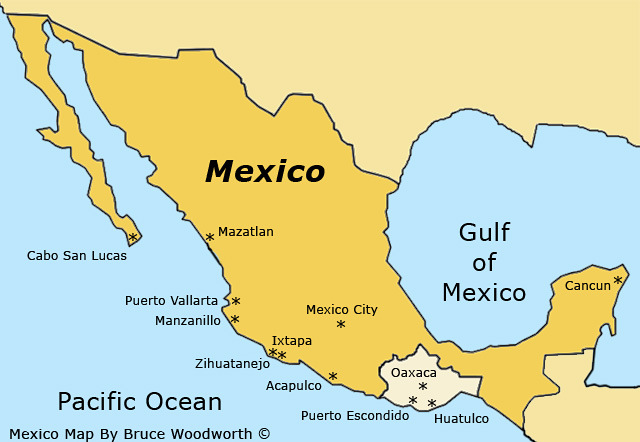
Oaxaca, Mexico has been in the news a lot this week because of the earthquake that struck the region on Tuesday. It measured 7.4 magnitude on the Richter scale and has damaged close to 1,000 homes in the area.
Ms. Jeannie was saddened to hear this news, because ever since discovering that the black clay pottery listed in her Etsy shop (pictured below) came from that area, she has been learning quite a lot about Oaxaca.
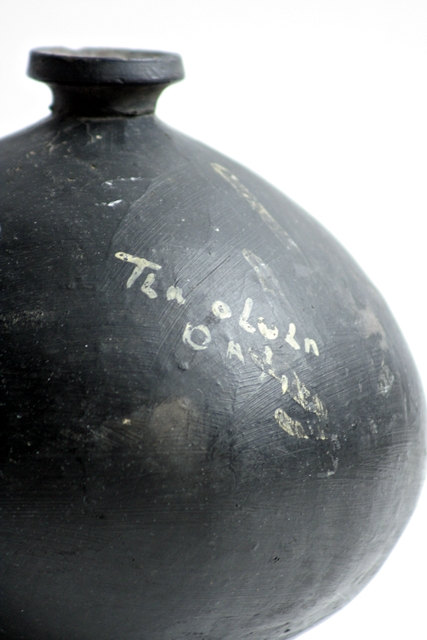
Mid-Century Black Clay Mexican Pottery from MsJeannieOlogy
This type of earthenware vessel, also called barro negro which means black clay, is handmade using ancient traditions indigenous to the Mexican culture in this area.
Primarily formed into utilitarian objects like jars and pots, Mexican artisans have been working with the black clay for centuries. And surprisingly, you can feel that somehow when you touch it.
In this close-up of the vessel you can see how smooth the texture is…
The only place in the world to find this black clay is in the rugged mountainous terrain of Oaxaca, which is located in the Central Valley area of Southwestern Mexico.
Map of Mexico
Since there are are no navigable rivers in the region, Oaxaca is an isolated community, which, while limiting at times, it is also the reason why the Mexican-Mayan culture, languages and traditions have been able to survive.
In this fascinating and soothingly hypnotic video below, watch Oaxacan women demonstrate how they make tamales using traditional methods. Ms. Jeannie loves watching these kinds of videos because you not only get to see how regional food is prepared but you also see how local people dress, interact and communicate with another. It’s like an 8 minute mini anthropology vacation to Mexico!
Ms. Jeannie really likes the cotton dresses and skirts these ladies are wearing too! They remind her of these, that she recently saw on Etsy.
Cotton Aline Skirt from ellainaboutiqueButtercream Triangle Sun Dress from SparrowCollective
There are also beautiful more traditional Mexican embroidery style clothing on Etsy too. Like these two examples. It’s folk art that you can wear!
Embroidered Party Maxi Dress by AidaCoronadoLa Bandida Mexican Folk Art Top from mybonny
The movie Frida starring Selma Hayak and Alfred Molina also offers a beautifully cinematic look into the life of Mexico and it’s artisians, particularly folk artist Frida Kahlo. The movie came out in 2002, but if you missed it, here’s the trailer:
In 2008, a traveling exhibit of Frida’s work went on tour…
Ms. Jeannie went to the exhibit with her sister at the Philadelphia Art Museum. It featured about a quarter of Frida’s painting collection and her never seen before personal photograph collection, which was a really intimate glimpse into her life. Of course all her photos were in black in white but after viewing her paintings, Ms. Jeannie could imagine all the colors of mid-century Mexico.
This is Ms. Jeannie’s favorite Frida Kahlo painting. She likes it for many reasons, but primarily because every time she looks at it she gets something different from it. Also, Ms. Jeannie has a black cat that looks just like this one!
Frida’s inspiration was really born out of a life of crippling health problems. Artistic achievement seemed to be one of the few ways she could emotionally and physically deal with her broken body. In expressing herself in that way, she had a positive effect on millions of other artists and collectors of her work.
To Ms. Jeannie, Frida Kahlo is a genuine example of making the best of your situation and focusing on your strengths instead of your weaknesses.
In that way she is similar to the clay artisians of Oaxaca. They may be limited because of their location and their lifestyle but those very limits are actually their gifts. And that is what sets them apart from everyone else.
Mexican folk art is a personal favorite of Ms. Jeannie’s. She likes the bright color combinations and the symbolism behind the art. She also likes how it acts as an emotional bridge between artist and audience in a demanding way that says “pay attention to me now.”
Ms. Jeannie especially likes the following:
Angel Retablo Tropical Alta from CristinaAcosta
Christina provided some history behind retablos that was so fascinating. She thought it was rather lengthy in description, but Ms. Jeannie enjoyed it so much she included it all…
“Retablos (or altarpiece in Spanish) are a traditional sacred art form with roots that pre-date Christianity, with roots in the Mediterranean areas that include part of what is now Italy. The art form of the retablo first came to North America with the Spanish settlers and artisans that followed the Conquistadors to the North American continent to settle what is now Mexico and the United States.
There are two types of Retablos, the Santos and the Ex-Voto. The Santos style of retablo is either a Saint (from the Roman Catholic Christian tradition) or a member of the Holy Family. Similar in concept to the art form of the Byzantine and/or European Orthodox Catholic icon, the Santos is painted in accordance with strict liturgical rules that define how the central figure of Saint or Holy Family member is represented. The counterpoint to the Santos is the Ex-voto, a no-rules, personal vision that is created to commemorate a blessing received or when a prayer has been answered.
The Ex-voto retablo is the art form I focus on. I love it! This retablo art form gives me a way to connect with the religion of my childhood, without having to get into any personal struggles with a dogma that doesn’t always jibe with who I am now.
When I was a child, my abuelita (paternal grandmother), Catalina Maria Ortiz Acosta would tell me about the ancestors we shared. They were goldsmiths, soldiers and settlers who had first come to North America in the 1500’s, eventually settling in what are now the towns of Santa Fe, Taos and Abiquiu in New Mexico and Ortiz, Colorado. Though she was born in Los Angeles, she held her New Mexican roots close to her heart, importing New Mexican chilis to her home by the beach in Playa del Rey. (I updated her recipe for Red Chili Sauce, if you’d like to try it.)
I paint my retablos to express and explore my gratitude for the blessings of my life. My favorite subject is the Divine Feminine which I interpret as Madonna / Female Creator images. Because my Spanish/Mexican ancestors migrated to North America in the 1500’s, I also include American Indian symbols, as that heritage is sure to be part of my mix.
Along with the visual symbols of my work, the materials I use have personal meaning. My Ortiz ancestors where famous goldsmiths. Thin sheets of 22kt. gold leaf, copper and sterling silver glisten under and over layers of oil paint and evoke the presence of those ancestors. The antique ceramic tile mosaic is glazed with 24kt. Gold and is from a now shuttered ceramic factory in the same area of Southern California where I grew up. The wood panels are built by an artisan wood worker and mostly include re-worked lumber siding from razed timber mill buildings in Bend.
I finish each Retablo with a blessing, usually on the back of the image. In the old tradition of territorial New Mexico, the Retablo often became the spiritual focus in the home when travel was dangerous and people could not attend church. Centuries of isolation in New Mexico led to the unique form of the Ex-Voto often painted on tin, leather or wood panels.
Artists were commissioned to paint retablos that often became symbols of a family’s spiritual life. In that tradition I offer myself to paint commissions of a Retablo for you that commemorates your blessings.” – Cristina Acosta
Side Note: To see more of Cristina’s work or to get your house color coordinated by her (very cool!) visit her website
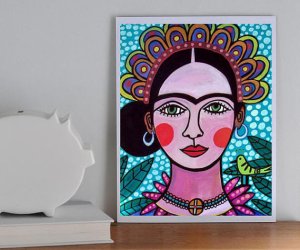
Love Shrine Mexican Folk Art by calaverasycorazonesMexican Folk Art Easter Egg from LatrouvailleFrida Kahlo Art Print Poster by HeatherGallerArtTropical Accent Pillow from arribachica
Kimberly of arribachica was inspired by Mexican culture as a child living in Los Angeles and San Diego. Frequent trips across the border, family cultural activities and her artistic folk artist grandmother fueled a passion to study art in the colonial city of San Miguel de Allende.
Side note: A portion of the proceeds from Kimberly’s exquisite pillows benefit two Mexican organizations that empower and support young children. Visit her blog for more information http://www.kimberlymaier.blogspot.com/
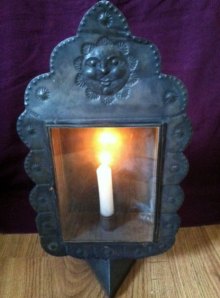
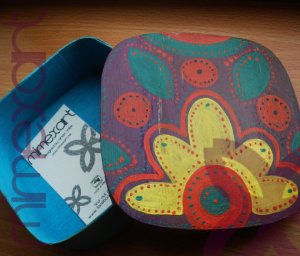
Vintage Tin Mexican Folk Art from Bittersweets13Vintage Mexican Folk Art Bird from TimelessFindsVintagePurple/Blue Folk Art Box from mimexart
Miriam of mimiexart had this to say about the inspiration behind her Mexican Folk Art Boxes.
“I’m a Mexican artist and since I leave my Mexico first to go to the Caribbean now in England. It has been difficult to be far away from home, family, friends, my city and all my culture but for some great reason now I understand why Mexico is so rich country so to cure my nostalgia I started to take back my memories of colour, images, people, places and paint- as an artist- is my first tool to communicate to the world.. so this is how I started to make this little boxes and become no just a therapy for my heart is also helping people to have a piece of Mexican love-art in their home and sometimes just inspire people to create similar things.This boxes are made to keep love-secrets, treasuries, jewelry, letters……… anything that you want to be safe and away from wrong hands.”
Side note: In addition to hand-painted boxes, Miriam also makes earrings and adorned mesh market bags. Stop by her website to learn more about this wonderfully talented artist, world traveler and teacher.
Vintage Wooden Virgin Mary Shadow Box from theVirginRose
And most importantly, Ms. Jeannie likes that folk art tells stories. Stories of it’s creators, stories of it’s history and stories of universal bonds that tie us all together.
“I used to think I was the strangest person in the world but then I thought there are so many people in the world, there must be someone just like me who feels bizarre and flawed in the same ways I do. I would imagine her, and imagine that she must be out there thinking of me too. Well, I hope that if you are out there and read this and know that, yes, it’s true I’m here, and I’m just as strange as you.” – Frida Kahlo
For years now, Ms.Jeannie has been collecting bits and pieces of antique china to use alongside her everyday dishes. These everyday dishes are as basic as basic can be: white, plain, unadorned. The only bit of flair they possess is that they were made by an Italian plateware company. This makes the plates oval shaped instead of round and the coffee cup saucers are offset to accomodate a slice of biscotti alongside your coffee cup. Other than that they are strictly ordinary.
Having said that Ms. Jeannie discovered one day, while cleaning out her china cabinet, that when she paired these ordinary day plates with her vintage china treasures, her whole table setting instantly hummed with it’s own sort of individuality and surprise. The ordinary looked extraordinary and the mis-matched patterns looked marvelous next to each other because they contained a lot of similar colors.
So Ms. Jeannie started experimenting and was delighted to discover a very broad range of different decorating options when it came to pairing vintage with contemporary.
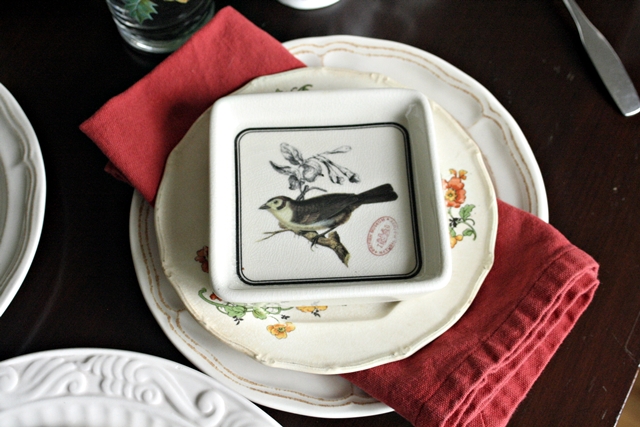
This is an example of how you can set a contemporary vintage table by combining contemporary dishes with vintage china.
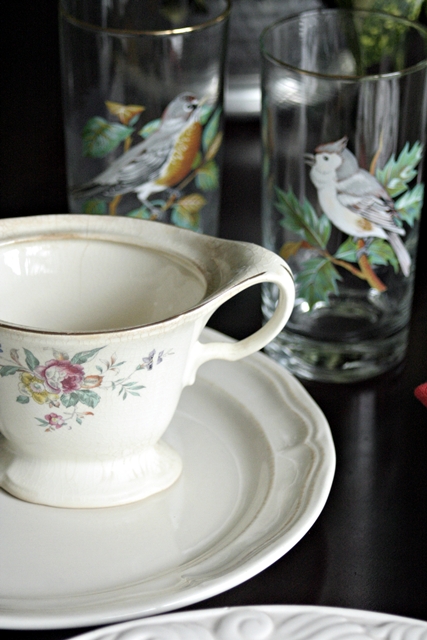
If you look closely there are 10 different plate patterns/designs in this setting. They all work together because they have two themes tying them together: birds and green leaves.
The unexpected vermillion color in the napkin also helps tie together all the warm colors without looking forced or too matchy matchy.
The square bird dish is actually a contempoary soap dish, but has been repurposed to act as a small bread plate or a drink coaster here. It also matches the colors of the black and white toile-looking hunt plate as well as the antique orange, black and green floral bread plate from the 1930’s.
The colors in the antique sugar bowl match the colors found on the vintage bird water glasses. The crazing on the sugar bowl also matches the faux antique patina on the contemporary white salad plate from the Todd English Collection.
You can see here just by adding or subtracting pieces you can get different effects from your table display:
Ms. Jeannie is drawn to three things when it comes to scouting vintage china. She loves anything made out of old English ironstone, anything that contains the color green in its design and anything that contains crackling or crazing marks. So her collection has thousands of ways that it could displayed together since they have those three characteristics in common. You can start your own vintage china collection based on color, shape, time period or region for your own unique look.
This table arrangement was made up of the following pieces:






















 In the Vintage Kitchen: Where History Comes To Eat