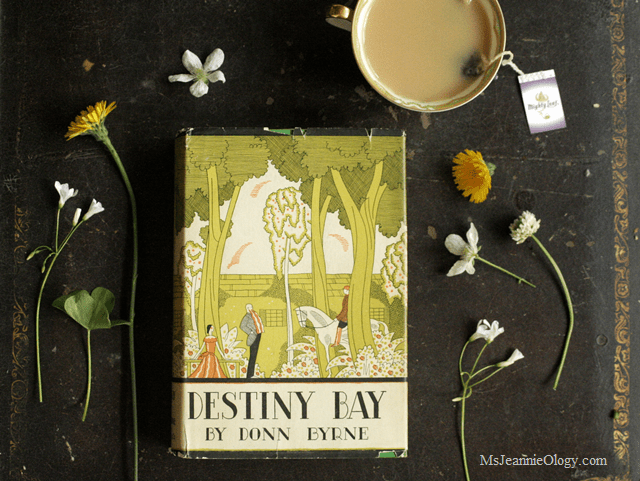
It is not often that Ms. Jeannie will tell you to judge a book by its cover, but in the case of Destiny Bay, a vintage fiction novel recently listed in her shop, she wholeheartedly recommends it. In an on-going conversation about book collections and what fuels them, we’ve talked about book batches centered around a favorite author (F. Scott Fitzgerald!) or a common theme (Africa!). Today’s post is all about the first impressions that draw us in and keep us going – the face of the book. A book’s aesthetic is often one of the key motivations in amassing a collection. Some people collect books with eye-catching covers for their color arrangement…
or for their stunning graphic layout and design…
Book covers from the 1920’s, 1930’s and 1940’s
Collections can be built around books from a specific time period, like this antique collection…
This is an antique collection with gorgeous decorated book spines.
or for the artist behind the image like these contemporary book covers designed by Chip Kidd…
In the case of Destiny Bay, there are a lot of things going for it in the pretty presentation department. By far, it is one of the most attractive books that has ever come across Ms. Jeannie’s bookshelves.
From its whimsical illustration, complimentary color palette and stylish graphics this edition of Destiny Bay fires on all cylinders in the book cover department.
The story, originally published in 1925 by Irish American writer Donn Bryne, centers around the MacFarlane family of Ulster County, Ireland and combines romance, comedy and tragedy. The story is set against the sweeping Irish countryside with its beautiful topography, exiting horse race tracks, and idyllic country estates and features an eccentric cast of characters including blind Aunt Jenepher, gypsy Lady Clontarf, butler James Carabine and red-blooded Uncle Valentino to name a few. Combining the themes and characters of the book California artist Frank McIntosh (1901-1985) illustrated a cover that symbolizes the bright green landscape of Ireland and the colorful personalities of the family.
The stylized dust jacket via font and graphics are a nod towards art deco – the 1920’s style that was popular when the book first debuted. The colors are a compliment in opposites with bright spring greens and tangerine oranges each elegantly outlined in black ink. An overall dramatic and glamorous aesthetic that always seems to be in vogue no matter what the decade!
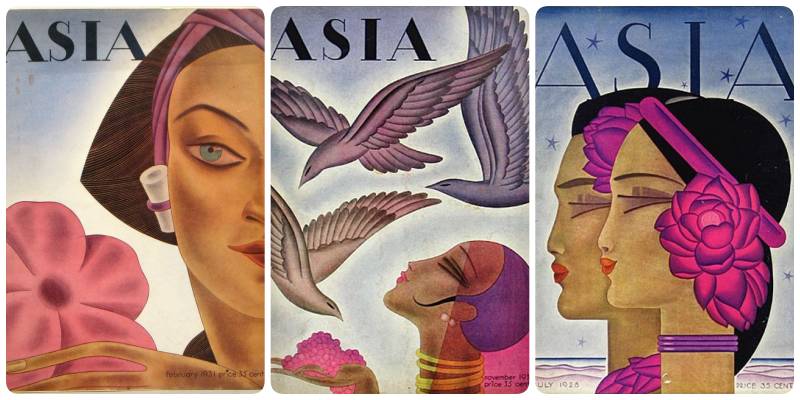
McIntosh built quite a career utilizing the sleek lines and sophisticated detailings that became so iconic of his work. He came of age in the 1920’s which no doubt left quite an impression on him and he carried that passion throughout his design career. Taking him from California all the way around the world to Paris and back again, he traveled in both commercial art circles and fine art circles. These are three of his beautiful covers for Asia Magazine…
We know from Destiny Bay, he was also a book designer and most of his work in the publishing world carried the same delicate disposition…
A robust career in advertising and freelance illustration left time to exhibit independently as well and kept his title of working artist relevant throughout most of the 20th century. Examples of his work in popular poster form are all so highly collectible now…
That makes Mr. Frank McIntosh a superstar in Ms. Jeannie’s world! His books look stunning on a shelf and his posters look equally amazing next to the shelf! So go ahead dear readers appreciate Destiny Bay for face value, and in doing so you’ll be pleased to discover that the story is equally beautiful as well! A gem of vintage book collecting all wrapped up in pretty package! Find the book here.
Open up more discussion on why you like to collect books by adding your thoughts in the comments section below!
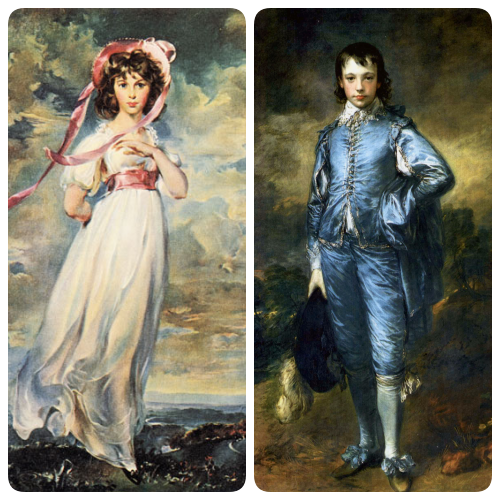
She stands poised and serene on the sea rocks underneath a blustery sky. He stands confident and bold, like a fashionable Fauntleroy against the backdrop of a golden grey garden. At first glance, they are similar in subject, stance and appearance. They are similar in color palette, context and composition, in attitude and affluence. But their sameness doesn’t stop there. Embedded beneath the patina of paint and brushstroke runs a strange series of coincidences and ironies that bind both painters and subjects together in an unusual web of wonder.
If you walk into just about any antique shop today, you’ll most undoubtedly see the 18th century images of Pinkie and The Blue Boy reproduced in an assortment of different ways. Most commonly they peek out from behind matching frames of varying ages and styles like this…
Two Large Framed Prints of Pinkie and The Blue Boy from Happy Go Vintage
but they also appear on a variety of creative endeavors from ceramic vases to needlepoint pillows from coffee mugs to calendars and most collectibles in-between.
As two of the art world’s most commonly printed masterpieces, they are almost always presented as a pair… a portrait of teenagers on the cusp of an adult world. A nod to young love, first love, new love and a symbol of tenderness, confidence, potential and optimism.
But you can’t always judge a painting by its presentation. Pinkie and The Blue Boy as a couple are the result of time-worn perception and assumption. Painted by two different artists in two different decades, Pinkie and Blue were never meant to be together.
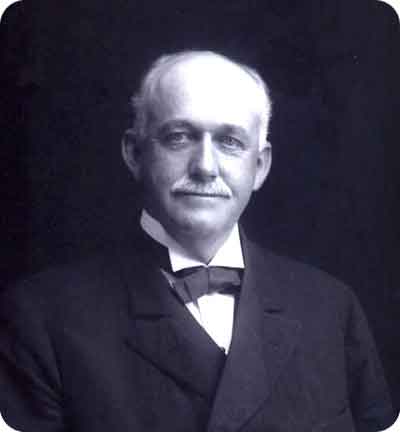
It wasn’t until the 1920s, roughly 150 years after they were painted, that this romantic perception took hold thanks to American railroad tycoon and enthusiastic art collecto,r Henry Edwards Huntington. Purchased in England during the American heyday of British portraiture, Huntington brought these two paintings across the ocean to California where he placed them in his library opposite one another.
Henry Edwards Huntington
The general public was then invited to come and take a look. From that moment forward Pinkie and The Blue Boy became associated as a couple forever linked by free association.
But oddly enough had Pinkie and Blue met in real-life and lived during the same time frame, they most likely could have been an actual real couple. They had so many similarities in common that relating to each other would have been as breezy as their painted backgrounds.
The linking of back stories between not only Pinkie and Blue, but also their painters and their collector is equally strong. Here are five people entwined in a strange sort of web that is made of parallels in all directions.
Let’s look at the links….
THE CONNECTION BETWEEN PINKIE & BLUE: Personal Lives
Painted somewhere around 1770, by famed British artist Thomas Gainsborough (1727-1788), The Blue Boy, is thought to be the commissioned portrait of Jonathan Buttall, who came from a wealthy English iron-trading family.
Jonathan Buttall
At the time the portrait was completed, Jonathan was about 18 years old. His father had died two years earlier leaving Jonathan to run the retail iron business and attend to the massive fortune it procured.
Pinkie, the nickname of Sarah Goodin Barrett Moulton, sat for her portrait with equally esteemed English artist Thomas Lawrence in 1794. At the time of the painting she was eleven years old, and also without a father, who had abandoned her family several years earlier.
Like Jonathan, Sarah also came from wealthy stock. The Moultons made their fortune in the lucrative business of exporting rum and sugar from Jamaica. At the time of this portrait, Pinkie was two years into a stay in England – a dramatic move made for educational purposes that took her far away from her home country of Jamaica. Just like Jonathan adjusting to a new business environment, Pinkie was adjusting to a new living environment. They were both wealthy, young, fatherless and undergoing challenging transitions.
THE CONNECTION BETWEEN JONATHAN & THOMAS LAWRENCE: Debt
Although affable and kind-hearted, Jonathan did not turn out to have quite the same knack for financial business savvy that his father possessed. After two decades Jonathan was so loaded down in debt he was forced to file bankruptcy and auction off his belongings including his own portrait.
Thomas Lawrence (the painter of Pinkie) was one of the most popular portrait artists of his day and a favorite of the royal courts. He worked constantly and consistently, but to the puzzlement of those around him, was always in debt. Throughout his career he continually relied on financial support from benefactors and loans from his friends and left little fortune when he died.
THE CONNECTION BETWEEN JONATHAN AND THOMAS GAINSBOROUGH: Music
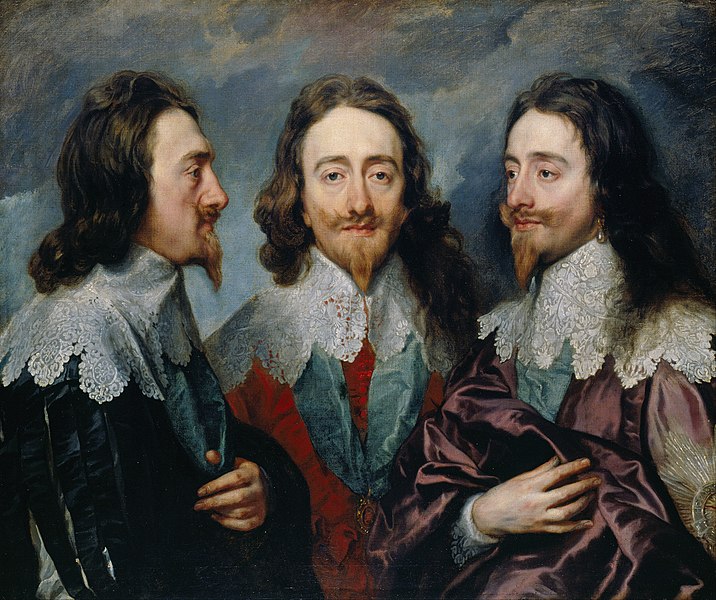
Gainsborough, at the time that he was commissioned to paint The Blue Boy, was looking to break into the theatrical art set of creative London. He appreciated the city’s cultured manner, their love of music and drama and their acceptance of artistic endeavors. But in order to fall in seamlessly with this crowd, he felt he had to step up his game as far as skill-level and painting technique. So he studied the style that he most admired, Flemish painter Anthony van Dyck…
Anthony Van Dyck’s portrait of Charles I of England, painted in in 1635.
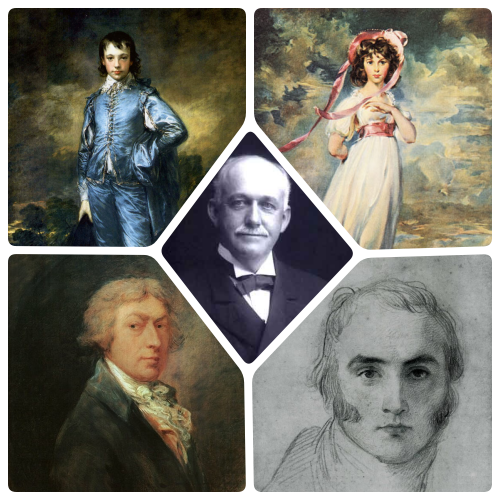
Through Gainsborough’s own evolution of painting style that was directly influenced by the work of Van Dyck, you can see what an impression the one artist had on the other…
Gainsborough’s evolution of style: (left to right) Before studying Van Dyck, Sketching like Van Dyck, Painting like Van Dyck
When Gainsborough met and became friends with the Buttall family he took a particular interest in young Jonathan who enjoyed a similar love of music. Gainsborough introduced his refined painting style (modeled after Van Dyck’s work) in his portrait of Jonathan, which became one of England’s most treasured paintings and Gainsborough’s most notable work. Gainsborough treasured his friendship with Jonathan for the rest of his life.
THE CONNECTION BETWEEN THOMAS GAINSBOROUGH & THOMAS LAWRENCE: The Royal Academy of Arts
Aside from the obvious facts that they were both portrait artists, both named Thomas, and both incredibly talented, the two Thomas’ were also big-time supporters of their trade. Separated by a generation in age, Thomas Gainsborough, the elder of the two, was a founding member in The Royal Academy of Arts which opened in London in 1768 as an exhibition venue and an educational support center for artists. Thomas Lawrence became its 4th president in 1820. While it is known that Lawrence was an admirer of Gainsborough’s work, it is uncertain if the two ever met.
The Royal Academy of Arts in London. Photo by Davis Landscape Architecture.
THE CONNECTION BETWEEN PINKIE AND THOMAS LAWRENCE: Early Death
Tragically, Pinkie never made it to adulthood. She died a year after her portrait was painted possibly from complications of an upper respiratory infection. Her painter, Thomas Lawrence also died unexpectedly from a heart attack at the age of 60.
THE CONNECTION BETWEEN THEM ALL: Love
In all its varied forms, from the passions of collecting, to the comfort of friendship, to the dedication of career, and to the lofty assumptions of amorous awakenings, Pinkie and The Blue Boy connected not only these five people but also millions of people around the world with one word: love.
Art is wonderful in uniting individuals, spawning ideas, energizing imaginations and recording place and time. Antique paintings like Pinkie and The Blue Boy serve not only as intimate proof of two young lives lived centuries ago, but they also serve as a playground for creative thought, intuitive whimsy and a universal need to understand and draw connections. And even though their association is not entirely based in accuracy, the fact that they were blended together in the 1920s and remain blended together today is a wonderful example of our human race’s need to connect and associate.
Sometimes making up a story is more unifying than defining an actual reality. That’s the beauty of art. That’s the beauty of Pinkie and the Blue Boy.
Interested in learning about more vintage art? Check out these two art history books here.
This week in the Vintage Kitchen we are going on an exotic adventure to the beautiful beachy, balmy enclave of Papeete on the French Polynesian island of Tahiti. The weather in Ms. Jeannie’s world recently has been crazy. She’s seen it all – frost, snow, heat, humidity, rain, strong winds, fog, sleet, hail, and tornado warnings all just within the past 14 days. And while the air and temperatures of the past few weeks have been very unsettled, Ms. Jeannie is excited because all of this wacky end-of-winter weather means that sunny Spring will be here very very soon!
While she waits for Mother Nature to get her schedule sorted out, Ms. Jeannie has been daydreaming of tropical island breezes thanks to the help of Mr. Victor Bergeron and his 1968 Pacific Island Cookbook.
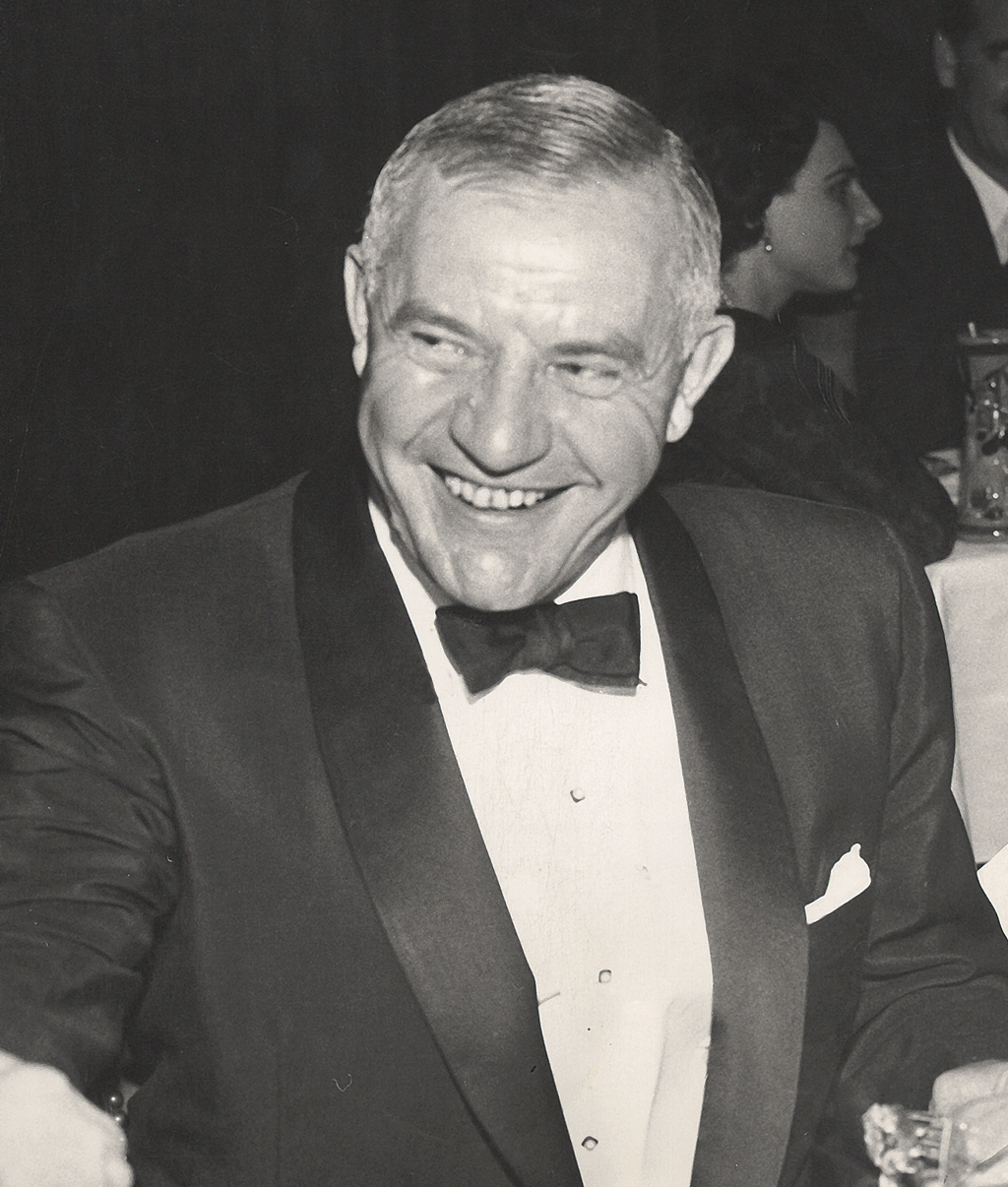
If you are unfamiliar with Victor’s full name, you might know him by his more casual moniker, Trader Vic, the king of 20th-century hospitality. A worldwide traveler and an enigmatic restaurateur Victor founded the world’s first highly successful string of polynesian-themed restaurants.
Victor Bergeron (1903-1984) the founder of Trader Vic’s restaurant chain.
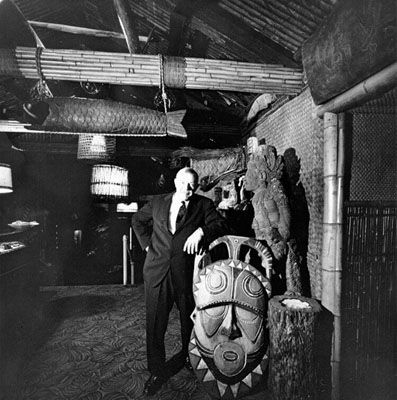
First opened in the 1950s in California, the still growing Trader Vic’s restaurant brand was a re-invention of Bergeron’s first attempt in the food industry with his humble lodge-style eatery and bar called Hinky Dink’s which he opened in 1934.
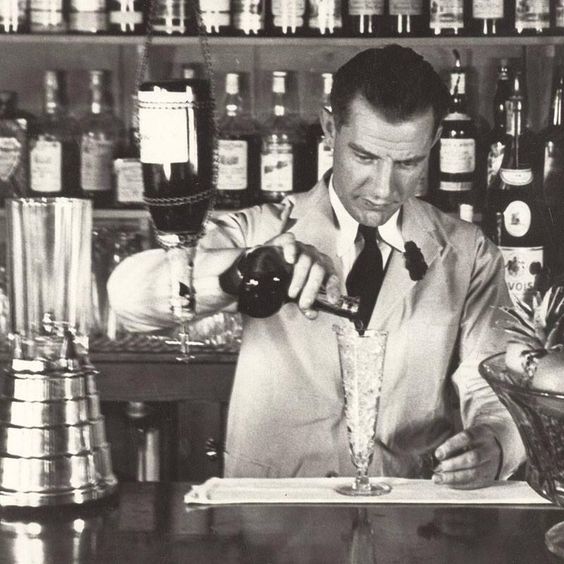
Victor smiles for a photo shoot in a 1951 issue of Holiday magazine.
Learning the ropes in the food industry taught him a lot those first twenty years, so by the time Trader Vic’s (the restaurant) launched, Victor was a skilled businessman with a big flair for entertaining and fine-tuned instincts as to what people wanted in a dining experience. As a lover of Cantonese-style cooking, Bergeron married exceptional storytelling, authentic exotic antique decorations, and traditional South Seas recipes with a festive dining atmosphere to create a unique brand of restaurant chemistry that appealed to the adventure seeker and jet-setter of mid-century America. It was the rise of all things terrifically tiki.
Victor’s travel experiences are all colorfully detailed in his cookbook making it a sort of fun travel journal and kitchen cooking primer in one. And then there are the drinks! In addition to cooking, Victor was also a mixologist creating a slew of enticing cocktails, like the first Mai Tai, which launched a wave of tropical drink requests for bartenders from then on out. Escapism never tasted so sweet!
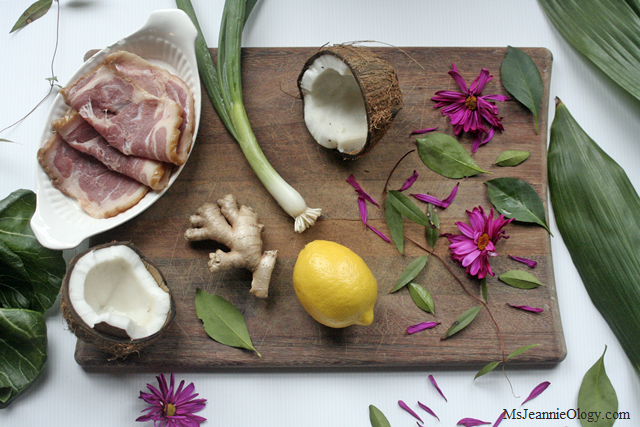
Which gets us back to Ms. Jeannie’s island getaway in the kitchen this February day. With 30-degree temperatures chilling the air outside, Ms. Jeannie cracked open coconuts, peeled ginger, poured a rum cocktail, and got down to cooking all the while pretending she was beach-side in Papeete where the view looks like this…
Vintage Tahitian postcard of Papeete.
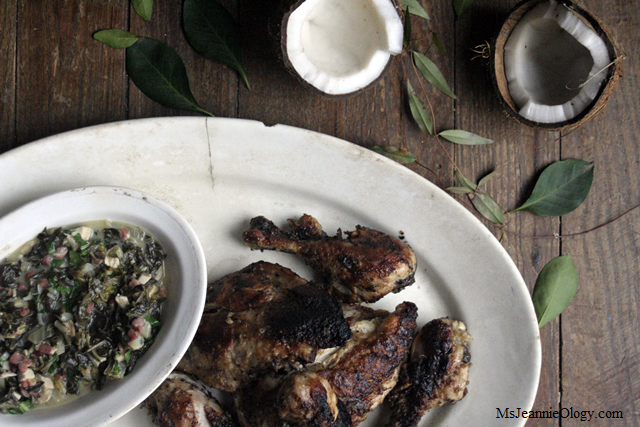
Cheers to Victor! It’s Pota on the menu tonight served alongside steamed rice and chicken sauced with coconut ginger.
Pota with Chicken and Ginger
Pota
4 tablespoons diced salt pork
1/2 cup chopped cooked chicken
5 cups coarsely chopped Bok Choy
4 tablespoons chopped green onions (scallions)
1/2 cup chicken stock
Salt & Pepper to taste
Juice of 1/2 lemon
4 tablespoons coconut milk
2 teaspoons cornstarch mixed with 1/4 cup water
Saute salt pork until brown in large skillet. Add chicken, chard and green onion.
Stir in chicken stock, seasonings and lemon juice. Simmer until chard is tender.
Add coconut milk, bring to a boil but just barely. Thicken with cornstarch, stirring constantly, adding just enough to thicken the mixture.
Serve immediately or keep warm over low heat until chicken and rice are ready.
Chicken with Ginger
1 whole chicken, 5 lbs
1/2 cup flour seasoned with salt and pepper
2-3 tablespoons olive oil
1 piece fresh ginger root (about the length of your thumb finger), grated
1/4 cup coconut milk
Preheat oven to 350 degrees.
Cut chicken in pieces. Do not remove the skin.
Place chicken, flour and salt and paper in a paper bag and shake until all chicken pieces are well-coated.
Heat the oil in a large pan on the stovetop and then saute the chicken, turning only once, until thoroughly cooked on each side (internal temperature should be 180).
Remove chicken from heat and place in oven-proof dish.
In a separate bowl mix together coconut milk and ginger. Pour over chicken and place dish in the oven for 5 minutes until the coconut sauce melts.
Serve alongside Pota and steamed rice and a fun fruity cocktail! Perhaps a homemade Mai Tai or two in Victor’s honor. He’d be as pleased as (rum) punch!
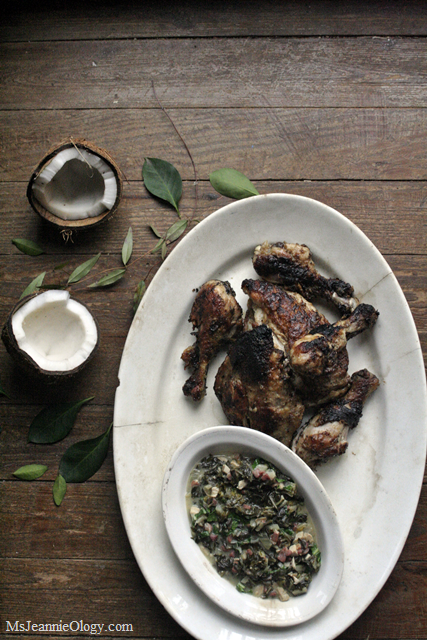
A Tahitian Dinner: Pote and Chicken with Ginger
This is a surefire recipe to chase away those end-of-winter blues. Satisfying for the spirit and for the belly! Find more Trader Vic recipes here. And more tropical cookbooks here. Manuia!
Olga Celeste on set with Neissa. Photo courtesy of Click magazine, 1938.
Seventy-eight Februarys ago (that’s 1938, if you struggle with math!) Katharine Hepburn and Cary Grant were lighting up the silver screen with funny situations in their second movie together, Bringing Up Baby.
They shared the comedic spotlight in this movie with two more co-stars – non-traditional sidekicks that were a bit out of the ordinary even for Hollywood standards…
Olga Celeste and her leopard Neissa. Photo courtesy of Click Magazine, February 1938.
Meet Olga Celeste, an early Hollywood animal trainer and her favorite Indian leopard Neissa. Olga was born in Sweden in the late 1880s and began working with animals at the age of 11. By 1938, she had taken her talent all the way to Burbank, California where she held court as the only female leopard trainer in the world.
Ms. Jeannie loves this photo below – you can see Olga’s excitement in working with her students.
Olga at work. Photo curtesy of Click Magazine 1938
Part of the Vaudeville circuit, she was also an actress and stunt double but her true passion lied in leopards. Using the art of conversation, rather than physical brut power, Olga trained her leopards by talking to them, using the power of her confident personality to gain control of the cats instead of using fear tactics and force.
The 1920’s Luna Park Zoo brochure which features Olga on the very far right. Brochure photograph courtesy of lincolnheightsla.com
Employed by the Luna Park Zoo in Los Angeles, Olga worked with and trained a handful of leopards but her favorite was Neissa, whom she considered nothing more than a large house cat. Because Neissa was such a joy to have around, Olga often took her home with her after a long day on the set. Like any person passionate about their profession, Olga’s home reflected her life with leopards in both the decor and the wall art, which was made up of signed photographs of all the actors she had worked with in Hollywood.
At home with Neissa. Photo courtesy of Click Magazine, February 1938.
Sweet and docile for the most part Neissa did have a precocious side. As a lover of perfume (like all pretty ladies!) Neissa was soothed, comforted and drawn to anything that smelled fragrant, so Olga used perfume as her main training technique.
In Bringing Up Baby, the very first scene shot for the movie featured Katharine Hepburn walking around her bedroom and talking on the phone wearing a gorgeous floating dressing gown.
True professionals…Neissa and Katharine in action.
Perfume was sprinkled on the cloth near Katharine’s knee so that Neissa in the scene would rub up against Katharine’s leg in affectionate greeting.
“I must add that I didn’t have enough brains to be scared, so I did a lot of scenes with the leopard just roaming around.” – Katharine Hepburn, on interacting with her feline co-star
Neissa’s character, Baby, was portrayed as a sweet and affectionate cat with a touch of wild precociousness. Like her real-life self, Neissa was also sweet and affectionate and wildly precocious.
Promotional still for Bringing Up Baby featuring Katharine and Neissa.
Katharine worked with Neissa at ease up until the point the innocent clinking of wardrobe weights on one particular skirt irritated Neissa so much so that she spontaneously lunged for Katharine’s hemline. Luckily Olga stepped in at just the right moment before anything unfortunate happened but it did cause fearless Kate to readjust her casual relationship with Neissa.
Olga, always quick on her feet had the strength and ability to lift up to 200 pounds, so she was capable of protecting all actors on-set should something go awry but Cary Grant wasn’t reassured by Olga’s presence just off-camera. He was so terrified of Neissa that the director Howard Hawkes had to come up with creative shots so that Cary and Neissa never actually acted together in any one scene.
This was one of the scenes that had to be patched together so that Neissa and Cary Grant didn’t have to be in the car at the same time together.
Olga understood that leopards weren’t for everyone but hoped through training demonstrations and film performances that people would come to understand how truly intelligent and extraordinary these exotic creatures were. Working well into her 60’s, Olga’s last film with her leopards was the 1950’s blockbuster The Ten Commandments, but a lover never truly stops loving, so she continued to stay engaged, interested and informed with all matters animal throughout her retirement. After more than seven decades in the film and animal training industries, Olga passed away at the age of 81 in Burbank.
Olga and Neissa, pals for life. Photo courtesy of Click Magazine. February 1938.
Olga is a fantastic role model for the month of February… this follow-your-heart time of year that is synonymous with love, passion, romance and taking chances. Olga made a lifetime career out of pursuing her interests, living fearlessly and having fun in the process. She fell in love with leopards at a young age and managed to stretch that interest across two continents, eight decades, one wild kingdom and millions of people.
Although initially under-appreciated, Bringing Up Baby is now regarded as one of the best comedic movies of all-time and consistently lands on the ten best list of Katharine Hepburn’s greatest performances. If there was never an Olga, there would never have been a Neissa. And if there was never a Neissa there might never have been a comfortable Kate and if there was never a comfortable Kate there would never have been a successfully comedic Baby. And if there was never a Baby there would be a few less laughs in the world. And the thought of that dear readers is an absolute tragedy.
Cheers to Olga and to living life with a heart full of love!
{A little side note: Photographs for this blog post came from a feature article in the debut issue of Click Magazine published in February 1938, which was recently for sale in Ms. Jeannie’s shop. As so happens sometimes with almost antique paper, this vintage magazine is starting to show signs of wear and tear so in order to preserve its contents Ms. Jeannie will be framing it behind glass and featuring it in an upcoming blog post on decorating. Stay tuned!}
In 1960, John Hay spent the month of November on the coast of Massachusetts.
John Hay
In 2015, Ms. Jeannie spent the month of November on the coast of Florida.
John Hay was writing a book about the seasonal evolution of life on Cape Cod – a month by month collection of observations he would publish in 1961 under the title Nature’s Year: The Seasons of Cape Cod.
In November 2015, Ms. Jeannie was navigating a bevy of hospital hallways and doctors offices with her sick dad.
John escaped to the beach to think about life. Ms. Jeannie escaped to the beach for a brief break from life. Both John and Ms. Jeannie found solace on the shores of November.
55 years, 1300 miles and 11 states separated John from Ms. Jeannie. Does that matter? Does the seasonal effect of nature change so emotionally at sea? Fundamentally month by month are we more different than alike? Ms. Jeannie thought about these questions while she walked the beach and tried to make sense of the medical mysteries surrounding her father. Decades earlier John thought about these same questions while he walked the beach and tried to make sense of the natural mysteries surrounding humankind.
In this post we’ll be looking at one month from two sets of eyes to see how the natural world compares and contrasts between decades, between states, between regions and between people. Just how different is November from one place to another?
” The clouds cover the sky like gun smoke and the air feels cold and restricting.” – John Hay, Cape Cod, November 1960
In November 2015 in Florida, the clouds also covered the sky like gun smoke but instead of being cold and restricting the air was oven hot and heavy with humidity.
“November rolls into view with cool, solemn, formal consistency…daylight diminishes. The summer no longer pounds at our temples. The fall color is gone. There is nothing to look at and very little to hear… to a city lover it is silent and deadly dull.” John Hay, Cape Cod, November 1960
In Florida in 2015, November rolled into view on the body of a heatwave. Temperatures hovered for most of the month in the mid-90’s. The air felt consistently relaxed and languid. If Ms. Jeannie was blind-folded and asked to guess the month she would have said August by the sticky feel of things around her. Summer was holding strong.
“Out on the bay the low waves look as if they have a harder push and pull to make, imbued with new heaviness.”- John Hay, Cape Cod, November 1960
In Florida in November 2015, the waves are not low. They are tall and fat and strong. So full of energy and life, their crashing chorus’ take up all the audible room in Ms. Jeannie’s eardrums.
“There is a kind of ice sludge being nudged in by the tides along the shore and through rippling purple waters of tidal inlets.” – John Hay, Cape Cod, November 1960
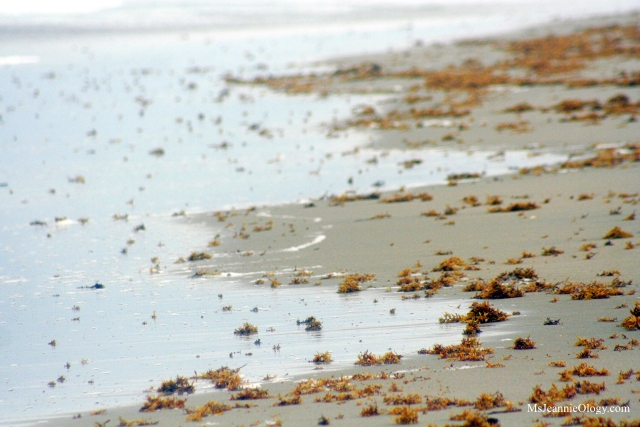
In Florida in November 2015, the tide drags ashore signs of autumn color in the form of clumpy pumpkin-tinted seaweed that stretches the entire length of the beach.
“Seeds, on grasses and weeds now grow thinner, drier, more colorless, are not only rich in generation on their own account but they provide beyond themselves. The simplest food chain suggests the links in many others. The time for persistence is coming, when those grasses we take so much for granted will hold our earth together.” – John Hay, Cape Cod, November 1960
In Florida in November 2015 as a whole it is easy to overlook the wild greenery in excitement to get to the water. The waves have a way of calling all attention.
But nature s running its course and Ms. Jeannie sees that the Florida beach grasses are also going to seed. Look closely below and you can see a little lizard scampering around the stalks.
Southern beach grasses wave hello and goodbye all at once as they share their seeds with beachcombers of both the two and flour-legged variety.
“The oaks are monumentally persistent. Cut them down fifty times and they will sprout back from the roots. This is their chosen land. The late fall wind makes their leaves rustle and stir…the whole year is full of the collaborative music of air and trees. ” – John Hay, Cape Cod, November 1960
In Florida in November 2015 there are no oak trees. In fact, surprisingly on the stretch of beach Ms. Jeannie visited there were very few palm trees. But what there was in great succession was a thick barricade wall of sea grape trees. Like an enchanted garden, they formed natural vestibules to and from the street to the beach and the beach to the street. Those are the trees in Florida that have made choices. Those are the ones who will continue to fight for life whether they are cut down fifty times or 1500 times.
“Since Cape Cod is surrounded by the sea it has another depth, another range, were other populations roam while the rest of us wait and shiver.” – John Hay, Cape Cod, November 1960
In Florida in November 2015 the most interesting and immediate animal life to observe was the multitude of shore birds. They provided beauty…
and comic relief…
intrique and mystery…
and even the threat of tragedy…
After a consult with the lifeguard and a call into animal wildlife patrol, Ms. Jeannie was happy to hear that this bird was no sick or injured creature who seemed helplessly hopeless clinging to the sand when she spotted him. Instead he was a just a baby learning how to fly…
“In fact there is no fundamental separation anywhere in this common world of life, despite the greatly various environments of water and and what we use to help us differentiate between the species. Winds blow through. Tides lap over. Each plant and animal is proof of general contact and association.” – John Hay, Cape Cod, November 1960
After seeing the baby gull and running through the gamut of emotions and feelings of wanting at first to observe him, then protect him, then help him, then understand him, Ms. Jeannie realized whole-heartedly that there is no real difference in the Novembers between years and states and places and faces.
Sure the typography changes and the climate varies but similarities are equally as present. We all just want to survive in the place where we are rooted. November is as much a natural state of mind as it is a calendar month, and although the landscapes may vary from North to South and East to West, fundamentally we are all the same at heart. We are all the little gull plopped down on the sand, learning how to fly. learning how to survive. learning how to make it from one day to the next. We are all the little gull trying to make our way in the big world.
Do you have any natural wonder stories from the month of November – something that surprised you dear readers? If so, please contribute your thoughts in the comment section below. In the meantime, if you’d like to see what John Hay has to say about the 11 other months of life on Cape Cod in 1960, you can find him in Ms. Jeannie’s shop here.
For your palm tree fill, visit Ms. Jeannie on Instagram!
Cheers to the new month of December! May it be equally as enlightening:)
Adele’s flat above the This, That and the Other Store in West Norwood where she filmed the at home video of Someone Like You
Celebrity decorating. It is something of endless fascination to Ms. Jeannie, mostly because the sky is big as far as budget, space and service, which yields a million varied possibilities. But while some really incredible rooms can be put together when you combine a team of decorators, exotic materials and bold statement pieces, sometimes the overall effect, while pretty as a magazine cover lacks the personality and individualism of the dweller who lives there.
Famed 20th century decorator, Sister Parish often said “all good decorating is about memories.” That’s so true and so relevant to people who like to decorate with antiques. Today we are going to look at one sensational singer’s library and examine how she has mastered the perfect balance between style and sentiment.
Adele’s new album, 25 officially releases this week, but we are going to look at one of the videos from her past album, 21, which was filmed in her humble flat where she was living just as fame started flirting. The video gives a wonderfully intimate glimpse into her personal space and the style she calls her own. By utilizing a fireplace mantle, one bookshelf and the wall in-between, Adele manages to pack a lot of detail into a moderately sized space. Let’s look…
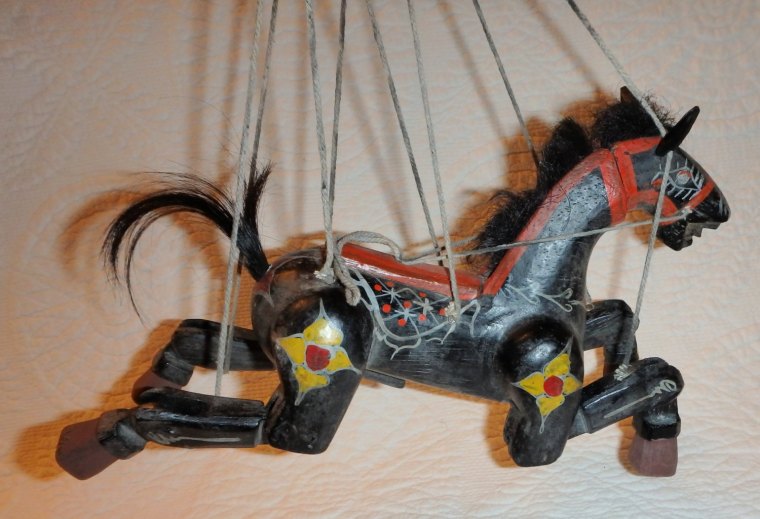
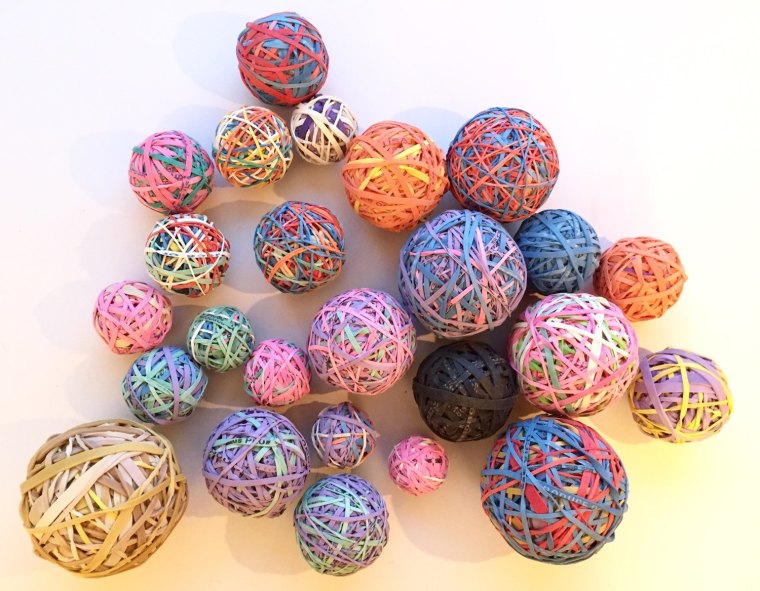
There are lots of odds and ends tucked into her shelves: pictures of her dog, a giant rubber band ball, a mini figurine of a man running, a horse marionette, sand art. Story and memory and intrigue wind their way up and down and across. The overall look is eclectic which makes it interesting, unique which makes it personal, and unfussy which makes it fresh. Sister Parish would have definitely approved!
Using Etsy as her shopping source, Ms. Jeannie recreated Adele’s library look with these following items (click on each picture for more information)…
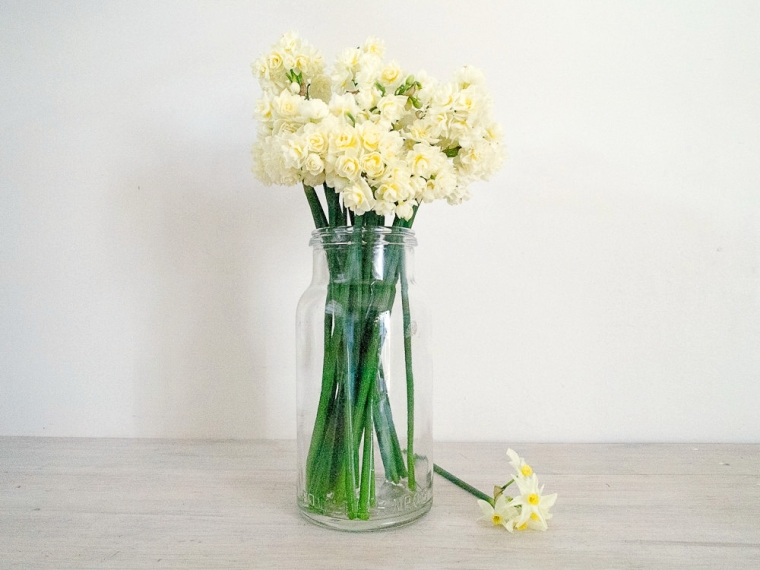
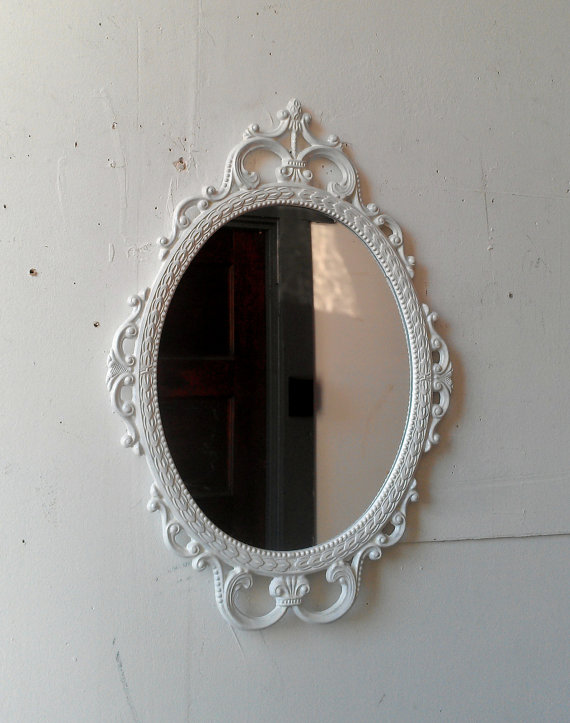
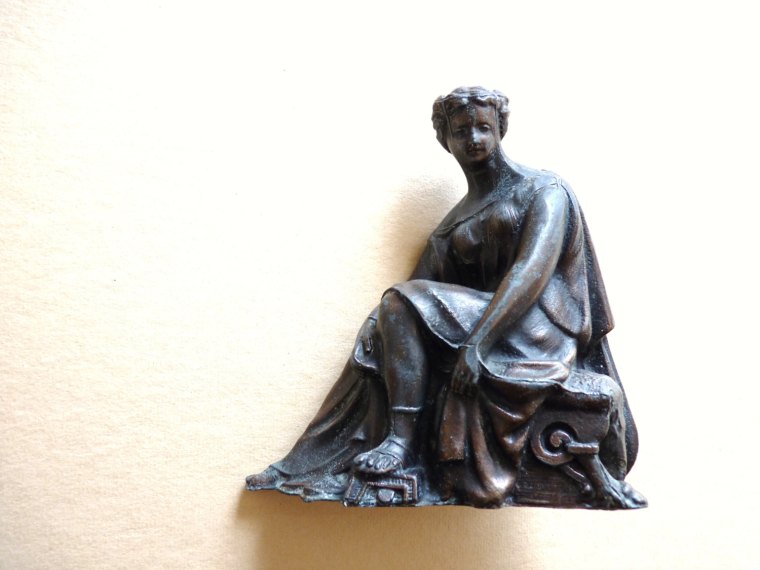
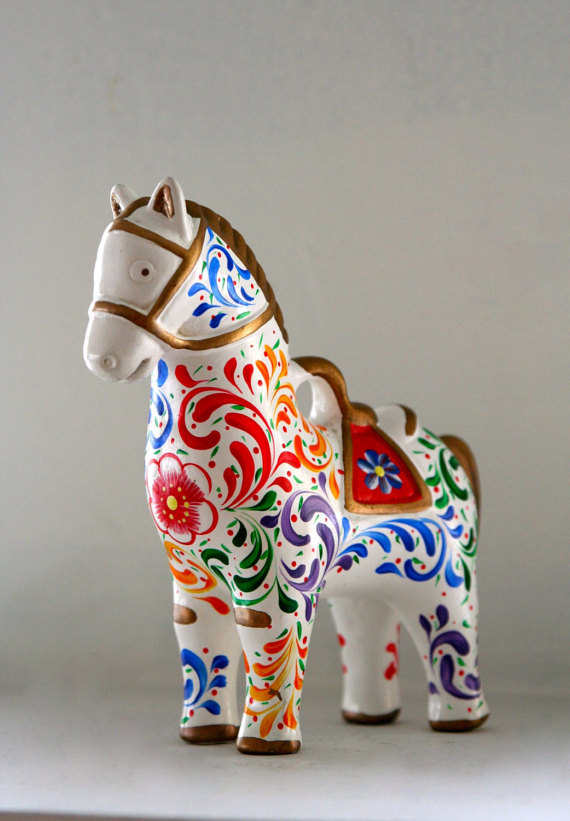
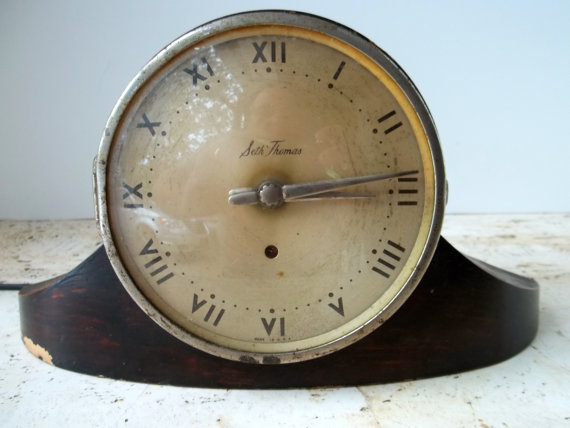
Vintage Fowler’s Preserving Jar from epochco, $25.58Cream Beethoven Bust made by mahzerandvee, $70Hand Carved Horse Marionette from Buddahagal, $28Mirror from SecretWindowMirrors, $76Antique Spelter Figurine from SquirrelMidden, $130.31Colorful Ceramic Horse from KukuliMarket, $38Puppy Love Photograph by Kalstek Photography, $33.00Colorful Rubber Band Balls by BeFashinoablyOnTime, $3.50Vintage Dachshund Figurine by VIntageGoofball, $9.95Antique Seth Thomas Wood Mantle Clock from OneReDunn, $149.99Ostrich Egg by BrocAndPop, $88.15
If decorating is a challenge for you, or you feel confused or uncertain as to where and how to begin to define your own interior style – take Adele’s lead and start with your book shelf. Like a mini room unto itself, bookshelves offer a vast amount of possibility when it comes to display and self expressionism. They can be changed and redecorated over and over again most easily. They offer a great blank canvas to play around with and they have the most effortless ability to really anchor a room as far as a focal point.
Ms. Jeannie encourages you to get beyond the typical effort of just lining up some books in a row and calling it done. Go and explore the little loves of your heart and watch your bookshelf come to life! And of course if you are looking for any books to fill out your shelves, there’s always Ms. Jeannie’s shop to help in that department.
On a side note, in 2013 Adele moved out of her cozy flat into this big beauty in Surrey. Ms. Jeannie imagines there’s a few more bookshelves there in need of her good style sense!
The flag of the United States of America in 1845 contained 27 stars.
Pomp and circumstance, stars and stripes, drum rolls and fifes, please! Election day celebrates its 175th birthday today!
Tucked in between Sunday and Wednesday, Congress chose the first Tuesday in November 1845 as the official day to declare this political event a national holiday. Ideal for voters who would have to make a day’s journey into the county seat to cast their vote (Monday) without disturbing the nation’s religious rest day (Sunday) or encroaching on merchant market day (Wednesday) Tuesday was the perfect day in the week to call upon the country to exercise it’s political powers.
In 2013, Ms. Jeannie’s mom sent a box of family treasures and interesting antiques that had been collected or used by various family members over a century ago. Contents included a civil war inkwell used by Ms. Jeannie’s great great grandfather Albert…
Albert’s inkwell that he carried with him throughout the Civil War.
and a silk scarf monogramed for Ms. Jeannie’s great, great grandmother Martha at the World’s Fair in 1893…
Silk Handkerchief Souvenir from the World’s Fair Chicago 1893
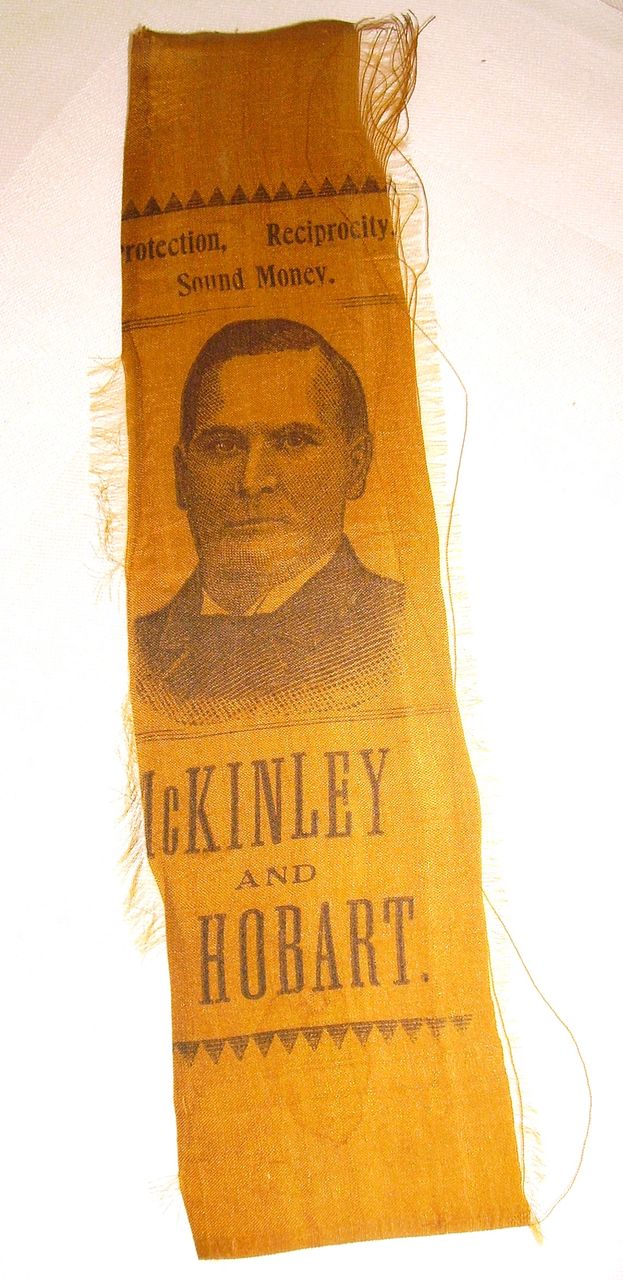
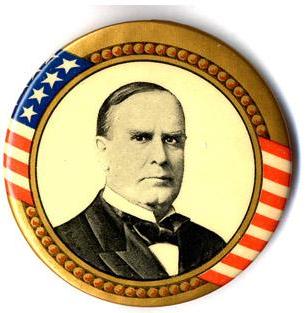
Another fantastic wonder included in the box was this pair of campaign buttons for Republican presidential nomination William McKinley and his vice presidential choice Garret Hobart.
Dating to 1896, the set is comprised of a 2″ inch round button badge and a 3″ inch tie clip encased in gold medal. McKinley was running on the platform of maintaining the gold standard as the foundation for the U.S. economy so almost all of his political swag included gold colors to communicate his cause.
There were gold campaign posters…
and gold bug pins…
There were gold campaign ribbons…
a bevy of gold buttons some featuring the pair, some just featuring McKinley…
and even a gold umbrella for rainy day rallies!
Donald Trump and his love of all things gold would definitely have approved of the McKinley/ Hobart campaign colors!
McKinley’s platforms of protection, sound money and reciprocity turned out to be winning tickets as he defeated Democratic hopeful William Jennings Bryant to become the 25th President of the United States with Garret Hobart at his side.
Get lost for just a minute in the patriotic spirit of the day with this footage from the National Archives as you take a walk along the parade route with spectators at McKinley’s inauguration in March 1897.
Striving for hope, opportunity and prosperity for citizens of the United States, McKinley barreled through his first two years as President before tragedy struck the White House in 1899 with the death of Hobart from a heart condition. McKinley, carrying on, campaigned and won a second term in office in 1901, this time with Theodore Roosevelt as his VP. But by 1901, McKinley himself would be dead – the third US President to be assassinated.
The last portrait photograph of President McKinley . Taken in Buffalo, eight days before he died. Photo courtesy of McMahan Gallery and Archive.
It is easy to get caught up in the hoopla of contemporary political campaigning and to forget the hundreds of campaigns that came before. In 1896 these two gentlemen, McKinley and Hobart were the dream team of the Republican party – riding high on their hopes and ideals for a better country and more golden skies ahead. Not much has changed in that department over the course of a century and half. Politicians still seek the same things – a better way of life for all. We are lucky in that way. To live in a country where we have the freedom to express our views, the encouragement to strive towards our dreams, and the support to accomplish our goals not only as individuals but also as Americans.
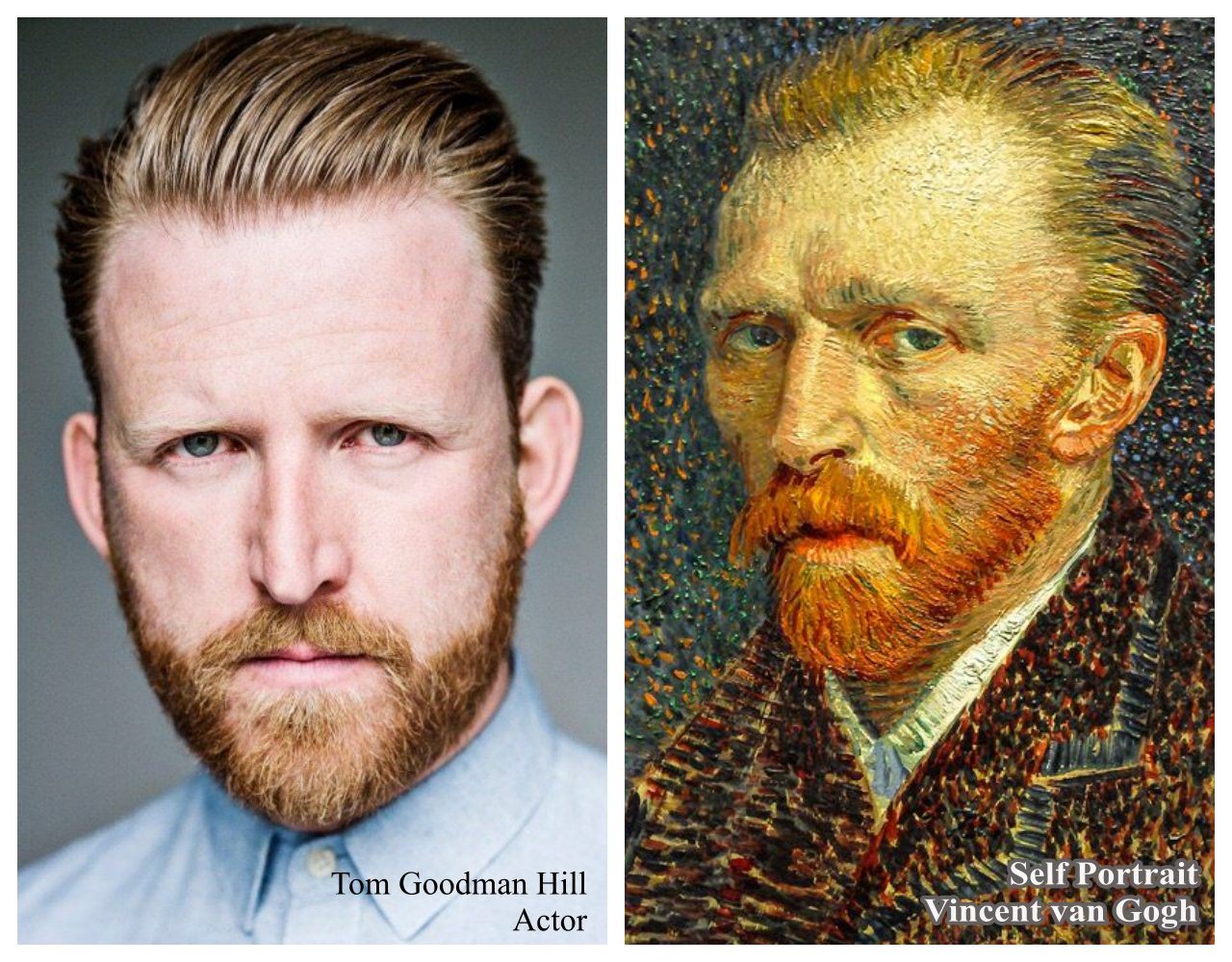
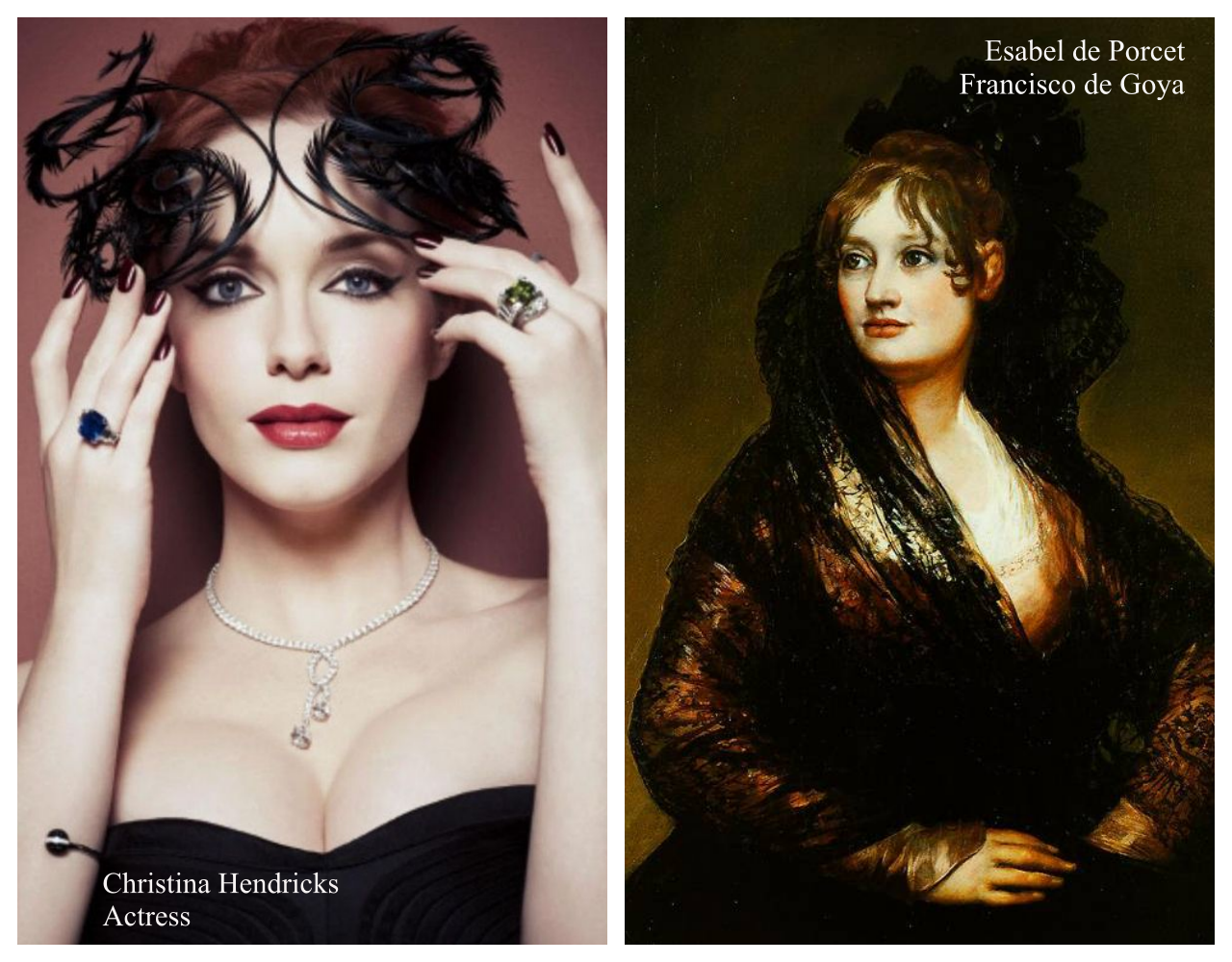
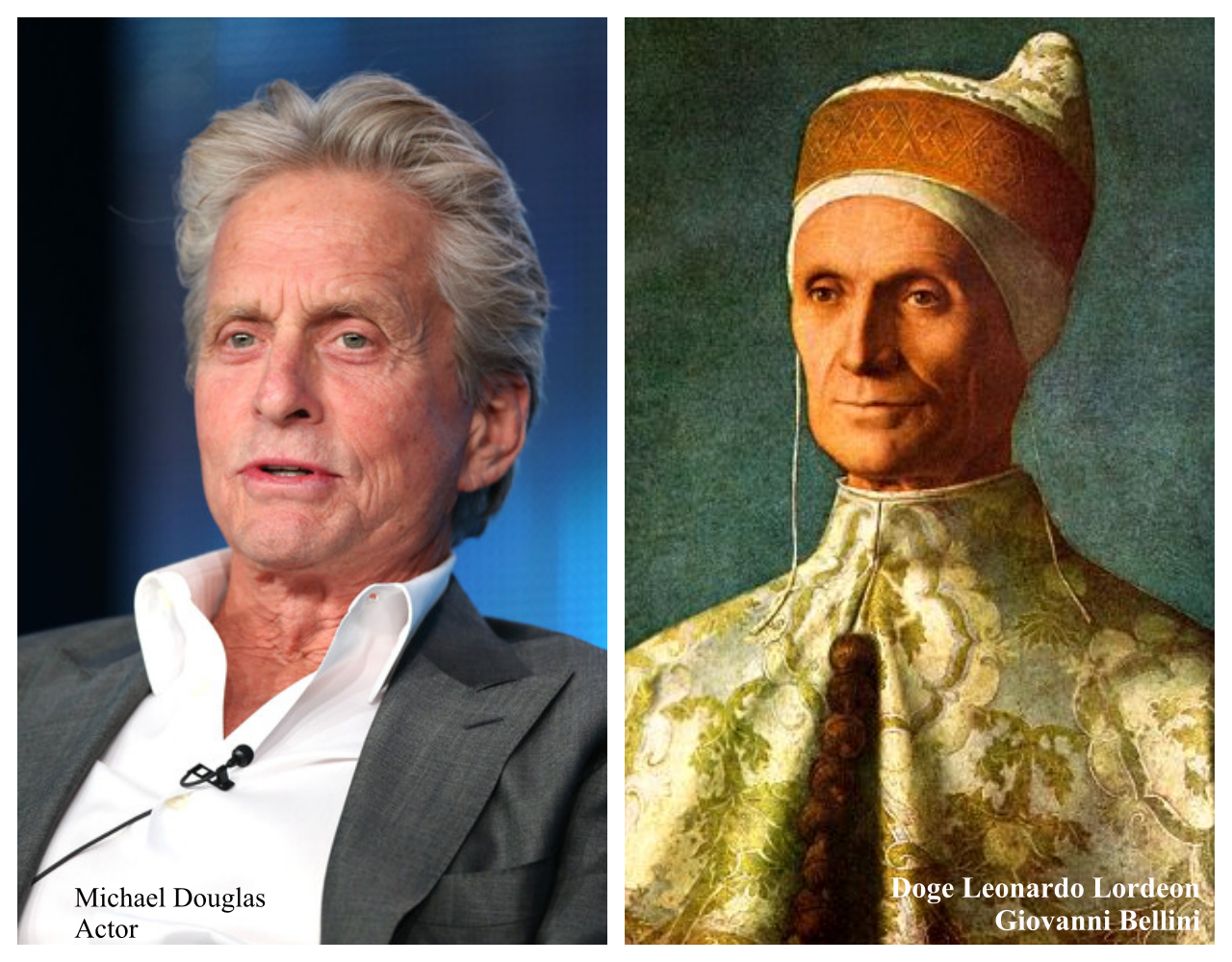
In celebration of the Halloween holiday weekend, Ms. Jeannie thought it would be fun to bring you part two of the celebrity doppelganger series – this time featuring famous modern-day celebrities who bare an eerie resemblance to portrait paintings that were created centuries ago. If ever these celebrities needed a creative costume for Halloween happenings then this would be their ticket to something dramatically different…(or should we say dramatically similiar!) …
Actor Tom Goodman Hill (from the PBS tv show Mr. Selfridge) and Vincent Van Gogh’s self portrait while painted in asylum in 1889Actress Christina Hendricks of most recent Mad Men fame and Francisco de Goya’s portrait of Esabel de Porcel painted in 1805.Actor Stanley Tucci and the portrait of Cardinal Don Fernando Nino de Guevara painted by Greek artist El Greco in 1600No bustle needed for curvy Kim Kardashian when it comes to mirroring George Seurat’s A Sunday Afternoon on La Grande Jatte painted in 1884!Film and television actor Amy Brennaman and the artistic muse Jane Burden featured here in Dante Gabriel Rosetti’s Day Dream painted in 1880Ethereal Actress Tilda Swinton and Joos Van Gent’s Adoration of the Maji painted in 1465Actor John Slattery (also of Mad Men fame) and Frank Blackwell Meyer’s 1858 painting titled Independence.Actress Saoirse Ronan and John Honore Fragonard’s The Billet Doux (meaning the love letter) painted in the 1770’sActor Jared Leto and Rembrandt’s portrait entitled The Head of Christ painted in 1648Back in the Kardashian camp, mom Kris Jenner and George Lepape’s fashion illustration for Paul Poiret titled Lassitude Dinner Dress was sketched and painted in the 1920’sRounding out the list is Michael Douglas and Giovanni Bellini’s portrait of Doge Leonardo Loredon painted in 1501
Looking for more celebrity doppelganger photos? Check out Ms. Jeannie’s modern day actors vs. vintage authors post here for more fun look-a-likes! In the meantime however (and whomever!) you choose to dress up as this Halloween, Ms. Jeannie hopes you take first prize in the costume contest:)
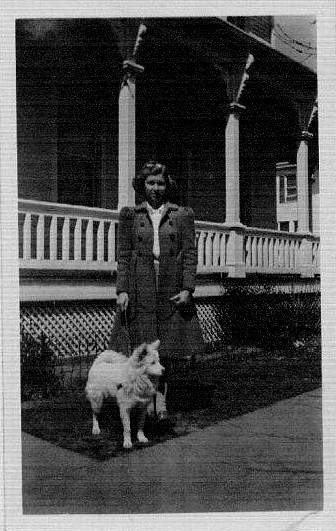
Fresh off of NYC’s Fall Fashion week and with a cool nip in the September air, this week’s post is all about sweater weather and a certain style that has gone to the dogs (literally!). This week’s spotlight is on the Samoyed…
photo via pinterest
one of the world’s oldest breed of dogs, originating from the snowy lands of Siberia.
Long prized for their happy faces, jovial personalities, strong fortitude and loyal devotion, the Samoyed is often depicted throughout history as members of working sled dog teams and instrumental aides of snow-peaked mountain search and rescue organizations. But they are also famous for one additional factor…
Photo via pinterest.
…their mountains and mountains of dog hair! Named after the Samoyed tribe of the Artic region of Northern Russia and Siberia…
Photograph courtesy of icecrownsamoyans.com
the hair of Samoyed dogs is as fluffy as a snow bank and as a dense as a thicket. With the ability to insulate in the winter but also keep dogs cool in the summer, and aided by the massive amount that can be procured from regular brushing, Samoyed hair has been a useful, if somewhat selective component in fiber arts for hundreds of years. One of the most common uses for this type of angora-like hair is sweaters, as seen on this handsome chap from Ireland…
Man, man’s best friend and a sweater made from this pup’s hair. Photo via pinterest
which can of course be knitted in a variety of different patterns and styles like these two examples found on a unique fiber knitting forum…
This sweater was made with 50% samoyed hair and 50% merino wool.
A host of dog hair knitting projects can also extend past sweaters into a slew of other wonders. In 1942, The Samoyed Club of America presented a large display of articles made from their dog’s hair at the Women’s International Exhibit in New York City. Among the many diverse pieces were socks, blankets, gloves, scarves and sweaters.
Of course, using dog hair is not a far stretch from the more traditional fibers like cashmere taken from goats…
photo via pinterest
or merino wool from sheep…
photo via pinterest
but dogs somehow seem a little to close to home somehow for Ms. Jeannie. What do you think dear readers? Is it creepy or cuddly, this dog sweater style? Is the face of your next fall fashion piece?
photo via pinterest
This blog post was inspired by the 1954 book, Dogs and People by George and Helen Papashvily, which is coming soon to Ms. Jeannie’s shop. For other vintage dog-themed books available now, including a marvelously beautiful antique book about a sled-dog named Hector, please stop by and browse a bit here.
Happy New Year dear readers! This coming Sunday marks the two day festival of Rosh Hashana, which celebrates the creation of Adam and Eve and mankind’s role in the world. Although Ms. Jeannie, herself is not Jewish, she thought it would be fun to mark the day with an international dinner night featuring a holiday approved (and kosher certified!) meal which brings together the unique and diverse flavors of the Holy Land.
Many cultural influences make up the demographic food map of Israel, including Indian, Greek, Arabic, Italian and French offering unexpected and interesting food combinations and flavor pairings. In this vintage Isreali cookbook, published in 1964…
The Israeli Cook Book by Molly Lyons Bar-David
author and culinary advisor to El-Al Airlines, Molly Lyons Bar-David compiled hundreds of authentic, local recipes from over 70 regions within the country. Many of the recipes had been passed down from generations bringing with them their own unique stories, folklore and legends which Molly also shares in the cookbook.
An alley in the Jewish Quarter in the old city of Jerusalem, Israel. Photo via pinterest.
Her intention for this culinary project was to serve true Israeli food on board mid-century El-Al airlines flights as a gateway experience for incoming passengers.
Vintage 1960s El-Al airlines travel poster. Via pinterest
But as Molly got deeper and deeper into the collection process, interviewing literally hundreds of locals, she learned that the diverse food scene was just as dynamic and layered as the centuries old history and faith long associated with Israel.
Cochin, India. Photo via pinterest
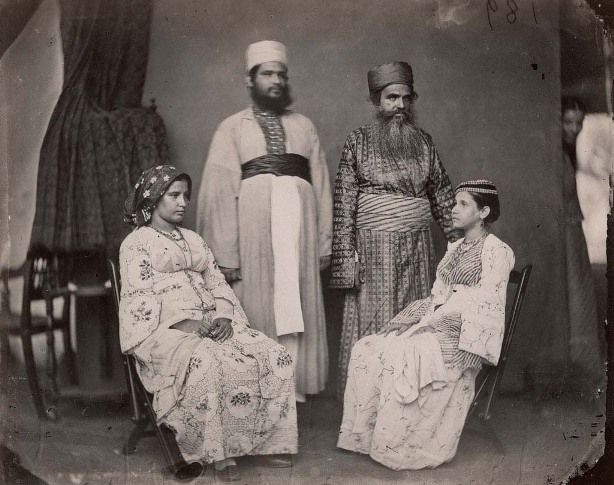
To honor the historical holiday, Ms. Jeannie chose an ancient chicken curry recipe that stems from the spice markets of Cochin, India as brought by the “Cochin Jews” who were believed to have emigrated from Palestine after the second destruction of the Temple.
A Jewish family from Cochin , India circa 1880. Photo via pinterest.
Molly writes in her introduction to the recipe…
“Although their culture, (including a caste system) and even their skin coloring has become indistinguishable from that of their Hindu neighbors, they never forsook their Jewish heritage. Their food, chiefly rice and curries, is like that of the Indians, except that they strictly maintain the kosher laws.”
Ms. Jeannie is a big fan of curry, and has made countless variations taken from recipe books, magazine articles, online sources and foodie recommendations, but this by far was the best (THE BEST!) curry recipe she has found to date. Full of flavor both subtle and bright, it makes a ton and keeps getting better day after day in the leftover department.
It is simple and easy to make and contains basic ingredients that are easy to gather. So if you are looking for a bit of the edible exotic to ring in the New Year or celebrate the history of a culture other than your own this is a fabulously delicious recipe! You can also omit the chicken and make it strictly a vegetable curry if you prefer. Ms. Jeannie served it on top of a bed of Jasmine rice with a side of warm Naan bread.
Cochin Curry
Chicken Curry (serves 4)
1 2lb chicken, cut in parts (do not de-bone)
5 tablespoons olive oil
3.5 cups water
5 large onions, chopped
2 cloves garlic, mashed
4 large tomatoes, chopped (or one large can of diced tomatoes)
1 cup celery, chopped
2 apples, peeled and cubed
2 tablespoons sugar
1 teaspoon ground ginger
1 tablespoon (or more!) curry powder (as a big fan, Ms. Jeannie used 2.5 tablespoons!)
1.5 tablespoons flour
3 cups coconut milk
2 tablespoons grated coconut (optional)
1.5 teaspoons salt
cayenne pepper (to taste)
Fry the chicken in 3 tablespoons of olive oil until lightly browned on all sides (about 10-12 minutes total or 5 minutes on each side). Remove from the pan and set aside.
Add the water to a large stock pot and bring to a boil. Add the chicken and simmer uncovered for 30 minutes on medium low heat.
In a new large pan, heat the remaining 2 tablespoons olive oil and add all the chopped vegetables and spices (onions, garlic, tomatoes, celery, apples, sugar, ginger and curry powder). Mix to combine. Sprinkle on the flour. Mix well again and then add the coconut milk and seasonings, and simmer. Once the chicken is ready, transfer all pieces to the curried vegetables and cook 10-20 minutes more.
Serve hot with rice and Naan bread if you like.* (Ms. Jeannie loves the Naan bread made by Stonefire Flatbreads which is available in most grocery stores in the fresh bakery section.)
Enjoy dear readers! If you’d like to learn about more authentic recipes from the Israeli Cook Book, the Jewish holidays they correspond with and the history behind them, please visit Ms. Jeannie’s shop here. And if you are celebrating the holiday this weekend, Happy Happy New Year:)
Authentic Indian Chicken Curry circa 1964 as prepared from The Israeli Cook Book by Molly Lyons Bar-David










































 In the Vintage Kitchen: Where History Comes To Eat