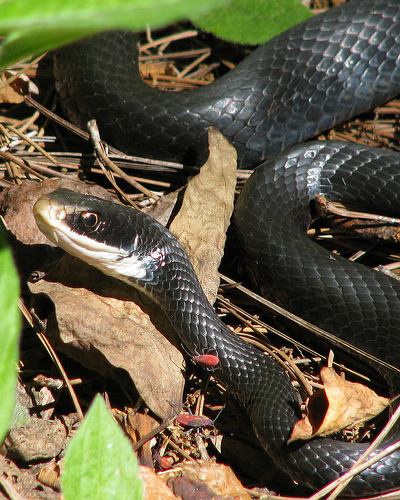
Thanks to Dave the snake expert, the snake skin Ms. Jeannie blogged about the other day has been determined to be a black racer, a common constrictor snake found in the Southern US.
Black Racer Snake. Photo courtesy of GeorgiaInfo
Ms. Jeannie is SO glad she did not see this snake in all its real-life glory!
They can reach up to 60″ inches in length, so Ms. Jeannie’s snake skin was well on its way to being a mature adult at 47″ inches long.
Active during the day, racers got their name because they are fast movers. Similiar snakes are the black snake, the rat snake and the king snake, but the racer is the only one of these grouping who will actively (sometimes aggressively) try to get away from humans while the other snakes will just freeze in their tracks or slowly slink off.
It is believed (although scientifically unproven) that snakes evolved from burrowing lizards over 130 million years ago. Through all these years of evolution, snakes have developed a a very sophisticated sense of smell and the ability to feel vibrations in their environment.
At night the black racers like to curl up in old tree stumps, between boards, or other out of the way places which makes sense that the snake skin was found in the shed.
Hopefully, this will be the end of Ms. Jeannie’s snake blogs!
Or more accurately, Ms. Jeannie should say, something has been in the shed. Take a look…
A snake skin! Mr. Jeannie Ology was the one to discover it, wrapped in between the prongs of a pitch fork hanging on the shed wall. Yikes – that would be quite a surprise to happen upon. Here’s a closeup of it’s head…where you can even see the skin covering his eyes…
Snake head.
If there is one creature in the natural world that Ms. Jeannie has an honest to god fear of – it would be snakes. The South is home to some pretty big ones, so as a gardener, Ms. Jeannie has learned to be cautious about where she goes digging.
This snake skin measures just over 47″ inches long and at it’s fattest area 1″inch around. Holy moley – that’s a big one!
The fattest part of the snake measures 1″ inch thick!
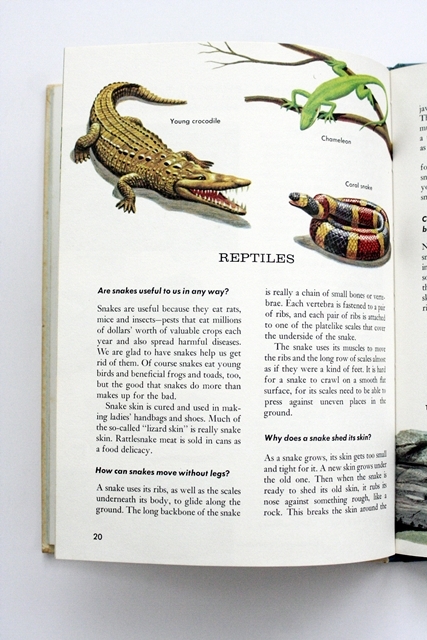
Snakes shed the outermost layer of their skin as they grow. Unlike humans, as we grow and expand, so does our skin. But as snakes grow, their skin only has so much capacity for extra give. So they shed what no longer fits and moves (or in this case slithers) along in life.
Illustration from The Question and Answer Book of Nature by John Saunders circa 1962. Available for sale in Ms. Jeannie’s shop. Click the photo for more info.
They do this shedding fairly often, more frequently when they are youngsters growing into adults (as much as once a month) but once they reach adulthood their growth slows down quite a bit, so shedding slows down to once every two or three months. This still seems like a lot to Ms. Jeannie. At those rates, you would think that we would come across more snake skins then we do.
Funny enough, as mentioned above, their was a small section on snake shedding in the nature book Ms. Jeannie has for sale in her shop…
The Question and Answer Book of Nature by John Saunders and illustrated by Donald Moss.Page 20…Why Does a Snake Shed its Skin ?Complete with illustrations from world renowned illustrator, Donald Moss.
Ms. Jeannie just knew this book would come in handy for both kids and adults! The illustration in the book features a timber rattlesnake, which got Ms. Jeannie to thinking about what kind of snake her skin is from.
While trying to identify the type of skin, Ms. Jeannie discovered a website where you can send in photos of your snake skins for free identification. So she just sent her pictures off. We’ll see what they say!
Mr. Jeannie Ology’s bet is that it belongs to a black snake. Do you have a guess? If so, comment below and we’ll put your naturalist abilities to test!
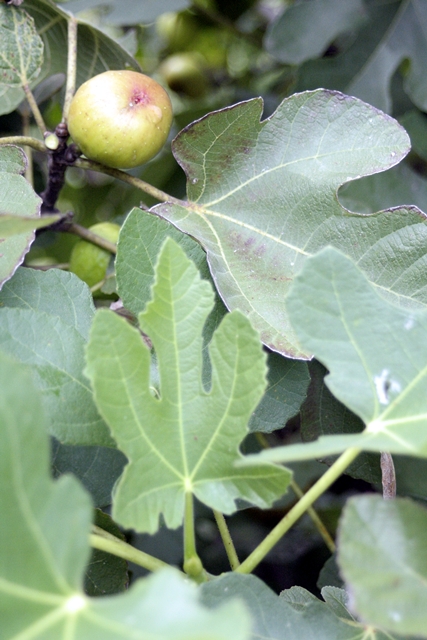
It’s fig season in Ms. Jeannie’s world! They have been coming in over the past week now in full force, which means picking every day.
It’s fig season!
With all that rain yesterday (over 1.25″ inches) from Hurricane Issac, Ms. Jeannie went out to pick today, prepared with a big bucket. Joining the mosquitoes, bees and butterflies, Ms. Jeannie set to task picking and pulling. As she got closer to the center of the bush, she discovered a surprise…
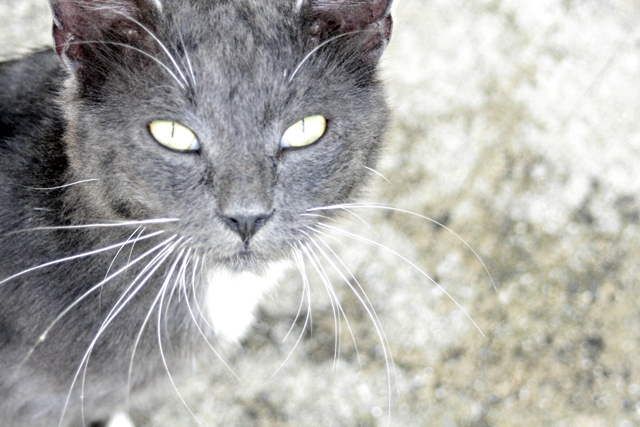
Garden Surprise
A stray grey cat! He turned out to be very sweet and quite a fig picking companion. Apparently he had quite a story to tell too – meowing the whole time…
Quite a handsome little thing, Ms. Jeannie is not sure where he came from, so she’ll call around to the neighbors and see if anyone is missing a sociable pal. In the meantime, he seems content to explore the yard here at Ms. Jeannie’s.
As for the figs…Ms. Jeannie’s bucket overflowed with over 5lbs! A friend is going to be giving her a jam lesson – so she’ll keep you posted on how it turns out.
Ms. Jeannie has never been to an International House of Pancakes that wasn’t packed. Usually with a waiting line out the door.
Now, she must confess that she has probably been to IHOP only about a dozen times in her life, but that doesn’t matter because there have been a million people before and after her that could more than make up for her irregularity. She’s sure of this. She’s seen them all eat pancakes.
The IHOP experience that Ms. Jeannie knows is a hustle and bustle of serving trays and laughing kids, bottomless coffee carafes and mile long little league tables. Glass upon glass of orange juice and seat upon seat of grandparent. The smell of bacon and butter, the scraping of silverware, the staking of plates.
Service is fast. You sit down, your coffee comes right along, you decide, you order and moments later you eat. The thing that amazes Ms. Jeannie most about IHOP though is their sheer volume of traffic and turnover. Each time she is there, it seems like everybody woke up with the same idea. “Let’s go to BREAKFAST!” Right now.
This same zest for morning decadence seemed to be occurring in Ms. Jeannie’s garden this very day.
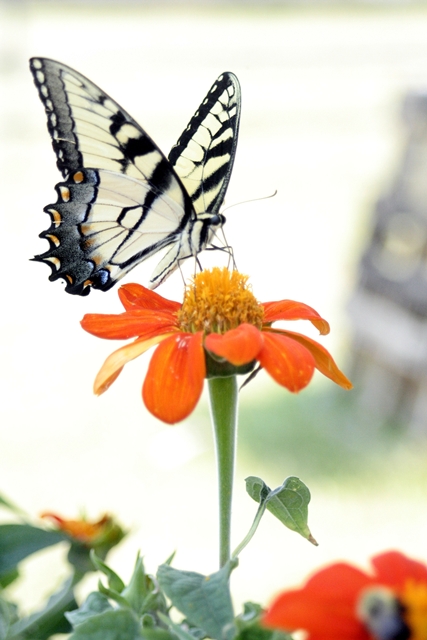
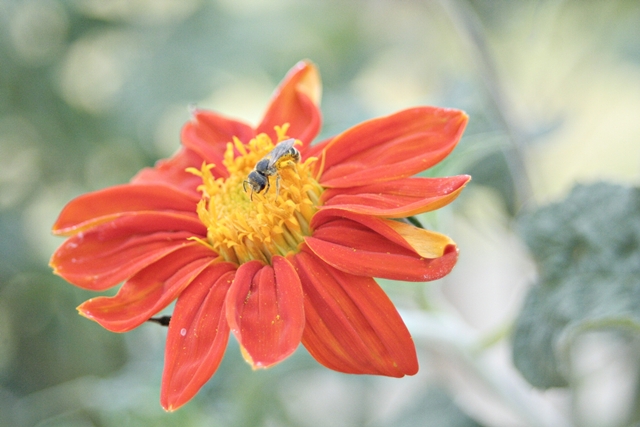
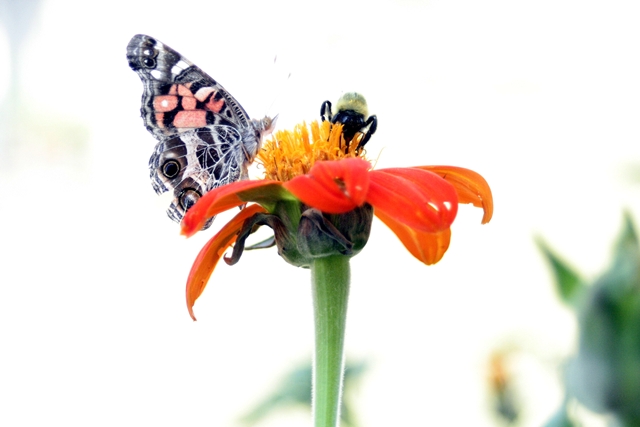
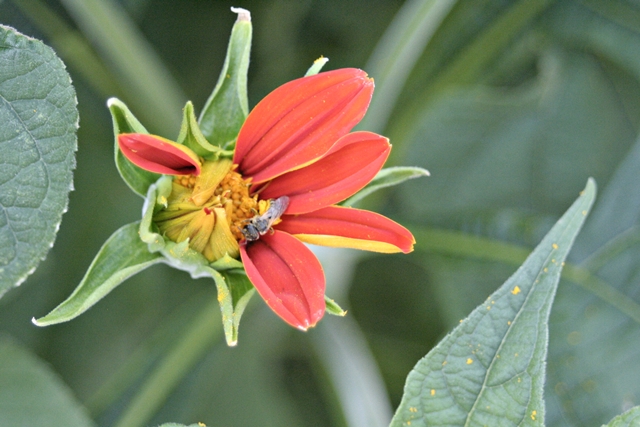
The bees, the birds, the butterflies were all abuzz! So much so that they were literally flying into Ms. Jeannie as she stood watering her Mexican Sunflowers. They couldn’t wait to get by her, diving down, flying up, brushing against – it was a veritable feeding frenzy! The petals were open! Breakfast was on!
Here is just a sampling of the crowd…
Swallowtail ButterflyGround BeeCarpenter BeesMs. Jeannie thinks this might be a Dull Firetip Moth – but she’s not 100% sure. Does anybody else know?American Painted Lady ButterflyWasp
Hummingbirds have been spotted too – but Ms. Jeannie has yet to have her camera ready when they come calling. They are such fast little things.
It is interesting to watch the bees interact with the butterflies. They sort of kick the butterflies out of the way so that they can dive deeper into the nectar. Ms. Jeannie doesn’t think the serving staff at IHOP would approve of that behavior.
There were high hopes for her Mexican sunflowers this year. It was Ms. Jeannie’s mission to hide the meter box along the south side of the house with a mexican sunflower screen. Her seeds started out great. 20 plants came to life!
When they were about a foot tall. a critter of some sort came and rooted up 14 plants. Ms. Jeannie suspects it might have been the workings of a mischievous armadillo that she she’s every once in while wandering about.
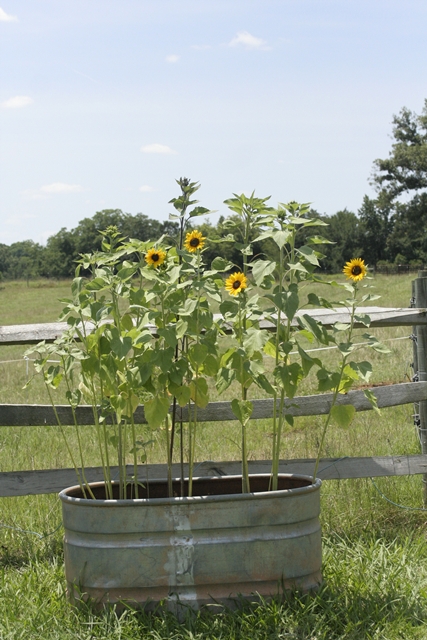
The six plants that remained grew and grew and grew (almost 6 feet tall). Practically filling out the whole area the original 20 would have occupied. So industrious!
Then two back to back wind storms last week took 4 more plants out. Leaving just two behind. There is just no controlling that Mother Nature.
The two remainders are flowering beautifully though, so Ms. Jeannie doesn’t dare complain. They are growing lots of new shoots too. So perhaps they will bush out some more and cover the bare spots.
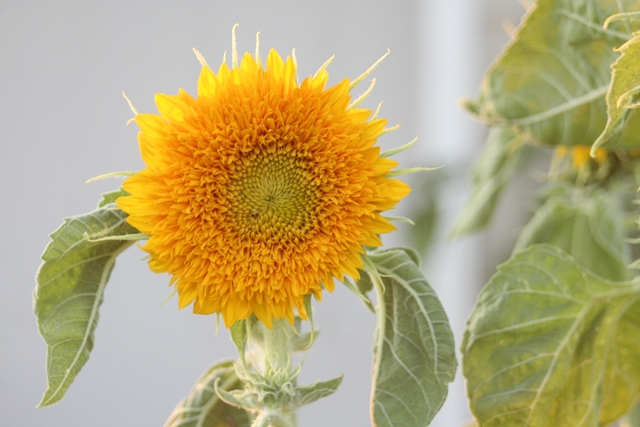
Anyway – this is a photo of them as they stand now. It is amazing to think that all this came from just two seeds.
Considered weeds in Mexico and South American countries, Mexican sunflowers are really easy to grow. Requiring little water and lots of sun, it is best to plant them in the hottest driest place in your garden. Ms. Jeannie only waters hers every few days, as too much water, yields lots of green leaves but not a lot of flowers.
Ms. Jeannie just adores them. They grow fast and big. Their leaves and stems feel soft like velvet, their flowers are a bright citrus orange and they feed the flying squad. What’s not to love?! It’s right up there with bottomless coffee and endless stacks of pancakes.
You know the saying…one thing always leads to another? Well ever since Ms. Jeannie wrote a blog post about the history of starlings she has been noticing the variety of birds that live in and around her garden. Not that she ever didn’t notice the birds before – but now she REALLY notices them. Their colors, their size, their nesting habits, their songs…fascinating! Her blog post also spawned similiar noticings and conversations among her friends, so much so that that they have sort of formed a little bird observation club of sorts. An occasional picture here, some observations there, a musing in-between.
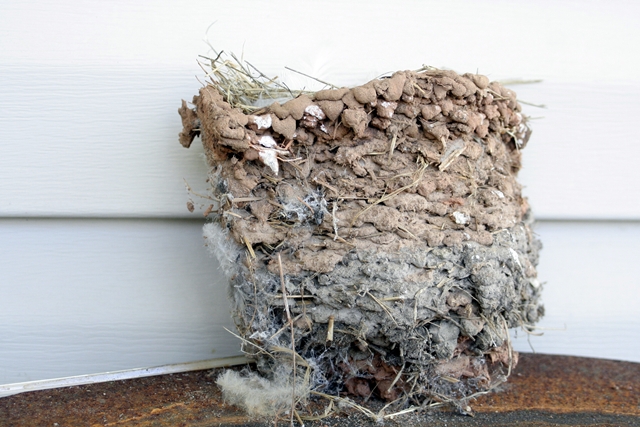
One such friend, just yesterday, brought a nest to Ms. Jeannie that needed to be removed from the underside of his portico. Here it is upon arrival at Ms. Jeannie’s…
Can you identify this nest?
After seeing a family of birds hatch, grow, and leave the nest, and seeing no further activity over the next 2 weeks, he figured the nest was empty and ready for demolition. But to his surprise, upon careful removal, he discovered…
Three eggs!
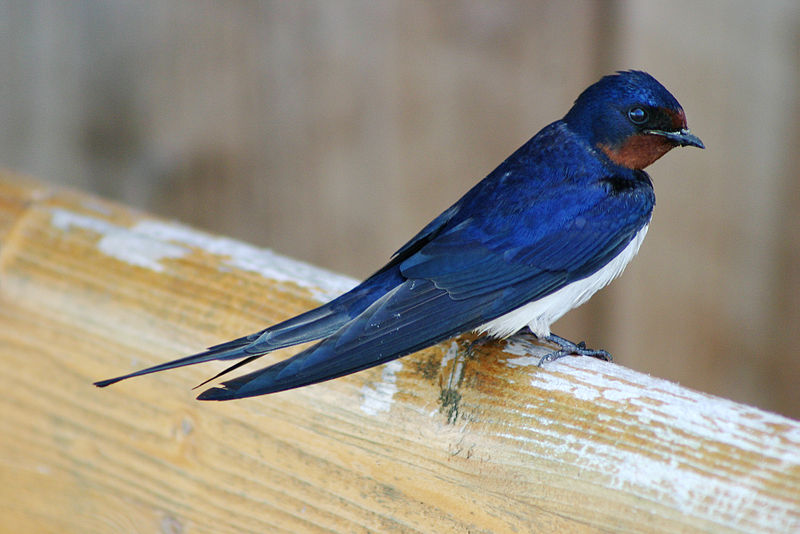
This bird’s nest belongs to the barn swallow, which like the starling, is one of the most common birds. So common in fact, that swallows can be found on every continent except for Antarctica.
Barn Swallow
Lying somewhere between the shades of cobalt blue and windsor blue, barn swallows are made up of beautiful blue feathers along their back and wings with white to orange belly feathers and long pronged tail feathers (like those extra long meat forks!).
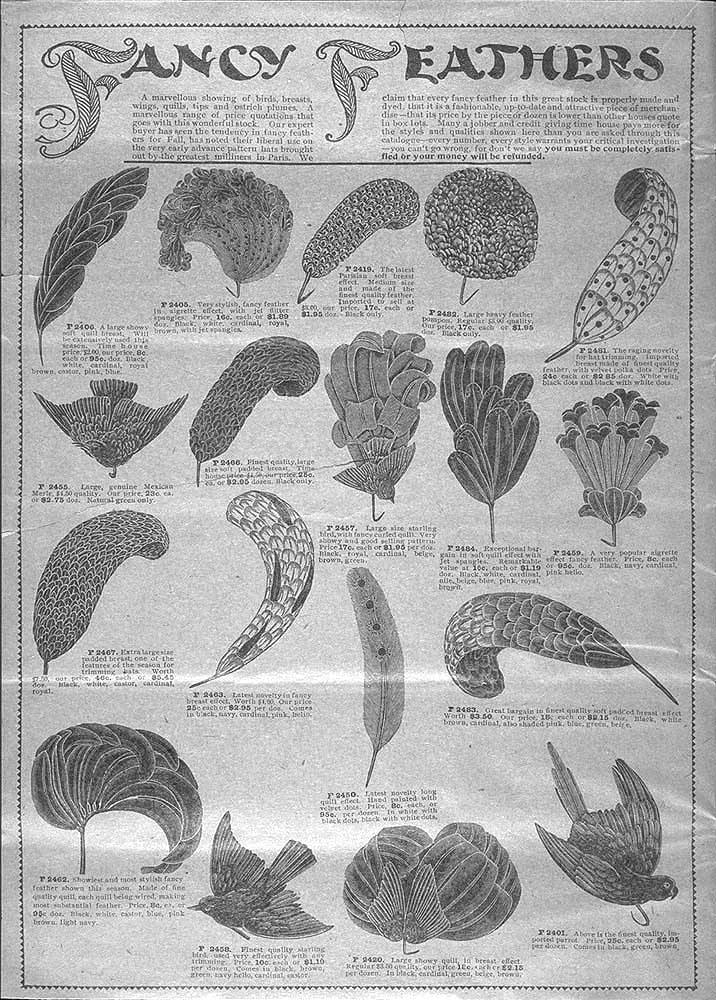
Back in the 1800’s, because of their bright colors, barn swallows were hunted exhaustively for use of their feathers in the millinary business. Ladies hats were big business back then, which led artisans to continuously try to one up each other in the creativity department. Seeking more and more exotic inspirations, birds proved just the ticket to create hats both remarkable in size and stature. Other common bird feathers besides the swallows included egrets, bobwhites, herons and terns.
Here’s a millinery supply catalog page from 1901. Note the starling (whole bird) offered for sale in the bottom left corner.
Millinery Supply Catalog. 1901. Photo courtesy of the Smithsonian Institute.
Understandably, hats were an important staple in every women’s wardrobe. In an era where women dressed in similar colors and clothes, hats were a creative outlet for self expression. Like the artists who created them, women continuously sought the most unusual arrangements. Dead animals included. By the 1870’s, whole birds were being perched on top of women’s heads with wings fanned out in all sorts of elaborate stylings. Here are several feathered hat examples…
Antique Cabinet Photo from VintageAntiqueLaneAntique Photo of the Hatcher Sisters from phunctumVictorian Lady Photograph from nancesnostalgia1800’s Cabinet Card from SusieQsVintageShop1870s Cabinet Card from HappySteiler
By the late 1890’s – early 1900’s, plume trading was a very lucrative business bringing at times $32.00 an ounce and esculating as high as $80.00 an ounce during peak trading. And it wasn’t just for women’s fashion, either. Men’s fedoras were also being embellished with feathers as status symbols of economic prosperity.
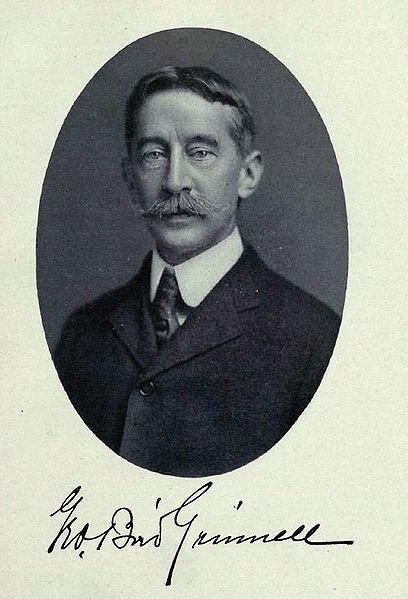
Fortunately, thanks to an 1886 editorial printed in Forest & Stream Magazine by naturalist, George Bird Grinell, the devasting effects plume trading was having on barn swallows and other birds was brought to light for the American public.
George Bird Grinell (1849-1938)
It seems women really hadn’t thought through this whole bird business. Being blinded simply by the sheer beauty of the fashion, they forgot to consider where these feathers came from, how the birds were treated and why they were winding up on their heads. Thanks to the editorial though, women all over New York City roused to the cause. Through boycotts and informational tea parties, word spread and awareness eventually led to the founding of the National Audubon Society in 1905. Today the Audubon Society is still dedicated to the conservation of birds, wildlife and healthy ecosystems. Fantastic!
Ms. Jeannie is thankful that people were watching out for the barn swallows a hundred years ago. Without their valiant efforts, she might not get to enjoy them in her neighborhood now. It’s lovely to see bright flashes of blue zip through the air before you and always so unexpected. Every time, she sees one – it is like the first time. A little extra thrill in her day!
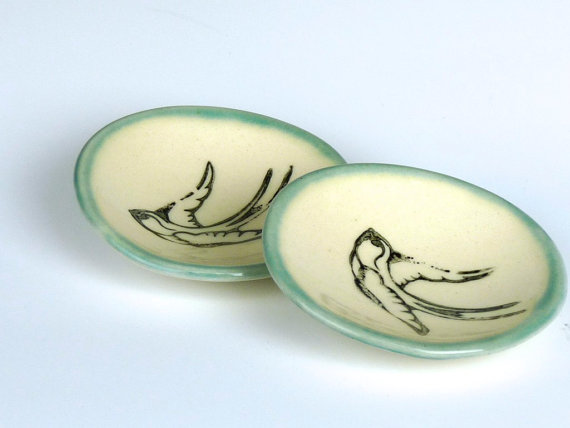
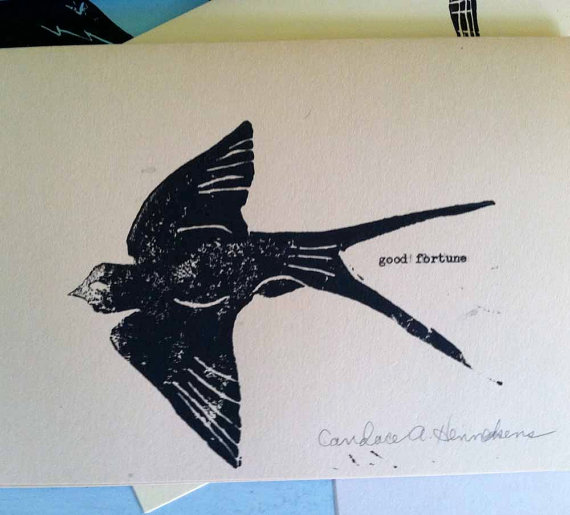
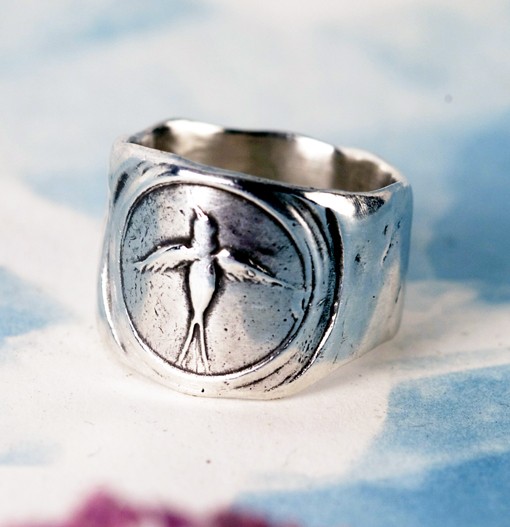
Barn swallows have been a source of inspiration for many areas of art, not just the hat industry. Check out the following swallow themed items, Ms. Jeannie found on Etsy. These are some of her favorites…
Painterly Barn Swallow by Claire HartmanBarn Swallows Cuff by UniqueArtPendantsSwallow Mini Bowls by AmandaMBarrBird Linocut Cards by SwallowNestArtStudioBird Stamp Ring by ardent1Lampworked Glass Barn Swallow Necklace by amnflameworkBe Still and Know Art Print by LisaMDSkinnerArt
If you notice barn swallows in your area, snap a photo and send it to Ms. Jeannie! Please include your location so she can share your sightings with everyone.
Have a birdy day!
BLOG UPDATE!
A reader from the Palm Beach Gardens area of Florida wrote in about this phenomena that occurs in his neck of the woods…
“Something confusing you would be interested in. About every so often, at lest once a month, A huge , I mean huge, flock of birds of all varieties gather on the lake and ring the shore. It consists of birds from pelicans to herons to cranes, etc. As if they are holding a convention. I’ve tried to research this phenomenon to no avail. Any ideas?
Ms. Jeannie is on the case to see what sort of gathering this might be. She’ll keep you updated on what she finds, but in the meantime, if you can help solve this mystery, please share!
Oh my dears, Ms. Jeannie was giddy all weekend in anticipation of this very blog post! She is happy to announce that on Saturday morning, her birthday, she was able to walk out into her garden and clip her very own birthday bouquet. Just as she had hoped for all those cool, dreary months ago, when she was planting seeds in the soil and dreaming of a lush summer garden.
The first bouquet of the season! Moulin Rouge and Drop Dead Red varieties.
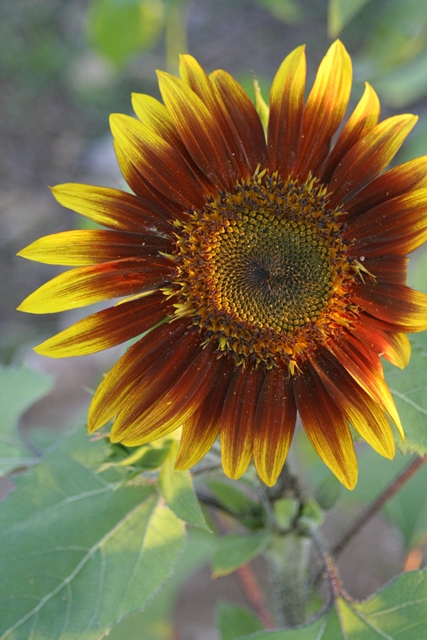
Since Saturday, flowers have been opening up, by what seems like, the minute. Every time Ms. Jeannie steps out she sees something new in bloom! If you recall Ms. Jeannie planted a bevy of sunflowers, in a range of colors. Here’s what blooming today…
A multitude of sunflowers! Clockwise (left to right): Autumn Beauty, Girasol and Del Sol Hybrid.Moulin Rouge Sunflower – not quite sure what those whitish splatters are!Autumn Beauty SunflowerDel Sol Sunflowers. They all contain clusters of blooms! The more the merrier Ms. Jeannie says!
These particular Gold Honey Bear sunflowers (below) definitely remind Ms. Jeannie of the Vincent Van Gogh paintings she blogged about in March…
Goldy Honey Bear Sunflower
And what’s fun about the Moulin Rouge variety…
Moulin Rouge Sunflower
is that some of the backsides of them are just as interesting as the front! Some contain stripes of golden yellow on the backsides…
Colorful reverse!
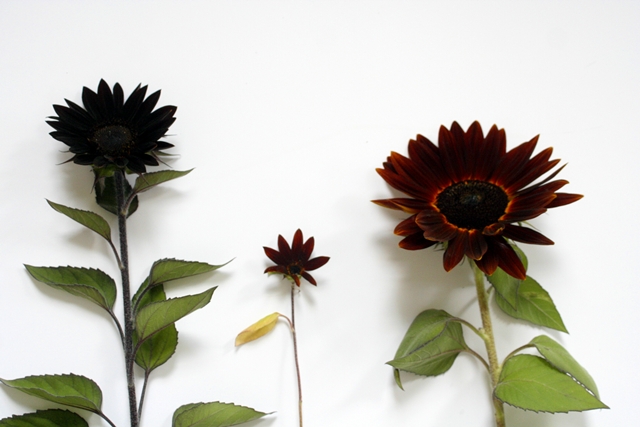
while others are as black in color as a flower can possibly be. Darker then espresso, even. Ms. Jeannie took these photographs so you could see the color difference yourself…
From black to red – sunflowers are quite diverse!
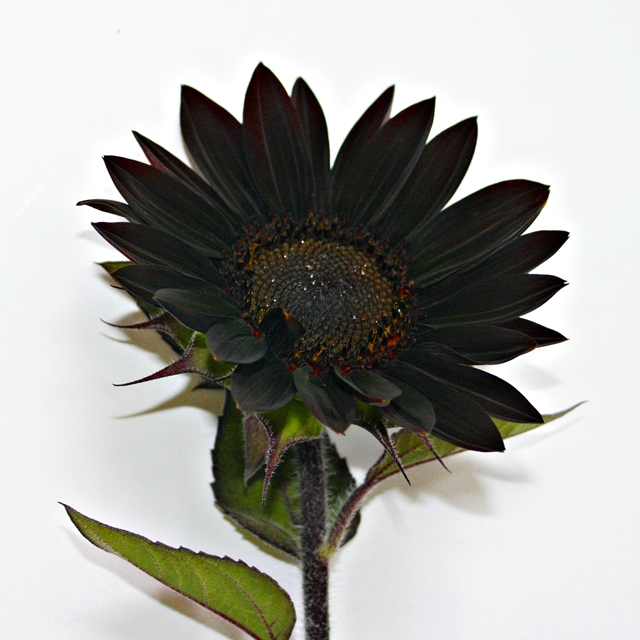
And a close up of the black one. It’s very striking!
Drop Dead Red Variety
These two on the vine are forming a lover’s knot!
Sunflower love!Sunflowers are peeking out everywhere!And they wave happy in the wind!
Ms. Jeannie even has a fellow appreciator of the garden, who as recently taken up residence above the Mexican Sunflowers (those flower pictures coming soon).
Mockingbird in the garden.
Here, he is perched on a bird feeder up above the vegetable garden. Ms. Jeannie saw him pull a fat tomato horn worm off her tomato plant the other day. Thank you Mr. Mockingbird:)
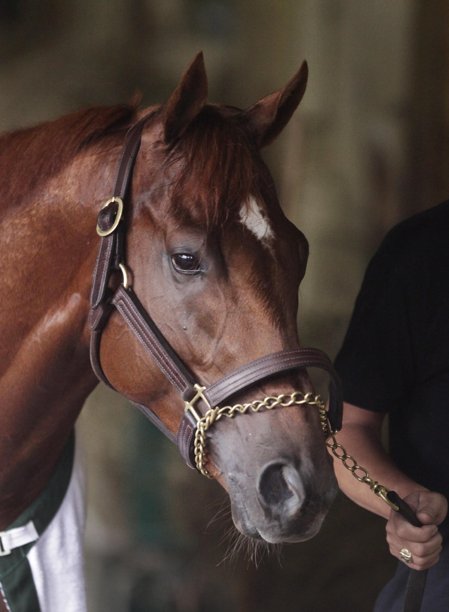
Ms. Jeannie was sad to hear that I’ll Have Another will not be running in the Belmont tomorrow due to a swollen left front tendon. Such a shame! She was looking forward to seeing history in the making. Poor guy…Ms. Jeannie hopes he’s back up and running soon.
I’ll Have Another no longer in Triple Crown contention.
Here it is, my dears, just over 2 months from original plant date and we some fruit from all of our labor!
The jalapenos are almost ready for picking!
Jalapenos
The cherry tomatoes were a surprise! The seedlings were given to Ms. Jeannie as a gift by a farmer at the farmers market, who had under-estimated his seedling growing abilities. Ms. Jeannie, at the time, didn’t think to ask him what kinds of tomato plants they were, assuming, most likely, they were some sort of traditional red summer tomato. But to her surprise, one plant turned out to be yellow cherry tomatoes! Always such a pretty choice in summer dishes! The other plant is growing much bigger tomatoes so we’ll just have to wait and see what those develop into! Since she was so forunate with the yellows – Ms. Jeannie is secretly hoping the others are a purple heirloom variety!
Yellow Cherry Tomatoes
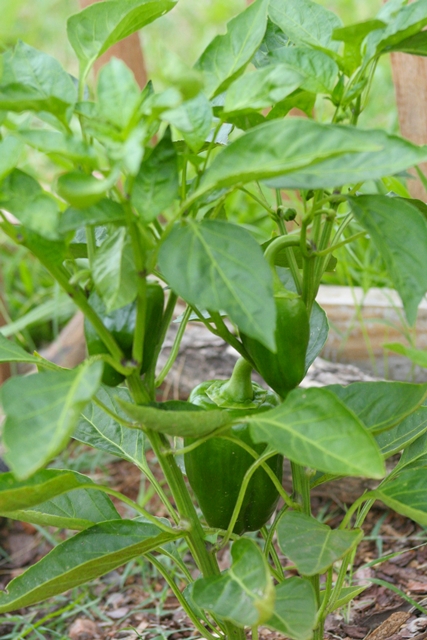
Bell peppers are growing bigger every day! Ms. Jeannie is holding out for red ones so she has to fight the urge to pick them early!
Bell Peppers
And a red sunflower nestled between stalks and leaves just opened up yesterday. He’s in a tricky little spot so it’s hard to get a good picture. Perhaps he’s a little shy!
Red Sunflower
Coming soon: English peas, Mexican sunflowers, snow peas, sweet potatoes, mystery tomatoes and many many many more sunflowers:)
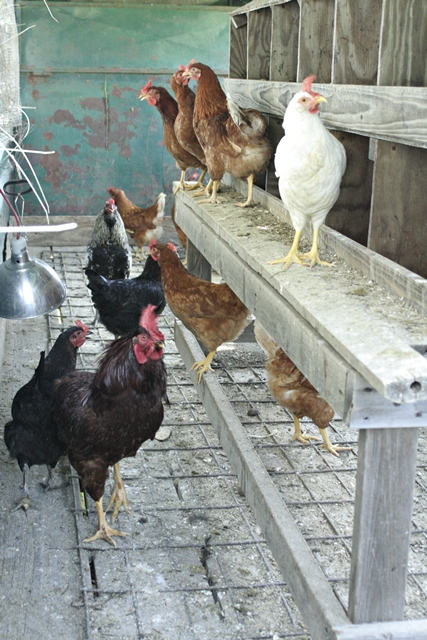
It has been a weekend of birds for Ms. Jeannie. While others may have been grilling or swimming or relaxing in a hammock , Ms. Jeannie was chicken sitting. Well actually, Ms. Jeannie managed to swim and grill and relax in a hammock too, as it turns out there really isn’t that much to chicken sitting, but responsibility is a responsibility so tethered to the feather she was. This was her flock of 18…
A curious bunch!
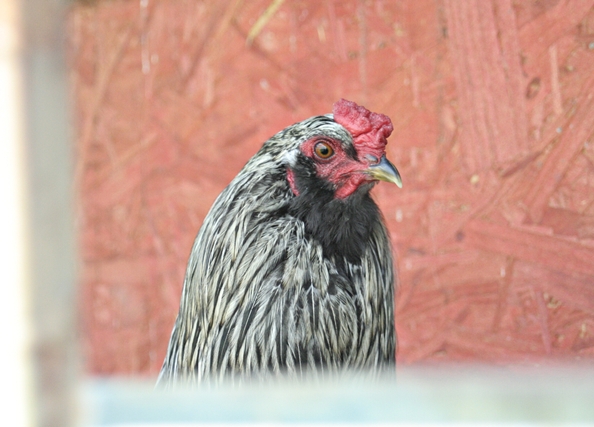
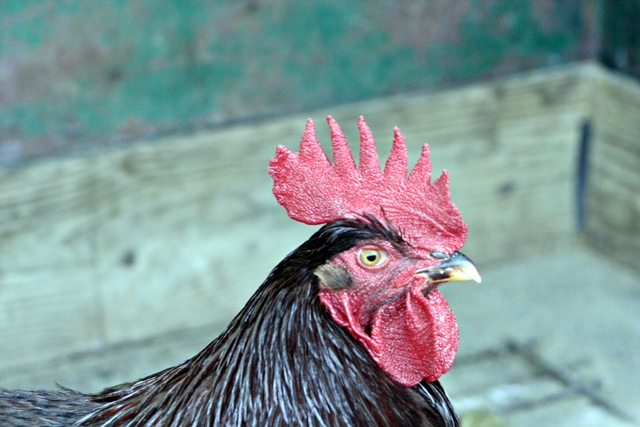
There were 16 hens and two roosters.
Rooster # 1Rooster #2
There is not really too much to watching chickens other than to make sure they have food and water every day and to collect their eggs. This group is temporarily housed in a vintage cow trailer that has been outfitted with chicken wire and nesting boxes.
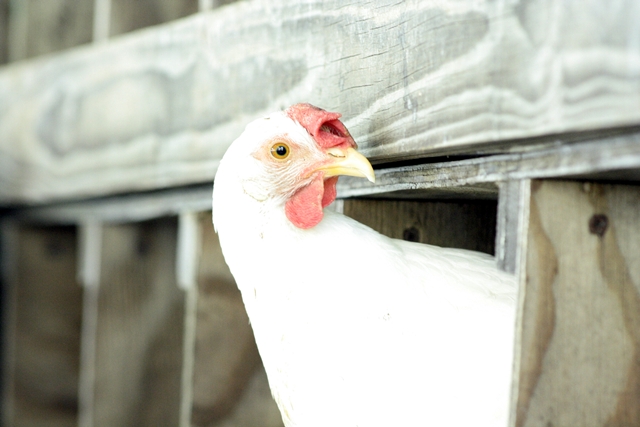
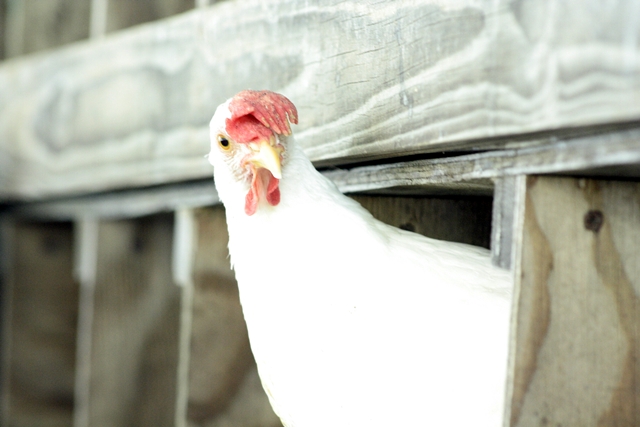
Ms. Jeannie kind of wanted to see a little guitar strapped around the white feathered one!
It has a lot of different levels in it so that the chickens can scamper about, look out the windows and catch the afternoon bugs. It sort of reminded Ms. Jeannie of those hippie buses from the ’70’s, with people poking in and out in all directions.
Hippie bus! Surely a chicken would feel at home with this bunch!
This housing arrangement is only temporary, as soon, the chickens will be grass-side and able to forage on their own. In the meantime though, they remained caged in. Ms. Jeannie’s friend had a dog named Tex who was a little too enthusiastic about having chickens around the farm. He wanted to herd them, he wanted to protect them, he wanted to eat them. As you can imagine, this was all most unsettling for the chickens.
Miraculously, like a cowboy drifter, Tex, moved on. To a new farm where he knew was needed to hered large animal livestock, many miles away from the chickens that tormented him.
Curious creatures..these chickens.
It was the talk of the chicken coop all weekend, with much nodding and bobbing for emphasis! The other big bit of gossip was the state of Flossie’s hairdo (or comb as it is officially called). Take a look…
On one side she looks like all the others…But in this picture you can actually see it’s quite floppy and always in her eyes.
Ms. Jeannie thought this might be some sort of defect in the chicken as she’s the only one of the gang that’s floppy headed. But actually, it is quite normal in female chickens. Some combs stick straight in the air, some flop over, it is just the way it is. Ms. Jeannie learned that there are actually eight different types of combs, all varying in shape and size. Who knew?!
Incidently, Rooster #1 has a pea comb.
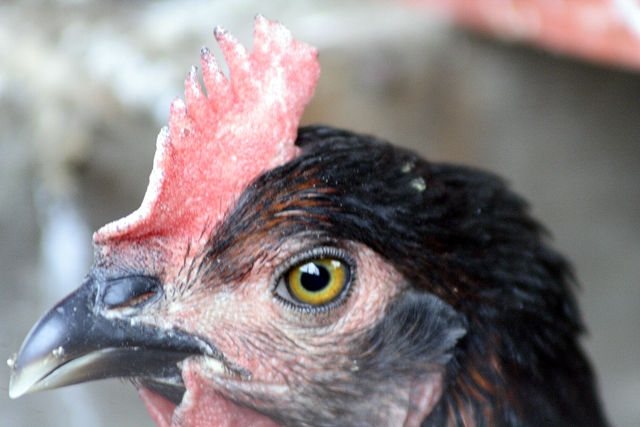
Another thing Ms. Jeannie didn’t realize about chickens, was how beautifully human-like their eyes are. Rooster #2 even looks like he has eye lashes…
Handsome looking eyelashes, even if he is a boy!Eyes the color of almonds.
Chickens eye color, like people, come in all shades from green to blue to gray to brown, yellow and even red (not so humanlike). They can also actually see more colors than people can, due to highly sophisticated retinas that allow them to see all colors at once from all parts of their eye.
Domesticated about 8,000 years ago from the wild Red Junglefowl, a breed that can still be found in Southeastern Asia, chickens now number 24 billion in population today. To Ms. Jeannie the male J looks a lot like an old english chicken. The female Junglefowls look very pre-historic, almost like buzzards.
Red Junglefowl: one male and two females.
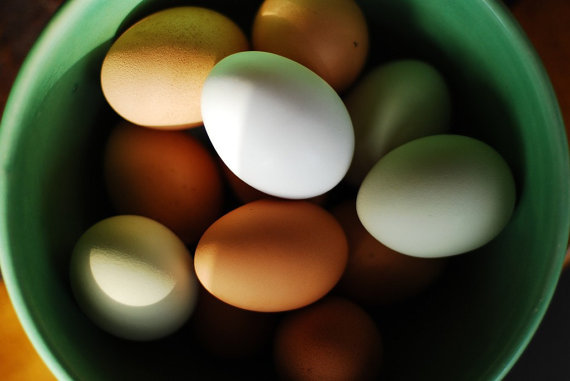
Ms. Jeannie did great with her brood on Days 1 and 2. She brought them kitchen scraps from the previous nights dinner preparation, which they seemed to like. Lettuce leaves, mango stones, banana peels, blackberries, garlic paper all seemed to be a big hit. On Day 1 she collected 13 eggs in a variety of shades from light brown to dark brown to white. On day 2, she collected 10 eggs. But on day 3, just as she went to fill her basket, one of the roosters (#2) attacked her.
Not quite sure what do about that, Ms. Jeannie left the bus and went home to research the situation. It seems that the rooster had mistaken Ms. Jeannie’s rubber boots for another rooster and was trying to show those boots just who exactly was boss.
Hmmm…
Is it a boot or a chicken?
These are Ms. Jeannie’s boots. They don’t look very chicken-like to her! But saddled with this new information, Ms. Jeannie went back to the chickie bus and plied that silly rooster with more blackberries which seemed to keep him happy while she collected the rest of the eggs in peace.
In the next few days, the chickens will move out to the grass. Ms. Jeannie’s friend is thinking about building a permanent chicken house before the winter sets in. That way, the chickens will stay nice and warm in the cool weather.
As it turns out you can pretty much design a chicken house anyway you like from grand to provincial. Tori Spelling’s coop is an elaborate affair…
Tori Spelling’s chicken coop. Photo courtesy of HookedonHouses.net
Mary sells her chicken eggs on Etsy. Check out her shop by clicking on the photo!
Ms. Jeannie has often entertained the idea of having a couple of chickens of her own. And now that she has a little experience under her boot buckle, she just might go ahead and take the plunge. One of the great things about watching the chickens over the weekend was that she got to keep all the eggs. Nothing taste better than a farm fresh egg!
Farm Fresh Egg Photograph by AmandaRaeK
Ms. Jeannie is currently reading a wonderful book called Tessie and Pearlie: A Granddaughter’s Story. It’s a memoir about the lives of author Joy Horowitz’ two grandmothers, Tessie and Pearlie, who were at publication time, both in their 90’s.
Tessie and Pearlie: A Granddaughter’s Story by Joy Horowitz
Tessie’s husband, Izzy Horowitz was an egg candler in Brooklyn in the 1920’s. Brooklyn and farm fresh eggs are two things you’d never think would go together. But alas, here there are in history! It was Izzy’s job to inspect the eggs by candlelight and discard any that were bloodshot. This is a picture of an electric egg candler from the 1930’s. Clearly a more sophisticated machine then an ordinary candle!
1930’s era egg candling machine. Photo courtesy of treatsforchickens.com
We have Christopher Columbus to thank for bringing chickens to the New World in the 15th century. At that time, chickens were more prized for their eggs then their meat.
Gaining mass popularity in the early 1800s as a valuable farm crop commodity, chickens were raised in larger and larger numbers on family farms for both their egg and their meat attributes. Following World War II, commercial egg production soared due to significant advances in breeding, feeding and housing chickens.
After seeing a disturbing documentary on PBS about modern-day chicken houses, Ms. Jeannie opposes the inhumane treatment of chickens in today’s commercial poultry industry. So she only buys organic, free range, humanely treated chickens and eggs. The eggs taste much better and the yolks are always a vibrant orange-yellow, instead of a pale butter color. Ms. Jeannie thinks it is because they are “sunnier” chickens – happy to be eating a natural diet and running around in a natural environment. Why not encourage as much happiness as you can!
Hopefully my dears, you had the chance to watch the Preakness on Saturday.
I’ll Have Another vying for the win at the Preakness!
It was nail biting all the way down to end, when I’ll Have Another won literally by a nose or a neck, depending on your vantage point! How exciting to watch him barrel down the last quarter stretch neck and neck with Bodemeister, only to summon that very last bit of “umph” to guarantee himself the winner of the Preakness!
I’ll Have Another and Bodemeister battling it out.Another viewpoint. You can see how close they were!
It was cute to watch him saunter around the track afterwards like it was no big deal. Just another day of racing!
If you missed it, here’s the race in full…
I’ll Have Another’s jockey, Mario Gutierez sang the praises of his talented partner. Here’s what he said:
“This is not about me. We talked about it with Mr. Reddam and Mr. O’Neill. We wanted to be a little bit closer to Bodemeister this time because normally that horse runs a huge race. My horse has a tremendous kick in the end. He has been proving that in the last three races. He didn’t disappoint again today.”
“I want to put the pressure a little bit on the side because the credit he earned all this. He has proven a lot of people wrong. I just have to prepare because I want to be at the same level as him. He’s an amazing horse.”
Such a humble pair those to are! And now it is on to the Belmont. If I’ll Have Another wins the Triple Crown, he will be the first horse since Affirmed in 1978 to hold that honor, proving how rare and spectacular an athlete all the Triple Crown horse winners really are.
Affirmed winning the Belmont, and therefore, the Triple Crown in 1978.








































 In the Vintage Kitchen: Where History Comes To Eat