

When it comes to describing great bread recipes, they tend to take on a variety of accolades based on specific attributes. Best flavor. Best texture. Best no-knead. Best whole wheat. Best no wheat. Best gluten-free. Easiest to make. Fastest to bake. Biggest loaf. Smallest effort. Best. Fastest. Easiest. Again and again, over and around, brilliant bakers everywhere boast.
No one that I’ve encountered yet, though, has ever described their favorite bread recipe as the kindest. There’s no Google search for the best kindest bread. Kind isn’t really the type of word that generally pairs well with food descriptions and a you-have-to-make-it recipe. Baking or otherwise. But the recipe I’m sharing here in this post today can really only be, first and foremost, described that way. It is, of course, delicious and healthy and not complicated to make and contains simple ingredients, but above all, the best part of this recipe is its core, standout attribute… its kindness.
Without fully embracing that trait, you won’t be able to make this recipe as intended. And in not being able to make this recipe as intended, you’ll miss out on a truly delightful experience. One that is calming, relaxing, and joyful. You don’t need to be an expert baker or a seasoned bread maker to enjoy the fruits of this labor. You don’t even need to be a well-versed cook. In order to achieve the desired outcome of this recipe, you just need to be kind to it. To treat the ingredients and the process gently from start to finish.
Yeast is a living, breathing, growing life. Therefore, in order to make a marvelous loaf of bread, you need to treat the yeast gently and handle the dough tenderly, in the same way you would handle a newborn baby. This recipe is not about rushing or shortcuts or pre-made, pre-packaged substitutes. You don’t want to begin this culinary adventure with a scattered mind, an irritable mood, or perfection-induced pressure and motivation. This recipe is about showing kindness to yourself, the baker. It’s about showing respect for the ingredients involved, and about showing genuine care and consideration for the process of turning piles of fine and powdery specks into two golden loaves of substantial, nourishing bread.

Simply called Yeasted Bread, the recipe comes from The Tassajara Bread Book, first published in 1970 by Edward Espe Brown. At the time of publication, Edward was in his mid-20s, newly married and running the kitchen at Tassajara, a Zen spiritual center located in the remote Ventana Valley in Central California.

Opened in the 1960s, Tassajara was the first Zen spiritual center in the United States, and also the only Zen monastery outside of Asia. There in the Los Padres National Forest, students and guests from all over the world came to practice Zen philosophies and Buddhist principles in order to gain a more gentle approach to life. One that focused heavily on kindness, compassion, and thoughtfulness.

Due to its remote location, food for the guests, students, and staff was grown on-site at Green Gulch Farm, part of the Zen Mountain Center campus. Edward saw firsthand the time and care it took to grow the vegetables and fruits that eventually wound up in Tassajara’s kitchen for him and his helpers to prepare. With every chop and slice, simmer and slow roast, he continued that same level of care and attention in his cooking. He looked at every single ingredient as if it were a gift that he in turn would make into another gift of a satisfying meal for his friends, family, and guests at Tassajara to enjoy.

“When I cook, I feel nurtured, sustained, like there’s energizing going on. It makes me feel the preciousness of life,” Edward shared in a 1985 Peninsula Times Tribune interview.

It’s that level of care and appreciation for the act of cooking and baking that established Edward’s reputation as a helpful coach in The Tassajara Bread Book. In this cookbook, as well as the other Tassajara books that followed, Edward wasn’t interested in telling home cooks how to make perfect food. He knew the act of cooking itself was too frenetic and ever-changing to prescribe a set of strict rules and guidelines that would be automatically applicable each and every time you came to the kitchen. Instead, he was interested in offering an understanding on how to approach cooking. He was interested in placing focus on intention and gratitude. Appreciating the life of the vegetable, the sharpness of the knife. Appreciating the aromatic steam from a bubbling broth, the flavors created when one ingredient combined with another, and the presence of the people sitting around the table. Good food would follow via the care put into its preparation.
Apart from being the first kind bread recipe that I’ve ever encountered, Edward’s bread book was also the first cookbook I’d ever run across that opens with a two-page poem of sorts that he wrote himself about working in the kitchen. It reads more like a spoken word piece than a traditional poem, but it has lovely sentiment and turns of phrase and sets the whole tone for the Tassajara cooking and breadmaking experience. Here’s an excerpt about mid-way through…
Each thing, asking to be seen, heard,
known, loved, a companion in the dark.
“Take care of the food, it is said,
“as though it was your own eyesight,”
not saying oh that’s alright, we
have plenty, we can throw that away.
Table, teapot, measuring cups, spoons:
the body within the body,
the place where everything connects.

The place where everything connects. That’s how Tassajara’s Yeasted Bread can best be described. A combination of person, plant, preparation, and product. Rest assured, you are following a recipe with step-by-step instructions and a definitive end result, but you are also following your heart, your intuition, and your awareness of the process in equal measure.
Coming from the earth, coming from the air,
a cool breeze, a spark, a flame, a go ahead:
Cook, offer yourself, hold nothing back.
Cooking is not like you expected, not like
you anticipated. What is happening is unheard
of, never before experienced. You cook. No mistakes.
You might do it differently next time, but
you did it this way, this time.
The end result is what it is.
– Edward Espe Brown
Breadmaking can be tricky. There are a lot of factors that can intervene and mess with the process – humidity, air conditioning, hard water, soft water, oven temperatures, inactive ingredients, bacteria, a hot atmosphere, a cool environment. All components that may or may not be within your control. I found it to be very calming to read about a breadmaking process that begins by telling you, first and foremost, to relax.

This was the first sandwich bread recipe I have tried to make since moving to New England. I didn’t know how my oven was going to act, or if our coastal air would make a difference, or if the summer heatwave temperatures on the day I first made it would help or hinder the process. Was it luck that made the bread turn out so well on the first try? Or was it the recipe and Edward’s call to action to treat every step along the way with care and kindness?
Edward called this recipe the basis from which all other bread recipes in the book are created. A springboard for later adding in additional flavorings or flours, as well as a solid resource for further experimentation and exploration of your own making. I’m not an expert breadmaker in any sense of the word and have had many failed experiments using other recipes from other places over many years, but none of those recipes ever mentioned baking with kindness and appreciation, nor stated anything close to Edward’s it-is-what-it-is philosophies. That might just be the winning equation to a good loaf of bread.
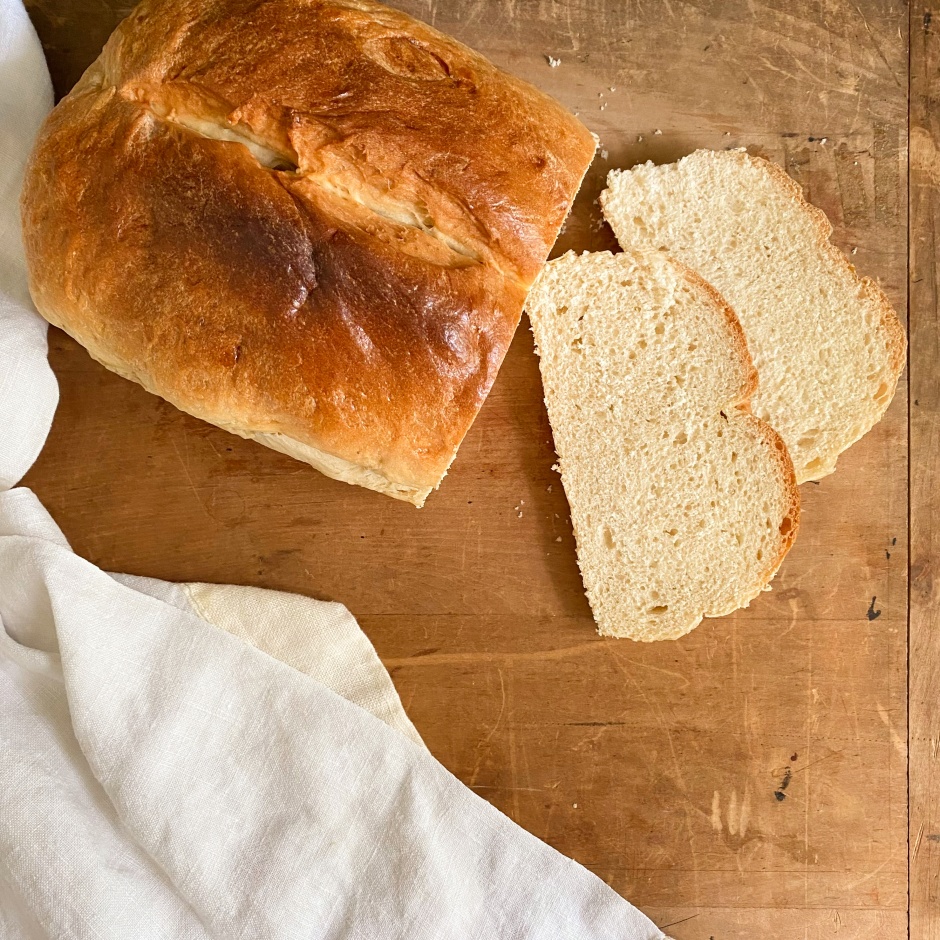
In case you have ever struggled, like me, with making homemade bread that winds up turning out flat, flavorless, or weighing twenty pounds, then this recipe will show you how to avoid all three. There’s a small amount of brown sugar that adds a hint of sweetness to the dough and also helps feed the yeast, but other than salt and butter, there are no other flavor enhancers. It produces two simple loaves that are ideal for sandwiches or toast with butter and jam. And it makes the type of bread meant to work in collaboration with other toppings, not compete with them. The loaves are of medium density with a light but substantial weight that makes you feel like you’ve eaten something nutritious, packed with good-for-you carbs and protein on a level that will sustain you for hours instead of just a few minutes. It’s not light and fluffy like a croissant nor is it hard and heavy like a peasant loaf. It’s somewhere in between. Spongey but firm with a texture that holds it shape and won’t fall apart when you cut it. I found it to be such a great, delicious, simple all-around bread. A best bread. Baked with kindness.

By 1973, three years after The Tassajara Bread Book was published, Edward had gained quite a following. The book at that point had sold over 150,000 copies, and racked up accolades from food critics, professional chefs and home cooks around the country. Edward went on to write Tassajara Cooking and then The Complete Tassajara Cooking, each featuring vegetarian recipes along with favorites from the bread book. In 1995, The Tassajara Bread Book celebrated its 25th anniversary with a reprinting and emphatic praise from the Washington Post, deeming it “the bible of breadmaking.” As it turns out, there is something about baking with kindness and gratitude, after all. Edward was right. The good food follows.
I can see why breadmaking is such a fulfilling form of baking. It’s a calming act. An encouraging endeavor. A delicious result. In our busy modern-day world that is grappling with so much unrest, noise, and difficult situations, it’s the serenity of this baking endeavor that I found to be most appealing. Baking in this Tassajara way is an act of love on all accounts…. thoughtfulness, acknowledgment, gratefulness, gratitude, and not just for the food but for yourself in the present moment too.

Tassajara Yeasted Bread
(makes 2 loaves)
3 cups lukewarm water (Note: lukewarm registers between 85 degrees F – 105 degrees F and does not feel warm or cold when splashed on the inside of your wrist).
1 1/2 tablespoons dry yeast (2 packets)
1/4 cup sweetening (honey, molasses or brown sugar) (I used brown sugar, loosely packed.)
1 cup dry milk (optional) ( I did not use it)
4 cups whole wheat flour or substitute unbleached white flour
4 teaspoons salt
1/3 cup oil or butter
3 cups additional whole wheat flour or unbleached white flour
1 cup additional flour for the kneading process

Dissolve the yeast in the water. Stir in sweetening and dry milk, if using. Stir in four cups of flour, one cup at a time, stirring briskly after each addition to form a thick batter. Scrape down the sides of the bowl occasionally as you mix. After the fourth cup of flour is incorporated, mix well with a wooden spoon for 100 strokes until the batter is very smooth.

Cover bowl with a damp cloth and let rise for 45 minutes in a spot that is between 85-100 degrees in temperature. If the spot is cooler than this temperature the dough will take longer to rise.
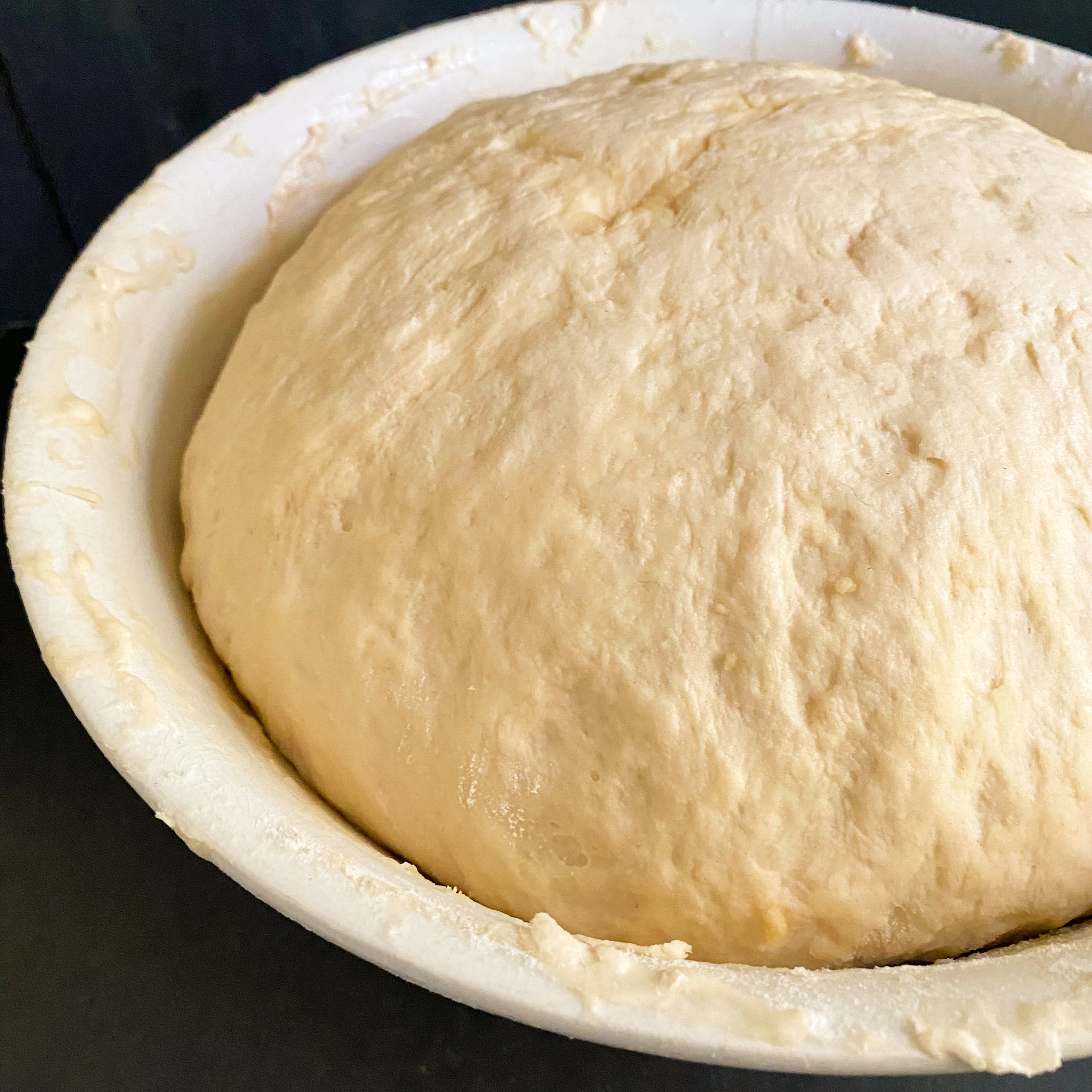
After 45 minutes, fold in the salt and oil or butter. Fold in the additional three cups of flour, mixing until the dough comes away from the sides of the bowl.
Using the final fourth cup of flour spread out on a board, knead the dough for about 10 minutes or until it no longer sticks to the board. Knead the dough by flattening it with your hands and then folding it in half by pulling the top half down to meet the bottom. Use the heels of your hands to push the dough down and forward, rocking your whole body forward with each push, not just your hands and arms. Rotate the dough a quarter of the way around and repeat each previous motion, flattening, folding down, and pushing the dough forward. Keep rotating and repeating these steps for the entire 10 minutes until the dough is smooth.
Put the dough back in the bowl, cover it with a damp cloth, and let it rise 50-60 minutes until doubled in size.
Punch down the dough by placing your fist into the center of the dough and then all over it about 15-20 times.

Let it rise in the same bowl for 40-50 minutes again until doubled in size.
Preheat the oven to 350 degrees. If using an electric oven, preheat it to 325 degrees.
Shape the dough into a round ball and cut into two equal pieces. Shape each piece into a ball and let them rest for 5 minutes.
Knead each ball in your hand five or six times. Shape the dough into logs. Oil two bread pans and then place a dough log in each pan.
Let the dough rise 20-25 minutes in the pans.
Cut the top of each loaf with a 1/2″ inch slit to allow steam to escape. For a golden brown, shiny top, brush the surface of each loaf with an egg wash made of 1 egg beaten with 2 tablespoons water or milk. (I used milk.)
Bake for 50-60 minutes or until golden brown.
Remove from the pans and let the loaves cool on a rack.

Although it took about 6 hours to make from start to finish, the time passed quickly and was peppered with little moments of surprise and delight as the dough bubbled and popped, rose to magical heights, and filled the house with the warm, inviting scent of a bakery. It’s pretty lofty to say that a slice of homemade bread can cure the world of all its harms, but cooking with kindness, appreciation, and an open heart is a good start.
Delicious enjoyed still warm from the oven, at room temperature the next day, or toasted slice by slice, I didn’t encounter any situation in which this bread did not taste wonderful. The only thing I haven’t tried yet is freezing it. As fast as I can make the loaves, they seem to disappear pretty quickly. I’m making a new batch this weekend though, so I’ll freeze a loaf and update the post with details on how that turned out.
In the meantime, if you find yourself stressed out or overloaded this summer, take a break, bake this bread and think about all the wonderful things there are to be greatful for in this world starting with your own two hands, the mixing bowl you’ll use, and the yeast and the sugar that will you get you started. By activity’s end, you’ll feel like you have embarked on a mini-vacation.
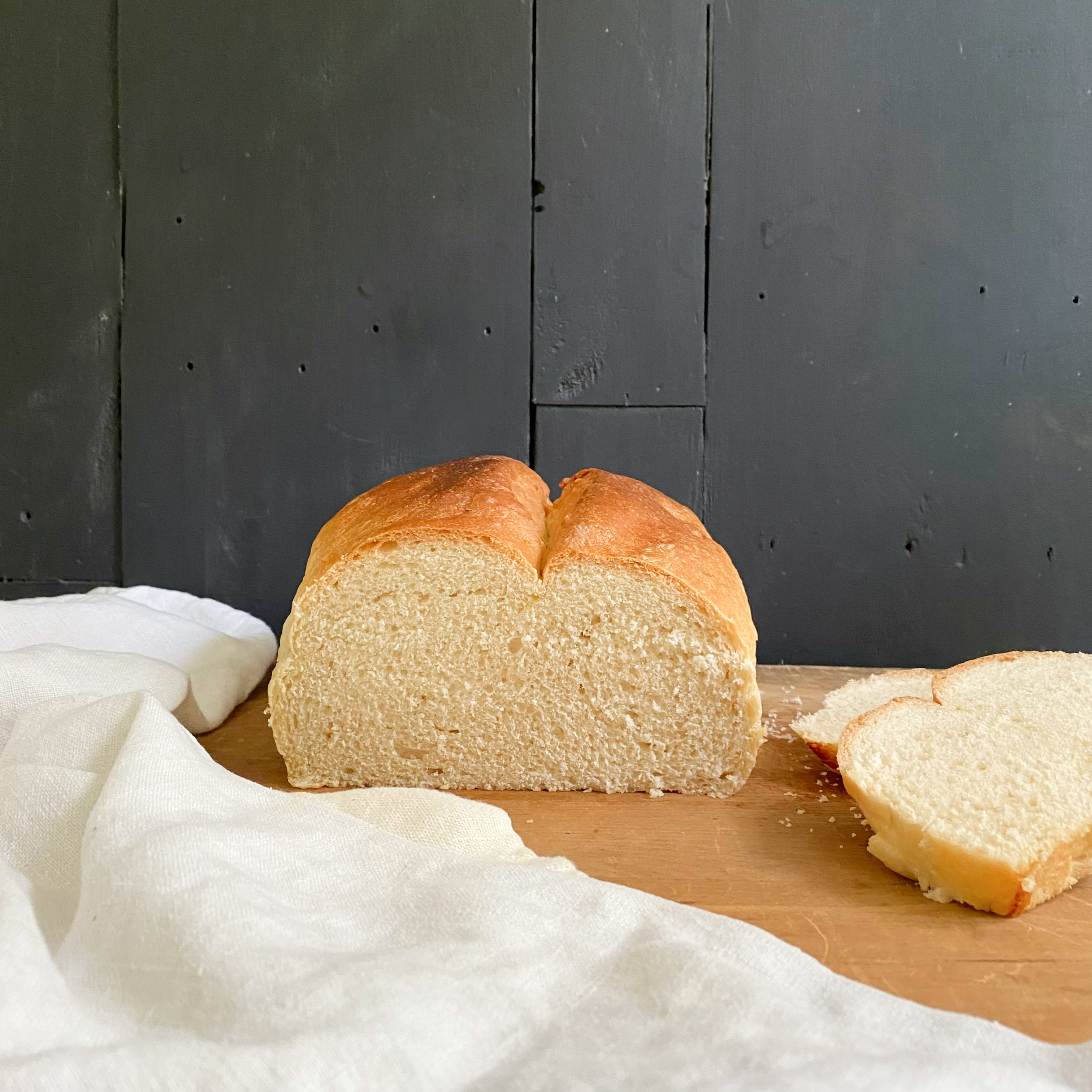

Cheers to Edward for helping us focus our intentions on kindness and gratitude in our cooking, instead of fast-made food and pressure-filled perfection. Cheers to the yeast, flour, butter, sugar, water, and salt. To the antique bread board, the 1930s mixing bowl, and the modern-day oven that made this post possible. And cheers to the beautiful, delicious loaves they produced. I hope you love this best kindest bread recipe just as much.
—
Learn more about Tassajara here.
Find vintage Tassajara cookbooks in the shop here.






 In the Vintage Kitchen: Where History Comes To Eat