Italy’s Chicken Canzanese and The Family of Artists Behind The Recipe

It’s just the start of 2024, but here in the Vintage Kitchen, there is a finish line coming into view. This year we will be wrapping up a five-year project that first started here on the blog in 2020. I’m so happy to say welcome back to The International Vintage Recipe Tour.

international-vintage-recipe-tour

What started out as an intended year-long project of cooking 50 recipes from 45 different countries in 2020 has now taken five years to complete just to the halfway mark. A pandemic, a tornado, a big cross-country move and 1750 House renovations have waylaid plans far more than ever anticipated, but this project has always been such a joy I never wanted to not finish it. So here we are, at the start of 2024 finishing things up from 2020.

For a quick recap and for anyone new to the blog, The International Vintage Recipe Tour takes home cooks and readers on an around-the-world adventure via the kitchen, as we cook our way through a collection of recipes featured in the 1971 New York Times International Cookbook.

the-new-york-times-international-cook-book
The vintage 1971 cookbook that launched the Vintage Recipe Tour.

Throughout the Tour, we are visiting 45 countries via the kitchen and making at least one traditional heritage food from each, sharing both the recipe and the cooking experience here on the blog. To add context to the food we are making, and to spark some new conversations around the table, every visit to a new destination is paired with a unique cultural story from that country’s history.

So far we’ve visited twenty-four countries via the kitchen on this tour… Armenia, Australia, Austria, Barbados, Belgium, Brazil, Canada, Ceylon, China, Colombia, Cuba, Czechoslovakia, Dahomey, Denmark, England, Fiji, France, Germany, Greece, Haiti, Hungary, India, Indonesia, and Israel. It’s been a whirlwind of fun, friendship and delicious food.

Highlights from the Recipe Tour!

We chatted with an author and a food columnist via Armenia, met a descendant of the designer of the Statue of Liberty via Germany, and embraced our inner bula in Fiji. We discussed tropical architecture in Haiti, made floating paper lanterns to celebrate the Hungry Ghost Festival in China and donated funds from shop sales to help save the koalas injured in the Australian wildfires. We discussed women’s fashion in India, interviewed a Cuban-American farmer in Miami, and learned about a long-lost African-American dance in Dahomey. On the food front, we curried in Ceylon, baked Queen Mother’s Cake in Australia, made homemade mustard in Denmark, learned that not all fondue comes in a hot pot in Belgium, and took a much-needed virtual vacation to Corfu via Greece.

A visit to Corfu

Our latest stop on the tour was Israel, which lined up with the 2021 holiday season. To celebrate we made a Hannukah wreath, cooked two recipes for dinner, and dove into the history of both the Jewish flag and the Jewish star. Now, our next stop on the International Vintage Recipe Tour takes us to Italy, one of the most beloved cuisines in the world. Here we’ll make a provincial meal meant for sharing and meet an artist whose family recipes formed the basis of a life-long passion with food. Welcome to Italy.

It’s impossible to write about Italy without writing about family. And you can’t write about this recipe, Chicken Canzanese without writing about a specific family. Like France and China, Italy is one of the largest chapters in the New York Times International Cookbook. There are literally dozens of recipes to choose from, a switch from some countries that had less than a handful.

Besides the long wait to get the Tour started again, the hardest part about starting up again with Italy was which recipe to choose and which cultural treasure to spotlight. Contenders in that department were Stanley Tucci’s gorgeous Searching for Italy show, the multi-generational novel The Florios of Siciliy and the genealogy of the love apple (aka the tomato). There were all the pastas and all the sauces, lovely vegetable side dishes, and quite a few desserts to pick from, but the recipe that I kept coming back to was a one-pot chicken dish that was credited to an artist.

Last fall, while visiting a local bookshop, I discovered a bright yellow 1970s Italian cookbook. To my sheer delight and surprise, it was written by the same artist mentioned in the New York Times International Cookbook. A quick peek inside revealed the same exact recipe that was also featured in the NYTimes cookbook. The same recipe by one artist in two different books. It was a sign. This was the right Italian recipe for the Tour and the right time to tell a story about a creative spirit, who also happened to be an Italian cookbook author.
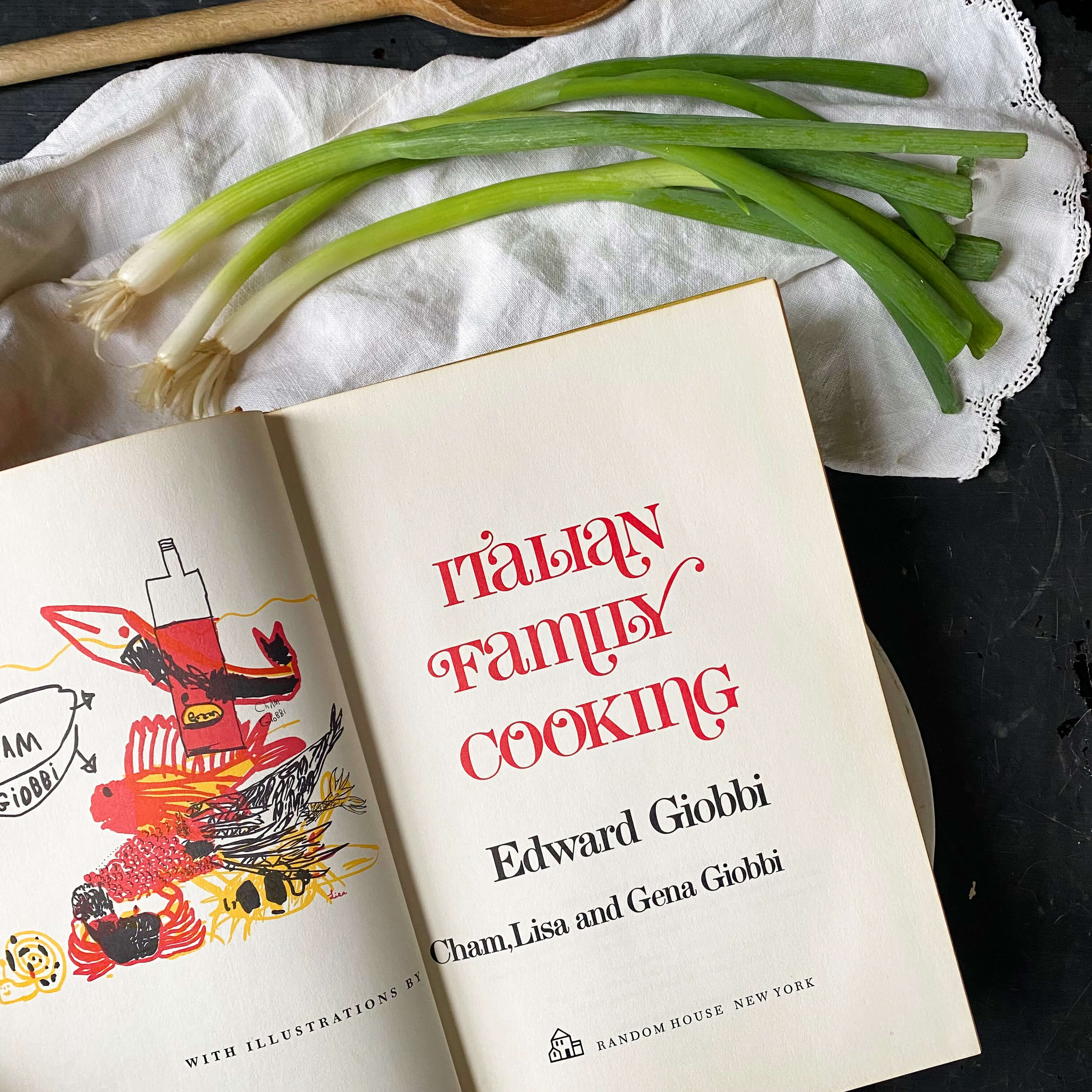
The artist is Edward Giobbi, a second-generation Italian-American born in Connecticut in 1926. Still painting today from his home studio in Katonah, New York, at the age of 98, Edward’s lived his entire life in pursuit of art and food. The book that made him well-known in the culinary world was his Italian Family Cookbook, first published in 1971. Selling over 30,000 copies by the 1980s, it offered home cooks a sincerity that resonated on multiple levels when it came to preparing economical and creative meals in true Italian style. The recipe featured here today, the one that appears not only in Edward’s cookbook but also in the New York Times International Cookbook, is his Chicken Canzanese, a slow-simmered one-pot made of chicken, herbs, wine, spices, and prosciutto.

A lovely selection for these end-of-winter days when the weather is jockeying back and forth between spring-like temps and snowstorms, this recipe is both light and hearty, depending on the sides that accompany it. It’s easy to prepare, has a warm, rich, earthy fragrance thanks to the prosciutto, garlic, and herbs, and can definitely be labeled a healthy comfort food since it contains no added fat.

The cooking prep is also interesting. There is a cold water brine, a unique set of flavor pairings, and a few very precisely measured spices… twelve peppercorns… six whole cloves… two sage leaves. I always find precise measurements like this fascinating. What was the process that a cook went through to determine that perfect balance of six versus seven cloves or nine versus twelve peppercorns? Would three sage leaves as opposed to two send the whole meal over the edge?

Edward Giobbi, tasting and testing in his kitchen circa 1971. Image courtesy of The News Messenger. Aug 12, 1971

As it turns out, Edward’s style of cooking and how he first learned it was based on quality but also frugality. Growing up during the Great Depression taught him and his family the value of growing your own food and utilizing agricultural resources close to home. Nutrition was key to keeping everyone healthy. Nothing was wasted or under-appreciated. Every bit of joy that you could scrape from an experience mattered. As an adult, Edward approached food in much the same way.

In the NYTimes cookbook, the recipe for Chicken Canzanese is simply attributed to Ed Giobbi, the artist. But in Edward’s cookbook, Italian Family Cooking, it’s attributed to Edward’s mother by way of a woman who lived in Canzano, in the Abruzzi region of Italy.

The Abruzzo region of Italy. Photo courtesy of iStock.

Located in the middle of the boot, Italy’s beautiful Abruzzi/Abruzzo region borders the Adriatic Sea and also the Apennines Mountains, both of which provide ample agricultural opportunity. Canzano is 105 miles east of Rome, and 230 miles southeast of Florence, and although geographically considered central Italy, the culture and food traditions of this area mirror that of Southern Italy.

Abruzzo, Italy. Photo: Sterlinglanier Lanier.

Full of food specialties ranging from provincial fish soups to local lamb dishes to plates of handmade pasta the traditional foods of Abruzzo favor both its maritime and mountain environs. Incidentally, this area of Italy is also known for a food often consumed at weddings here in the US. It’s the birthplace of the pastel-colored, candy-coated Jordan Almond, also called Italian Confetti locally.

All the pretty pastel shades of a Jordan Almond.

Edward’s parents immigrated to the US in the early 1900s first to Pennsylvania and then to Connecticut where they labored in factories and mills. Even though they both just had a third-grade level education, his parents had an appreciation for food, art and music which made a strong impression on Edward during his childhood. The Giobbi family kitchen would come alive at night and on weekends with the scents and flavors of his parent’s home country.

Life with Flowers. Edward Giobbi. 1958

Once he left home to pursue his art, his mom’s heirloom recipes became a vital part of the creative process as he perfected each one in his own kitchen, practicing them over and over again, until they met her standards and his memories. That dedication to good food and good eating, combined with artistic sojourns to stay with extended family in Italy sealed his love of cooking indelibly.

By the time Edward married and had his own family, preparing daily meals was a pleasure equal to painting. In his children, he instilled a similar joy. Art and cooking became a throughline that ran strong in the new generation of the Giobbi family members.

Apart from the myriad of wonderful traditional Italian recipes in Edward’s cookbook, the illustrations stand out with vibrant appeal and eye-catching charm. The art was executed not by a hired freelancer or a publishing industry dynamo. It wasn’t executed by a professional food photographer or a graphic design studio. Instead, the illustrations for his cookbook were illustrated by a collection of painters entirely new to the world – his children, Cham, Lisa and Gena who at the time ranged in age from six to nine.

Edward gave his kids no direction when he asked them to paint pictures for the cookbook other than to say “draw a fish, or a soup pot or a bottle of wine.” Each of his artists offered their own interpretation.
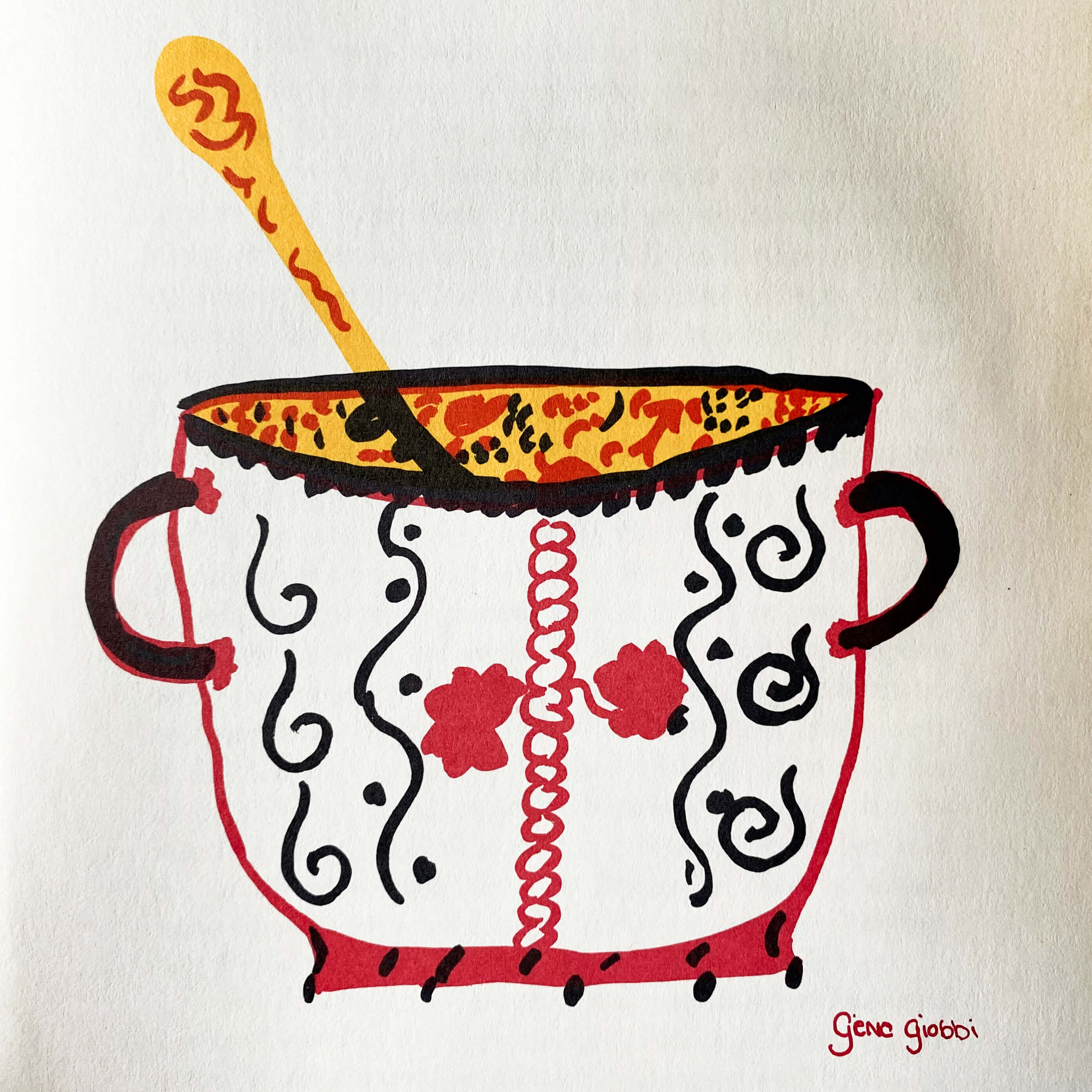
Whimsical and sweet, Edward Giobbi’s Italian Family Cookbook was indeed, in all ways, a family affair from kids to parents to extended relatives. It didn’t stop at this cookbook either. Edward went on to write another successful cookbook, Eat Right, Eat Well: The Italian Way (1985) and his band of illustrators grew up to pursue their own careers in art, dance, music and food science.

In keeping with the Giobbi clan’s combined love of the kitchen, nothing seems more fitting than presenting this recipe on a Sunday night when family dinner rules the kitchen in most Italian households. Named for the town in which it hails, Chicken Canzanese is a meal intended for communal family dining. Simple to make, it’s a two-step process that involves a one-hour wet brine and forty minutes of cooking time. True to Edward’s nature and his mother’s style of cooking, it’s made of simple ingredients and offers a bevy of creativity in the side dishes in which you choose to serve with it. More on those thoughts follow the recipe.

Edward Giobbi’s Chicken Canzanese

Serves 4

One 3 lb chicken, cut in pieces

2 sage leaves

2 bay leaves

1 clove garlic, sliced lengthwise

6 whole cloves

2 sprigs fresh rosemary or 1/2 teaspoon dried

12 peppercorns, crushed

1 hot red pepper, broken and seeded (optional) or 1 teaspoon dried red pepper flakes

1/4 lb prosciutto, sliced 1/2 inch thin or one 4oz package of pre-sliced prosciutto*

1/2 cup dry white wine

1/4 cup water

Salt for brine (see note)

Place the chicken pieces in a mixing bowl and add cold water to cover and salt to taste. *Note: I used a large mixing bowl and 1/8 cup of sea salt to 6 cups of water. Cover with plastic wrap and store in the fridge for 1 hour.

Drain the water and rinse the chicken pieces completely before patting dry with paper towels.

Arrange the chicken pieces in one layer in a skillet. Add the sage, bay leaves, garlic, whole cloves, rosemary, peppercorns and red pepper. Cut the prosciutto into small cubes and sprinkle it over the chicken. *Note: If using pre-sliced prosciutto, remove all the paper or plastic sheets between each slice. Stack the prosciutto one on top of the other, and cube the whole stack at once.

Add the wine and water. Do not add any additional salt, since the prosciutto will season the dish. Cover and simmer 40 minutes. Once the chicken has cooked to an internal temperature of at least 165 degrees. Uncover and cook briefly until the sauce is reduced slightly. Serve hot.

Rustic and earthy, Chicken Canzanese is tender and full of subtle flavors. The broth itself is fairly salty on its own thanks to the simmered prosciutto, but soak it up with a piece of crusty bread, and the briny flavor mellows. There were no serving suggestions mentioned in Edward’s recipe nor the NYTimes, but the broth would be lovely tossed in a warm bowl of pasta, spinach, peas, potatoes or mushrooms. If you are feeling decadent you could add a dash of cream to the broth to balance all the flavors. As Edward says in the introduction…”Cook the food in this book with a free hand, using your own creativity with the freshest ingredients you can get.”

Collected by museums and galleries around the world, throughout Edward’s long art career his style has varied…

Summer Shower, Pescara, Italy. Edward Giobbi. 1951

Dried Flowers #14. Edward Giobbi. 1999

Hanover, Triptych. Edward Giobbi. Exact date unknown – possibly 1970s.

He dislikes labels or being lumped into a certain type of painting, but he one thing Edward consistently strives for in his art instead is honesty. The same could be said for his cooking. All of his recipes are celebrations of local eating. They reflect riding the highs and lows of economy, of balancing cooking constraints with bounty, and the importance of identifying local resources. His recipes are interesting, creative, nourishing. They are of the earth and of the moment. I think that’s what makes Italian food so appealing. It’s a cuisine rooted in a waste-not culture that appreciates what’s right there in front – all the bounty that the earth can offer.

Fall Still Life- Edward Giobbi. Photo courtesy of Chroma Fine Art Gallery. Find out more about this painting here.

My favorite piece in Edward’s catalog of work is this one. I think it’s the most food and family-like of all his art. In my interpretation of it, I can see his whole entire world. His whole lineage in mixed media. There are blue fish in the sea at the bottom right. A mountainous landscape in the middle. There’s red for blood, life, wine and energy. I see flowers, woodland foraging, and garden soil. In my mind, that blob of brown represents all the possibilities that might grow from a simple swatch of ground. And the tree. The beautiful, exuberant tree surrounded by dots of confetti-like splatters and stars. That’s the Giobbi tree. The one that represents the vitality of nature, the sparkle of life, of wife, of children all rolled up in one. I could be reading too much into it. Maybe it’s just what the title says - Fall Still Life. Maybe it’s an autumn landscape in Canzano, Italy. Or a pairing of items Edward arranged in his home studio in Katonah, New York. Maybe it represents a lot more or even possibly a lot less. Or maybe… just maybe… it’s the word, the work, that Edward’s been striving for all along.. honesty.

Cheers to Edward for sharing his family’s Italian heritage with us here in America via books, art and storytelling. Cheers to his kids, Cham, Lisa and Gena for their fantastic illustrations. And finally, cheers to the unnamed woman in Canzano, who passed this recipe along. I wish we knew your name so we could credit you properly for the delicious dish.

If you’d like to catch up with the recipe tour from the very beginning days in 2020, start here or click on any of the country links mentioned above to visit those specific posts.

Next up on the International Vintage Recipe Tour, it’s a trip to Jamaica via the kitchen. Hope you’ll join us!

The Handmade Tablecloth: A 1916 Immigration Story

Every family has some tales when it comes to history and the lineage that connects us to ancestors who lived a long time ago. If we are lucky, they are long-winded stories full of color and detail and a relatable sentimentality that can carry our imaginations far across cities and centuries connecting us to relatives we never met.

Other times, there are family histories that are just one-liners. Snippets of stories punctuated with the sparest amount of context and detail. Enough to give you some ideas about who this or that ancestor might have been, or where they came from, or how they experienced life, but beyond that no other information is known. I’m always most intrigued by these slim snippets of genealogical detail. The ones that aren’t flushed out yet enough to form a complete story with a defined beginning, middle, and end. The ones that could have been recited so many times they are now legend tumbled and tossed through generations yet never gaining new insight or understanding. We have quite a few in my family – a great aunt who was a Rockette, a lost family fortune buried somewhere on the island of 18th century Manhattan, a doughnut shop in the Pacific Northwest still waiting to be found. Those quick glimpses into all types of family biography are ripe for more storytelling and a deeper understanding of the experiences that makes up the unique histories of American lives.

In today’s post, we are sharing a 100 year-old-family story brought to the Vintage Kitchen in the form of an heirloom. It did not come with one of the long-winded stories like we mentioned above, the ones full of color and life and detail. Instead, it falls into the latter category. The opposite one. This heirloom came with just a few facts. Vague yet weighty snippets of a story that lightly scratched the surface of a much larger experience.

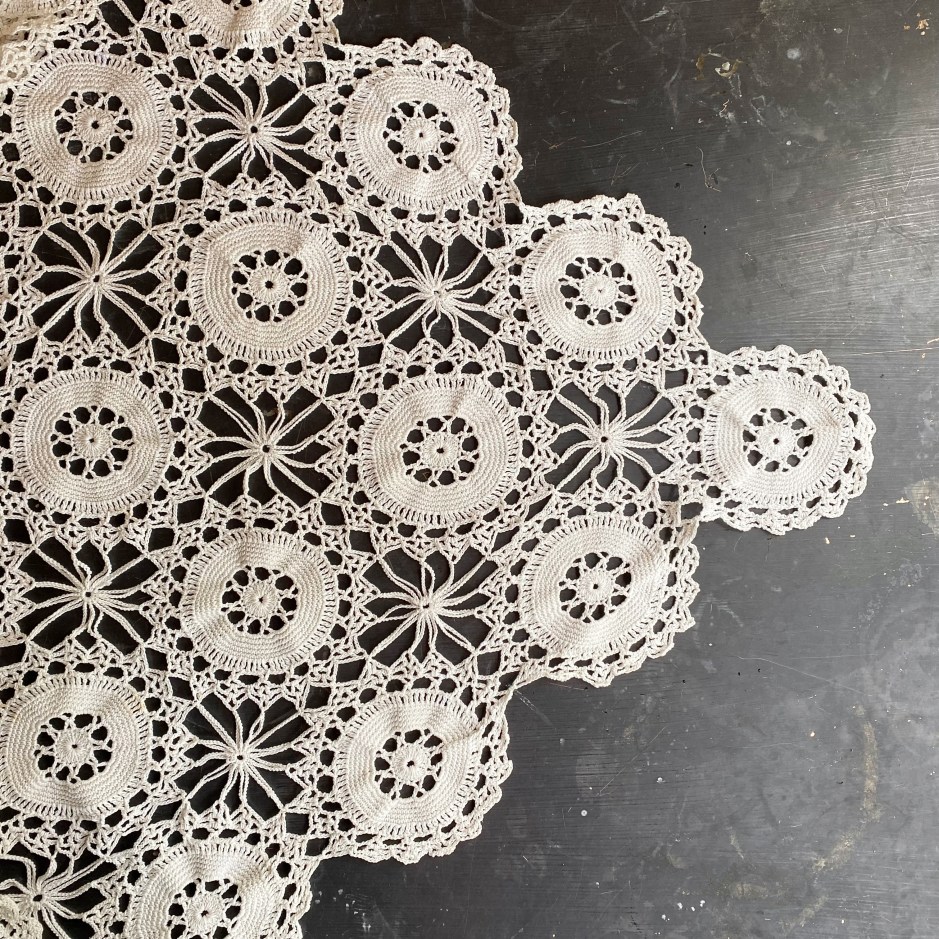
It starts with an antique tablecloth. Folded up it weighs just over a pound and a half. It’s delicate but also strong, with a heft to its weight like rope. Featuring a hand-crocheted pattern of circular medallions and spider-like stars, it’s executed in thread that is the color of bones. In appearance, it’s not unlike a lot of similar tablecloths that were popular during the 20th century, but this one tells a very specific American story that is very fitting for the 4th of July holiday.

Sent by a woman named Linda, who is a vintage collector in New Mexico, this tablecloth was a family heirloom belonging to Ann, her ex-mother-in-law. When passing down items from her life, Ann requested that this particular linen be handled with respect and appreciation. Although Linda admired the beauty of this tablecloth and the story it represented, she contacted the Vintage Kitchen to see if we might be able to give it a new home.

Arriving in the mail shortly after, the cloth came with a note detailing a few facts surrounding its history.

  • It belonged to Linda’s ex-husband’s mother, Ann who had recently passed at the age of 87
  • It was passed down through Ann’s family with the understanding that it came to America by way of an Italian ancestor named Catherine who had traveled by boat from Sicily to Ellis Island in the early 1900s and then went on to Chicago to settle.
  • According to family lore, the tablecloth was handmade while on the boat waiting to dock in the US

Even though I had a dozen more questions for Linda upon receipt of the cloth, and had requested a photo of it’s maker, unfortunately, Linda and I lost touch shortly after the package arrived. So here it was, this pretty antique tablecloth wrapped up in a handful of intriguing little story snippets just waiting for something more to be told about it.

After a bit of genealogy work and a hunt through Ellis Island immigration records, Linda’s ex-grandmother-in-law’s story burst into colorful life just like a 4th of July firework. It begins here on Ellis Island in March 1916…

Ferry boats carrying immigrants from transatlantic steamer ships that initially docked in lower Manhattan arrive here at Ellis Island’s Immigration Station where their paperwork was completed. Photo courtesy of the New York Public Library.

Even though it was the very first day of Spring, it was a chilly 34-degree March day when the Caserta arrived in New York Harbor. Carrying immigrants from Naples, Italy, the steamer ship coasted into the harbor on choppy waters passing the welcoming sight of the Statue of Liberty. Her torch was not yet electrified, it would be another nine months before that happened, but to the arriving immigrants, she signaled a bright future ahead regardless. Aboard the ship was 20-year-old rosy-cheeked, chestnut-haired Caterina from the seaside town of Bagheria, Sicily.

Caterina’s ship manifest.

Most Italian immigrants during the 1910s were fleeing to America to escape economic depravity in their home country. Depending on weather, war, quarantine, detainments, and ship reroutings, the voyage from Naples to New York could last anywhere from twenty-one days to three months. When Caterina came over it was the middle of WWI, and Italy was involved in the battle of Austria-Hungary. Traveling with her older sister Maddalena, we don’t know specifically why these two girls left Italy, but we do know that Caterina paid her own passage and carried $25.00 extra in her pocket along with a crochet needle and a bundle of thread.

Of medium height and good health, Caterina would have no trouble passing through the medical checkpoint before she was allowed access to her new country. Her $25 dollars in savings would not be an issue either as she brought an amount deemed substantial enough by the US government to successfully start afresh in the New World. With intentions to stay with her cousin, Filippo, in the Midwest, Caterina’s final destination was the bustling city of Chicago.

A 1916 map of Chicago IL courtesy of the Library of Congress

According to Linda’s family story, while waiting to dock in New York Harbor, Caterina took her crochet needle from her pocket and put her hands to work. She soothed her anxious nerves by crocheting this 82″ x 52″ inch delicately threaded tablecloth featuring a series of interlocking circles and stars.

I loved this part of Linda’s story for two reasons… 1) I didn’t realize that immigrants had to wait for any extended period of time to gain entry into the US. I assumed that most were docked and processed in the same day. So it was interesting to think that Caterina’s boat could have been detained for a significant amount of time – one in which an entire tablecloth could have been made by hand. 2) The other reason I loved Linda’s story was for the amount of comfort that this tablecloth must have brought. The calming effect of repetitive motion and the focus and attention to detail required to make a circle then a star, a circle then a star intertwining each until there was a cloth over 4′ feet long and 3″ feet wide.

I loved this artistic glimpse into one woman’s life and that I could hold in my hands a tangible item that combined thread with all the emotions of a new adventure – excitement, uncertainty, nervousness, fear, and awe experienced over 100 years ago. I wondered about Caterina, there on the boat, stuffed full with people from her home country all experiencing a cacophony of feelings while she sat calmly making this piece. Was she dreaming of the future table in which she would display her needlework? Did she think about it becoming not only a practical household item for her new home but also a tangible reminder of the journey that she chose to take? Did she know then, that it would eventually become an artifact proving that she, Caterina of Bagheria, Sicily and now of the United States had lived?

The closing of other U.S. ports, the rerouting of ships during WWI, and the threat of communicable diseases could have been some of several reasons why Caterina got hung up in New York Harbor long enough to hand-stitch a linen for her new life. After much research, I couldn’t find anything that would attribute to the delay around that date, but I did learn that four days later, the ship she arrived on, the Caserta, was on its way back to Italy loaded with war-time ammunition for the Italian government.

That led me to wonder if the details of Linda’s family story had gotten a little muddled over the past 100 years. Maybe, Caterina made the tablecloth on the voyage over and finished the last pieces of it while she was waiting to dock. Or maybe in fact, she was on a quarantined boat, arriving in New York days or weeks before the immigration officer officially stamped her papers with the date March 20, 1916. Or maybe she just happened to be a master, faster crocheter that indeed had plenty of ample hours in an ample amount of days to complete such a creative undertaking.

I can imagine that this waiting period at Ellis Island whether brief or lengthy, spent while you are between your old life and your new life, would be a pretty intense time. There is something incredibly marvelous and moving about Caterina documenting her stay in these New York waters under the reassuring gaze of Lady Liberty with her crochet needle and some Italian thread. A simple household item made during a magnificent moment with skill enough to make it last a lifetime. And then some.

Linda’s initial recount of the situation began and ended at Ellis Island, but a bit more research uncovered Caterina’s complete life story. She did make it to Chicago. There she became known as Catherine, the Anglicized version of Caterina, and a little over a year later she met and married Alberto, a fellow Sicilian who had immigrated to America just a few years before her.

Alberto was in the grocery business, successful enough to own three delis in the Chicago area during the early to mid-1900s. Catherine and Alberto had two boys – Anthony and Joseph. Joseph served in the US Air Force during WWII and Anthony in the US Navy. The deli trade was never far from Anthony’s heart and upon return from the war, Anthony followed in his dad’s footsteps and worked in the grocery industry for the rest of his life – first in Chicago and then in California where he opened a deli shop specializing strictly in Italian fare. After Anthony married Ann, a former customer of his dad’s shop back in Chicago, they also had two children – Albert and Diane. Albert a young groom in the 1960s, married Linda, the vintage collector who sent us the tablecloth.

Clockwise from top left: Linda, Albert, Anthony, and Ann. Photo courtesy of Pleasant Family Shopping blog

As for Caterina, she passed away in Los Angeles in 1987, at the age of 92. Living a majority of her life in the US made her geographically much more American than Italian, but she never ventured far from her Italian roots nor the chance to pass on her cultural pride to her boys who then passed it on to their families. A part of all that was this tablecloth. The heirloom made en route from old Italy to new America. The cloth that wove together two parts of one woman’s life. A woman who chose to settle in the United States, to become a citizen, to raise a family of boys who then fought for the US during WWII and then saw her children’s children grow the branches of their family trees in America all the while contributing to the vibrancy of our country’s dynamic landscape. Caterina’s story is a small leaf on the big tree of immigration, but I felt so honored to be able to tell her story and attach it to the tablecloth, her tablecloth, that still lives bright and beautiful in the world today.

I couldn’t ever find a photo of Caterina, so I wrapped her tablecloth around a mannequin and photographed the two together. It’s the closest I could get to visually communicating that the cloth was made by an actual person. Hopefully one day, I’ll come across a photograph of Caterina so that we can know her face. Until then, this portrait will have to do.

Cheers to celebrating all the immigration stories that make our country culturally vibrant this Independence Day. To slim snippets, that form big stories. And most importantly, cheers to Linda and to Ann and to Caterina for sharing their family’s American experience. Important stories lie in everyday objects.

However you choose to commemorate the 4th of July, we hope it’s a memorable one!

Special note: While researching this post, I came across two pieces of media that were especially insightful when it came to understanding the very human and very humbling experience of immigrating to America.

An oral history interview with Italian immigrant Filomena Latta…

https://heritage.statueofliberty.org/oral-history-library

A tour of the Ellis Island Immigration Museum with National Park Ranger Peter Urban…

Annie’s Wine Baked Brisket & How a St. Patrick’s Day Staple Came to America

Cows are sacred, salt is expensive, cross the sea trading is prohibited and immigrants had to get to New York. In a nutshell, those are the four substantial situations that had to occur in order to bring brisket to your dining tables today. Happy St. Patrick’s Day dear readers!   Today’s post is all about a traditional Irish food that actually is, in reality, a multi-cultural collaboration between three countries.  While it is certain that many a crock-pot will be simmering away today in honor of the holiday, and the famous corned beef and cabbage that has become associated with it, you might be surprised to learn that the propulsion for this traditional heritage food actually has more to do with New York City than Ireland.

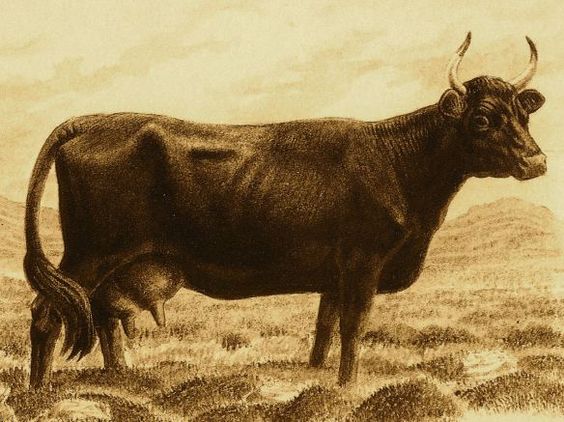
The Kerry cow is considered to be the oldest breed of cattle in Ireland.

It all started back in Ireland’s ancient times when cows were considered sacred animals. Valued for their milk and their strength over anything else, Irish cows were essential components to a working farm and were never considered a viable meat source. But England adored beef, particularly roasts, so much so that by the 1600s, England couldn’t keep up with their own country’s supply and demand.  So they went to Ireland to see about some cows.

A good revenue stream for the Emerald Isle and a can’t-live-without-it commodity for England, this cow commerce between countries was mutually beneficial for all.  That is until the Cattle Acts of the 1660s. In an instant, thanks to the Act, the sale of live cows to England was no longer allowed.  The sudden halt in commerce left Ireland scrambling for a solution and left England grumbly with hungry bellies.  This all came about at a time when salt was also an extremely expensive ingredient in England. Ireland, on the other hand, was not only flush with cattle but also abundant with coastal salt pans. The combination of these two riches formed a clever way for Ireland to package meat for export that skirted around the law. They created a new method of food preservation called corned beef – a salted meat product that could withstand time and travel to England without spoiling.

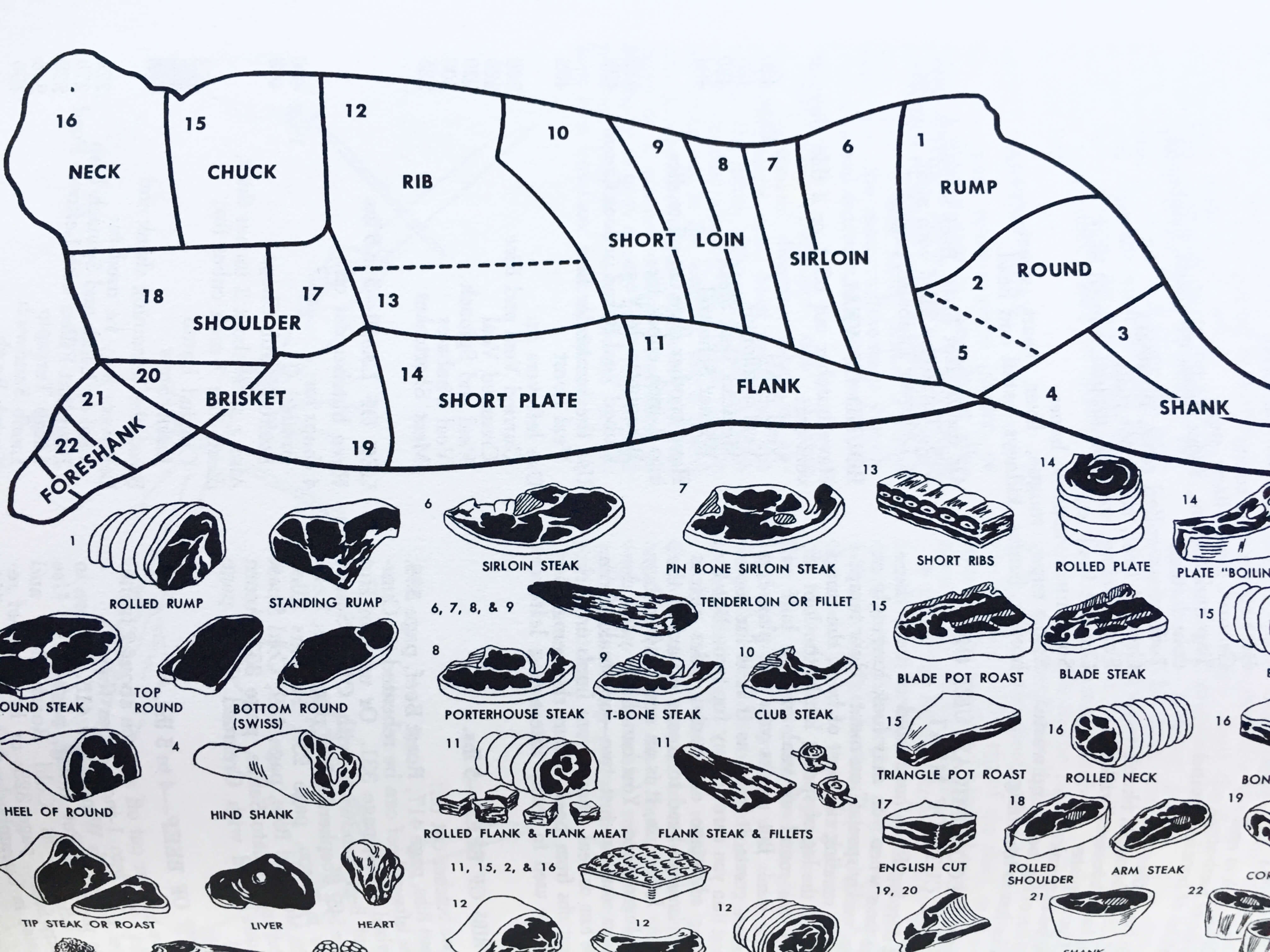
Coming from the brisket cut of the cow (located between the front knees and the shoulder area) this salt-infused food was named corned beef because of the corn kernel-sized salt crystals used in preserving it.  Generally known as a tougher piece of meat since that area of a cow’s body gets quite a lot of exercise, early corned beef was essentially just a slab of meat that was rumored to taste more like salt than beef.

Commercial Cuts of Beef chart from the Joy of Cooking by Irma S. Rombauer, 1967 edition

Because it was shelf stable, easy to prepare, and came in bigger portions, corned beef became a popular staple in the diets of 18th-century Englanders as well as sailors away at sea for long stretches of time. It even made its way into the diets of Early American colonists who were struggling to produce food for their new country. The only people who were not enjoying this salty slice of protein were the Irish, who, in a terrible twist of irony, couldn’t afford to buy the very product they were exporting.

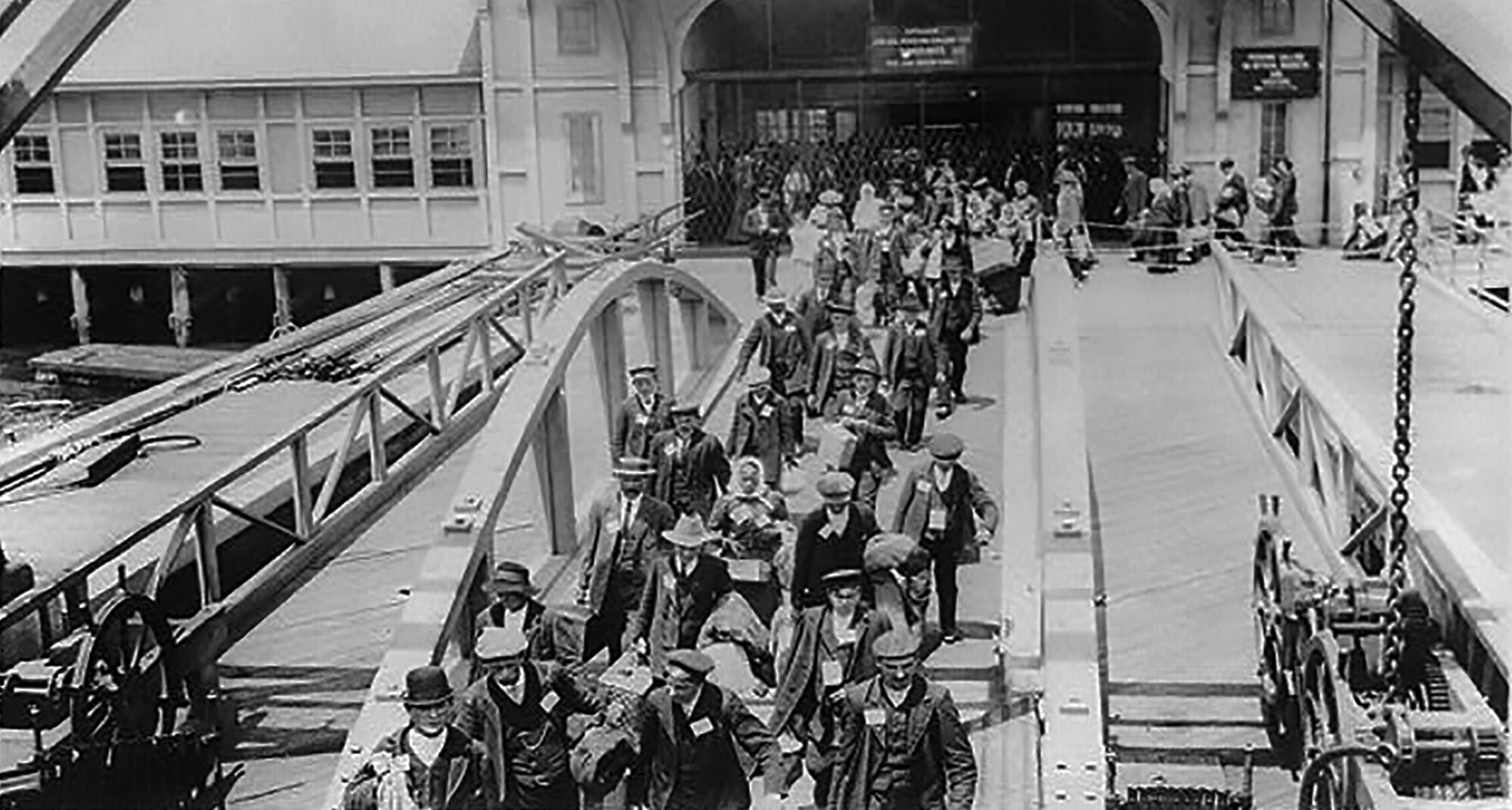
Newly arrived immigrants at Ellis Island. Photo courtesy of the Library of Congress.

It would take one more century and a move to America before Irish immigrants were able to afford and enjoy the corned beef that made their home country famous. In the mid-late 1800s, a majority of the butcher shops within the New York metropolitan area were owned and operated by Jewish immigrants.

The Lustgarten family owned a Jewish butcher shop in NYC in the late 1880s. Photo courtesy of tenement.org

Living in close-knit communities, both Irish and Jewish transplants bonded over feelings of displacement and discrimination experienced in their new world. Financial resources were a challenge for most city dwellers, but especially for these two ethnic groups in particular, as they faced prejudices in work and social environments. Luckily, food brought them together via thrift and necessity, and novelty.

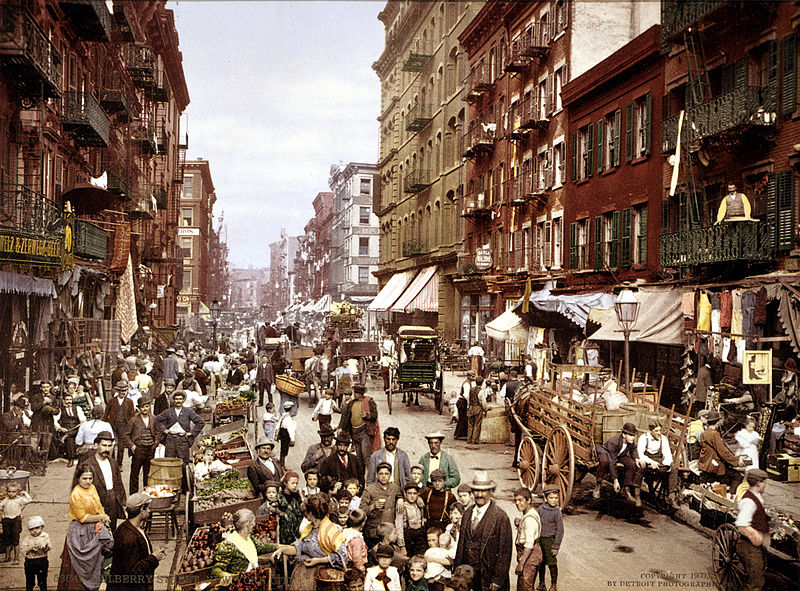
Market shopping along NYC’s Mulberry Street in 1900

Upon arriving in America, Irish immigrants were delighted to discover that corned beef was much less expensive in New York then it was back home in Ireland. Likewise,  Jewish immigrants liked brisket because it was one of the least expensive cuts in the butcher shop and could feed a crowd.  Through experimentation in their New York City kitchens,  Jewish and Irish newcomers developed the low, slow cooking methods that eventually evolved brisket from a salty slab of preserved meat into a rich and flavorful meal.  Cabbage was often paired with it since it was the least expensive vegetable. Both cultures developed their own trademark dishes – slow simmered corned beef and cabbage for the Irish and smoked pastrami and sauerkraut for the Jewish community. Each specialty stemmed from the humble brisket cut.

Beef Chart from the Culinary Arts Encyclopedic Cookbook circa 1948

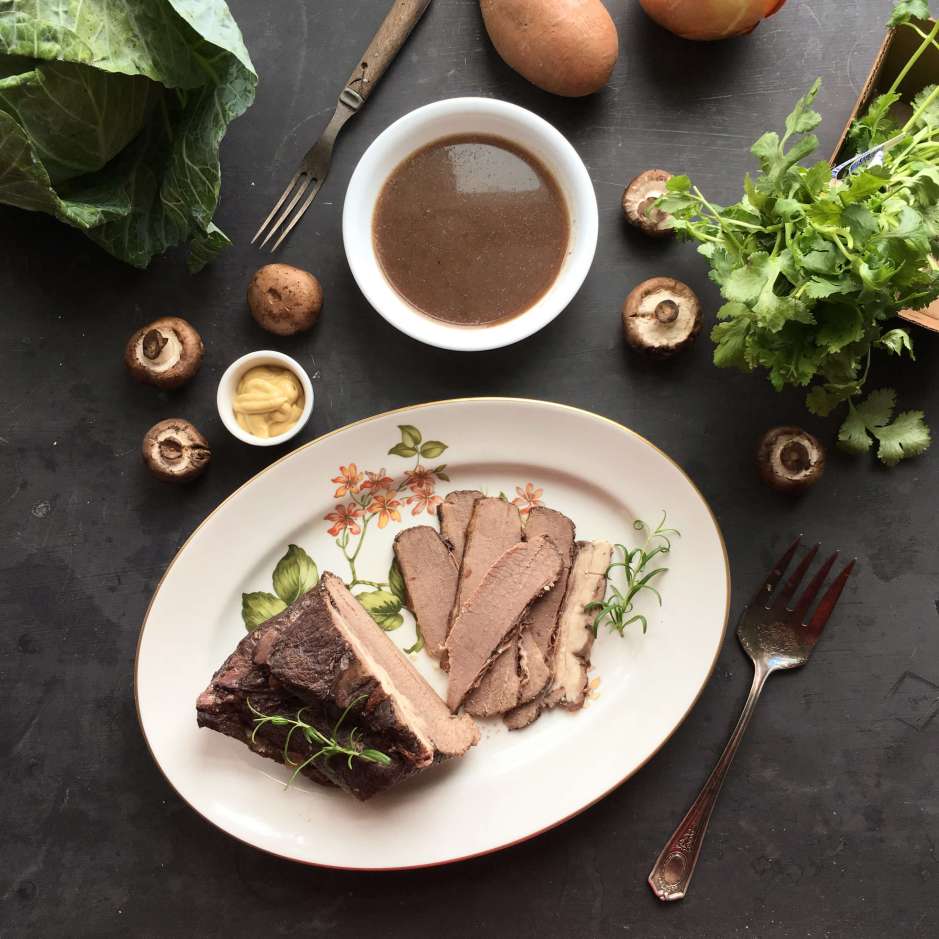
Today’s recipe focuses on the Jewish side of cooking, with a brisket that quickly browns in butter on the stovetop before heading into the oven for a slow simmer in red wine. If you are not a fan of the saltiness of traditional corned beef or are wary of the seasoning packet that comes in most store-bought brisket kits, this recipe is a great alternative, since you can control your own level of spices. It comes from Annie, an avid cook, and a world traveler who lived in New York for most of her life. A dear friend to my father, she’s proud of her Jewish heritage and is famous for many signature dishes including homemade horseradish (more on that in a future post).

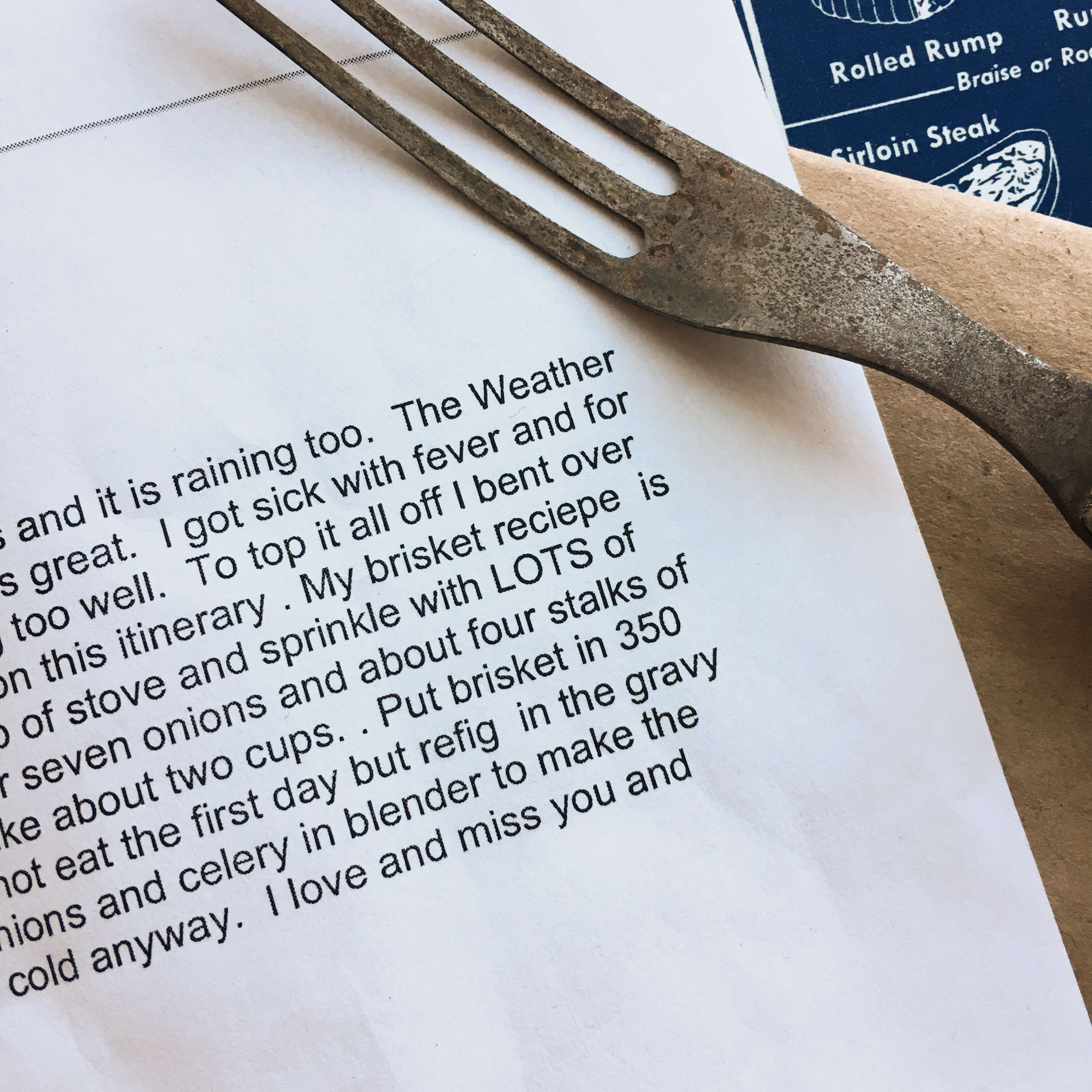
Annie sent this recipe to my dad over email 15 years ago while she was at sea traveling between Buenos Aires and Santiago.  The trip was rough with wild waves and cold temperatures but Annie was more than happy to take a few moments to share her way of making brisket. In our modern age, email letters aren’t quite as pretty as handwritten ones – but the sentiment is there nonetheless. My dad has hung onto her correspondence for over a decade and a half. I discovered it recently, tucked inside one of his favorite cookbooks.

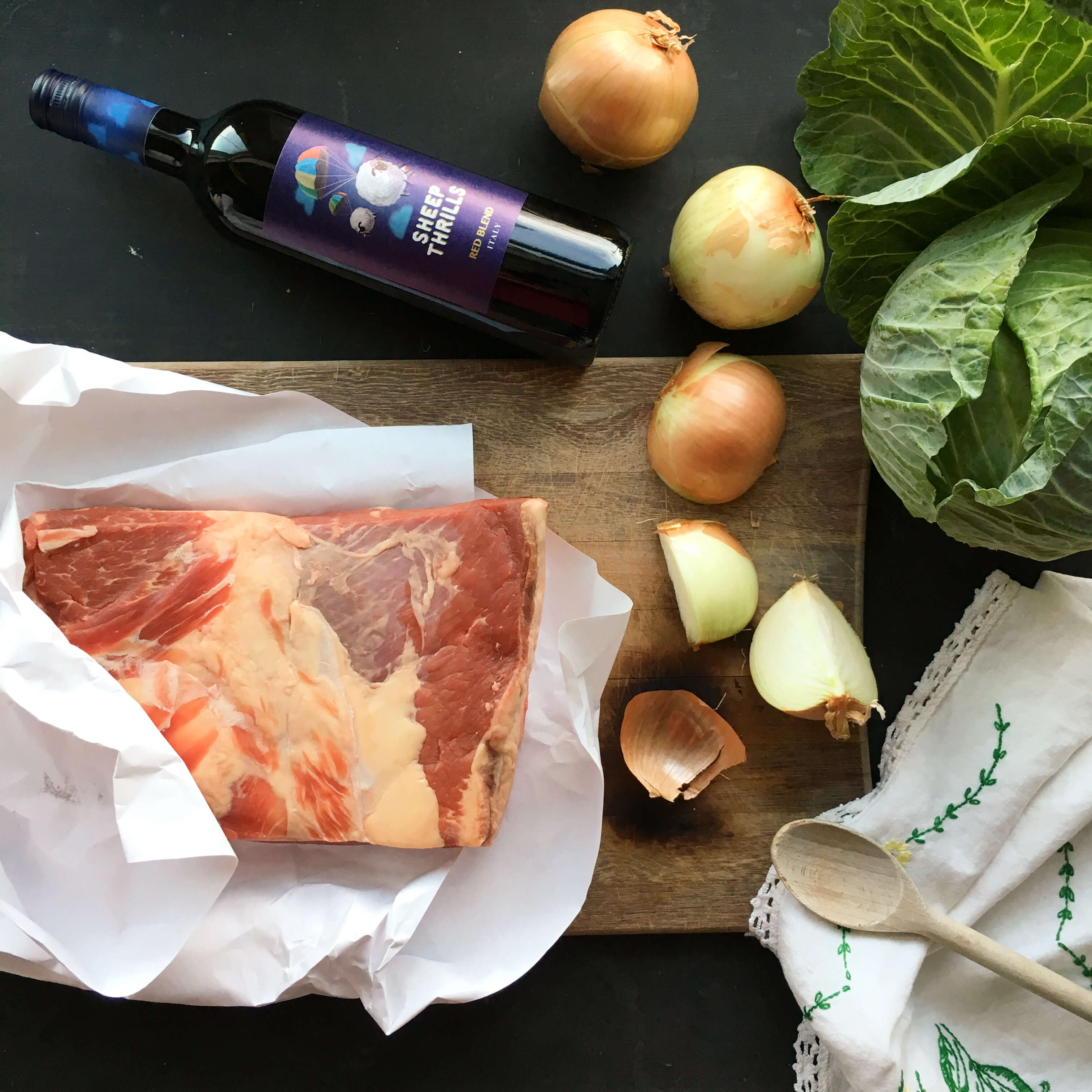
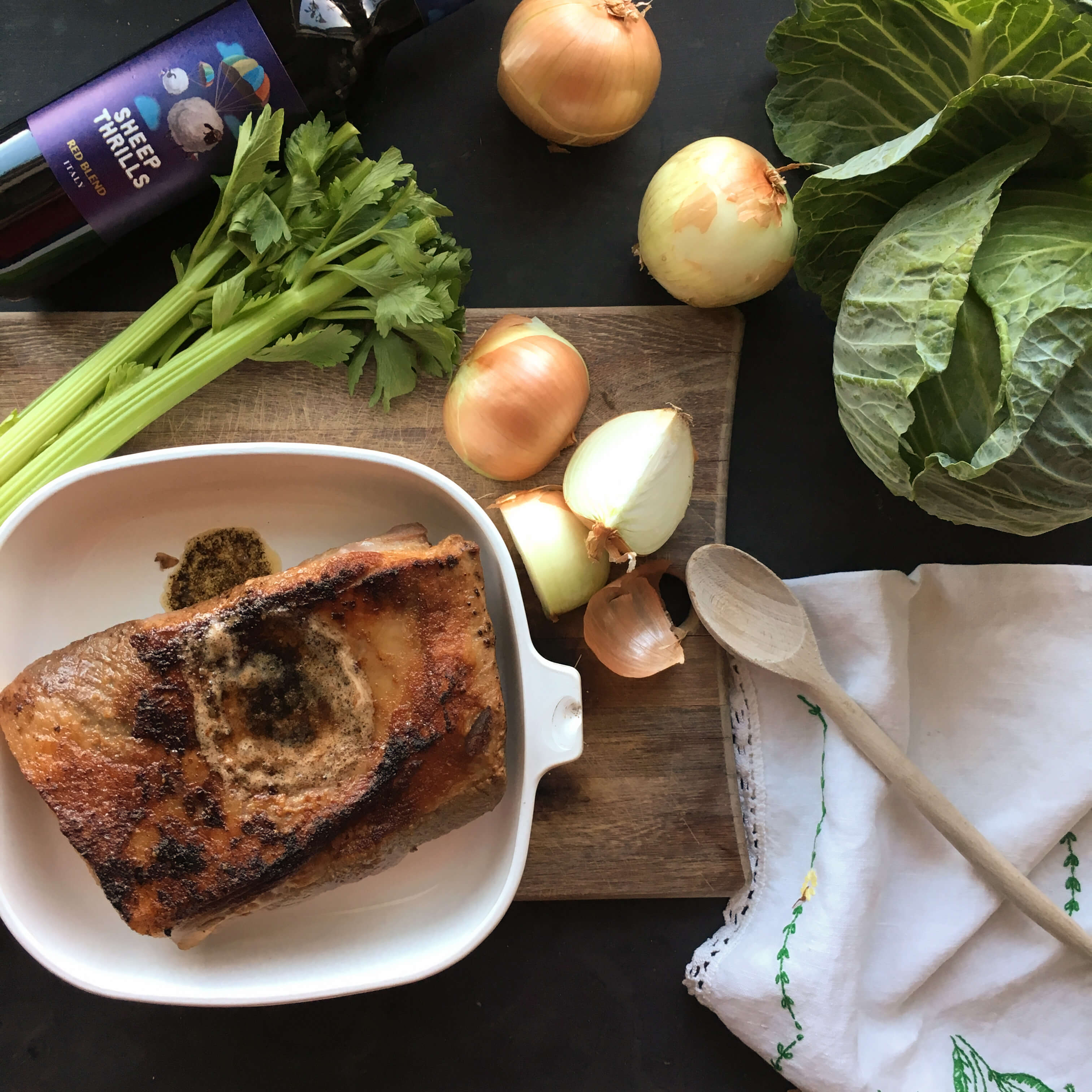
Although it requires two days to make, it is very simple and involves just a few ingredients. I used grass-fed beef from the farmers market and a red wine blend called Sheep Thrills for the fun pun. Also, Annie cooks like James Beard recommends – with your intuition – so she doesn’t specify in her recipe exactly how much seasoning to use. In the directions, I share my method, but you may want to add more or less depending on your preference.

Annie’s Wine Baked Brisket

4-5lb beef brisket ( I used a 3.5 lb grass-fed beef brisket)

4 tablespoons butter (only necessary if using grass-fed beef)

6-7 onions

4 stalks celery

2 bay leaves

2 cups red wine

Onion Powder

Garlic Powder

Celery Salt

Preheat the oven to 350 degrees.

Remove the brisket from the packaging and let rest on the counter for 45 minutes to 1 hour. If you are using frozen grass-fed beef make sure that it has completely thawed in the fridge before beginning this recipe. Do not trim the fat from the brisket.

Seasonings with dots of butter on top before the flip to brown the other side.

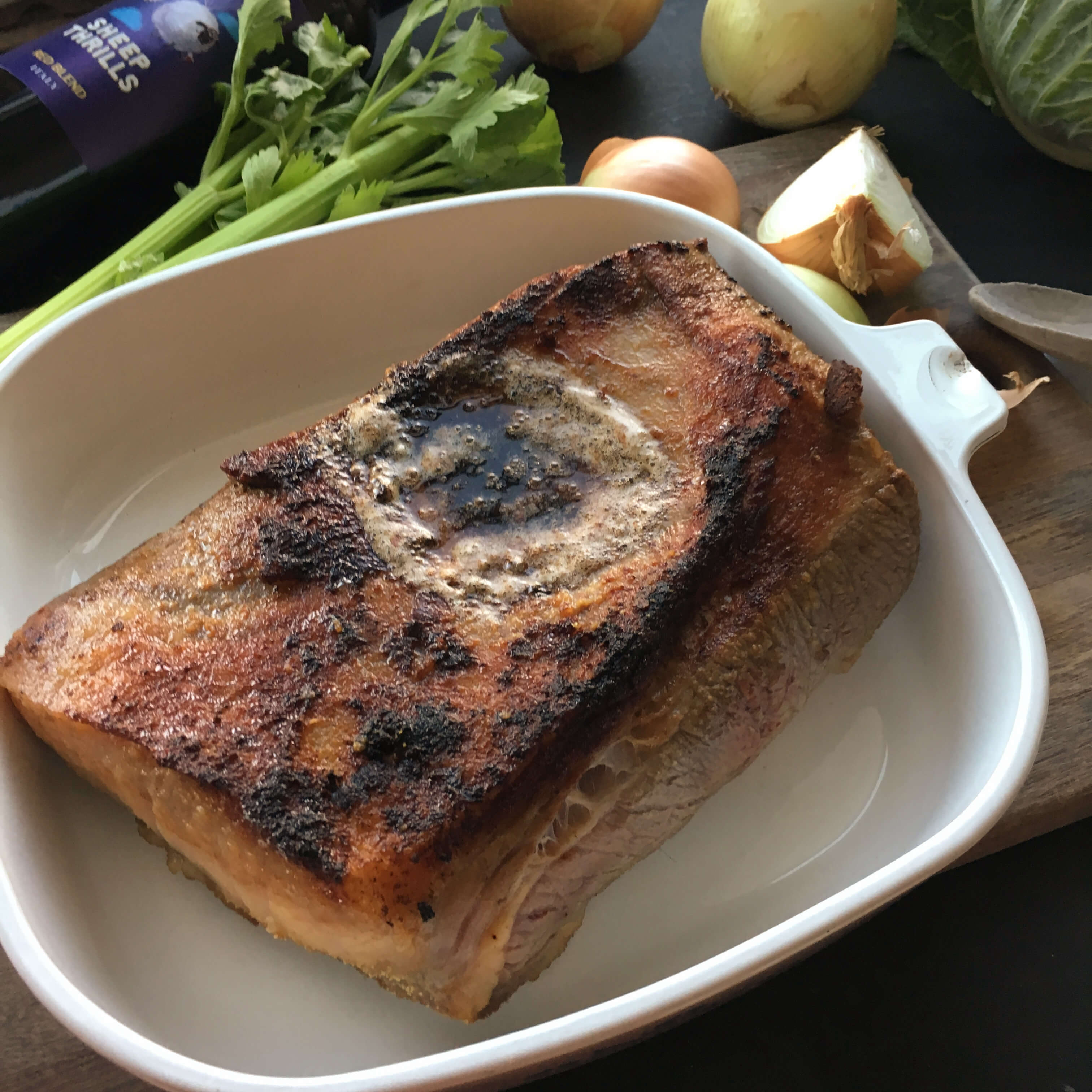
In an ovenproof pan (preferably one that has a lid) over medium high heat, add the butter (but only if using grass-fed beef, otherwise omit the butter). Generously sprinkle each side of the meat with the onion and garlic powders and the celery salt (I did about five passes on each side with each of these seasonings). Brown the brisket, fat-side down, for 5 minutes on each side.

Roughly chop the onions and the celery and add them to the brisket pan.

Pour in the red wine and add the bay leaves. Cover and bake in the oven for 2 to 3 hours or until the brisket reaches an internal temperature of 170 degrees. (Note: Grass-fed beef cooks faster than grain-fed beef, so watch the temperature and time closely.  My 3.5 lb brisket came out exactly at the 2-hour mark.)

Let the brisket cool to room temperature and then refrigerate overnight it in the same pan that you cooked it in so that all the juices can soak back up into the meat.

The next day, remove the pan from the fridge and scoop off the top layer of fat.

Remove the onions and celery to a blender and mix until well combined. This will form a thin au jus style gravy which is delicious for dipping.

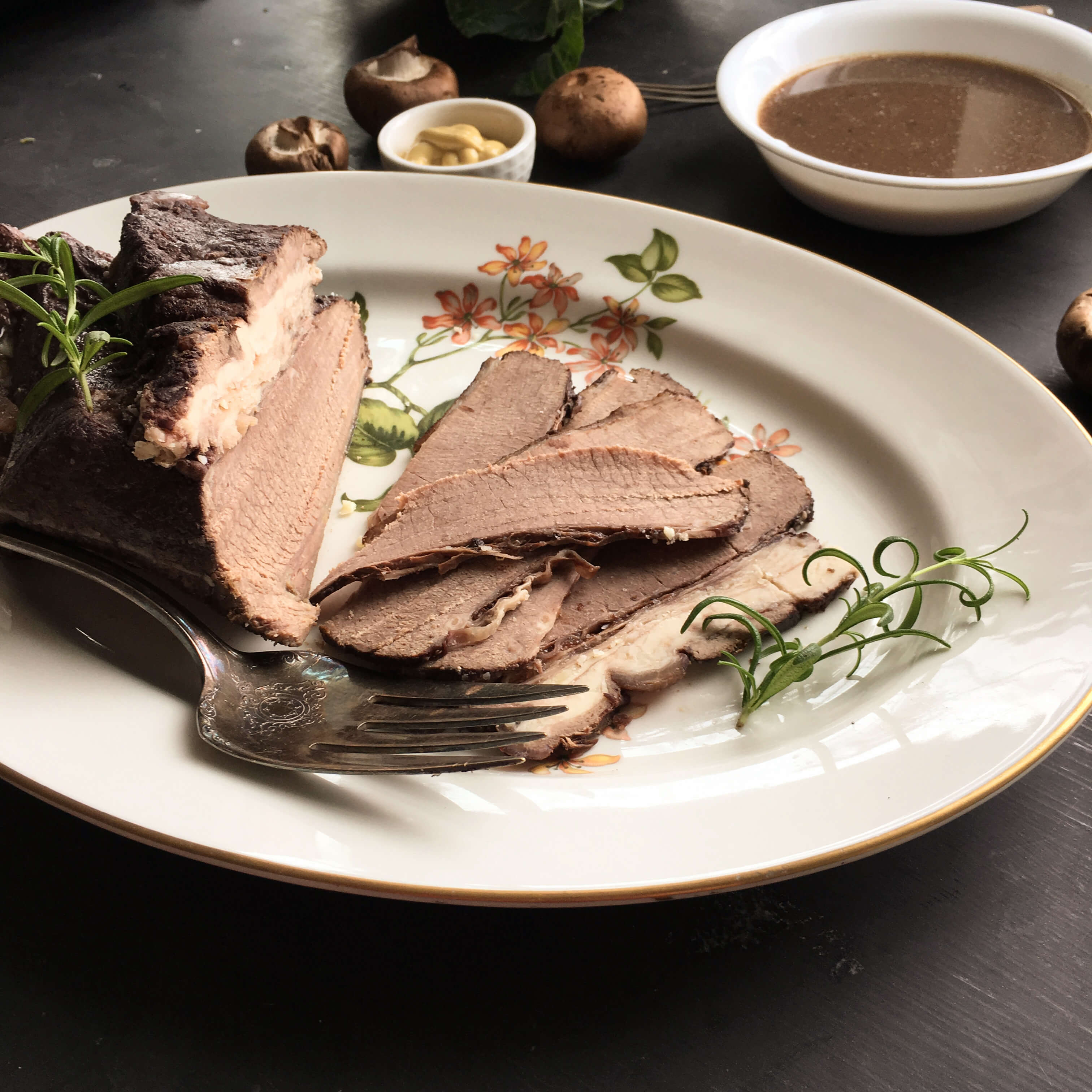
Transfer the au jus to a small saucepan and warm over medium heat. Next, thinly slice the brisket and serve cold or at room temperature alongside the au jus and/or with your favorite condiments like mustard, mayo, or horseradish.

This style of brisket is perfect for French Dip style sandwiches served on crusty rolls. It also travels well for springtime picnics and outdoor family gatherings. In Annie’s house, it is a staple for many Jewish holiday celebrations.  Simple fare with a collaborative past, that’s the brisket in all its wonderful ways.

There is something lovely about Annie’s recipe that ties all the historical elements of the holiday into one tidy package. With its Irish and Jewish heritage,  its international transmittance, and Annie’s New York roots, it feels like this recipe really embraces the spirit of the holiday. The parallels are endless. The recipe was written on a boat in the 2000s featuring a food that was once eaten by sailors in the 1700s. Annie lived in New York during the 20th century. The immigrants who helped perfect this style of cooking lived in New York in the 19th century. Annie is Jewish. The butchers who sold brisket cuts to the Irish in NYC were Jewish. Annie uses brisket to feed her family on Jewish holidays. The Irish-American community uses brisket to celebrate their national Catholic holiday.

St. Patrick’s Day isn’t only for the Irish – it’s for everyone in America who hand a hand in building a country where people and food worked together to create new things and new traditions in a new land. Cheers to foods that continue to bring people together in surprising ways. And cheers to Annie for sharing her delicious brisket recipe.  Hope this St. Patrick’s Day is your most festive one yet!
Journey of a Norwegian American Family: An Adventure in Research

For a time, when Ms.Jeannie was small, she thought she was Asian.

She recalls a story, her mother was telling at the dining room table one night about her great grandparents, the Wongs. Certainly Ms. Jeannie didn’t look Asian, with her dark blond hair and green eyes, nor did any of her family members look Asian. But Ms. Jeannie had a wonderful imagination as a child and of course, she was a subscriber to National Geographic.

She could picture the Far East with it’s geishas, it’s red paper dragons, it’s rice fields….the silk brocades, the fishing villages, the serene gardens. She could here the gonging of the metal.

As the dinner conversation continued, Ms. Jeannie learned from her mother that in fact the Wong ancestors were not really Asian at all. They were Norwegian actually.  Their named just happened to both look and sound Asian.

Well, from that moment Ms. Jeannie was hooked. She peppered her mother with questions about her Asian sounding now Norwegian ancestors. But Ms. Jeannie’s mother knew very little, so the questions went unanswered, and the spark laid dorment for a time.

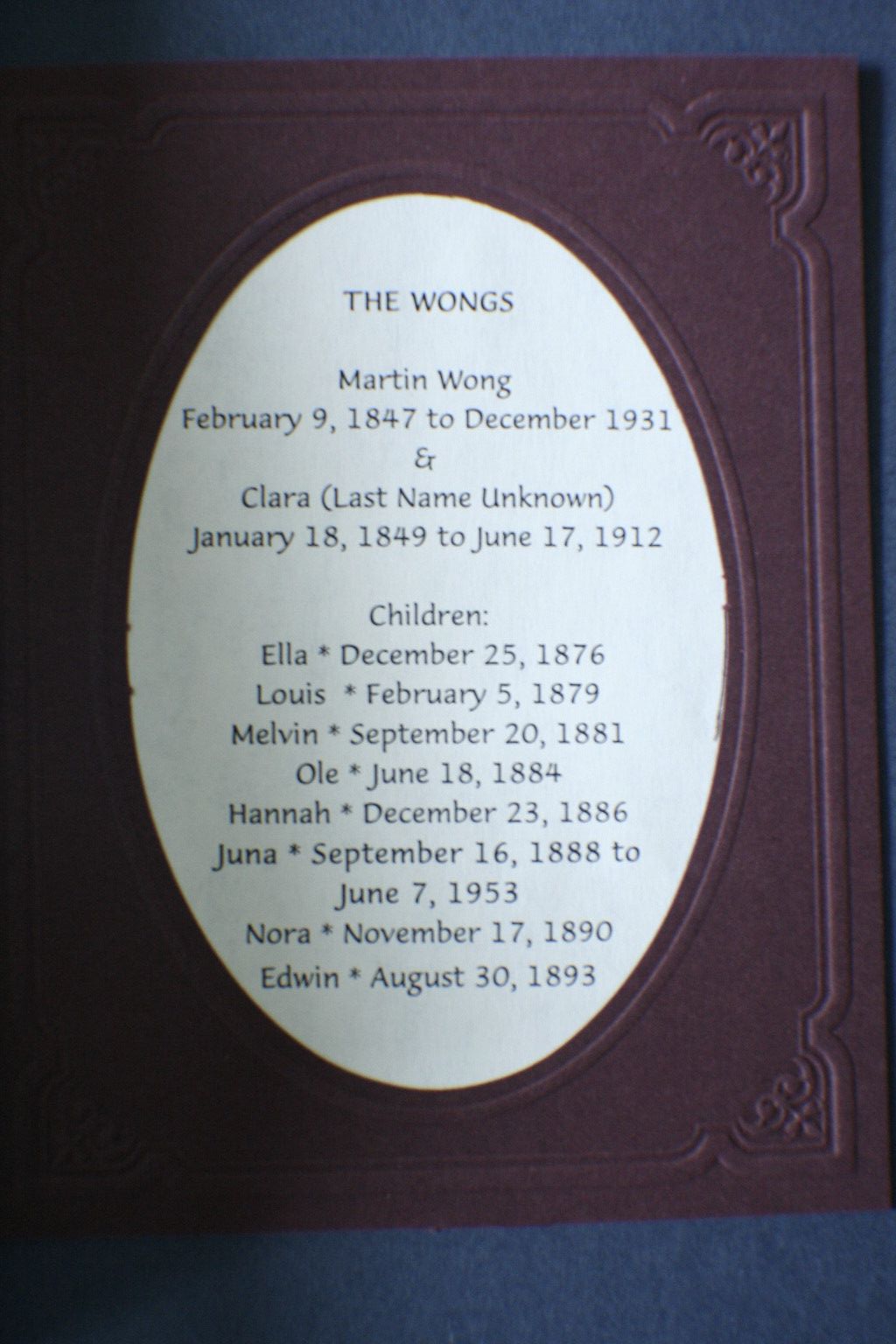
Years later, taking matters into her own hands, Ms. Jeannie emabarked on a mision to find out just who these Nordic people were. She started with this information from her mother…which turned out to be the only things that her family knew about the Wongs at that time.

So she knew that Martin & Clara had eight children and she knew there birthdates & the parents death dates. It was a mystery where they were born, where they lived, the last name of mother Clara and what happened to all the kids.

So the research began! Through careful study, the process of eliminaton and millions of census records, the mystery of the Wongs started to unravel.

Ms. Jeannie learned the Wong name was really spelled Wang (and pronounced Vang) so out the door the Asian culture theories flew!  Now that Ms. Jeannie had the correct spelling, her search got much simpler.

She narrowed it down to households containing the name Martin & Clara and all the children.  There were only two families with similiar names, one in North Dakota and on in Wisconsin. Ms. Jeannie’s grandmother was born in Wisconsin, so she started researching that family. Luckily she was on the right track! Through ancestry.com she found a few records for Martin Wang and a picture of he and Clara…

Martin & Clara Wang

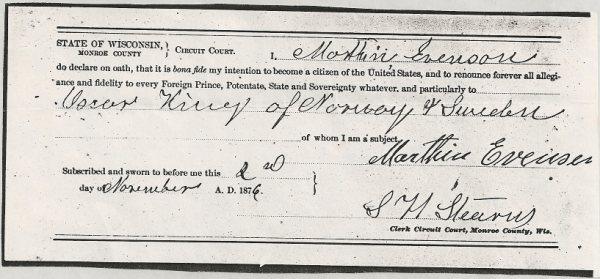
Exciting! Through the information provided in the census, Ms. Jeannie learned that Martin & Clara were from Ostre Toten Norway and Hurdal, Norway respectively.   And Clara’s last name was Erickskillet. Martin applied for American citizenship in 1876 as determined by this document:

Martin Wang’s citizenship card

Martin & Clara actually had nine children. J. William Wang died when he was 12 years old. Ms. Jeannie uncovered this picture of the Wang family taken at J. William’s funeral. Everybody looks sad, especially little Edwin (the one holding the frame)…

Ms. Jeannie was on a role now – gathering various bits and pieces of information. Martin had a glass eye. He was a cabinet maker. They lived on a farm.

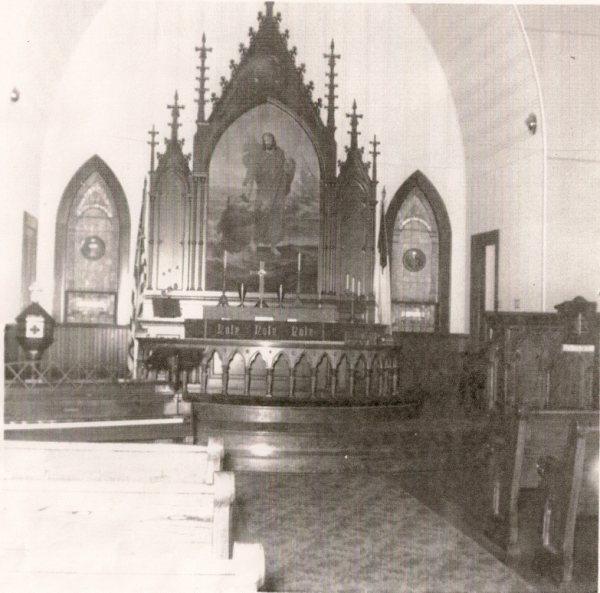
Martin built a church in Wisconsin:

The church that Martin built

Interior view of the church.

Contemporary picture of the church.. It’s still there!

Ms. Jeannie’s mother found a box with some old unmarked family photos and now they could add names to faces…

Wang Family Portrait

Juna Wang.

Originally everybody thought this was Nora Wang – Juna’s sister. But extra research put the right name with the right face.

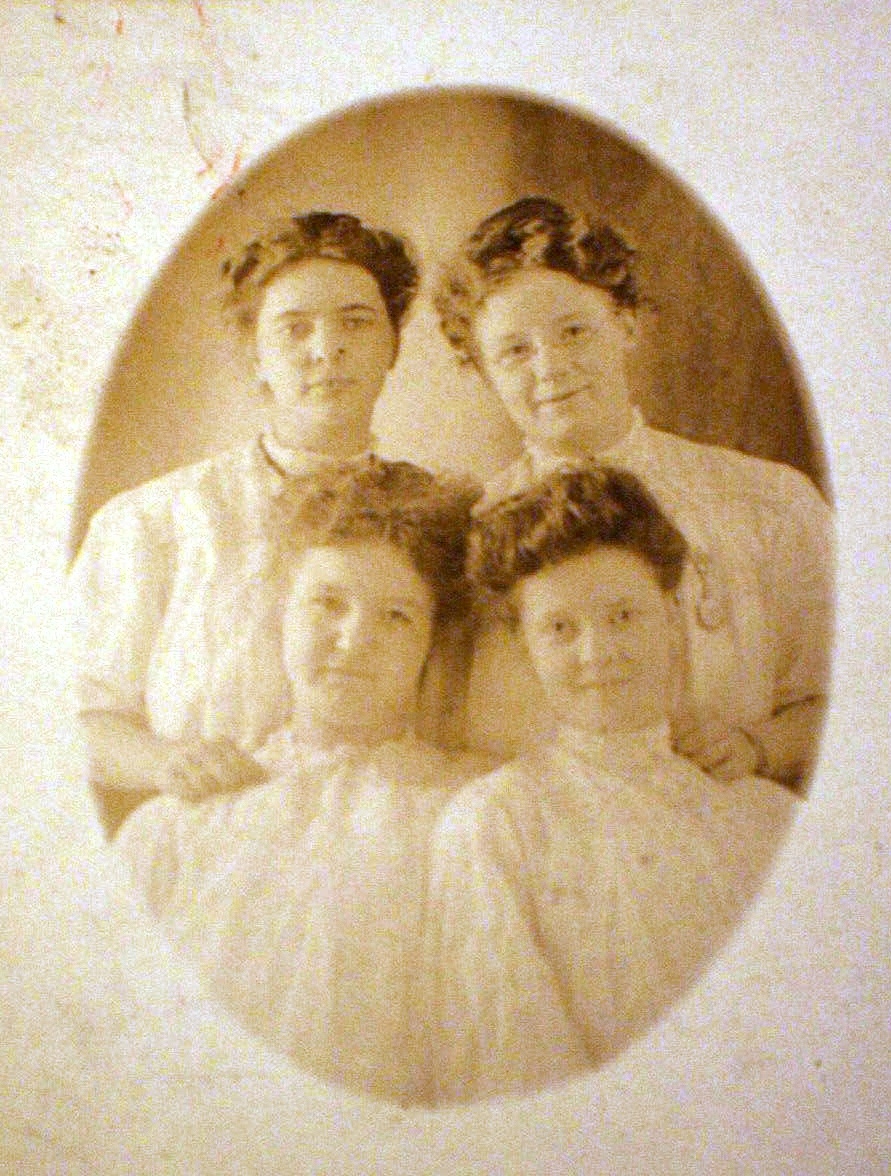
Juna and her sisters.

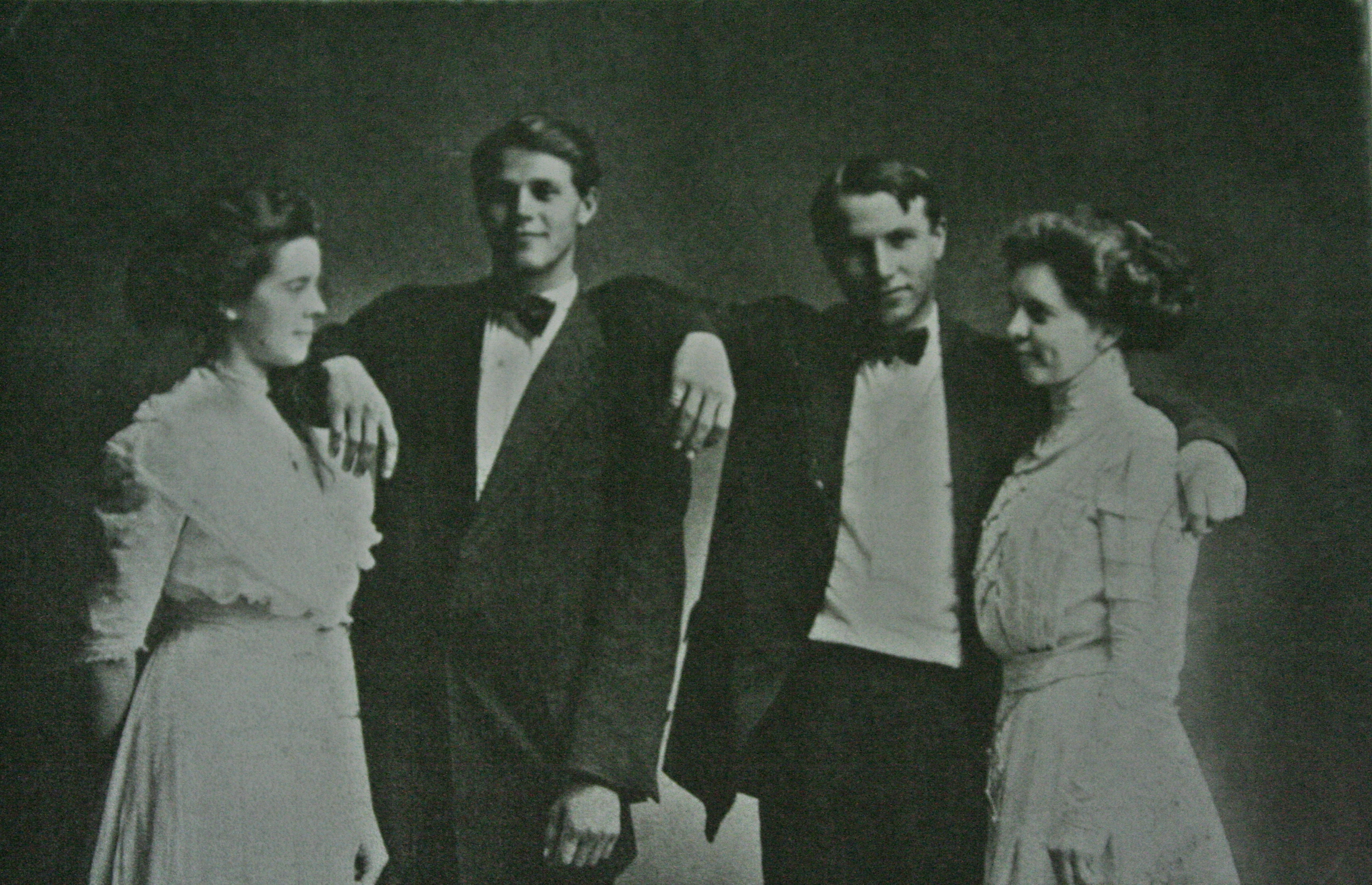
Juna and her sister. Unidentified men -pPossibly her brothers.

Meeting other Wang family relatives on ancestry.com led to the sharing of this picture of Clara Wang in her senior years. She sure looks like a hard worker.

Seeing this picture, Ms. Jeannie’s mother realized she had  this  picture of Clara that was taken with Clara’s granddaughter.:

Clara Wang with grandaughter.

Ms. Jeannie’s mother now recalled stories  of  Clara not being able to  speak any English. The census lists the family as speaking Norwegian in their household. Possibly Martin spoke English and Norwegian, in order to conduct business in America.

Ms. Jeannie has now learned quite a bit about of information about the Wang Family. She has all their birth & death dates and places, information about all the children, who they married, where they lived and died, etc.

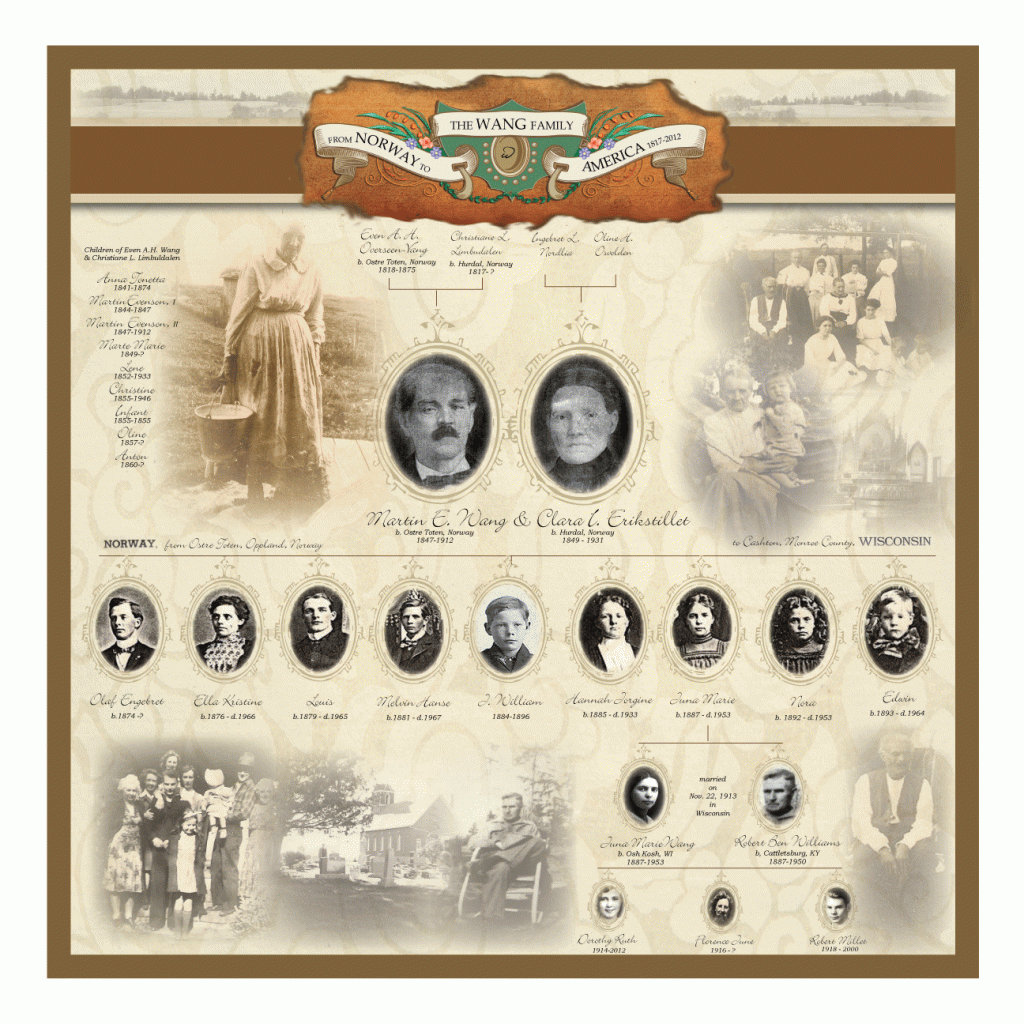
It’s exciting to see that Ms. Jeannie started here:

And wound up here:

Custom Ancestry Chart by msjeannieology

If you’d like help tracing your family stories and photographs, send Ms.Jeannie a message! She would love to spark your interest in genealogy!

Want to learn more stories? Watch celebrities trace their roots on  Who Do You Think You Are on NBC every Friday at 8:00pm.  They are already in their third season!

Here’s a clip from one of Ms. Jeannie’s favorite episodes from season 1 featuring Lisa Kudrow:

Who Do You Think You Are

Search for amazing Norwegian antiques on etsy.com. You never know…you might find something that once belonged to your relatives!

Antique Scandinavian Oval Wedding Box from mustnc

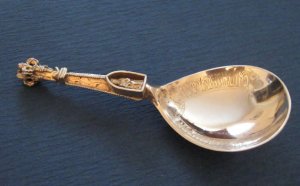
Antique Norwegian Baptismal Spoon from davidjp1927

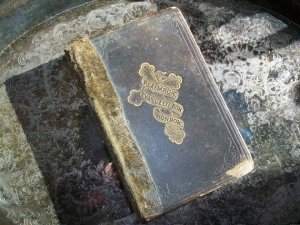
1879 Norwegian Psalm Book from Bill

1927 Map of Norway & Sweden from ImSoVintage

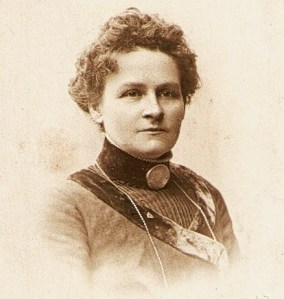
Antique Photo Card – Lady in Norwegian Uniform from christmasangel

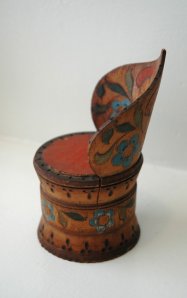
Miniature Norwegian Folk Art Chair from BlackRoosterVintage

1920’s Norwegian Christmas Card from BurtsFirstRodeo

1920’s Ivar T. Holt Brooch from ZoesGems