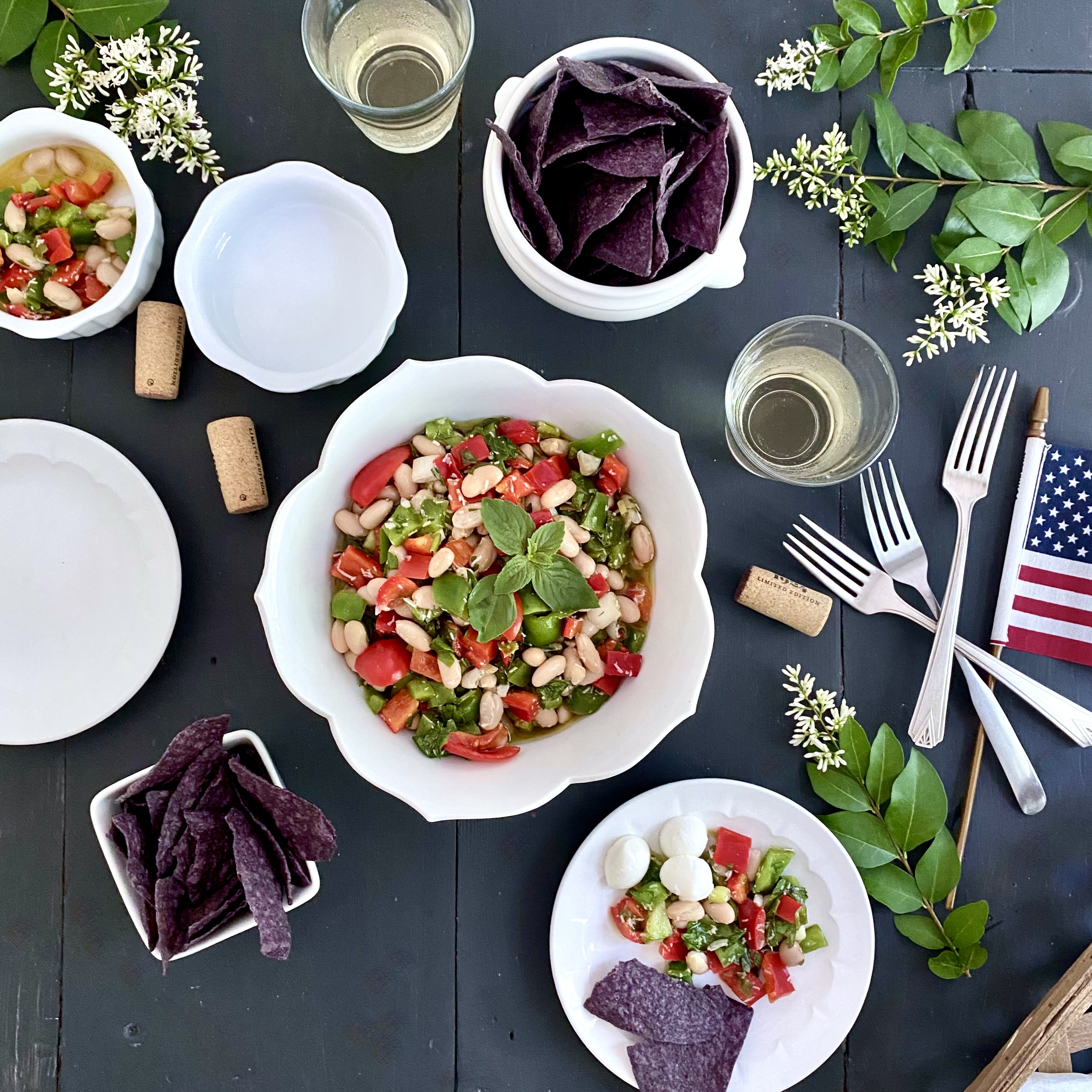
Marinated White Beans: A Cold Vegetarian Summer Salad Fit for a Holiday Heatwave

Here we are on the eve of the Fourth of July and America’s big birthday. The outdoor temps have risen to the occasion. 97 degrees with a feels-like temp of 100 can be an intimidating atmosphere for any cook in any decade, let alone any century, but a short-term heat spell doesn’t mean that you have to shy away from cooking something festive for the hot holiday weekend ahead.

Today’s post features a 1970s vegetarian summer salad that’s been marinating in the fridge for the past two days. Loaded with garden vegetables and fresh herbs, it’s a quintessential easy breezy summer salad packed full of flavor, protein, and color. Light yet filling, it offers the opportunity to serve it in a handful of different ways and in a handful of different situations. From backyard barbeques and potluck parties to beach picnics and road trip car fare, it’s the type of recipe that packs easily, presents well, and only gets better the longer it marinates. On the menu for this hot holiday weekend, it’s Marinated White Beans, a colorful cold salad of chopped vegetables, Great Northern beans, and fresh herbs tossed in a zesty lemony vinaigrette. The recipe comes courtesy of Martha Rose Shulman’s first cookbook, The Vegetarian Feast, published in 1979.
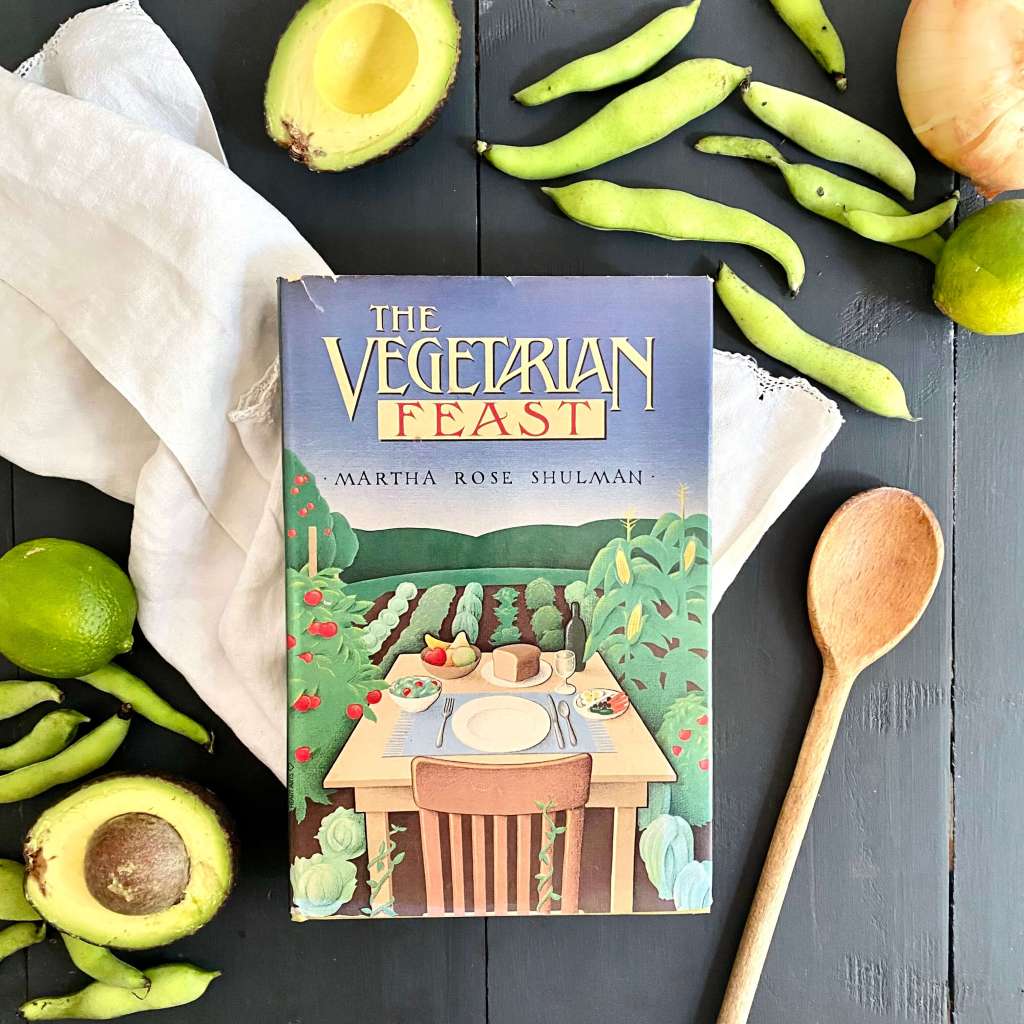
You might already be familiar with Martha’s name today. She’s written over 25 cookbooks and contributed over 1500 recipes to the New York Times Cooking section, mostly on vegetarian cuisine. But before all that, back in the very beginning of her career, Martha found her footing in the landscape of Austin. Texas, in the 1970s, where she was running a catering company and a supper club, teaching vegetarian cooking classes, and writing a food column for the Austin American-Statesman. At the time, she was in her late 20s, nurturing a love of cooking that she first fully embraced as a teenager growing up in New England.
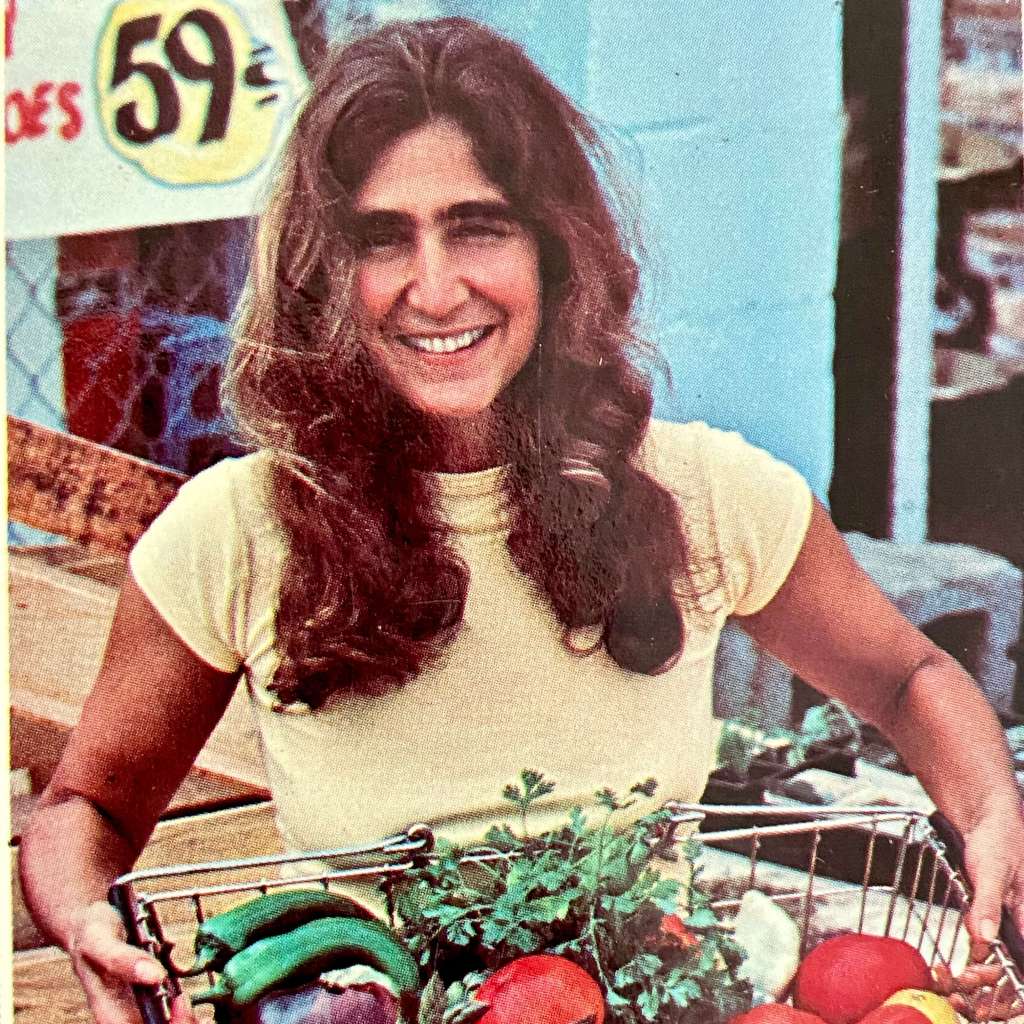
Attune to the early vibrations of the fresh food movement that was just beginning to bubble up in the 1970s, Martha, although not strictly a vegetarian herself, preferred a vegetable-laden diet and a style of cooking that combined fresh local produce with her two favorite international cuisines – Mexican and Mediterranean. As a self-described “chubby child,” she appreciated the health benefits that a plant-based diet yielded in her adult years, but she was too interested in all kinds of food to limit herself to a strictly vegetarian diet. She also liked to socialize and connect with people over meals, preferences aside. If that meant being invited to someone’s house for dinner where steak was on the menu, she’d happily eat it. Such experiences were fuel for her kitchen and her creativity.

As the host, creator, and cook of a supper club, Martha naturally loved to entertain and surprise her guests with unexpected vegetarian dishes that traditionally might have included meat, fish, or poultry. It was this sort of intriguing exercise that tantalized the appetites of her guests and eventually formed the basis of her cookbook. Needless to say, the supper club was booked for two years straight, and Martha had a keen audience happily willing to try out her new recipe creations.

Upon debut, The Vegetarian Feast won the Tastemaker Award (an equivalent to a James Beard Award today) and set Martha on the path to a lifetime career talking, writing, and teaching her three favorite things… vegetables, Mexican food, and Mediterranean cuisine.

I love that Martha never veered from her favorite types of food and, in doing so, has engineered thousands of recipes throughout the past 40 years, all blended into her signature trifecta of cooking styles. It’s a testament not only to her creativity but also to the wide array of possibilities that a vegetarian diet enhanced by flavors and ingredients from other global cuisines offers. Over the course of her career, she has dispelled two common myths over and over again. One being that vegetarian food is bland and unappetizing-looking. And the other being that vegetarian recipes are chock-full of unusual, hard-to-find ingredients that tend to get used once and then go to waste. What is wonderful about Martha’s recipes is that they are primarily simple, elegant affairs containing ingredients that are both visually appealing and easily accessible via the grocery store, the farmers market, or your own garden. The marinated summer salad featured here is a lovely example. It’s uncomplicated, easy to make, and full of classic summer vegetables and herbs.
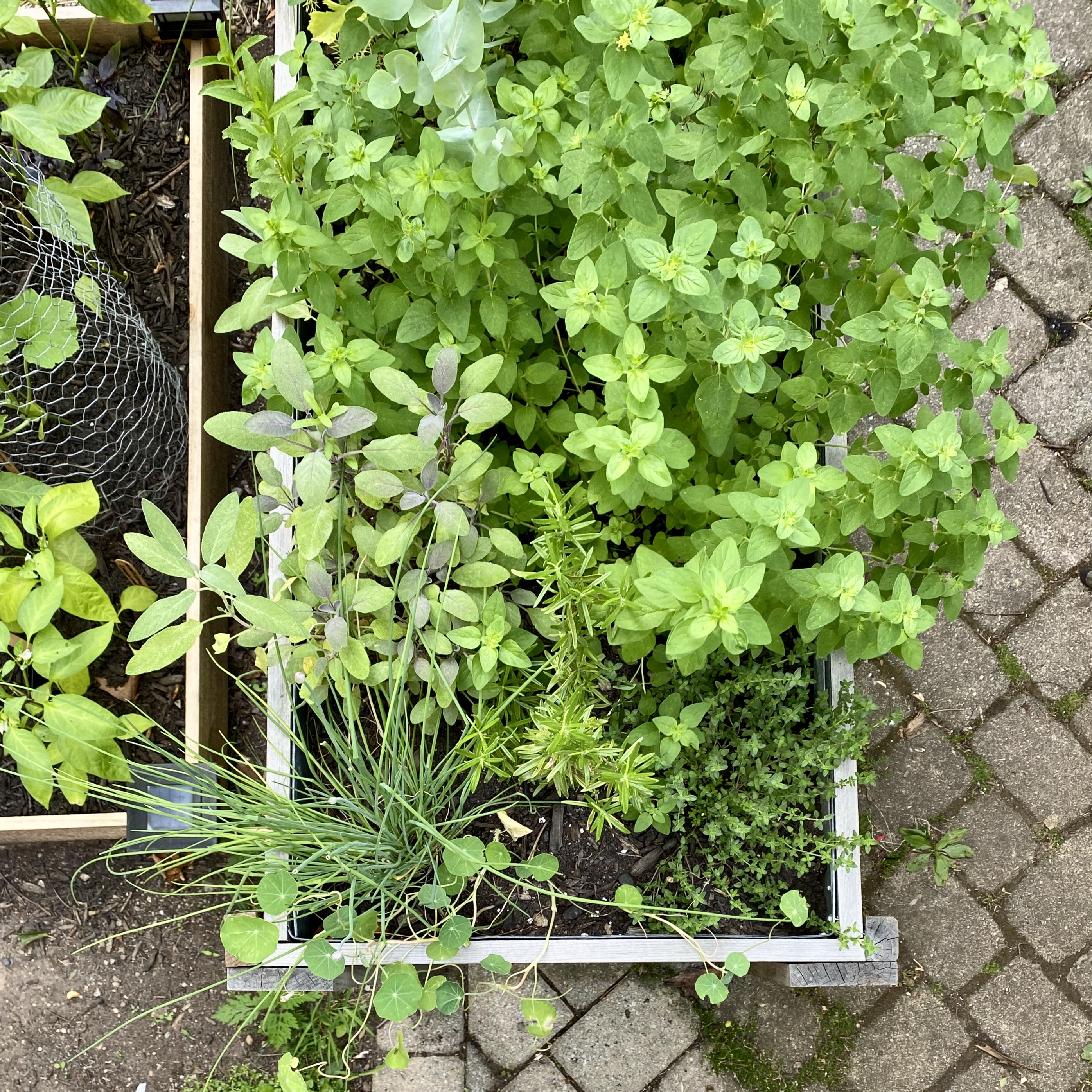
Five herbs for this recipe were picked right from the garden.

Featuring fourteen ingredients in a three-step process, it might seem like a lot of work at first glance of the recipe, but don’t be dissuaded. Once the beans are cooked, the whole salad comes together in less than 30 minutes and marinates in the fridge for a few hours or overnight if you want to plan ahead. And if you don’t have time to soak and cook dried beans, you can skip that whole step and substitute canned beans instead.
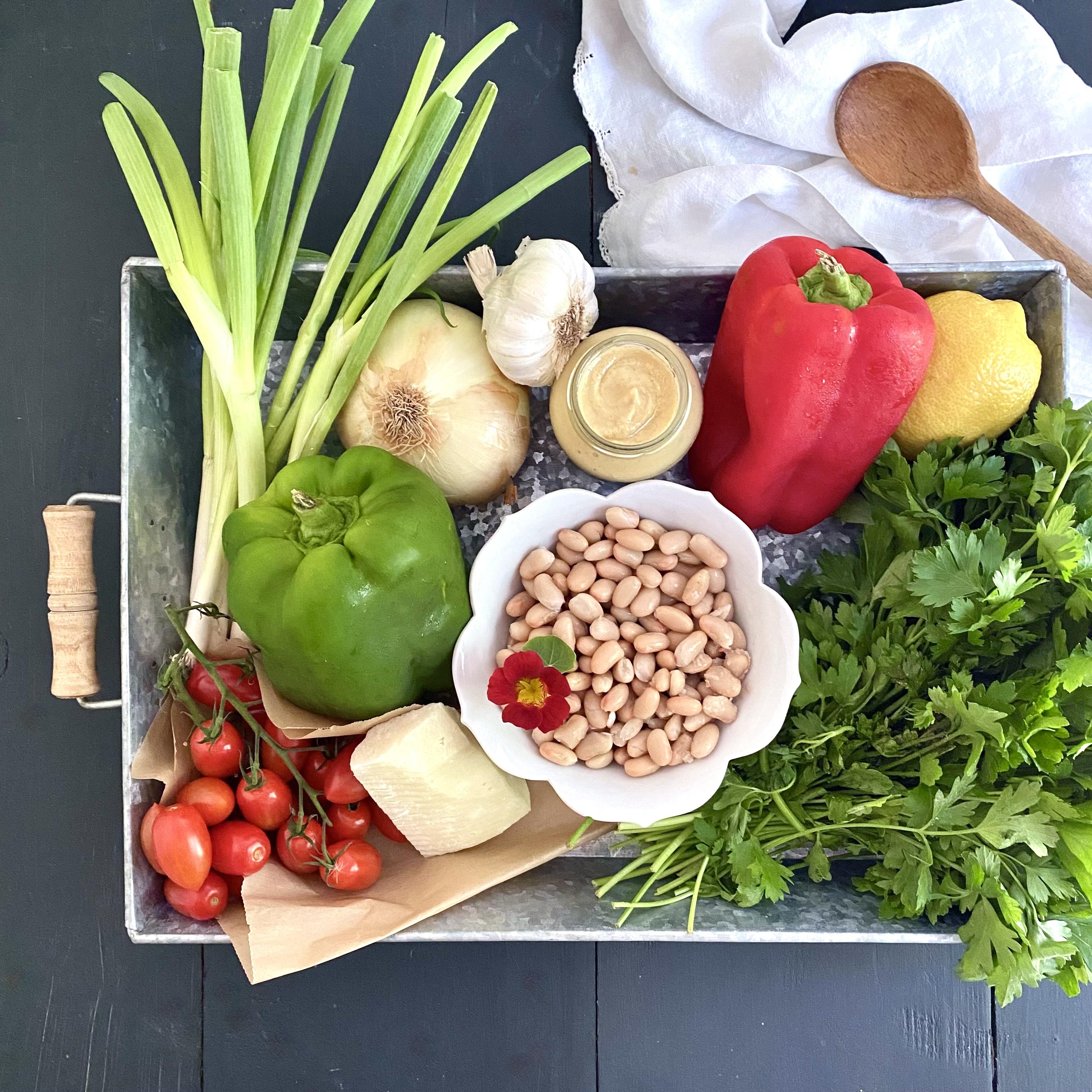
Marinated White Beans

from The Vegetarian Feast by Martha Rose Shulman, 1979

Serves 6-8

For the Beans:

2 cups small dried white beans (ex., Navy beans or Great Northern beans)

1 1/2 quarts water

2 tablespoons olive oil

1 onion chopped

3 cloves garlic, minced

1 bay leaf

1 teaspoon sea salt

Or – eliminate all of the above and substitute two 15 oz cans of Great Northern beans or Navy beans, rinsed

For the Salad:

1/4 -1/2 cup choppd fresh parsley

4 green onions including white and green parts, sliced

2 tablespoons fresh herbs (basil, marjoram, thyme, fennel, chives)

1 green pepper, seeded and chopped into bite size pieces

1 red pepper, seeded and chopped into bite size pieces

1/4 cup freshly and finely grated parmesean cheese

Cherry tomatoes (optional)

For the Marinade:

Juice of 1 lemon

1/4 cup vinegar

1 clove garlic

1 teaspoon Dijon mustard

1/2 teaspoon oregano

1 teaspoon chopped fresh basil or 1/2 teaspoon dried

1/4 teaspoon drid tarragon or 1 teaspoon fresh tarragon

Sea salt and freshly ground pepper to taste

3/4 cup olive oil

If using dried beans… wash the beans and soak in water overnight. In a heavy-bottomed flameproof bean pot or Dutch oven, heat the olive oil and sauté the onion and garlic until the onion is tender. Add the beans, water, bay leaf, and salt. Bring to a boil, then cover, reduce the heat, and cook for one to two hours until the beans are tender but still firm. Remove from the heat, drain, and remove the bay leaf.

If using canned beans…. rinse beans in a colander or strainer and set aside.
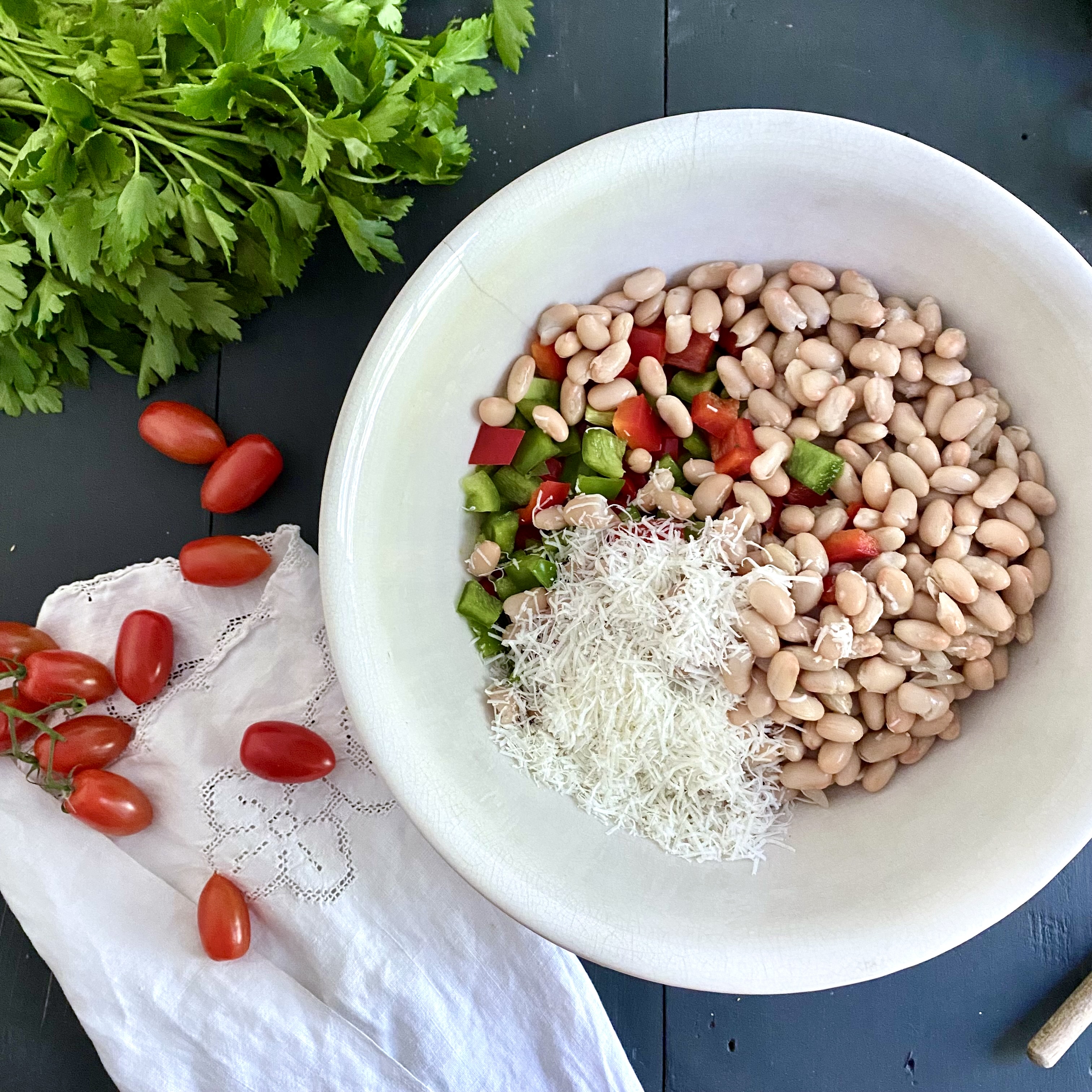
In a large mixing bowl, combine the parsley, green onions, herbs, green and red peppers, and the Parmesan cheese. Mix together. Add the beans and lightly combine so that the beans don’t get crushed or broken. Set aside.
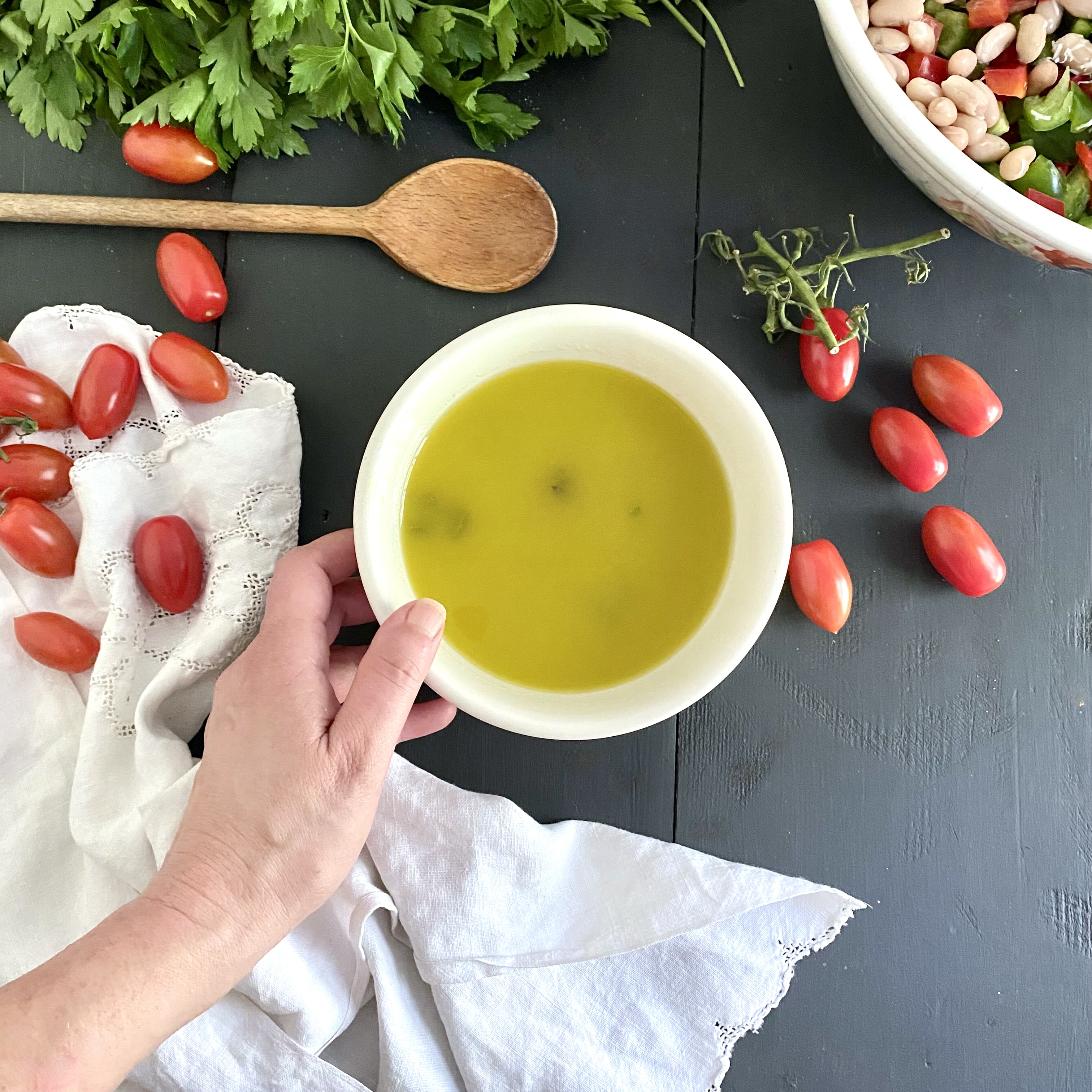
In a small bowl, combine the lemon juice, vinegar, garlic, mustard, and the seasonings. Stir in the olive oil, then toss with the bean mixture and refrigerate for several hours or overnight.
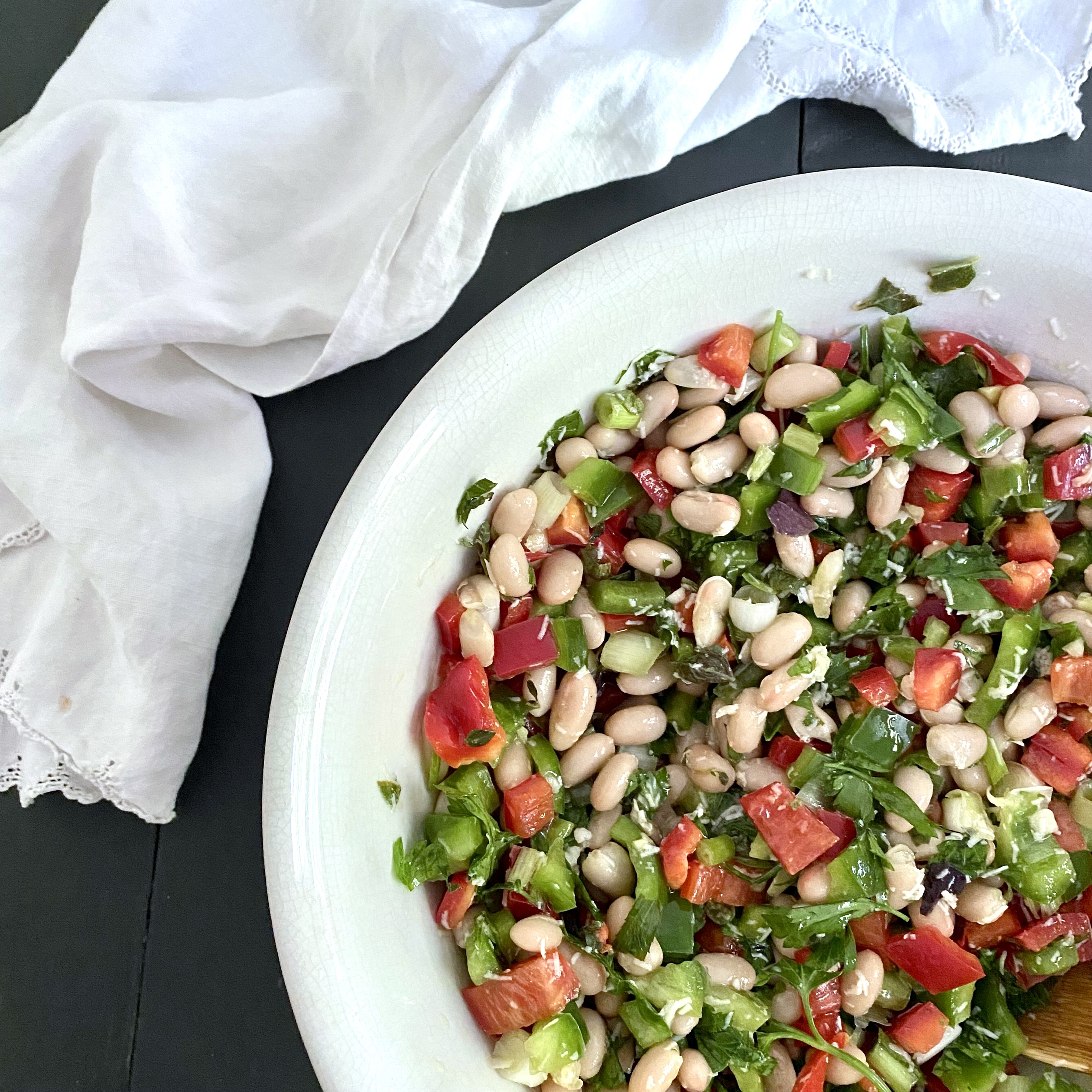
Just before serving remove the salad from the fridge and let it stand at room temperature for a few minutes to loosen the olive oil. Toss once more before garnishing with fresh cherry tomatoes and a basil sprig or two.
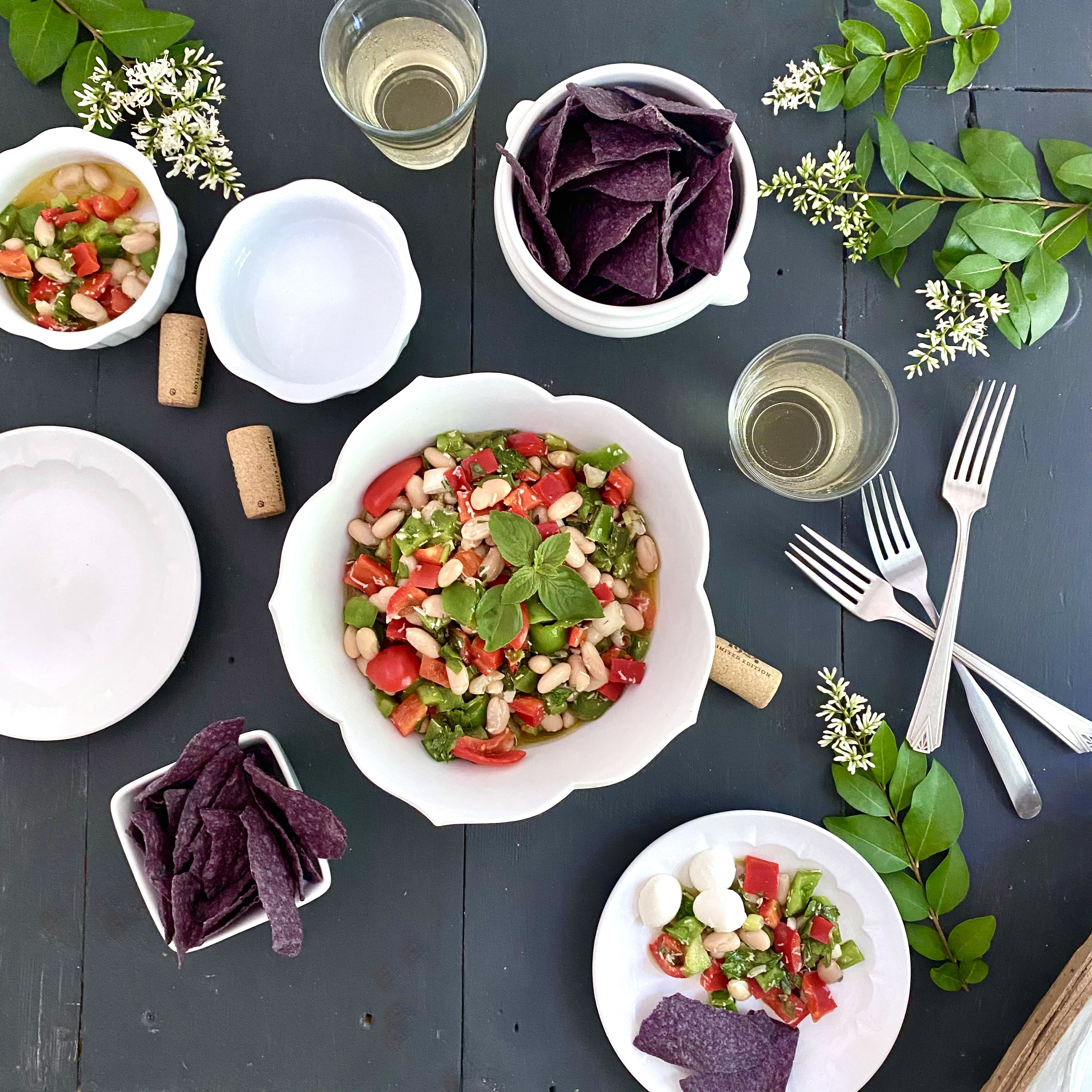
Bright, colorful, and full of flavor, this salad is a lovely meal on its own or a zesty side dish that complements a wide array of other foods, including all the traditional holiday grill favorites… chicken, fish, sausages, and burgers. Many of Martha’s recipes in The Vegetarian Feast are foundational building blocks ready to let your own culinary creativity shine.

The green and red peppers add a lovely crunch while the lemony mustard vinaigrette offers an extra bit of dressing that could be soaked up with additional toppings of diced chicken, homemade croutons, sliced avocado, or hard-boiled eggs. Other complimentary sides include grilled corn, hummus and pita chips, guacamole, fish tacos, cheese quesadillas, slices of peasant bread or baguettes, tortellini, devilled eggs, BLT sandwiches… you get the idea.

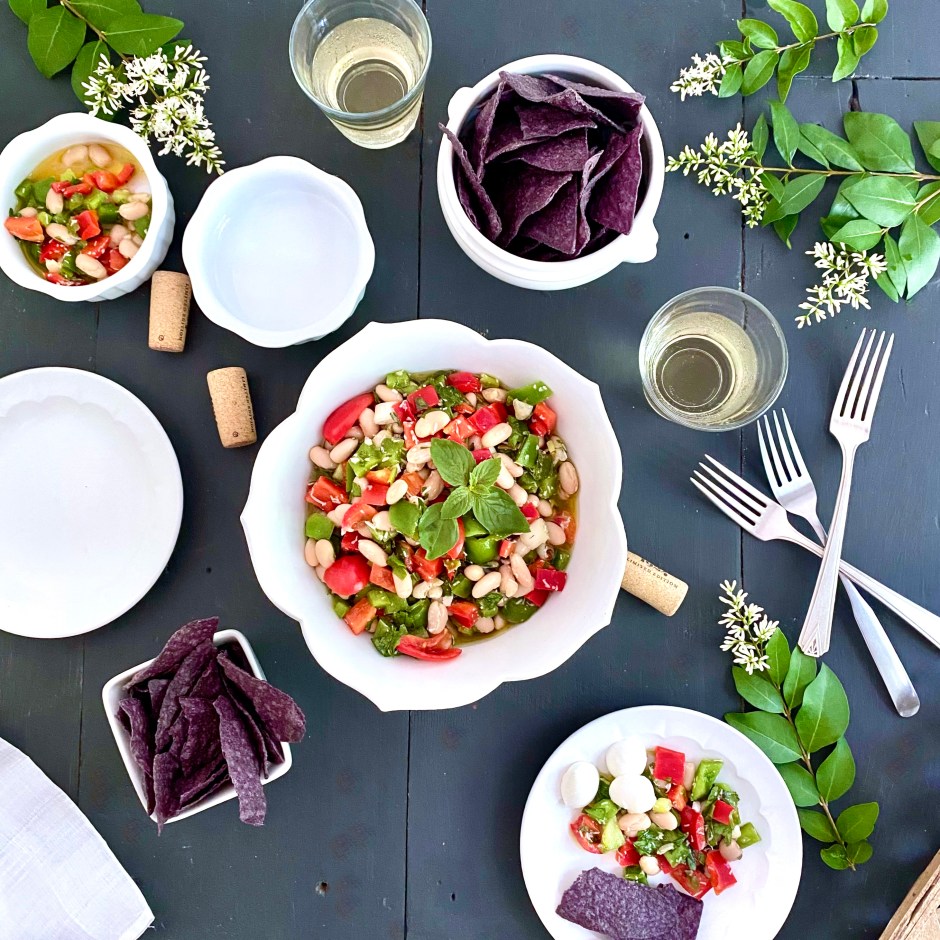
If you wanted to add a bit of Fourth of July flair to this recipe, serve it with blue corn chips and bite size mozzerrella balls for a red, white, and blue palette that celebrates the colors of the day.
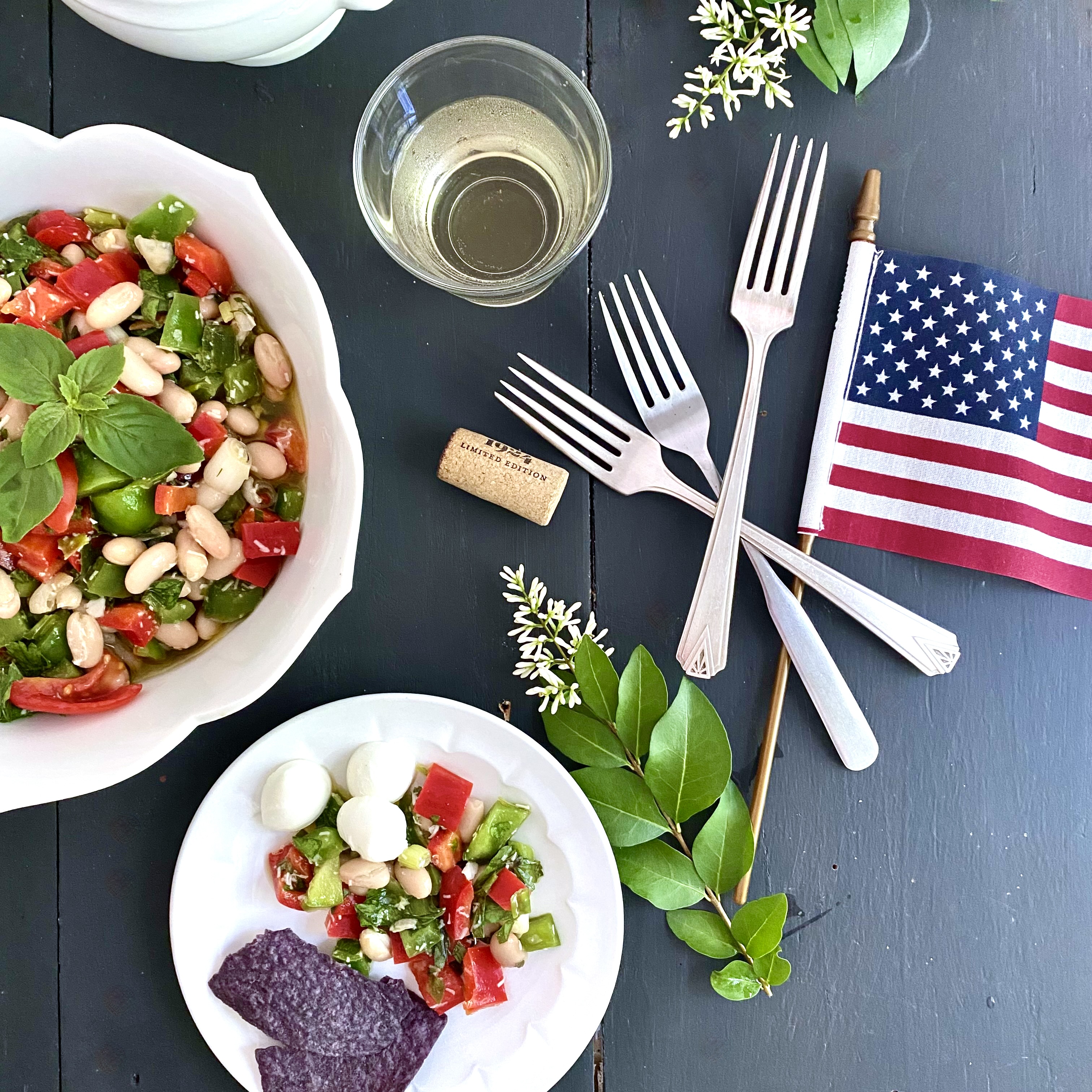
Lovely served as part of your holiday hors d’oeuvres table, as an appetizer, or as a main dish, it’s a refreshing snack as much as a picnic component or the main meal of the party. Whether you are staying home or traveling around the country, this salad is easy to pack up and tote along on any sort of summertime adventure. It also stores well in the fridge in an airtight container for up to five days.

When it comes to the history of the United States and food, Martha is a prime example of our country’s dynamic and diverse culinary landscape, one that has been influenced by a wide range of cultures. She was born in Connecticut and educated in Massachusetts. She started her career in Texas, traveled extensively throughout Mexico, lived in Paris for a dozen years, and currently resides in California, where she continues to cook in her beloved Mediterranean, Mexican, and vegetarian style. All along the way, she’s espoused the value of sourcing fresh, local fruit, vegetables, and herbs that are so abundant in our country. That’s something to celebrate. For every American cook, there’s a story. And for every American recipe, there’s an influence inspired by someone else, somewhere else. Good food brings us altogether.

Cheers to simple summer cooking, to the heatwave that inspired this post, to Martha for sharing four decades worth of recipes, and to America on turning 250.

Find more Fourth of July recipes on the blog here… Lady Liberty Cheesecake, Americano Cocktail, Belle’s Star Spangled Cheese Straws, Homemade Blueberry Tart, and Colonial-Themed Blackberry Sally Lunn Cake.

The Handmade Tablecloth: A 1916 Immigration Story

Every family has some tales when it comes to history and the lineage that connects us to ancestors who lived a long time ago. If we are lucky, they are long-winded stories full of color and detail and a relatable sentimentality that can carry our imaginations far across cities and centuries connecting us to relatives we never met.

Other times, there are family histories that are just one-liners. Snippets of stories punctuated with the sparest amount of context and detail. Enough to give you some ideas about who this or that ancestor might have been, or where they came from, or how they experienced life, but beyond that no other information is known. I’m always most intrigued by these slim snippets of genealogical detail. The ones that aren’t flushed out yet enough to form a complete story with a defined beginning, middle, and end. The ones that could have been recited so many times they are now legend tumbled and tossed through generations yet never gaining new insight or understanding. We have quite a few in my family – a great aunt who was a Rockette, a lost family fortune buried somewhere on the island of 18th century Manhattan, a doughnut shop in the Pacific Northwest still waiting to be found. Those quick glimpses into all types of family biography are ripe for more storytelling and a deeper understanding of the experiences that makes up the unique histories of American lives.

In today’s post, we are sharing a 100 year-old-family story brought to the Vintage Kitchen in the form of an heirloom. It did not come with one of the long-winded stories like we mentioned above, the ones full of color and life and detail. Instead, it falls into the latter category. The opposite one. This heirloom came with just a few facts. Vague yet weighty snippets of a story that lightly scratched the surface of a much larger experience.

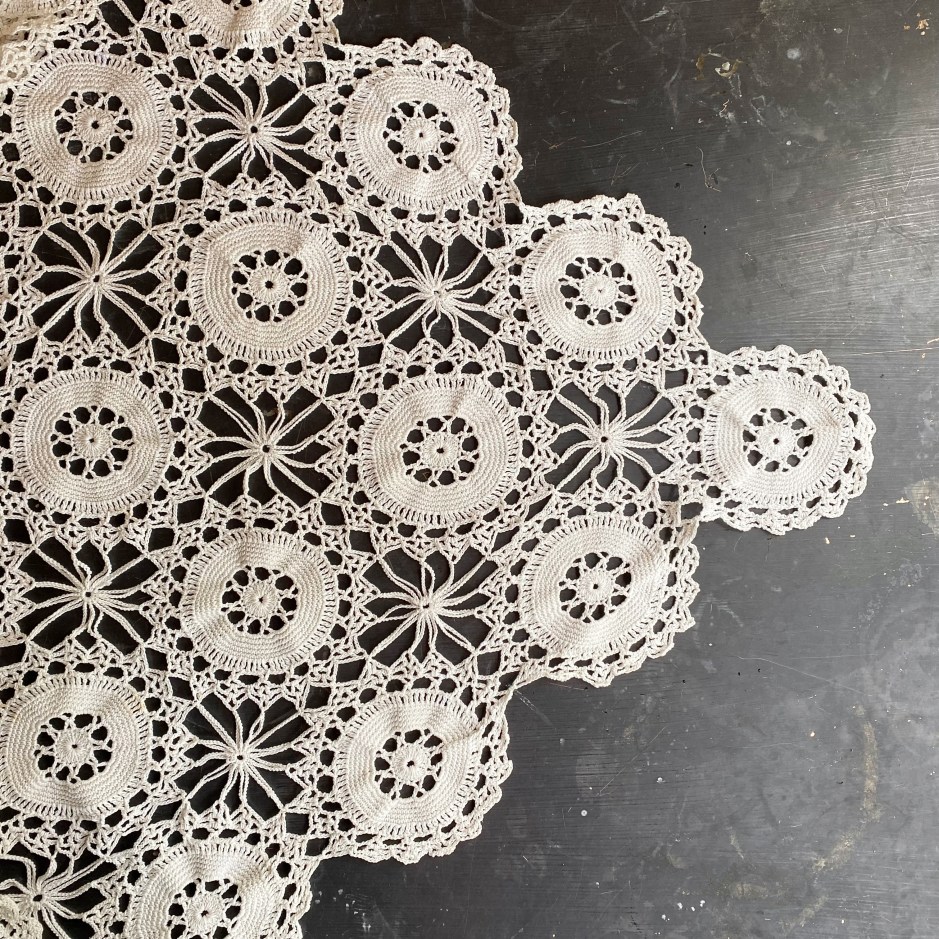
It starts with an antique tablecloth. Folded up it weighs just over a pound and a half. It’s delicate but also strong, with a heft to its weight like rope. Featuring a hand-crocheted pattern of circular medallions and spider-like stars, it’s executed in thread that is the color of bones. In appearance, it’s not unlike a lot of similar tablecloths that were popular during the 20th century, but this one tells a very specific American story that is very fitting for the 4th of July holiday.

Sent by a woman named Linda, who is a vintage collector in New Mexico, this tablecloth was a family heirloom belonging to Ann, her ex-mother-in-law. When passing down items from her life, Ann requested that this particular linen be handled with respect and appreciation. Although Linda admired the beauty of this tablecloth and the story it represented, she contacted the Vintage Kitchen to see if we might be able to give it a new home.

Arriving in the mail shortly after, the cloth came with a note detailing a few facts surrounding its history.

  • It belonged to Linda’s ex-husband’s mother, Ann who had recently passed at the age of 87
  • It was passed down through Ann’s family with the understanding that it came to America by way of an Italian ancestor named Catherine who had traveled by boat from Sicily to Ellis Island in the early 1900s and then went on to Chicago to settle.
  • According to family lore, the tablecloth was handmade while on the boat waiting to dock in the US

Even though I had a dozen more questions for Linda upon receipt of the cloth, and had requested a photo of it’s maker, unfortunately, Linda and I lost touch shortly after the package arrived. So here it was, this pretty antique tablecloth wrapped up in a handful of intriguing little story snippets just waiting for something more to be told about it.

After a bit of genealogy work and a hunt through Ellis Island immigration records, Linda’s ex-grandmother-in-law’s story burst into colorful life just like a 4th of July firework. It begins here on Ellis Island in March 1916…

Ferry boats carrying immigrants from transatlantic steamer ships that initially docked in lower Manhattan arrive here at Ellis Island’s Immigration Station where their paperwork was completed. Photo courtesy of the New York Public Library.

Even though it was the very first day of Spring, it was a chilly 34-degree March day when the Caserta arrived in New York Harbor. Carrying immigrants from Naples, Italy, the steamer ship coasted into the harbor on choppy waters passing the welcoming sight of the Statue of Liberty. Her torch was not yet electrified, it would be another nine months before that happened, but to the arriving immigrants, she signaled a bright future ahead regardless. Aboard the ship was 20-year-old rosy-cheeked, chestnut-haired Caterina from the seaside town of Bagheria, Sicily.

Caterina’s ship manifest.

Most Italian immigrants during the 1910s were fleeing to America to escape economic depravity in their home country. Depending on weather, war, quarantine, detainments, and ship reroutings, the voyage from Naples to New York could last anywhere from twenty-one days to three months. When Caterina came over it was the middle of WWI, and Italy was involved in the battle of Austria-Hungary. Traveling with her older sister Maddalena, we don’t know specifically why these two girls left Italy, but we do know that Caterina paid her own passage and carried $25.00 extra in her pocket along with a crochet needle and a bundle of thread.

Of medium height and good health, Caterina would have no trouble passing through the medical checkpoint before she was allowed access to her new country. Her $25 dollars in savings would not be an issue either as she brought an amount deemed substantial enough by the US government to successfully start afresh in the New World. With intentions to stay with her cousin, Filippo, in the Midwest, Caterina’s final destination was the bustling city of Chicago.

A 1916 map of Chicago IL courtesy of the Library of Congress

According to Linda’s family story, while waiting to dock in New York Harbor, Caterina took her crochet needle from her pocket and put her hands to work. She soothed her anxious nerves by crocheting this 82″ x 52″ inch delicately threaded tablecloth featuring a series of interlocking circles and stars.

I loved this part of Linda’s story for two reasons… 1) I didn’t realize that immigrants had to wait for any extended period of time to gain entry into the US. I assumed that most were docked and processed in the same day. So it was interesting to think that Caterina’s boat could have been detained for a significant amount of time – one in which an entire tablecloth could have been made by hand. 2) The other reason I loved Linda’s story was for the amount of comfort that this tablecloth must have brought. The calming effect of repetitive motion and the focus and attention to detail required to make a circle then a star, a circle then a star intertwining each until there was a cloth over 4′ feet long and 3″ feet wide.

I loved this artistic glimpse into one woman’s life and that I could hold in my hands a tangible item that combined thread with all the emotions of a new adventure – excitement, uncertainty, nervousness, fear, and awe experienced over 100 years ago. I wondered about Caterina, there on the boat, stuffed full with people from her home country all experiencing a cacophony of feelings while she sat calmly making this piece. Was she dreaming of the future table in which she would display her needlework? Did she think about it becoming not only a practical household item for her new home but also a tangible reminder of the journey that she chose to take? Did she know then, that it would eventually become an artifact proving that she, Caterina of Bagheria, Sicily and now of the United States had lived?

The closing of other U.S. ports, the rerouting of ships during WWI, and the threat of communicable diseases could have been some of several reasons why Caterina got hung up in New York Harbor long enough to hand-stitch a linen for her new life. After much research, I couldn’t find anything that would attribute to the delay around that date, but I did learn that four days later, the ship she arrived on, the Caserta, was on its way back to Italy loaded with war-time ammunition for the Italian government.

That led me to wonder if the details of Linda’s family story had gotten a little muddled over the past 100 years. Maybe, Caterina made the tablecloth on the voyage over and finished the last pieces of it while she was waiting to dock. Or maybe in fact, she was on a quarantined boat, arriving in New York days or weeks before the immigration officer officially stamped her papers with the date March 20, 1916. Or maybe she just happened to be a master, faster crocheter that indeed had plenty of ample hours in an ample amount of days to complete such a creative undertaking.

I can imagine that this waiting period at Ellis Island whether brief or lengthy, spent while you are between your old life and your new life, would be a pretty intense time. There is something incredibly marvelous and moving about Caterina documenting her stay in these New York waters under the reassuring gaze of Lady Liberty with her crochet needle and some Italian thread. A simple household item made during a magnificent moment with skill enough to make it last a lifetime. And then some.

Linda’s initial recount of the situation began and ended at Ellis Island, but a bit more research uncovered Caterina’s complete life story. She did make it to Chicago. There she became known as Catherine, the Anglicized version of Caterina, and a little over a year later she met and married Alberto, a fellow Sicilian who had immigrated to America just a few years before her.

Alberto was in the grocery business, successful enough to own three delis in the Chicago area during the early to mid-1900s. Catherine and Alberto had two boys – Anthony and Joseph. Joseph served in the US Air Force during WWII and Anthony in the US Navy. The deli trade was never far from Anthony’s heart and upon return from the war, Anthony followed in his dad’s footsteps and worked in the grocery industry for the rest of his life – first in Chicago and then in California where he opened a deli shop specializing strictly in Italian fare. After Anthony married Ann, a former customer of his dad’s shop back in Chicago, they also had two children – Albert and Diane. Albert a young groom in the 1960s, married Linda, the vintage collector who sent us the tablecloth.

Clockwise from top left: Linda, Albert, Anthony, and Ann. Photo courtesy of Pleasant Family Shopping blog

As for Caterina, she passed away in Los Angeles in 1987, at the age of 92. Living a majority of her life in the US made her geographically much more American than Italian, but she never ventured far from her Italian roots nor the chance to pass on her cultural pride to her boys who then passed it on to their families. A part of all that was this tablecloth. The heirloom made en route from old Italy to new America. The cloth that wove together two parts of one woman’s life. A woman who chose to settle in the United States, to become a citizen, to raise a family of boys who then fought for the US during WWII and then saw her children’s children grow the branches of their family trees in America all the while contributing to the vibrancy of our country’s dynamic landscape. Caterina’s story is a small leaf on the big tree of immigration, but I felt so honored to be able to tell her story and attach it to the tablecloth, her tablecloth, that still lives bright and beautiful in the world today.

I couldn’t ever find a photo of Caterina, so I wrapped her tablecloth around a mannequin and photographed the two together. It’s the closest I could get to visually communicating that the cloth was made by an actual person. Hopefully one day, I’ll come across a photograph of Caterina so that we can know her face. Until then, this portrait will have to do.

Cheers to celebrating all the immigration stories that make our country culturally vibrant this Independence Day. To slim snippets, that form big stories. And most importantly, cheers to Linda and to Ann and to Caterina for sharing their family’s American experience. Important stories lie in everyday objects.

However you choose to commemorate the 4th of July, we hope it’s a memorable one!

Special note: While researching this post, I came across two pieces of media that were especially insightful when it came to understanding the very human and very humbling experience of immigrating to America.

An oral history interview with Italian immigrant Filomena Latta…

https://heritage.statueofliberty.org/oral-history-library

A tour of the Ellis Island Immigration Museum with National Park Ranger Peter Urban…

Happy 4th of July! This Is What This Day Tasted Like in 1902…

Happy 4th of July! It has been super quiet around here on the blog since mid-May and I must say, I have missed you all terribly.  There was a family tragedy and a family illness that took me unexpectedly far away from the Vintage Kitchen for most of June. But I’m happy to write that I’m back and ready to dive into a plethora of new kitchen stories starting this week.

Exciting things coming up in July include an interview with a creative artist who will make you look at your refrigerator in an absolutely new and enchanting way; we will travel back in time to a hotel in 20th century Minnesota and share a few recipes that made them famous around the world; we’ll learn about a guy who invented one of the most addictive foods ever known to eaters; we’ll celebrate three national food recognition days and we’ll host a giveaway that is guaranteed to add a little sparkle to your life. So stay tuned on that front. July is full of fun!

In the meantime, since it’s a holiday today and you are out and about celebrating with friends and family, we’ll keep this post short – a litle dollap of history pertaining to patriotism and how Americans ate their way through Independence Day in 1902.

In that year, this guy was president…

Theodore Roosevelt – the 26th President of the United States.

And patriotic family gatherings looked something like this…

A fourth of July family picnic in St. Augustine, Florida in 1902. Photo courtesy of FilsonHistorical.org

Decorations were simple…bunting, flags, flowers and the natural settings of the great outdoors. There were parades and town concerts and special events planned throughout the day.

July 4th, 1902 in King’s River, California. Photo courtesy of the Sierra Club.

Conversations were full of pride, in the general achievements of the country. Unlike today, where the political terrain is quite rocky and American morale is at an all-time low, in 1902, patriotism was a bit more revered. President Roosevelt prepared a speech saying nothing but thank you to the American military for continuing to extend and uphold the open arm ideals of the United States and pledged to continue to promote peace and tolerance throughout the world.

In American households during the early 20th century, the 4th of July was the one day where political affiliations were set aside. What was celebrated in conversation was not that someone was a Democrat or a Republican but instead an American. And topics led more towards incredible examples of what had been achieved in the past as a unified country as opposed to criticisms about the work that still needed to be accomplished individually.

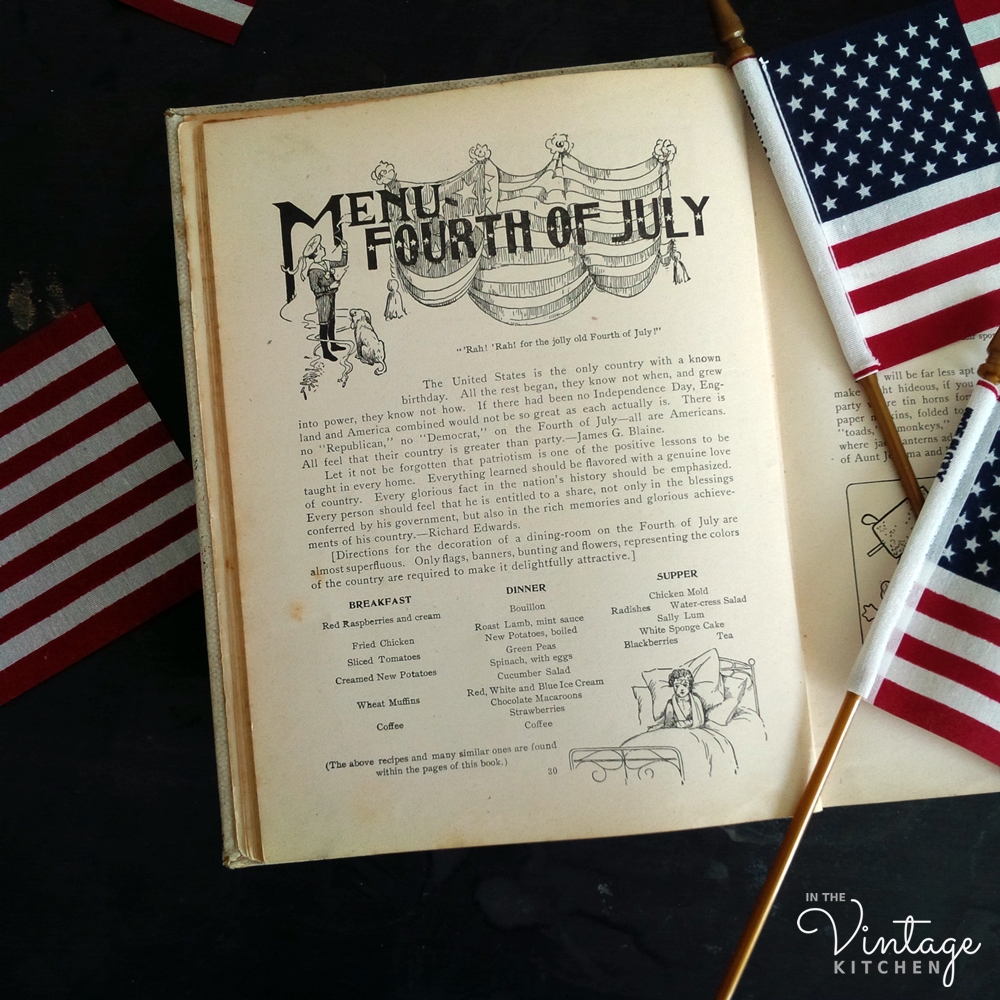
Eating occurred on a large all-day scale with a full breakfast, lunch and dinner… each incorporating the colors of the American flag. Here’s a suggested menu from Woman’s Favorite Cook Book published in 1902…

Woman’s Favorite Cook Book, 4th of July Menu, 1902

You’ll notice, even back then, the holiday has always been about cooking and spending time together. The kitchen would have been a hotbed of activity (just like it still is today) preparing all the staples we still enjoy eating on the Fourth – ice cream, salads, garden vegetables, fresh berries, cake. Our national pride might be much more diluted now than it was 116 years ago but our bellies are traditionally still enjoying the same types of food. That is a comfort at least.

Theodore Roosevelt once said…“Patriotism means to stand by the country. It does not mean to stand by the president or any other public official, save exactly to the degree in which he himself stands by the country. It is patriotic to support him insofar as he efficiently serves the country. It is unpatriotic not to oppose him to the exact extent that by inefficiency or otherwise he fails in his duty to stand by the country. In either event, it is unpatriotic not to tell the truth, whether about the president or anyone else.”

Teddy would have appreciated all the new voices coming forth this year (no pun intended!) in our fights for democracy and fairness and freedom for every person in America. He would have admired all the political bravery that exists today and marveled at all that we have accomplished so far.  Americans of the early 20th century would have lauded our collective efforts too, noting how far we have come on the food scene as far as innovations and improvements and equipment while still managing to keep the culinary traditions of our ancestors alive.

So it is with that in mind that we say cheers to the holiday, to the progress we have made, and to the traditions we still hold dear. However you choose to celebrate the 4th of July – whether you are partying it up at a fish fry, a barbeque, a picnic, a seafood boil or a campfire roast – I hope your holiday is filled with fun, family, and friends. May it be peaceful and light. And may all those fireworks be bright. Cheers to a happy holiday! We’ll see you back in the Kitchen shortly.

Happy 4th!

Goodness gracious! Is it scorching hot here in the South!

Everything is either wilting or dripping. The garden has been wind-whipped by hot dry dust storms almost everyday, and that is after we went through an almost tornado storm on Sunday with 60 mph wind gusts, thunder and lightening. The garden is starting to show some wear and tear.  Pictures will come later this week.

In the meantime… the heat of the summer always signals the start of Ms. Jeannie’s movie marathons. There is nothing more decadent then curling up by a fan and losing yourself in the lengthy plot lines of seasonal tv shows, mini series and movie epics.  That’s how she was first introduced to Mad Men, the Tudors, Empire Falls, Castle, The Godfather, Good Neighbors…

So it is with that in mind, if you are experiencing a horrendous heat wave in your neck of the woods as well, that Ms. Jeannie recommends a most patriotic mini-seies for this holiday week… the HBO mini-series John Adams.

This came out a few years ago(2008), but the more Ms. Jeannie talks about this movie, the more she realizes a lot of people never saw it. If you fall in that boat, here’s the trailer…

Delightfully, it starts out in the winter with John Adams (played fantastically by Paul Giamatti) riding his horse through a blizzard in 1770 Boston.  Just watching that scene alone instantly cools you off and makes you forget about the temperature outside.

John Adams – Opening Scene

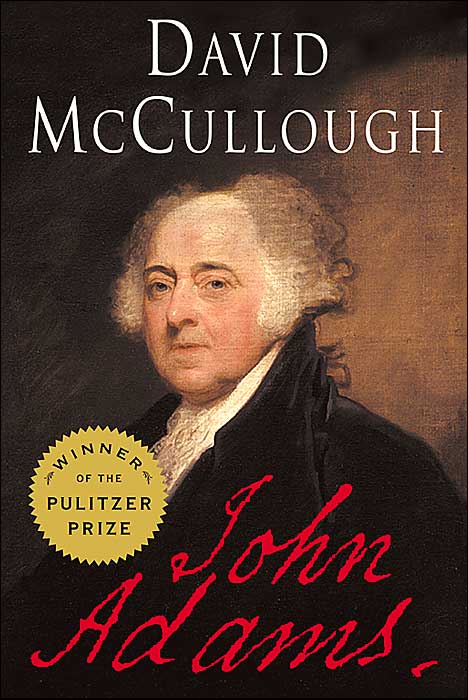
The mini-series is based on the thoroughly researched book John Adams by David McCullough.

A New York Times Bestseller! John Adams by David McCullough

Like the book, the mini-series painstakingly brought every single detail of colonial life alive in the production. Tom Hanks, a huge history buff, was one of the executive producers. It stars in addition to Paul Giamatti, Laura Linney (Abigail Adams), Tom Wilkinson (Ben Franklin) and David Morse (George Washington). The production team was dedicated to making the film look and feel exactly like life would have been in 1770’s America.

Official Poster. Such a smart tagline…He united the states of America.

They even aged the teeth of John and Abigail so by the end, they were pretty decayed. Exactly what people’s teeth would have looked like at the time! The whole production is a visual feast for not only the eyes but the imagination as well.

The opening theme delighted Ms. Jeannie.  Simple yet so dramatic and full of emotion. You can’t help but feel inspired by just watching that!

Since Ms. Jeannie used to live in Philadelphia it was equally fascinating to look at the sets and then remember the city as she knew it. Of course she has the done the history tour of Philadelphia many times, but now after watching the movie and reading the book she feels like she understands that time period, the city and our early government so much better now.

So if you want to fall in love with America all over again, Ms. Jeannie highly recommends losing yourself in this eight hour marathon. She guarentees you will walk away with a different perspective on our forefathers struggle to create our nation of independence.

“Let us tenderly and kindly cherish, therefore, the means of knowledge. Let us dare to read, think, speak, and write.” – John Adams

Have 4th of July dear blog readers!