There it is. In all the swoops and swirls, the dips, the flourishes, the misspellings, the slanted letters, the shaky hand. There’s the story and the memory. There’s the cook. There’s the guy, the gal, the friend, the aunt, the spouse, the sister, the dad, the mom. There’s the he, the her, the who, the what, the when. There’s the life.
Handwritten recipe cards and cooking scrapbooks are the heartbeat of the kitchen. They are the record keepers of culinary explorations. The physical testaments of good times and good food. The guardians of memories that ensure that loved ones long gone remain present and that favorites stay afloat.
On a handwritten recipe card, no one ever dies or moves away or leaves the friendship or the family. With every dot of an i, cross of a t, loop of an o, handwritten measurements, ingredient lists, and instruction guidelines pass over illnesses and arguments, ignore long distances and intermittent communications, rise above world events and traumatic upsets. They defy decades and borders, cities and languages, personality clashes and cultures. Hands down, there is no better way, and definitely no more delicious way, to get closer to a memory or a person than through food made from a recipe that has been passed down from one cook to another.
Whip up Aunt Louisa’s banana bread, Grandpa Gordon’s hot fudge cake or Cousin Camilla’s corn chowder soup. Put on a pot of Paula’s poblano chili or Theresa’s heirloom tomato sauce. Mix up a casserole of Betty’s baked brown rice or Sarah’s cheesy egg souffle, and these cooks suddenly appear in exactly the way you remember them. It doesn’t matter if the recipe is two years old, 28 years old, or 200 years old; magic still surrounds the very foods that once made the making of them so memorable.
In the late 1990s, my mom made a slim binder for each of her kids filled with all of our favorite family recipes. At the time, she was just learning how to use a computer, so instead of handwriting each one, which she normally would have done if there wasn’t so many recipes and four sets of copies to be made, she typed them out page by page, category by category, and printed them out. One copy for each binder.
I don’t recall how long it took her to type these recipes into the computer, nor exactly how many she included, but I do remember the excitement that I felt when the binder arrived. My mom grew up in a small town in the Pacific Northwest during the 1940s and was raised on food she often describes as wholesome and nutritional. Her parents valued hard work, resourcefulness, outdoor activities, and homemade food always made from scratch.
My mom and grandmother.
My grandmother would be the first to say that she did not think of herself as a great cook, but everything she ever made that I remember was delicious. Pot roast, twice-baked potatoes, homemade bread… those were some of her specialties. My mom learned the basics of cooking not so much from her mom but from her home ec class in school. When my mom became a mom herself and moved to California, my oldest sister remembers simple recipes and a lot of health food coming from the kitchen while she was growing up in that same from-scratch manner that my grandmother championed too. Fifteen years later, when I came along and the whole family was living in New York, my mom was traveling the world with my dad, courtesy of his airline executive career. Her culinary palate and pursuits expanded to include more international cuisine from the places she was often visiting. France, Italy, Germany, Egypt, Greece, Africa, Asia, the Mediterranean all influenced what she was making at home in one way or another.
My mom in Monte Carlo in the 1980s, shortly before we enjoyed a spectacular dinner of homemade risotto aboard our friend’s boat. Sadly, much to my whole family’s disappointment, we never collected that recipe to share.
Like my grandmother, my mom wouldn’t openly boast that she herself is a great cook. Even though the food she prepares has always been, and still is, undoubtedly delicious, and she’s well known among her friends and family for making lovely meals. But what she lacks in confidence or personal recognition, she more than makes up for in wholeheartedly promoting a good recipe when she sees one.
While I was growing up she was a devout reader of magazines like Sunset, Food & Wine, Bon Appetit, and Gourmet. My parents entertained quite a bit, often treating their NYC restaurant-regular-eating friends to a home-cooked meal at our family house located in a sleepy suburb along the Hudson River. And because my dad did a lot of dinnertime/cocktail party networking, my mom was always trying out new recipes on us kids that would be suitable for party fare or hosting my dad’s European colleagues.
So when her slim binder arrived in the mail just after I finished with college and was ready to start throwing my own dinner parties, it felt like the best, most dependable gift in the world. Thanks to her binder, I had all the good recipes in hand. The ones that always brought comfort, the ones that always received rave reviews, the ones that traveled well for potlucks and picnics, and the ones that looked especially pretty on a plate. The ones that came from her sister’s kitchen (also a wonderful cook) and the ones that came from her mom and dad and their parents. And the ones that my mom had perfected over years of revisions. In the binder were all my favorites… Thanksgiving stuffing, Grandma’s casserole, all the fruit pie recipes, the Israeli chicken, Aunt Patti’s chocolate layer cake, the tortellini summer salad, the three bean casserole, the German-style chicken with the creamy noodle sauce, the much-loved potato salad.
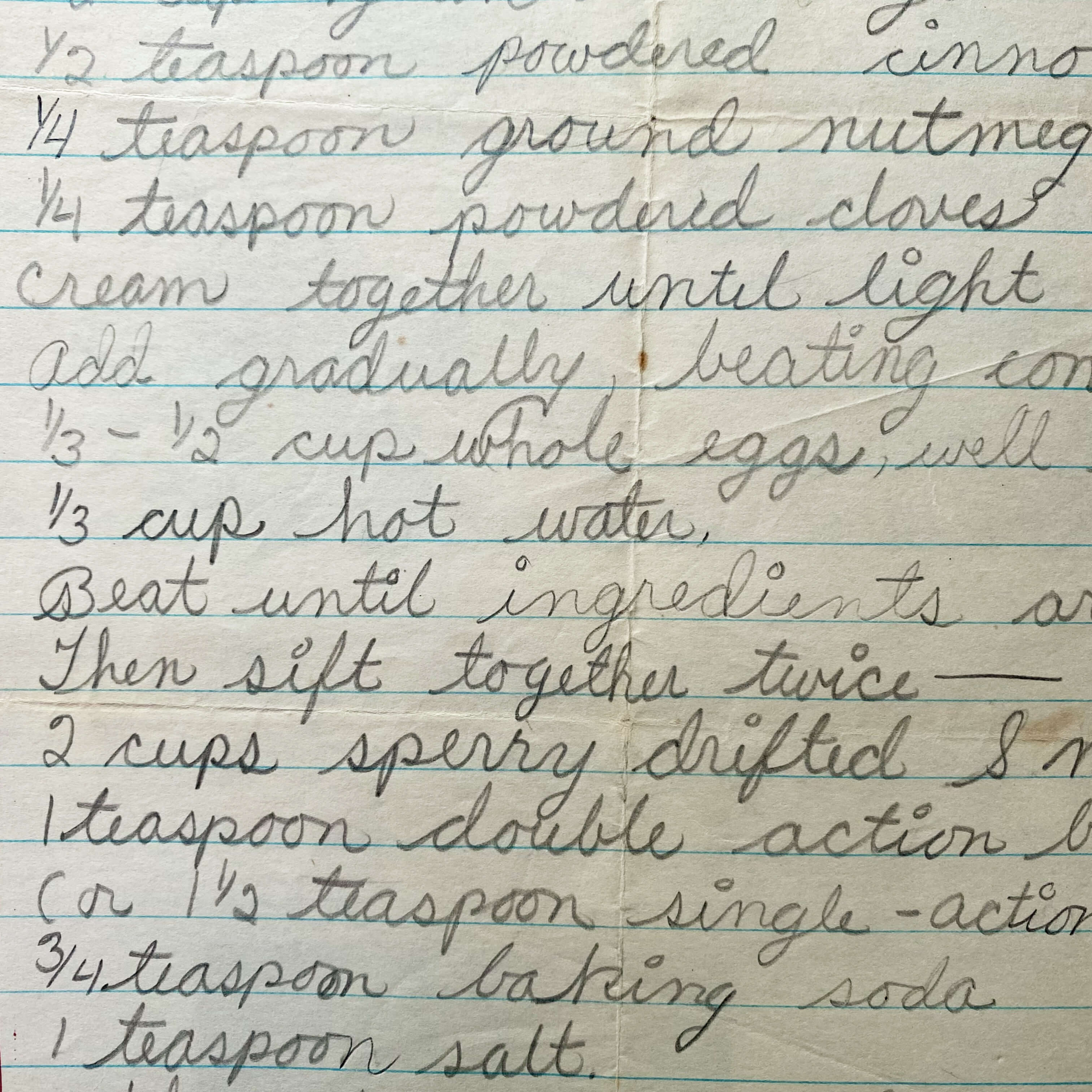
Not long after the binder arrived, my grandmother passed away at the age of 97. One of the things I asked my mom if I could have was some of my grandmother’s handwritten recipes from her recipe box. Back home, I taped each one, a little over two dozen in total, into the blank areas that separated one typed recipe from another in the binder. Those early additions of Grandma’s recipes led to further cutting and pasting inclusions as I, too, discovered and collected recipes from various sources. Friends, food magazines, newspapers, on-loan cookbooks, my brother and sisters, their spouses, their families, my husband, his family and a whole host of people I’ve had the joy of sharing a meal with along the way over these past decades all have a presence via a recipe or two or twenty in the binder.
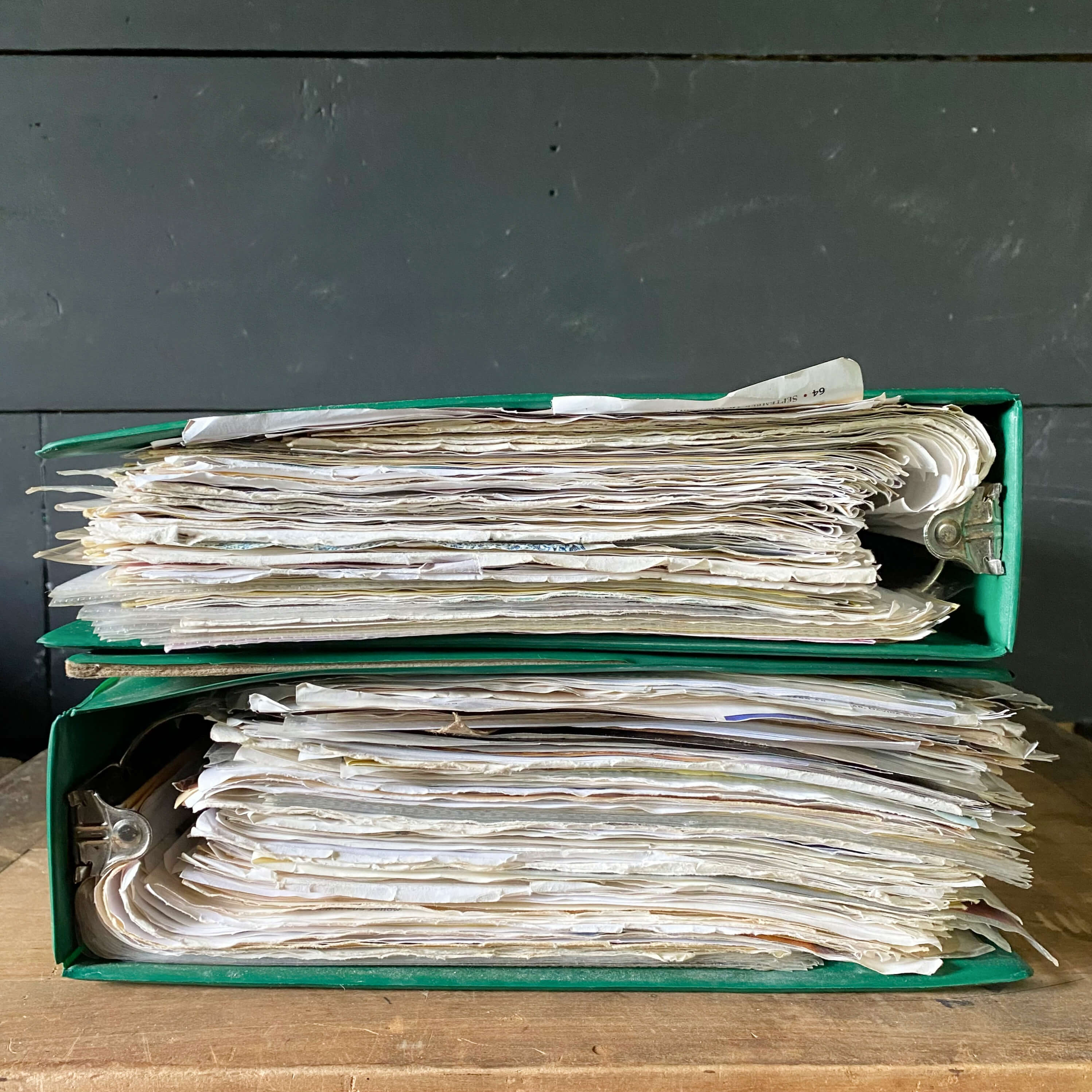
With each new recipe addition, my enthusiasm for cooking grew and grew. The binder grew and grew too. Eventually, it outgrew the slim size that my mom initially packaged the favorites in, and I transferred everything to an extra-large 3-inch binder. Quickly enough, that one filled up and overflowed, too. So a second extra-large 3-inch binder was acquired, and I divided half of my mom’s original categories into one binder and the other half into the second binder, thinking that I had arrived at the ultimate storage solution. But my enthusiasm for cooking and recipe collecting has yet to calm down, and the two binders are now stuffed full to bursting once again.
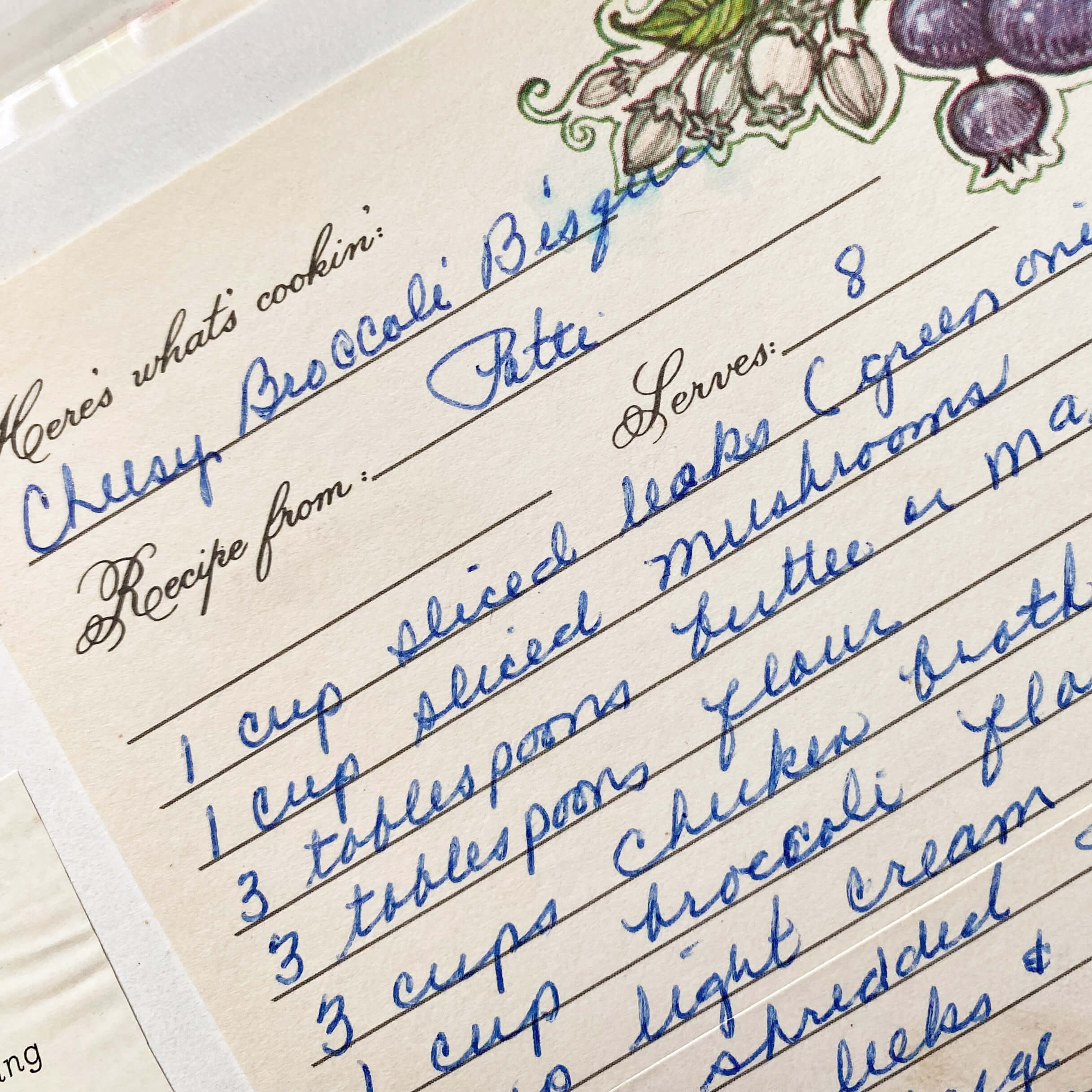
Despite their stuffed sausage appearance, now when I flip through these two binders, I see nothing but joy in years and years of memories. I see my mom’s handwriting in the original recipe category tabs.
I see my husband’s handwritten recipes for his pork pie inventions.
I see my sister-in-law’s slightly charred recipe card for baking powder biscuits that accidentally got stuck to the bottom of the baking sheet and cooked right along with the biscuits. I see the handwriting of my dearest friend, whom I’ve known since kindergarten, on a recipe for oven-roasted leeks that marks the first Thanksgiving that we cooked together.
There’s a recipe from my dad’s ex-wife written on his airline office stationery taped into the casserole section. There’s my grandmother’s delicate and lacy penmanship, my aunt’s large and loopy handwriting, midcentury recipe cards, tanned newspaper clippings from up-and-coming chefs featured in the New York Times, and hundreds of hand-cut recipes from all the great cooking magazines before they went online, before they created paywalls to access them, or before they folded for good. Recipes from Saveur, Bon Appetit, Gourmet, Southern Living, Cooking Light, Martha Stewart Living, Food & Wine all fill these binder pages, making them like my own homemade version of epicurious.com
The gift that my mom gave me years ago is the gift that has literally and figuratively kept on giving day in and day out. And it just keeps on encouraging more cooking and more collecting. That’s the power of a good passed-down recipe. I have my mom to thank for all this collecting and curiosity. For my love of old recipes and the memories they represent. My mom and I don’t always see eye to eye on everything, but when it comes to cooking, we have a shared interest and a mutual understanding surrounding food and meal-making that can always bring us together.
A lot of people inspire me when it comes to cooking, but it’s my mom’s slender binder of a book that was the original muse that started all this recipe collecting to begin with. I don’t think she could have known the depths to which I would eventually come to love her gift while she was typing away at those recipes on the computer all those years ago. How much her act of recording them would come to mean so much to my culinary journey. But now those recipes are among my most prized treasures. So it’s with a sincere heart on this Mother’s Day, that I wanted to say thank you to my mom for the joy she created in passing down our family favorites.
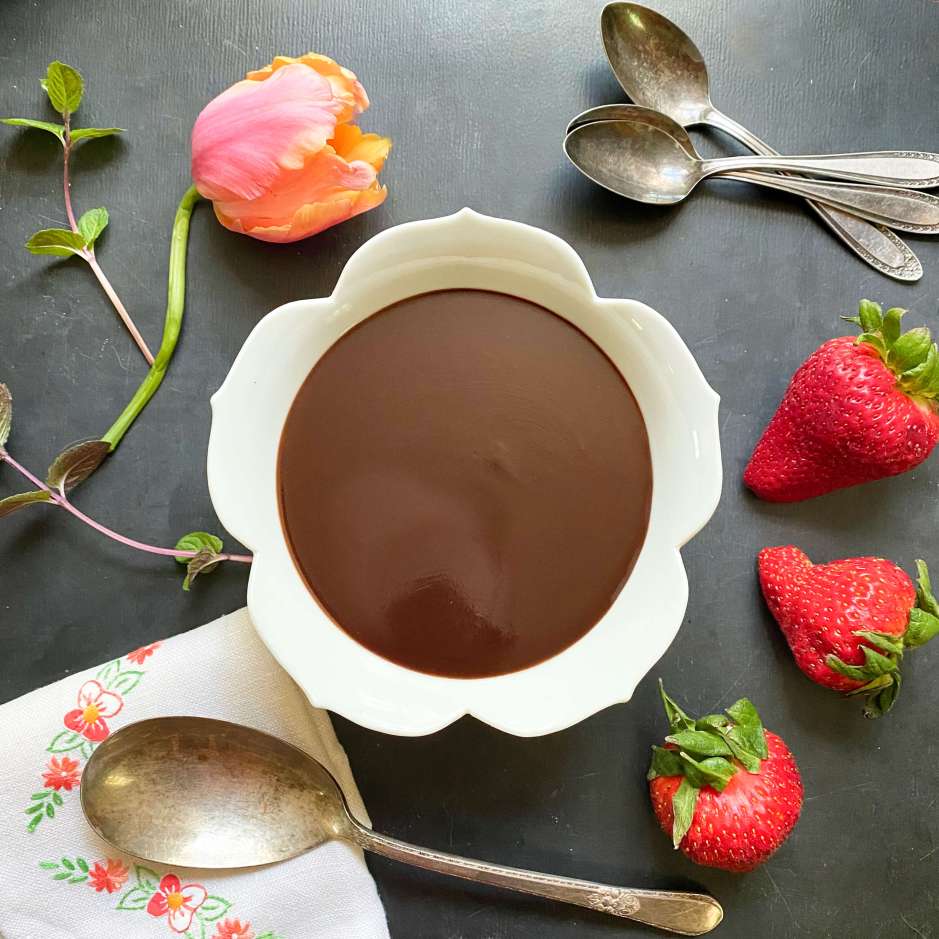
To celebrate the day and the occasion, I’m so happy to share one of the recipes from my mom’s family favorites collection. The recipe is for homemade chocolate sauce. A sweet treat companion that both inspires and complements so many other desserts.
Quick to make (less than 15 minutes) and lovely for all sorts of foods, it is thicker than syrup, yet thinner than frosting in consistency. It can be poured over ice cream like a hot fudge sundae, drizzled over a simple sheet cake like frosting, layered in clear glass stemware for parfaits, or served like a dipping sauce for fresh fruit.
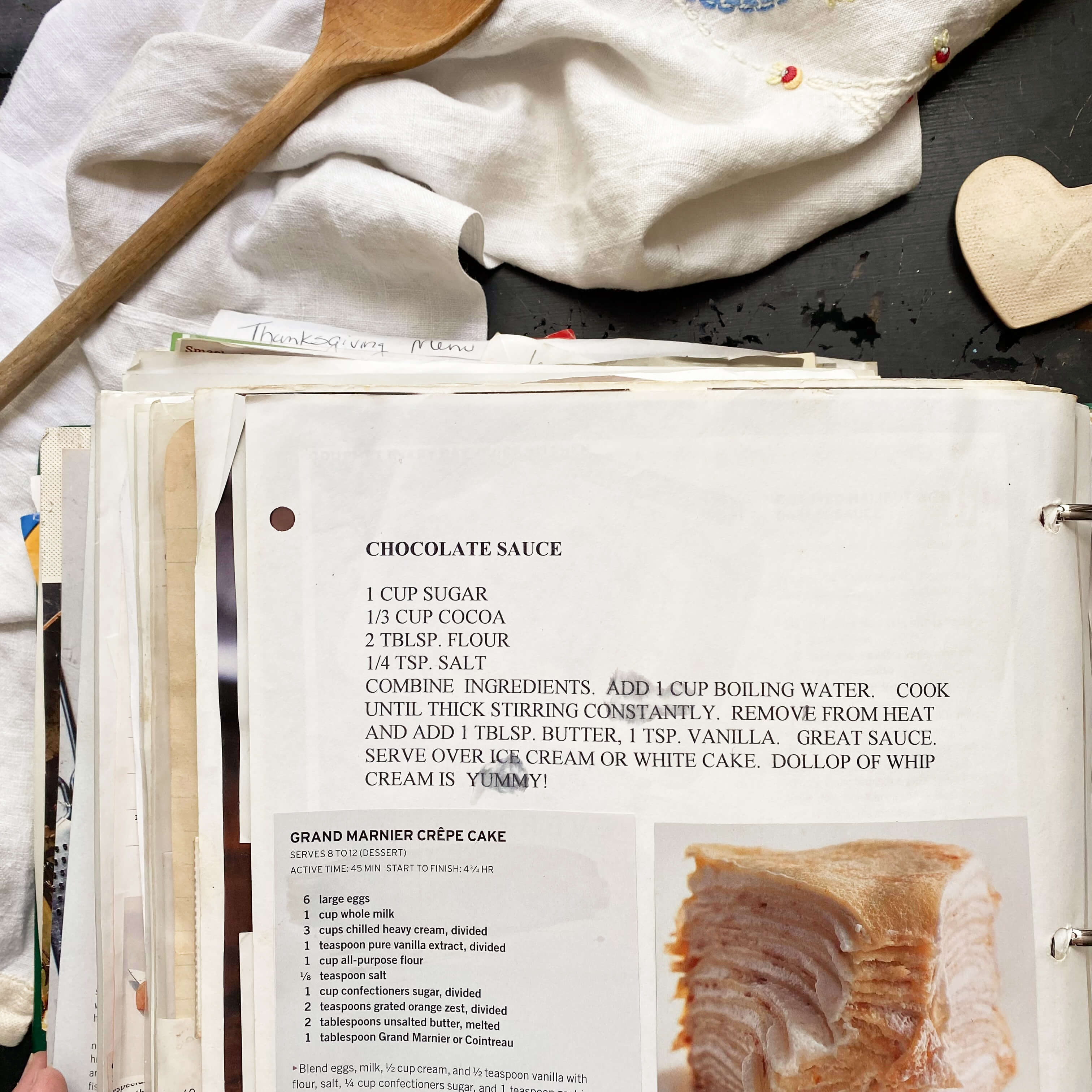
Always a winner in my book, I have made this recipe so many times for so many different holidays from Valentine’s Day to Christmas and every season in between. I’m not sure where my mom got the recipe from – if it was truly a family recipe that was passed down to her or if it was just a favorite that she picked up somewhere along her culinary adventures. I could Google these ingredients and probably find the source pretty quickly, but for once, the provenance doesn’t interest me. I’ll always think of it as my mom’s homemade chocolate sauce. And in turn, whenever I make it, I always think of my mom and her gift of good food. Tried and true.
Chocolate Sauce
Makes 2 cups
1 cup sugar 1/3 cup unsweetened cocoa powder 2 tablespoons flour 1/4 tsp salt 1 cup boiling water 1 tablespoon butter 1 teaspoon vanilla
Mix together the sugar, cocoa powder, flour, and salt in a medium saucepan.
Add in 1 cup of boiling water and stir constantly over medium-high heat while the mixture comes to a slow boil.
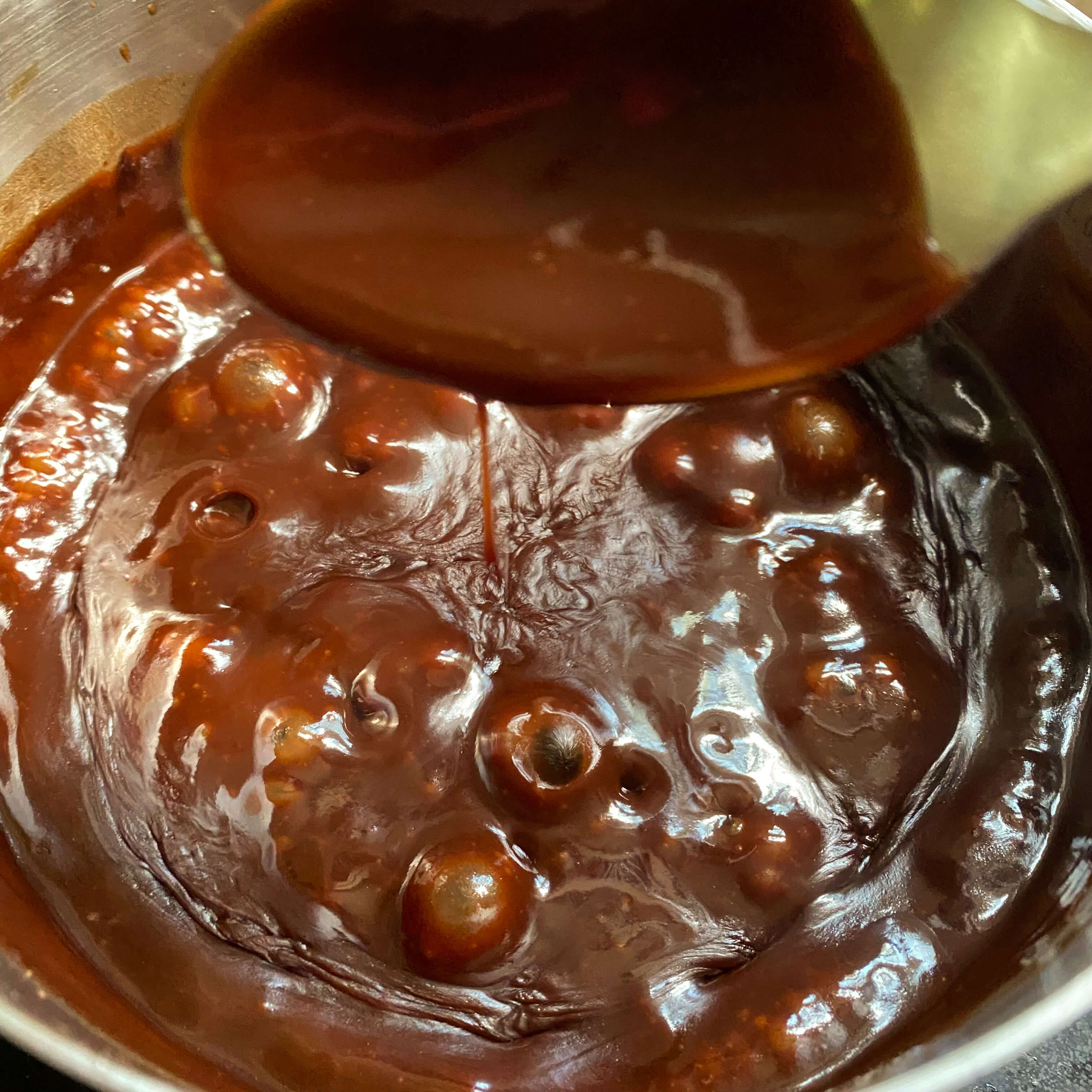
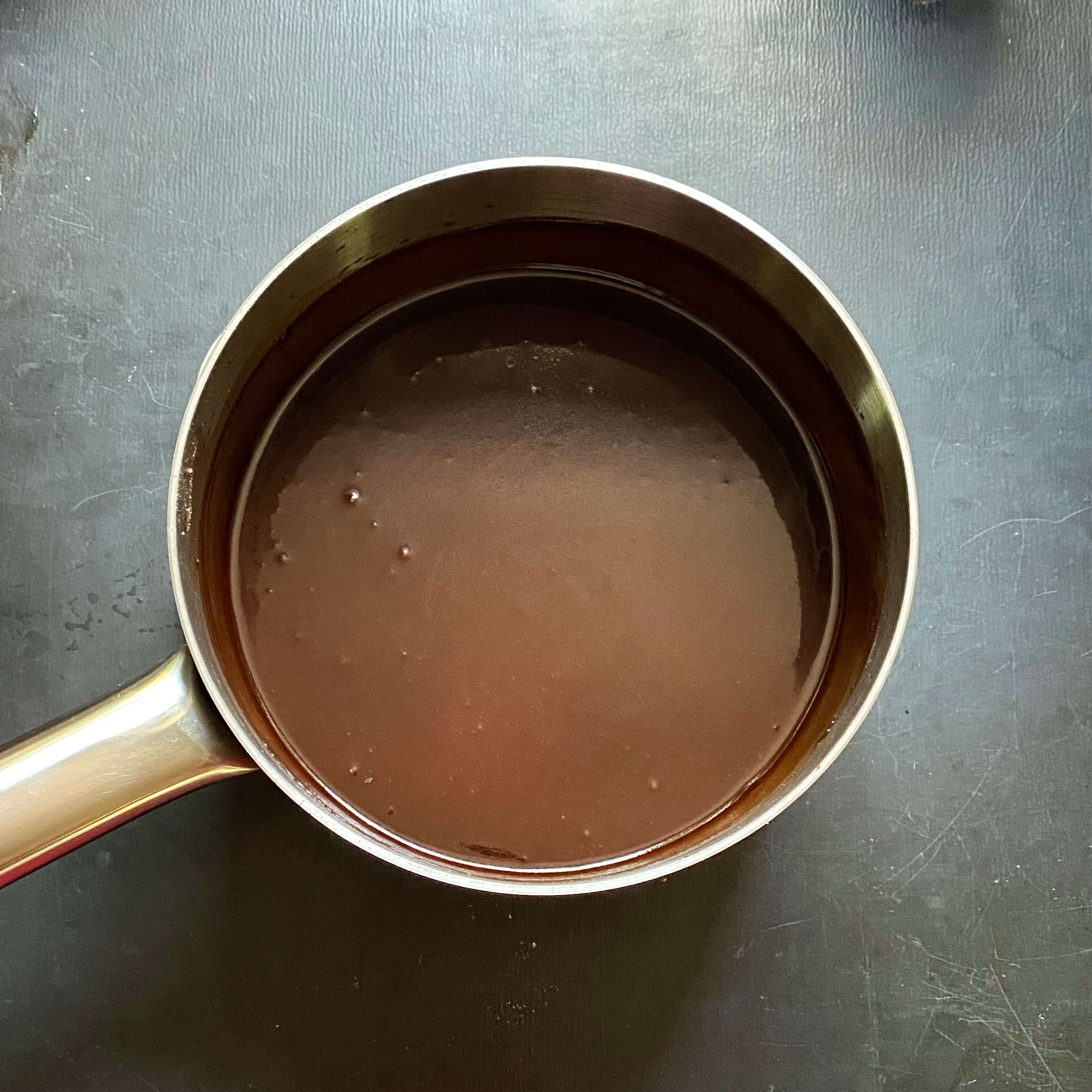
When the consistency thickens enough to coat a spoon but still drips off the spoon in a slow, steady stream, drop by drop, it’s ready to be removed from the heat. This consistency level usually takes about five minutes to achieve. Stir in the butter and vanilla. Serve hot or let cool to room temperature. If you have any leftovers, it stores well in the fridge in an air-tight glass jar for up to five days.
If you serve this as a dipping sauce with fruit, in a parfait, or over ice cream, let it cool to room temperature. If you are serving it over cake, serve it hot. There’s also room to add your own additional accompaniments too in the form of chopped nuts, coconut flakes, or a dollop of whipped cream as my mom suggested in her original recipe. However you choose to enjoy it, I hope it becomes a new favorite family recipe in your kitchen too.
Happy Mother’s Day to all the moms out there who inspire kitchen adventures in more ways than one. And cheers to my mom, for every single home-cooked meal, every single shared recipe, and every single family favorite that was recorded in the marvelous, magical gift that has now become my most treasured memory-keeper in the kitchen.
One of the biggest travesties in discovering a vintage embroidered linen at an antique shop or an estate sale or an auction house is not knowing anything about the sewer who made it. The sewer who so beautifully executed a specific stitch or a scene. The sewer who skillfully transformed a plain piece of fabric into a stunning work of art. Who spent hours or days working towards a piece of self-expression in the same way a painter paints a canvas or a sculptor builds a statue. With the exception of antique samplers and quilts, which often carry the names of the artist who made them, embroidered linens of the past are history’s most uncredited works of art.
“These small bits of embroidered cloth are often all that remains to testify to the otherwise unrecorded lives of their makers,” wrote Amelia Peck in a 2003 article highlighting the embroidery collection at the Metropolitan Museum of Art. It could be easy to dismiss some old pieces of fabric until you read a statement like that.
Needless to say, Amelia’s remark has stuck with me for a long time. Whenever a new batch of vintage or antique linens comes into the shop, I always think about the woman behind the fabric, the sewer behind the stitchwork, and the circumstances in history that might have surrounded them both. In collecting and curating these items for the shop, I’m not often afforded any real-life stories that can be attached and retold about a specific linen or the life that made it. But today I’m very pleased to introduce you to a woman in Minnesota who has some stories to share about sewing.
At this point, you might be nonchalant and think how much can I learn from an 8” inch x 8” inch piece of fabric? A napkin is a napkin afterall. But here in the land of the Vintage Kitchen a napkin, as you’ll discover in this post is much more. It’s a gateway… to stories of the past.
When I first met DeDe, who is in her 70’s, it was over email in the beginning of February. She was looking to rehome her vintage linen collection, and in her initial inquiry as to whether or not I might be interested in it for the shop, she mentioned the fact that her mom had sewn some of the pieces. The slice of vintage life that poured out over the next several months and many emails was so interesting I knew hers was a story destined for the blog. Touching on Italian immigration, women’s history, cooking, Minnesota, entrepreneurism, family heirlooms and her mother’s zesty love of life, this interview turned out to be the perfect heartwarming story for Mother’s Day weekend. So yes, a napkin is a napkin. But it’s also a life, and a family, and a passion.
Let’s meet DeDe, her mom Teresa, and their family…
Teresa as a baby with her parents Carmina and Salvatore.
In The Vintage Kitchen: Tell us a little bit about your mom’s parents. What brought them to America? Where were they from in Italy and how did they wind up living in Minnesota? Did they assimilate well?
Dede: My grandparents, Carmina and Salvatore, were both from Boiano, Campobasso, Molise, Italy.
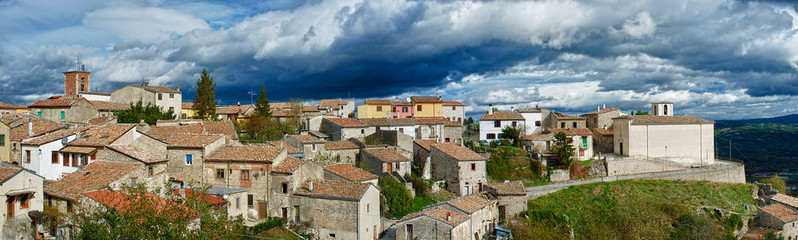
Located in central Italy, the town of Boiano in the province of Campobasso in Molise, Italy was first founded in the 7th century. It is home to the oldest chestnut trees in Italy and most well known for its mozzerella cheese produced using milk from cows that have grazed the surrounding mountainsides.
My grandparents were married in 1906 and in 1909 they came to Minnesota. Grandpa worked in the mines in Chisholm, Calumet, Stevenson and St. Paul. He was employed by the Pickands Mater Co. for over 40 years. There were many different nationalities on the Iron Range and I imagine like all immigrants today they left Italy and were looking for a better life. I never heard of anyone in the family having difficulty assimilating into the community as they were fortunate to have siblings and many Italians in their community. A sister of my Grandmother’s and a cousin and brother of my Grandfather also immigrated to Keewatin.
My mother Mary Teresa Rico was born on February 25, 1911 and was the oldest of six children. She was born in Hibbing, Minnesota and the town they lived in was Keewatin. A population of less than 2,000.
Main Street in Keewatin circa 1921. To learn more history about this midwestern mining town visit here. Photo courtesy of lakesnwoods.com
EDITORIAL NOTE: During her childhood throughout the 1920s, starting at the age of 10, Teresa was involved in 4-H, a youth development program whose mission was (and still is!) “to encourage kids to reach their fullest potential while also creating positive change within their community.” This experience turned out to be a gateway for Teresa – one in which she could showcase her natural talents and abilities. While naturally gifted in a range of extra-curricular activities including basketball, tennis and dramatics, two of Teresa’s most prized talents were baking and sewing. A consistent winner at state and county fairs, between the years 1921 and 1931, Teresa baked more than 1,000 cakes and 2,000 loaves of bread which she sold to local residents in an effort to raise money for her college tuition. Triumphantly, through those entrepreneurial endeavors, Teresa managed to raise $3000.00, which provided enough for her to enroll in the University of Minnesota.
Teresa (age 17) in 1929 – the State Champion at her baking table.
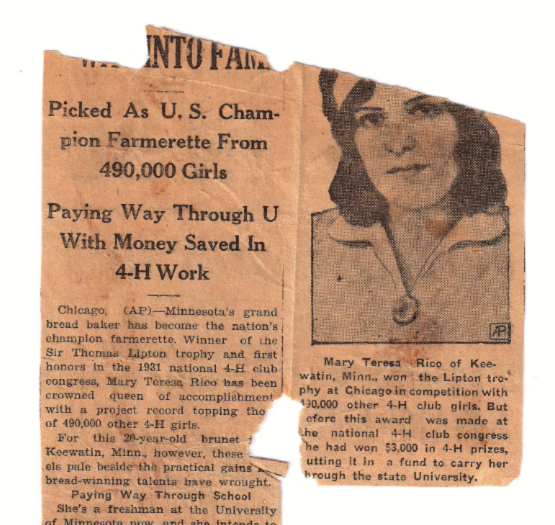
In 1931, at the age of 20, the last year she was eligible to participate in 4-H due to age caps, Teresa won the Sir Thomas Lipton Trophy, competing against 490,000 other girls. This was an honor awarded by Thomas Lipton (of Lipton Tea fame) that signified overall achievement and was given to the top boy and top girl in 4-H. In addition to a trophy and significant media attention, the award also came with a scholarship, ensuring that Teresa would financially be able to put herself through college, assistance free, all on her own accord.
This local Minnesota newspaper article proudly called Teresa the “Queen of Accomplishment” and reiterated her goal of putting herself through college without any finanncial assistence.
In The Vintage Kitchen: Your mom must have felt really proud of that moment, especially winning out over so many other 4-H’ers (490,000 female candidates!). Also, this happened in 1931, during the Great Depression. The fact that she was able to pay her way through college with her baking is fantastic. That must have been a really big deal. Were her parents really proud of her too?
Teresa and her fellow prize winner, Charles L. Brown posed for photos with their Lipton trophies in 1931. The Associated Press
DeDe: I am sure that my Grandparents were very proud of her winning the Sir Lipton Cup and also all the other accomplishments in her life, of which I refer to in the following questions. One of the newspaper clippings mentioned winning over 850,000 young women, quite a discrepancy.
My mother did not really talk about her accomplishments and honestly, I really did not learn about how much she really did until my parents downsized into an apartment. My mother had kept newspaper clippings, pictures, ribbons from the State Fair, etc. But my father did not keep much so he was tossing much of this into the trash barrel. I was able to rescue some of it and put it into a scrapbook for her. After that, we really did start to talk about her accomplishments in detail.
Teresa with her girls explaining all about her State Fair ribbons.
Sadly, as children we are absorbed in our own lives. This is not to say that I was not aware of the bolts of fabric and the sewing she was doing when I was a young child as well as the entertaining and fabulous cooking and baking that she was always doing. When I was in junior high school my mother was no longer sewing for others and instead went to work in retail. She had an incredible style knowledge for clothing and furnishings and an eye for fashion. The perk for me were the wonderful fashionable outfits I owned.
In The Vintage Kitchen: The Lipton Trophy newspaper article mentions that she was “boss of her household” both in the kitchen and otherwise. Can you tell us a little bit more about her family life growing up?
DeDe: My mother and her siblings all enjoyed sports and her brothers all played football in high school and the girls played whatever sports were offered for them but it sounded like choir and drama were offered to women. At home, my grandparents listened to records which were mostly opera. They all enjoyed dancing and playing cards with friends and family. Neighbors would get together and socialize. Food was always involved. The siblings all enjoyed one another which continued on for them as adults. My uncles loved to play jokes and there was always a lot of laughter and singing. Perhaps they all thought they were Enrico Caruso.
As far as my mother’s role at home, she shared that she would often make meals for her family and certainly she made all the bread. She was also sewing her own clothes as well as making dresses for her sisters and mother. Often her family pictures indicated that she had sewn the clothing her mother or siblings were wearing. Again, my mother was the oldest and she was a very strong determined woman who knew exactly what she wanted. Not a bad trait to have.
Teresa in the center with her sisters all sporting dresses that Teresa made for a special family celebration.
In The Vintage Kitchen: Did her parents speak English?
DeDe: Yes, my Grandparents spoke English very well but when my aunts and uncles would come over to our house on weekends to see Grandma and Grandpa, they all spoke Italian. We had many family Sunday dinners at home as everyone wanted to see Grandma and Grandpa. It was frustrating to not know what they were saying because I nor my siblings and cousins did not speak any Italian other than a few words.
In The Vintage Kitchen: Were her brothers and sisters equally as industrious?
DeDe: My uncle Pat was a chef and the others all made a decent living but no one was as driven or creative as my mother.
In The Vintage Kitchen: Tell us a little bit about your dad. What was he studying at the University of Minnesota?
DeDe: My father’s heritage was English and Irish not Italian. His grandfather Ward immigrated to America from Ireland as a young boy with his widowed mother and siblings. His mother’s family originated from Colonial New England. He was a very patient and darling man with a very big heart and a great sense of humor. I always thought he was very handsome and debonair. He grew up in Wisconsin Rapids, Wisconsin. As far as my father’s culinary talents he loved to make chili and simple meals. However, he loved his desserts and there were always homemade cookies, pies, and cakes in our home.He studied engineering at the University of Minnesota.
Teresa and George
In The Vintage Kitchen: What did your mom study?
DeDe: She studied Home Economics. My motherwas not only an accomplished baker and chef, she was also an accomplished seamstress and had her own cottage industry, Teresina. Neighborhood women sewed for my Mother and at that time she was paying them $5.00 an hour. She sewed beautiful women’s clothing, draperies, anything else you could imagine.
As a child we always went to Amluxson’s where I was able to pick out fabric for my first day of school. She made many of my clothes as well for my brother and sister. She reupholstered furniture as well and made men’s clothing too. Her industrial Singer was in our basement and I have beautiful memories of her singing while she sewed. A favorite was the Maurice Chevalier song Louise.
She also wrote articles for the Minneapolis Star Tribune called Sewing is Simple. Over the years my mother was someone who often was featured for her sewing or entertaining.
Teresa was featured in a magazine ad for Folgers – – It was no surprise to the neighbors of Mrs. George D. Ward of Minneapolis, Minnesota when her Orange Delight Cupcakes won First Prize at the State Fair. She’s famous for’em! Have them for dinner along with another “Famous Flavor” — Mountain Grown Folgers Coffee. Copies of this ad now hang in DeDe’s home as well as the homes of her kids.
In The Vintage Kitchen: Did your dad encourage and support your mom as she started her Teresina sewing business?
DeDe: Definitely. My father was very supportive of whatever my mother wanted to do. And honestly if my mother wanted to do something nothing would stop her. She was a force to be reckoned with but as generous as could be.
Teresa’s Teresina ribbon labels.
My mother was color blind. Thread as you know used to be on wooden spools. My dad would write the colors of the thread on the spools for her.
In The Vintage Kitchen: We hear so much about gender discrimination regarding women in the 20th century, but it seems like your mom really defied a lot of those stereotypes (working, going to college, having her own business, etc.). Can you tell us a little bit about her motivations and about how her ideas were received within her family and her community?
DeDe: My mother had a strong desire and a dream to make things happen. She never spoke of any obstacles being in her way that I recall. She did mention that as a child in school they were not allowed to speak Italian, only English. There were so many nationalities on the range, that it would have been difficult for a teacher to deal with so many languages in a classroom.
Her family appreciated her and at any given time we had a relative living with us. Multigenerational homes were very common. My mother was very generous and shared whatever she had with others. She was also very involved with the Italian Community in Minneapolis. When she had her Teresina company in our home, she employed neighborhood women who she paid quite generously for that time.
Community-wise, looking at old newspaper clippings my mother was involved with the Minneapolis Symphony Orchestra and one year put on an Italian Feast as a Fund Raiser. There were three children in my family and my mother was involved in all our school activities from PTA and being a Scout Leader or a Den Mother to sewing costumes and lending her living room furniture for high school drama productions.
DeDe with her brother and sister and her parents, Teresa and George.
One of the greatest tributes to my mother and the impression she made on others became evident at her funeral. When she passed away and her obituary was in the newspaper, I received a call from a young woman who said she would like to come to my home and meet me. When my mother lived in her Minneapolis apartment building, she befriended this young woman whose parents were divorced. With this young women’s birthday coming up she made her a German Chocolate Birthday Cake and gave her pearl earrings from her days at the U of M. She was truly touched by my mother’s friendship and she wanted to speak at her upcoming funeral. I took a leap of faith and said okay to this request. She did speak that day and it turns out that she was a speaker for Billy Graham and she was incredible. What a gift she gave us. I regret that I did not stay in contact with her and what a treasure that tribute would be too own today.
In The Vintage Kitchen: What did she like about sewing?
I am sure it was the creativity of it all and the fact that she could make something beautiful and functional.
Vintage 1940s/1950s era applique sailboat kitchen linens made by Teresa.
In The Vintage Kitchen: Where did she gather inspiration from in regards to her sewing projects?
DeDe: My mother had an ability to see how to improve things. It did not matter if it was a food item, a piece of furniture or a piece of fabric. She would have a vision and would make it happen. She loved to repurpose as evident in her Sewing is Simple articles for the Minneapolis Star Tribune. I had mentioned to you in earlier emails that she made clothing, drapes, upholstered furniture and wrote for the newspaper but there is more. My mother also came up with an idea for an adjustable elastic waistband for women’s skirts that she made from fabrics such as drapery material and chintz. She created a patent for it but unfortunately, someone else managed to maneuver it away from her. I have one of the skirts left that I use for a Christmas Tree Skirt.
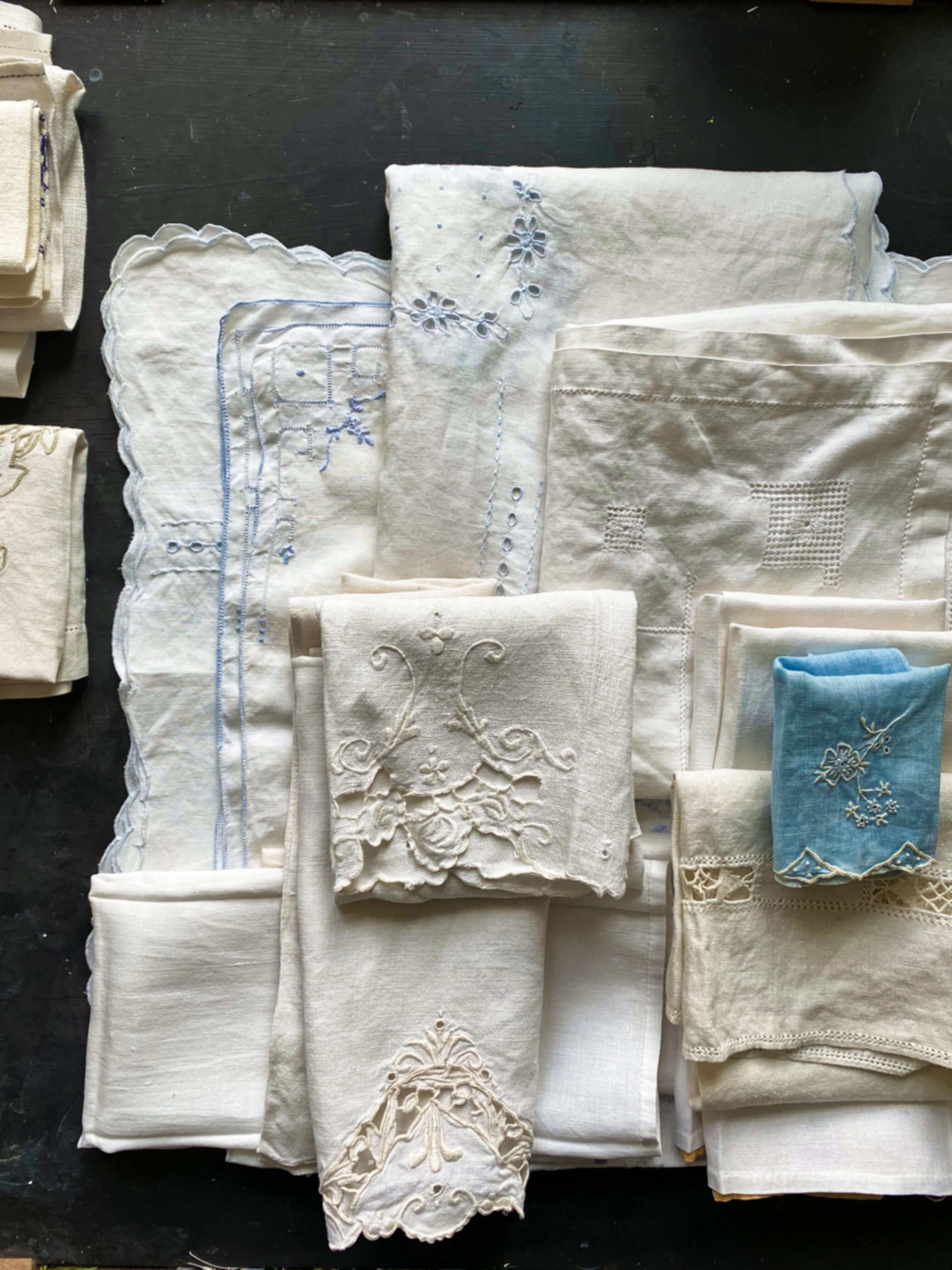
EDITORIAL NOTE: I was thrilled to welcome Teresa’s vintage linen collection into the shop. These next few questions and accompanying photographs highlight some specific pieces from her carefully curated linen collection amassed throughout her life.
In The Vintage Kitchen: Did she sew all the linens that you sent?
DeDe: I do not believe that she sewed all of them. I know the applique ones with boats on them and definitely the items that have lace. Honestly, they have been in a cupboard for years either with my mother or myself and my mother passed away many years ago.
In The Vintage Kitchen: In the package that you sent, there are 4 tablecloths which I think you referred to as bridge cloths. Did your mom sew those?
DeDe: I always referred to them as bridge table cloths but others might call them a luncheon cloth. No, I believe those were purchased.
In The Vintage Kitchen: One of them, along with several other linens you sent, looks like they are made with antique fabric. Could they have belonged to your grandmother?
DeDe: Probably not. My mother also loved house sales and again had an eye for finding wonderful things to furnish a home.
A set of colorful vintage tea towels joyfully collected by Teresa. This is just one example of her carefully curated linen collection amassed during the 20th century.
In The Vintage Kitchen: Was your grandmother, Carmina, a sewer too?
DeDe: Not that I am aware of. I recall my grandmother having cataracts and her sight was compromised. My mother told me she had taught herself to sew as a young girl. She started off with making clothes for her dolls and as she grew older, she started to sew for herself and her sisters.
In The Vintage Kitchen: How long did your mother maintain Teresina?
DeDe: I believe she kept it going through the 1950s. She sewed her entire life. She would make outfits and Halloween costumes for the grandchildren. In the 1970s, she was still sewing some beautiful outfits for me.
In The Vintage Kitchen: Where did you grow up?
DeDe: I grew up in Minneapolis, Minnesota on one of the city lakes. It was an ideal time to live there.
A view of Minneapolis taken during the 1950s. Photo via pinterest.
In The Vintage Kitchen: Did your mom expect you to be as industrious as she was during her childhood?
DeDe: My mother accepted us for who we were. Keewatin is a small community and Minneapolis is not, so opportunities for me were vastly different than what was available for her. I honestly did not feel pressured to be anyone other than myself.
In The Vintage Kitchen: Did she teach you how to cook and sew?
DeDe: Yes, my mother taught me to bake and cook. It was wonderful to be in her kitchen with all of the wonderful smells and tastes. I love to cook and entertain in our home much as my mother always did. Baking and cooking for others brings me great joy. Sewing is another story. I can sew out of desperation, but I only enjoy small projects and the older I get the less I attempt. I am not a seamstress and sewing stresses me out although I always kept trying. I expected it to be as easy for me as it was for her. Fortunately, I did inherit her love of cooking.
In The Vintage Kitchen: Thank you so much for including your mom’s sauce recipe. Was this a recipe that was handed down to her or did she make it up on her own?
DeDe: It was probably a recipe that was given to her by Grandma Rico. It is a pretty traditional sauce. I have shared that recipe with so many friends along with my mother’s wisdom of you can always add more herbs so start off with less. Of course, when you add a meat to the sauce it definitely helps to flavor it. I adore my mother’s red sauce and often tried to make it just like hers. The last Christmas she was alive she stayed with us for a few days and we had a blast. We looked at her old slides of her travels to Italy with my dad, baked traditional foods, and just laughed a lot. I had started a red sauce and ran to the store for a few items that I needed. Later when I was stirring the sauce and tasting it, I was overjoyed at how wonderful it was. I exclaimed to my mother that I was thrilled that I could make it like hers. She just smiled and later admitted that while I was gone, she had doctored it.
In The Vintage Kitchen: Was your mom’s love of sewing and cooking passed down to any of your kids?
DeDe: Actually, all the kids are very good cooks and will try out new recipes. My oldest niece does fun sewing projects and is very creative and like my mother is great at repurposing. She also enjoys baking and shares recipes with me. My daughter will try new recipes and make lighter fare than I do. I tend to cook more old school than my kids do. My boys love to make pizza with a homemade crust. Sometimes my oldest and his wife will make pasta when time allows. Everything comes down to when time allows. The grandkids are all interested in cooking and baking which I just adore.
In The Vintage Kitchen: Where do you draw inspiration from for your own cooking?
DeDe: A favorite for me is to eat something out and then try to duplicate it at home. I have come up with some interesting dinners that way. I see something that looks tempting in a magazine or the newspaper and I will try it although I will often massage the recipe. My husband loves to tell me that I use them like a road map and then veer off course. I enjoy making Italian dishes for friends and family but I adored Splendid Table when Lynne Rossetto Kasper hosted it. She had a segment of what to make with a few ingredients in your refrigerator. I am a great one to try that method.
If you are unfamiliar with the engaging Lynne or The Splendid Table radio program that she co-created and hosted for 20 years here’s a quick recap. DeDe and I are both BIG fans of Lynne and the show!
Lynne came to our home for a fund-raising dinner and I along with a friend were the ones that were cooking. Cooking for a professional cook and author was very intimidating. It turned out to be a fabulous evening.
In The Vintage Kitchen: Wow, DeDe! That’s amazing that you got to not only meet but also cook for Lynne! I’m a BIG fan of hers! What was that experience like?
DeDe: The dinner was very simple with a simple antipasto tray, roasted chicken, and delicious roasted root vegetables along with a tossed salad. I do not recall if I made homemade bread for this or purchased store-bought. My dessert was a fried Italian pastry that we called curly cues. They are fried in oil and dusted with powdered sugar or drizzled with honey. My mother always made these at Christmas and often I will too. I probably served the lemon sherbet with crème de menthe. There were six guests and Lynne that night. One was a surgeon who was kind enough to slice the chicken and arrange it on the platter and another was a woman who owns a cooking school and I believe leads trips to Italy or did back then. I consider myself a decent cook but felt a little out of my league that evening. Unfortunately, we did not take pictures of that fabulous evening but my Lynne Rossetto Kasper cookbook is signed by Lynne. This was years ago.
In 2017, Lynne retired, but thankfully, that was not the end of the program. The Splendid Table continues each week with fresh and dynamic culinary content thanks a new, equally charming host, Francis Lam. If you haven’t listened to the show before I highly recommend it. Visit the link here to learn more.
In The Vintage Kitchen: Do you have any particular favorite chefs or cookbooks that you love?
DeDe: I have many of my mother’s old cookbooks and my comfort food choice of my childhood go-to is the Betty Crocker Picture Cookbook from the 1950s. Chicken A La King, Meatloaf, Pineapple Upside Down Cake, Jelly Roll Cake, and all the basics are there.
The Betty Crocker Picture Cook Book – First Edition, 1950
With my mom’s recipes, many are from worn cookbooks, notes scribbled inside a cookbook, note cards or from what I recall her making. Many of my recipes are handed down from mom, relatives and friends and have been doctored to suit my tastes. Italian favorites are The Talisman Italian Cookbook by Ada Boni, The Art of Italian Cooking by Maria Lo Pinto and Milo Miloradovich and Leone’s Italian Cookbook by Gene Leone. I love Gourmet magazine and cooking shows on PBS but I really do not have a favorite chef.
DeDe’s favorite vintage Italian recipe resources!
In The Vintage Kitchen: Tell us a little bit about your trip to Italy? Did you feel a natural connection to the country?
DeDe: Our oldest son was studying in Florence, Italy for a semester at the same time as his friend so we traveled to see him with his parents in March. My parents had been to Italy twice to see the sights and my mother’s family. My mother was so excited that our son was traveling there and that we were going to as well. It was our first trip to Europe and it was magical. It was so fun to see people that looked like my mother’s family and to hear all that Italian. So much history and beautiful architecture, museums and people. I soon learned why I appreciate gold, glitz, and all the pizzazz.
Two trips to Trevi Fountain: Teresa and George (above) in Italy many decades ago and Dede and her husband Tom (below) on a more recent excursion.
Travel is all about the experiences. One such experience for me was to see two over the road drivers enjoying their lunch at a rest stop. They had a beautifully set table complete with linens and glassware. Their food looked scrumptious and I asked if I might take a picture of them. They agreed only if I would be in the picture and share their vino. I treasure that moment and the picture. The one Italian reminded me of my grandfather.
DeDe with her “over the road drivers” in Italy!
Another story that related to my mother is the time we had to wait for a very long time for a table for our dinner. The uncle who was seating us was very friendly and attentive to our dinner choices. When we finished, he said that he had a treat for us because we had been so patient. When he brought us our dessert it was lemon sherbet drizzled with creme de menthe. Oh, how I laughed as that was a favorite of my mother’s to serve after a heavy dinner along with the traditional Carnevale Italian bow tie cookies.
My mother passed away that May. She was so excited that we were going on this trip and I believe she stayed alive until we could share our stories with her.
Filled with light and love and so fitting for this post, this street art was spotted on a Florentine wall. Photo: Nick Fewings
In The Vintage Kitchen: And what was it like visiting some of the places where your grandparents lived?
DeDe: My Grandparents lived in a town outside of Naples and we did not get to Naples but we did see Milan, Rome, Venice, and Florence. I hope to one day get to Naples.
The sights that inspire DeDe in and around Minneapolis. Clockwise from top left: The Minneapolis Chain of Lakes; The Basilica of St. Mary (switchroyale); The Gutherie Theater (Mark Vandeve); The Minneapolis Institute of Art (McGhiever); The Stone Bridge Arch (Minneapolis Parks and Recreation Board).
In The Vintage Kitchen: Name five places that inspire you in your city…
DeDe: The Minneapolis Chain of Lakes and our incredible parks system. The Guthrie Theater that offers classical and contemporary productions. The Minneapolis Institute of Art is an art museum that is home to more than 90,000 works of art representing 5,000 years of world history. The Basilica of St. Mary as It was the first basilica established in the United States. The Stone Arch Bridge is a former railroad bridge crossing the Mississippi River at Saint Anthony Falls in downtown Minneapolis, Minnesota. It is the only arched bridge made of stone on the entire Mississippi River.
In The Vintage Kitchen: If there is one thing that you wish could never be forgotten about your heritage, what would it be?
DeDe: The belief in the importance of family and nurturing with food and compassion.
In The Vintage Kitchen: If you could invite six people (living or dead) to dinner, who would you invite and why?
Clockwise from top left: DeDe’s Parents Teresa & George; Pope Francis; Geraldine Ferraro, Margaret Meade, Eleanor Roosevelt
DeDe: My parents. Since I have been working on Ancestry there are so many unanswered questions that I have. Geraldine A. Ferraro, so I could ask her this question…. Would you have changed how you ran your campaign for Vice President with Walter Mondale? Margaret Meade because I have been fascinated with her since I took my first anthropology class in college. Eleanor Roosevelt because she was the woman behind the man and she is the longest-serving First Lady. Pope Francis, so that I could ask him about what changes he wants to see within the Catholic Church.
In The Vintage Kitchen: And because it’s Mother’s Day, we’ll end with a question about Teresa. What is the greatest lesson your mother taught you?
DeDe: Definitely the love of entertaining, the comfort of food and the sharing of her talents. Happy Mother’s Day Mom. I love you!!
In addition to sharing these lovely stories about Teresa, DeDe also graciously shared her mom’s “red sauce,” the recipe, she referred to her in her interview that was most likely passed down by Teresa’s mother, Carmina. I made two batches of this sauce (one using pork chops, the other using chicken legs). Both were incredible.
Teresa’s Basic Spaghetti Sauce
2 tablespoons olive oil
4 garlic cloves, crushed
1 onion, roughly chopped
1 small can tomato paste
3-28oz cans Italian peeled tomatoes ( or 5.25lbs of fresh tomatoes, skins on, roughly chopped)
16 oz can tomato sauce
2 cups water
Salt & Freshly ground pepper
1 tablespoon sugar
6 fresh basil leaves, torn into small pieces (or dried herbs*)
3 fresh oregano sprigs, torn into pieces (or dried herbs*)
1/2 green pepper, chopped
1/4 cup finely chopped fresh flat leaf parsley
2 veal chops or pork chops
*If using dried herbs, start off with 1 teaspoon each and amend from there to suit your taste.
To make the sauce, heat the oil in a large heavy pot over medium heat. Pat the pork/veal dry and put in the pot. Cook turning occasionally for about 15 minutes or until nicely browned. Transfer the chops to a plate.
Drain off most of the fat from the pot. Add the garlic and onion, cook until golden brown. Add the green pepper and cook for two minutes until tender. Stir in the tomato paste and cook for 1 minute.
Chop up the tomatoes and add to the pot, including the liquid. Add tomato sauce, water, sugar, parsley, basil, oregano and salt and pepper to taste. Add the chops and bring sauce to a simmer. Partially cover the pot and cook over low heat, stirring occasionally, for 2 hours. If the sauce is too thick, add a little more water.
Remove the meat from the sauce and set aside. The chops are great reheated with a bit of the sauce. If you used fresh tomatoes, puree the sauce at this stage with a hand blender for a smooth consistency. Makes about 8 cups.
I keep salt pork and chicken fat in the freezer to use for flavoring if I do not have pork chops on hand. My Mother would also add chicken legs or wings to the sauce if she had that on hand.
Teresa’s Spaghetti Sauce
I couldnt think of a better way to wrap up a Mother’s Day post than with this delicious heritage recipe passed down through the family kitchen of three generations of Italian women. A foundation for all sorts of culinary inspiration from spaghetti to pizza, eggplant parmigiana to stuffed peppers, meatballs to casseroles, this is the recipe you’ll want to keep on hand year after year for merry memory-making in your own kitchen. Just like Teresa would have encouraged!
When we were exchanging emails back and forth, DeDe shared one of her favorite quotes by memoirist Molly Wizenberg… “When I walk into my kitchen today, I am not alone. Whether we know it or not, none of us is. We bring fathers and mothers and kitchen tables, and every meal we have ever eaten. Food is never just food. It’s also a way of getting at something else: who we are, who we have been, and who we want to be.” Well said, Molly!
Meeting DeDe and learning about her family and their lovely linen collection was such a pleasure. Had I encountered one of Teresa’s exquisite embroidered cloths in an antique shop, I would have admired its beauty but I would have never known about the full and magnanimous life that had been woven into it. I would have never known that behind those linens was a star baker with a go-getter attitude, a color-blind seamstress who clothed her community, a second-generation Italian woman from a family newly immigrated to the US. I would have never known about the husband who loyally and affectionately encouraged his wife, nor about the independent dreamer who raised money for her own education, nor about the delicious tomato sauce passed down by generations of her family. DeDe gave a voice and a spirit and a context to her mom’s linens, and in doing so, made them all the more special, all the more valuable for the love and for the life they represent. So yes, a vintage napkin is a napkin, but it is also so much more.
Cheers and a big thank you to DeDe for sharing this wonderful glimpse of your vivacious mom and all her talents with us. Cheers to vintage linens who light the halls of history one story at a time. And cheers to all the mom’s out there who inspire us each and every day. Happy Mother’s Day!
Find more of Teresa’s linens in the shop here with new additions being added each week..
Happy May! Hope everyone’s new month is off to a lovely start. Around here, all the trees are proudly sporting their leafy greens and the city flowers are unfurling so many colorful shades each day brings a new sight of delight in the neighborhood. These long waited pops of color remind me of Janice in her book, A Paris Year, when she walked around the City of Light scouting out items of a specific color to photograph. Starting out at the onset of each journey, Janice would pick a particular color, say red or yellow or turquoise, and then look for things to photograph that were made up primarily of that hue during her walk. This past weekend, I did the same thing when I walked to the farmers market. Before I started out I decided on the color peach. This is what I saw along the way…
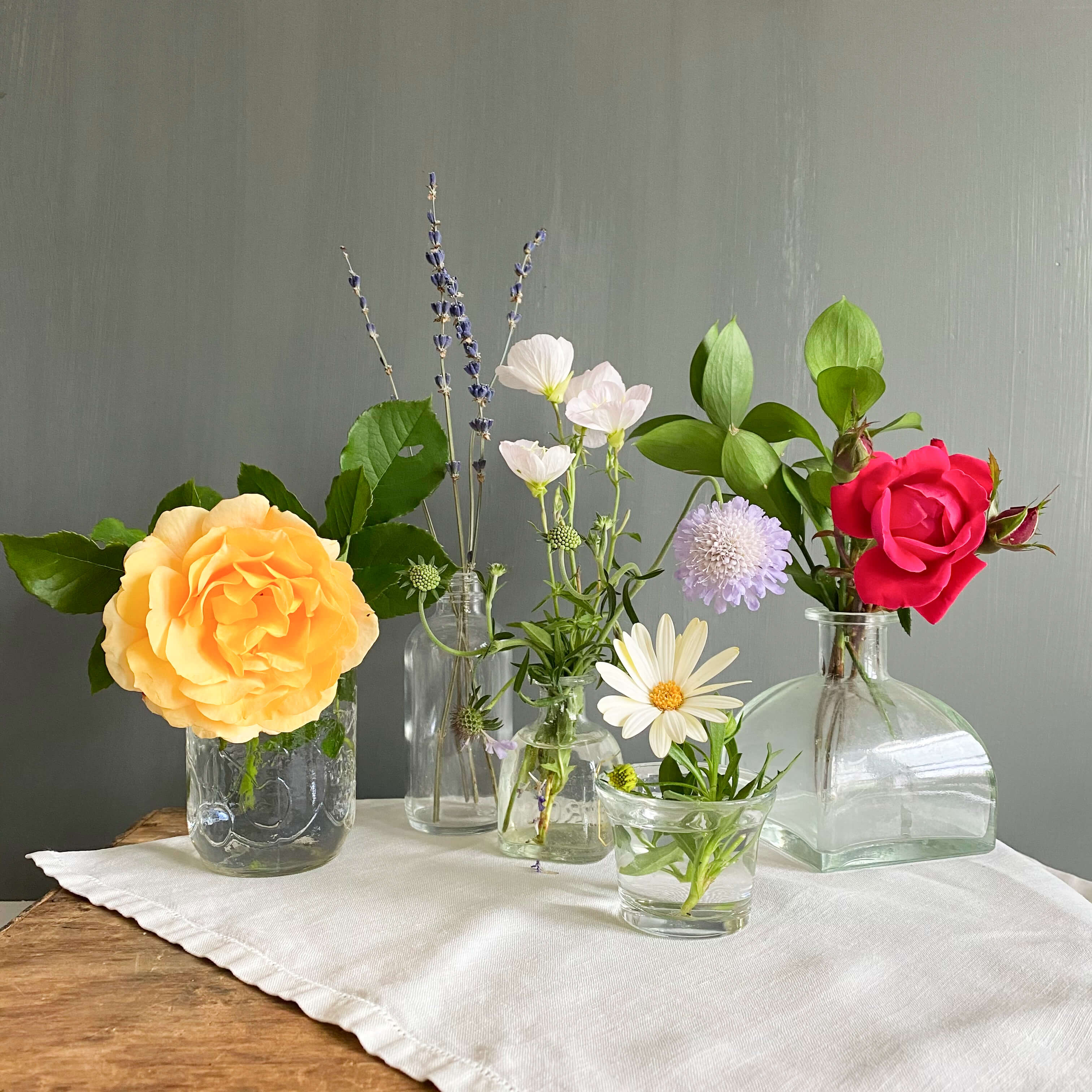
Blooming roses, a bright front door and a sidewalk cat named Lorenzo!
It’s too early for peaches at the market so there were no color-themed fruits to photograph in that department quite yet, but while we wait for summer crops and our next blog post coming out this week (a special Mother’s Day themed story and interview!) I wanted to share, in the meantime, some new changes that are occuring in the Vintage Kitchen, so that you can be kept abreast of all the latest news.
New Products
Most excitedly, the Vintage Kitchen is growing! Over the next few months, we’ll be expanding our vintage product range in the shop to include some newly made yet very classic kitchen essentials all based on historic designs or nostalgic stories that have been personally tried and tested for years. This is in an effort to introduce fun and unique finds to your space that will not only augment your love of the vintage aesthetic, but will also be of very helpful assistence in the kitchen. The first of these new products arrived in the shop this past week…
Introducing the French market bag! Imported from Europe, this is the best way I have found to tote vegetables home from the farmers market.
The bags, made of handwoven palm leaves, are light-weight yet very durable. The long leather straps rest comfortably on your shoulder and the funnel shaped design (wider at the top than it is at the base) allows for longer and more fragile items to be stowed away securely without being crushed or tossed about. No more broken baguettes or decapitated flowers with this beauty!
There are two different styles of the market bag available in the shop. One has long leather shoulder straps (pictured above) and the other has hand-held rolled leather handles (pictured below). Both are convenient for grabbing and going and they are both the same size as far as bag capacity. The preference, of course, is totally up to you, but I recommend the shoulder strap version if you generally tend to walk to your market or live in a more urban environment where you gather your groceries primarily on foot. It’s such a comfortable way to tote your items around town. The hand-held bag…
… I would recommend for shoppers who drive to their market since the bag sits up right on its own and stows away really well in the car. Tucked into the back seat or the trunk it does not topple over easily, and will keep all your market finds secure while you drive home.
In addition to being helpful, these market bags also bring a bit of Parisian style and joie de vivre to your shopping experience. Each bag holds quite a bit of items, so if you get carried away at the market, your bag will be able to handle all your whims. For example all this fits in one bag with plenty of room to spare…
I have used my market bag (the very same one with the long straps) for over 4 years now. It has become so indispensable, it adventures with me on a daily basis. At this point, it feels not only like a bag but also like a true and cherished companion! I can’t say enough wonderful things about it. I hope you will love the bags just as much too. There are limited supplies of each style and they are selling quickly, so if they strike your fancy don’t hesitate. You can find them in the shop here and here.
Email Newsletters
If you would like to be made aware of new items listed in the shop each week, along with special promotions and added seasonal content, then please sign up for our new email newsletter which will be going out once a week (starting next Friday). Unlike many of these blog posts, this newsletter is designed to be a quick read, featuring mainly photographs and a few links to some fun content. In response to many shoppers asking how they can be kept aware of new items coming to the Vintage Kitchen, and after testing out many avenues over the past few weeks, I’m excited to finally have a good solution that will help collectors find what they love quickly. Sign up for the email newsletter by clicking the subscribe now button on the left-hand side of the shop’s home page here. It looks like this…
Sold Items in the Shop
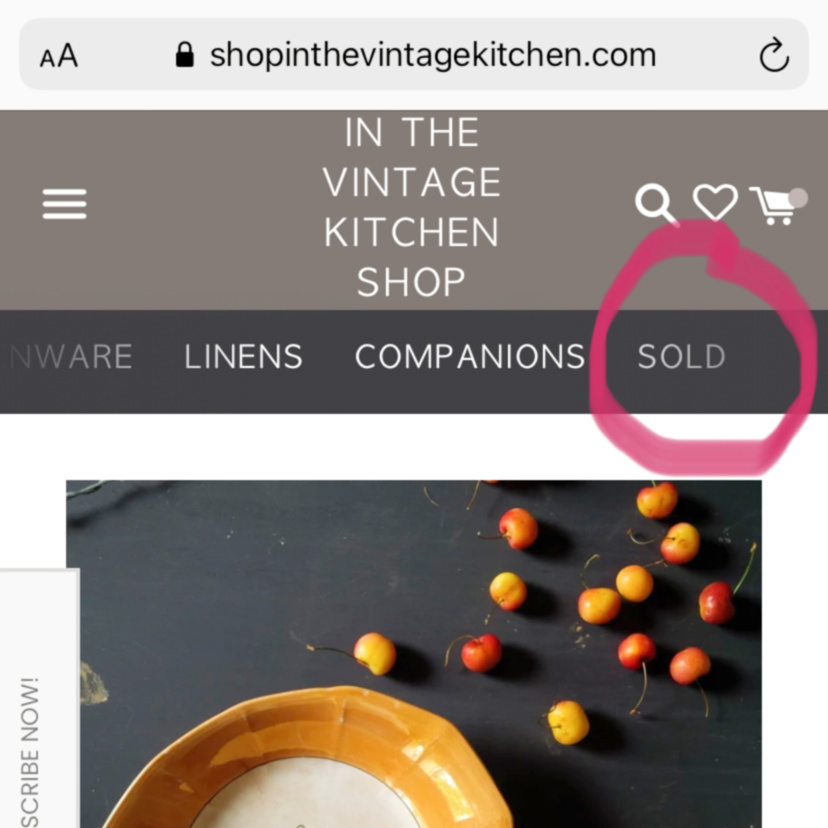
Another improvement for the shop this past week came in the form of relocating sold items to a new category all their own. This transfer, which removed all listings that were sold out from the general inventory of available items, came at the request of a few shoppers who were frustrated in not being able to easily navigate around the site to see what was actually available to purchase. But with many historians and researchers accessing the shop for informational purposes (due to all the history we include with each item’s listing) I didn’t want these sold items to be completely removed from the shop all together. In an effort to make it a pleasant experience for everyone spending time in the shop, I hope this new solution will help. From here on out, see all the sold items in this category (found in the header section) here…
Mother’s Day
I hope you’ll come back to the blog this week to read our upcoming Mother’s day inspired post about a talented seamstress in Minnesota who led a really an interesting and dynamic life. Through an interview with her daughter, who generously shared family photographs, their family linen collection, and many stories about her mom (including a recipe!) we’ll learn how one spirited woman lived a passion fueled life and defied many stereotypes that tend to be attached to women of the mid-20th century.
Until then, of you are looking for any last-minute Mother’s Day gifts, there’s still time left to find something just as unique and treasured as Mom is. From the shop, I recommend these items…
From top left: Vintage 1950s Maurice Urtillo Art Print, Antique 19th Century Steamship Chairs, Embroidered 1950s Pillowcases, Vintage Peacock Wall Pocket Planter, French Market Basket
What makes these particular items so wonderful for mom? All of the mothers in our lives deserve to spoiled on their special day. These carefully selected items will add a little dose of symbolic beauty to her every day, while also presenting her with a unique bit of history. French artist Maurice Utrillo (1883-1955) learned to appreciate the beauty of flowers from his mother, Suzanne Valadon who was also a painter. The his & hers set of antique steamship chairs signifed luxury and comfort aboard cruise liners of the late 1800s. Breakfast in bed never looked prettier in the 1950s than with a pair of embroidered pillowcases, which were often gifted as wedding presents. Peacocks throughout history have been considered the most beautiful bird in the avian kingdom and signifies power, protection and elegance. And finally, the market bag will add chic Parisian style and a little extra joie de vivre to each and every one of her days.
Adelaida Cuellar photographed in 1901 with three of her children. photo courtesy of D Magazine.
In 1892, two young lovers crossed the border from Mexico into the United States and got married in Texas. They spoke no English but were very fluent in the language of love. They were dreamers yearning for better opportunities then their home country could provide, and they were determined to work hard to create a beautiful life that would bring them all they desired.
The newlywed years of Macurio and Adelaida Cuellar led them through a myriad of jobs on ranches around the Texas countryside. For five years they moved about before they settled down in Kaufman, Texas, a suburb of Dallas, where Macurio started sharecropping and Adelaida started a family. As the seasons passed, their family grew, eventually producing twelve babies.
This is an unidentified farm photo from the Cuellar collection. It may have been the farm where Adelaida and Macurio raised their family. If not, it gives an interesting perspective on what farm life looks like in Texas during the time Adelaida and Macurio lived and worked there. Image courtesy of the University of North Texas Digital library.
Ranch and farm work weren’t the most profitable of jobs, so Adelaida took a stall at the Kaufman County Fairgrounds in 1926 selling two things… chili and tamales. It was her hope that her homemade recipes, so loved by her family, would bring in a little extra income to help support her children. To her surprise, the food stand was an instant success. The profits she made from her entrepreneurial endeavor were much larger than farm or ranch work earnings, so Adelaida kept at it, turning her stall into a tidy little family business. Some of her children helped her cook while others formed a family band playing Mexican music to entertain the eaters.
During the 1920’s, Tex-Mex cuisine was a new style of cooking that combined traditional recipes from Mexico and Spain but with toned down spice factors which were more appealing to American palates. Adelaida’s chili and tamales debuted at just the right time – exotic enough for adventurous eaters and flavorful enough without being too spicy to dissuade repeat business. With every taste of tamale and every cup of chili, Adelaida’s reputation for preparing delicious Mexican food began growing.
Adelaida’s Cafe – simply called Cuellar Cafe – opened in 1928. Image courtesy of the University of North Texas Digital library.
In her mid-fifties, Adelaida opened her own restaurant which did well until the Great Depression hit and she was forced to close due to the terrible economy. Each of her grown boys inspired by their mother’s own entrepreneurial spirit opened their own independent Mexican restaurants in different cities throughout Texas, Oklahoma and Louisiana using the recipes that Adelaida made for them growing up.
Each of the sons, enamored with cooking just like their mom, quickly realized there was something missing from their independent ventures… family love and support. From the beginning, in the county fairground days, the Cuellar family was successful at the tamale and chili stand because they all worked together towards one common goal. But now the family was spread over many cities, and their restaurants couldn’t be as successful because they all weren’t working together.
This is one of the original porcelain neon signs from the first El Chico restaurant in Dallas. It’s now for sale on ebay here.
So in 1940, five of the brothers banded together to form one restaurant in Dallas, which they named El Chico. The entire family and extended family worked there together, each bringing their own unique talents.
Opening night of El Chico featured a Mariachi band to entertain the crowd. Image courtesy of the University of North Texas Digital library.
Everyone who worked at the restaurant was fluent in Adelaida’s style of perfection when it came to selecting quality ingredients and blending the spice mixtures in the correct way, so the food was authentic and consistent, which kept customers coming back. And the Cuellar family was proud of what they were accomplishing. At the heart of their restaurant lay the heart of Adelaida and all that she stood for. Her children wanted to extend that same level of love and devotion with all who dined at El Chico.
A popular dining place indeed! This photo was taken in 1945. Image courtesy of the University of North Texas Digital library.
Just like Adelaida’s chili and tamale stand, El Chico became phenomenally successful, making the Cuellar family and the El Chico brand one of the greatest American success stories. They went on to open more than 40 restaurants throughout the country, built a successful packaged food division for the retail market, and offered franchise opportunities for budding entrepreneurs. By the 1970s, they were the largest full-service Mexican food company in the world. They cooked for United States presidents at the White House, for princess Grace Kelly at her palace in Monaco and entertained movie stars like John Wayne in Dallas. The family stayed together through all these years and all this growth, never veering from what they knew – good food taught to them by Adelaida.
A Cuellar family portrait with Adelaida and Macurio in the front row center. Image courtesy of the University of North Texas Digital library.
Adelaida passed away in 1969 at the age of 97, not before experiencing the overwhelming success of her family and seeing how her humble tamale and chili stand at the Kaufman County fairgrounds grew into a multi-million dollar corporation over the course of forty years. The Cuellar children credit both their mom and their dad with teaching them about the value of working hard (and quickly) toward their goals and the importance of taking chances.
In 1970, El Chico published a small, spiral bound cookbook of some of the family recipes that they used in the restaurant, along with some others collected from their travels. Hailed as one of the most authentic Tex-Mex cookbooks ever published, it’s now a hard-to-find treasure. It is in fact, so special and represents such an importantand integral part of the ethnic American food landscape, that it’s held in special collection at the Smithsonian’s National Museum of American History. We are also very pleased to offer a copy in the kitchen shop.
Since Cinco de Mayo is coming up this Saturday, on the same day as the Kentucky Derby, we thought it would fun to highlight two vintage recipes from the El Chico cookbook to ring in the festivities. A general crowdpleaser with a ton of creative toppings, these recipes are fun party foods so whether you are celebrating Mexico or Kentucky, or both this weekend, there will be something edible for everyone.
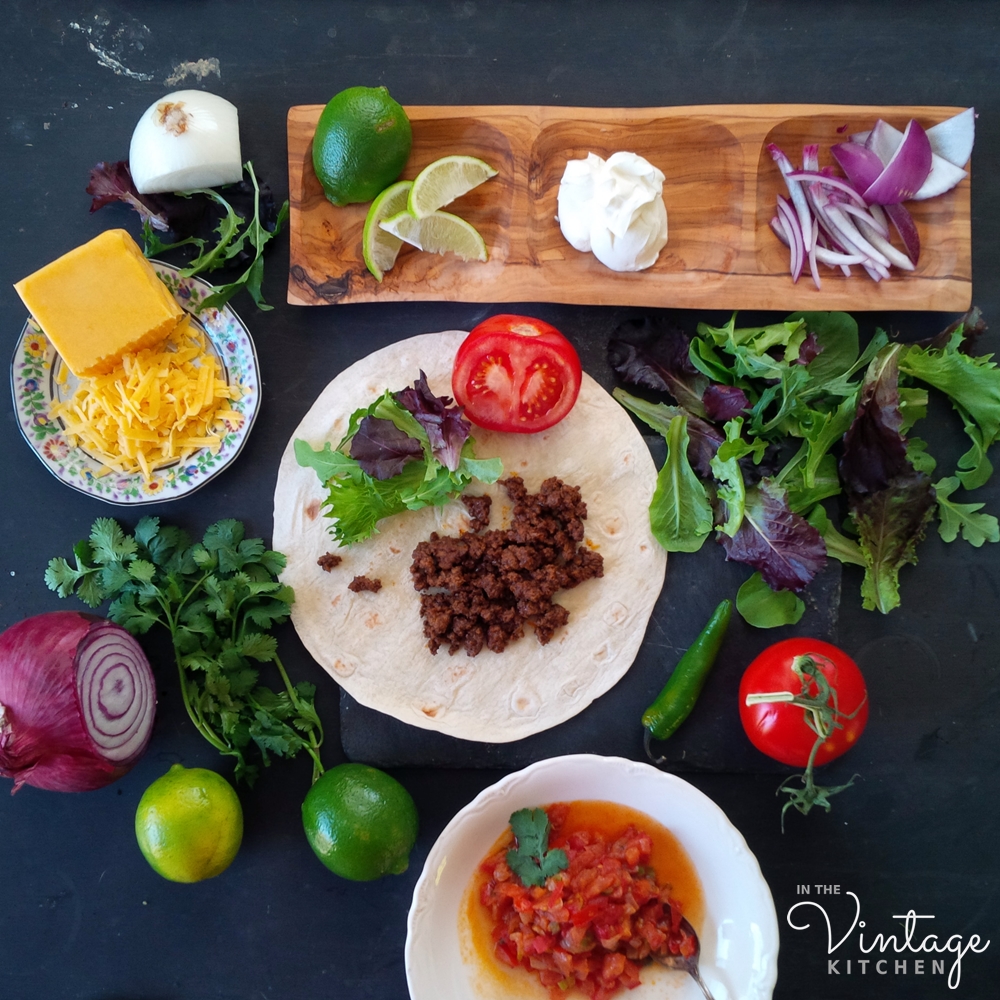
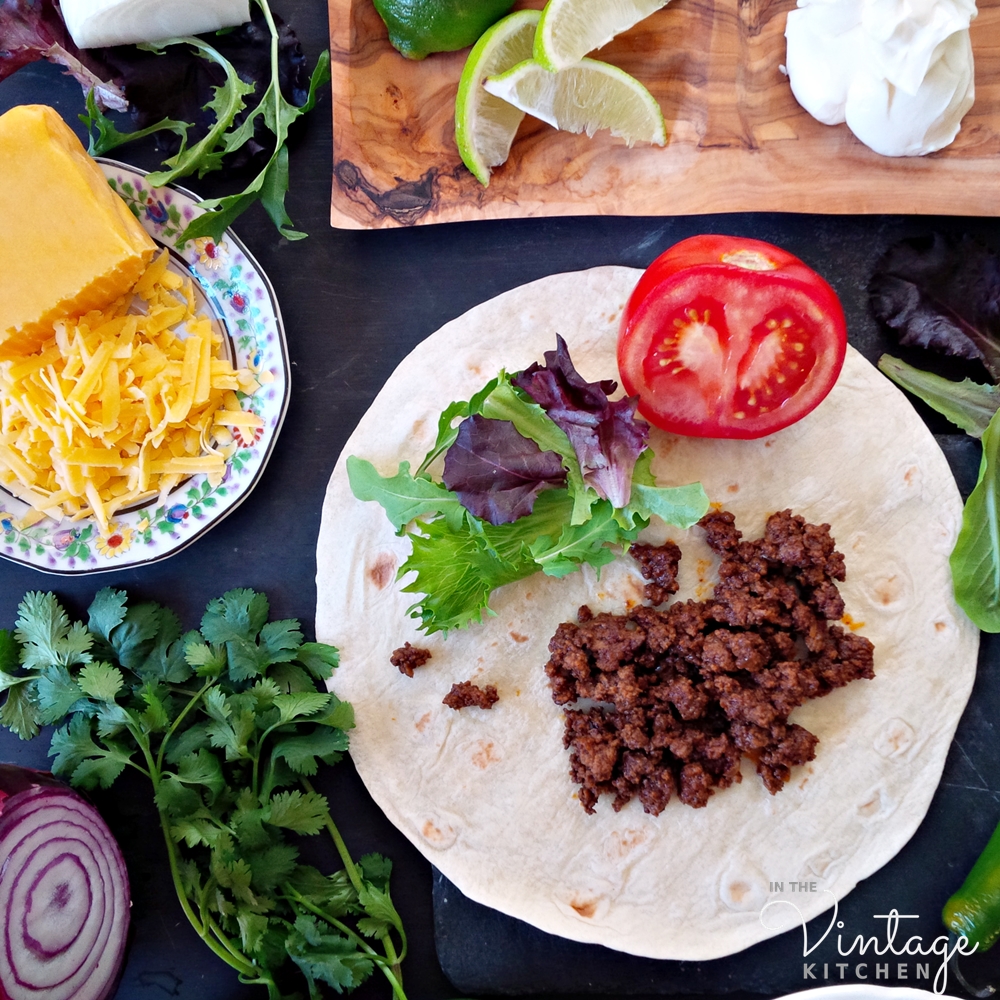
On the menu it’s El Chico’s Homemade Beef Burritos & Ranchera Sauce. Both are really easy to make. You’ll have the whole thing whipped up in under 30 minutes. Each recipe features fresh ingredients with generous amounts of spices, so you can skip buying the taco seasoning packages and the taco sauce at the grocery store. There’s plenty of flavor between the two recipes. In addition to ground beef, you could also incorporate ground pork, turkey or chicken if you wanted to offer multiple variations.
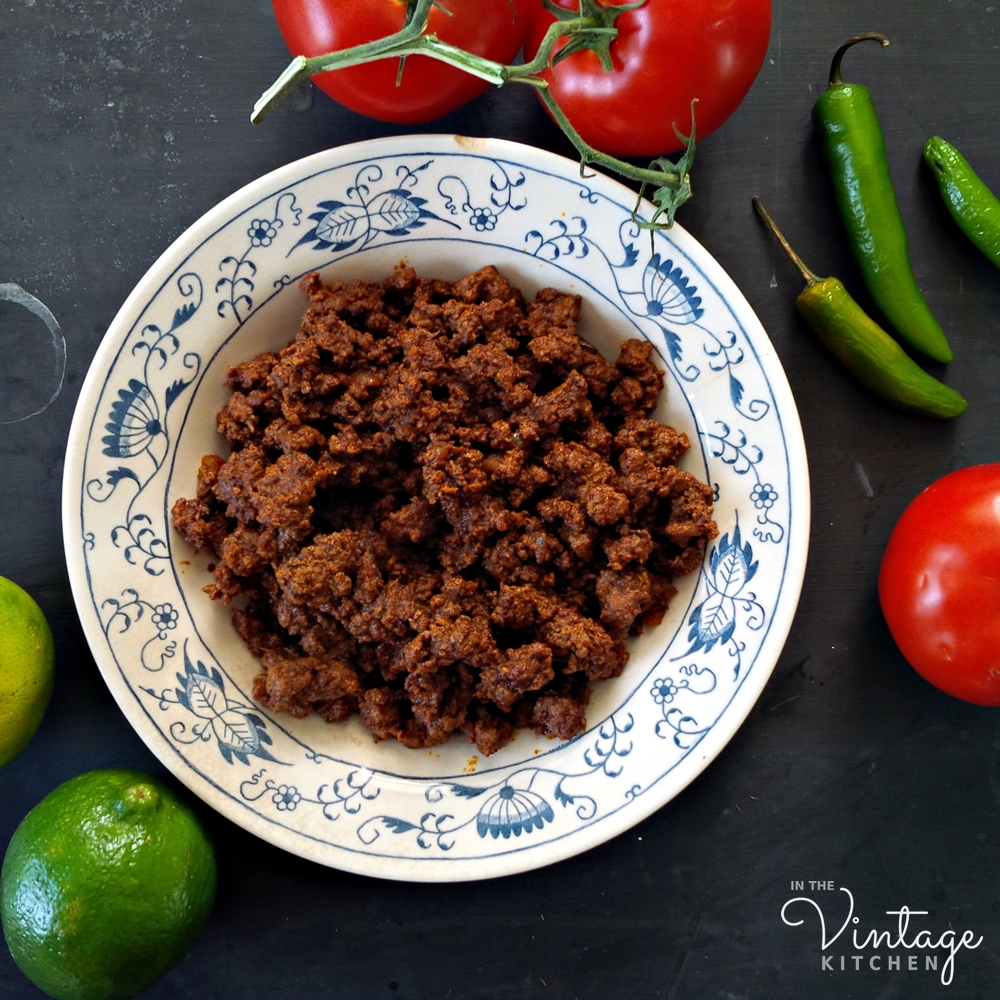
What’s especially great about the Carne Mexicano recipe is that it includes vinegar which gives it a little bit of tang and de-greases the pan all at once so you don’t need a thickening agent like cornstarch or flour which is included in most commercial taco seasoning packets. As with many vintage recipes, we cut down the salt by 2/3rds, so we recommend starting with our measurement first and adding more to taste if you feel it needs it.
Carne Mexicano for Burritos
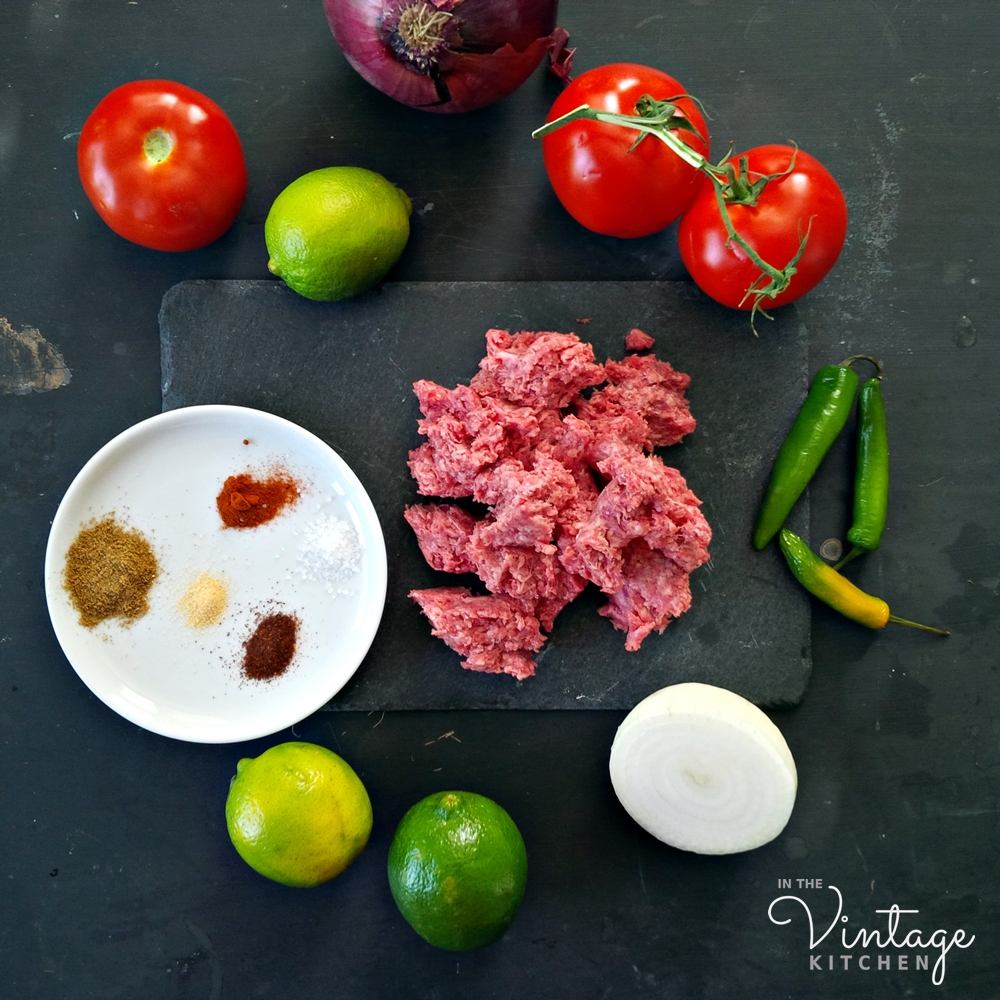
2 lbs. ground beef (we used grass-fed beef)
2 tablespoons chili powder
2 tablespoons paprika
2 tablespoons salt (we used only 2 teaspoons)
1 teaspoon garlic powder
1 teaspoon ground cumin
1/2 cup vinegar
1/4 cup chopped onion
In a cast-iron pan over medium-high heat brown the beef and onions until cooked through. Add the spices and cook for 1-2 more minutes. Add the vinegar, scraping the bottom of the pan to deglaze it. Remove from heat and serve immediately or store mixture in a covered dish and keep warm until ready to serve.
El Chico’s Ranchero Sauce (A La Caballero)
2 cups fresh chopped tomatoes
1/4 cup chopped onions
1/4 cup chopped hot green peppers (we used serrano peppers)
2 tablespoons shortening (we used olive oil)
Salt and Pepper to taste
Saute the onions and peppers in shortening (or olive oil). When the onions are translucent add the tomatoes and simmer over a low fire for five minutes. Serve it immediately or at room temperature.
Obviously, the hotter your peppers, the spicer your sauce is going to be. This recipe makes about 1/2 cup of sauce so if you are cooking for a crowd you might want to double or triple the recipe. We used serrano peppers which were quite hot so a little bit spooned on top of your Carne Mexicano goes a long way!
There are so many topping options when it comes to burritos, so your creativity can really shine here based on your preferences. El Chico suggested that their burritos include only cheese, refried beans, Carne Mexicana and the Ranchero Sauce. But we added a bunch of our favorite toppings too which included sour cream, spring lettuce, red onion, mango, tomato, cilantro, avocado and lime juice. Other possibilities re guacamole, green olives, rice, etc etc. The sky is the limit. Can your burrito ever really have too much stuff?
Coming up tomorrow on the blog, we’ll be sharing our picks for the Kentucky Derby winner, as well as our table decorations for the Derby Party, which tie together both the Mexican theme and the horse theme. If you are planning a party for either event, we’d love to hear how you are celebrating.
In the meantime, cheers to Adelaida and the Cuellar family for sharing their long-time favorite family recipes with all of us. We will definitely be sending a toast their way on Saturday!
Explore more information about the El Chico cookbook here. And learn more about the restaurant chain, still in operation, here.
This weekend, Ms. Jeannie was invited to a semi-annual cattle round-up at her friend’s organic farm. She had never been to a cattle-round up before. It all sounded very exciting!
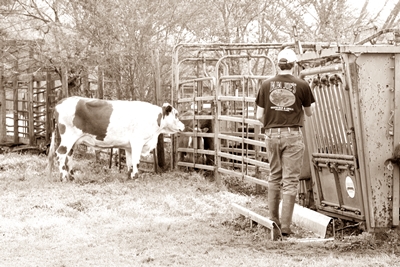
On this farm, the round up occurs twice a year, once in the spring and once in the fall. The purpose is to take inventory of the herd, worm all the cows and castrate the baby boy bulls that have been born between roundups.
Being somewhat of a city slicker herself, Ms. Jeannie was excited to put on her rubber boots and spend a day romping around the farm. She brought along her camera to document the experience.
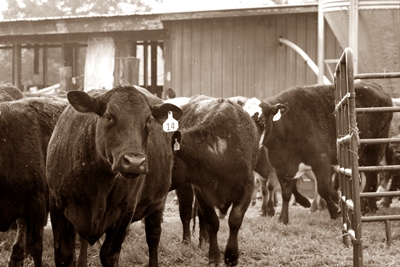
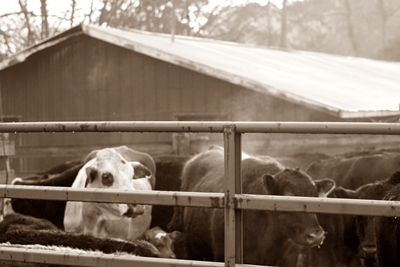
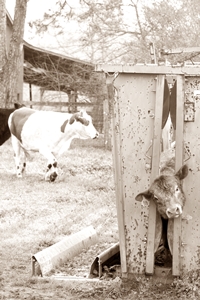
Starting at day break (which is farmers speak for bright and early 6:30am) it took about fours hours from start to finish to move 100 cows through a head gate shoot, where they would be quickly examined,wormed and castrated. The cows on this farm are 100% free range over many acres, so first, they had to be herded together.
Once corraled into one paddock they keep moving into smaller and smaller fenced areas.
For most cows, this is a routine procedure, sort of like a doctor’s check-up for us. They don’t love it – but they endure it just fine. Waiting at the holding gate is like waiting in a doctor’s office. Everyone is antsy to get their examination over with.
While the cows were cueing up Ms. Jeannie spotted the smallest cow in the herd…
…a baby born just 3 weeks ago! You can see see him in this picture with the little white spot on his side.
To keep the cows organized right before they line up for the shoot, they are broken into groups according to size.Which meant Mama and Baby had to be seperated. Baby went to the holding pen with all the other calves to wait
his turn while Mama lined up with the heifers in the shoot.
They both called for each other when they were separated, which pulled at Ms. Jeannie’s heart.
The older cows traveled through the shoot relatively easily. Here is one getting wormed. Which looks like a giant tube of toothpaste that gets spread onto their back.
Almost done…
Some look even downright content like this one…
but the babies are a little more rambunctious since it is their first time in such a confined area. This one below kept trying to figure out how to get her head unstuck.
Mama went through the shoot, was vaccinated and wormed. Her whole procedure took about four minutes.
Ms. Jeannie was surprised to see that when each cow is released from the shoot – they sort of spring out of the gate, sort of half jumping like a bunny rabbit. Free at last! When Mama was released she stood off to the side, just feet away to wait for her baby who was about 60 cows in…way in the back of the calf group. Mama is looking for Baby here in this photo…
Waiting on Baby…
Alas! Mama spots him through the fence!
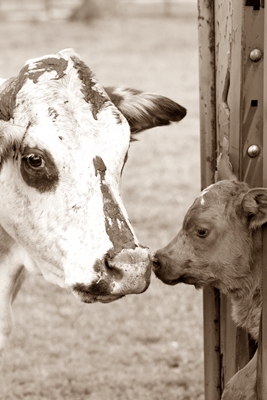
When he got close enough in line, Mama reassured him that everything was going to be fine and gave him a kiss for good luck!
A kiss for good luck!
Finally it was his turn in the shoot. His head was collared in place for his exam.
This may look like it hurts, but it doesn’t. Holding them in like this protects the cows from getting over excited and from breaking a leg or hitting their head against the metal rails.
Mama waited next to him the whole time. She touched noses for extra support…
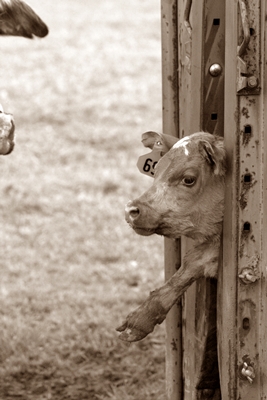
Baby wanted to put his own spin on this whole head lock thing, by throwing a leg out. He was such a little guy – there was a bit of extra space in the holding collar. Why not air out a leg while you have the chance. It’s one step closer to freedom afterall!
Mama advised that this was probably not a good idea.
Stick your leg back in baby!
Moments later, the collar let him go and he was out! Mom and baby headed off together to mull over the whole experience.
Ms. Jeannie was struck by what a wonderful and encouraging mama this cow was. And how Baby really depended on her for moral support. Seeing the two of them interact together was the highlight of Ms. Jeannie’s day!
Etsy is full of whimsical items that celebrate the wonderful relationship between animal moms and their babies. If you need some inspiration this Mother’s Day, take a look…
Plush Animal Mom and Baby Snuffalo from cuteandcreepy
BlackBears Mom and Baby from wishdaisy
Nursery Wall Decal Mom and Baby Giraffe from LeoLittleLion
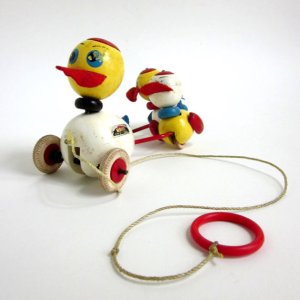
Vintage Mama and Baby Ducks Pull Toy from OopseeDaisies
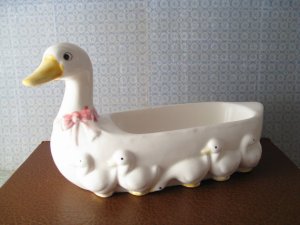
Duck Dish from AutumnAlways
Hummingbird Babies Metallic Photograph from LD Photography
Mama & Baby Elephant Vintage Ring from bigGreengiraffe






































 In the Vintage Kitchen: Where History Comes To Eat