Reading While Eating in 2024: Five Recommended Books About Food, Friendship and Appreciation

When December comes around every year, I always love compiling the book list. This month marks the end of 2024, and also the start of the wintertime reading season with the release of the annual Vintage Kitchen recommended book list. Blog stories were a bit sparse this year due to many unanticipated factors, but I’m happy to say that they haven’t hindered this annual tradition of posting a collection of favorite books discovered throughout the year.

If you are a long-time reader of the blog, you already know that these lists are made up of books that were serendipitously found over the course of the year while doing research for Vintage Kitchen blog posts, shop stories and recipes. Every year, they cover a range of subject matters and time periods, and span a range of publication dates from new releases to books written decades or even centuries ago. As an avid reader, averaging about 30 books a year, I save the most beloved ones for this list. The ones that left an indelible mark, or sparked some new inspiration, or offered a different perspective on a subject matter already familiar. These are the books I couldn’t put down. The ones that I still continue to think about long after the last page is read.

This year’s selection is varied in content but they do have an underlying connective theme of gratitude and appreciation. There’s a book about nature, a book about a summer vacation house, and a book about American life lived three hundred years ago. Three of the books this year are memoirs, one book contains recipes, and unlike last year’s list, all five of these books are non-fiction. They tell bittersweet stories of friendship, of being present in time and place, of establishing traditions, and of searching for meaning in everyday life. These five take us around the world from coastal Massachusetts to New Orleans to New York City to Paris, Stockholm, South America, and to our own backyards. One book even helped solve a mystery about the floorboards of 1750 House. Interesting adventures await on all fronts.

Let’s look…
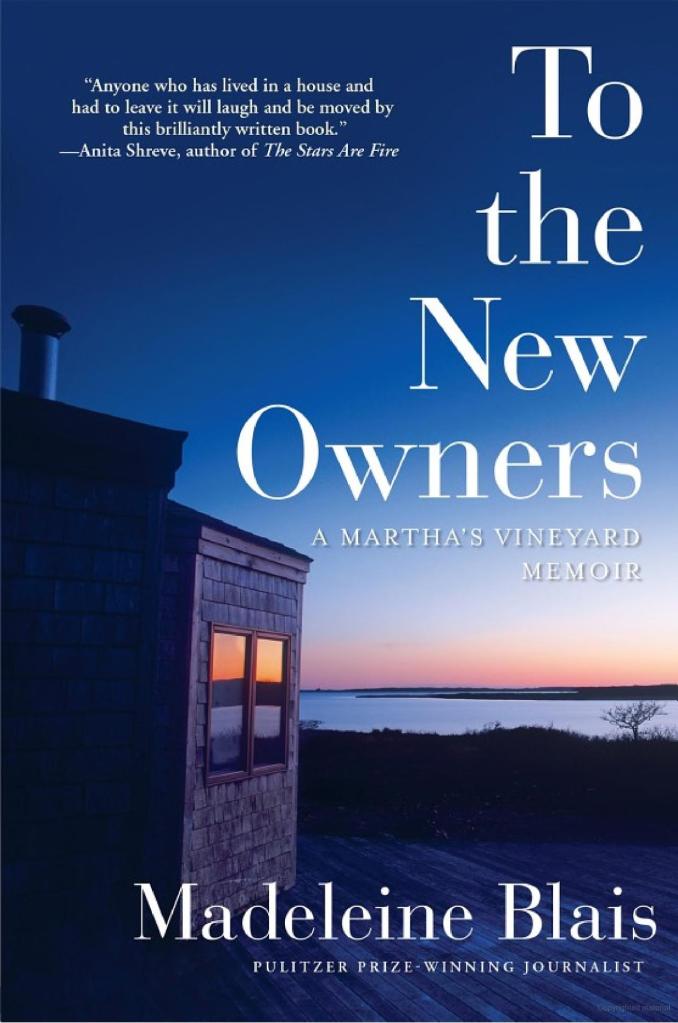
To The New Owners – Madeleine Blais (2017)

A love story to summer. To family. To a seasonal beach house on the shore of Martha’s Vineyard. To the New Owners is one long anticipated string of summer sequels highlighting vacation life spent in coastal Massachusetts. Written by Pulitzer prize-winning journalist Madeleine Blais, who married into the enigmatic and literary Katezenbach family, this memoir starts off with news that the beloved beach house, the family vacation compound for five decades, is going up for sale.

You might suspect with a topic like this that what could follow is a sappy cliche. A backward look at a family home where frivolity, relaxation, and low expectations were the driving force behind each summer. A book chock-full of events and experiences only interesting to the people who actually experienced it. That’s not the case here.

While there is certainly sentimentality and a true loyalty to the land and its residents, both seasonal and year-round, this memoir reads like an engaging conversation shared over a lengthy dinner party. It is full of quirky characters, funny stories, interesting history, and an undying love of the written word.

From record-keeping log books to island newspaper articles to Madeleine’s own accounts of house repairs, family dinners, environmental changes, historical events, and all the people and pups that marked their time on the island, this is a memoir of Martha’s Vineyard not from the glitzy, multi-million dollar mansion perspective, although there is mention of that too, but from a rowdy, vivacious, thrifty, unpretentious contemporary family viewpoint. The type of living that represents the true spirit of the island and its origins. And in the case of the Katezenbach family, a lifestyle that respected the power of words over the power of the pocketbook.

Gay Head Cliffs – Moshup Public Beach – Martha’s Vineyard – Boston – USA.

When she first shows up to the Vineyard, Madeleine doesn’t exactly know what to expect. She knows nothing of the island, or the people she’s going to stay with, or the type of lifestyle that requires a summer residence and a winter residence. But she does have an imagination. And what she pictures in her mind on the way to her first visit to the summer house is not the almost dilapidated shack that she encounters. Rustic is what her husband called it, a far cry from the multi-million dollar estates that dot much of the M.V. coastline. Intrigued by the island’s humble roots and the glamour it was later associated with, Madeleine explores the history of the island, her new family, and the literary-loving community that it reflected all through the lens of the summer house.

Martha’s Vineyard in the 1800s

Funny, wise, poetic, and relatable whether you’ve ever had the experience of summer beach house living or not, Madeleine’s memoir is about love, loyalty, nature, pride of place, and acceptance of what is, as it is. A look at an island that boasts extremes from all directions including wealth, prestige, celebrity, notoriety, and eccentricity, but also sandy kitchen floors, wet dogs, leaky roofs, fishless-fishing trips, thwarted dinner invitations, spectacular sunsets, faulty wiring, stunning beaches and the whole mess with the nearby pond that affected everybody.

At the heart of the story are the log books – the fortuitously started notebooks that hold random journal entries of all the small, everyday details that make up life at the beach house for fifty summers. Sporadic and eclectic, with contributions by family members and visiting guests, the log books were available to anyone staying at the house who wanted to note something, anything. The first log book started what would become a tradition and then ultimately a treasure trove of notes and musings on recipes, house improvements, weather, linguistic games, family health, poems, housecleaning tips, recommended book lists, pet antics, children’s drawings, island events, and conversational interactions with town locals. No one particularly thought that the first log book was going to turn into something special, but when it was full and there were no pages left to record anything else, another book was ordered and filled again, and over and over it went for five decades.

Having that kind of family detail available helped Madeleine paint such an intimate look at life on Martha’s Vineyard that by book’s end you’ll feel like a local yourself. What’s particularly lovely is how everyone truly appreciated the house, the parcel of land it sat on, and the exposure to nature that it provided them. Across all the fifty years, any one guest, family member or otherwise, who couldn’t appreciate this slice of paradise or didn’t see the charm of it all wasn’t invited back the following year. So the summer house became a club-like haven of love and joy and appreciation and fulfillment even on the leaky roof and the fishless fishing trip days. It chronicled the years of a couple’s marriage and embraced the outpouring of their offspring. It sheltered three generations, countless friends, family pets, and invited guests. And then the inevitable happened. Life changed. And with it, the bittersweet goodbye to fifty years of what once was.

Grief Is For People – Sloane Crosley (2024)

Just as there are many stages of grief there are many things in the world to grieve. In this book, Sloane Crosley grieves two real-life events simultaneously… the suicide of her best friend and the theft of family jewelry from her NYC apartment. Both incidences occurred within 30 days of each other. Both were a shock to the system. And both left Sloane at a loss confronting major thoughts and feelings about each situation.

You might suspect that the death of her dear friend would take precedence over the theft of jewelry she inherited from a grandmother that no one really liked, but Sloane is an incredible storyteller and manages to give equal emotional weight to both scenarios while also offering an interesting behind the scenes look at the publishing industry that she and her friend were very much a part of for over two decades.

Grief Is For People is, yes, a book about grieving but it’s also a memoir of a specific time period in Sloane’s publishing career, a portrait of a friendship, a writer’s coming-of-age in the big city of New York, and the emotional value of inherited objects. It’s humorous and insightful, smart and sincere. It’s full of grit and determination to right the wrong of burglary while also bravely sorting through what it means to love, rely on, appreciate, and remember someone who was here one minute and gone the next.

Sloane shares this story in a captivating timeline of events. So as not to spoil the pacing, I won’t say anymore other than that if you are new to Sloane Crosley and her work, I’d also highly recommend her 2008 book of essays I Was Told There’d Be Cake.
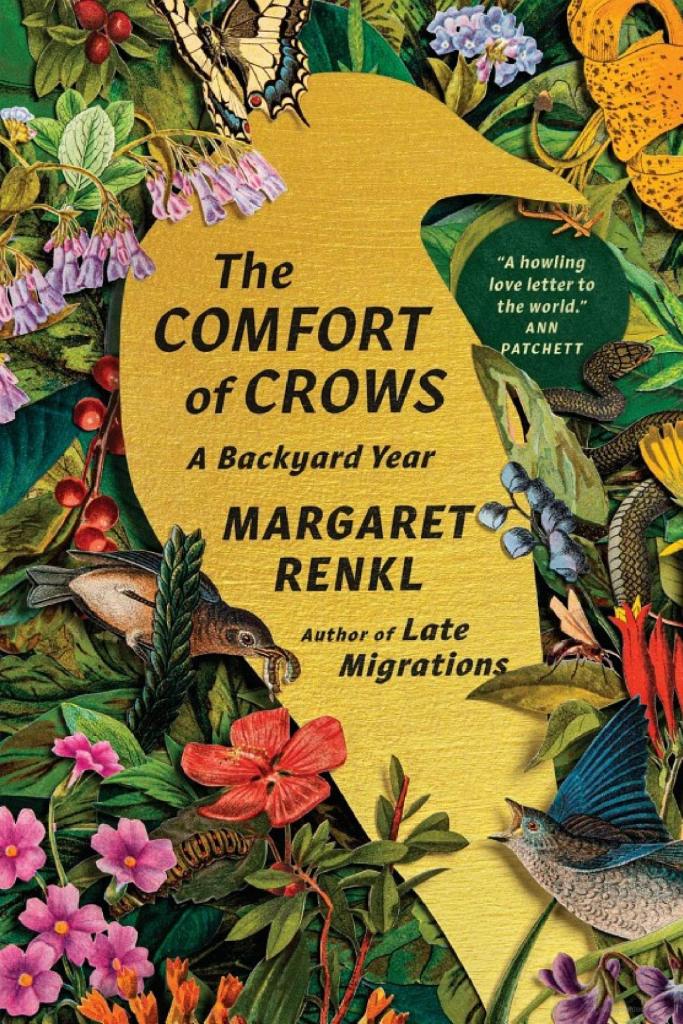
The Comfort of Crows – Margaret Renkl (2023)

Stop and look. Those are the first three words of Margaret Renkl’s ruminations on nature and her year-long accounting of it in The Comfort of Crows. Written from the vantage point of her backyard in Nashville, TN and a friend’s nearby vacation cabin in the mountains, Margaret writes about the sights and sounds of nature witnessed firsthand over the course of a calendar year. In brief vignettes accompanied by her brother’s beautiful illustrations, Margaret draws attention to common occurrences happening with the birds and the squirrels, the trees and the bees, the plants and the pollinators, week by week, while also reflecting on her own life and the parallels these natural encounters draw.

Part nature study, part memoir, part call to action, I would recommend The Comfort of Crows to anyone who wants to unplug from the outside world for a weekend, a week, a month, a year. If you need a break from social media, the news, the what-ifs, and the how-to’s, this book is easy to fall into. Calming, thought-provoking, and comforting, it offers a gentle reminder that in nature there’s a plan, a purpose, and a resourcefulness that is indefatigable, adaptable, and inspiring.

Stop and look. Stop and listen. Stop. Look. Listen. See. Hear. These are simple words that yield powerful insight into the dramas, destinies, and determinations going on in everyday life around us. Whether it’s the backyard, the city park, the country meadow, the forest, the beach, or the planting strip in the parking lot of your local grocery store, there’s insight to be gained from the creatures that inhabit these parcels of place.

Starting on Week One, the first of January, Margaret shares in her lovely, poetic voice how nothing is actually dead even in the dead of winter. “Everything that waits is also preparing itself to move,” she notes. “The brown bud is waiting for its true self to unfold: a beginning that in sleep has already begun.”

I can’t really describe this book as anything other than an experience. It’s heartwarming and serene, playful and curious, sentimental and sad. It is fun facts and first-hand observations. It’s a love letter to what is and a longing to change what might become. It’s a book. It’s short stories. It’s prose and it’s poetry.

Conscious of global warming and human impact on the natural world, Margaret is hopeful that we can right the ship and learn how to cohabitate with plants and trees, insects, and animals in order to encourage a beneficial landscape for all instead of just some. In acknowledging that we have collective work to do in that regard, this book carries its own bittersweet narrative – an appreciation of what is here now but a realization that it might it not be here in the same way tomorrow. That viewpoint automatically sets the tone for awareness which is the overall theme of Margaret’s year. To be aware of one’s natural surroundings. To be aware of what is in one’s natural surroundings. To be aware of the wild in the world. It’s that recognition that Margaret hopes will propel you out into the greenspaces of your life. To look and to see. To hear and to help. All, so that we can continue to hope.

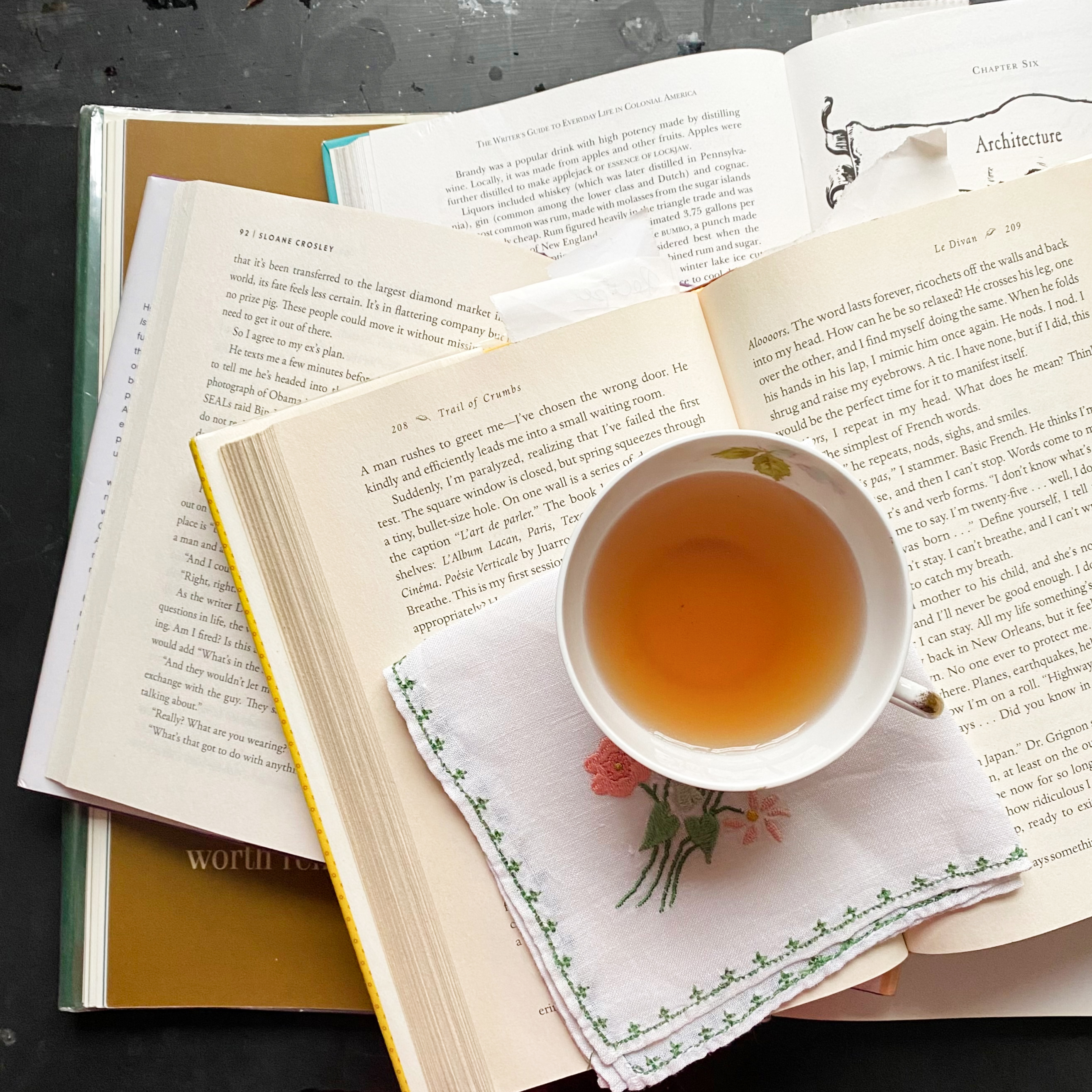
Trail of Crumbs – Kim Sunee (2008)

Abandoned in a Korean marketplace when she was three years old, Trail of Crumbs follows the real-life of Kim Sunee from toddlerhood through her late twenties via place, people, and passion. Adopted into a well-meaning American family and taken to live in New Orleans, Kim’s presence in the world from the beginning never quite clicks. Seesawing between feelings of gratitude and abandonment, she grows up out of place as an Asian American in the Deep South. Carrying the emotional baggage of a person who has been left behind, Kim is too young to put words to her lost person emotions.

As a child, the only place she finds real comfort is in her grandfather’s kitchen, watching him and helping him cook an array of Southern specialties. This early introduction to the internal power of food becomes Kim’s barometer, her measurement of what feels right and wrong in her life, of what is fitting and falling apart around her. Cooking becomes the bridge that connects her with a cast of characters that come in and out of her life, leading her around the globe over twenty years in search of the definition of home, both internal and external.

With every new person she meets, every new relationship she begins, her life pivots. She makes friends with artists and writers. She teaches English classes to foreign children. She writes poetry. She translates business brochures. She runs a bookshop. All the while searching for her true self.

In all these people, all these places, all these jobs, Kim tries to move on from being left behind. She tries to make peace with her past and the mother who left her on a bench in a market with just a fistful of crackers. She goes to Paris. To Sweden. To South America. She eats, drinks, and cooks in new kitchens of new friends, new lovers, new neighbors. In France, she meets and falls in love with a high-profile businessman who is determined to give her everything she ever wanted. For a time, this romance is ideal. A fairy tale in the making with affable rom-com pacing. She’s finally met someone who is ready to unclasp her fingers from the tight grip that carries her emotional suitcases. He wants to give her everything she never had. A fresh start. A new life. Her own making.

But as much as they love each other, and as passionate as their relationship is, it’s also fraught with complications. Kim questions this knight-in-shining-armor and her worthiness of him. She wears the invisible letter L for leaveable like a badge that defines her. And in believing that she’s leaveable she can’t ever truly stay anywhere. That creates a restlessness that no amount of kindness, no amount of money, no amount of love, or attention, or security can cure until she learns to love herself for herself.

Along with this search for peace and family, Kim’s memoir is dotted with recipes throughout, each one representing a different aspect of her physical and emotional journey from childhood to adulthood. There are recipes that reflect her Korean heritage, her Southern upbringing, and her love of French food. There are recipes for snacks, comfort foods, fancy dinner parties and elegant desserts. Each one, a place marker of her growth and development. They represent comfort in times of unease and joy in times of safety and security. There are so many truly lovely-sounding recipes in Kim’s book that I practically tagged each and every one. In the next blog post, we’ll be delving into one of her recipes from Trail of Crumbs – Chicken Thighs with Cinnamon and Dates – which appears about halfway through her story when she’s in the middle of her French love affair. Stay tuned for that post coming shortly.

The Writer’s Guide to Everyday Life in Colonial America from 1607-1783 – Dale Taylor (1997)

This is pretty niche reading, and I realize not everyone may be as curious about colonial life as we are here at 1750 House, but this book provides so much interesting, little-known information on domesticity in the 17th and 18th centuries, it will appeal to history lovers of all sorts on all levels. Covering architecture, clothing, occupations, gender roles, homekeeping, agriculture, professions, education, religion, and government, I came to this book initially interested in reading the chapter on architecture in hopes of learning some new information about 1750 House, but the whole book turned out to be captivating and I flew right through it.

Brimming with all sorts of very fun fun facts, historical interpreter Dale Taylor wrote this book specifically for writers so that they would have an accurate understanding of the all details that made up real life in the colonial era. With that audience in mind, Dale includes an array of anecdotes that help bring history alive in a relatable way. It’s also a great resource when solving floorboard mysteries.

Wide plank floors upstairs

Upstairs in 1750 House, the original wide plank wood floorboards which are made of solid 3″ inch thick chestnut, measure between 9.5″-15″ inches in width per board. But downstairs, the wood floors are much narrower in width, about 3.5″ inches on average.

Narrow-width floorboards downstairs

This has always led to curious conversations about why the floorboards aren’t the same on each floor. We suspected that the downstairs floors were replaced at some point later in time, possibly in the mid-1800s when the kitchen room was added. But come to find out, according to Dale, in colonial days, wide plank boards were less expensive to mill, so they were often used for flooring in the more private rooms of the house, which tended to be on the second floor or at the back of the house on the first floor. The narrow-width floorboards were laid in the front of the house on the first floor in the parlor rooms. These narrow boards acted as a status symbol letting visitors know that the family who lived there could afford such luxury. In the case of 1750 House in particular, this newly learned information makes a lot of sense.

Not long after we moved in, we learned about the architectural significance of the front door, which is also original to the house. In the photo below, you’ll notice four small windows that are built in at the top of the door. During the colonial era, that was another bit of luxury – to be able to afford glass in your front door. The panes not only allowed extra light to illuminate the interior but there was also religious symbolism attached to them too. Religious colonists believed that by installing windows at the top of the door, it allowed God a peek down from the heavens to make sure there was nothing improper going on indoors. Just like the original H-Hinges found throughout, it’s another little bit of unique symbolism that lives here. And thanks to Dale’s book, it now gives us a better understanding of the economic status of the original owners of the house.

Windows on the original front door c. 1750

Architecture notes aside, other types of fun facts that can be found in Dale’s book include these little marvels…

  • Pets during the colonial era included dogs and cats, but not birds. Birds would not be kept animals until the Victorian era. However, squirrels and deer were also common pets in colonial days and the deer were allowed free reign both inside and outside the house.
  • Bearskin rugs were the first indoor fire alarms. In the 17th and 18th centuries, they were laid out in front of the fireplace in case an errant ember flew or a log rolled out into the room. At night, after the household had gone to bed, if an ember sparked or a log rolled out, the rug was the first point of contact. It would begin to smolder, emitting the smell of burnt hair. That smell would awaken people in the house and signal that there was a fire near the fireplace which could be easily and quickly be put out because of the rug.
  • 25% of women’s deaths in colonial days were due to life-threatening burns caused by cooking in an open fireplace. That led women to start hoisting up their skirts and tucking them into the waistband of their dresses in order to avoid catching the hems on fire. From that point forward, the kitchen was viewed as an indecent place to spend time and the staff that worked in them were viewed as having low repute.
  • Since cloth was one of the costliest items in colonial America dresses were made to last for 15 years which means that some women owned only about 2-3 dresses in their lifetime.
  • Wigs were commonplace for men and women in colonial times, but the super tall and lofty wigs were only worn by women in big cities like Philadelphia. These wigs were so elaborate in design, style, and augmentation that they were often worn even at night while sleeping. This full-time, overnight headress necessitated arrangement in such a way to accommodate mouse traps since they were made of natural nesting materials.
  • In 1752, the celebration of the new year was moved from March 25th to January 1st, which of course, has stayed the same ever since.

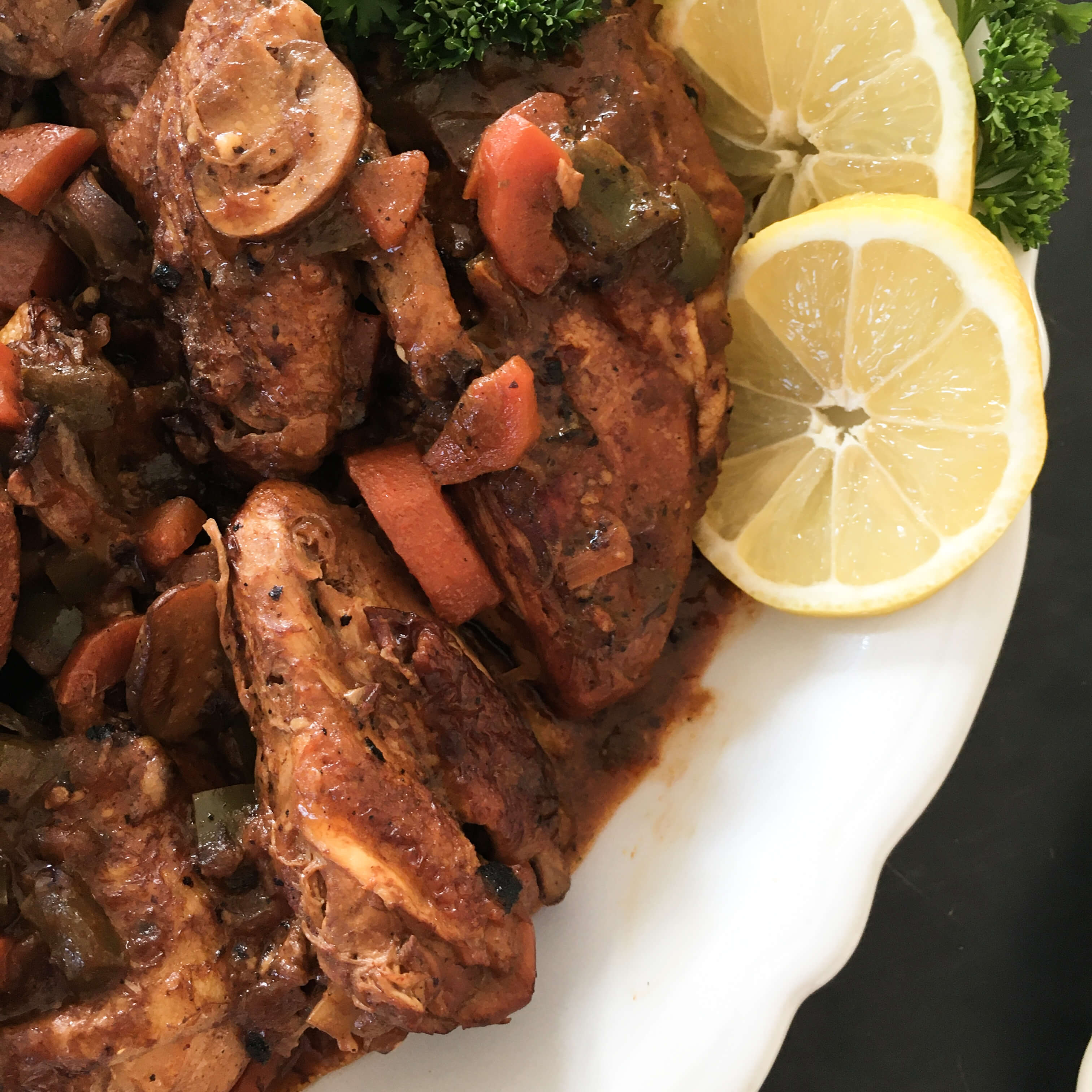
Reading is so subjective when it comes to personal preference. Everyone has their own favorite styles, writers, and genres, but I hope by sharing my list of favorites, you’ll discover some new favorite ones too. Stay tuned for a recipe I just made from Kim Sunee’s memoir coming up next on the blog. It’s an aromatic, cozy, wintertime dinner that is absolutely lovely for the holidays. Here’s a sneak peek…

Chicken Thighs with Cinnamon and Dates from A Trail of Crumbs by Kim Sunee

Until then, happy reading! And a big cheers to Madeleine, Sloane, Kim, Margaret, and Dale for making 2024 such an interesting one.

Italy’s Chicken Canzanese and The Family of Artists Behind The Recipe

It’s just the start of 2024, but here in the Vintage Kitchen, there is a finish line coming into view. This year we will be wrapping up a five-year project that first started here on the blog in 2020. I’m so happy to say welcome back to The International Vintage Recipe Tour.

international-vintage-recipe-tour

What started out as an intended year-long project of cooking 50 recipes from 45 different countries in 2020 has now taken five years to complete just to the halfway mark. A pandemic, a tornado, a big cross-country move and 1750 House renovations have waylaid plans far more than ever anticipated, but this project has always been such a joy I never wanted to not finish it. So here we are, at the start of 2024 finishing things up from 2020.

For a quick recap and for anyone new to the blog, The International Vintage Recipe Tour takes home cooks and readers on an around-the-world adventure via the kitchen, as we cook our way through a collection of recipes featured in the 1971 New York Times International Cookbook.

the-new-york-times-international-cook-book
The vintage 1971 cookbook that launched the Vintage Recipe Tour.

Throughout the Tour, we are visiting 45 countries via the kitchen and making at least one traditional heritage food from each, sharing both the recipe and the cooking experience here on the blog. To add context to the food we are making, and to spark some new conversations around the table, every visit to a new destination is paired with a unique cultural story from that country’s history.

So far we’ve visited twenty-four countries via the kitchen on this tour… Armenia, Australia, Austria, Barbados, Belgium, Brazil, Canada, Ceylon, China, Colombia, Cuba, Czechoslovakia, Dahomey, Denmark, England, Fiji, France, Germany, Greece, Haiti, Hungary, India, Indonesia, and Israel. It’s been a whirlwind of fun, friendship and delicious food.

Highlights from the Recipe Tour!

We chatted with an author and a food columnist via Armenia, met a descendant of the designer of the Statue of Liberty via Germany, and embraced our inner bula in Fiji. We discussed tropical architecture in Haiti, made floating paper lanterns to celebrate the Hungry Ghost Festival in China and donated funds from shop sales to help save the koalas injured in the Australian wildfires. We discussed women’s fashion in India, interviewed a Cuban-American farmer in Miami, and learned about a long-lost African-American dance in Dahomey. On the food front, we curried in Ceylon, baked Queen Mother’s Cake in Australia, made homemade mustard in Denmark, learned that not all fondue comes in a hot pot in Belgium, and took a much-needed virtual vacation to Corfu via Greece.

A visit to Corfu

Our latest stop on the tour was Israel, which lined up with the 2021 holiday season. To celebrate we made a Hannukah wreath, cooked two recipes for dinner, and dove into the history of both the Jewish flag and the Jewish star. Now, our next stop on the International Vintage Recipe Tour takes us to Italy, one of the most beloved cuisines in the world. Here we’ll make a provincial meal meant for sharing and meet an artist whose family recipes formed the basis of a life-long passion with food. Welcome to Italy.

It’s impossible to write about Italy without writing about family. And you can’t write about this recipe, Chicken Canzanese without writing about a specific family. Like France and China, Italy is one of the largest chapters in the New York Times International Cookbook. There are literally dozens of recipes to choose from, a switch from some countries that had less than a handful.

Besides the long wait to get the Tour started again, the hardest part about starting up again with Italy was which recipe to choose and which cultural treasure to spotlight. Contenders in that department were Stanley Tucci’s gorgeous Searching for Italy show, the multi-generational novel The Florios of Siciliy and the genealogy of the love apple (aka the tomato). There were all the pastas and all the sauces, lovely vegetable side dishes, and quite a few desserts to pick from, but the recipe that I kept coming back to was a one-pot chicken dish that was credited to an artist.

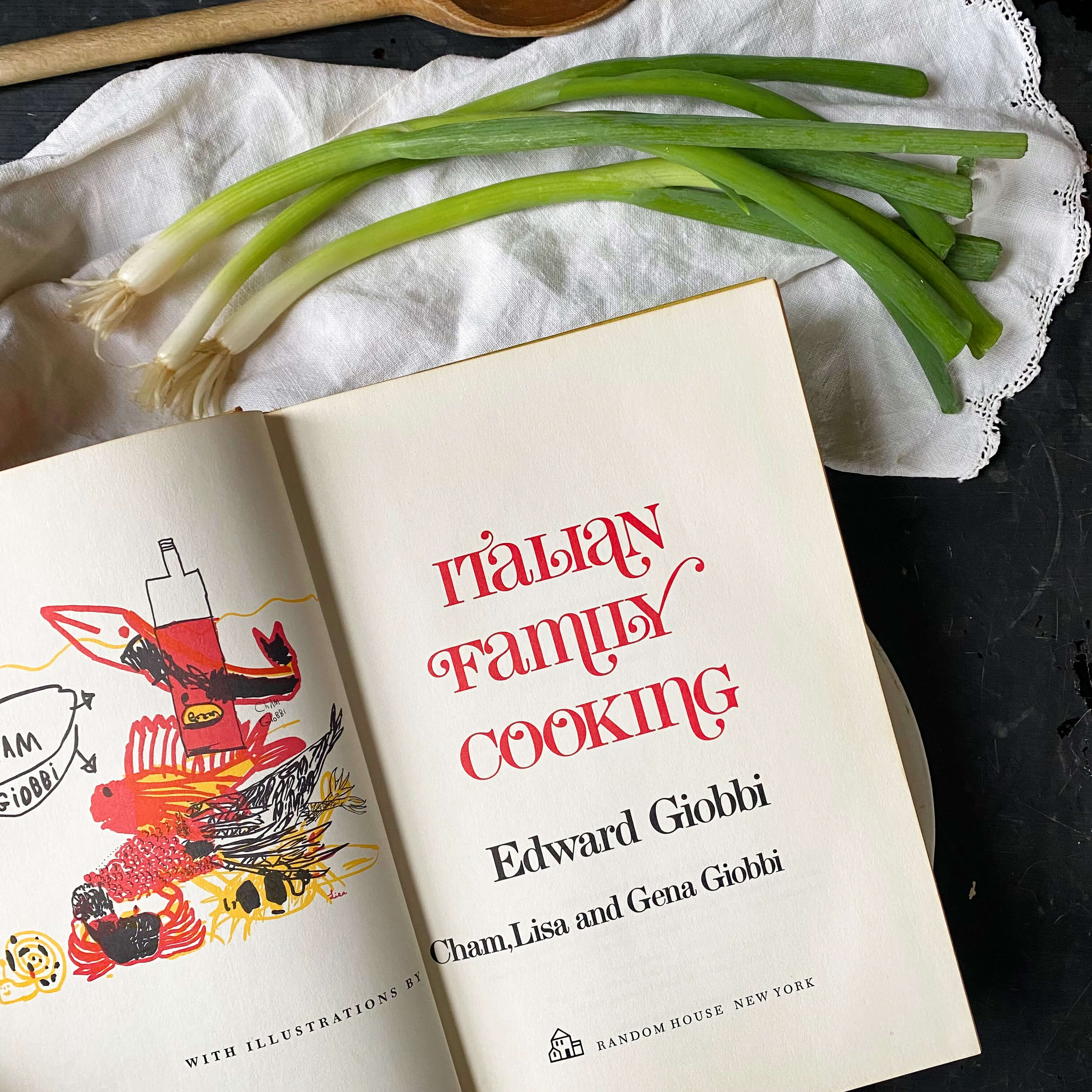
Last fall, while visiting a local bookshop, I discovered a bright yellow 1970s Italian cookbook. To my sheer delight and surprise, it was written by the same artist mentioned in the New York Times International Cookbook. A quick peek inside revealed the same exact recipe that was also featured in the NYTimes cookbook. The same recipe by one artist in two different books. It was a sign. This was the right Italian recipe for the Tour and the right time to tell a story about a creative spirit, who also happened to be an Italian cookbook author.

The artist is Edward Giobbi, a second-generation Italian-American born in Connecticut in 1926. Still painting today from his home studio in Katonah, New York, at the age of 98, Edward’s lived his entire life in pursuit of art and food. The book that made him well-known in the culinary world was his Italian Family Cookbook, first published in 1971. Selling over 30,000 copies by the 1980s, it offered home cooks a sincerity that resonated on multiple levels when it came to preparing economical and creative meals in true Italian style. The recipe featured here today, the one that appears not only in Edward’s cookbook but also in the New York Times International Cookbook, is his Chicken Canzanese, a slow-simmered one-pot made of chicken, herbs, wine, spices, and prosciutto.

A lovely selection for these end-of-winter days when the weather is jockeying back and forth between spring-like temps and snowstorms, this recipe is both light and hearty, depending on the sides that accompany it. It’s easy to prepare, has a warm, rich, earthy fragrance thanks to the prosciutto, garlic, and herbs, and can definitely be labeled a healthy comfort food since it contains no added fat.

The cooking prep is also interesting. There is a cold water brine, a unique set of flavor pairings, and a few very precisely measured spices… twelve peppercorns… six whole cloves… two sage leaves. I always find precise measurements like this fascinating. What was the process that a cook went through to determine that perfect balance of six versus seven cloves or nine versus twelve peppercorns? Would three sage leaves as opposed to two send the whole meal over the edge?

Edward Giobbi, tasting and testing in his kitchen circa 1971. Image courtesy of The News Messenger. Aug 12, 1971

As it turns out, Edward’s style of cooking and how he first learned it was based on quality but also frugality. Growing up during the Great Depression taught him and his family the value of growing your own food and utilizing agricultural resources close to home. Nutrition was key to keeping everyone healthy. Nothing was wasted or under-appreciated. Every bit of joy that you could scrape from an experience mattered. As an adult, Edward approached food in much the same way.

In the NYTimes cookbook, the recipe for Chicken Canzanese is simply attributed to Ed Giobbi, the artist. But in Edward’s cookbook, Italian Family Cooking, it’s attributed to Edward’s mother by way of a woman who lived in Canzano, in the Abruzzi region of Italy.

The Abruzzo region of Italy. Photo courtesy of iStock.

Located in the middle of the boot, Italy’s beautiful Abruzzi/Abruzzo region borders the Adriatic Sea and also the Apennines Mountains, both of which provide ample agricultural opportunity. Canzano is 105 miles east of Rome, and 230 miles southeast of Florence, and although geographically considered central Italy, the culture and food traditions of this area mirror that of Southern Italy.

Abruzzo, Italy. Photo: Sterlinglanier Lanier.

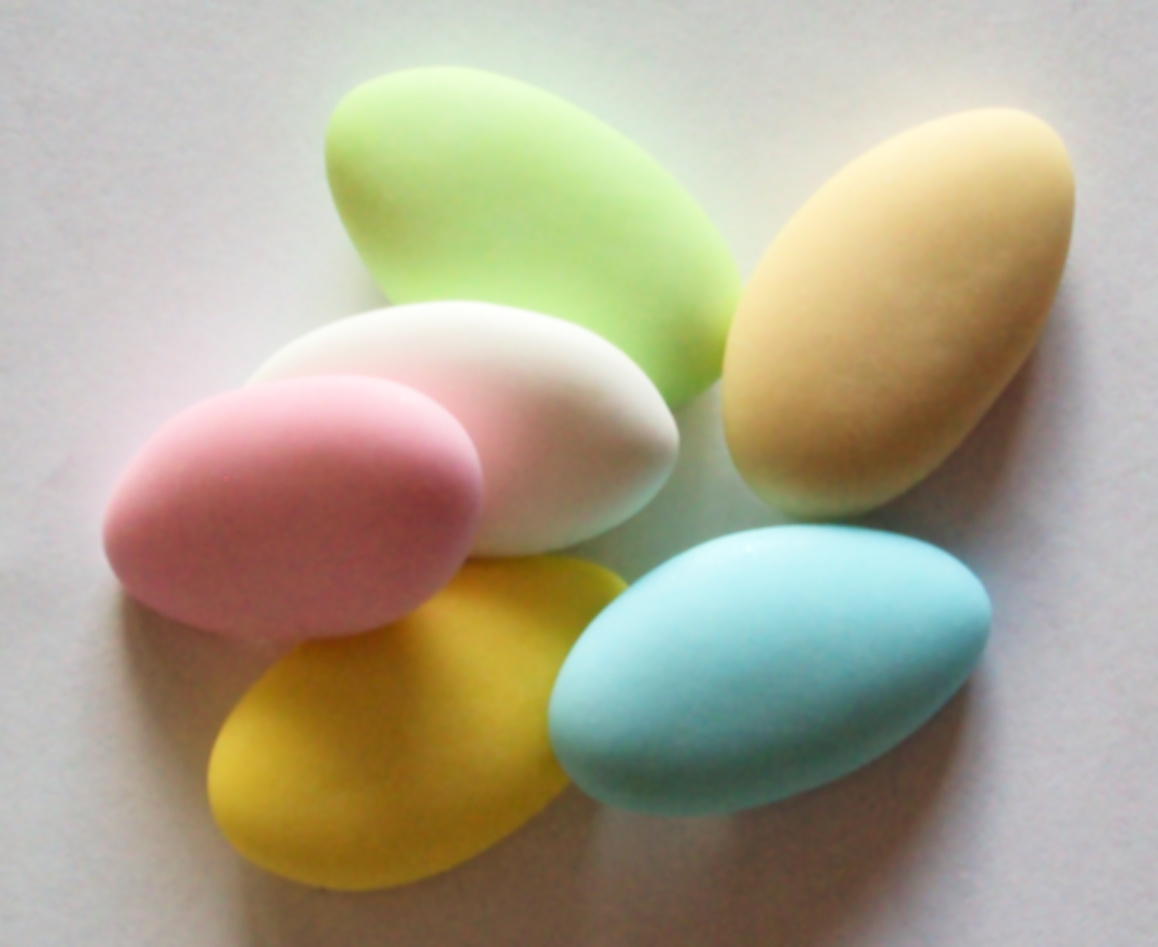
Full of food specialties ranging from provincial fish soups to local lamb dishes to plates of handmade pasta the traditional foods of Abruzzo favor both its maritime and mountain environs. Incidentally, this area of Italy is also known for a food often consumed at weddings here in the US. It’s the birthplace of the pastel-colored, candy-coated Jordan Almond, also called Italian Confetti locally.

All the pretty pastel shades of a Jordan Almond.

Edward’s parents immigrated to the US in the early 1900s first to Pennsylvania and then to Connecticut where they labored in factories and mills. Even though they both just had a third-grade level education, his parents had an appreciation for food, art and music which made a strong impression on Edward during his childhood. The Giobbi family kitchen would come alive at night and on weekends with the scents and flavors of his parent’s home country.

Life with Flowers. Edward Giobbi. 1958

Once he left home to pursue his art, his mom’s heirloom recipes became a vital part of the creative process as he perfected each one in his own kitchen, practicing them over and over again, until they met her standards and his memories. That dedication to good food and good eating, combined with artistic sojourns to stay with extended family in Italy sealed his love of cooking indelibly.

By the time Edward married and had his own family, preparing daily meals was a pleasure equal to painting. In his children, he instilled a similar joy. Art and cooking became a throughline that ran strong in the new generation of the Giobbi family members.

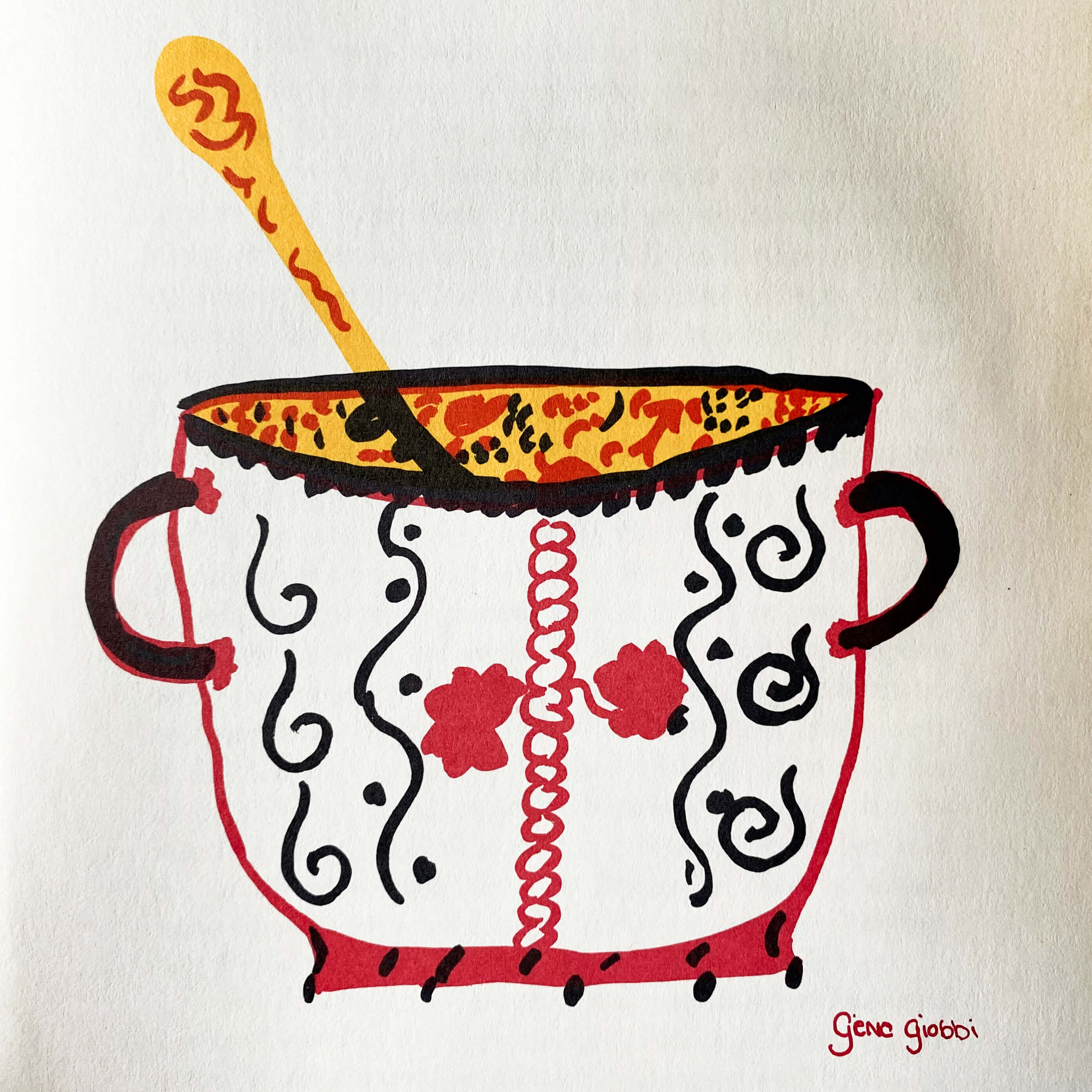
Apart from the myriad of wonderful traditional Italian recipes in Edward’s cookbook, the illustrations stand out with vibrant appeal and eye-catching charm. The art was executed not by a hired freelancer or a publishing industry dynamo. It wasn’t executed by a professional food photographer or a graphic design studio. Instead, the illustrations for his cookbook were illustrated by a collection of painters entirely new to the world – his children, Cham, Lisa and Gena who at the time ranged in age from six to nine.

Edward gave his kids no direction when he asked them to paint pictures for the cookbook other than to say “draw a fish, or a soup pot or a bottle of wine.” Each of his artists offered their own interpretation.

Whimsical and sweet, Edward Giobbi’s Italian Family Cookbook was indeed, in all ways, a family affair from kids to parents to extended relatives. It didn’t stop at this cookbook either. Edward went on to write another successful cookbook, Eat Right, Eat Well: The Italian Way (1985) and his band of illustrators grew up to pursue their own careers in art, dance, music and food science.

In keeping with the Giobbi clan’s combined love of the kitchen, nothing seems more fitting than presenting this recipe on a Sunday night when family dinner rules the kitchen in most Italian households. Named for the town in which it hails, Chicken Canzanese is a meal intended for communal family dining. Simple to make, it’s a two-step process that involves a one-hour wet brine and forty minutes of cooking time. True to Edward’s nature and his mother’s style of cooking, it’s made of simple ingredients and offers a bevy of creativity in the side dishes in which you choose to serve with it. More on those thoughts follow the recipe.

Edward Giobbi’s Chicken Canzanese

Serves 4

One 3 lb chicken, cut in pieces

2 sage leaves

2 bay leaves

1 clove garlic, sliced lengthwise

6 whole cloves

2 sprigs fresh rosemary or 1/2 teaspoon dried

12 peppercorns, crushed

1 hot red pepper, broken and seeded (optional) or 1 teaspoon dried red pepper flakes

1/4 lb prosciutto, sliced 1/2 inch thin or one 4oz package of pre-sliced prosciutto*

1/2 cup dry white wine

1/4 cup water

Salt for brine (see note)

Place the chicken pieces in a mixing bowl and add cold water to cover and salt to taste. *Note: I used a large mixing bowl and 1/8 cup of sea salt to 6 cups of water. Cover with plastic wrap and store in the fridge for 1 hour.

Drain the water and rinse the chicken pieces completely before patting dry with paper towels.

Arrange the chicken pieces in one layer in a skillet. Add the sage, bay leaves, garlic, whole cloves, rosemary, peppercorns and red pepper. Cut the prosciutto into small cubes and sprinkle it over the chicken. *Note: If using pre-sliced prosciutto, remove all the paper or plastic sheets between each slice. Stack the prosciutto one on top of the other, and cube the whole stack at once.

Add the wine and water. Do not add any additional salt, since the prosciutto will season the dish. Cover and simmer 40 minutes. Once the chicken has cooked to an internal temperature of at least 165 degrees. Uncover and cook briefly until the sauce is reduced slightly. Serve hot.

Rustic and earthy, Chicken Canzanese is tender and full of subtle flavors. The broth itself is fairly salty on its own thanks to the simmered prosciutto, but soak it up with a piece of crusty bread, and the briny flavor mellows. There were no serving suggestions mentioned in Edward’s recipe nor the NYTimes, but the broth would be lovely tossed in a warm bowl of pasta, spinach, peas, potatoes or mushrooms. If you are feeling decadent you could add a dash of cream to the broth to balance all the flavors. As Edward says in the introduction…”Cook the food in this book with a free hand, using your own creativity with the freshest ingredients you can get.”

Collected by museums and galleries around the world, throughout Edward’s long art career his style has varied…

Summer Shower, Pescara, Italy. Edward Giobbi. 1951

Dried Flowers #14. Edward Giobbi. 1999

Hanover, Triptych. Edward Giobbi. Exact date unknown – possibly 1970s.

He dislikes labels or being lumped into a certain type of painting, but he one thing Edward consistently strives for in his art instead is honesty. The same could be said for his cooking. All of his recipes are celebrations of local eating. They reflect riding the highs and lows of economy, of balancing cooking constraints with bounty, and the importance of identifying local resources. His recipes are interesting, creative, nourishing. They are of the earth and of the moment. I think that’s what makes Italian food so appealing. It’s a cuisine rooted in a waste-not culture that appreciates what’s right there in front – all the bounty that the earth can offer.

Fall Still Life- Edward Giobbi. Photo courtesy of Chroma Fine Art Gallery. Find out more about this painting here.

My favorite piece in Edward’s catalog of work is this one. I think it’s the most food and family-like of all his art. In my interpretation of it, I can see his whole entire world. His whole lineage in mixed media. There are blue fish in the sea at the bottom right. A mountainous landscape in the middle. There’s red for blood, life, wine and energy. I see flowers, woodland foraging, and garden soil. In my mind, that blob of brown represents all the possibilities that might grow from a simple swatch of ground. And the tree. The beautiful, exuberant tree surrounded by dots of confetti-like splatters and stars. That’s the Giobbi tree. The one that represents the vitality of nature, the sparkle of life, of wife, of children all rolled up in one. I could be reading too much into it. Maybe it’s just what the title says - Fall Still Life. Maybe it’s an autumn landscape in Canzano, Italy. Or a pairing of items Edward arranged in his home studio in Katonah, New York. Maybe it represents a lot more or even possibly a lot less. Or maybe… just maybe… it’s the word, the work, that Edward’s been striving for all along.. honesty.

Cheers to Edward for sharing his family’s Italian heritage with us here in America via books, art and storytelling. Cheers to his kids, Cham, Lisa and Gena for their fantastic illustrations. And finally, cheers to the unnamed woman in Canzano, who passed this recipe along. I wish we knew your name so we could credit you properly for the delicious dish.

If you’d like to catch up with the recipe tour from the very beginning days in 2020, start here or click on any of the country links mentioned above to visit those specific posts.

Next up on the International Vintage Recipe Tour, it’s a trip to Jamaica via the kitchen. Hope you’ll join us!

A One-Pot Recipe for Your Pup: Homemade Dog Food Back by Reader Request

To view the full 30-Days graphic that includes all 30 bowls, click here.

This past January, we shared a post highlighting thirty days of homemade dog food that we made for our pup, Indie, during the month of December 2022.

As much a photo collage as a visual guide on the types of food that Indie has been eating throughout her life here with us, I wanted to dispel the myth that cooking for your pup is difficult, time-consuming and complicated. It was a piece that worked in tandem with a 2018 post about the history of dog food where we also introduced how to make your own balanced meals for your dog regardless of size, age or breed.

The history of dog food and how to make your own.

Both posts shared details about a large majority of the types of food Indie (and all dogs) can eat but neither contained a specific recipe. So in today’s post, as requested recently by our canine-loving readers, I’m sharing one of Indie’s most favorite meals complete with an ingredient list, step-by-step instructions and notes on scaling proportions depending on the size of your dog.

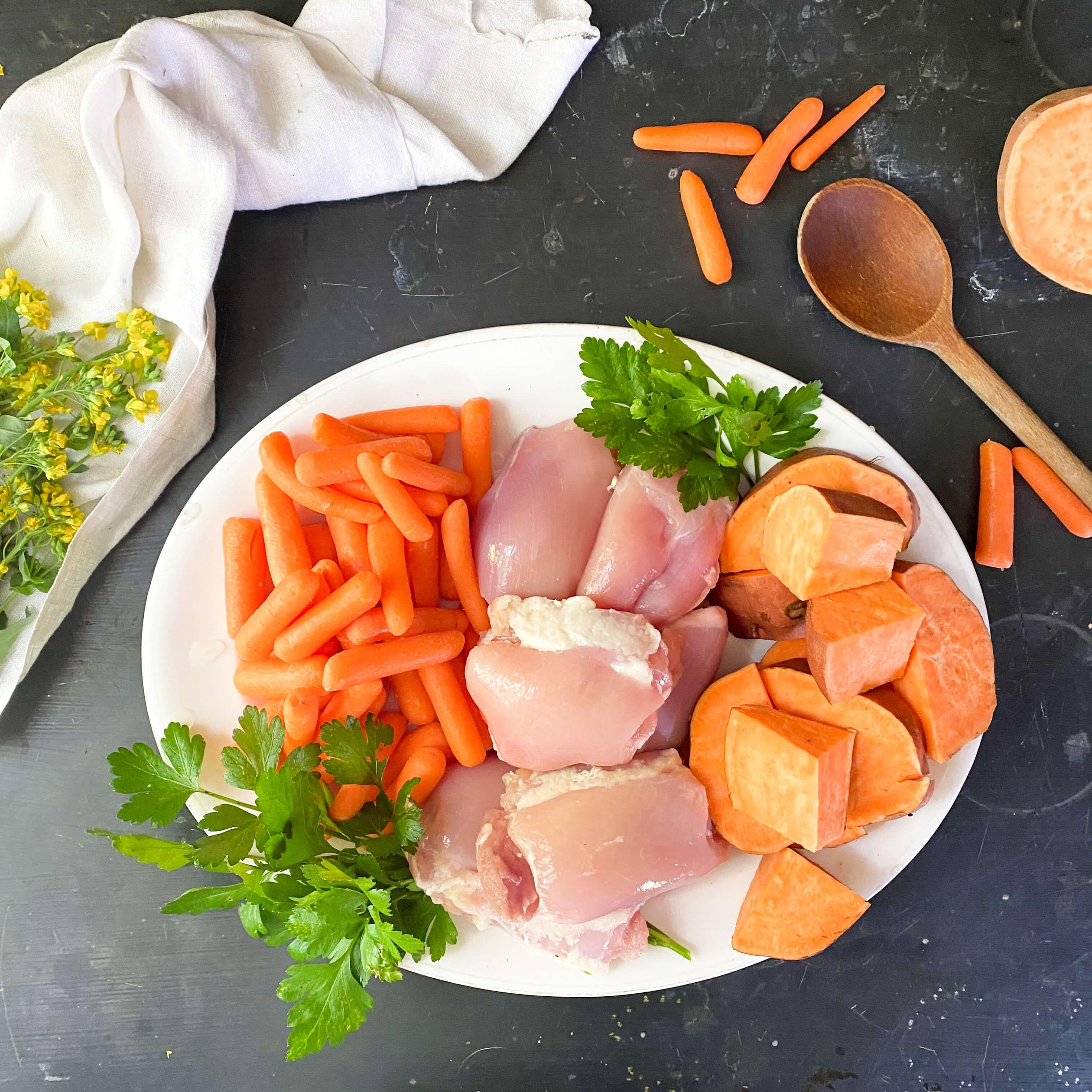
On the menu today it’s Steamed Chicken, Carrots & Sweet Potatoes – a one-pot stovetop meal that takes five minutes to prepare and one hour to cook. You can amend the recipe to make a large batch that will make up to eight meals or you can make a small batch that will provide a fresh homecooked meal for one to two days worth of dinners and breakfasts. Fridge-friendly, freezer-friendly and on-the-go-approved, if packed in an air-tight container and kept cold, this recipe can tag along on your all summer outings including picnicking, hiking, and overnight vacations. It can be reheated in the microwave or the oven if your dog likes warm food, or it can be enjoyed cold right from the fridge. You can toss in additional grains or vegetables if your pal has a big appetite, or serve it as is – a simple meat and two.

This is also a good starter recipe if you are new to the world of making homemade dog food or are introducing your pup to this new way of eating. It’s simple to make, requires just a handful of ingredients, and is easily digestible for all dogs. And just like all of Indie’s other meals, it’s 100% human friendly too. That’s the key to homemade dog food. There is not one ingredient in this recipe that you wouldn’t want to eat yourself. Let’s look…

Steamed Chicken with Carrots & Sweet Potatoes served here over a bed of green lentils.

Homemade Dog Food: Steamed Chicken with Carrots & Sweet Potatoes

This recipe makes 4-5 servings for a medium-sized dog weighing 45-50 lbs. Please see note regarding portion sizes following the recipe.

One 2-3lb package of chicken thighs, containing 4-6 thighs (Bone-in and skin-on preferred, but you can also use skinless/boneless thighs, chicken breasts or chicken tenders. We do not recommend bone-in-chicken breasts or wings though as these contain too many small bones. Please see note below.)

3 tablespoons olive oil

1 lb baby carrots

3 large sweet potatoes, skin-on and roughly chopped into large 3″ inch cubes

1 healthy pinch of sea salt

Optional: a handful of roughly chopped fresh parsley

Rinse chicken and pat dry with paper towels. Set aside. In a large stock pot, over medium-high heat, add the olive oil, making sure it coats the entire bottom of the pot. Let the oil warm up for about one minute. Add the carrots in a flat layer.

Next, add the chicken (skin side down if using bone-in thighs) …

Sprinkle the chicken with a generous pinch of sea salt. Then add the chopped sweet potatoes on top of the chicken and the fresh parsley on top of the potatoes.

Turn the heat down to medium. Cover the pot and cook for 60 minutes. Remove the pot from the heat and let it rest for 15 minutes on a cooling rack. Dinner is done!

With stew-like consistency, this dog-friendly recipe is full of comfort food flavors all bathed in a natural broth that forms when the water in the carrots and sweet potatoes mixes with the olive oil and the chicken fat. The hour-long steam makes the chicken fall off the bone and makes the vegetables so tender you can slice them with a butter knife.

If you use skin-on chicken thighs with bones you’ll get a richer-looking broth.

After the chicken has rested, remove one thigh, one cup of sweet potatoes, 1/2 cup of carrots, and 1/3 cup of broth to your dog’s bowl. Pull the chicken from the bone with a fork and then discard the bone. Because they splinter easily and can cause internal damage to organs, you never want to feed your pup any chicken bones. This is why we don’t recommend using bone-in chicken breasts which usually come with the ribs attached. The same goes for chicken wings which are made up of many small bones that can be easily missed when cutting the chicken up after it cooks.
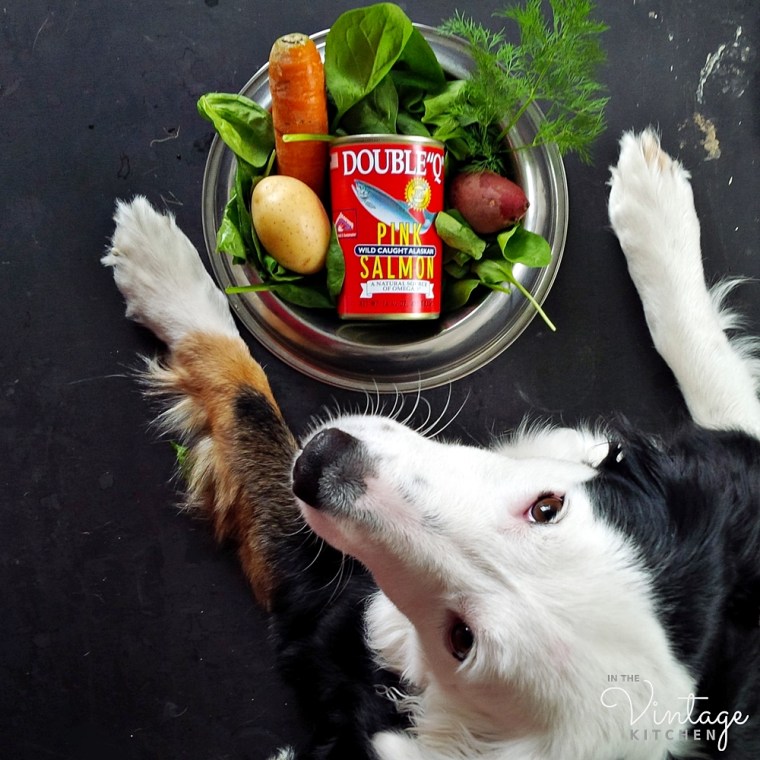
Once you have transferred the chicken and vegetables to your pup’s bowl, slice everything into bite-sized pieces, mix it all together and let it cool to room temperature before serving.

Hands down one of Indie’s most favorite meals, Steamed Chicken with Carrots & Sweet Potatoes is a year-round pup-pleaser of a recipe and contains all sorts of nutritious vitamins and minerals. Collagen (chicken skin), beta-carotene (sweet potatoes, carrots), magnesium (sea salt), healthy fat and vitamins E & K (olive oil), and lean protein (chicken) are just a few of the beneficial vitamins and minerals wrapped up in this recipe that will help keep your dog happy and healthy.

Over the 4th of July weekend, Indie celebrated her 10th birthday. Of course, we surprised her with her favorite chicken dinner. This time, in addition to the sweet potatoes and carrots we added in some chopped-up cucumbers, another summer love of hers.

For the love of homemade food and cucumbers.

That is just a little example of how carefree this chicken recipe can be. The carrots, olive oil, and the chicken itself are mainstays, but the sweet potatoes can be swapped out for butternut squash, red potatoes, broccoli, cauliflower, cabbage, pumpkin, celery, beets. Just avoid adding any onions, garlic, or citrus fruits – three types of food that also seem like they might be natural companions to this meal, but are actually toxic to dogs. If you are interested in more possibilities to add in or swap out be sure to check the lists of other approved dog-friendly foods in the previous two posts here and here.
Leftovers can be stored in an air-tight container in the fridge for up to four days. When the broth cools it transforms into a jelly-like consistency similar to aspic. Don’t be put off by its wiggly jiggly nature. It’s just the coagulation of the olive oil, broth, vegetable juices and chicken fat. Your dog will love it, so be sure to include a little bit of it with each additional serving. If you decide to make some rice or lentils to augment the chicken and vegetables that jelly will add extra flavor to the new additions.

Day Two – the wiggly jigglys!

And two final notes on year-round enjoyment of this recipe and portion sizes …

In the summer, Indie tends to eat a little less food if it’s particularly hot, so when it comes to this recipe, she’s happy most of the warm-weather months with just the chicken, sweet potato and carrot combo. But in fall, winter and spring when she is at her most active, we usually add in a few other foods too for both variety and an extra dose of go-power. Other accompaniments you might like to include are the following…

  • 3/4 cup of cooked rice, 1/2 cup of cooked lentils or 1/4 cup oatmeal
  • 1 cup of additional cooked and chopped green vegetables (broccoli, collard greens, kale, spinach, zucchini, celery, green beans or peas)

All the proportions discussed so far are based on Indie’s medium 55lb. frame. If you are making this recipe for a small breed dog like a chihuahua or a bichon, you can certainly swap out the thighs for smaller cuts like chicken tenders or thin-cut chicken breasts. If you decide to use either of those, simply adjust the cooking process by starting with the layer of carrots first after you add the olive oil, then add the chicken, salt and sweet potato layers. That way the chicken won’t get stuck to the bottom of the pot.

And on the opposite spectrum, if you have a large breed dog over 60 lbs. I’d recommend doubling the portion size of the recipe above. The nice thing about using a big stock pot is that you can fit quite a bit of food in it. I’ve made this recipe using all types of chicken cuts, and all types of quantities from 4 to 8 thighs with 2lbs of carrots and six sweet potatoes, and it still comes out great every time.

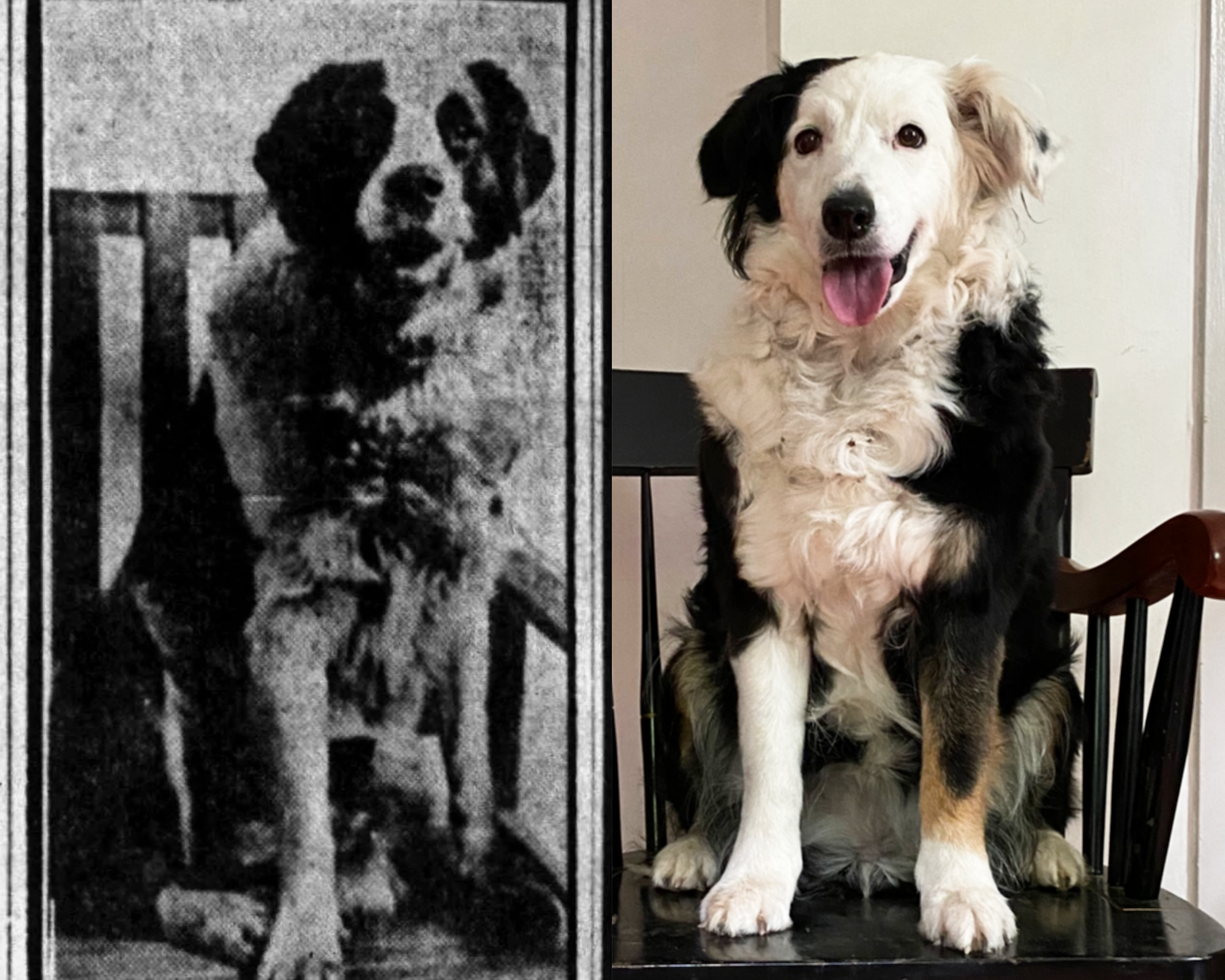
Recently I discovered the 1910 story of Bum, a stray dog in St. Joseph, Missouri who frequented the back door of several restaurants in town each day. He was such a polite and enthusiastic eater, the kitchen cooks and wait staff couldn’t help but spoil him with the finest menu selections of the day. After Bum enjoyed a delicious meal at his favorite luncheonettes, he’d trot down the street and wait patiently for his next favorite set of restaurants to open up for dinner service. Bum so charmed all the restaurant workers that he became the most beloved (and well-fed) fixture in the neighborhood.

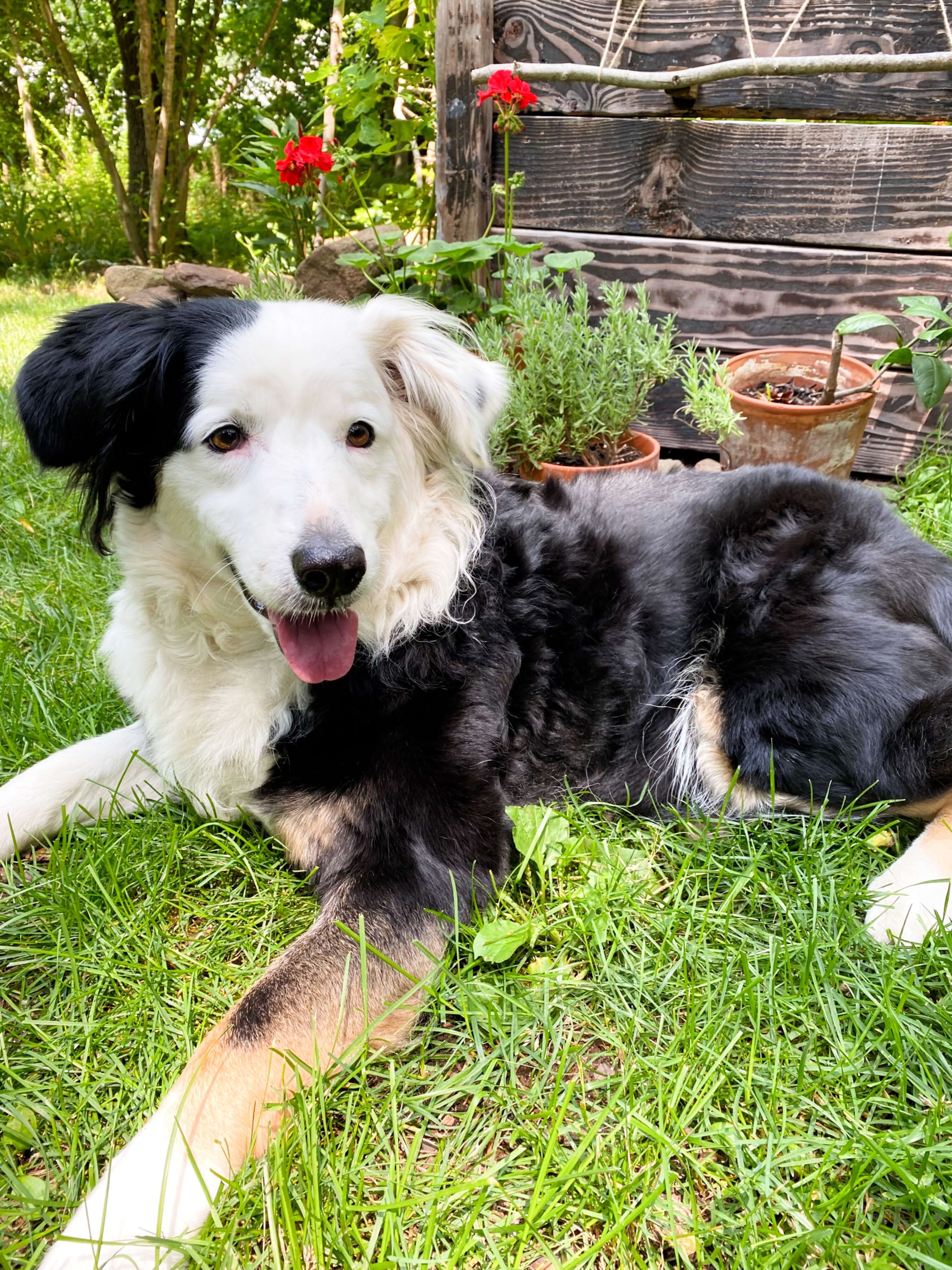
This story reminds of Indie, who was also a stray who trotted into our backyard during our Fourth of July barbecue in 2014. Once she had her first bite of grilled chicken, she never left. And so began a now nine-year adventure of cooking for Indie, our most enthusiastic taste-tester here in the Vintage Kitchen. Julia Child was famous for saying ” People who love to eat are always the best people.” Around here, we could say the same about dogs too.

Bum in 1910. Indie in 2023. Photo of Bum courtesy of the St. Joseph News-Press (Dec. 16, 1910).

I hope this post is helpful to the readers who requested it. We are always here to answer any questions you might have so feel free to ask away should you run into any troubles. In the meantime, happy eating to your pups. I hope they love this recipe as much as Indie does!

Cheers to all the dogs out there who inspire a wealth of joy and creativity in the kitchen. And to Indie, our delight of a dinner eater from day one.
All Around Austria via Food and Festivity: An Interview and a Recipe

From the land of Johann Strauss, Mozart, Gustav Klimt, and my lovely friend, Viktoria, comes the latest escapade in our around-the-world culinary adventure. Welcome to Week Three of the International Vintage Recipe Tour 2020!

Last week, we were in Australia dissecting the history of a favorite Aussie cake that turned out to be inspired by a famous woman from England. This week, we are heading here…

… to picturesque Austria… a country known for its gorgeous snow-capped mountains, stunning cityscapes and panoramic vistas. On the menu is Viennese Chicken – a saucy vegetable-laden vintage recipe that is perfect fare for cold winter weather.

Viennese Chicken

In this post, we will not only be cooking something warm and hearty, but we will also be getting to know the warm-spirited Viktoria, an Austrian native who has been living and working in the U.S. for the past year and a half. She’s about to head back home to Europe, but before she bids Nashville goodbye, I caught up with her to discuss the food culture in her native country, how it compares and contrasts with ours here in America, and to see what she knows about the mysterious Austrian recipe that’s the focus of our international menu this week. She also recommends a list of the most interesting things to see (and eat!) in Austria, reflects on which aspects of her U.S. adventure she will miss most and shares how one particular type of American restaurant stole her heart.

Photo courtesy of Drew Beamer.

Our recipe this week is an easy one to make, so before we get to cooking, grab a glass of Riesling or an Austrian beer and get to know a beautiful part of the globe through the eyes of a local. I’m so pleased to introduce to you to Viktoria, art director by day, intrepid explorer by night (and on the weekends!)…

In The Vintage Kitchen: Tell us a little about the city in Austria in which you are from…

Viktoria: Well, first and foremost I cannot call it a city ha – I grew up in a very small town, called Stans, with only around 2000 people. It’s one of those charming little places with one tiny grocery store, one butcher, one bakery, one bank and so on… but hey, that’s everything you basically need, right? 

Stans im Karwendel

Stans is a town within the state of the Tyrol – one of 9 states within Austria. It’s in the western part of Austria, surrounded by the Alps, yet only 1h away from the German border in the north and the Italian border in the south. (Yes, dimension in Europe are a little bit different.)

What are some things you missed most about Austria while living in the United States?

The 4 F’s: Family, Food, Fall Fest and Fasching!

1) Family: The thing I missed the most is definitely my family. Just to be clear, I was never homesick, from the second I stepped out of the airplane at BNA airport I immediately knew I found my second home away from home, but my family and I are very close so it was definitely a big change for me to not see or spend time with them every other day.

2) Food: I am not a picky person at all, I have no allergies or intolerances and I definitely have what Americans would call a “goat stomach.” Having said that, it is not hard for me to adjust to a country’s culinary culture. Besides that Austria and America have lots of similarities in food, so from the very beginning I was sure I would not starve overseas. Yet, nothing is as good as granny’s Schweinebraten or my sister’s chocolate mousse cake. People who know me, know that I am not a big fan of sweets, but man, let me tell you what, I just can’t resist it!

The fancy cows of Fall Fest!

3) Fall Fest: I’m sure people are familiar with the Octoberfest in Munich. Our fall fest is similar to that, beside the fact that we also have a cattle drive. Farmers drive their cows down from the mountain meadows into the valley where they spend the winter months. People from Italy, Germany and France come to see this spectacle, which happens every year during the last two weeks of September. The cows wear bells and flower arrangements; it’s almost like a fashion show for cows if you want to put it that way ha. There is a farmers market, souvenir booths, food courts, live music, and, most importantly, the men and women dress in snazzy Lederhosen and beautiful Dirndls.

The colorful and creative world known as Fasching. Photo courtesy of austria-forum.org

4) Fasching: It’s the Austrian word for carnival. Fasching season starts on the 6th of January and ends on the day of Ash Wednesday, which is February 26th this year. Within this period we have days like Fasching Tuesday or Silly Thursday. People dress up in conspicuous costumes and we have parades with floats and wild colorful parties. This time of the year even has its very own pastry, specifically dedicated to Fasching– The “Faschings-Krapfen”.

Faschings Krapfen! Photo via pinterest.

How is daily life different in the U.S. vs Austria?

There’s actually not a big difference. You go to work, run your errands, and meet up with friends – the basics. I think the biggest difference for me personally is that back in Austria I had to get up at 6AM at the latest to drive to the railway station, catch my train to Innsbruck (the capital and biggest city of the Tyrol) where I had to catch a bus in order to get to work.

The beautiful cityscape of Innsbruck, Austria

We Austrians love out public transportation system ha! Here in Nashville I only have to hop into my car and I’m at work 10 minutes later. So yes, I’m definitely super spoiled when it comes to sleeping late in the morning now! But besides that I think Americans and Austrians have a pretty similar everyday life.

Since 2018, Viktoria’s U.S. home base has been the city of Nashville. Photo courtesy of Tanner Boriack.

What are some things you’ll miss most about America once you return home?

Just circle back to question 3 and you will have your answer ha! No, to be serious, I had a great time here in the U.S.: I worked a job that I loved, I was part of a culture that I enjoyed inhaling and most importantly, I was surrounded by so many loving and caring people. It’s almost unbelievable what great personalities I met and the close friends I made on this journey.

Oh, and brisket! I love brisket; unfortunately that’s not a thing in Austria.

What is your most favorite Austrian food? And what is your most favorite American food?

I wish I could give you a definite answer for this questions but I cannot. And I love that fact! There is way too much good food out there and it would be a waste to focus myself on only one most favorite thing. That’s why I’ll give you my top 3:

Viktoria’s favorite Austrian foods -Clockwise from top: Kaiserschmarn, Schweinebraten and Cheese and Spinach Dumplings

For Austria it is definitely Schweinebraten. The one they have at the Bavarian Beerhouse here is not bad at all but in no way comparable to the Austrian original. Schweinebraten is followed by cheese and spinach dumplings. Unlike what Americans call dumplings, these are more like balls of batter that contains a lot of different ingredients and gets boiled and served with lots of melted butter. We even have a festival to celebrate our love for dumplings in the Tyrol. And last but not least the – the“Kaiserschmarn.” I looked up the translation and the dictionary suggested “sweet cut-up pancake with raisins.” We serve it with powdered sugar and apple mousse. It’s a main dish as well as a desert – a dish that deserves to be among my top 3.

When it comes to American cuisine it’s the brisket that would probably make it on the winner’s rostrum. I am a meat lover and since I didn’t know what brisket was before I moved to the States I immediately fell in love with this dark smoked delicacy. Another thing that I am hardly able to resist is a Nashville specialty: Hot Chicken! Wings, thighs, breasts, battered and fried or grilled – I don’t care, I love them all, as long as they come with a hot and spicy Buffalo sauce.

Are you familiar with Viennese Chicken? If so, do you have any stories that relate to it in some way? Maybe you’ve made a version yourself or this was something you mom made?

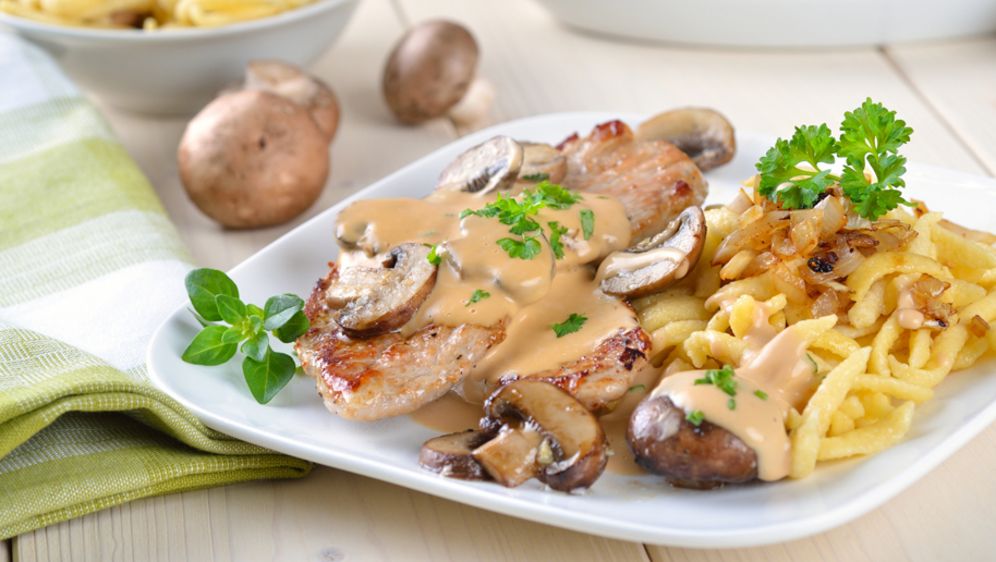
Unfortunately I’m not familiar with this specific recipe. It reminds me a little bit of “Jäger Schnitzel” (“hunters-schnitzel”). It’s either a pork or chicken schnitzel, served with spaetzle and creamy mushroom sauce.

Jager Schnitzel

Also, cheese speatzle is a very famous Austrian dish. Speatzle are little pasta dough twirlings, mixed with melted cheese, garnished with cheese and topped with fried onions, usually served in a traditional cast iron pan. Super filling but super yummy!

If someone was traveling to Austria for the first time, which top five places would you recommend they visit first?

First and foremost is definitely Vienna. Yes, there are thousands of tourists but there is a good reason for that. Vienna offers so many things to see and do: outstanding architecture, fascinating history, open minded and hospitable locals, a wide culinary palette, from traditional Austrian dishes to food inspired by different countries from all over the world, to the newest food trends; you will find it all in Vienna.

When you come to Austria you should also pay Carinthia, our most southern state, a visit. Carinthia’s biggest lake, the Worthersee lake is one of Austria’s most famous summer destinations. It appeals not only to those who want to canoe across the lake, but also spelunkers who will want to check out several caves, including Griffen Stalactite Cave, which is considered Austria’s most colorful cave. Those who are vintage car enthusiasts may enjoy a visit to Gmund, birthplace of the Porsche, or to the large Villach Automotive Museum with its collection of cars, motorcycles and more.

I studied and worked in Innsbruck for 4 years. It’s this great historical jewel surrounded by stunning scenery. Rumor has it that Innsbruck replaced Vienna as the most expensive city to live in. Innsbruck, with a name that translates as “bridge over the inn,” (Inn is the name of the river that runs through Innsbruck) is an all-season tourist destination.

It is internationally known for its winter sports, having hosted the Winter Olympics in 1964 and 1976. But this Tyrolean city offers more than just great skiing. It offers a good mix of cathedrals, such as Hofkirche, which houses the tomb of Emperor Maximilian I; the Schloss Ambras, which has a collection of paintings and armor; and the Bell Museum, a nod to 400 years of bell-making.

The gorgeous town of Halstatt

More beautiful scenery can be found in the Salzkammergut. It is a beautiful resort area that starts with Salzburg and heads east into a land of lakes. Sparkling clean lakes, green hills, wonderful mountains, romantic towns like St.Wolfgang and Hallstatt make up this region. Travelers who have seen the movie The Sound Of Music will know what this lake region looks like, because that movie was filmed in and around the city of Salzburg and the neighboring Salzkammergut region. For those who enjoy classical music, a visit of the city Salzburg, the home of the Mozartkugel and birth house of Mozart is worthwhile.

Mozart’s Birthplace in Salzburg, Austria

And last but not least St Anton am Arlberg. It is a must visit for all winter sport enthusiasts. This town is widely regarded as the leading ski resort destination in Austria. Located in the Tyrol, this village offers serious, legendary ski terrain that caters to a mixed level of abilities. Often attracting adventurous youths, St Anton is notorious for living up to the saying “work hard, play hard”. The vast landscape welcomes its loyal winter crowd, as well as its summer mountaineers, who come to trek the landscape each year.

Here’s a very accurate video about the best places in Austria that I can highly recommend watching. It even taught me things I didn’t know about:

Have you been to Vienna before? If so what is your impression of it?

Yes, in fact I studied and lived there for over a year when I was working for McCann Erickson. Vienna is the capital of Austria and such a multifaceted city. Vienna is not only famous for its architecture and history but also for its worldly and cosmopolitan vibe. I loved grabbing my laptop and just hanging out in one of many cozy coffee houses and watch people strolling by. Vienna is a very lively city and there is always something going on for everyone.

Every aspect of Vienna looks like a perfect picture postcard!

Also, since everything here is kind of food related, I want to use this opportunity to resolve one of the most misconstrued stories of the culinary world – the story of the croissant!
The earliest known occurrence of the croissant dates all the way back to 1683 Vienna, Austria. The legend takes place during the Ottoman Turk siege of the city; a baker apparently heard the Turks tunneling under the walls of the city as he lit his ovens to bake the morning bread. He quickly sounded an alarm, and the military collapsed the tunnel, saving the city. To celebrate, the baker baked a crescent-shaped bread, in the shape of the crescent moon of the Turkish flag.

And for whom this is not enough, the Vienna Kipferl pastry actually dates back to the 13th century. Ergo, Austria invented the ‘croissant’. It is a sore topic for this Austrian, so thanks for letting me vent publicly – ha!

Who taught you how to cook?

It was definitely my school education, maybe combined with me having always been a connoisseur of delicious food and being curious about new recipes. Many people don’t know that I went to Tourism College for 5 years between the age of 14 and 19. Besides majoring in tourism management and marketing I also had to complete a 4 year apprenticeship where I was thought how to cook as well as learn to fold at least 40 different shapes of napkins. But let’s be serious for a second – the Tirol is one of the top tourism regions in Austria and skilled professionals within this sector are highly in demand. My interest in tourism wasn’t the main reason why I went to Tourism College though – it was because of the language studies they offered. I studied German, English, Italian, French and Russian. Languages always fascinated me. Long story short, this is how I learned cooking. If you are trained on how to cook a 5-course meal for 10 people all by yourself, you can also cook a box of pasta just for you.

What are some of your favorite things to cook?

Speaking of pasta! I love love love pasta in all variations with all sauces possible. Pasta creations are my favorite! Pasta might sound boring to some people but you can create so many creative delicious variations with all kinds of ingredients. I am definitely always looking for new adventurous and interesting recipes out there; I like trying new things.

Viktoria with her mom, sister and niece

When it comes to traditional food though, I would never even try to compete with my sister. You would think making the perfect Schweinebraten takes decades of experience and at least 2 cut off fingers, but at the young age of only 32 she has already perfected the recipe for a sublime Schweinebraten with Sauerkraut, potatoes and breaded dumplings.

When you return home to Austria, what is the first thing you will eat?

I will most like have a Kaiser Roll with smoked bacon and a bottle of ice-cold Zipfer beer (it is a local beer and my most favorite).

You might want to ask why I am so sure about this. The answer is simply: because whenever I go back home my family picks me up from the airport and brings exactly these two things with them! What a lovely tradition it has become.

Do you have a favorite restaurant back in Austria? If so, what about it did you like? 

There definitely is. Let me mention one thing first: If you are looking for a place to eat in the Tirol region and you find places which names include “Gasthaus” or “Gasthof” you can’t go wrong. These are local restaurants with local food and local specialties.
And when it comes to Tyrolean delicious dishes I definitely have a favorite restaurant.

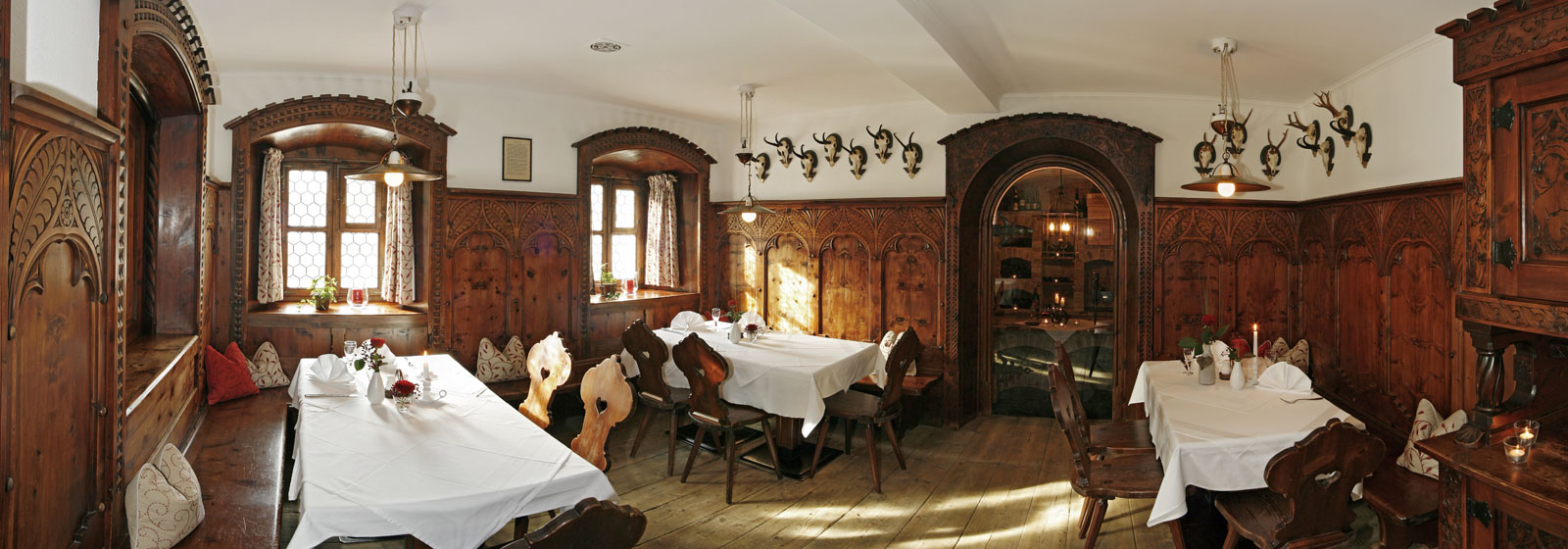
It is called “Gasthof Herrnhaus” (see “Gasthof, you can’t go wrong). I not only really like this place because I once did an internship in their kitchen but moreover because they serve great local food for a moderate price. Don’t get me wrong, I know that good food and especially good quality has its price but at Gasthof Herrnhaus you really get something for your money, and that is one thing that Tyrolean hospitality is about.

Interior of Gasthof Herrnhaus

How is food and/or the culture surrounding food different in the US than in Austria?

I have two approaches to this question.

One word: barfood.

Unlike America, in Austria we either have a bar where you can get something to drink, or a restaurant where you can get something to eat. If I think about trying to find a place in Austria where I can just hangout, watch my favorite sports team, eat my delicious chicken wings and drink a beer, I will probably not be able to come up with a single place. I am very simple as you can see ha.

Downton Nashville Bar Scene. Photo courtesy of Drew Hays

There are great restaurants in both, America and Austria, of course, but when it comes to the barfood culture as I call it, there is definitely a big difference and something I would love to have in Austria as well.

Before food is served on our plates it has to be bought. And I think this is a big difference between America and Austria. My first grocery-shopping-trip to Kroger took me a striking two hours! Can you believe this ha. By now I have become a total pro as to knowing in what aisle the items are that I need, but when I first moved here I was totally lost. The overwhelming amount of goods and different products completely over stimulated me. And please don’t get me started on my first experience with a self check-out counter ha.

One event that I consider myself lucky of having been able to be a part of is Thanksgiving. In Austria we have something that’s called “Ernte Dank” which means being thankful for this falls crops, but it is neither a very special nor a family get together kind of event. I was invited twice to my landlady’s nephew’s house for Thanksgiving and I always had a great time there. People getting together for good (and way too much) food, quality time, maybe some football and pumpkin shooting is a wonderful occasion. I am very happy and thankful for having been invited to this annually family event.

When you are not busy designing beautiful things for work, what do you like to do with your free time? Do you have any hobbies?

Funny enough, I would say my hobby is looking for new hobbies. I mean I like to work out, cook, paint, go for a walk, and be in nature but I always try to find new interesting activities. Recently I have been into axe throwing and it turns out I am actually quite good at it. It is a lot of fun and will definitely help you forget some of the everyday stress. When it comes to watching sports, I definitely count soccer and ice hockey to my most favorite kinds of sport. When I have to think about an activity that satisfies me the most though, I have to say it is definitely meeting up with friends, having a beer and simply spending a good time together with the people I love.


What are three places in Austria that most inspire you and why? 

1) Wolfsklamm Gorge, Tirol:

The Wolfsklamm Gorge impresses nature lovers with thundering waterfalls and emerald green pools. The location of this trail is very convenient for me because I can start the hike right from my doorstep. I used to go there a lot with my dad when I was a kid.

Walking through the Wolfsklamm Canyon in the Karwendel Alps, Stans in Tyrol, Alps, Tyrol, Austria, Europe

The beautiful waterfalls, timber bridges and the galleries carved into the rock have always fascinated me- it seems so magical. Its 354 steps, to be precise, that lead upwards to the pilgrimage monastery of St. Georgenberg, where we always used to rest and stop for a bite to eat because they have a great restaurant up there. It’s a picturesque and magical hike that makes you feel like you are in a different world.

Kloster St. Georgenberg in Tirol

2) Millstätter Lake, Carinthia:

My stepdad is from this region of Austria where my grandparents still run a farm up on a mountain. Whenever I go there to visit them I can’t get enough of the spectacular view on the lake…

especially on a summer day when the setting sun is reflecting in the waters surface and makes the entire like sparkle. It’s a beautiful place where the time seems to stop whenever you soak up this stunning view. I love to go there to recharge my batteries.

3) My grandma’s attic:

A place you will not find in a tourist guide – my grandma’s attic. My grandma is Italian (that might explain my love for Italian food) and she used to run a souvenir shop. After the shop closed she kept a lot of the stuff, my grandma likes keeping stuff in general, she wouldn’t even throw away an old and broken picture frame. I loved to play in my grandma’s attic when I was a kid because I always found new ancient items and made up stories for them. It’s for sure a so repository for inspiration!

Who or what inspires your cooking? 

I think I am a typical millennial when it comes to answering this question. Most of the time it simply happens that a recipe, of one of the social media food channels that I follow, pops up in my feed. I save it for later and whenever I feel like trying something new I recall it and it tells me what ingredients I need and how to cook it – super convenient.

One time it happened though, that I found an old cookbook that my grandma used to use. You know, one of those with a handwritten font and no photos ha. What an adventure it was to cook a recipe from this book, completely without any pictures to show how the outcome would look. Now that I remember how much fun this was, I think I should do it more often. Maybe not for family gatherings, at least not without doing a test run first. I love to cook for my family. The feedback has always been good so far, at least they keep asking me to cook for them ha.

If you could invite any five famous people (living or dead) to dinner who would you choose and why?  

That is a tough question but considering my current mood and time here are the 5 people I would invite right now and right away:

Four of five ideal guests at Viktoria’s dinner party. Clockwise from top left: Hermione Granger, Anthony Bourdain, Kurt Cobain, Nick Offerman

Hermione Granger: I hope movie characters count as well. I always wanted to meet her. Hermione was literally my role model when I was kid: she is brave, smart, modest and a very loyal friend. Maybe she would teach me a thing or two about magic. I love magic; I think everyone should have some magic in their lives. Wingardium Leviosa ha!

Kurt Cobain: I read his biography when I was 12 (yep, I was a weird kid) but there has always been something that fascinated me about this guy. He always conveyed the image of this very anguished and beyond his time creative person. I would have a lot of questions for that dude. Also, I am curious to see how he would act at a dinner party in 2020.

Nick Offerman: He is super interesting, entertaining and also kind of a genius. He definitely has an appreciation for some of the finer things in life and I think 5 minutes with him would leave an impression, so a dinner party can only be fantastic. Also he can probably treat a steak better than I, so he’s on grill duty.

My uncle Michael: He was my mom’s younger brother and my godfather. I was born in November 1993; he passed away from cancer shortly after my baptism in 94 at the age of 30. I never had the change to meet him. According to my mom I apparently inherited his assertiveness and my love for motorcycles. On his tombstone they engraved the swallow tattoo that he had. I got the same tattoo on my lower leg.

Anthony Bourdain: His love of great adventures, new friends, fine food and drink and the remarkable stories of the not only culinary world made him a unique storyteller that I would love to meet. Also, I need someone to watch the food and the kitchen while I hang and practice my magic tricks with Hermione. 😉

I think we would be a fun round: Good food, great music, fun entertainment, some magic and family, sounds like a good combination to me.

What is one goal that you hope to accomplish in 2020?

2020 is going to be a very interesting year for me I would say. There are lots of uncertainties. People who know me will tell you that I am a person who always has a plan A, B and at least C. My plan A for 2020 is to go back home to Austria, since my visa expires, and apply for a new one in March. I have made the decision for myself that I will not have a precise plan B or C this time. Simply because it will take me some time to process a possible failure of plan A. So even if I do not know what is going to happen, I am still very excited about seeing what this year has in store for me.

Karwendel wandern Stanser Joch

There is one very specific goal that I have for 2020 though: I want to scale the “Stanser Joch”. My dad keeps telling me: “You are not a genuine local (Stanser) if you haven’t been at the summit cross and written down your name in the book of Stanser Joch.” Sounds like ancient mythology, but it’s not, simply something my dad will keep rubbing under my nose until the end of days if I won’t eventually hike up there with him ha.

Do you think you’ll ever come back to live and work in the U.S. again? (Secretly, I hope so!) 

Thank you for saying that haha. I do hope so too. When I moved to the US in 2018, if you had told me where I would be today, I would not have believed it! I have enjoyed my time and have loved living in Nashville. I definitely widened my horizons, professionally as well as personally. Every place you go and every person you meet is a part of your storybook. My time here was one of the most enriching experiences of my -still very young I should say- life. So yes, I really hope there will be another U.S. chapter in my storybook. 🙂

Now that we are all experts on the festive foods and vibrant landscape of Austria, thanks to Viktoria, we can get to work on making Viennese Chicken. So far, the easiest recipe of the Tour to make, it is also the most obscure when it comes to its origin story. It even managed to stump our interviewee, who likened it to something along the lines of a somewhat more familiar Austrian favorite – schnitzel.

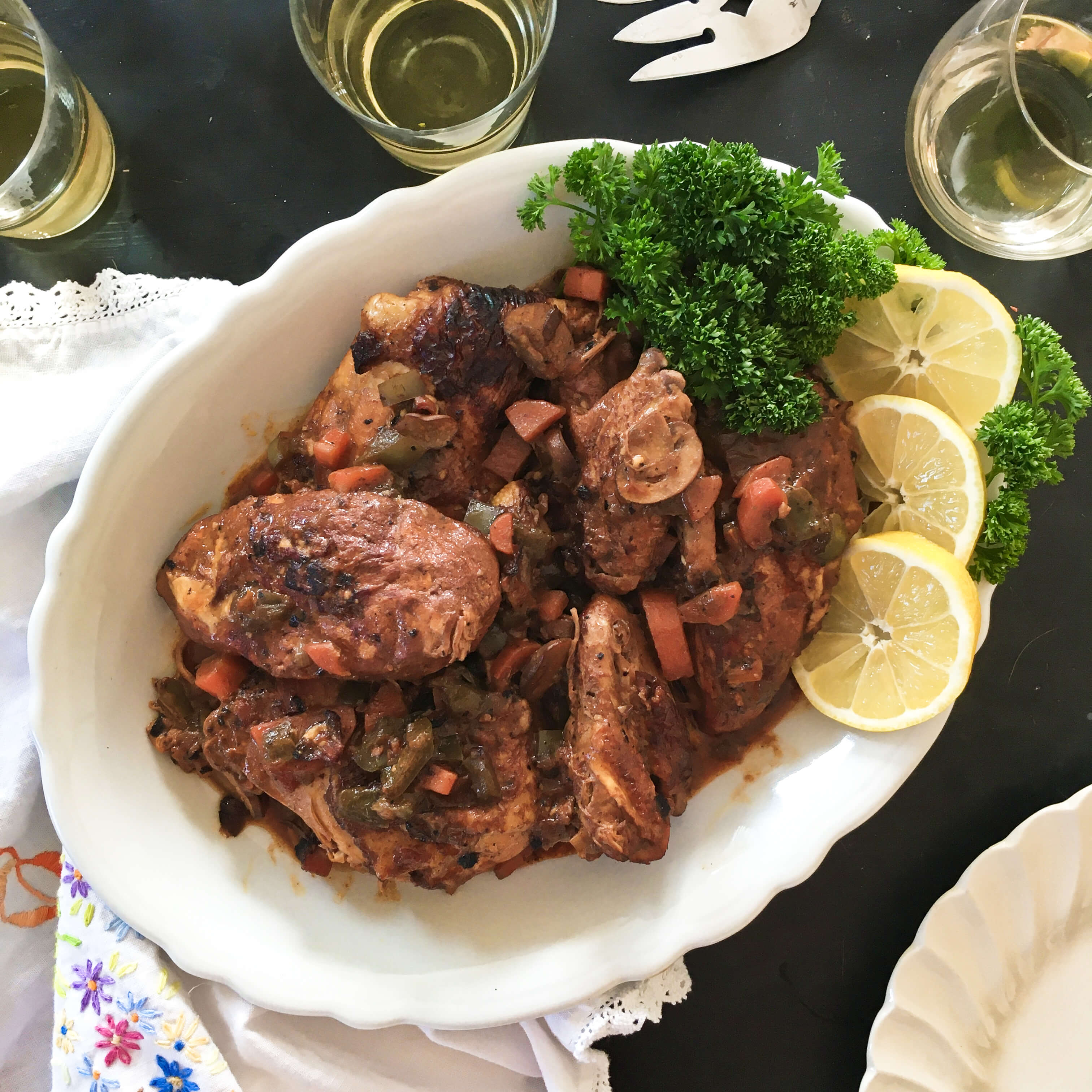
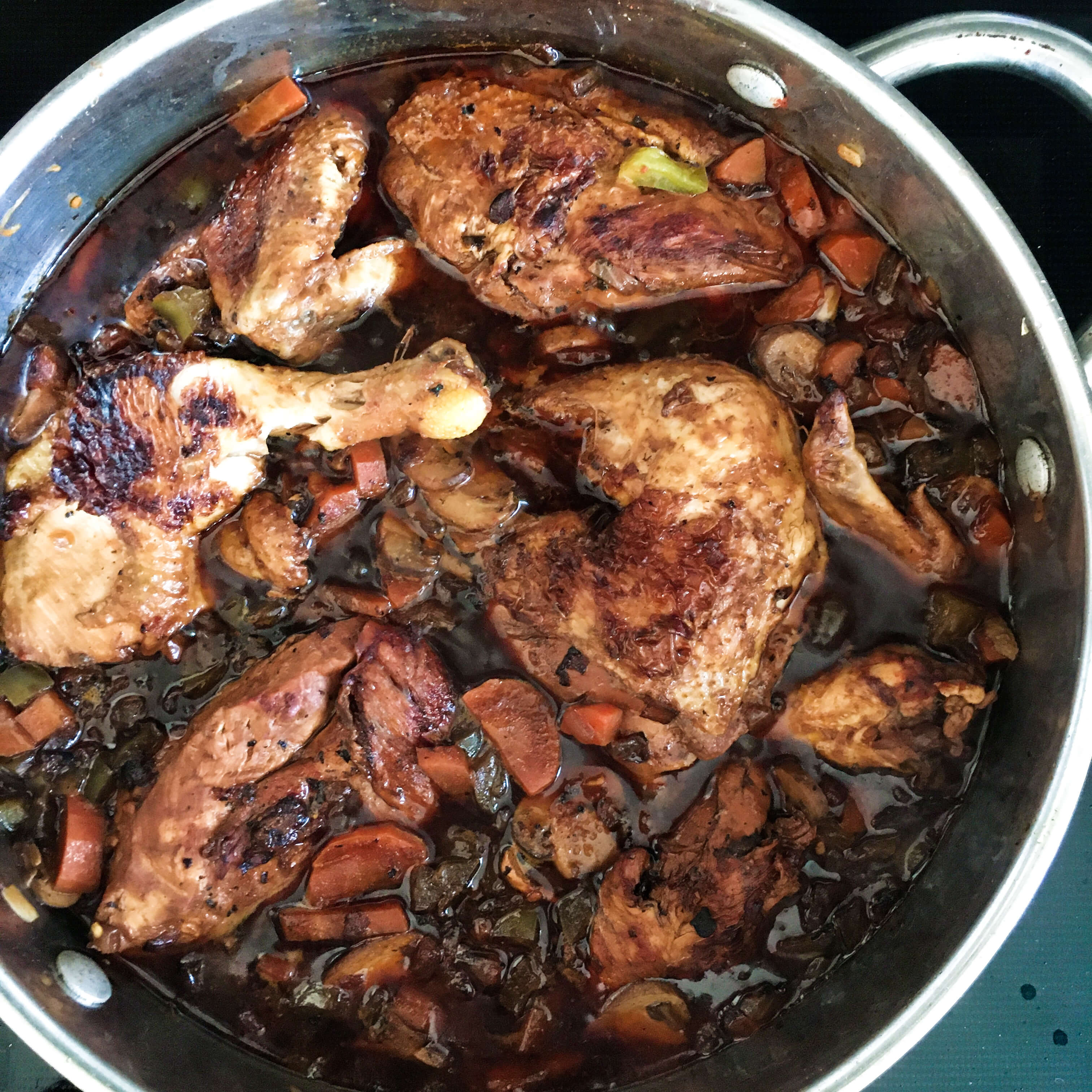
Viennese Chicken made from a 1971 recipe

Close but not exactly, the difference between Viennese Chicken and Vienna Schnitzel lies in bread crumbs. The latter has them, the former does not. Similar also to Italian and French recipes for Chicken Cacciatore or Hungarian Parikahendl, it seems that Viennese Chicken (at least in the way that we are making it here) has fallen into obscurity. Fantastic!

This is exactly the kind of recipe we were hoping to uncover this year during the Tour – something that is delicious but barely known about. At least when it comes to recipe searches online. The only recipe that I could find that was almost exact (but again not totally) was a reference to a Boston Cooking School recipe that was posted on a cooking website back in 1996. The Boston Cooking School operated from the 1870’s to the 1950’s, which means this recipe could have first emerged during that early time period, then resurfaced in the 1970’s (when this recipe was published) and then fell out of favor sometime after the 1990’s.

The only spices in Viennese Chicken are simple ones – paprika, salt and pepper

Whatever the case may be, I’m glad to be drawing attention to it again. A healthier alternative to pounded, pan fried and breaded schnitzel, Viennese Chicken is much more similar to a hearty beef pot roast or a winter stew. Ready in under an hour, including prep time and cooking, it requires only one big pan and one big spice – paprika. The chicken gently cooks in its own juices with the help of a homemade chicken stock and a few stew-happy vegetables, so it’s a breeze to make and only gets more flavorful the next day and the day after that.

I followed the recipe exactly, except that I wound up using smoked paprika (a personal preference) instead of regular paprika and I wound up adding another 1/2 teaspoon of salt and about 1 tablespoon of freshly squeezed lemon juice to the sauce at the very end. I’ll include those extras in the ingredient list as well, but before adding those two last minute additions though, you might want to test the sauce yourself to see what you think.

Also, making homemade chicken stock, as recommended in the recipe, is an easy and fulfilling task that really brings out a round bouquet of flavors in this dish. That recipe is included here too. The stock simmers on the stove for an hour and a half, but if you are running short on time, you could substitute pre-packaged stock from the grocery. {One side note: I like to use chicken legs in my stock recipe in place of wings and backbones. Once the chicken has thoroughly cooked in the broth I cut the meat from the bones for use in Indie’s dog food. It’s a time saver step for me but not a necessary one for you.}

Homemade Chicken Stock

(makes 1 3/4 quarts)

3 pounds chicken necks, wings, and backs (or legs!)

10 cups water

1 onion, peeled

2 ribs celery

2 sprigs parsley

salt to taste (I used about 1 teaspoon Kosher sea salt)

10 peppercorns

Place all the ingredients in a large kettle and bring to a boil. Simmer, uncovered, for an hour and a half, skimming the surface as necessary. Strain through cheesecloth and boil rapidly, uncovered to reduce the stock to about 7 cups. Skim off all the fat and chill.

Viennese Chicken

Serves 4

2 tablespoons butter

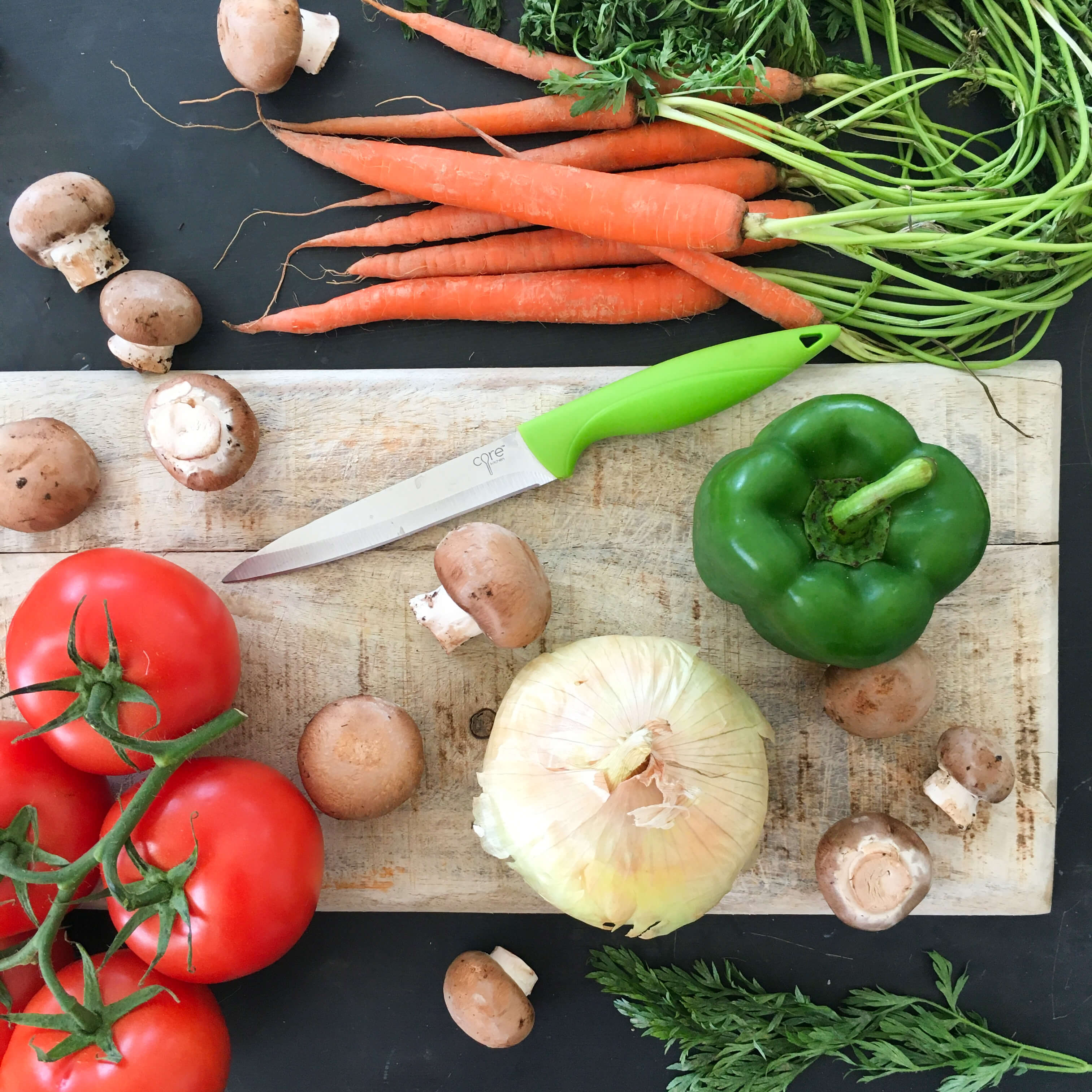
1 onion, finely chopped

1 chicken (2 to 3 pounds), cut into serving pieces

1 green pepper, chopped

2 carrots, chopped

6 mushrooms, sliced

1 tomato, skinned and diced

1 cup chicken stock

1 teaspoon paprika ( I used smoked paprika)

1/2 teaspoon salt

1/8 teaspoon freshly ground black pepper

1 tablespoon all-purpose flour

1/4 cup sour cream

Additional – 1/2 teaspoon salt

1 tablespoon freshly squeezed lemon juice

Melt the butter in a large heavy saucepan. Add the onion and saute until tender but not browned. Add the chicken pieces and brown on all sides.

Add the green pepper, carrots, mushrooms, tomato, stock, paprika, 1/2 teaspoon salt and pepper.

Bring to a boil. Cover and simmer twenty five to thirty five minutes, until the chicken is tender.

{A little tip:  My big heavy duty saucepan never came with a lid, so when a recipe calls for a cover I just use tin foil and seal it really tight around the edges. This works perfectly in place of a conventional lid, but this does remind me for this year-long cooking project, I should really invest in some new pots and pans!}

Remove the lid…

In a separate bowl, blend the sour cream and flour together and then stir it into the pan. {Note: It’s a little awkward to smoothly stir the sour cream mixture into the saucepan because of the chicken, so I suggest removing about a cup of liquid from the pan and stirring that into the sour cream bowl, blending it thoroughly, and then incorporate that mixture back into the pan.}

Toss everything to coat…

At this stage, taste the sauce and determine whether you want to add an additional 1/2 teaspoon salt and the lemon juice. Once seasoned to your preference, transfer the chicken to a warm platter, and spoon the sauce over the top. Garnish the dish with lemon slices and fresh parsley and serve.

Good companion foods with Viennese Chicken would be anything in the potato family (mashed, baked, boiled, sauteed), any kind of rustic bread or baguette, any vegetable that is bulky yet light like peas or cauliflower or just a simple dish of rice or pasta.

Originally, before I began actually cooking this recipe I thought it was going to be very light and creamy in color and texture. But as the onions caramelized while the chicken was browning on each side, they built a foundation of flavor that turned the broth a dark brown like the color of soy sauce. When the sour cream and flour were added at the end, it brightened the whole dish up a bit but left all that slow roasted, caramel-like flavor. If you aren’t a red meat eater, but long for hearty, comforting foods like pot roast or beef stew, especially on these cold winter days,  than this just might become your new favorite. I hope you guys love this recipe so much that you help it become a trend again. It is definitely worthy of  some new time in the spotlight!

Cheers to Viktoria for sharing her Austria with us, and cheers to new (old) recipes coming out of the dark recesses of history once again! If you try this recipe, please let us know your thoughts in the comments section below. If you ever get a chance to visit Austria – stop by Stans and say hi to Viktoria. She’ll be the one in the beautiful dirndl that’s ready to greet you in five languages.

Join us next Wednesday, Week Four of the International Vintage Recipe Tour 2020, as we island hop our way over to Barbados, where will be livening up the night with a little party atmosphere. Stay tuned!

In the Vintage Kitchen: Sage Smothered Chicken with Polenta

An Herb and Spice Cookbook

This week in the vintage kitchen we are celebrating the wonders of the summer herb garden with a vintage recipe that has absolutely antique roots.

If you are a regular reader of the blog, you’ll recognize the name and face of the recipe writer…

craigclaiborne2

…celebrated New York Times food critic and cook Craig Claiborne. Back in February Ms. Jeannie shared his recipe for Eggplant Pizza from his 1963 Herb and Spice Cook Book – a complete gem of a compendium organized by herb and spice for quick reference.  In that post, oregano was the featured herb and Ms. Jeannie gave all the credit to Craig for his imaginative and most delicious creation.

pizza6
Eggplant Pizza! Find the recipe here.

But while Craig was the chef in the kitchen, the writer of the words and the name attached to the dust jacket, there was another face behind the flavor of the book – a muse of intellectual imagination that inspired Craig and enhanced his cook book.

Hilda Layel (1880-1957)
Hilda Leyel (1880-1957)

Her name was Hilda Leyel and she was the woman behind the crusade to bring back the herb.

For centuries herb gardening has been considered a feminine endeavor and a maternal skill –  a salve for the sick, a staple for the diet and a component in clean living. But with the introduction of doctors and hospitals and modern medicine, and the dawn of the industrial revolution, herbs and herb gardening fell out of fashion by the early part of the 20th century. Then Hilda came along.

A life long lover of gardens, a student of medicine, and an appreciator of fine food, good wine and natural living Hilda published several books on the importance of herbs, opened Culpepers, the first herbal-only shop in England (which offered herbal remedies, food, makeup and holistic products) and founded the still-going strong  Herb Society all within a decade between the 1920’s and 1930’s.  The efforts of this one woman single-handedly revitalized the popularity of herbs in gardening, cooking and personal product choices for not only the citizens of England but also of the world at large.

Three of Hilda's cookbooks.
Three of Hilda’s cookbooks.

It was Hilda’s passion, promotion and sheer love that inspired Craig with his Herb and Spice cookbook. Her detailed research and botanical understanding of each of the 54 herbs and spices featured in his cookbook tell of the history, symbolism and importance of each plant. Which makes the two of them a great team. She tells why herbs are important and he shows how they taste great.

It is wonderful to see that Hilda’s efforts had numerous and lasting effects decades after her death in 1957.  To honor Hilda’s magnificent determination, it is only fitting to feature a recipe from the sage section of the Herb and Spice Cook Book which comes from the botanical name salvio, meaning to “save” since Hilda in her own way saved the herbs from obscurity. Cheers to Hilda!

This week we are making Sage Smothered Chicken with Polenta, which is on the heavier side of summer cooking but features so many garden ingredients that its hard to resist. If you want to make a lighter (aka cooler) dinner during this hot season, just omit the polenta and serve the chicken alongside a fresh garden salad. It’s delicious either way!

sage3

Sage Chicken with Polenta

(serves 4-6)

1 4lb. chicken cut into serving pieces

Salt and freshly ground Pepper

1/4 cup olive oil

1/2 cup onion, chopped

1 clove garlic, minced

2 1/2 cups diced tomatoes (canned if your garden tomatoes aren’t ready yet!)

1 six-ounce can tomato paste

1/2 teaspoon ground sage

A small bunch of fresh sage leaves (for garnish)

4 cups water

1 teaspoon salt

1 cup yellow or white corn meal

Sprinkle the chicken pieces with one teaspoon salt and one quarter teaspoon black pepper. Heat the oil and brown the chicken, onion and garlic lightly. Add the tomatoes, paste, sage and pepper (about 1/4 teaspoon pepper or more to taste).

sage2

Cover and simmer until chicken is tender, about 50 minutes or so. While chicken is cooking prepare the polenta by bringing two and a half cups water to boil. Add 1 teaspoon salt. In a separate bowl mix the cornmeal with one and a half cups water until combined. Add cornmeal mixture to the boiling water and stir until pot comes to a boil. Reduce heat to low, cover and cook, stirring occasionally for 45 minutes.

Place the polenta on a large platter. Arrange the chicken on top and spoon the sauce over it. Garnish the platter with fresh sage leaves for presentation. Serve hot.

sage4_1

You will most likely have extra sauce left over with this recipe, which you can freeze for later use as a homemade tomato sauce for pasta or pizza. Delicious and helpful! A big cheers to Hilda for inspiring Craig who then inspired Ms. Jeannie.

Find the Herb and Spice cookbook for sale in Ms. Jeannie’s book shop here. 

Happy cooking dear readers!


Tahiti Bound: An Exotic Adventure in the Vintage Kitchen!

Vintage Tahiti travel poster.

This week in the Vintage Kitchen we are going on an exotic adventure to the beautiful beachy, balmy enclave of Papeete on the French Polynesian island of Tahiti. The weather in Ms. Jeannie’s world recently has been crazy. She’s seen it all – frost, snow, heat, humidity, rain, strong winds, fog, sleet, hail, and tornado warnings all just within the past 14 days. And while the air and temperatures of the past few weeks have been very unsettled,  Ms. Jeannie is excited because all of this wacky end-of-winter weather means that sunny Spring will be here very very soon!

While she waits for Mother Nature to get her schedule sorted out, Ms. Jeannie has been daydreaming of tropical island breezes thanks to the help of Mr. Victor Bergeron and his 1968 Pacific Island Cookbook. 

tv7

If you are unfamiliar with Victor’s full name, you might know him by his more casual moniker, Trader Vic, the king of 20th-century hospitality. A worldwide traveler and an enigmatic restaurateur Victor founded the world’s first highly successful string of polynesian-themed restaurants.

Victor Bergeron (1903-1984) the founder of Trader Vic’s restaurant chain.

First opened in the 1950s in California, the still growing Trader Vic’s restaurant brand was a re-invention of Bergeron’s first attempt in the food industry with his humble lodge-style eatery and bar called Hinky Dink’s which he opened in 1934.

Victor smiles for a photoshoot in a 1951 issue of Holiday magazine.
Victor smiles for a photo shoot in a 1951 issue of Holiday magazine.

Learning the ropes in the food industry taught him a lot those first twenty years, so by the time Trader Vic’s (the restaurant) launched, Victor was a skilled businessman with a big flair for entertaining and fine-tuned instincts as to what people wanted in a dining experience. As a lover of Cantonese-style cooking, Bergeron married exceptional storytelling, authentic exotic antique decorations, and traditional South Seas recipes with a festive dining atmosphere to create a unique brand of restaurant chemistry that appealed to the adventure seeker and jet-setter of mid-century America. It was the rise of all things terrifically tiki.

Victor Bergeron mixing it up!

Victor’s travel experiences are all colorfully detailed in his cookbook making it a sort of fun travel journal and kitchen cooking primer in one. And then there are the drinks!  In addition to cooking, Victor was also a mixologist creating a slew of enticing cocktails, like the first Mai Tai, which launched a wave of tropical drink requests for bartenders from then on out. Escapism never tasted so sweet!

luau6

Which gets us back to Ms. Jeannie’s island getaway in the kitchen this February day. With 30-degree temperatures chilling the air outside, Ms. Jeannie cracked open coconuts, peeled ginger, poured a rum cocktail, and got down to cooking all the while pretending she was beach-side in Papeete where the view looks like this…

tahiti3
Vintage Tahitian postcard of Papeete.

Cheers to Victor! It’s Pota on the menu tonight served alongside steamed rice and chicken sauced with coconut ginger.

Pota with Chicken and Ginger

Pota

4 tablespoons diced salt pork

1/2 cup chopped cooked chicken

5 cups coarsely chopped Bok Choy

4 tablespoons chopped green onions (scallions)

1/2 cup chicken stock

Salt & Pepper to taste

Juice of 1/2 lemon

4 tablespoons coconut milk

2 teaspoons cornstarch mixed with 1/4 cup water

  1. Saute salt pork until brown in large skillet. Add chicken, chard and green onion.
  2. Stir in chicken stock, seasonings and lemon juice. Simmer until chard is tender.
  3. Add coconut milk, bring to a boil but just barely. Thicken with cornstarch, stirring constantly, adding just enough to thicken the mixture.
  4. Serve immediately or keep warm over low heat until chicken and rice are ready.

Chicken with Ginger

1 whole chicken, 5 lbs

1/2 cup flour seasoned with salt and pepper

2-3 tablespoons olive oil

1 piece fresh ginger root (about the length of your thumb finger), grated

1/4 cup coconut milk

  1. Preheat oven to 350 degrees.
  2. Cut chicken in pieces. Do not remove the skin.
  3. Place chicken, flour and salt and paper in a paper bag and shake until all chicken pieces are well-coated.
  4. Heat the oil in a large pan on the stovetop and then saute the chicken, turning only once, until thoroughly cooked on each side (internal temperature should be 180).
  5. Remove chicken from heat and place in oven-proof dish.
  6. In a separate bowl mix together coconut milk and ginger. Pour over chicken and place dish in the oven for 5 minutes until the coconut sauce melts.

Serve alongside Pota and steamed rice and a fun fruity cocktail! Perhaps a homemade Mai Tai or two in Victor’s honor. He’d be as pleased as (rum) punch!

A Tahitian Dinner: Pote and Chicken with GInger
A Tahitian Dinner: Pote and Chicken with Ginger

This is a surefire recipe to chase away those end-of-winter blues. Satisfying for the spirit and for the belly! Find more Trader Vic recipes here. And more tropical cookbooks here. Manuia!

Israel, India and the International Dinner Night – A Vintage Rosh Hashana Recipe

Authentic India-based Chicken Curry circa 1964

Happy New Year dear readers! This coming Sunday marks the two day festival of Rosh Hashana, which celebrates the creation of Adam and Eve and mankind’s role in the world.  Although Ms. Jeannie, herself is not Jewish, she thought it would be fun to mark the day with an international dinner night featuring a holiday approved (and kosher certified!) meal which brings together the unique and diverse flavors of the Holy Land.

Many cultural influences make up the demographic food map of Israel, including Indian, Greek, Arabic, Italian and French offering unexpected and interesting food combinations and flavor pairings. In this vintage Isreali cookbook, published in 1964…

The Israeli Cook Book by Molly Lyons Bar-David

author and culinary advisor to El-Al Airlines, Molly Lyons Bar-David compiled hundreds of authentic, local recipes from over 70 regions within the country. Many of the recipes had been passed down from generations bringing with them their own unique stories, folklore and legends which Molly also shares in the cookbook.

An alley in the Jewish Quarter in the old city of Jerusalem, Israel. Photo via pinterest.

Her intention for this culinary project was to serve true Israeli food on board mid-century El-Al airlines flights as a gateway experience for incoming passengers.

Vintage 1960s El-Al airlines travel poster. Via pinterest

But as Molly got deeper and deeper into the collection process, interviewing literally hundreds of locals, she learned that the diverse food scene was just as dynamic and layered as the centuries old history and faith long associated with Israel.

Cochin, India. Photo via pinterest

To honor the historical holiday, Ms. Jeannie chose an ancient chicken curry recipe that stems from the spice markets of Cochin, India as brought by the “Cochin Jews”  who were believed to have emigrated from Palestine after the second destruction of the Temple.

A Jewish family from Cochin , India circa 1880. Photo via pinterest.

Molly writes in her introduction to the recipe…

“Although their culture, (including a caste system) and even their skin coloring has become indistinguishable from that of their Hindu neighbors, they never forsook their Jewish heritage. Their food, chiefly rice and curries, is like that of the Indians, except that they strictly maintain the kosher laws.” 

Ms. Jeannie is a big fan of curry, and has made countless variations taken from recipe books, magazine articles, online sources and foodie recommendations, but this by far was the best (THE BEST!) curry recipe she has found to date. Full of flavor both subtle and bright, it makes a ton and keeps getting better day after day in the leftover department.

It is simple and easy to make and contains basic ingredients that are easy to gather. So if you are looking for a bit of the edible exotic to ring in the New Year or celebrate the history of a culture other than your own this is a fabulously delicious recipe! You can also omit the chicken and make it strictly a vegetable curry if you prefer. Ms. Jeannie served it on top of a bed of Jasmine rice with a side of warm Naan bread.

Cochin Curry
Cochin Curry

Chicken Curry (serves 4)

1 2lb chicken, cut in parts (do not de-bone)

5 tablespoons olive oil

3.5 cups water

5 large onions, chopped

2 cloves garlic, mashed

4 large tomatoes, chopped (or one large can of diced tomatoes)

1 cup celery, chopped

2 apples, peeled and cubed

2 tablespoons sugar

1 teaspoon ground ginger

1 tablespoon (or more!) curry powder (as a big fan, Ms. Jeannie used 2.5 tablespoons!)

1.5 tablespoons flour

3 cups coconut milk

2 tablespoons grated coconut (optional)

1.5 teaspoons salt

cayenne pepper (to taste)

c3

  1. Fry the chicken in 3 tablespoons of olive oil until lightly browned on all sides (about 10-12 minutes total or 5 minutes on each side). Remove from the pan and set aside.
  2. Add the water to a large stock pot and bring to a boil. Add the chicken and simmer uncovered for 30 minutes on medium low heat. c4
  3.  In a new large pan, heat the remaining 2 tablespoons olive oil and add all the chopped vegetables and spices (onions, garlic, tomatoes, celery, apples, sugar, ginger and curry powder). Mix to combine.  Sprinkle on the flour.  Mix well again and then add the coconut milk and seasonings, and simmer. Once the chicken is ready, transfer all pieces to the curried vegetables and cook 10-20 minutes more.
  4. Serve hot with rice and Naan bread if you like.* (Ms. Jeannie loves the Naan bread made by Stonefire Flatbreads which is available in most grocery stores in the fresh bakery section.)

Enjoy dear readers! If you’d like to learn about more authentic recipes from the Israeli Cook Book, the Jewish holidays they correspond with and the history behind them, please visit Ms. Jeannie’s shop here. And if you are celebrating the holiday this weekend, Happy Happy New Year:)

Authentic India-based Chicken Curry circa 1964
Authentic Indian Chicken Curry circa 1964 as prepared from The Israeli Cook Book by Molly Lyons Bar-David

Tuesday In the Kitchen – The Art of Greek Cookery

Opa! It's international dinner night!
Opa! It’s international dinner night!

Today, dear readers, we are going on a wonderful culinary adventure that is taking us from Greece to Long Island, New York  to Ms. Jeannie’s kitchen in Georgia.  The subject of our adventure is a recipe from this Greek cookbook…

The Art of Greek Cookery circa 1963

The recipes in The Art of Greek Cookery were compiled in 1958, by 16 first generation Greek women who lived in Hempstead, New York and were part of the congregation of St. Paul’s Greek Orthodox Church.

St. Paul's Greek Orthodox Church, Hempstead, NYPhoto courtesy of rohlfstudio.com
St. Paul’s Greek Orthodox Church, Hempstead, NYPhoto courtesy of rohlfstudio.com

The Church, which was formed in 1944, needed to expand as their congregation grew, so the ladies of the Church formed a recipe committee, which was a segment of the church’s social organization, the Mr. & Mrs. Club (so cute!). The intention of the recipe committee was to gather traditional recipes from their homeland into a book for American cooks and then to sell the books as a fundraiser for the new building construction. In true Julia Child spirit,  these ladies got to work gathering, testing and and adapting hundreds of recipes that were representatives of their Greek culture.  This is a picture of some of the original members of the recipe club…

Photo courtesy of stpaulhempstead.org

After two and half years of laboring,  they published a simple spiral bound cookbook entitled, The Grecian Gourmet, which turned out to be a runaway success. Both the The New York Times and the New York Tribune published articles about the women and their book project, which caught the attention of people all across the country and book orders poured in.

The recipe committee was humbled and amazed that their little cookbook had become such a sensation.

“It was a book that had immense appeal for all food conscious people. For gourmets and experimental cooks of all kinds; for tourists who upon returning from Greece, wished to duplicate  in their own kitchens some of the interesting and exciting dishes they had tasted in Greece on the Grecian islands. It was a work of love and a great pleasure for all of us.” – Theodora Lourekas, Chairmen of the Recipe Committee, 1963.

The cookbook also caught the attention of New York publishing giant Doubleday and Company, who wanted to republish it under their “Art of ” cookbook series. And so the Art of Greek Cookery was born in 1963.

greek9

Containing a wealth of recipes ranging from appetizers to desserts, the cookbook also contains information on Greek wines, traditional feast days, customs, traditions, suggested menus and a lovely forward by the then pastor, Father George Papadeas. To say that he was not only proud but impressed by the hard work and determination of these women was an understatement.  Just by reading the forward, preface and introduction of this cookbook you can tell that so much love and good cheer was behind this project.

100% of the proceeds from the book sales went into the church construction fund, which provided them with more than enough money to undertake the expansion.  Both the Church and the recipe club are still going strong today!

So in true spirit, Ms. Jeannie embarked on a new cooking challenge and made one of the recipes from the book. Ideally, she would have liked to have chosen a lamb recipe, since that is so traditional, but Ms. Jeannie feels bad for the little lambs and doesn’t know of a local, ethically sourced lamb company, so she chose a chicken dish instead. It had five ingredients and was ready within an hour. And it was DELICIOUS (with a big capital D!). Here’s the recipe…

All the ingredients you will need!
The ingredients!

Chicken with Scallions (also known as Kotopoulo me Kremidakia Freska)

3-4 lb. organic chicken, cut into 6 pieces

5 tablespoons butter

Salt & Pepper to taste

1 cup hot water

6 bunches organic scallions, rinsed and ends trimmed

3 organic eggs

1 lemon, juice of

Rinse chicken pieces and pat dry with paper towels. In a Dutch oven (or you can use a large soup pot) melt the butter, add the chicken pieces and brown until golden on all sides. Sprinkle with salt and pepper. *Add hot water and scallions. Cover and cook over low-heat for one hour.

In a medium bowl, beat eggs. Incorporate lemon juice slowly into egg mixture while constantly stirring to prevent curdling. Add some broth from the pan (about 1/2 cup), again constantly stirring to prevent curdling. Stir actively for about a minute.

Remove chicken from pan and place on a plate. Add the egg mixture to the pan broth and stir constantly for another minute to avoid curdling. Add the chicken back into the pot to soak up the sauce. The heat under the pan must be on low and the sauce must not be allowed to boil. Let the chicken rest in the sauce fora few minutes before removing from heat and serving.

* Special note – Ms. Jeannie doesn’t have a Dutch oven so she used a large soup pot. After she browned the chicken and before she added the water and scallions, she de-glazed the pan with 1/4 cup of white wine just because her pot tends to burn easily. If you are using a Dutch oven you might not need to add that step at all.

.. cook2

Once Ms. Jeannie placed the chicken and sauce in a serving dish she sprinkled it with some chives from her garden. This of course is optional. She served the chicken with a simple homegrown tomato basil salad which was marinated in olive oil and garlic for an hour, a crusty baguette and a glass of sauvignon blanc. Enjoying an authentic Greek dinner outside on the patio with Mr. Jeannie Ology made Ms. Jeannie feel like she was on a little vacation!

cook3

It is armchair traveling at its best and most delicious! Cheers or Opa (as they like to say in Greece)!