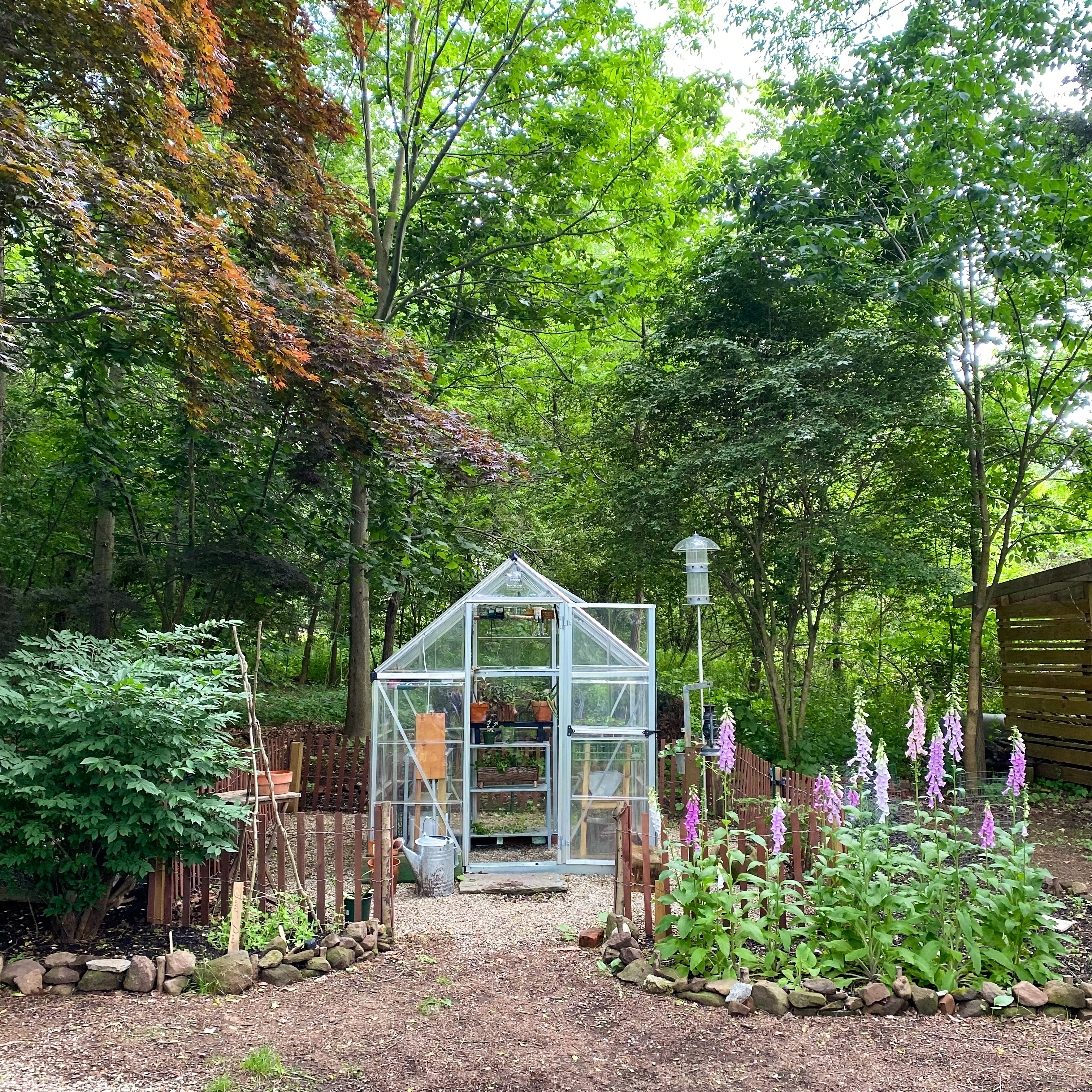
Mid-June in the Vegetable Garden

Lily

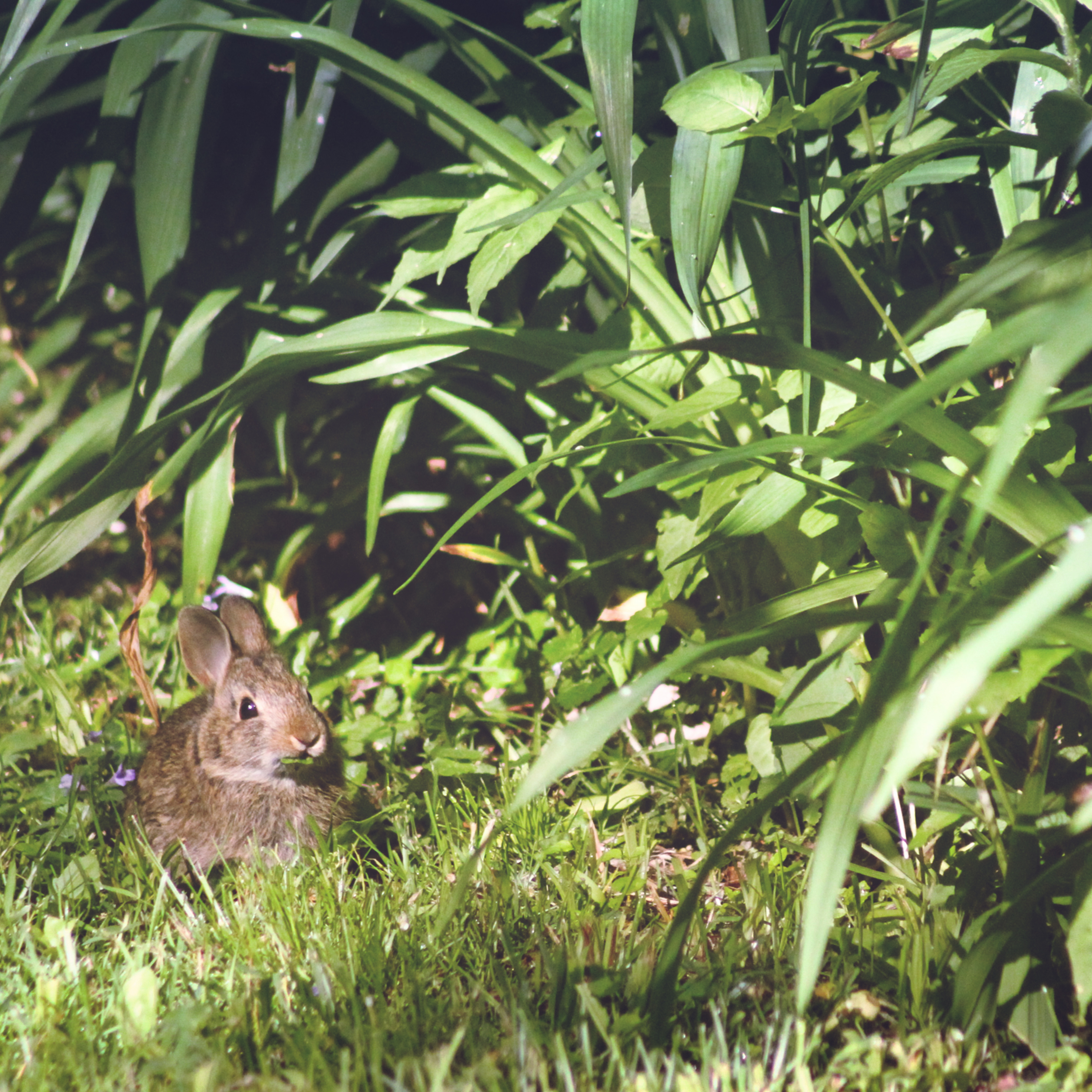
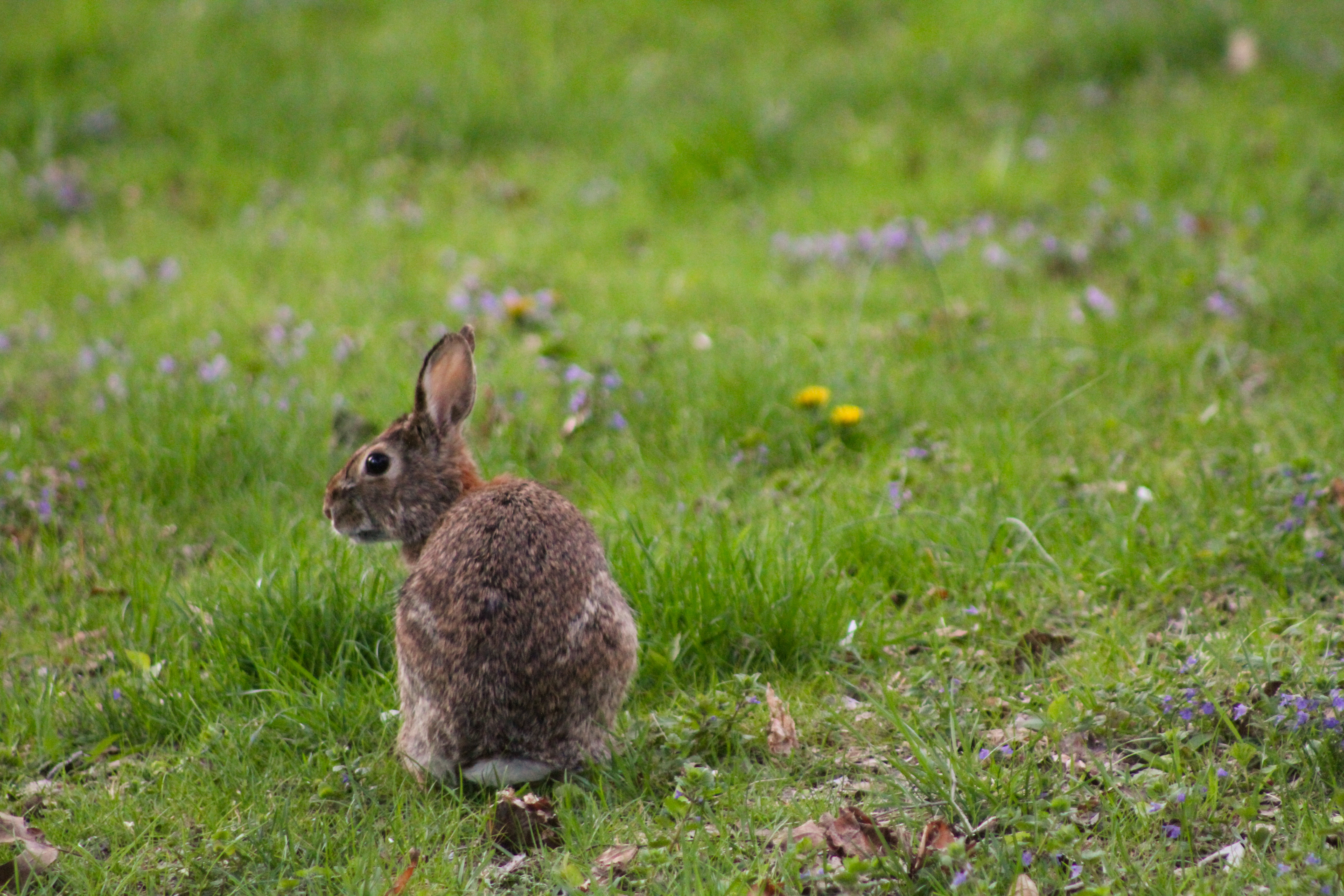
If I walk out of the back door very quietly on these early, almost-summer mornings, I can usually spot Lily eating grass at the edge of a way too overgrown decades-old daylily bed. Lily, as we came to call her due to her preference for this area of the yard, is a baby rabbit about the size of a teacup. She was born to Lefty, a wild cottontail that lives in our woods.

Lefty

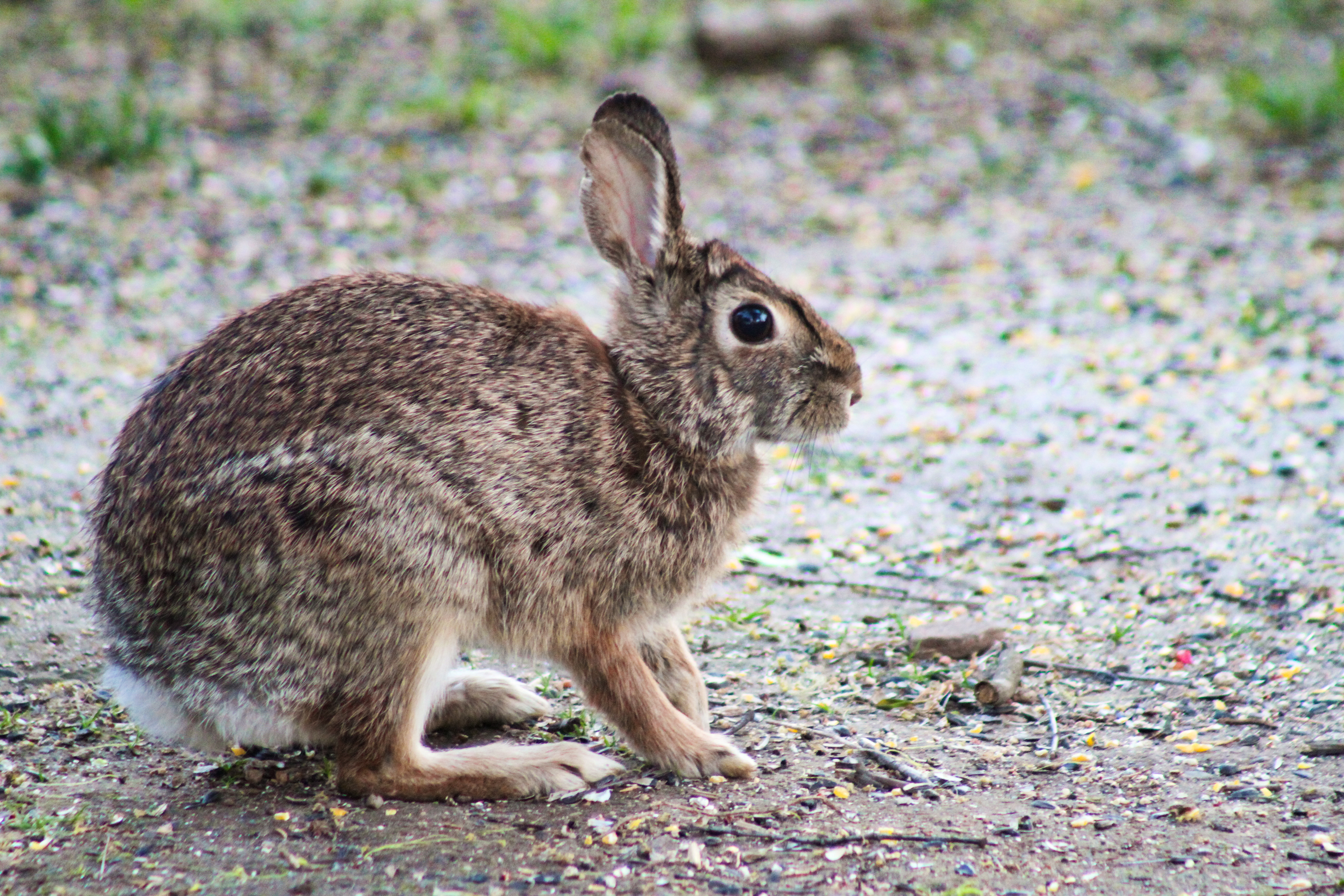
Lefty came by her name because she holds her left paw in the air whenever she is at rest. Whether that is some sort of injury or just her natural proclivity, we don’t really know, but she gets around great regardless, seemingly unfazed by what, if anything, troubles that part of her leg. Originally, we thought Lefty was a boy bunny because of her big size, but once we realized that Lefty made Lily, we started calling her Lefty Lucy after that sing-song mechanical phrase, righty tighty lefty loosey about tightening screws and bolts. Obviously, Lefty Lucy is not running around the yard with carpentry tools, but she is an important component and a key contributor to the natural health, vitality, and inner workings of the woodlands that back up to our property, so Lefty Lucy seemed fitting in more than one way.

A mix of mid-June salad greens

Every year, spring seems to bring on a new set of circumstances and situations to be considered when it comes to how, what, where, and why we are growing food here at 1750 House. Year one, it was learning the capabilities of the greenhouse. Year two, it was tackling the slugs. Year three, it was increasing perennials. Year four, we are learning the wilds.

This is our first spring without Indie chasing all the squirrels, corraling all the chipmunks, and defending us from turkeys and deer, coyotes and foxes, and that one time glimpse of a bear. Indie was not a classically trained working dog, but she had the super smart instincts of her collie/shepherd breeding and was pretty skilled at keeping everything wild at the far perimeter of the property and away from all the garden beds.

Indie!

When we first moved to 1750 House, in an effort to co-exist in happy harmony with the surrounding wildlife, we taught Indie some loose boundaries. We established an imaginary border for her that separated the yard from the woods and it took her no time at all to understand that the yard was her territory and the woods belonged to the wild animals. This worked pretty well, on both the wild creatures’ side and Indie’s. During the day, the wildlife mostly kept to the woods and the treetops and Indie mostly kept to the yard. At night though, our garden camera showed a different story. While Indie was asleep in the house, the yard was full of critter traffic. This proved both Indie’s effectiveness at day patrol and also nature’s clever way of working around our silly ideas about confined borders. Now, without Indie this spring, I wondered how our property would change when there was no presence of a pup. What would happen to the imaginary boundary? Would the wild creatures reclaim the yard as their own?

Our parade of deer.

As it turns out, wholeheartedly yes. To say that the backyard bloomed with critters and creatures is an understatement. Our woodland deer sightings have tripled in size from two to seven. A pheasant, which in the past was just a one-day-a-year passer-through, spent days in early spring wandering the woods. Last month, a female turkey took up residence in the long grass near the bird feeder for a week. A pair of hawks has chosen a nest spot midway through the woods. Lefty and Lily set up home. And a veritable city of chipmunks and squirrels now keep the yard in a continuous state of rustle and bustle from treetop to underbrush, morning to night.

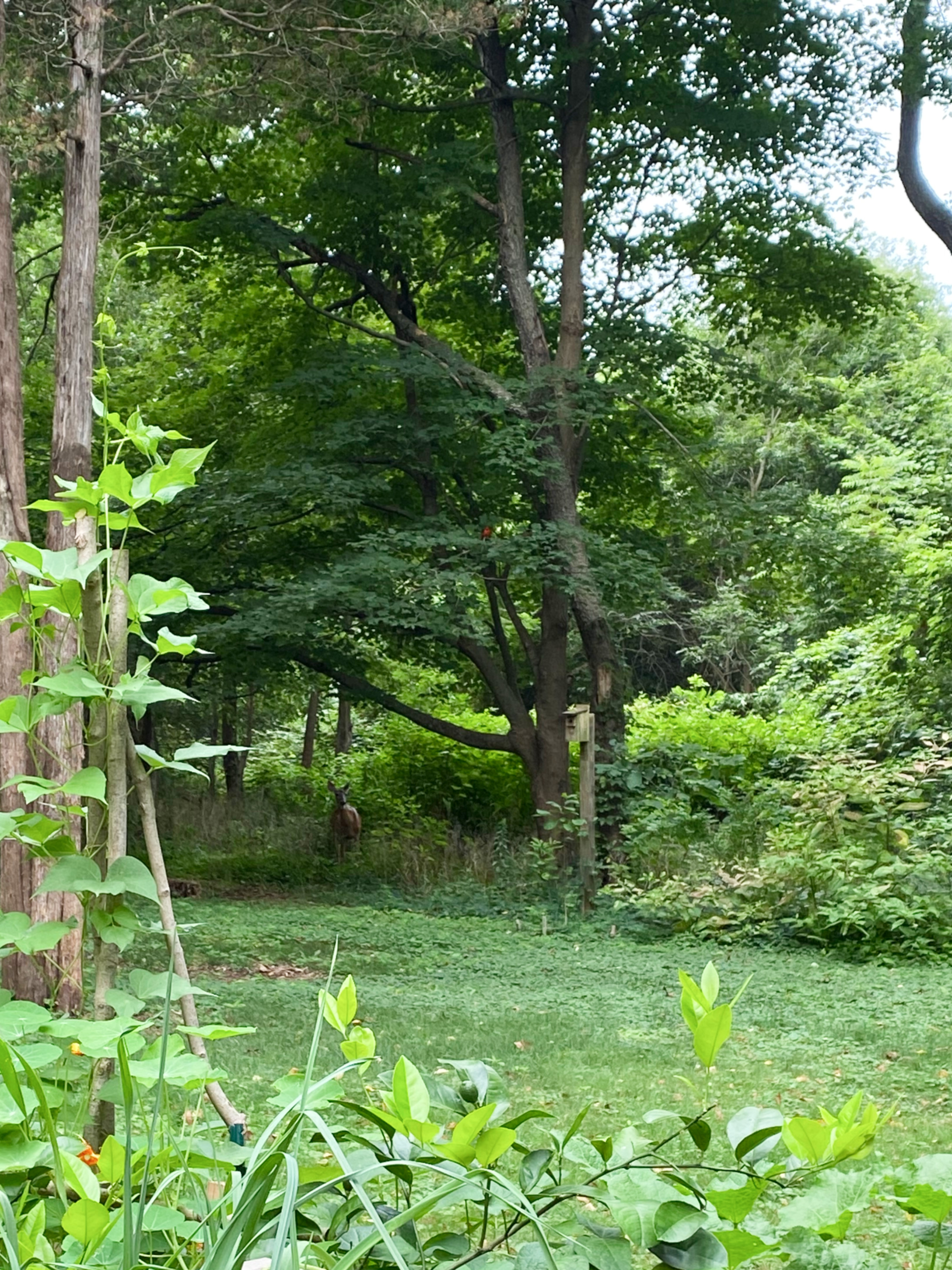
Turkey sighting to the left of the tree trunk

Not realizing how impactful something is until after it’s no longer there, Indie’s absence raised a question. How exactly will her not being here affect the garden this spring? Will the deer feel free to eat every last tomato? Every last flower? Will the squirrels and the chippies destroy the plantings? Will all of our hard work and time spent seed-starting and sowing, building, and bed designing be in vain?

The vegetable garden, almost fully planted out by the first of May, stopped and started, struggled and rallied, round and round again as temperatures jumped between the low 40s and the high 50s in seesaw fashion all the way into early June. Almost everything that we planted was cool-weather hardy and tolerated the damp, sunless days. But my optimism in planting out the tomato, cantaloupe, and squash seedlings proved to be a bit too ambitious. Not fans of cold, wet weather, all three vegetables succumbed to early blight, root rot and/or a general overall malaise that caused yellowing leaves and drooping stems.

The wildlife didn’t seem to mind the wet weather at all, nor the absence of Indie. Whipping up their own kind of fun, a particularly rambunctious set of squirrel siblings made joyful use of the yard unencumbered by a patrol pup. They chased each other through the canna beds, knocking off fragile tips of newly emerging sprouts. They dug holes all over the garden looking for nuts. They upset roots in the pea patch, the corn plot, the bean bed. With their acrobatic leaps and bounds, dangles and dives, they beheaded sunflower starts, dropped tree limbs onto fragile seedlings from overhead, romped through the wildflower bed, and knocked over many a wire cage protecting nerbs and flowers, fruits and vegetables.

The chipmunks celebrated spring in the garden in their own way. Keen on building subterranean housing, they endeavored to make entry and exit tunnels all over the yard and the garden beds. So far they’ve dug golf-ball-sized holes by the Mediterranean herbs, by the witch hazel tree, by the evergreen saplings, by the Hosta plants.

All this energetic play and home building aside though, surprisingly, so far at least, the deer, the squirrels, the chippies, and the bunnies have been very respectful of the actual garden plantings themselves. The deer win the award for best behaviour and for keeping within their boundaries. But the squirrels and the chippies can’t be scolded simply for playing andf home building. Apart from the antics that uprooted the corn and topped off some of the cannas, I’m happy to say that none of our wildlife neighbors have nibbled or rearranged or broken any of the plants or emerging fruits and vegetables in the garden. As it turns out, Indie might have trained them just enough. Either that or it’s the daily birdseed buffet that keeps everyone full and satisfied enough to leave the vegetables alone.

Despite all the cold, rainy weather and the spirited playground, the late spring garden, although not quite as grown up as last year, is starting to finally make some headway. Here are some photos taken in the last few days…

Oregon Sugar Pod Snow Peas

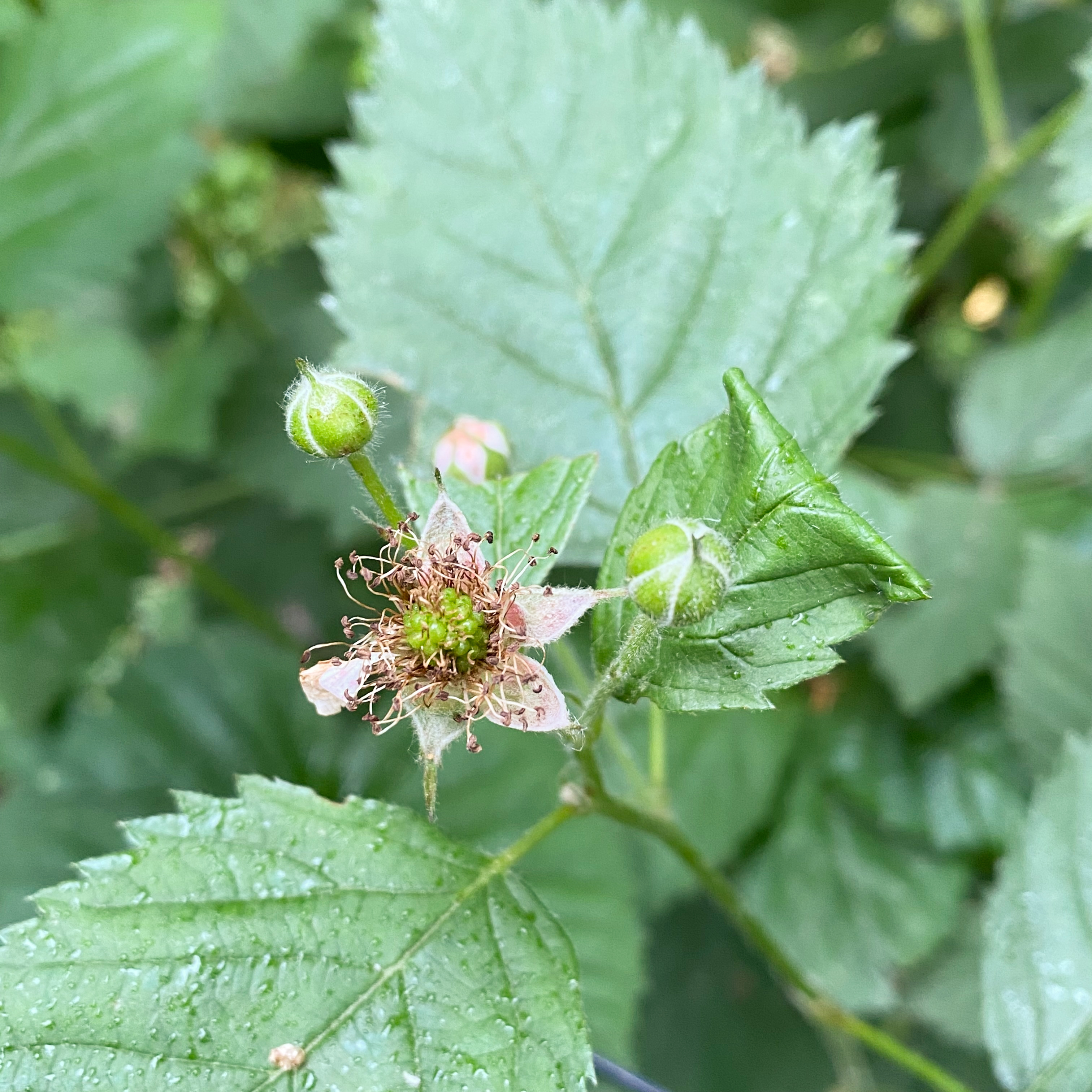
Blackberry bush…

…with blackberries emerging!

Windsor fava beans in front and Scarlet Emperor pole beans climbing the wire panel in back.

Fava bean flowers

Fava beans!

Buttercrunch lettuce in front and dandelion greens in back.

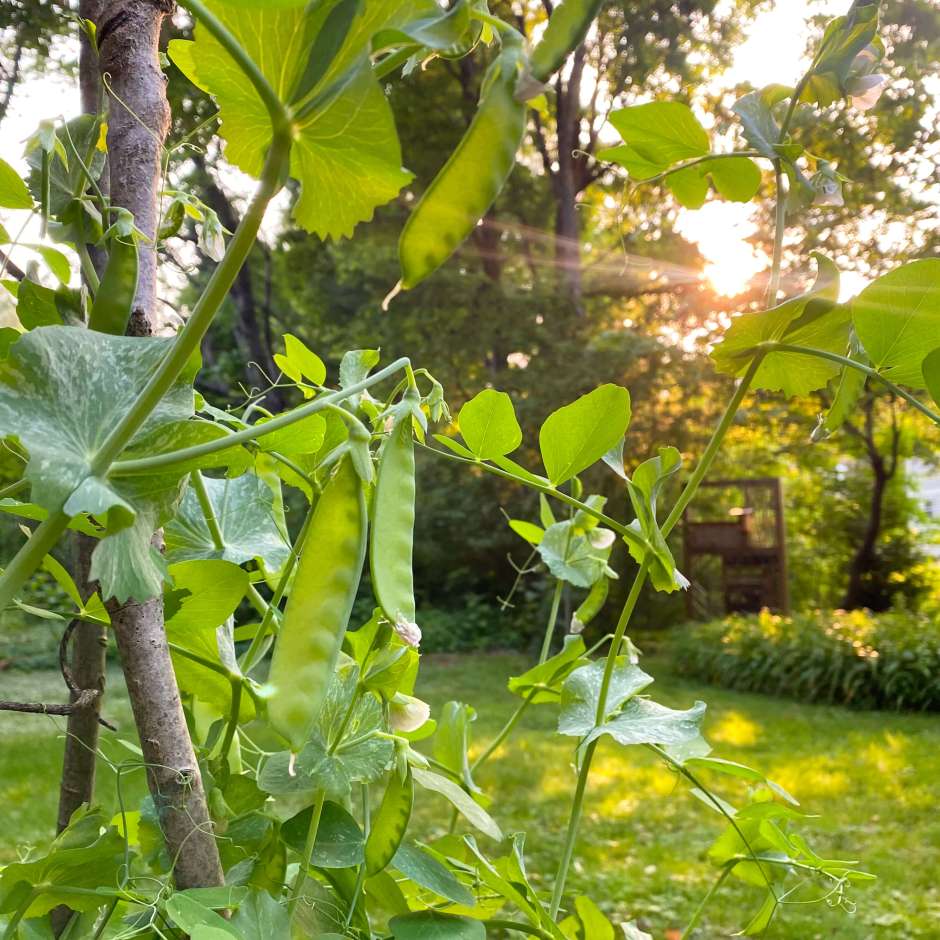
First pea flower

First pea pod!

Onions & leeks

Silver Queen corn – 2nd sewing. This time in pots to sidestep the squirrels.

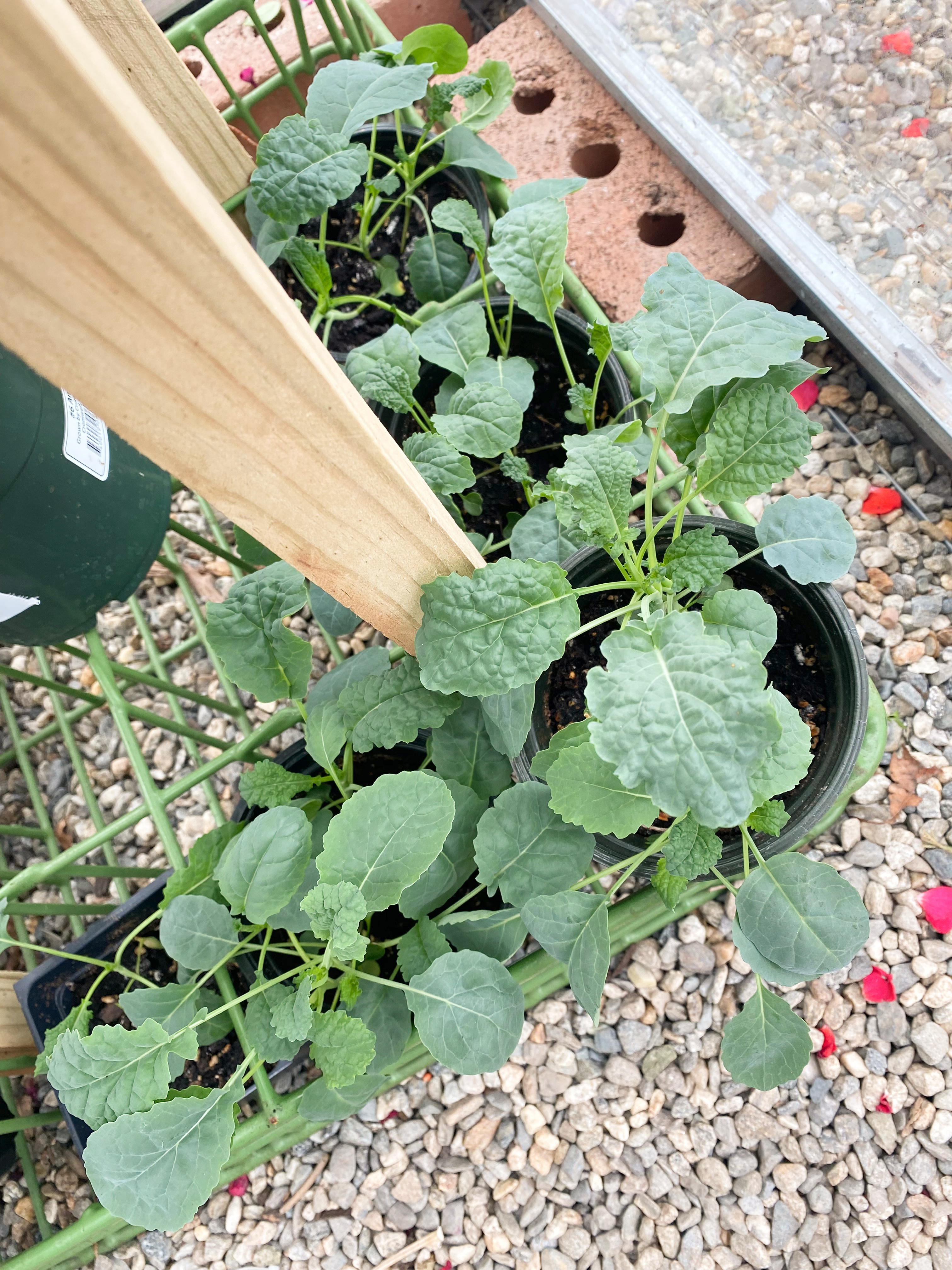
Dinosaur kale. Currently at 18″ inches in height, this is the tallest kale plant we have ever been able to grow so far.

Overhead view of the tall kale. Also, the first kale plant that has ever escaped caterpillar and slug damage.

Shin Kuroda carrots

Green Globe Artichokes – currently 23″ inches tall.

Provider Beans

Nasturtiums grown from seed harvested from last year’s flowers

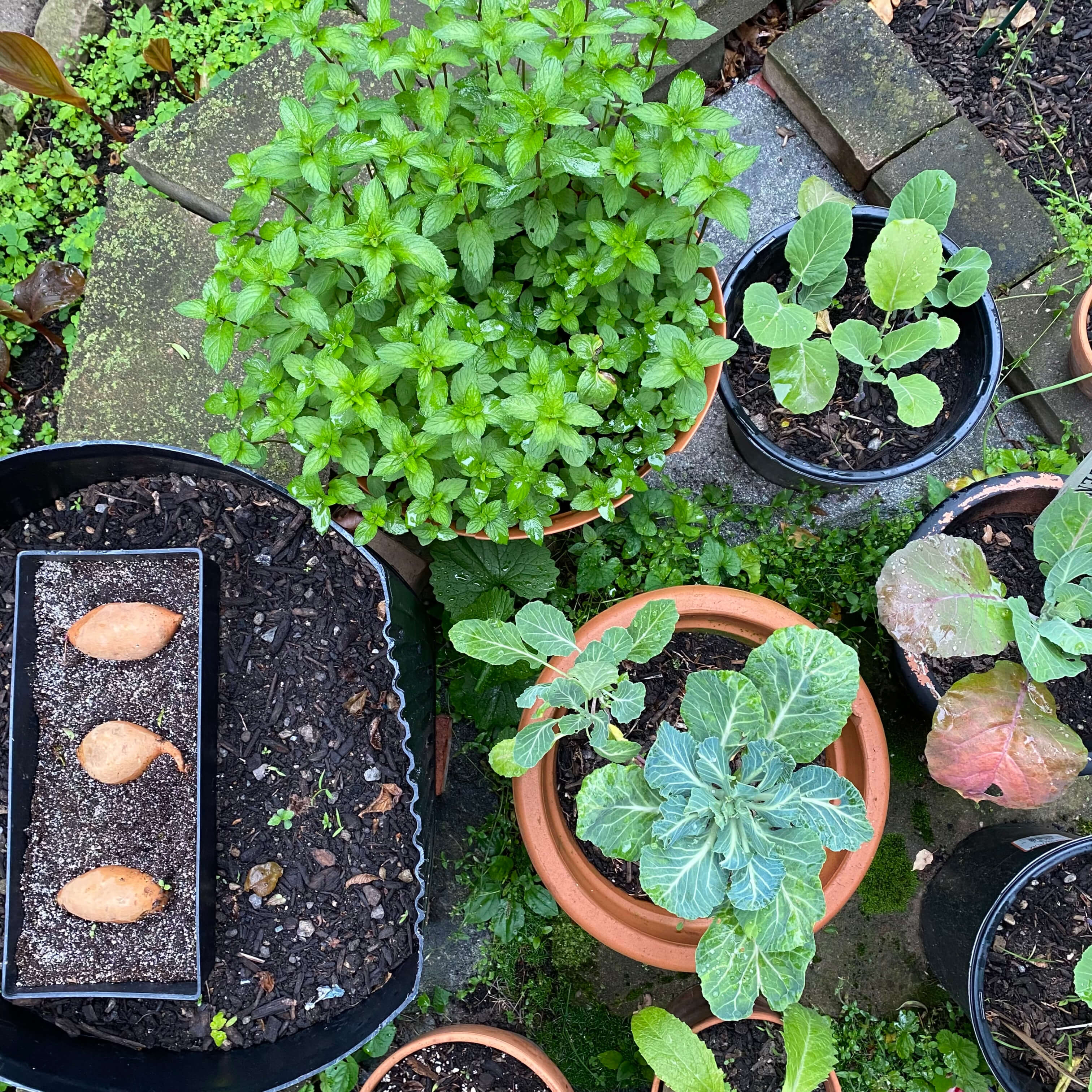
Experimental porch pots – mint, sweet potato slips, collard greens and artichokes. The collard green leaves on the right are turning pink from too much rain.

Foxglove – these four self-seeded from last year’s blooms.

More foxglove by the greenhouse.

The tallest foxglove this year reached 4′ feet 5″inches, about a foot shorter than last year. Maybe the lack of sun and heat made them a little smaller.

Foxglove at the greenhouse.

Other veggies not yet quite photo-ready include eggplant, pepper plants and the second sowings of tomatoes, honeynut squash, cucumbers, and cantalope. There is lots of information to share about the herb garden growing up too, but in order not to make this post a million miles long, details on that project will come in a separate post later this month.

Lefty

Even though it is a bittersweet spring due to the absence of Indie, it is lovely to be surrounded by our new menagerie of wild animals. They each bring such personality and interest to the day and to the garden. Nature is a remarkable healer.

From all of us at 1750 House, cheers to the growing season and all the surprises it brings.

Reading While Eating in 2024: Five Recommended Books About Food, Friendship and Appreciation

When December comes around every year, I always love compiling the book list. This month marks the end of 2024, and also the start of the wintertime reading season with the release of the annual Vintage Kitchen recommended book list. Blog stories were a bit sparse this year due to many unanticipated factors, but I’m happy to say that they haven’t hindered this annual tradition of posting a collection of favorite books discovered throughout the year.

If you are a long-time reader of the blog, you already know that these lists are made up of books that were serendipitously found over the course of the year while doing research for Vintage Kitchen blog posts, shop stories and recipes. Every year, they cover a range of subject matters and time periods, and span a range of publication dates from new releases to books written decades or even centuries ago. As an avid reader, averaging about 30 books a year, I save the most beloved ones for this list. The ones that left an indelible mark, or sparked some new inspiration, or offered a different perspective on a subject matter already familiar. These are the books I couldn’t put down. The ones that I still continue to think about long after the last page is read.

This year’s selection is varied in content but they do have an underlying connective theme of gratitude and appreciation. There’s a book about nature, a book about a summer vacation house, and a book about American life lived three hundred years ago. Three of the books this year are memoirs, one book contains recipes, and unlike last year’s list, all five of these books are non-fiction. They tell bittersweet stories of friendship, of being present in time and place, of establishing traditions, and of searching for meaning in everyday life. These five take us around the world from coastal Massachusetts to New Orleans to New York City to Paris, Stockholm, South America, and to our own backyards. One book even helped solve a mystery about the floorboards of 1750 House. Interesting adventures await on all fronts.

Let’s look…

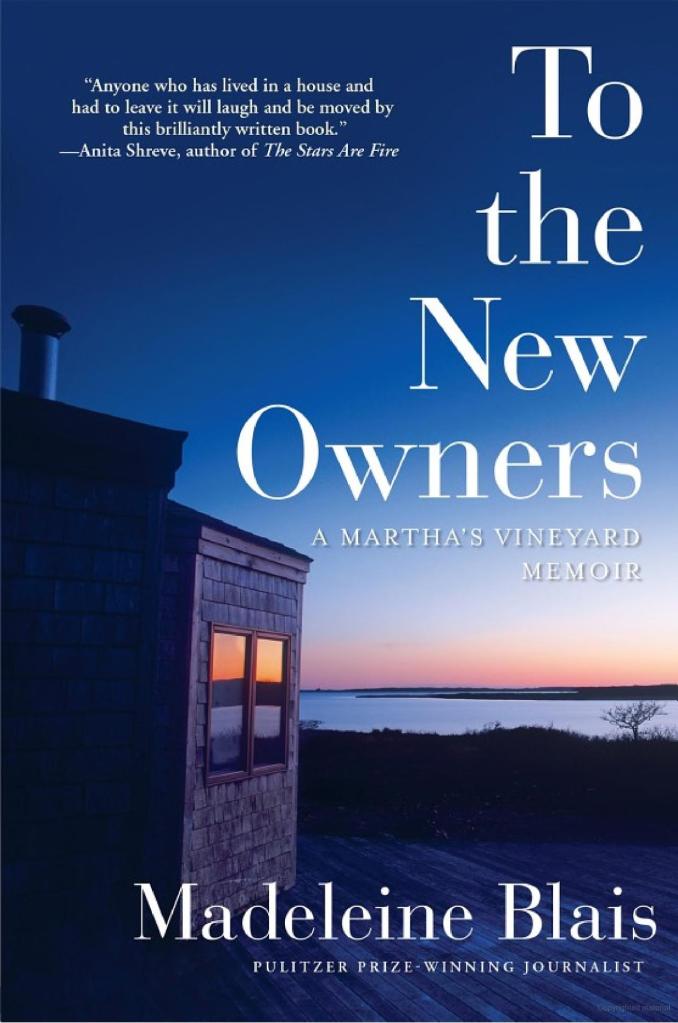
To The New Owners – Madeleine Blais (2017)

A love story to summer. To family. To a seasonal beach house on the shore of Martha’s Vineyard. To the New Owners is one long anticipated string of summer sequels highlighting vacation life spent in coastal Massachusetts. Written by Pulitzer prize-winning journalist Madeleine Blais, who married into the enigmatic and literary Katezenbach family, this memoir starts off with news that the beloved beach house, the family vacation compound for five decades, is going up for sale.

You might suspect with a topic like this that what could follow is a sappy cliche. A backward look at a family home where frivolity, relaxation, and low expectations were the driving force behind each summer. A book chock-full of events and experiences only interesting to the people who actually experienced it. That’s not the case here.

While there is certainly sentimentality and a true loyalty to the land and its residents, both seasonal and year-round, this memoir reads like an engaging conversation shared over a lengthy dinner party. It is full of quirky characters, funny stories, interesting history, and an undying love of the written word.

From record-keeping log books to island newspaper articles to Madeleine’s own accounts of house repairs, family dinners, environmental changes, historical events, and all the people and pups that marked their time on the island, this is a memoir of Martha’s Vineyard not from the glitzy, multi-million dollar mansion perspective, although there is mention of that too, but from a rowdy, vivacious, thrifty, unpretentious contemporary family viewpoint. The type of living that represents the true spirit of the island and its origins. And in the case of the Katezenbach family, a lifestyle that respected the power of words over the power of the pocketbook.

Gay Head Cliffs – Moshup Public Beach – Martha’s Vineyard – Boston – USA.

When she first shows up to the Vineyard, Madeleine doesn’t exactly know what to expect. She knows nothing of the island, or the people she’s going to stay with, or the type of lifestyle that requires a summer residence and a winter residence. But she does have an imagination. And what she pictures in her mind on the way to her first visit to the summer house is not the almost dilapidated shack that she encounters. Rustic is what her husband called it, a far cry from the multi-million dollar estates that dot much of the M.V. coastline. Intrigued by the island’s humble roots and the glamour it was later associated with, Madeleine explores the history of the island, her new family, and the literary-loving community that it reflected all through the lens of the summer house.

Martha’s Vineyard in the 1800s

Funny, wise, poetic, and relatable whether you’ve ever had the experience of summer beach house living or not, Madeleine’s memoir is about love, loyalty, nature, pride of place, and acceptance of what is, as it is. A look at an island that boasts extremes from all directions including wealth, prestige, celebrity, notoriety, and eccentricity, but also sandy kitchen floors, wet dogs, leaky roofs, fishless-fishing trips, thwarted dinner invitations, spectacular sunsets, faulty wiring, stunning beaches and the whole mess with the nearby pond that affected everybody.

At the heart of the story are the log books – the fortuitously started notebooks that hold random journal entries of all the small, everyday details that make up life at the beach house for fifty summers. Sporadic and eclectic, with contributions by family members and visiting guests, the log books were available to anyone staying at the house who wanted to note something, anything. The first log book started what would become a tradition and then ultimately a treasure trove of notes and musings on recipes, house improvements, weather, linguistic games, family health, poems, housecleaning tips, recommended book lists, pet antics, children’s drawings, island events, and conversational interactions with town locals. No one particularly thought that the first log book was going to turn into something special, but when it was full and there were no pages left to record anything else, another book was ordered and filled again, and over and over it went for five decades.

Having that kind of family detail available helped Madeleine paint such an intimate look at life on Martha’s Vineyard that by book’s end you’ll feel like a local yourself. What’s particularly lovely is how everyone truly appreciated the house, the parcel of land it sat on, and the exposure to nature that it provided them. Across all the fifty years, any one guest, family member or otherwise, who couldn’t appreciate this slice of paradise or didn’t see the charm of it all wasn’t invited back the following year. So the summer house became a club-like haven of love and joy and appreciation and fulfillment even on the leaky roof and the fishless fishing trip days. It chronicled the years of a couple’s marriage and embraced the outpouring of their offspring. It sheltered three generations, countless friends, family pets, and invited guests. And then the inevitable happened. Life changed. And with it, the bittersweet goodbye to fifty years of what once was.

Grief Is For People – Sloane Crosley (2024)

Just as there are many stages of grief there are many things in the world to grieve. In this book, Sloane Crosley grieves two real-life events simultaneously… the suicide of her best friend and the theft of family jewelry from her NYC apartment. Both incidences occurred within 30 days of each other. Both were a shock to the system. And both left Sloane at a loss confronting major thoughts and feelings about each situation.

You might suspect that the death of her dear friend would take precedence over the theft of jewelry she inherited from a grandmother that no one really liked, but Sloane is an incredible storyteller and manages to give equal emotional weight to both scenarios while also offering an interesting behind the scenes look at the publishing industry that she and her friend were very much a part of for over two decades.

Grief Is For People is, yes, a book about grieving but it’s also a memoir of a specific time period in Sloane’s publishing career, a portrait of a friendship, a writer’s coming-of-age in the big city of New York, and the emotional value of inherited objects. It’s humorous and insightful, smart and sincere. It’s full of grit and determination to right the wrong of burglary while also bravely sorting through what it means to love, rely on, appreciate, and remember someone who was here one minute and gone the next.

Sloane shares this story in a captivating timeline of events. So as not to spoil the pacing, I won’t say anymore other than that if you are new to Sloane Crosley and her work, I’d also highly recommend her 2008 book of essays I Was Told There’d Be Cake.

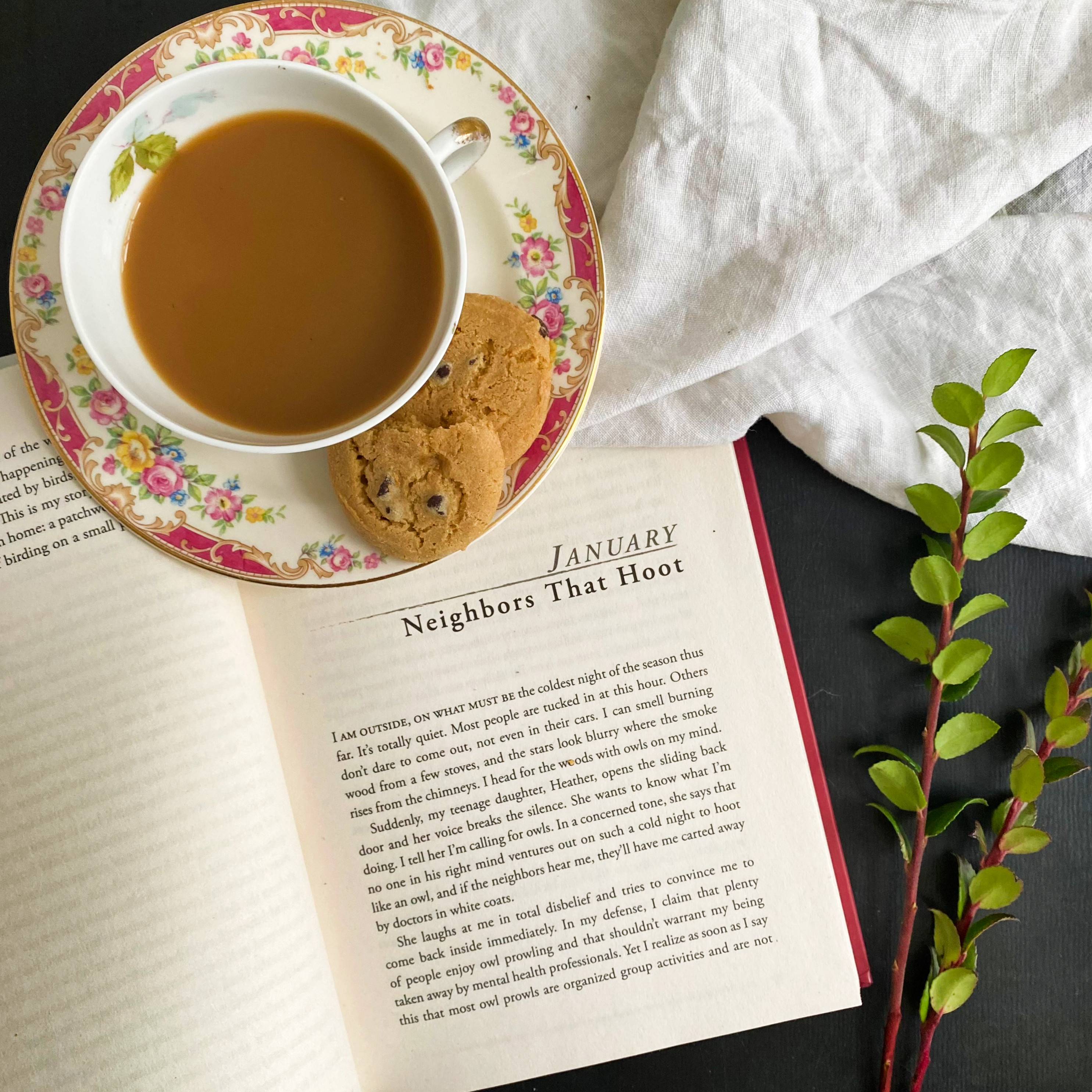
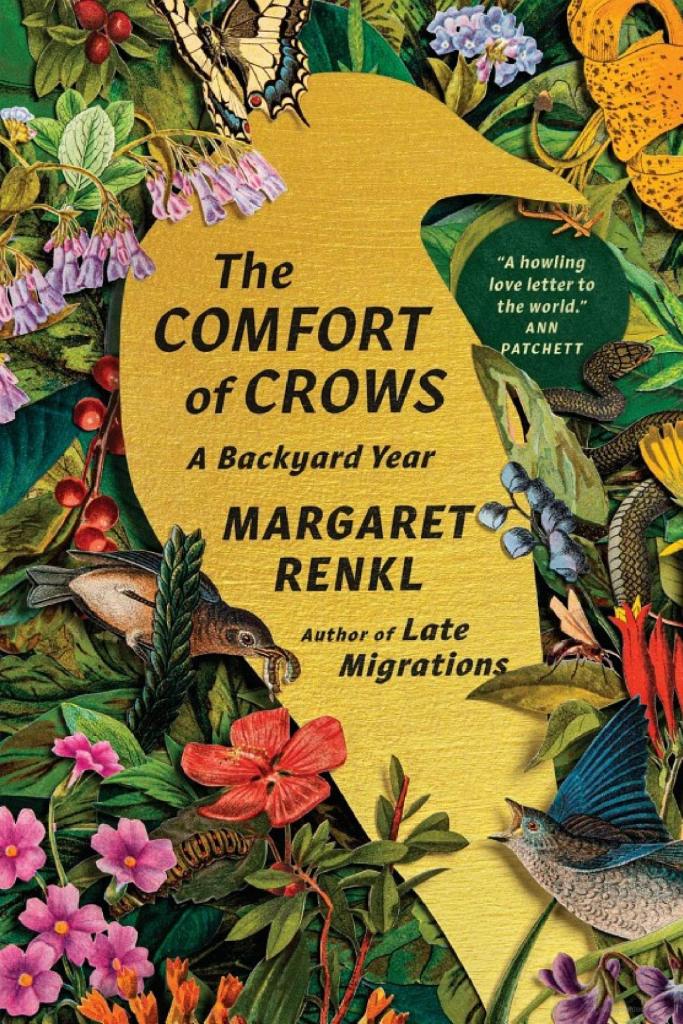
The Comfort of Crows – Margaret Renkl (2023)

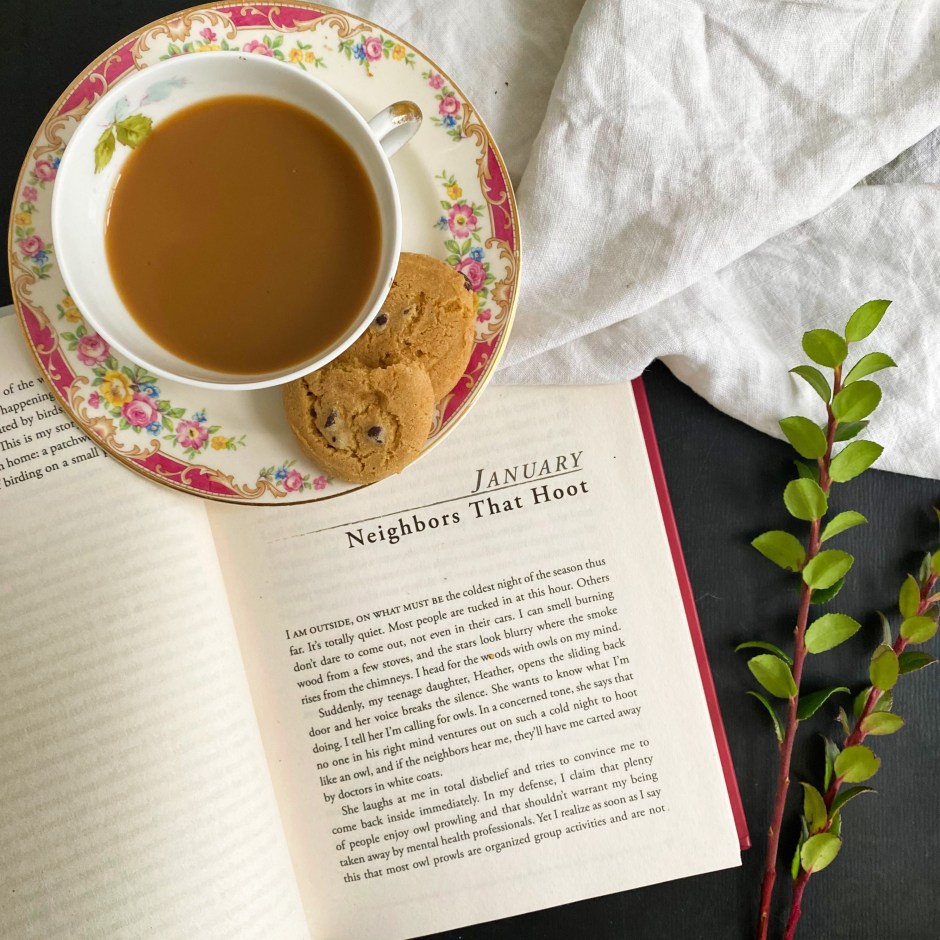
Stop and look. Those are the first three words of Margaret Renkl’s ruminations on nature and her year-long accounting of it in The Comfort of Crows. Written from the vantage point of her backyard in Nashville, TN and a friend’s nearby vacation cabin in the mountains, Margaret writes about the sights and sounds of nature witnessed firsthand over the course of a calendar year. In brief vignettes accompanied by her brother’s beautiful illustrations, Margaret draws attention to common occurrences happening with the birds and the squirrels, the trees and the bees, the plants and the pollinators, week by week, while also reflecting on her own life and the parallels these natural encounters draw.

Part nature study, part memoir, part call to action, I would recommend The Comfort of Crows to anyone who wants to unplug from the outside world for a weekend, a week, a month, a year. If you need a break from social media, the news, the what-ifs, and the how-to’s, this book is easy to fall into. Calming, thought-provoking, and comforting, it offers a gentle reminder that in nature there’s a plan, a purpose, and a resourcefulness that is indefatigable, adaptable, and inspiring.

Stop and look. Stop and listen. Stop. Look. Listen. See. Hear. These are simple words that yield powerful insight into the dramas, destinies, and determinations going on in everyday life around us. Whether it’s the backyard, the city park, the country meadow, the forest, the beach, or the planting strip in the parking lot of your local grocery store, there’s insight to be gained from the creatures that inhabit these parcels of place.

Starting on Week One, the first of January, Margaret shares in her lovely, poetic voice how nothing is actually dead even in the dead of winter. “Everything that waits is also preparing itself to move,” she notes. “The brown bud is waiting for its true self to unfold: a beginning that in sleep has already begun.”

I can’t really describe this book as anything other than an experience. It’s heartwarming and serene, playful and curious, sentimental and sad. It is fun facts and first-hand observations. It’s a love letter to what is and a longing to change what might become. It’s a book. It’s short stories. It’s prose and it’s poetry.

Conscious of global warming and human impact on the natural world, Margaret is hopeful that we can right the ship and learn how to cohabitate with plants and trees, insects, and animals in order to encourage a beneficial landscape for all instead of just some. In acknowledging that we have collective work to do in that regard, this book carries its own bittersweet narrative – an appreciation of what is here now but a realization that it might it not be here in the same way tomorrow. That viewpoint automatically sets the tone for awareness which is the overall theme of Margaret’s year. To be aware of one’s natural surroundings. To be aware of what is in one’s natural surroundings. To be aware of the wild in the world. It’s that recognition that Margaret hopes will propel you out into the greenspaces of your life. To look and to see. To hear and to help. All, so that we can continue to hope.

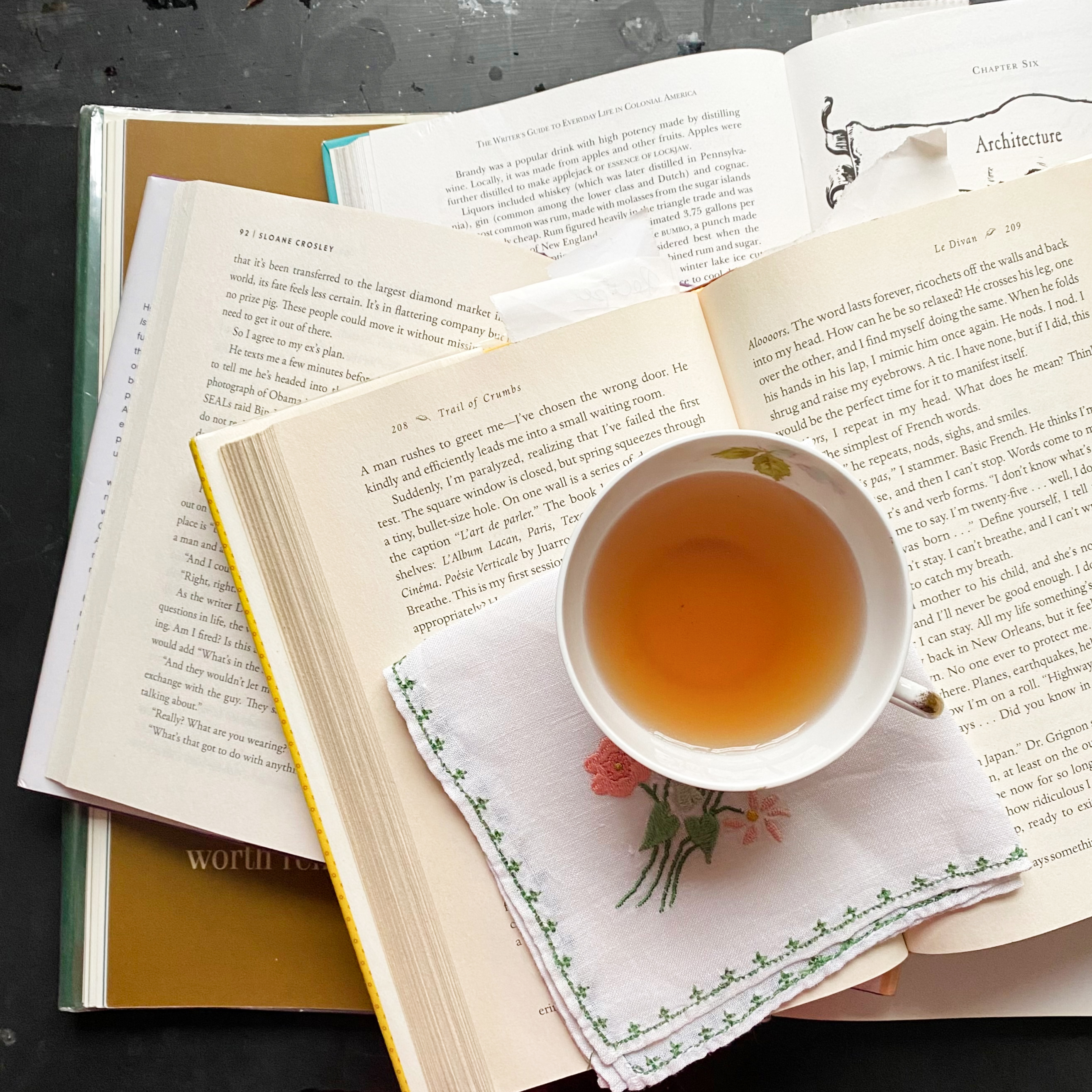
Trail of Crumbs – Kim Sunee (2008)

Abandoned in a Korean marketplace when she was three years old, Trail of Crumbs follows the real-life of Kim Sunee from toddlerhood through her late twenties via place, people, and passion. Adopted into a well-meaning American family and taken to live in New Orleans, Kim’s presence in the world from the beginning never quite clicks. Seesawing between feelings of gratitude and abandonment, she grows up out of place as an Asian American in the Deep South. Carrying the emotional baggage of a person who has been left behind, Kim is too young to put words to her lost person emotions.

As a child, the only place she finds real comfort is in her grandfather’s kitchen, watching him and helping him cook an array of Southern specialties. This early introduction to the internal power of food becomes Kim’s barometer, her measurement of what feels right and wrong in her life, of what is fitting and falling apart around her. Cooking becomes the bridge that connects her with a cast of characters that come in and out of her life, leading her around the globe over twenty years in search of the definition of home, both internal and external.

With every new person she meets, every new relationship she begins, her life pivots. She makes friends with artists and writers. She teaches English classes to foreign children. She writes poetry. She translates business brochures. She runs a bookshop. All the while searching for her true self.

In all these people, all these places, all these jobs, Kim tries to move on from being left behind. She tries to make peace with her past and the mother who left her on a bench in a market with just a fistful of crackers. She goes to Paris. To Sweden. To South America. She eats, drinks, and cooks in new kitchens of new friends, new lovers, new neighbors. In France, she meets and falls in love with a high-profile businessman who is determined to give her everything she ever wanted. For a time, this romance is ideal. A fairy tale in the making with affable rom-com pacing. She’s finally met someone who is ready to unclasp her fingers from the tight grip that carries her emotional suitcases. He wants to give her everything she never had. A fresh start. A new life. Her own making.

But as much as they love each other, and as passionate as their relationship is, it’s also fraught with complications. Kim questions this knight-in-shining-armor and her worthiness of him. She wears the invisible letter L for leaveable like a badge that defines her. And in believing that she’s leaveable she can’t ever truly stay anywhere. That creates a restlessness that no amount of kindness, no amount of money, no amount of love, or attention, or security can cure until she learns to love herself for herself.

Along with this search for peace and family, Kim’s memoir is dotted with recipes throughout, each one representing a different aspect of her physical and emotional journey from childhood to adulthood. There are recipes that reflect her Korean heritage, her Southern upbringing, and her love of French food. There are recipes for snacks, comfort foods, fancy dinner parties and elegant desserts. Each one, a place marker of her growth and development. They represent comfort in times of unease and joy in times of safety and security. There are so many truly lovely-sounding recipes in Kim’s book that I practically tagged each and every one. In the next blog post, we’ll be delving into one of her recipes from Trail of Crumbs – Chicken Thighs with Cinnamon and Dates – which appears about halfway through her story when she’s in the middle of her French love affair. Stay tuned for that post coming shortly.

The Writer’s Guide to Everyday Life in Colonial America from 1607-1783 – Dale Taylor (1997)

This is pretty niche reading, and I realize not everyone may be as curious about colonial life as we are here at 1750 House, but this book provides so much interesting, little-known information on domesticity in the 17th and 18th centuries, it will appeal to history lovers of all sorts on all levels. Covering architecture, clothing, occupations, gender roles, homekeeping, agriculture, professions, education, religion, and government, I came to this book initially interested in reading the chapter on architecture in hopes of learning some new information about 1750 House, but the whole book turned out to be captivating and I flew right through it.

Brimming with all sorts of very fun fun facts, historical interpreter Dale Taylor wrote this book specifically for writers so that they would have an accurate understanding of the all details that made up real life in the colonial era. With that audience in mind, Dale includes an array of anecdotes that help bring history alive in a relatable way. It’s also a great resource when solving floorboard mysteries.

Wide plank floors upstairs

Upstairs in 1750 House, the original wide plank wood floorboards which are made of solid 3″ inch thick chestnut, measure between 9.5″-15″ inches in width per board. But downstairs, the wood floors are much narrower in width, about 3.5″ inches on average.

Narrow-width floorboards downstairs

This has always led to curious conversations about why the floorboards aren’t the same on each floor. We suspected that the downstairs floors were replaced at some point later in time, possibly in the mid-1800s when the kitchen room was added. But come to find out, according to Dale, in colonial days, wide plank boards were less expensive to mill, so they were often used for flooring in the more private rooms of the house, which tended to be on the second floor or at the back of the house on the first floor. The narrow-width floorboards were laid in the front of the house on the first floor in the parlor rooms. These narrow boards acted as a status symbol letting visitors know that the family who lived there could afford such luxury. In the case of 1750 House in particular, this newly learned information makes a lot of sense.

Not long after we moved in, we learned about the architectural significance of the front door, which is also original to the house. In the photo below, you’ll notice four small windows that are built in at the top of the door. During the colonial era, that was another bit of luxury – to be able to afford glass in your front door. The panes not only allowed extra light to illuminate the interior but there was also religious symbolism attached to them too. Religious colonists believed that by installing windows at the top of the door, it allowed God a peek down from the heavens to make sure there was nothing improper going on indoors. Just like the original H-Hinges found throughout, it’s another little bit of unique symbolism that lives here. And thanks to Dale’s book, it now gives us a better understanding of the economic status of the original owners of the house.

Windows on the original front door c. 1750

Architecture notes aside, other types of fun facts that can be found in Dale’s book include these little marvels…

  • Pets during the colonial era included dogs and cats, but not birds. Birds would not be kept animals until the Victorian era. However, squirrels and deer were also common pets in colonial days and the deer were allowed free reign both inside and outside the house.
  • Bearskin rugs were the first indoor fire alarms. In the 17th and 18th centuries, they were laid out in front of the fireplace in case an errant ember flew or a log rolled out into the room. At night, after the household had gone to bed, if an ember sparked or a log rolled out, the rug was the first point of contact. It would begin to smolder, emitting the smell of burnt hair. That smell would awaken people in the house and signal that there was a fire near the fireplace which could be easily and quickly be put out because of the rug.
  • 25% of women’s deaths in colonial days were due to life-threatening burns caused by cooking in an open fireplace. That led women to start hoisting up their skirts and tucking them into the waistband of their dresses in order to avoid catching the hems on fire. From that point forward, the kitchen was viewed as an indecent place to spend time and the staff that worked in them were viewed as having low repute.
  • Since cloth was one of the costliest items in colonial America dresses were made to last for 15 years which means that some women owned only about 2-3 dresses in their lifetime.
  • Wigs were commonplace for men and women in colonial times, but the super tall and lofty wigs were only worn by women in big cities like Philadelphia. These wigs were so elaborate in design, style, and augmentation that they were often worn even at night while sleeping. This full-time, overnight headress necessitated arrangement in such a way to accommodate mouse traps since they were made of natural nesting materials.
  • In 1752, the celebration of the new year was moved from March 25th to January 1st, which of course, has stayed the same ever since.

Reading is so subjective when it comes to personal preference. Everyone has their own favorite styles, writers, and genres, but I hope by sharing my list of favorites, you’ll discover some new favorite ones too. Stay tuned for a recipe I just made from Kim Sunee’s memoir coming up next on the blog. It’s an aromatic, cozy, wintertime dinner that is absolutely lovely for the holidays. Here’s a sneak peek…
Chicken Thighs with Cinnamon and Dates from A Trail of Crumbs by Kim Sunee

Until then, happy reading! And a big cheers to Madeleine, Sloane, Kim, Margaret, and Dale for making 2024 such an interesting one.

Growing A Fragrant Year: Violas For March and Part of April

{A Fragrant Year is an ongoing series shared throughout 2024 highlighting twelve fragrant plants, trees, flowers, shrubs and herbs added to the New England garden landscape, month by month, surrounding a house built in 1750. This series was inspired by the 1967 garden book, The Fragrant Year by Helen Van Pelt Wilson and Leonie Bell. If you are new to the blog, catch up with our first introductory post here.}

March blew into the kitchen in a flurry of raindrops, wind chills and the occasional threat of one more snowstorm. My favorite local nursery didn’t open for the season until mid-month, and as we are quickly learning, not much happens in New England on any sort of instant gardening level until the beginning of April. So this month, there will be two fragrant garden posts – one for March and then the other for April so that we can keep on track for a full year of fragrant gardening month by month.

When our local garden nursery did open its doors for the season, a much-anticipated event in my world, a sea of pastel colors unfolded rack by rack, tray by tray, row by row. Aside from all that lovely Easter egg-shaded splendor, the thing that immediately greeted everyone at the door was the unexpected scent of warm honeycomb. This was not a fragrance brought on by bees zipping in and out of the flower pallets nor by close-by hives where they like to linger. This was the scent of violas, our featured fragrant flower for the month of March and part of April.

Dainty and delicate, a smaller but more robust version of their bigger blossomed offspring, the pansies, violas have always been a flower I passed by in previous years because of their size and what I thought was a sort of a hum-drum, everyday ordinariness. But when seeing them altogether, in masses of bright purples, oranges, lavender blues, crimson reds, lemon yellows and perfect whites they were a bright sight for winter-weary eyes. I also never realized what an incredible fragrance they carry, but after reading all about them in Helen and Leonie’s book, The Fragrant Year they were definitely worth a second look. “The fragrance reaches out to snare you into stopping, marveling, ” wrote Helen and Leonie back in 1967. Indeed.

Technically considered an herb, violas are the parent plant of pansies, and though while smaller in size, will put out more buds and blooms in the late winter/early spring months than pansies. They are also a heartier plant that is able to withstand freezing temperatures and snowy landscapes, an ideal match for our New England climate, but also for other areas around the country that experience cool weather temperatures during springtime too. Ideal temperatures for growing these ladies are 40 degrees at night and 60-70 degrees during the day.

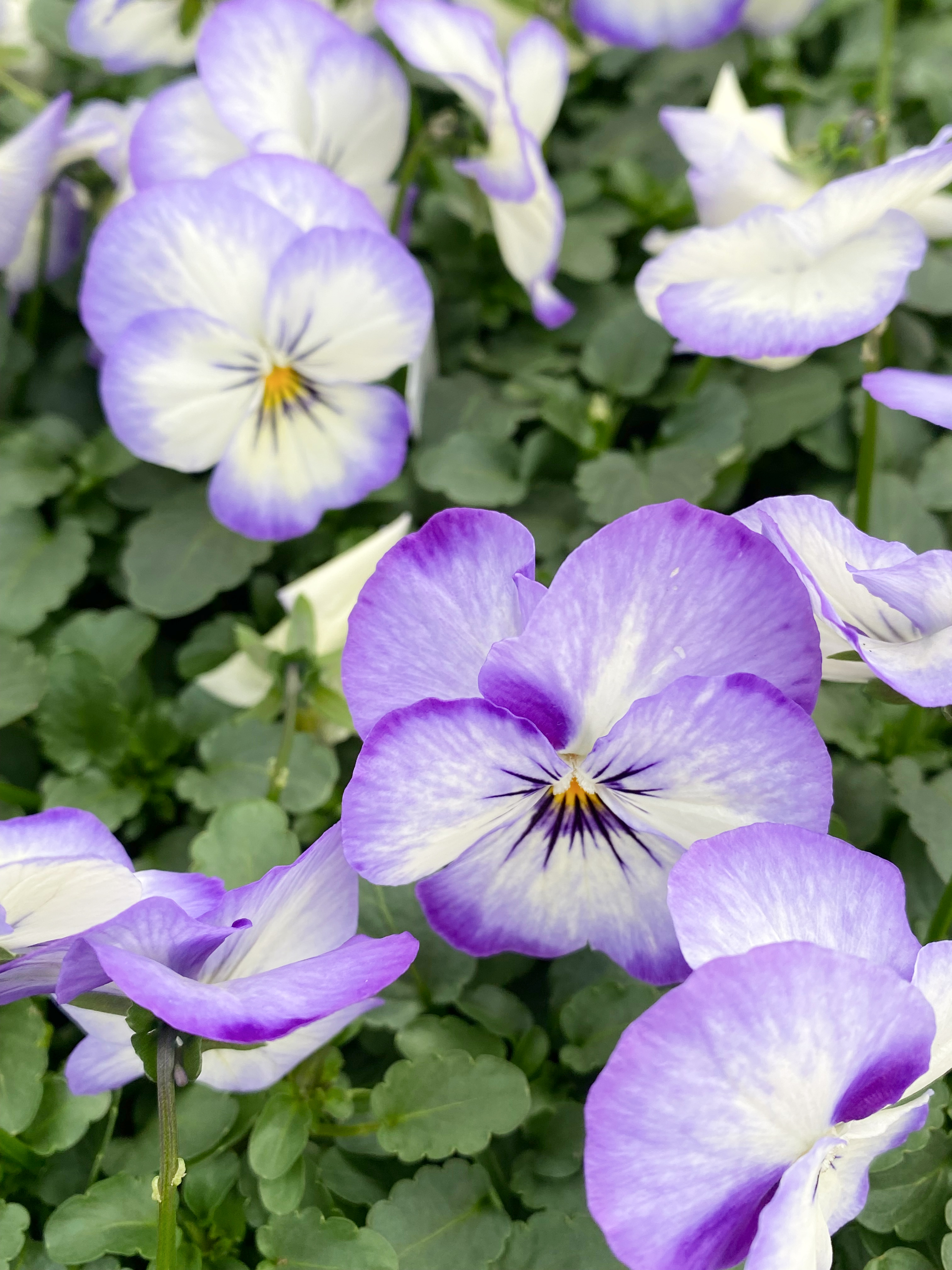
“The end of the growing season is the beginning for violas since short cool days are needed to trigger bud formation,” write Helen and Leonie. That means that when you plant violas, you actually encourage two growing seasons from them each year – one in fall and one in spring. And since they come in an array of colors beyond the most traditional (lavender), they can complement most garden palettes. Here are just a few color choices within the viola family…

First discovered in the Pyrenees, violas have been part of kitchen gardens for centuries. Used in making tea, wine, and liqueurs, they are also members of the edible flowers club. Not only do they add an interesting slightly sweet flavor to salads, cheese, butter and desserts but they also add beauty and color to the plate as well. And their contributions to everyday life just don’t stop at the kitchen either. Throughout history, violas have also been used in making perfume and medicinal salves since they contain both anti-inflammatory and anti-bacterial properties. These flowers might be mini in size but they certainly are mighty when it comes to usefulness.

Viola cornuta circa 1830

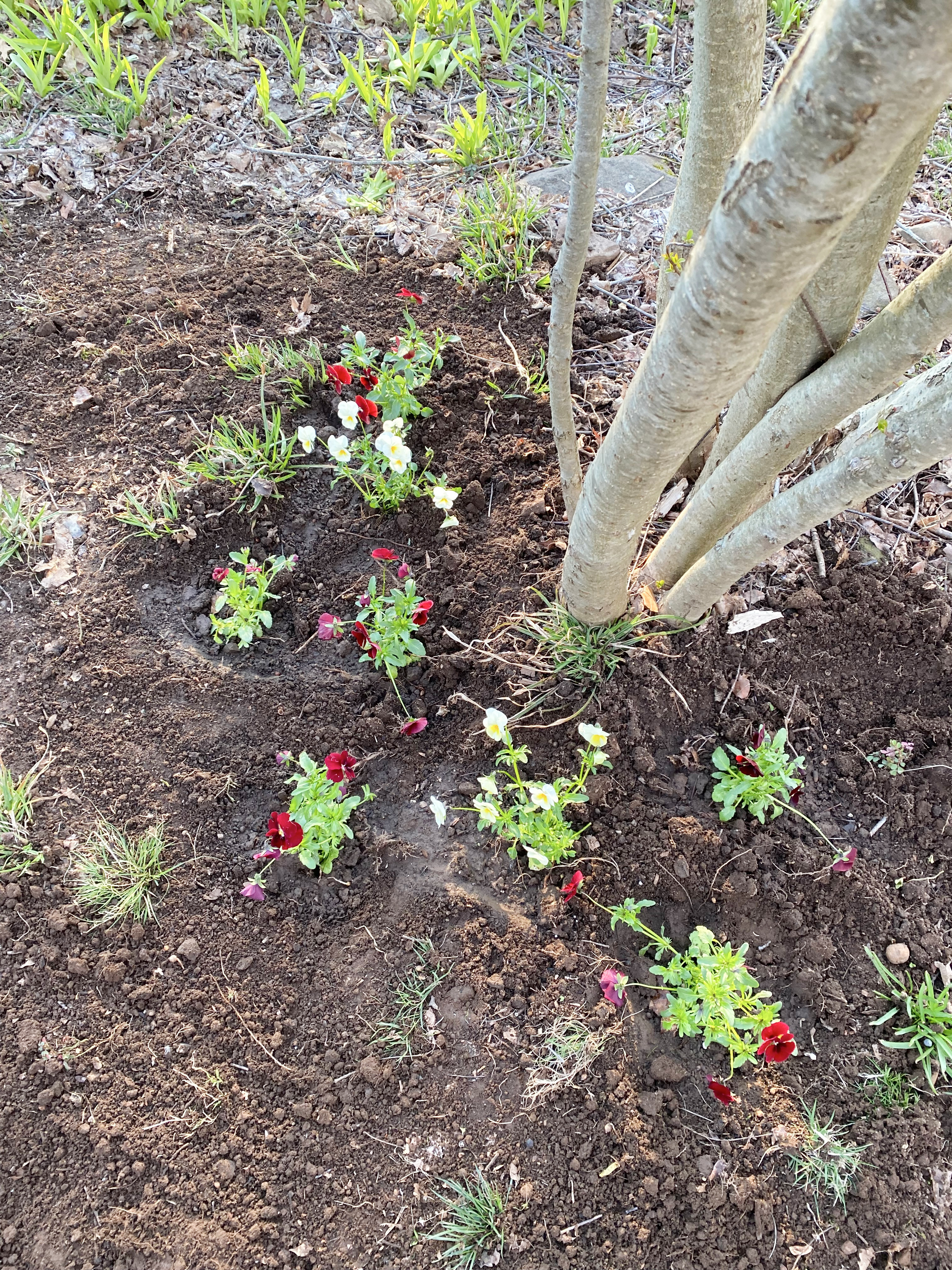
I came home with a variety called Penny Lane (a hybrid of the Viola cornuta family) which comes in a mix of shades ranging from deep red to white and yellow. The more you plant, the greater the scent of course, but it’s amazing to think that even one small plant can carry what seems like an entire perfume factory in just a few petals.

We have French botanist, Rene Louiche Desfontaines (1750-1833) to thank for describing and naming this variety of viola. He did this in the late 1700s, which makes them a very age-appropriate choice for 1750 House. That was an unexpected surprise learned after I brought the Penny Lanes home, but now that they are firmly nestled under a crab apple tree, tucked in between woodland border beds of daylilies and foxglove starts from last year (see more of those below) they seem quite fitting.

My eight plants might not be much of an exuberant site at the moment, but one of the fun things about violas is their ability to self-seed on their own. In theory, fingers crossed, in the next couple of years, we’ll see violas popping up all over the woodland areas surrounding this small bed that will add color, interest and most importantly, fragrance to the early spring and late autumn landscape. We’ll catch up with them again in fall to see how this set is doing and to see how much they’ve grown over the course of the next seven months.

Meanwhile, here are some other sights and updates from the greenhouse diaries of March and part of April 2024…

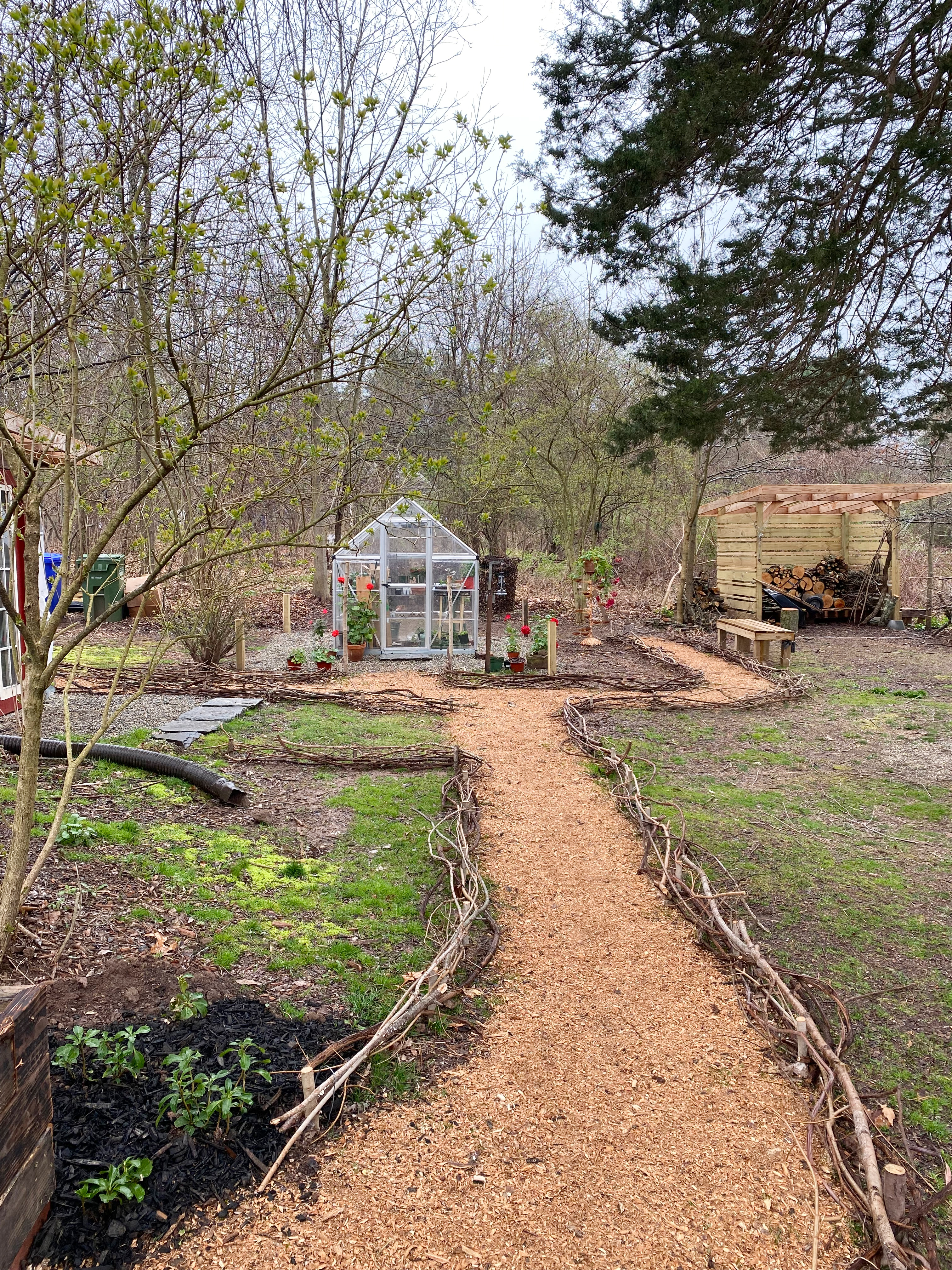
New pathways around the greenhouse and the yard are underway. We’ve lined each one with a wattle border using invasive vines cut down from the woodlands that were taking over some of the tree canopies. Landscaping bushes, a short fence around the greenhouse, and more planting beds are coming soon to that area.

Do you remember the first planting of the foxglove seedlings from last year? This is them now after being planted in the garden last May. The one thing that is difficult to find online these days is a visual example of what foxglove, started from seed, should look like year one just as a green plant before it flowers in year two. There are plenty of photographs that show foxglove fully flowered out in year two but none taht I could find at least of how the plants should look in their first year. I’m so happy to share these photos because hopefully it will become a helpful reference for other gardeners too. As I discovered, year one foxglove plants (leaves only) are beautiful.

In the first year, they grow to about the size of a large head of lettuce and stay green year-round including during the winter – even in below-freezing temperatures and snow. We planted ours on the edge of the woods in an area that we will continue adding to year after year, so that eventually the woodlands bordering the edge of the yard will be lush and green and full of foxglove. Much prettier than looking at bare patches of dirt.

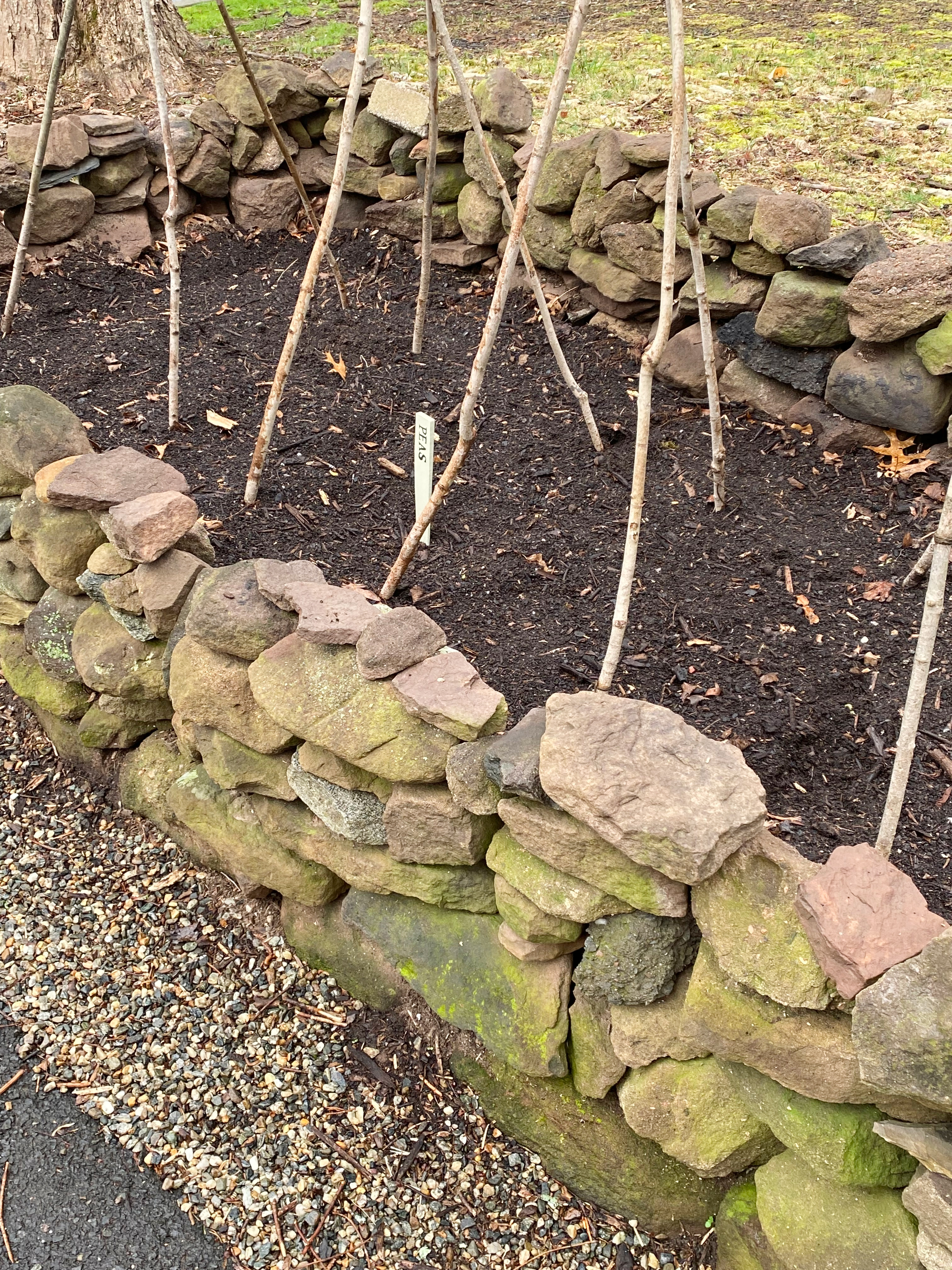
The collard greens and the peas have been planted in their springtime beds…

The pea patch also increased in size to three 8 foot rows. The more peas the better.

And the brocolli is now 12″ inches tall. The beets greens are growing.The kale is just right at 6″ inches now and Liz has a lemon with triplets on the way.

Broccoli!

Beets!

Kale

Liz Lemon!

An industrious pair of black-capped chickadees pecked their way through a post on the back porch of 1750 House. What’s particularly fascinating is that this post is not made of wood but of a plastic composite that holds up one corner of the 1990s addition. The post will eventually get replaced with real wood, but for now, the chickadees seem more than happy to call it home. And we are more than happy to have these cute little songbirds as neighbors. Not only do they sing their way through the day but they also feast on a host of insects that can be problematic in the garden including the dreaded scale bug, which we had troubles with last year.

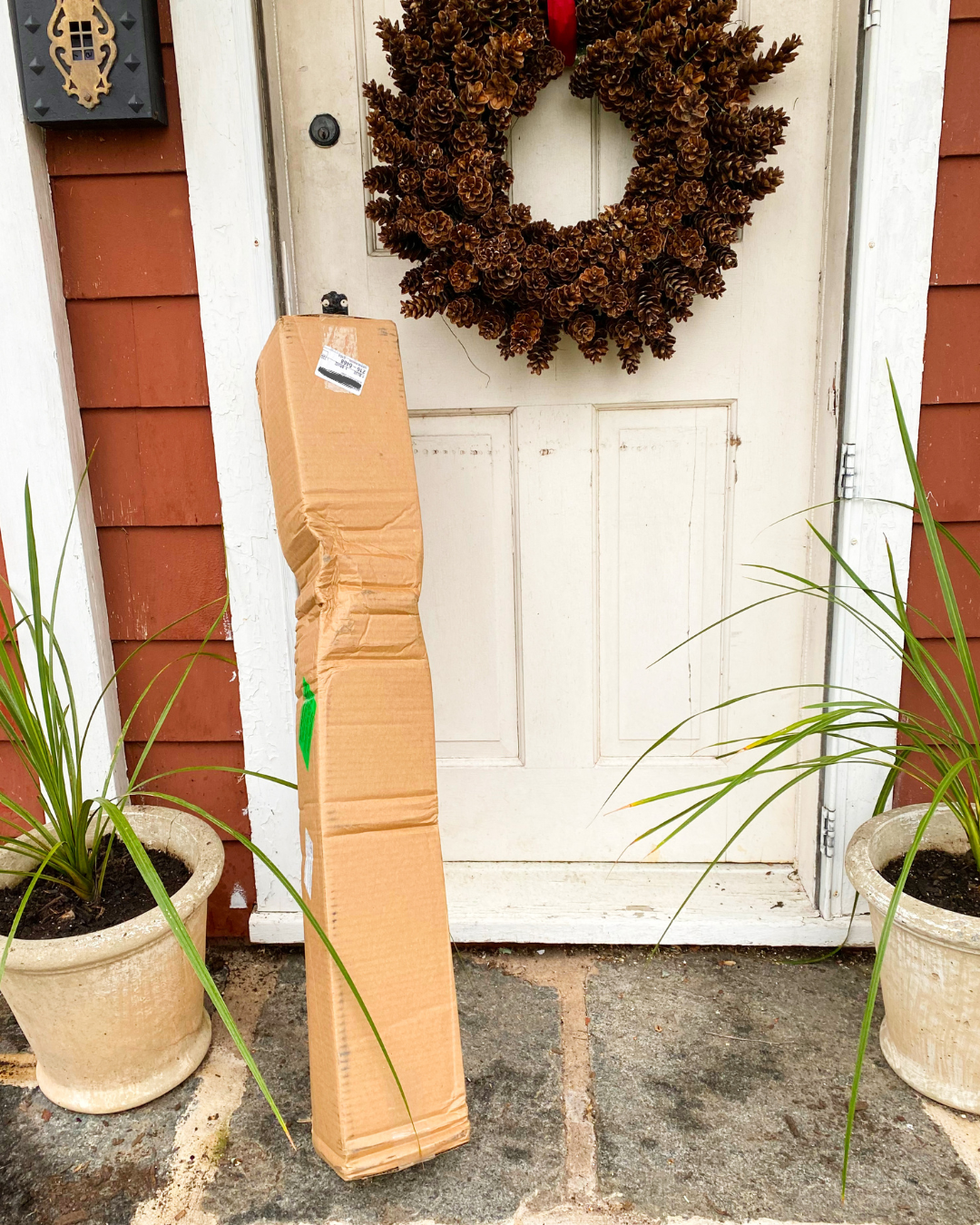
And just in time for publication of this post, something arrived in the mail…

Could it be the witch hazel from February’s Fragrant Garden post?! Stay tuned for the second half of April’s Fragrant Garden series coming soon. In the meantime, cheers to the cheerful viola. Happy Spring!

The Greenhouse Diaries: Entry #1

Inspired by the writings of Katharine Sergeant Angell White, there’s a new series coming to the blog called The Greenhouse Diaries. A week-by-week account of growing flowers, food and ornamentals in a 4′ x 6′ greenhouse in New England, it’s a work-in-progress series that chronicles our adventures as we build the gardens of 1750 House and grow ingredients for our vintage recipe posts.

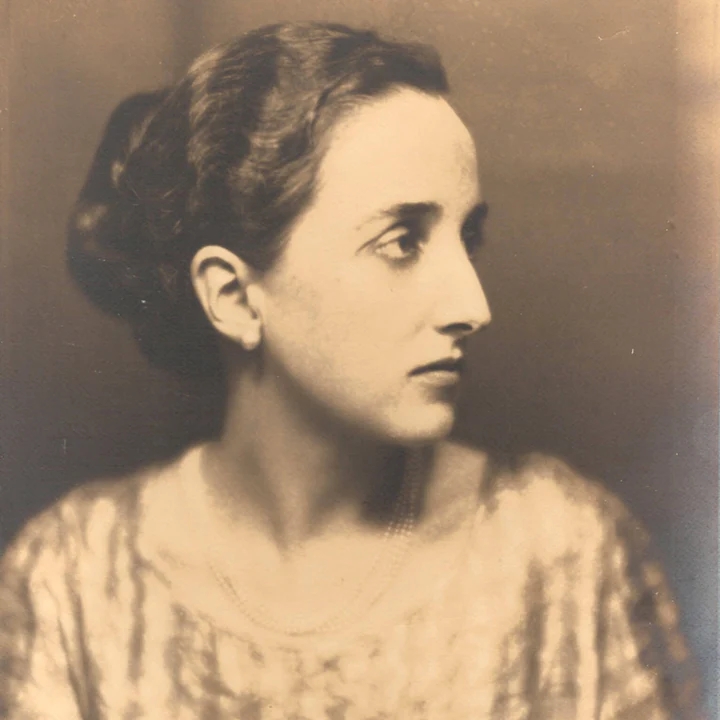
Katharine Sergeant Angell White (1892-1977)

If you are unfamiliar with Katharine, she was a longtime editor of The New Yorker magazine, working there from its infancy to the mid-20th century. She was also the wife of E.B. White, who wrote Charlotte’s Web, Stuart Little and other fantastic works that delighted the imaginations of both kids and adults.

Katharine and E.B.’s home in Brooklin, Maine. Image courtesy of maineaneducation.org

In the 1950s, when Katharine and E.B. left their New York City apartment to take up permanent residence in their vacation house in Maine, Katharine embarked on a writing career. After decades of working around some of the best literary talents of her generation including her own husband, you might suppose she would turn to writing things she was accustomed to reading at the magazine – fiction or poetry or short stories or perhaps some reminiscences about life in the publishing world that she had known so well for so long. Not so. Instead, Katharine was inspired by the thing that grew around her in Maine – her garden and all that it entailed. From planning and plotting to cultivating and researching, she fell in love with horticulture from all angles. On index cards, in diary pages, and in letters to friends, for two decades she enthusiastically documented her successes and failures, her insights and observations, the learned histories, and the passed-along advice relating to gardening as hobby, art, and food source.

Katharine’s expertise grew by trial and error, by curiosity, and by a passion that captured her attention year-round despite the cold winds that blew off the Atlantic, the snow that inevitably piled up in winter, and the wild, rugged landscape that made growing anything in Maine both a challenge and a reward. Her published pieces eventually led to a book of collected works on gardening compiled by E.B. after Katharine’s death in 1977. Lauded for her fresh perspective and interesting subject matters (like one essay that reviewed the writers of garden catalogs), she had a unique voice that resonated with other gardening enthusiasts around the country. Even E.B. was surprised at his wife’s candor and affection for her subject matter.

Katharine’s book of collected garden writing published in 1977.

As you might recall from previous posts, we have big plans for the heirloom gardens that will envelop 1750 House just like they would have done one hundred, two hundred or almost three hundred years earlier. Having spent most of the spring, summer and fall building and establishing garden beds and planning out landscaping details for the front and back yards, we will be ready for Phase Two of our landscape design by next spring, which means putting the greenhouse to full use this winter. Just like Katharine approached gardening in Maine with continual curiosity and enthusiasm, I thought it would be fun to share our progress of winter gardening as it unfolds. Since we are new to gardening in New England and also new to greenhouse gardening in general, this weekly diary will be an adventure in unknown outcomes. Nature is rarely predictable. Surprises can be encountered at every turn. It’s my hope that by discussing both challenges and successes, this series will help attract and connect fellow greenhouse gardeners so that we can all learn together by sharing tips and techniques discovered along the way.

So let’s get going and growing. The Greenhouse Diaries await…

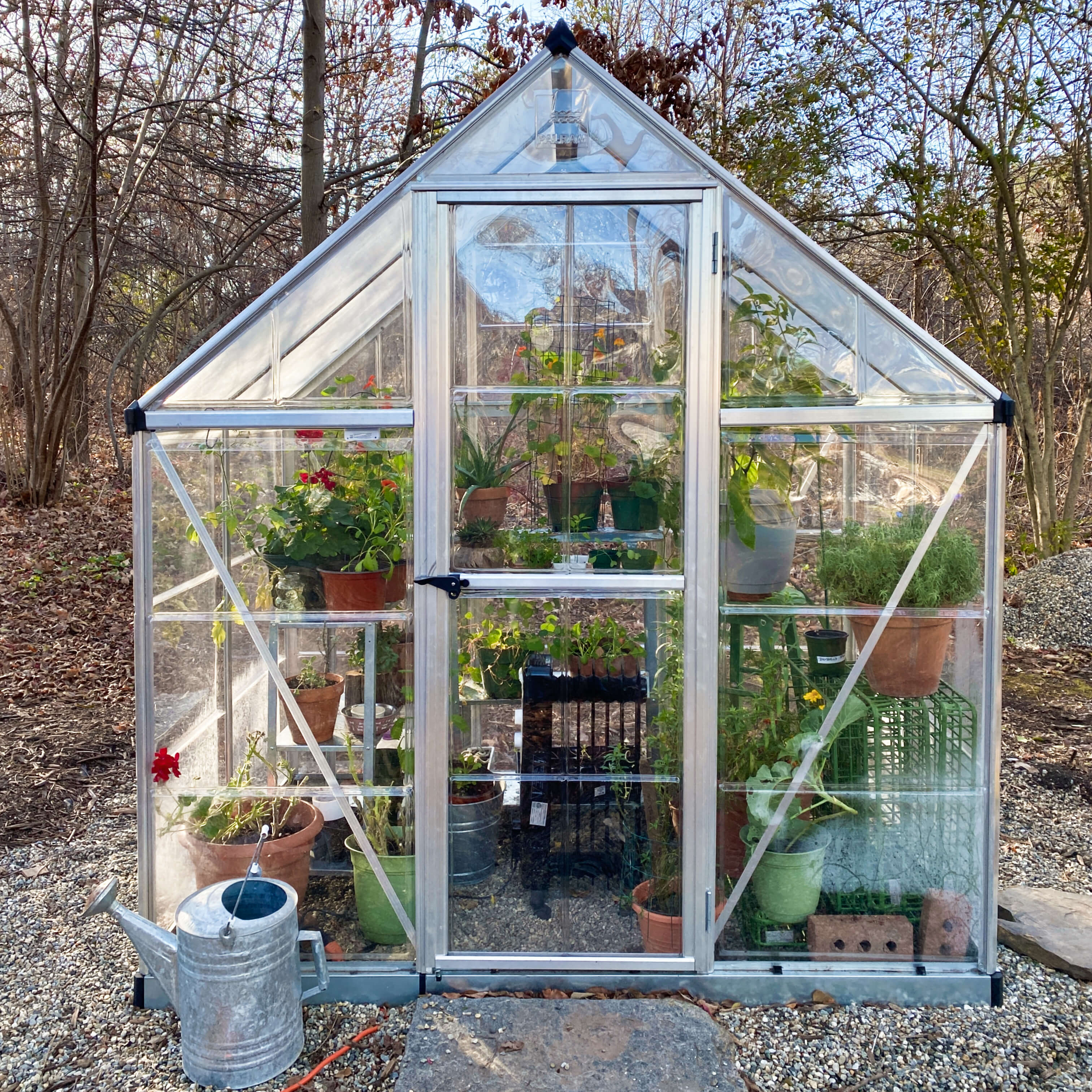
First and foremost, a formal introduction to our workspace.

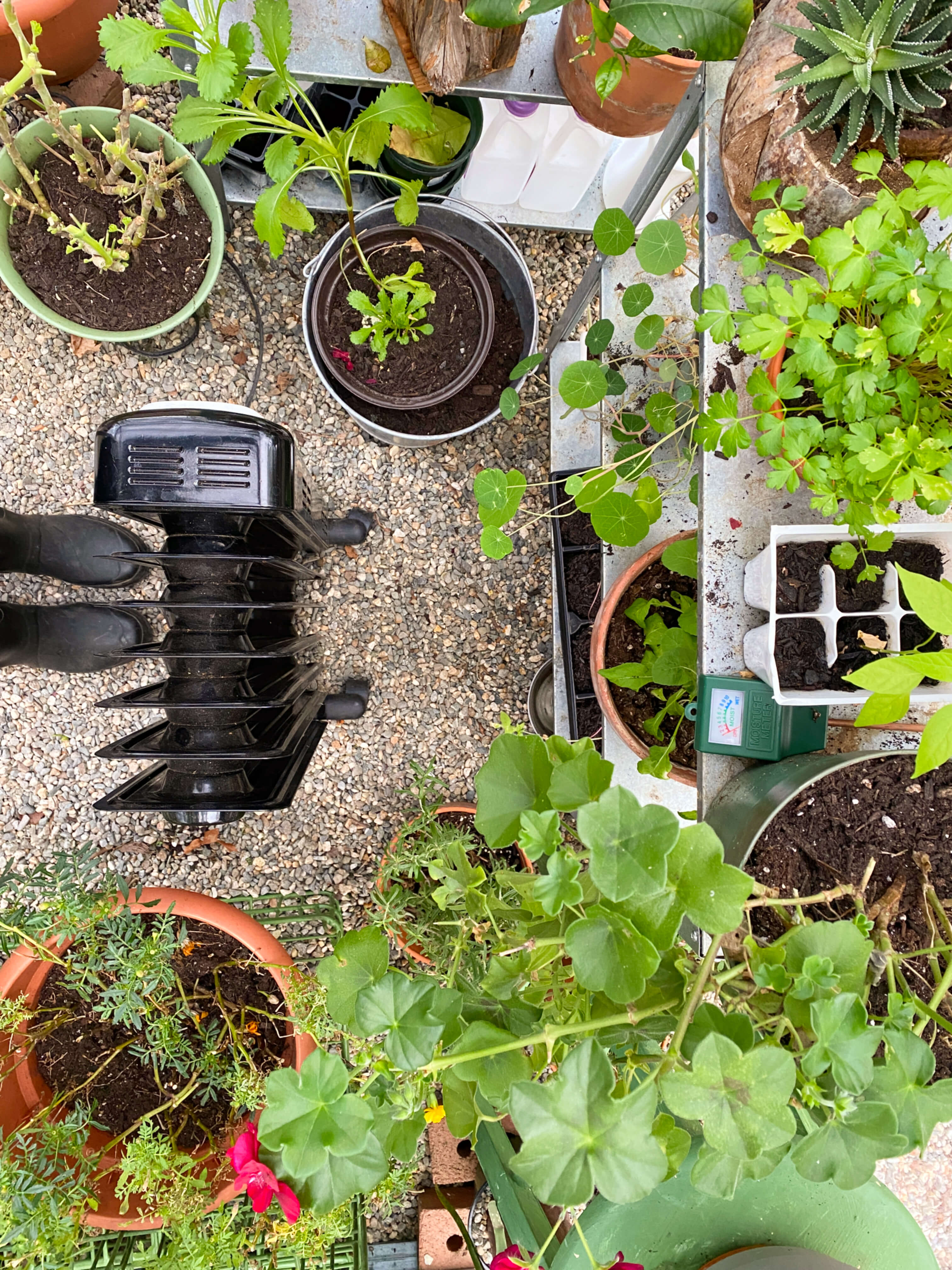
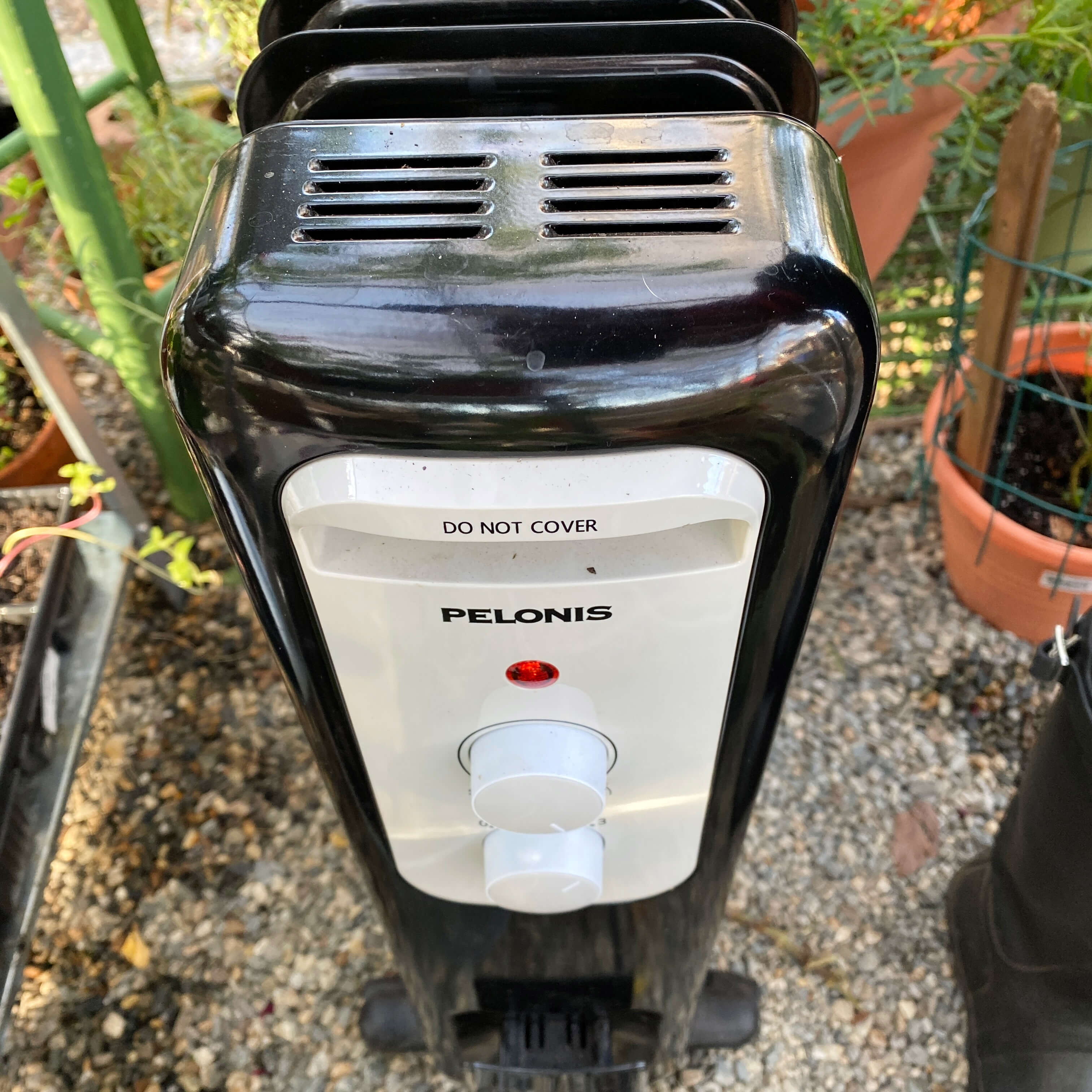
Our greenhouse measures 4’x6′. It has a steel base, aluminum framing, a pea gravel floor, a door with a secure handle, an adjustable roof vent, and clear polycarbonate walls. Inside, there is room enough for two metal shelving units, a wooden stool, 33 pots of varying sizes, one galvanized bucket, two water jugs, a hand soap station, and a portable heater. Tucked in between all that, is a little extra space for standing and potting.

We assembled the greenhouse in the late spring in the sunniest spot in the backyard. During the warm months, it held trays of seed starts and some plants that preferred to be out of the direct path of slugs and cutworms. But once autumn came and the threat of the first frost hovered, we turned it into an experiment station. Curious to see what we could keep alive from the summer garden, we potted our most successful growers and crossed our fingers. So far so good. Everything but the oregano and one pot of marigolds have taken well to the location change.

The nasturtiums in particular really like their new spot. Blooming at a rate of three to four new flowers a day, they keep the greenhouse bright with color and the air sweetly scented like honeyed perfume.

Currently, the greenhouse is uninsulated, an issue that will need to be addressed as the daytime temperatures fall into the 20s and 30s. But for now, we have found success in creating a summer climate using a portable electric heater that was put into service as soon as the outdoor temperatures began to repeatedly fall below 50 degrees.

With just the help of the heater and the sun, the greenhouse right now averages temperatures that are 20-35 degrees above the outdoor temperature. Once we get our insulation plan in place, it should become even warmer. For now though, all the plants seem happy with this cozy climate.

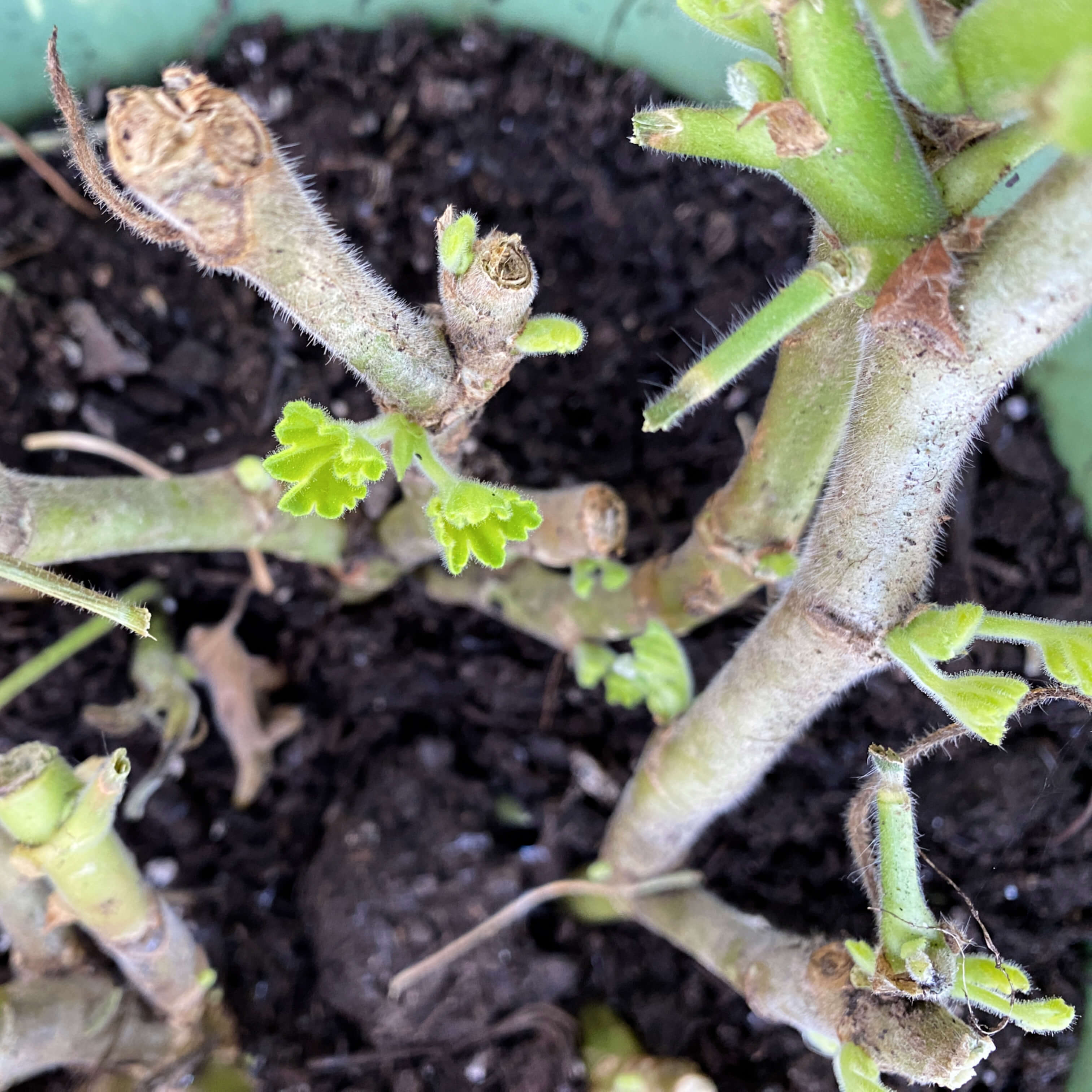
I read once that a single geranium plant can live up to 50 years if properly cared for season by season. That’s my goal for the four pots that are overwintering now.

Accidently overlooked, two of the four geranium pots experienced the first frost in mid-November before they made it into the greenhouse. Wilted and weepy-looking, I cut off all the affected leaves and stalks and brought them into the greenhouse, hoping that the warmth might help them recover and encourage new growth. Yesterday, they started sprouting new leaves…

The other companions that make up this house full of green are…

  • lavender
  • tarragon
  • mint
  • parsley
  • rosemary
  • broccoli
  • basil
  • succulents
  • sage
  • tomato
  • peppers
  • thyme
  • arugula
  • zinnia
  • pincushions
  • lemon tree
  • collard greens
  • chives
  • aloe
  • bunny ear cactus
  • brussels sprouts
Lavender

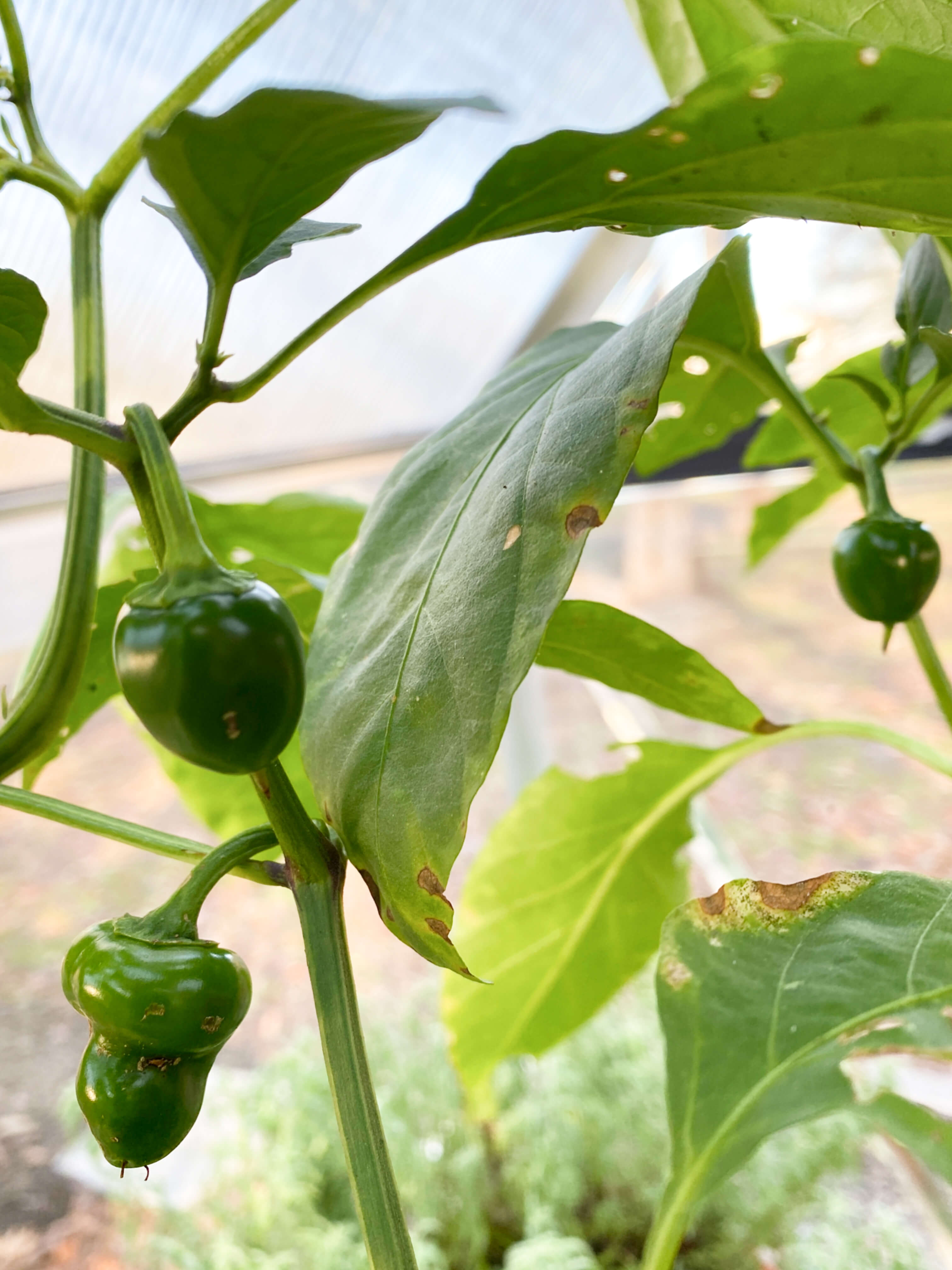
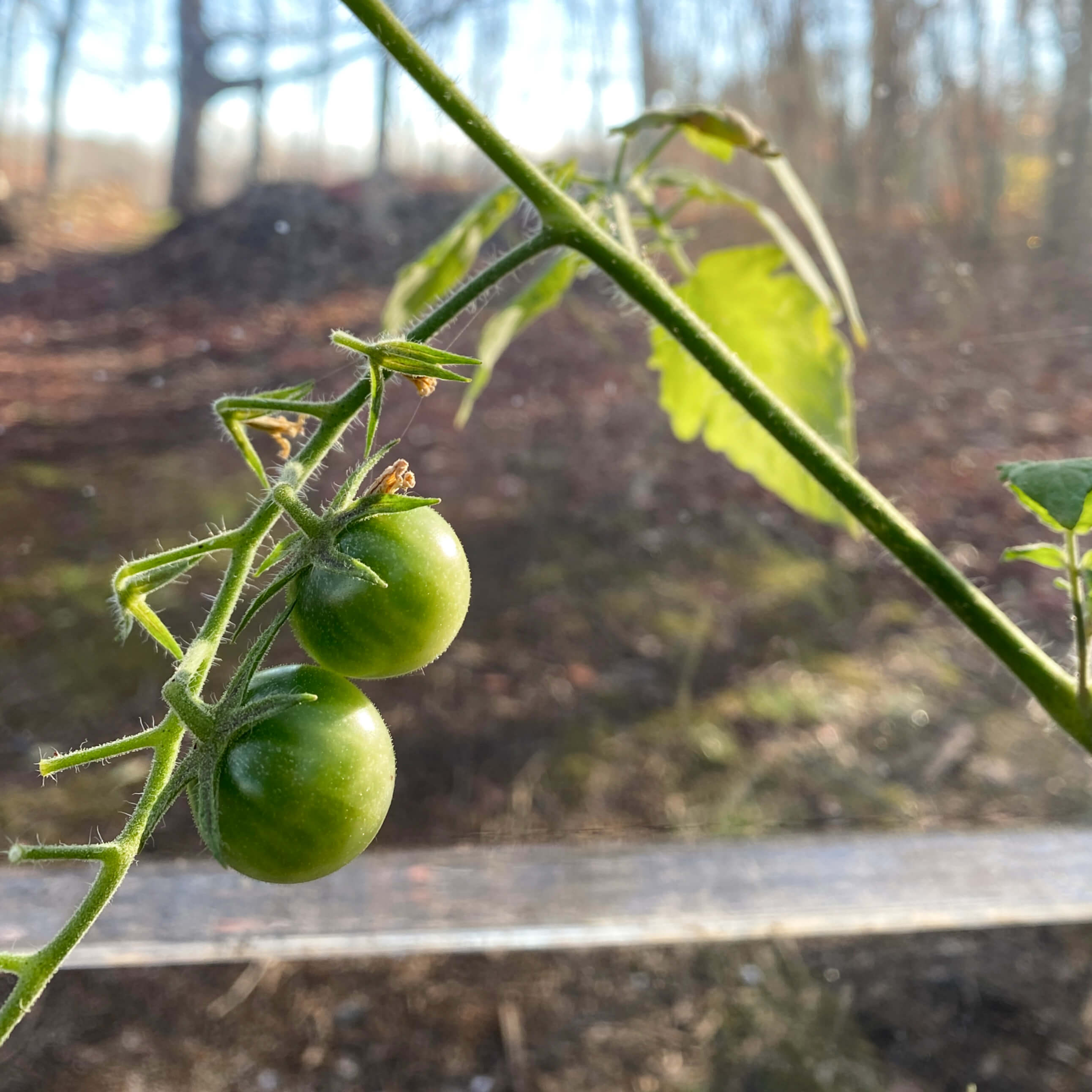
The peppers, tomatoes, and broccoli are all sporting fruit these days. I’m not sure how long they will take to grow and ripen but if we could manage a small harvest in the dead of winter that would be exciting.

Lemon jalapenos
Cherry tomatoes
Broccoli

The winter crops that we are trying out this year – broccoli, arugula, collard greens and Brussels sprouts – hopefully, will reach maturity and harvest time by late February. We run the chance of running out of room if these guys get really big, but a full house is better than none at all, so we’ll take it one week at a time and see what happens.

Arugula

In one of her essays, Katharine wrote.. “from December through March, there are for many of us three gardens – the garden outdoors, the garden of pots and bowls in the house, and the garden of the mind’s eye.” Gardening in a greenhouse in winter gives us the ability to experience all three – to create, to grow, and to dream during a time of year that the outside world reserves for dormancy and hibernation. Our small structure set in pea gravel with a portable heater and a steel base, aluminum framing, and metal shelves shelters big, colorful dreams – ones both realized and yet to be imagined. We can’t wait to see what blooms.

Cheers to Katharine for inspiring this new series, to the greenhouse for holding all our hopes and to nature for feeding our brains and our bellies.

The Art of the Vintage Picnic

Happy August! As promised in the last post, here is the article written for Artisans List that highlights the beauty and joy of a vintage style picnic. We’ve got just six weeks left before Autumn officially starts, but rest assured that doesn’t mean that picnic season, as we most traditionally know it, is over. There are plenty of Fall foliage opportunities for all you Northerners intent on a day trip and a dine out in nature. If you happen to live in the Southern half of the hemisphere than lucky you – everyday is a good day for a picnic no matter what time of year. When we settle into the cooler months, I’ll also be featuring two outside of the box picnic ideas – the carpet picnic and the car picnic  – both which promise to hold as much fun as their summertime counterpart. So stayed tuned on that front. In the meantime, six full weeks of summer still await. From somewhere I can hear a basket calling your name…

Twentieth century foodie, gourmand and all around good cook, James Beard declared that “picnicking is one of the supreme pleasures of outdoor life.” Indeed. No other dining experience seems quite so decadent. The fresh air, the natural setting, the creative food choices, the deliciously idle intentions. Picnics have a wonderful way of engaging all of our senses in such a fantastic way. It’s almost overwhelming.

Those first few moments at picnic’s start – when you are dizzy with the view and the weather and the notion of doing nothing but relaxing and reveling in food and friends – is satisfaction enough. But then a truckload of simple delights follow one right after another. There is that liberating sensation of kicking off shoes and wiggling bare toes in soft grass.  The crisp, snapping action of the picnic blanket as it unfurls from containment, joyfully sailing on the breeze before floating to the ground. There is the laying out of the carefully wrapped food parcels and the first sip of a celebratory toast. The giddy laughter, the bird songs, the sound of leafy trees dancing on the breeze… suddenly you are aware of the musical vitality of nature and yourself in it.

On a picnic, the world shines newly bright with details mostly overlooked in the hustle bustle routine of everyday life. It is an activity that encourages you to stop and to breathe and to melt – into your surroundings, into your friends, into the food that makes up your lunch or your dinner or your breakfast time snack. Yes, picnics are a triumphant and pleasurable experience. And there’s no better season for them then right now. In today’s post, we will be discussing the art of of the vintage picnic – how it came to be, how it shaped us, and why we still need to celebrate it now. Highlighting a handful of old, but still very relevant recipes, this post also offers suggestions on how to build your own vintage picnic experience so that you too can succumb to the relaxing style of outdoor eating that our ancestors favored so long ago. It’s history in a most delicious form, unveiled, just as we are about to round the corner towards the 4th of July, the most popular picnic holiday of the year.

This idea of eating outdoors from a basket on a blanket is no trend. It has been around for centuries and has taken eaters on a plethora of picturesque adventures. But it wasn’t always a simple act. At first, outdoor dining began in grand style. Lavish entertaining in lavish settings. In the 1700’s, there were the hunting after-parties which made glorious outdoor feasts of animals bagged from the day’s sport. Garden gatherings in the 1800’s involved fine china, silverware and fancy dress. Plein air luncheons in the early 1900’s focused on seasonal foods, artistic creativity and exquisite manners. Today, picnics involve technology fueled cooling mechanisms, compartmentalized backpacks and fitted amenities made for details and devices. Needless to say, the desire to picnic has never been lost, but the way we eat outdoors has evolved quite a bit over time.

Nowadays, anything goes when it comes to picnic style and presentation.  An impromptu paper bag lunch for two in a city park can be just as engaging as a thoughtfully prepared country basket for six. But just like any activity worth doing, there is a certain art form to a well produced picnic that makes for a more pleasurable experience. The vintage-style picnic favors china plates and real glassware, classic cocktails and linen napkins, and most importantly, homemade food. It is the sort of affair that wraps you up in a long, restful lazy day adventure fueled with time-honored tradition and attention to detail. It discourages anything fast or obtuse- like technology and frenzied time schedules and plastic utensils. It champions a slower, simpler and more relaxing rhythm. The type of experience that not only feeds your appetite but also your senses, your spirit and your sanity. Basically, a vintage-style picnic is a big, long break in your day meant for resting, relaxing and restoring through small details… the time-worn touch of an old plate, the taste of an heirloom recipe, the time-out of technology, and the tune in to your natural surroundings.

Legend loosely states that the word picnic stemmed from the French pique-nique which derives from the action of picking and selecting small spots or things. Originally, pique-niques were more like potlucks, in that all invited guests were asked to contribute a little food or drink for the group to share together. But it was England, in the 19th century, not France who created the picnic in the modern sense that we know it as today. Both a mealtime and a leisure activity, the English made picnicking a deliciously long-term and lengthy event that could last all day and well into the night if done right. They played games, read books, plucked instruments, talked, sang, painted, swam, flew kites, played sports and generally just all around enjoyed themselves while snacking on small plates of assorted foods from wicker hampers and baskets.

Monet’s painting, Le Dejeuner Sur L’Herbe (Dinner on the Grass) was painted between 1865 and 1866.

In America, prior to the Civil War, there were no lackadaisical, carefree picnic outings. If any outdoor eating occurred before that time period, it was eating en masse – generally a large sociable event where whole communities of people turned out to enjoy a barbecue or a church social or a political rally. The Victorians ushered in more intimate, family-style picnic parties, rambling in close proximity to home, as their appreciation of nature and outdoor enthusiasm bloomed in the late 1800’s.  But the rise of the automobile, the building of the U.S. highway system, and the introduction of drive-up motor lodges and nationals parks all encouraged a whole new independence when it came to on-the-go eating as the 20th century began. Suddenly, the English style picnic took hold as Americans began exploring their more easy-to-navigate country. Economical, spontaneous and available to everyone, picnics naturally turned destinations into dining opportunities. All you needed was a basket, a blanket, a small collection of foodstuffs and an adventurous spirit. Outdoor eating euphoria had arrived!

A group of picnickers photographed in 1914 by Albert M. Price. Photo credit: Library of Congress

Back in earlier centuries, outdoor eating meant bountiful quantities and dramatic fare. Whole animals roasted over fire pits, multiple courses served by domestic staff, exotic ingredients, rich foods, elaborate presentation. But as outdoor dining began to evolve over time into smaller parties and simpler affairs, the food that accompanied it changed also. As serving staffs diminished and people became more independent, picnics and the baskets they represented, became simpler – filled with foods that could be easily made, easily transported and easily unpacked. By the time the mid-20th century rolled around, there was a definite type of picnic fare anticipated and defined by the activity. Fried chicken, salads and deviled eggs topped the favorites list, along with hot dogs, sandwiches, pies, cakes, bread and fruit.

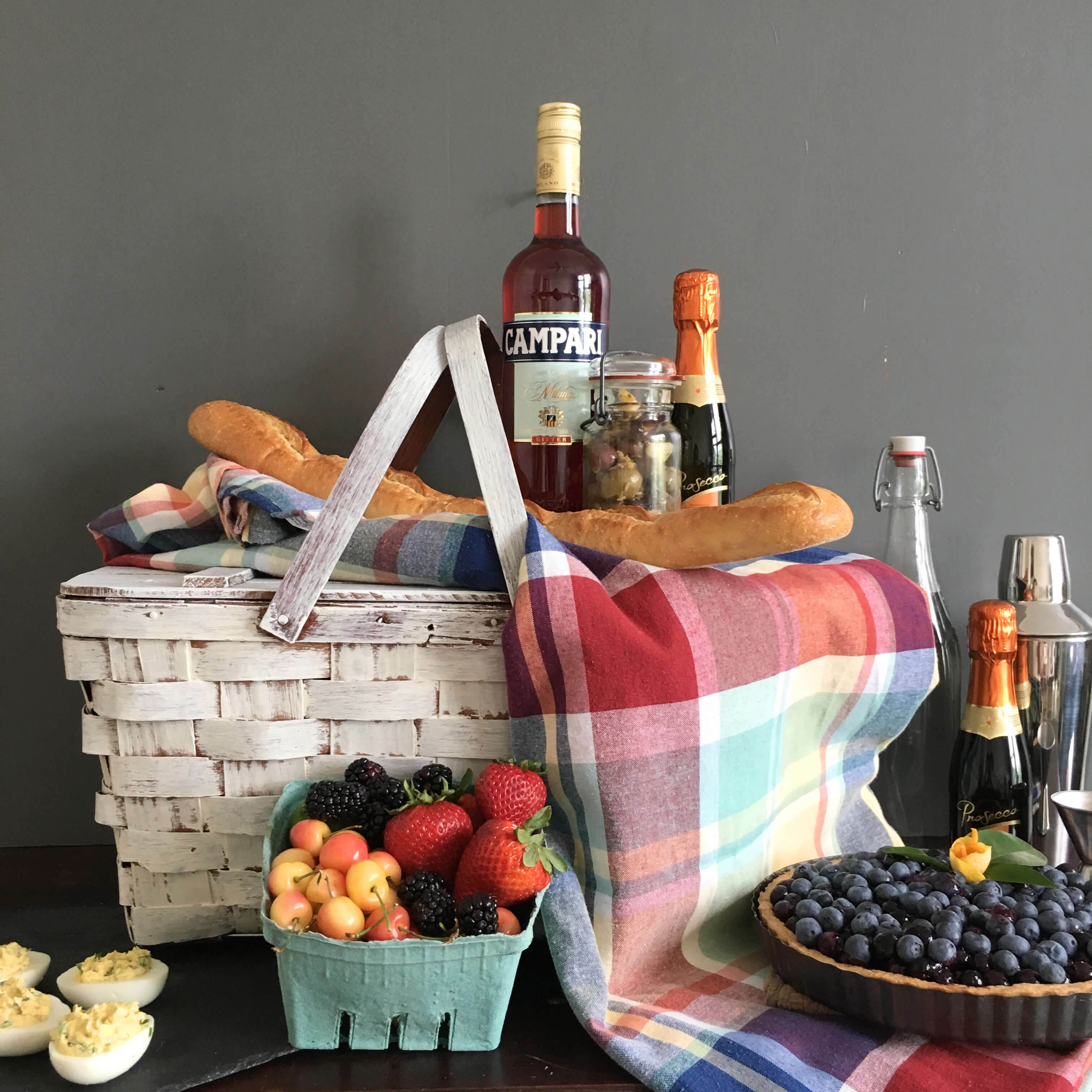
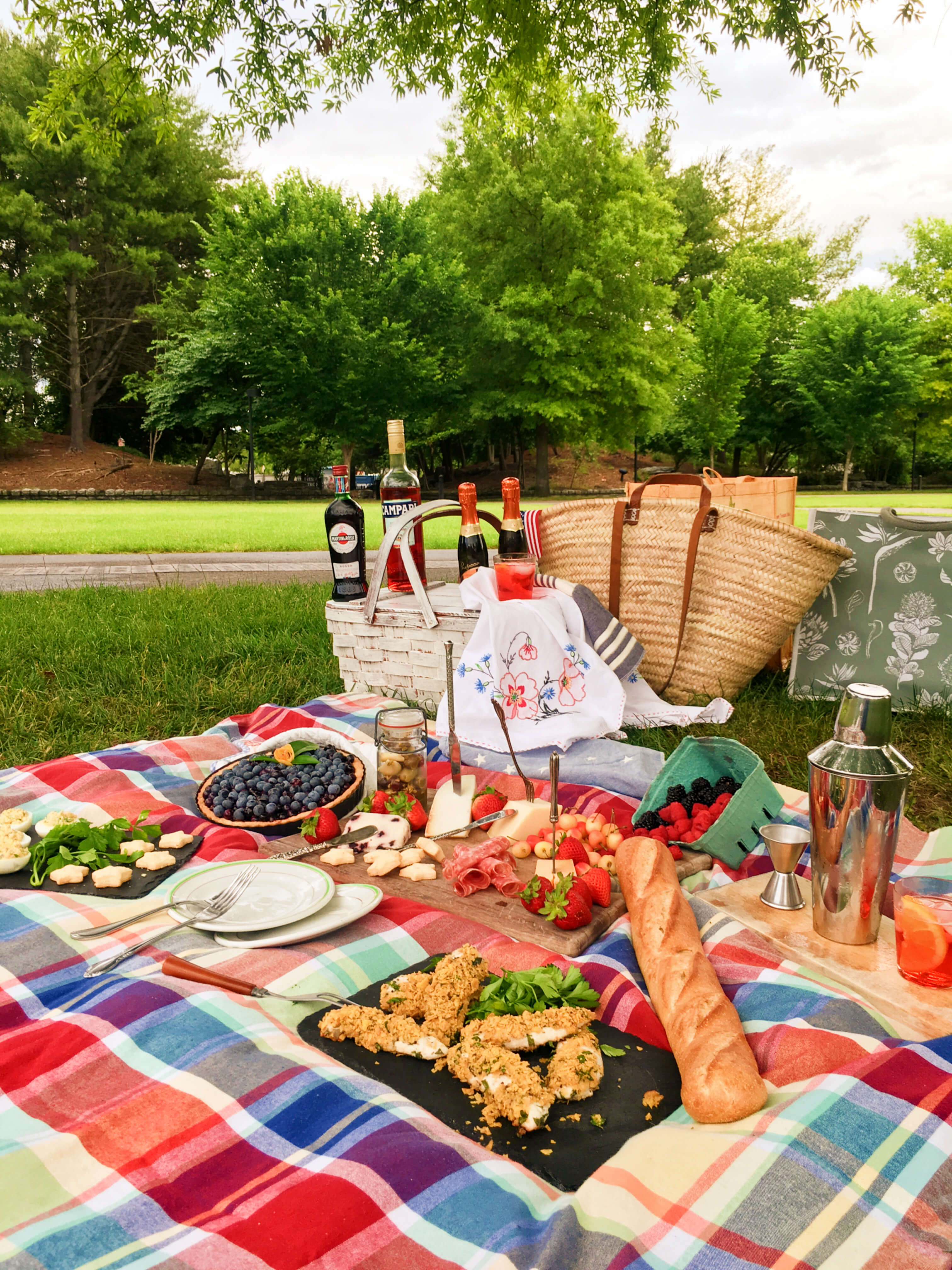
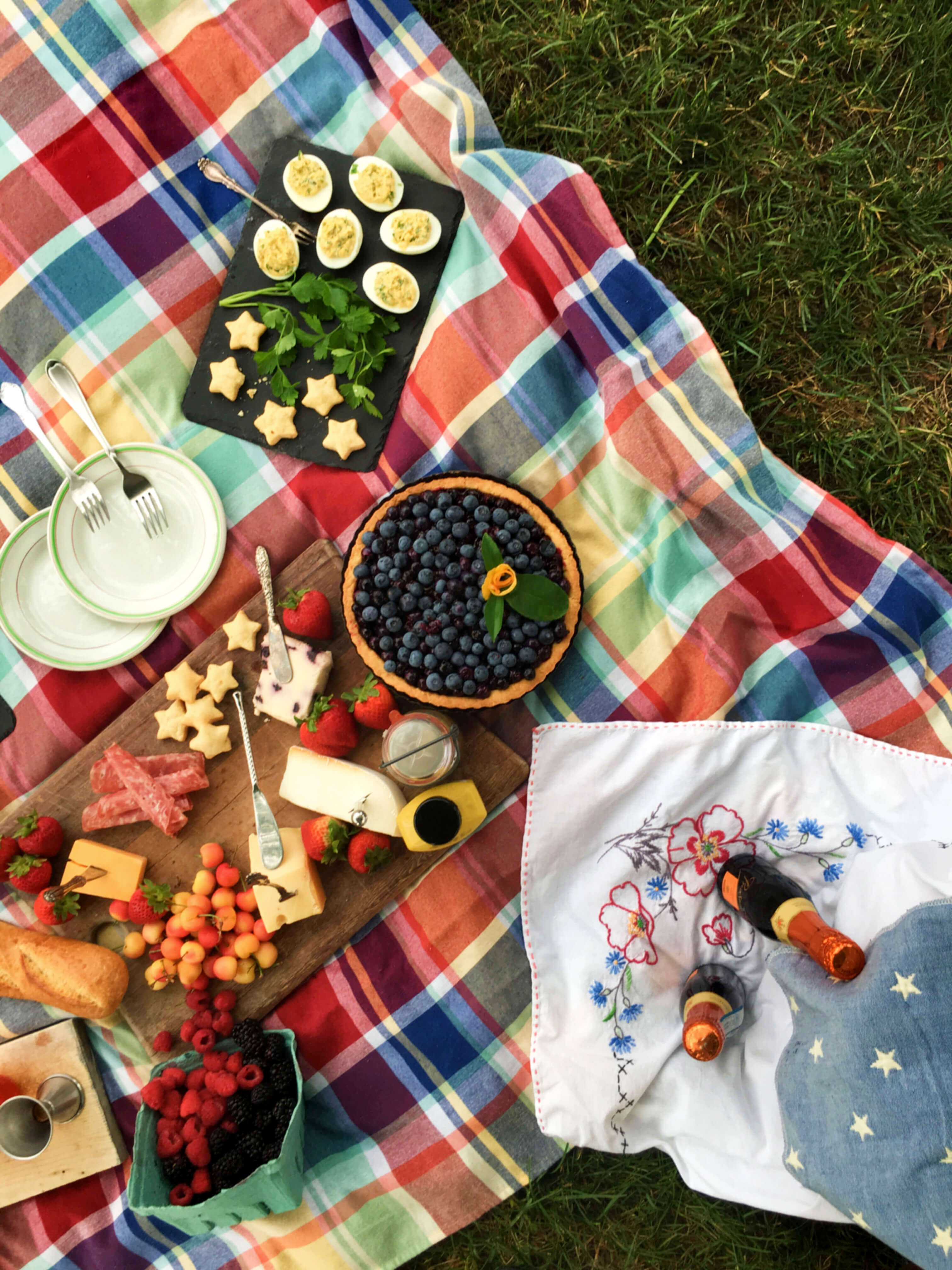
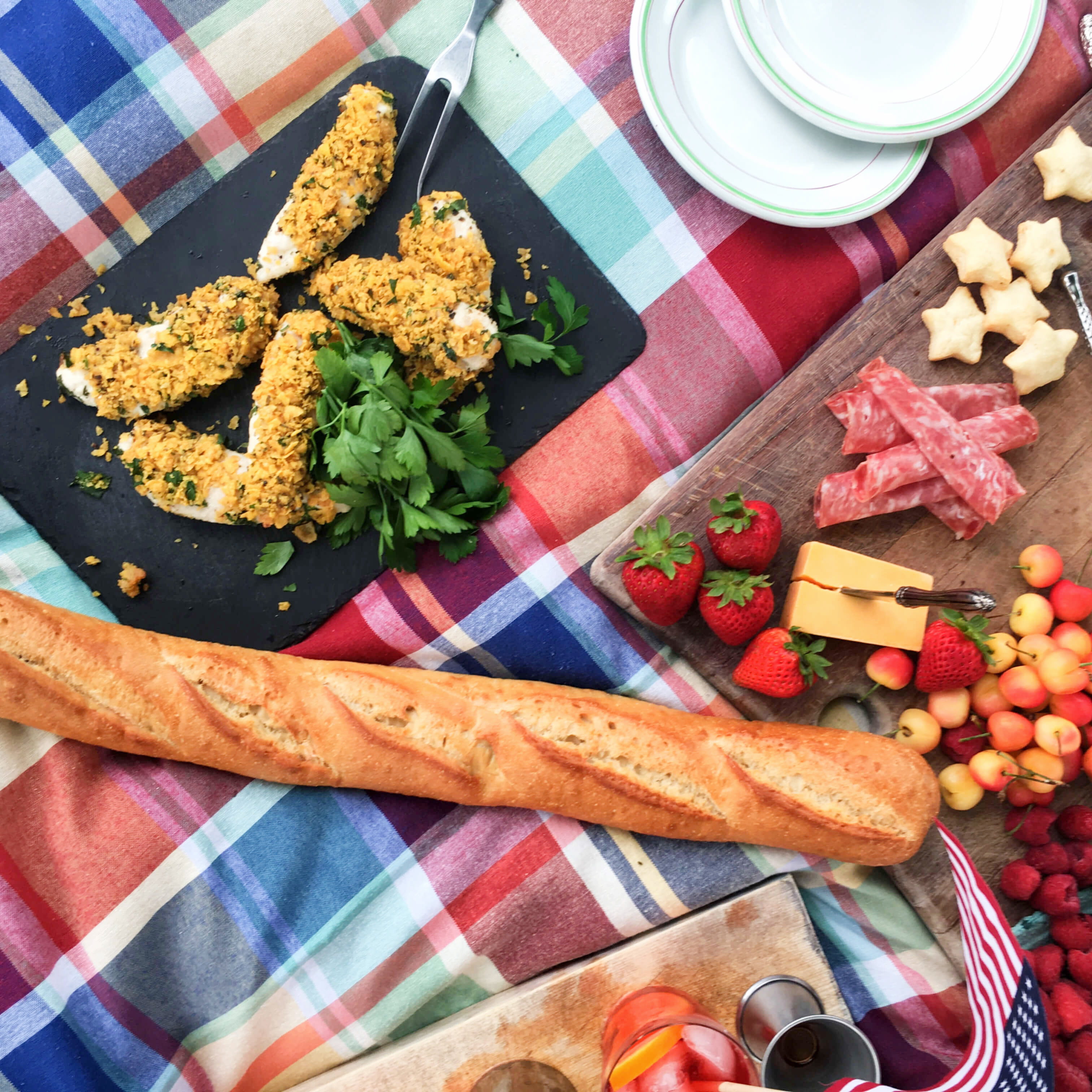
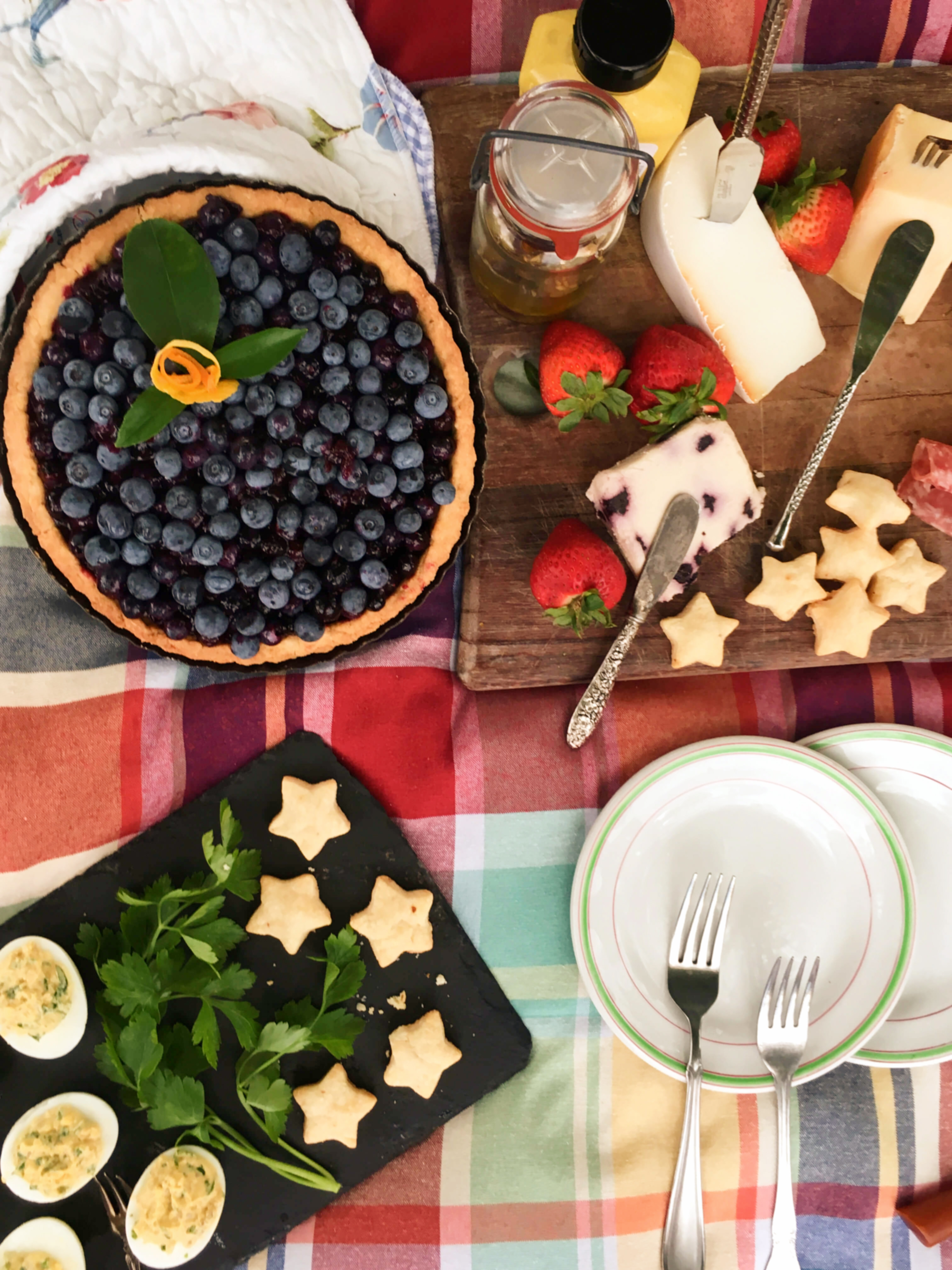
The picnic basket spread out before you in this post highlights vintage recipes that capture that same essence of familiarity and practicality, while also providing a well-rounded balance of flavors and tastes. Vintage recipes include Sicilian-Style Marinated Olives, Oven-Fried Chicken, Deviled Eggs, Cheese Straws and Blueberry Tart. Americanos join the party as a refreshing aperitif to toast the season and the stars. 

Ranging from the 1960’s to the 1980’s, these recipes came from a handful of treasured vintage cookbooks. They pair gourmet creations from famous chefs like James Beard with regional favorites from lesser-known sources, like the ladies of the Junior League of Huntsville, Alabama. Covering all matters of taste from sweet to salty, savory to sour, they are considered traditional picnic foods, but each contains an unusual twist in the form of a cooking method or an ingredient pairing that makes them both interesting and innovative. Whether you make all of these recipes at once for your next outing or just focus on a dish or two to sample and try, you’ll discover that all of these options listed here are steeped in simplicity. Almost all of them can be made a day or two ahead of time, so that your restful day of picnicking doesn’t include you running around the kitchen like a crazed cook.  

And, just one more note before we get to the recipes. While food is obviously the main attraction in a picnic, the vintage-style picnic places just as much importance on the accessories that go along with it as well – a.k.a. the servingware.  While it is true that we may no longer entertain as formally as we did in centuries past, there is something lovely about incorporating some little niceties into your basket in the form of linen napkins, china plates and glass drinkware. These details add an elevated aesthetic to your picnic that reflects the elegant English versions of yesteryear, and really just makes for a nicer overall dining experience.  A cocktail enjoyed from a plastic cup or a homemade dessert pierced with a plastic fork is never quite the same experience as using real glass and real flatware. Even James Beard agreed about that point. “Skimp on all the other dishware if you have too – but never on the glassware for your cocktail,” he advised.

A few vintage items featured in this post are a handwoven picnic basket from the 1930’s, a matching set of W.H. Grindley hotelware salad plates made in England (also in the 1930’s) and a handful of embroidered vintage linens in various shapes and sizes. Vintage restaurantware dishes in general are a great choice for picnics because they are heavy duty and aren’t quite as fragile as delicate ceramic or porcelain dishes. Salad plates or bread and butter plates are also the perfect size for your small snack needs and aren’t as bulky to pack as dinner sized equivalents. Likewise, vintage tablecloths make ideal picnic blankets thanks to their soft fabrics (decades of washing and drying!), variety of sizes and nostalgic designs. As you build your vintage accessories collection, you’ll also notice that these elements have a fun way of engaging people in conversation too.  Each item in your basket expresses its own unique story.  When packing all these elements up I like to designate the sturdy picnic basket for fragile foods, a separate tote bag for the servingware and linens and an additional tote for drinks and ice. That way everything remains intact from the moment you leave your kitchen to the moment you arrive at your destination.

Americano (serves 1)

1 1/2 oz. Campari

1 1/2 oz. Sweet Vermouth

3 oz. Club Soda

Ice Cubes

Twist or Slice of lemon or orange for garnish

Add the Campari and vermouth to an old-fashioned glass. Add ice cubes and club soda. Stir to combine. Garnish with a slice or twist of lemon or orange.

Marinated Olives, Sicilian Style (from the Silver Palate Good Times Cookbook, 1985)

1 pound Ligurian, Nicoise or Greek Olives  or a combination, drained

8 cloves garlic, cut lengthwise in half

Zest of 1/2 orange

Zest of 1/2 lemon

2 tablespoons fennel seeds

1 tablespoon chopped fresh rosemary

1/2 cup fresh lemon juice (about 2 lemons)

3 tablespoons olive oil

Combine olives, garlic, citrus, fennel and rosemary in a large bowl. Drizzle with lemon juice and oil. Marinate, stirring occasionally at room temperature at least 24 hours.

Deviled Eggs (from James Beard’s Menus for Entertaining Cookbook, 1965)

8 hard boiled eggs, shells removed

1 small tin boneless skinless sardines

1 small onion, finely chopped

1/4 cup parsley, finely chopped

Mayonnaise

Cut the hard-boiled eggs in half and remove the yolks to a small bowl. Mash yolks with sardines, onion and parsley. Blend with mayonnaise until you reach ideal consistency then fill each egg half. Chill in fridge until ready to pack into your picnic basket. These can be made up to 24 hours in advance.  * If you don’t have a portable egg carrier, disposable muffin tins make a great alternative.

Oven-Fried Chicken (adapted from Better Homes & Gardens New Cook Book , 1965 Souvenir Edition)

1 lb. chicken cutlets

1/4 teaspoon garlic powder

1/4 teaspoon salt

1/4 teaspoon pepper

4 tablespoons Herbes de Provence

1/8 cup fresh parsley, finely chopped

1/3 cup butter, melted but cooled to room temperature

6 cups corn flakes, crushed

Preheat oven to 375 degrees. Combine the garlic, salt, pepper, herbs, parsley and melted butter in a shallow dish and mix thoroughly. In a separate shallow dish add the crushed cornflakes. Dredge each piece of chicken on both sides in the butter mixture and then coat them on each side in the cornflakes. Place the prepared chicken on a lightly greased cookie sheet and bake for 20 minutes or until chicken is golden brown and crispy. *Note: This chicken recipe will loose its crunch factor the longer it sits. So if you are picnicking, this should be the last dish you make before packing the picnic basket and heading out the door. That being said, it’s still wonderful hours later or even the next day, but the corn flake coating will have a more breaded consistency rather than a crispy crunch.

Belle’s Star-Spangled Cheese Straws (from the Huntsville Heritage Cookbook, 1967 Edition)

1 lb. New York State sharp cheese (or any sharp cheddar), grated

3/4 cup butter

2 cups flour

1 teaspoon salt

1/2 teaspoon red pepper

smoked paprika for garnish

Leave both the cheese and the butter out overnight on the counter to soften. The next morning, preheat the oven to 350 degrees. Mix all the ingredients together (except the smoked paprika)  in a medium bowl by hand. Knead the dough until it turns into a consistency like play-doh. Form into a ball shape. On a lightly floured pastry cloth, roll the dough out firmly to 1/4 inch thickness with a wooden rolling pin. By pressing it into the cloth with the rolling pin, you’ll be able to smooth out any crumbly or wrinkly areas as you work. Using a small star shaped cookie cutter, cut out the stars and place them on an ungreased cookie sheet. Bake for 12-14 minutes or until lightly golden in color. Let stars cool on a rack and dust with smoked paprika just before serving.

Homemade Blueberry Tart (recipes adapted from the Smitten Kitchen and Martha Stewart)

For the tart shell:

1 1/2 cups all-purpose flour

1/2 cup confectioner’s sugar

1/4 teaspoon salt

1/2 teaspoon cinnamon

9 tablespoons very cold (or frozen) butter, cut into small pieces

1 large egg

In a large bowl, mix the flour, sugar, salt and cinnamon together. Add the chopped butter pieces and blend with with a fork until the mixture resembles small bread crumbs in various sizes. Add the egg and mix until combined. Form the dough into a ball, wrap in plastic wrap and chill in the fridge for at least 2 hours.

Butter a 9-inch tart pan (the kind with a removable bottom). Place the chilled dough on a lightly floured pastry cloth and roll out to a size big enough to accommodate an extra 1/2 inch of dough in diameter when placed in the tart pan. Add dough to pan, trim any excess dough beyond the extra 1/2″inch that hangs over the sides. Fold the remaining  1/2″ inch of dough back into the tart pan, so that you are re-enforcing the side walls with an extra layer of dough. Pierce crust all over (bottom and sides) with a fork. Place tart pan in freezer for at least 45 minutes.

Preheat oven to 375 degrees. Remove tart pan from freezer and place directly in oven for 20-25 minutes or until the tart shell turns a soft golden brown. Remove from oven and let cool on a rack.

For the blueberry filling:

6 cups fresh blueberries

2/3 cup cane sugar

1/2 teaspoon cinnamon

1/2 teaspoon nutmeg

4 tablespoons all-purpose flour

3 tablespoons fresh lemon juice

pinch of salt

In a medium saucepan, bring 1/4 cup water and 1 1/2 cups blueberries to a boil over high heat. Reduce heat and let berries simmer, stirring occasionally for about 4 minutes.

In a small bowl mix the flour with 4 tablespoons of water until smooth and then add to the blueberries in the pan. Next, add the lemon juice, sugar, salt, cinnamon and nutmeg. Bring to a boil and then reduce heat. Let the mixture thicken for about 1 minute. Remove from heat and stir in 3 1/2 cups of blueberries. Immediately, add this hot blueberry mixture to the tart shell.

Sprinkle the remaining cup of fresh blueberries across the top of the hot mixture, gently pressing the berries down so that they stick into the hot mixture enough to bind them together. Place the tart in the fridge for at least 30 minutes or at most overnight.

Additional Picnic Companions

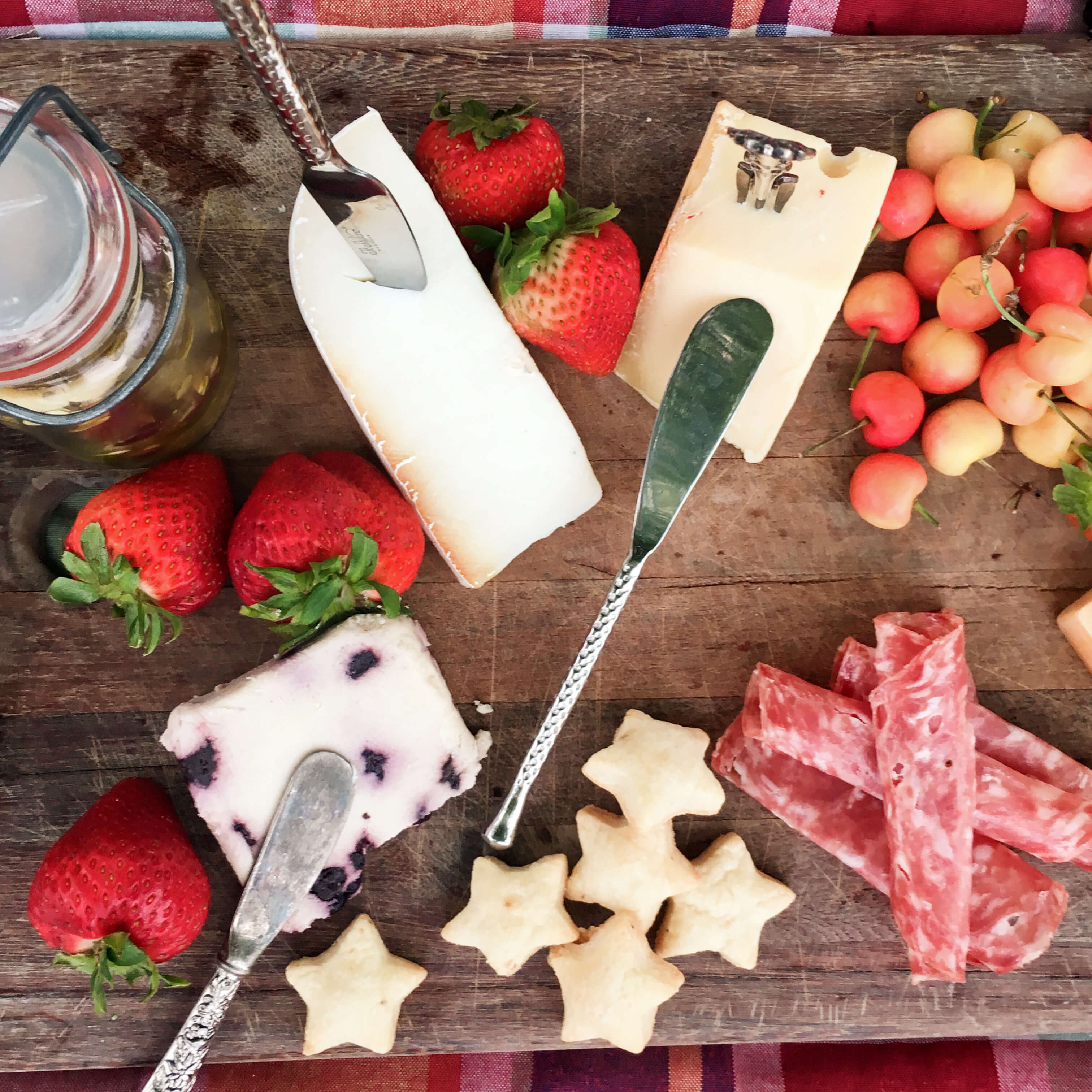
One of the joys of picnic fare is the ability to snack and nibble on little bits of food at whim throughout the day. Since the original pique-nique days, small has been the favored size and serving proportion. For that purpose, a wooden cutting board filled with fresh fruit, a sampling of cheeses, cured meats, fresh herbs and bread offer an infinite number of little edibles that can be combined in interesting ways with the food options listed above. From chicken baguette sandwiches to cheese and crackers to deviled egg wrapped prosciutto, variety runs the gamut. The picnic board here included rainier cherries, strawberries, blackberries, raspberries, goat’s milk Gouda, cave-aged cheddar, blueberry Stilton, herb stuffed salami, thinly sliced prosciutto, Genoa salami, a bouquet of fresh herbs and a French baguette.

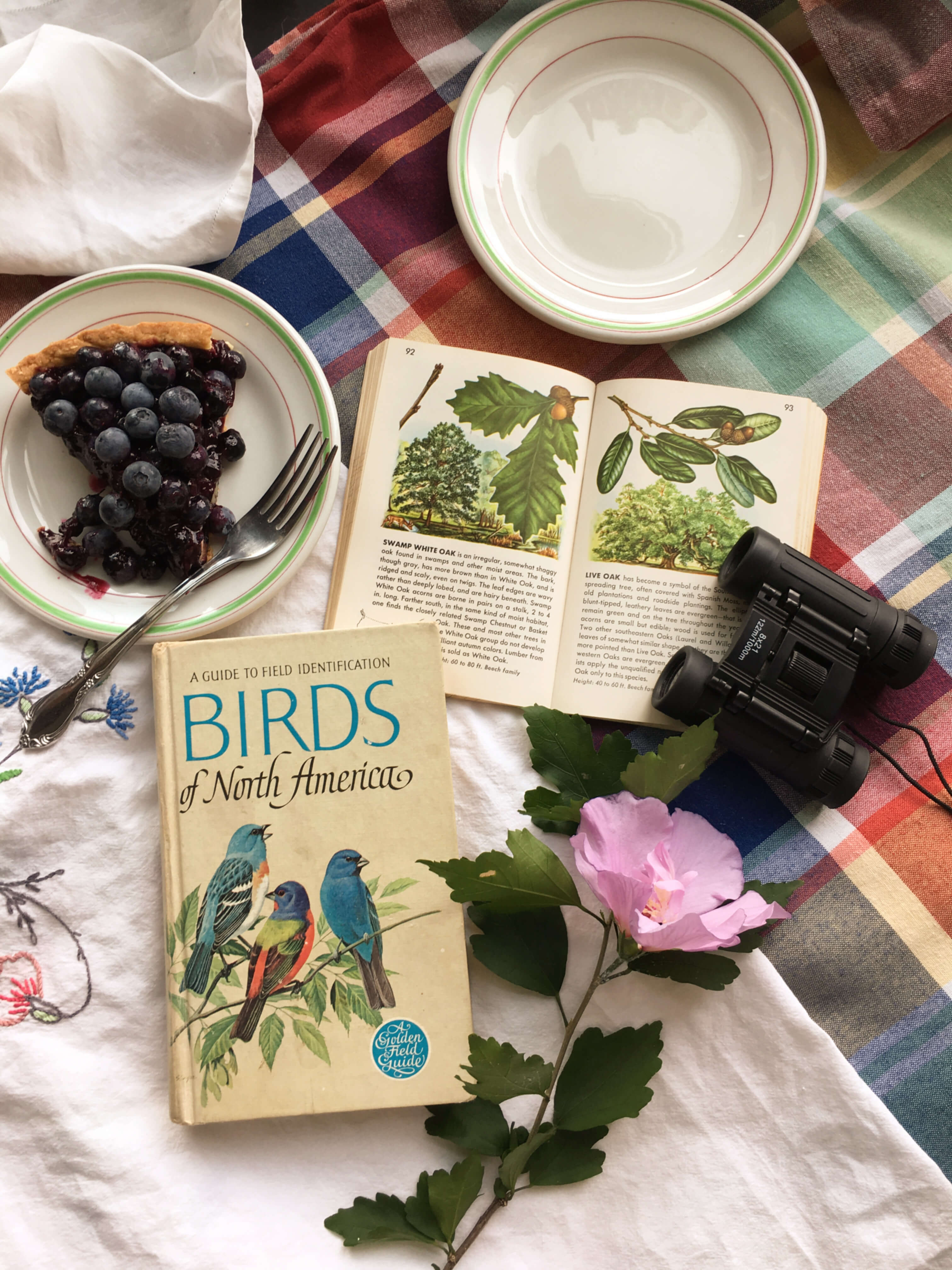
Finally, when bellies are full and appetites satisfied, the vintage-style picnic experience celebrates and salutes the pursuit of leisurely activities. There’s no rushing to clean up or clear out once you finish eating.  The whole, blissful idea behind a vintage-style picnic is to stay awhile and relax into yourself and your surroundings. One of my most favorite picnic activities is bird watching and tree scouting. I usually tote along a couple of species guides and a pair of binoculars, so that I can identify what’s flying over and growing up around me. Other fun activity suggestions (depending on your setting) include painting, sketching, walking, kite flying, playing cards, reading, talking, napping, swimming, collecting and just appreciating the people and places that share your afternoon. 

The world is a beautiful place. Time is a priceless gift. Eating is a ceremonial act. The art of the vintage picnic reminds us of that. Just as it has in the past and will continue to do so in the future. Wherever your picnic adventures take you this summer, I hope they are magical and delicious. Cheers to dining out in nature. Hope it is your best meal yet!

A Kingfisher in the Kitchen…

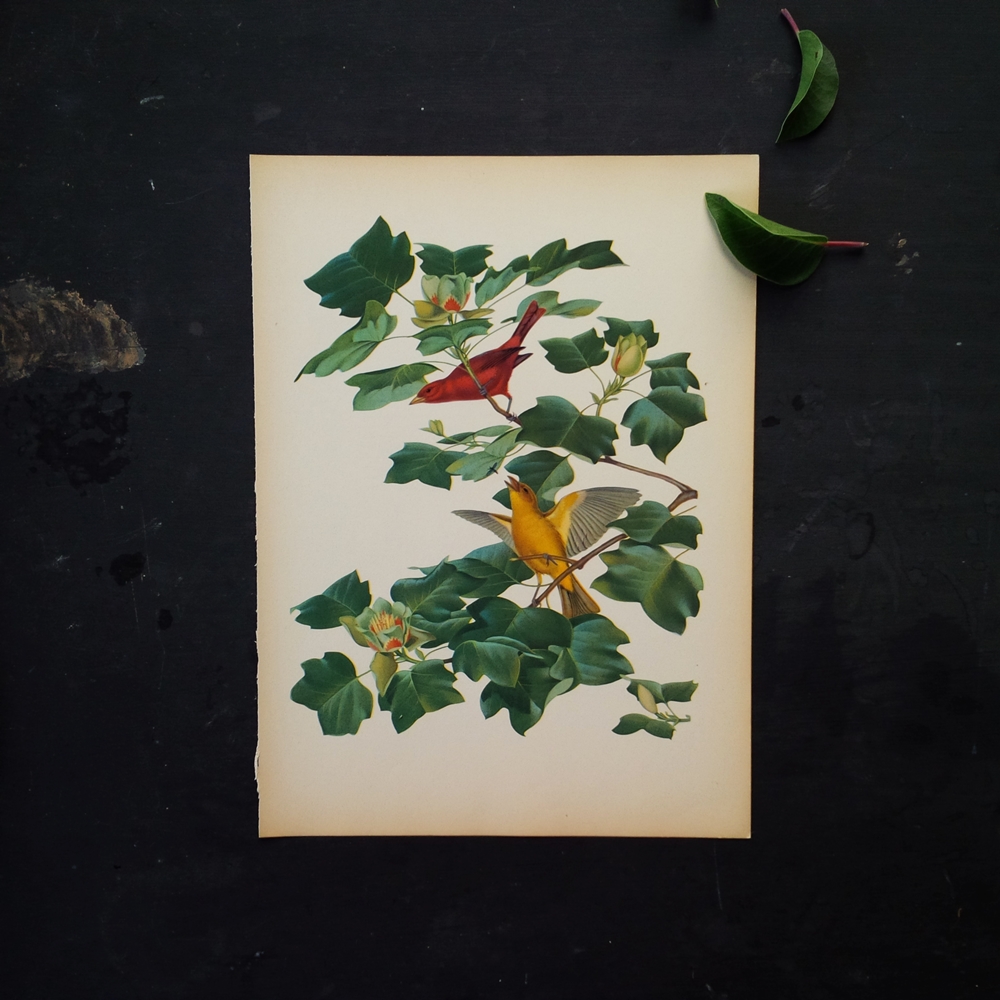
Vintage 1950’s Kingfisher bird illustration by Athos Menaboni

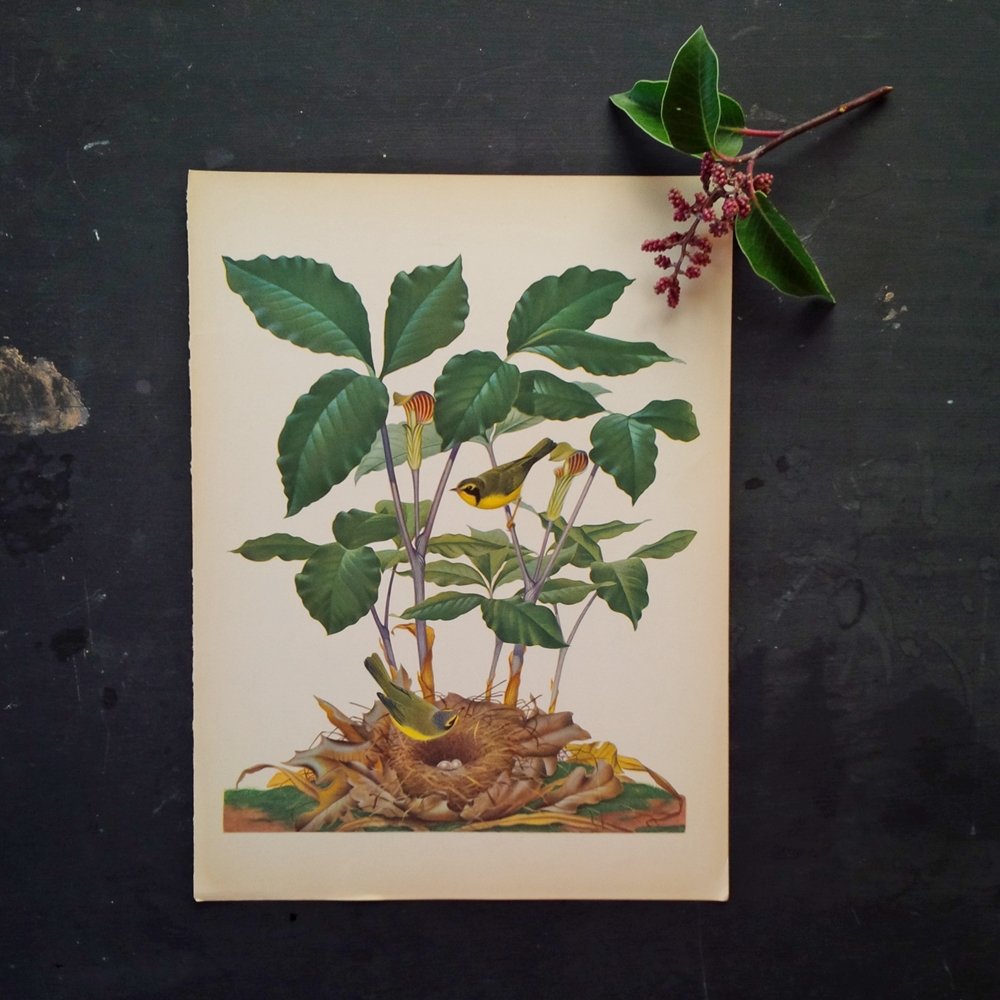
Some time ago, in a dusty section of an old antique shop, I found a broken down book full of beautiful portrait prints. The book was getting ready to be heaved into a rolling bin headed for the recycling center, along with many other books that had been damaged by a recent leak in the shop. Still on the shelf, but tagged for recycling, the fate of the bird book didn’t look good.  On the outside, it didn’t have much going for it. The spine was shredded, the cover splotchy with water stains, the dust jacket missing. But on closer inspection, with a flip through its interior pages, a little miracle had occurred. The bird bookplates inside had somehow escaped the water leaks. The images were bright and colorful and perfectly preserved. The birds fluttering among the pages, each depicted in their own natural setting with their mates and their foliage, were too beautiful to be tossed away.

ref=”https://shopinthevintagekitchen.com/collections/art/products/1950s-bird-botanical-print-summer-tanagers-vintage-menaboni-bird-prints”> Summer Tanagers[/ca
 

f=”https://shopinthevintagekitchen.com/collections/art/products/1950s-plover-and-oyster-bird-print-menabonis-birds-bookplate”> Plover shore birds flying over the oyster beds[/capt
 

https://shopinthevintagekitchen.com/collections/art/products/vintage-bird-botanical-print-kentucky-warbler-1950s-menaboni-bird-bookplate”> Kentucky Warblers[/captio
Illustrated by Southern botanical artist Athos Menaboni in the 1950’s, these bookplate prints featured a whole aviary of birds. Many were familiar… geese, hawks, doves…but some were new like this handsome duo…

I liked their spiky head feathers immediately and thought they might be part of the woodpecker family. But I was wrong. Do you know what kind of birds they are? Here are a few hints…

  1. They LOVE to fish.
  2. They come from one of the few bird species where females are more colorful than males
  3.  A grouping of them is called is called a crown.
  4. They have big heads and even bigger hairdos, not for vanity, but to accentuate their superior skills when diving for dinner.

Could you guess? Do You know it?! If you said the Eastern Belted Kingfisher then you are correct (and a wonderful birder).  The kingfishers capabilities at mealtime know no equal. They are one of the best fishermen on the planet and can gather up enough aquatic life to get a fish fry started in a jiffy. Industrious, talented and always ready to get to work on planning the possibilities of their next meal, kingfishers are wonderful kitchen role models, happiest when engaged in the food options around them. See their expressive personality in this fun two-minute video…

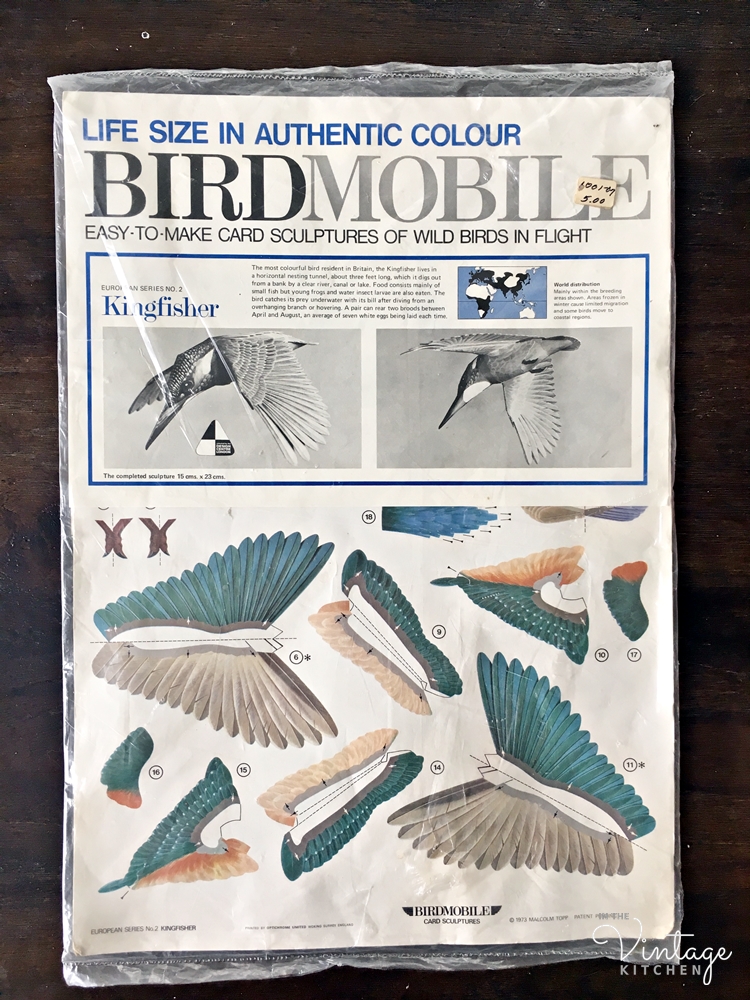
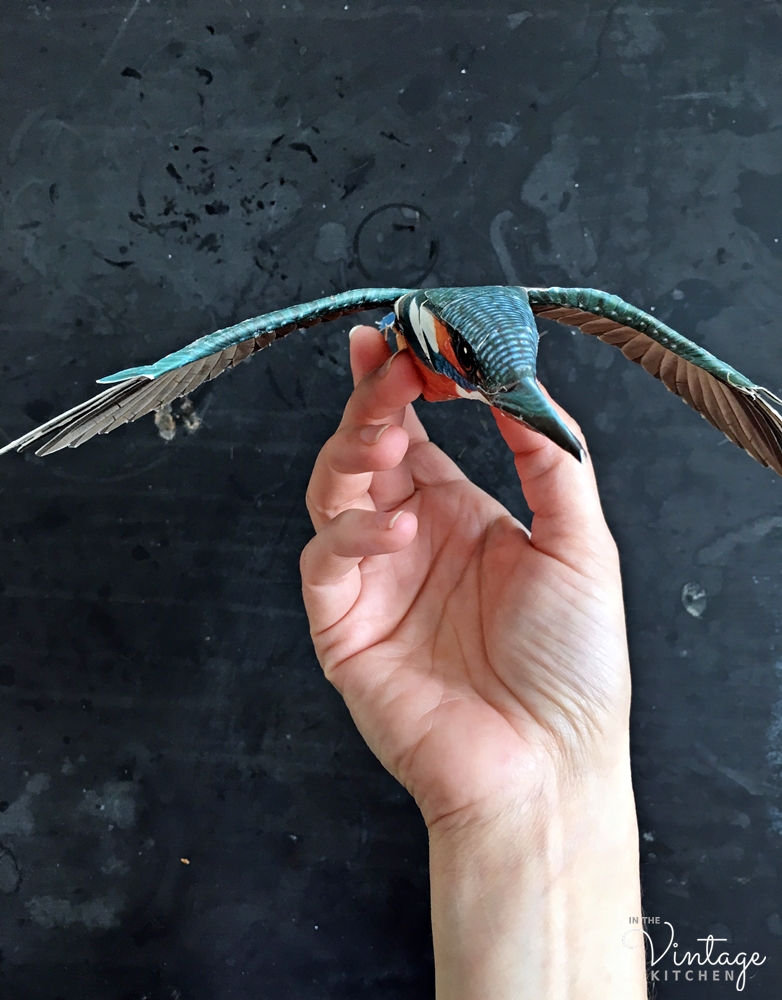
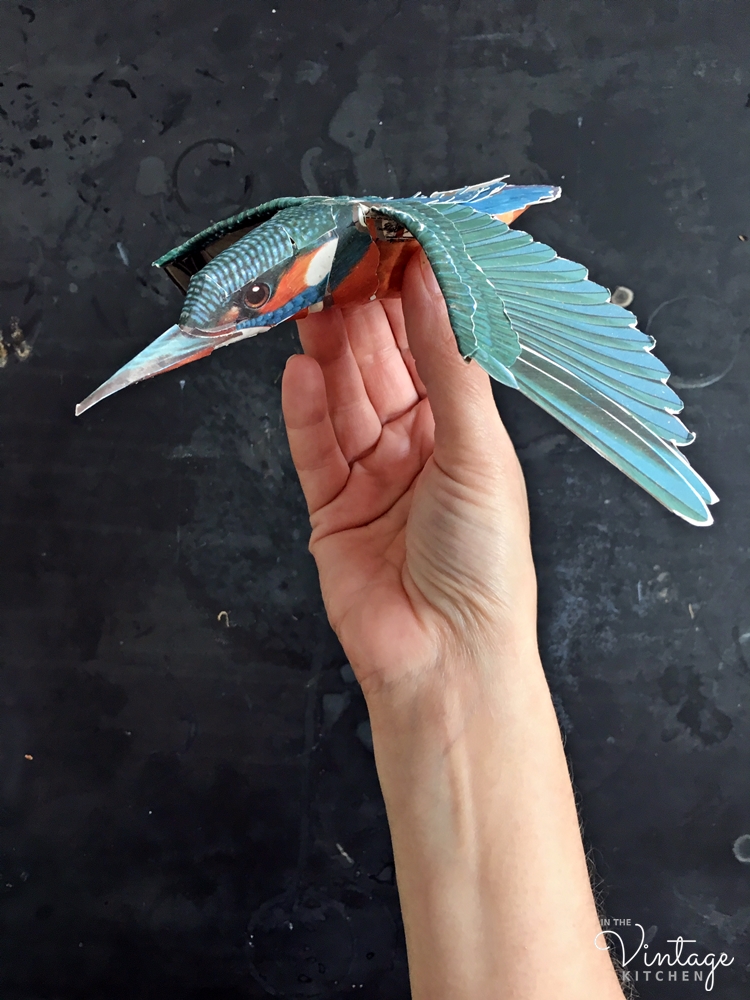
Ever since  I learned about these remarkable little birds I have been on the lookout for more of their images and information. Serendipity came calling the other day when I found a vintage 1970’s paper bird model of a kingfisher that had never been assembled.

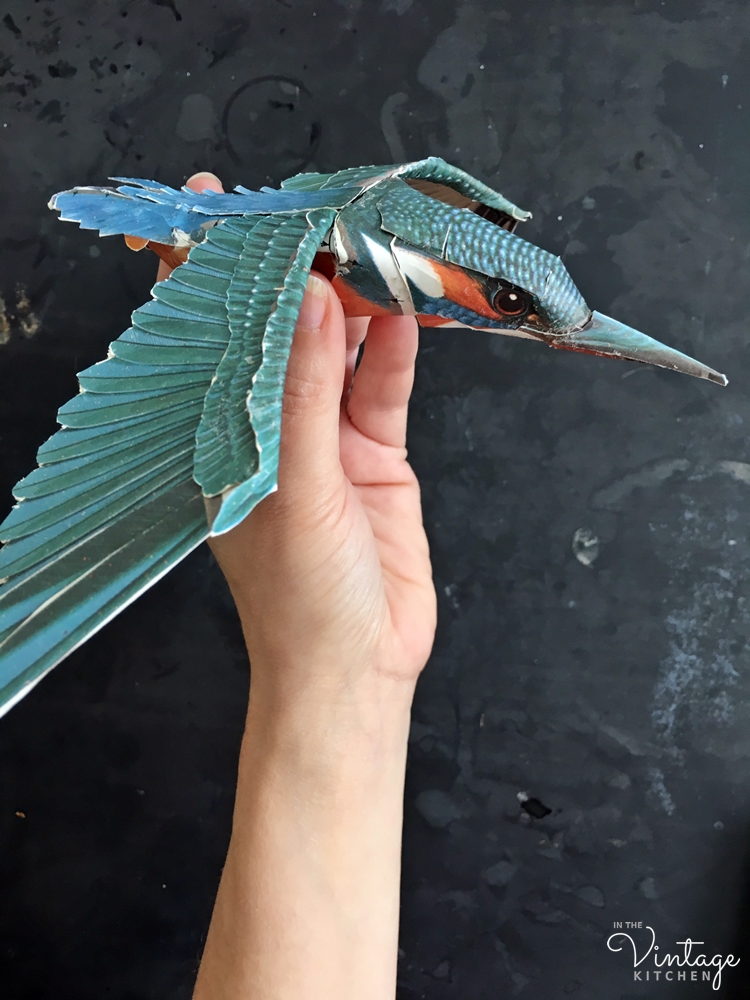
How exciting! A new craft project – our very own paper kingfisher for the kitchen. Last Sunday, Bradley, the Vintage Kitchen’s resident builder of all things fun and functional, got to work assembling the new paper bird. The whole thing took 4 hours to come to life, but we shortened all that time down to just a 27-second video so that you could see how it all came together too…

Now the Vintage Kitchen has its own little symbol of industry, talent and enthusiasm flying around the kitchen and watching over all our cooking endeavors.

Usually, the birds most symbolic of the kitchen are chickens, roosters, turkeys and pheasants but I recommend the kingfisher any day. Aesop once said it is not only fine feathers that make fine birds. The effervescent kingfisher proves just that. Even though they are beautiful their abilities are even more so.
Look for more kingfisher magic coming to the shop this fall and winter. In the meantime, find their botanical print here along with others from the rescued bird book here. 

May your next cooking endeavor be as joyful and as enthusiastic as any kingfisher’s catch. Cheers to the birds who make our culinary spirits fly!

North vs. South: The Beach in November

florida_heron


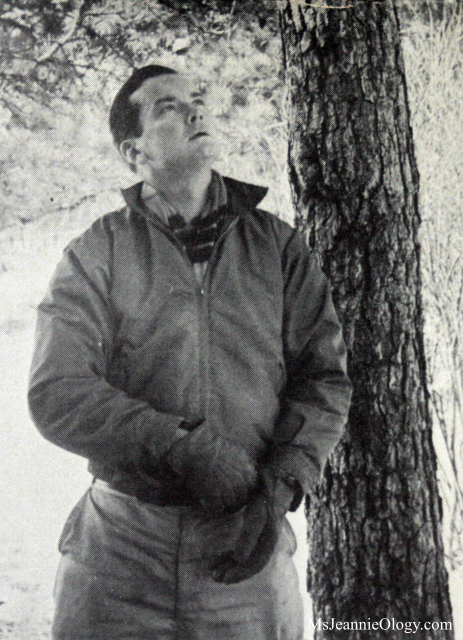
In 1960, John Hay spent the month of November on the coast of Massachusetts.

johnhay4
John Hay

In 2015, Ms. Jeannie spent the month of November on the coast of Florida.

florida1

John Hay was writing a book about the seasonal evolution of life on Cape Cod – a month by month collection of observations he would publish in 1961 under the title Nature’s Year: The Seasons of Cape Cod.


nature1

In November 2015, Ms. Jeannie was navigating a bevy of hospital hallways and doctors offices with her sick dad.

John escaped to the beach to think about life. Ms. Jeannie escaped to the beach for a brief break from life. Both John and Ms. Jeannie found solace on the shores of November.

55 years, 1300 miles and 11 states separated John from Ms. Jeannie. Does that matter?  Does the seasonal effect of nature change so emotionally at sea? Fundamentally month by month are we more different than alike? Ms. Jeannie thought about these questions while she walked the beach and tried to make sense of the medical mysteries surrounding her father. Decades earlier John thought about these same questions while he walked the beach and tried to make sense of the natural mysteries surrounding humankind.

In this post we’ll be looking at one month from two sets of eyes to see how the natural world compares and contrasts between decades, between states, between regions and between people. Just how different is November from one place to another?

” The clouds cover the sky like gun smoke and the air feels cold and restricting.” – John Hay, Cape Cod, November 1960

In November 2015 in Florida, the clouds also covered the sky like gun smoke but instead of being cold and restricting the air was oven hot and heavy with humidity.

clouds1

“November rolls into view with cool, solemn, formal consistency…daylight diminishes. The summer no longer pounds at our temples. The fall color is gone. There is nothing to look at  and very little to hear… to a city lover it is silent and deadly dull.” John Hay, Cape Cod, November 1960

In Florida in 2015, November rolled into view on the body of a heatwave. Temperatures hovered for most of the month in the mid-90’s. The air felt consistently relaxed and languid.  If Ms. Jeannie was blind-folded and asked to guess the month she would have said August by the sticky feel of things around her.   Summer was holding strong.


florida9

“Out on the bay the low waves look as if they have a harder push and pull to make, imbued with new heaviness.”- John Hay, Cape Cod, November 1960

In Florida in November 2015, the waves are not low. They are tall and fat and strong. So full of energy and life, their crashing chorus’ take up all the audible room in Ms. Jeannie’s eardrums.

florida_waves

“There is a kind of ice sludge being nudged in by the tides along the shore and through rippling purple waters of tidal inlets.” – John Hay, Cape Cod, November 1960

In Florida in November 2015, the tide drags ashore signs of autumn color in the form of clumpy pumpkin-tinted seaweed that stretches the entire length of the beach.

florida3

florida2

“Seeds, on grasses and weeds now grow thinner, drier, more colorless, are not only rich in generation on their own account but they provide beyond themselves.  The simplest food chain suggests the links in many others.  The time for persistence is coming, when those grasses we take so much for granted will hold our earth together.” – John Hay, Cape Cod, November 1960

In Florida in November 2015 as a whole it is easy to overlook the wild greenery in excitement to get to the water. The waves have a way of calling all attention.

florida7

But nature s running its course and Ms. Jeannie sees that the Florida beach grasses are also going to seed. Look closely below and you can see a little lizard scampering around the stalks.

florida6

Southern beach grasses wave hello and goodbye all at once as they share their seeds with beachcombers of both the two and flour-legged variety.

florida5

“The oaks are monumentally persistent. Cut them down fifty times and they will sprout back from the roots. This is their chosen land. The late fall wind makes their leaves rustle and stir…the whole year is full of the collaborative music of air and trees. ” – John Hay, Cape Cod, November 1960

In Florida in November 2015 there are no oak trees. In fact, surprisingly on the stretch of beach Ms. Jeannie visited there were very few palm trees. But what there was in great succession was a thick barricade wall of sea grape trees. Like an enchanted garden,  they formed natural vestibules to and from the street to the beach and the beach to the street. Those are the trees in Florida that have made choices. Those are the ones who will continue to fight for life whether they are cut down fifty times or 1500 times.

florida8


“Since Cape Cod is surrounded by the sea  it has another depth, another range, were other populations roam while the rest of us wait and shiver.” – John Hay, Cape Cod, November 1960

In Florida in November 2015 the most interesting and immediate animal life to observe was the multitude of shore birds.  They provided beauty…

florida_birds1

and comic relief…

florida_bird6

intrique and mystery…

florida_bird2

florida_bird5

and even the threat of tragedy…

florida_bird3

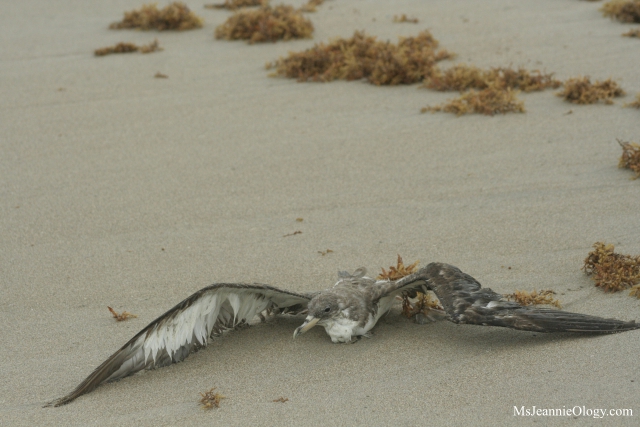
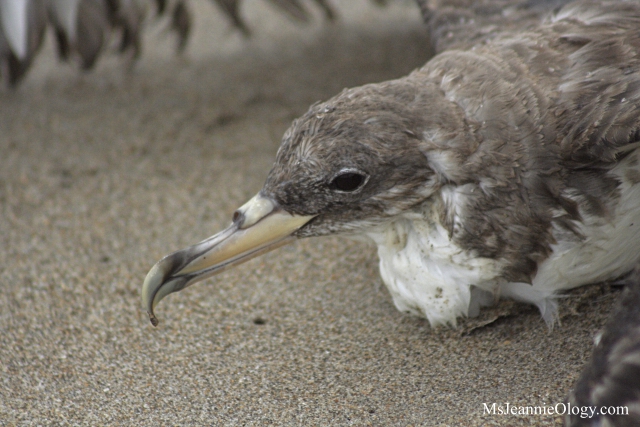
After a consult with the lifeguard and a call into animal wildlife patrol, Ms. Jeannie was happy to hear that this bird was no sick or injured creature who seemed helplessly hopeless clinging to the sand when she spotted him. Instead he was a just a baby learning how to fly…

florida_bird4

“In fact there is no fundamental separation anywhere in this common world of life, despite the greatly various environments of water and and what we use to help us differentiate between the species. Winds blow through. Tides lap over. Each plant and animal is proof of general contact and association.” – John Hay, Cape Cod, November 1960

After seeing the baby gull and running through the gamut of emotions and feelings of wanting at first to observe him, then protect him, then help him, then understand him, Ms. Jeannie realized whole-heartedly that there is no real difference in the Novembers between years and states and places and faces.

Sure the typography changes and the climate varies but similarities are equally as present. We all just want to survive in the place where we are rooted. November is as much a natural state of mind as it is a calendar month, and although the landscapes may vary from North to South and East to West, fundamentally we are all the same at heart. We are all the little gull plopped down on the sand, learning how to fly. learning how to survive. learning how to make it from one day to the next. We are all the little gull trying to make our way in the big world.

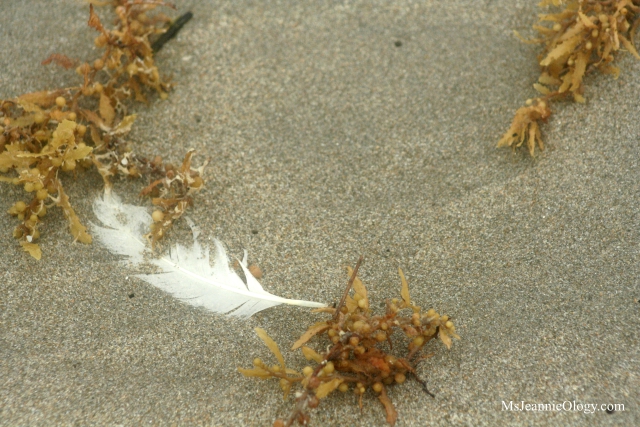
florida_feather

Do you have any natural wonder stories from the month of November – something that surprised you dear readers? If so, please contribute your thoughts in the comment section below. In the meantime, if you’d like to see what John Hay has to say about the 11 other months of life on Cape Cod in 1960, you can find him in Ms. Jeannie’s shop here.

For your palm tree fill, visit Ms. Jeannie on Instagram!

Cheers to the new month of December! May it be equally as enlightening:)


Early Auditions!

green1

This week in the garden there has been a lot of activity in the creepy crawly department. As it turns out Mother Nature was holding early auditions for her haunted garden tour that she’s hosting at the end of October. Naturally you have to pick the baddest of the bad and the most wicked of the wicked, and while there were a lot (a whole yard full) of entrants who came to try out, in the end it came to four who really made an everlasting impression.  Here’s the cast of the 2014 Haunted Hollow Garden tour…

Most Haunting:

Camouflage of the most intellectual kind;)

…goes to Melvina, a 6″ inch long praying mantis. Six inches dear readers! That’s as long as Ms. Jeannie’s hand!

pm3

Most Scary

green4

…goes to Pistachio, the poisonous saddleback caterpillar who auditioned with a hot pepper plant prop. Pistachio was quite cute in all his ferocity with a costume that  looked like a cross between a scrub brush and a diseased finger.

If Frankenstein had a pet he may choose something like this!

If you come in physical contact with him Pistachio will not hesitate to sting you with his bristles – which then causes a welted rash for days. Luckily Ms. Jeannie does not know this from experience! While everything about him from his pudgy belly color to his markings makes you want to touch him – it’s his “eyes” looking at you from all directions that warn against it.

Most Creative…

He might win the award for most crafty costume!

goes to Roberto the red footed cannibalfly for his cool name and his cool conglomeration of costumes.  Roberto couldn’t decide on which bug he wanted to be for Halloween so he decided to incorporate elements from all four of his favorites for a really spooky creation…part bumblebee and part beetle with fly eyes and dragonfly wings…

there's a lot of time and energy taht when in to building this costume!
There’s a lot of time and energy that when into concepting this costume!

Roberto was sure to incorporate the best features from each bug. He even threw in some spiky hair and extra long legs for  added panache:)

And last but not least, the winner of the…

Most Creepy (but somewhat cute) category…

A family portrait!
A family portrait!

…goes to Wilomena the Wolf Spider and her four dozen back-pack babies! That’s right gang, all those little dots on her back are the kiddos. There was no holds barred when it came to Wilomena’s costume –  this year, she was involving the whole family. Nothing like bringing your 57 kids along to make an everlasting impression:)

That’s a  lot of eyes looking at you!

Wolf spiders are the only spiders that carry their kids around like this.

Here’s a close-up if you really want to see how that whole baby carriage works…

photo via pinterest
photo via pinterest

This picture gives Ms. Jeannie goosebumps every time!

Is Mother Nature holding auditions for a Haunted Hollow tour in your neck of the woods too? If so, You have to let Ms. Jeannie know who your winners are. Maybe next year the whole cast of characters can hit the road and go on a country-wide tour!


Baby’s First: A Cattle Round-Up Story

This weekend, Ms. Jeannie was invited to a semi-annual cattle round-up at her friend’s organic farm. She had never been to a cattle-round up before. It all sounded very exciting!

On this farm, the round up occurs twice a year, once in the spring and once in the fall. The purpose is to take inventory of the herd, worm all the cows and castrate the baby boy bulls that have been born between roundups.

Being somewhat of a city slicker herself, Ms. Jeannie was excited to put on her rubber boots and spend a day romping around the farm. She brought along her camera to document the experience.

Starting at day break (which is farmers speak for bright and early 6:30am) it took about fours hours from start to finish to move 100 cows through a head gate shoot, where they would be quickly examined,wormed and castrated. The cows on this farm are 100% free range over many acres, so first, they had to be herded together.

Once corraled into one paddock they keep moving into smaller and smaller fenced areas.

For most cows, this is a routine procedure, sort of like a doctor’s check-up for us. They don’t love it – but they endure it just fine. Waiting at the holding gate is like waiting in a doctor’s office. Everyone is antsy to get their examination over with.

While the cows were cueing up Ms. Jeannie spotted the smallest cow in the herd…

…a baby born just 3 weeks ago! You can see see him in this picture with the little white spot on his side.

To keep the cows organized right before they line up for the shoot, they are broken into groups according to size.Which meant Mama and Baby had to be seperated. Baby went to the holding pen with all the other calves to wait
his turn while Mama lined up with the heifers in the shoot.

They both called for each other when they were separated, which pulled at Ms. Jeannie’s heart.

The older cows traveled through the shoot relatively easily. Here is one getting wormed. Which looks like a giant tube of toothpaste that gets spread onto their back.

Almost done…

Some look even downright content like this one…

but the babies are a little more rambunctious since it is their first time in such a confined area.  This one below  kept trying to figure out how to get her head unstuck.

Mama went through the shoot, was vaccinated and wormed. Her whole procedure took about four minutes.

Ms. Jeannie was surprised to see that when each cow is released from the shoot – they sort of spring out of the gate, sort of half jumping like a bunny rabbit. Free at last! When Mama was released she stood off to the side, just feet away to wait for her baby who was about 60 cows in…way in the back of the calf group. Mama is looking for Baby here in this photo…

Waiting on Baby…

Alas! Mama spots him through the fence!

When he got close enough in line, Mama reassured him that everything was going to be fine and gave him a kiss for good luck!

A kiss for good luck!

Finally it was his turn in the shoot. His head was collared in place for his exam.

This may look like it hurts, but it doesn’t. Holding them in like this protects the cows from getting over excited and from breaking a leg or hitting their head against the metal rails.

Mama waited next to him the whole time. She touched noses for extra support…

Baby wanted to put his own spin on this whole head lock thing, by throwing a leg out. He was such a little guy – there was a bit of extra space in the holding collar. Why not air out a leg while you have the chance. It’s one step closer to freedom afterall!

Mama advised that this was probably not a good idea.

Stick your leg back in baby!

Moments later, the collar let him go and he was out!  Mom and baby headed off together to mull over the whole experience.

Ms. Jeannie was struck by what a wonderful and encouraging mama this cow was. And how Baby really depended on her for moral support. Seeing the two of them interact together was the highlight of Ms. Jeannie’s day!

Etsy is full of whimsical items that celebrate the wonderful relationship between animal moms and their babies. If you need some inspiration this Mother’s Day, take a look…

Plush Animal Mom and Baby Snuffalo from cuteandcreepy

BlackBears Mom and Baby from wishdaisy

Nursery Wall Decal Mom and Baby Giraffe from LeoLittleLion

Vintage Mama and Baby Ducks Pull Toy from OopseeDaisies

Duck Dish from AutumnAlways

Hummingbird Babies Metallic Photograph from LD Photography

Mama & Baby Elephant Vintage Ring from bigGreengiraffe

Le Mama & Baby Dust Bunny Totems from leanimale