Mark Your Calendars: Our Annual 40% Off Sale is Sunday, November 2nd!

Autumn 2025 comes to 1750 House in a blanket of color.

It’s hard to believe that our annual once-a-year shop sale is just two weeks away, especially since our last blog post left off with baking bread in the middle of a summer heatwave. And yet, now here are, firmly swaddled in a blanket of autumn leaves with the woodpeckers performing their yearly tap tap tapping on the shingles of 1750 House reminding us that seasonal celebrations are close at hand. Lots has happened between now and that day in July when the kind bread was rising as high as the humidity and the garden was growing right along with the shop stories.

The lemon balm… one of our star growers in the herb garden this year.

I’m very excited to catch up, especially when it comes to hashing out the happenings of the herb garden and the triumphs and tragedies it endured over our experimental summer. But before we get to all that, I wanted to give everyone a quick calendar reminder in this post about the shop sale since it’s coming up right around the bend.
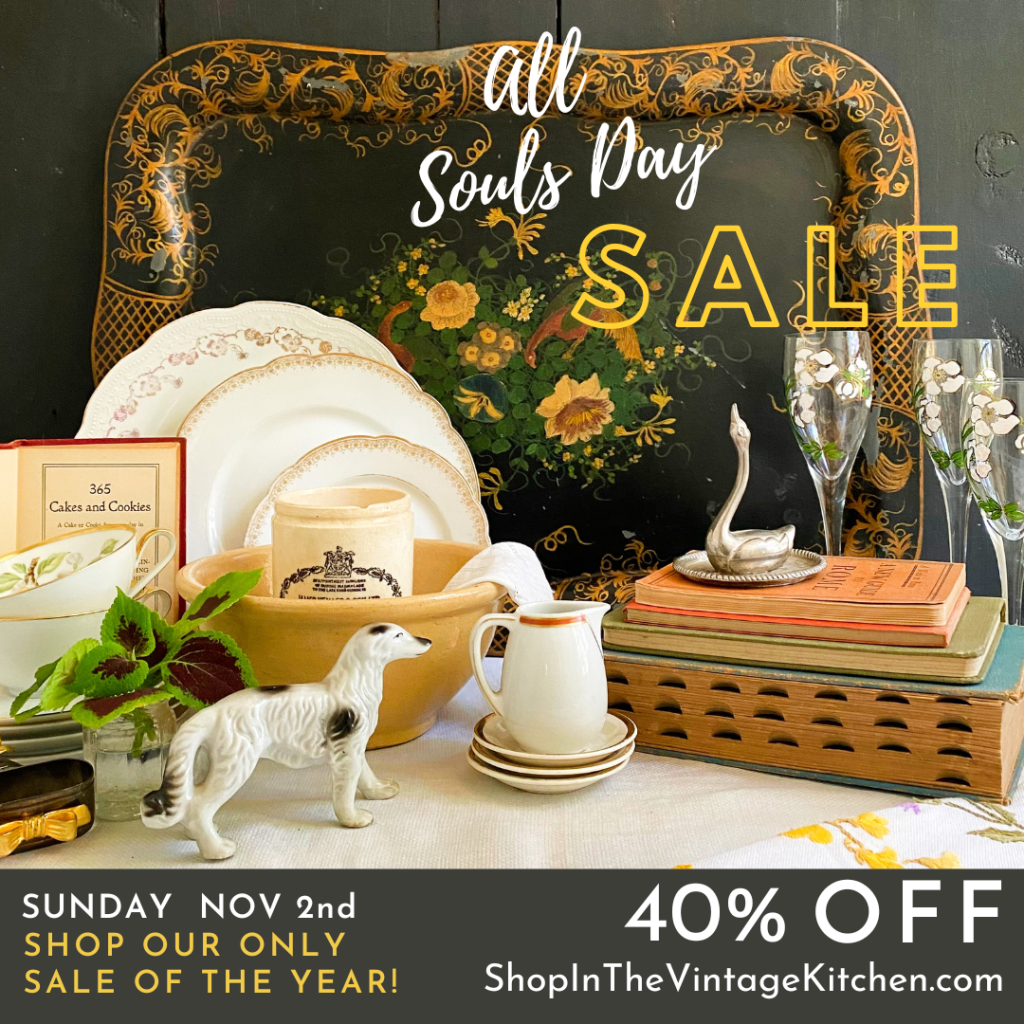
Two very exciting things are happening this year in regards to the sale. 2025 marks our 5th year of the sale, and it also happens to occur this year on the same day as daylight savings time, so you’ll be able to fall back and enjoy an extra hour of shopping should you so choose.

If you are a regular visitor to the shop, you’ll know that we adore a good floral and that the shop is forever covered in blooms no matter what the time of year. But when it comes to the change of seasons from summer to fall, the shop starts filling with heirlooms that embrace this cozy time of year by reflecting the colors in the landscape that help create autumn vibes in the kitchen and a beautiful feast for the Thanksgiving table. Whether its cookbooks, dishware, or decorative pieces, this year you’ll find some unique heirlooms that not only speak of history but of harvest time too…

If you are new to the All Souls Day sale, every year, November 2nd marks 40% off everything in the Vintage Kitchen shop for one day only. We call it the All Souls Day sale, not for the Catholic holiday that it shares the day with, but for the heirloom history that it encompasses.

All Souls Day is the only communal holiday in the calendar year that celebrates and remembers all deceased ancestors, and to us, that seems like the perfect time to celebrate vintage and antique heirlooms too. None of our shop items would be here today if they had not traveled through time, cherished and cared for in the hands of the people before us.

It’s up to the ITVK team to curate the shop, but the heirlooms do all of the storytelling. Each year, these heirlooms share new insights into the past that help shed light on things in the present. Since no two items in the shop are ever exactly alike, no sale from year to year is ever exactly the same either.

Just like the majority of one-of-a-kind heirlooms that can be found In The Vintage Kitchen, unique stories offer glimpses into culinary history and garden life that occurred decades ago or even centuries earlier. Hidden histories are everywhere and they tend to show up in ways that consistently surprise and delight. Just when you think a napkin is a napkin, a plate is a plate, a book is a book, a detail will jump out from in its history and take us on a marvelous trip through time to understand and explore other places and faces. These are some of the unique heirlooms you’ll find in this year’s sale…

A Rare Chesapeake & Ohio Railroad Luncheon Plate c. 1923
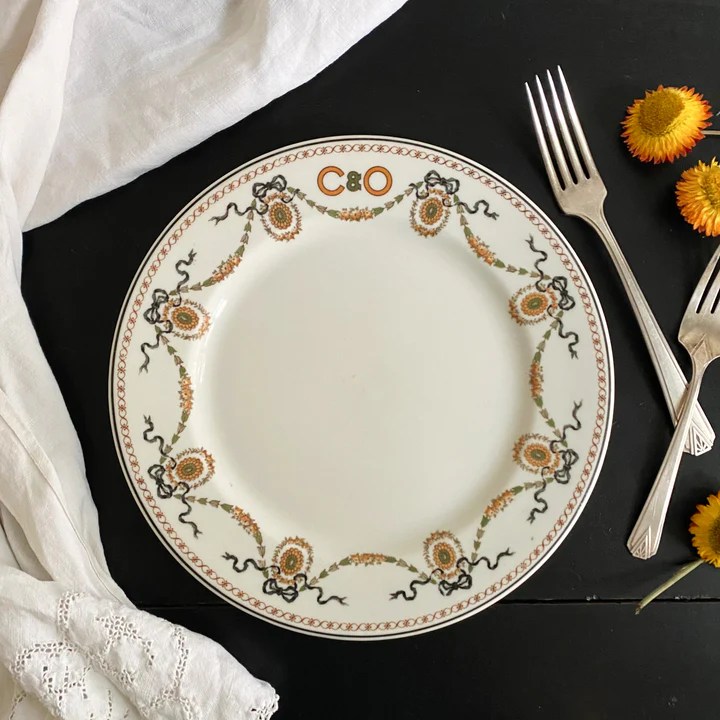
With its roots extending all the way back to canal transportation in the 1790s, the C&O Railroad has a long and winding history through the American landscape. Throughout most of its life, C&O trains hauled coal, agriculture, retail products, and travelers between Virginia, the Midwest, the Northeast, and parts of Canada up until the 1980s. In the 1920s, the decade in which this luncheon plate was made, the C & O trains looked like this…

Dining service aboard C&O started in 1899 and was only offered on their luxury lines. Signature menu items included shirred eggs, Saratoga chips, broiled sea fish, baked apples and cream, Spring lamb chops, and French toast with marmalade. 

A Signed First Edition of Alice’s Restaurant Cookbook circa 1969

Not every cookbook comes with it’s own theme song, but when Alice May Brock (1941-2024) befriended a young Arlo Guthrie, the whimsical world Alice lived in was all the inspiration Arlo needed to write a hit song called Alice’s Restaurant Massacree, which in turn inspired a cult classic film of the same title. The cookbook came after the song and the movie, but shares the recipes that made Alice a local legend in New England as the proprietor of three restaurants and a catering company. A free-spirit, an artist, and a lover of food and friends, this cookbook features some of the favorites served in her restaurants and at her famous home-hosted dinner parties. It also includes still photos from the movie, Alice’s illustrations, and photos of Arlo and their friends who made a good time out of every meal. Adding an extra layer of the joie-de-vivre she embodied, this particular book is also signed by Alice.

A Collection of Original Floral Feed & Flour Sacks circa 1930s-1940s

You can’t really get any closer to touching real-life history than these floral feed and flour sacks. Stitched into traditional sack shape, similar to a pillowcase, these bound together fabrics were once the commercial packaging that held a variety of pantry staples, including flour, sugar and grain. Made by the manufacturing industry in response to the financial burdens placed upon American families during the Great Depression, this cotton sack packaging was made solely for the purpose of recycling.
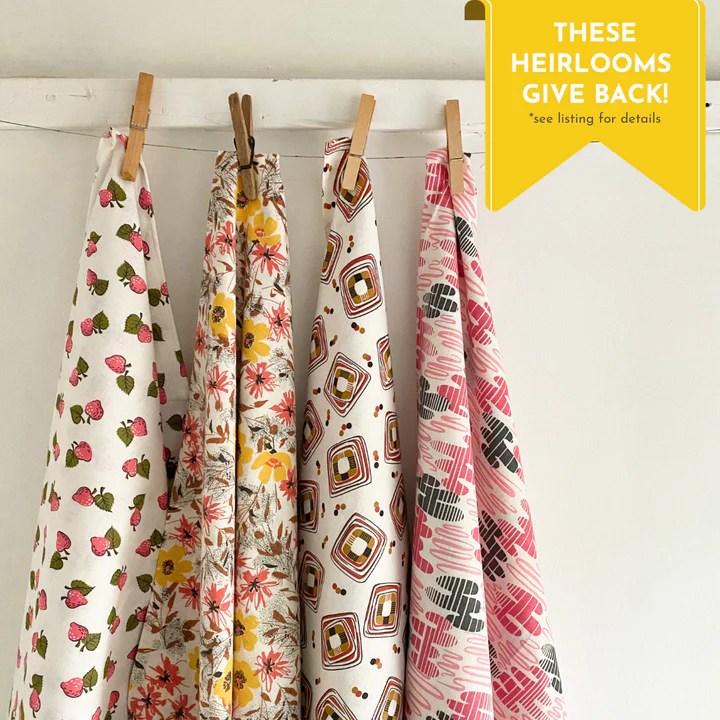
Knowing how thrifty and creative the American seamstress was, and knowing how tight household budgets were during the Great Depression and World War II years, grain and food manufacturers packaged their products in these floral cloths specifically so that women could repurpose them by turning the fabric into clothing, household linens, toys, rugs, curtains etc. It was a winning collaboration that not only responded to and eased economic stress, but also showed unwavering care, support and appreciation for customers during one of the most challenging times in American history. This batch in the shop came from a private collector and was so well-cared for across ninety years that each piece of fabric looks practically brand-new. Two of the sacks even retained traces of grain remnants hinting at the original products contained within.
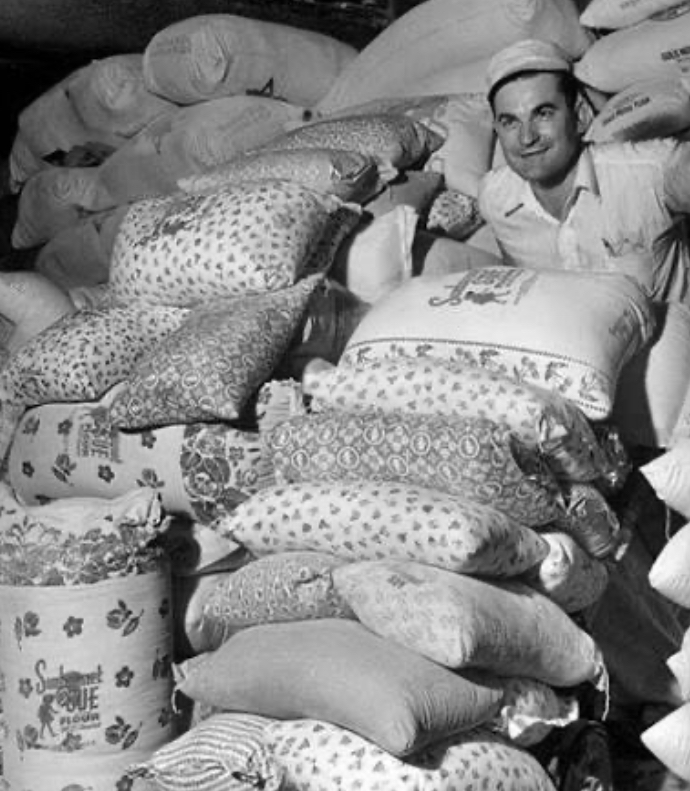
Cotton flour sacks full of flour featured in a 1940s photograph published in LIFE magazine

An Antique Basin Bowl & Wash Pitcher That Changed the American Plumbing Industry

It’s hard to imagine life without modern conveniences like indoor plumbing and bathrooms, but back in the 18th and 19th centuries, this wash basin and pitcher was your gateway to cleanliness, both literally and figurately. Made by Maddock’s Lamberton Works in Trenton, New Jersey, between 1888-1902, the British-born Maddock family were the first immigrants to realize that America needed their own sanitaryware pottery manufacturer. Up until they opened up shop, all basin bowls, wash pitchers, slop jars, chamber pots and grooming sets were imported from England. The Maddocks changed that by producing American chamber sets using local clays, and in doing so, revolutionized the plumbing industry in the process. Recognized as pioneers in the world of sanitary toiletry products, the Maddock family patented several plumbing innovations before they eventually sold the pottery in 1929 to American Radiator & Sanitary Corporation, who would go on to create our country’s indoor heating and plumbing infrastructure including radiators, sinks, bathtubs, and toilets for households across the country.  

An Intimate Glimpse into the Life of a Literary Hostess
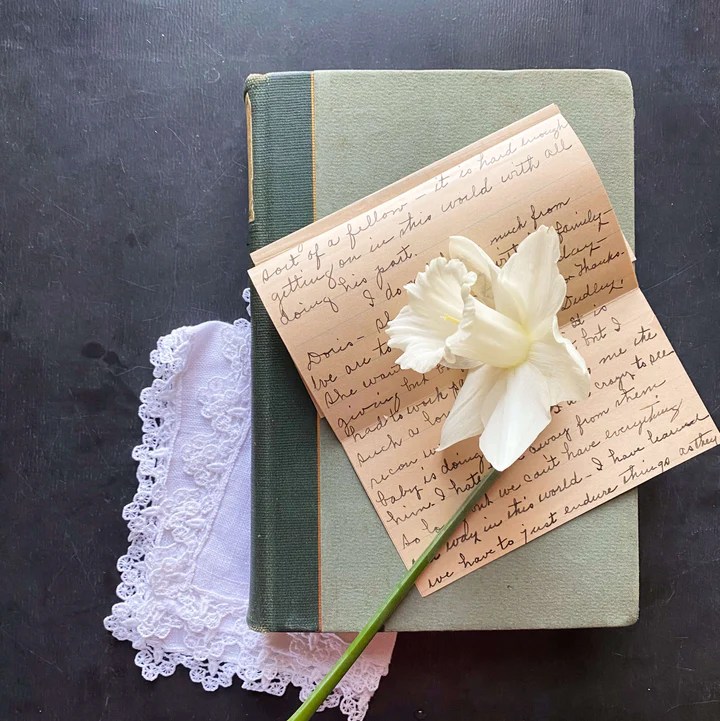
Guests at the Boston literary salon of Mr. James & Annie Fields were a veritable who’s who of prominent 19th-century writers. Mark Twain, Charles Dickens, Sarah Orne Jewett, Ralph Waldo Emerson, Henry Wadsworth Longfellow, Bret Harte, Henry James, Bronson Alcott, Nathaniel Hawthorne and Harriet Beecher Stowe, to name a few among were just some of the visitors that spent time in their home along with other notable painters, actors, musicians, and political activists. 

In addition to being a writer, activist and philanthropist herself, as well as the wife of distinguished Boston publisher James Fields, Annie Adams Fields (1834-1915) was also a charming, kind-hearted hostess and keen observer of conversation amongst her literary friends. Never interested in self-promotion, scandal or gossip, she regularly recorded bits and pieces of conversations among her friends in diaries that she kept throughout her life. Sketches of dialogue, character traits, pressing matters of the day, viewpoints on life and literature all freshly detailed the lives of extraordinary figures, painting them as humble, human, fallible beings tackling life, their passions and their creativity as anyone might. 

Before Annie passed away in 1915, she granted noted biographer Mark Antony DeWolfe Howe Jr. access to all her diaries in his pursuit to record the friendships enjoyed between the Fields and their artistic community. She had one caveat, though, in sharing her books. That Mark’s book not be about her but about the extraordinary friends whom she knew and loved so well. What resulted is this book, Memories of A Hostess: A Chronicle of Eminent Friendships, published in 1922.

Highlighting correspondence, diary entries, cultural events, and touchpoints from history for context, Mark Antony DeWolfe Howe pieced together an intimate glimpse into the lives of the 20th century’s greatest thinkers and artistic minds, courtesy of Annie and James’ record-keeping collection.

Annie’s husband, James Fields

Uncovering a portrait to attach to each heirloom’s story is one of our ultimate joys. In this year’s sale, you’ll also meet many new faces. This year, we shared stories of Attia, Alfredo, Pamela, Freddie, Doris, John, Judy, Miroslav, and Marjorie along with her daughters, Kate and Susan…
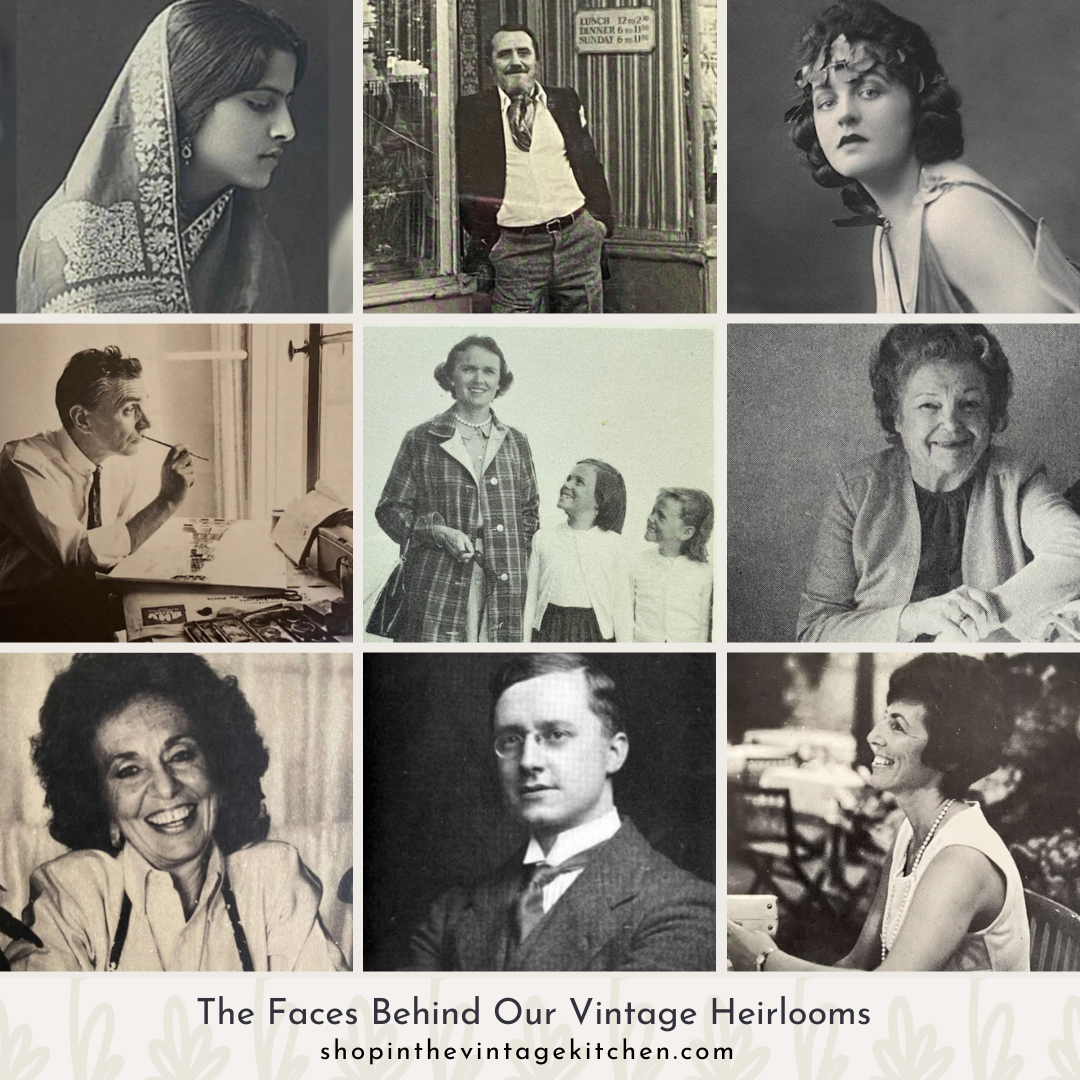
Clockwise from top left: Attia Hosain, Alfredo Viazzi, Pamela Lyndon Travers, Freddie Bailey, Doris Muscatine, John Ramsbottom, Judy Gethers, Miroslavo Sasek, Marjorie Winslow and daughters.

Each brought many new perspectives of history to life. Attia Hosain (1913-1998) was a writer, actor, cook, broadcast journalist and intellectual focusing on stories of India and British post-colonialism. Freddie Bailey (1904-1992) was famous in Mississippi for her hot pepper jelly along with other regional favorites that made her kitchen the epicenter of Southern food, flavor and hospitality. In the 1930s, Pamela Lyndon Travers (1899-1996) introduced the world to Mary Poppins, who still remains 90 years later, the globe’s most well-known and most beloved nanny. Alfredo Viazzi (1921-1987) was the proud owner of a popular Greenwich Village restaurant known for its convivial atmosphere, great food and reasonable prices. Judy, Doris, Marjorie and Miroslav shared their artistic talents via saucepan and sketchbook. British mycologist John Ramsbottom (1885-1974) taught gardening enthusiasts all about the fascinating world of fungi.

This year also introduced personal stories shared by readers and their families. One of our favorites is that of Beverly, whose collection of handwritten recipes is not just a set of random cards in a box. They are the story of her. Of one woman’s culinary journey as she grew from a young, inexperienced midwestern bride, who barely knew how to boil an egg, into a confident, seasoned California cook and recipe collector over the course of her entire adult life.

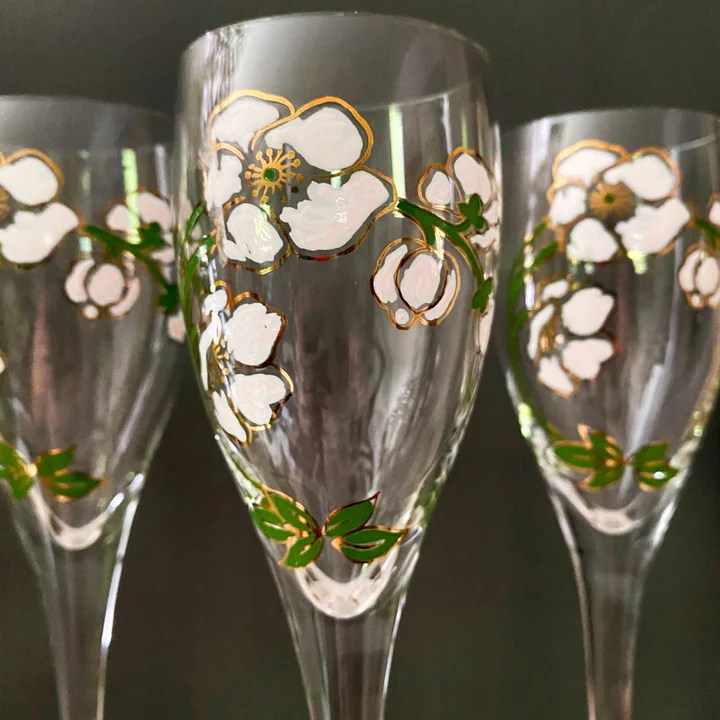
Familiar favorites can be spotted in the shop sale too, bringing with them their marvelous heritage stories that are worth retelling again and again. This stemware is the story of champagne, of “drinking the stars,” of a husband and wife couple, Pierre Perrier and Rose Jouet, who created the first true champagne made from the Chardonnay grapes in the Champagne region of France in the early 1800s. Together, with Rose in the vineyard and Pierre in the sales office, they launched Perrier-Jouet Champagne in 1814, a brand that still continues to enchant wine enthusiasts around the world today.
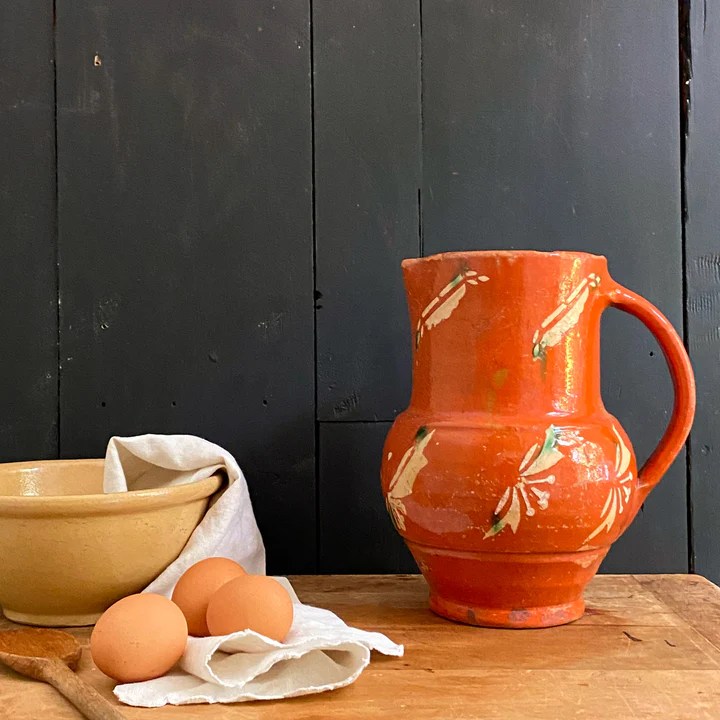
Every year we also like to spotlight the oldest antique in the sale. In this year’s case, it’s this French pottery water pitcher that dates to the 1850s…
More history floats. More stories emerge. In the shop, a cookbook is never just a cookbook. It’s a tactile understanding of what WWII cooking really looked like for women in the 1940s. Its a story of how they had to portray strength, creativity, courage, ingenuity and optimism at every meal, every day while creating delicious, nutritious and interesting meals on limited war rations, tight budgets, and victory garden harvests.
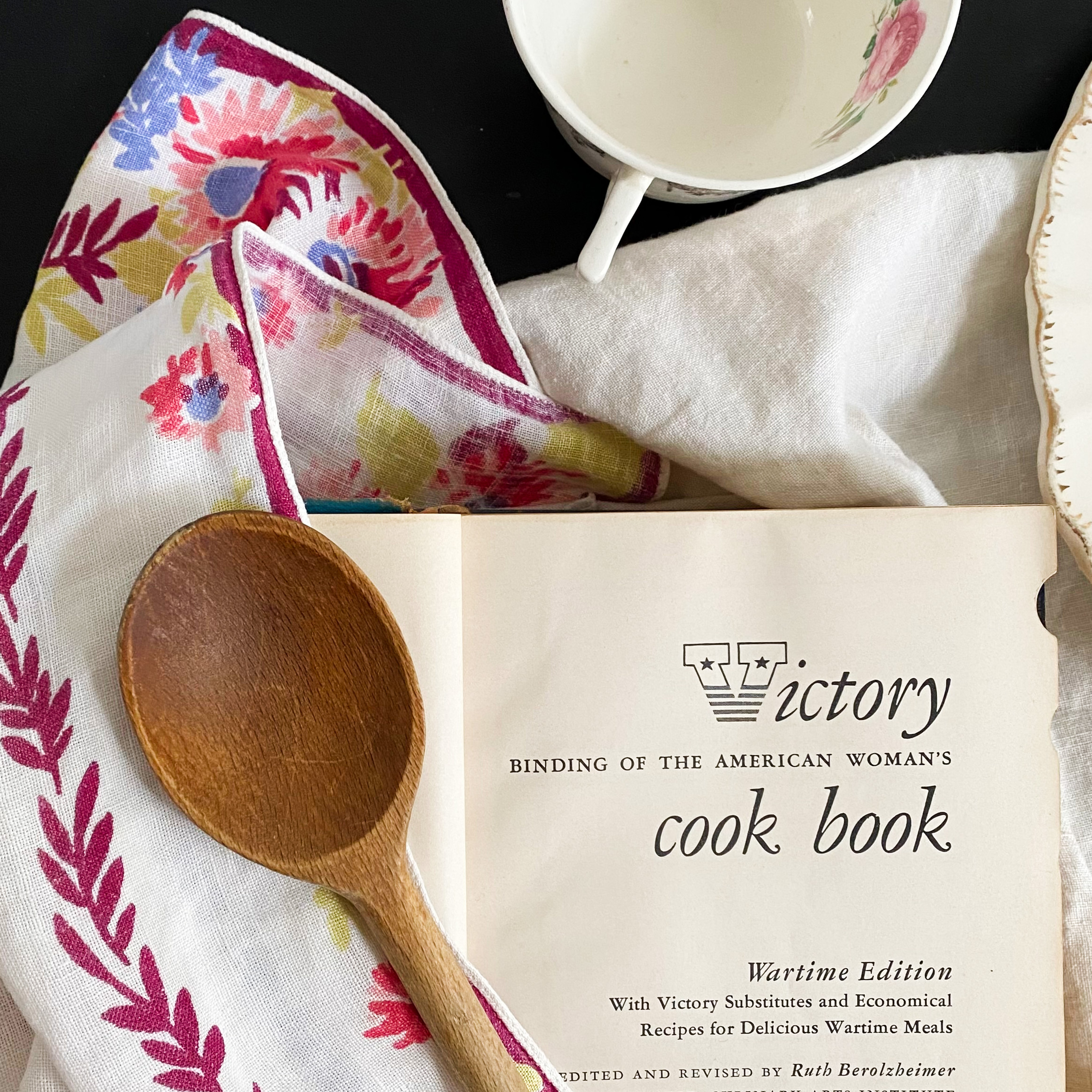
Cookbooks in the shop tell intimate stories not only of their authors but also their owners too. This 1931 edition of the Boston Cooking School Cook Book showcases the enduring legacy of Fannie Farmer (1857-1915), who not only raised generations of home cooks but shared recipes that still inform regional New England cuisine today. It also highlights, through a myriad of cooking splatters and stains, the adventures of a previous cook (or cooks) who cherished the recipes so much their culinary endeavors have turned into an artful aesthetic.
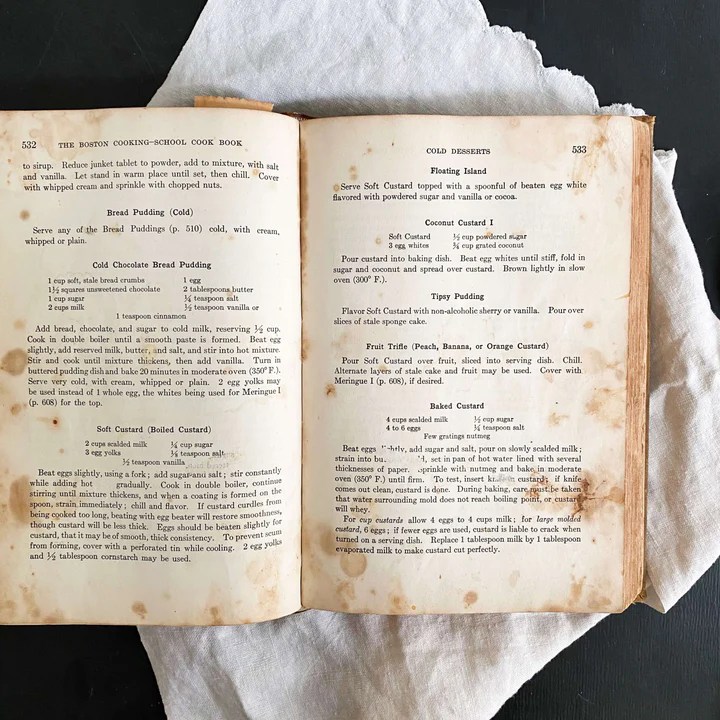
Also every year, there’s one stand out cook, who warrants days or sometimes even weeks of research thanks to a fascinating life lived. This year, it was Lois Burpee (1912-1984)…

who married into the Burpee Seed Company family in the 1930s and managed to carve out an incredible cooking, gardening, and philanthropic career that lasted her entire lifetime.

Other equally interesting cookbooks in the shop sale this year include two rare compendiums of culinary curiosity that offer suggestions on what to make and what to bake every day for a year…

Decorative pieces in this year’s sale highlight the handmade arts. An antique tole tray, a vintage hand-carved wooden swan, a vintage print of a tulip painting dating all the way back to 1827, a hand-embroidered linen…

These are just a few examples of the people, places, and stories that have found their way into the Vintage Kitchen shop in 2025. I hope at this year’s sale you discover an heirloom that captivates your attention, that steals your heart away to another time or another country, and that inspires new creativity from history’s forgotten muses.
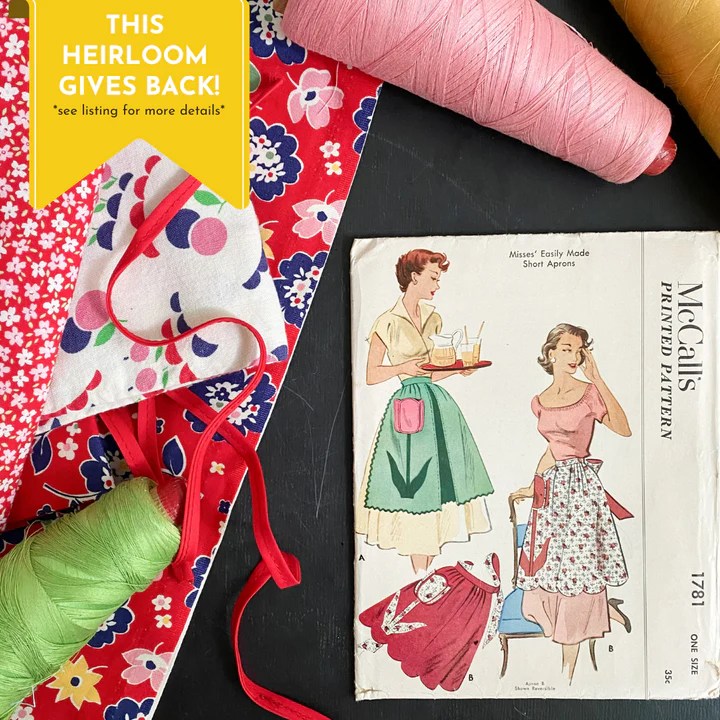
At this year’s sale, just like last year’s, you’ll notice that some heirlooms sport a festive yellow banner in their listing photos. Those banners signify a donation program that we launched in 2024. Any heirloom that you see in the shop that says This Heirloom Gives Back qualifies for a 20% donation to Feeding America, a nationwide non-profit network of food banks, food pantries and local meal programs dedicated to providing nutritious meals to food-insecure communities around the United States. Not all heirlooms in the shop qualify for this program, so be sure to look for the yellow banners if you would like to participate.

The sale begins at 12:00am (EST) on Sunday, November 2nd, 2025 and runs through 11:59pm that same night. Discounts are automatically tallied upon checkout, so there is no need to enter any coupon codes or discount phrases to receive 40% off.

New heirlooms continue to be added to the shop daily, so stop by for fresh vintage and antique finds leading all the way up to the sale. And, as always, if you are looking for something that we no longer have in stock, please send us a message. We’ll be happy to add your name and needs to our waitlist.

Whether you are interested in experimenting with a new cuisine, looking for a new favorite vintage dish pattern, or starting a collection that recalls memories of a happy time from your past, I hope you find something in the shop that calls to your heart and adds extra delight to your kitchen.

Cheers to all the old souls that inspire the shop each and every day. Cheers to all the heirlooms that they have been passed on to us to love and cherish just as much. And cheers to the kitchen for being the one spot in the house where everyone is always welcome.

A Rare Look at a Halloween Sweet Treat from the 1960s

Happy Halloween! In today’s post, we are starting off your holiday with a rare treat – a little something sweet from the files of food history.

In 1960, a bit of marketing magic happened to a specific sector of the food industry that no one ever saw coming. It didn’t burst onto the scene with immediate stardom but it was fresh and fun and set the stage for something much bigger down the road. This initial marketing campaign didn’t debut at Halloween, but it did get caught up in the fervor of the holiday and all the potential that trick or treating offered.

In celebration of this sweet treat day, in today’s post, I thought it would be fun to feature a vintage advertising campaign that centers around a very rare piece of Halloween ephemera that was almost lost to history. This one piece of found paper tells the story of a food, an industry, a holiday, and one group of clever individuals who had an unfailing love for one very specific product.

It all starts with the advertising campaign that began rolling out in 1960. This was a campaign that was not promoting a food or a recipe or a meal that was rare or coveted or exotic. It was actually the opposite. It was spotlighting a food that was quite humble and ordinary and pretty unremarkable in the appearance department. It was one of those foods that lies under the radar. Helpful, necessary, enjoyable, but not exactly glamorous, it wasn’t until a certain advisory board formed that this food’s reputation got a total makeover in the likeability department. Through clever ads, product placement, and innovative promotions, this group grabbed attention and shook things up. Eventually, two decades later the food they promoted would become a pop culture icon known by millions of people around the world. By then, it would be forever linked with a catchy theme song and a field of merchandise that stretched way beyond anything to do with kitchens and cooking. The Smithsonian Museum even took note and acquired it for their collection.

So what is it you ask? What is this magical food that went from simple to superstar over the latter half of the 20th century? Here’s a clue… it’s brown and wrinkly. It comes in petite boxes and big canisters. It’s used in baking and cooking. It’s sweet and small, mini and meaty. Can you guess what it might be?

It’s a raisin.

The group of individuals responsible for bringing the raisin into the limelight was the California Raisin Advisory Board, based in Fresno. Founded in the 1950s, the Board was crazy for raisins and wanted to share their joy of this dehydrated fruit with eaters everywhere. Their enthusiasm was backed by noble intent too. They wanted to help draw attention to the local raisin growers who were struggling to make a profit in mid-20th century California.

Typically, when you hear the words “advisory board” you don’t automatically think of whimsy and fun but the California Raisin Advisory Board (also ironically known as C.R.A.B.) proposed a marketing campaign that was full of joy from beginning to end. Their mission was to produce effective advertisements that targeted the heart of the home – the kitchen – and all the ways in which raisins could become a household favorite and a sustainable staple, cherished enough to support the industry that grew them.

This is still life painted by Clara Peeters in 1615 featuring a bowl of raisins and almonds.

Raisins of course had been an ingredient in cooking and baking since the 1600s, so in the 1960s they were not a new food, but the industry was struggling and the Advisory Board wanted to step in to help. They wanted to take the raisin out of the cabinet of yesteryear, dust off its stodgy patina, and give it some zing. With centuries worth of material to work with there was no shortage of ideas when it came to inspiration, but the Advisory Board wanted to focus on a fresh approach and universal appeal. So where did they start?

With bread. As in raisin bread. A sweet, studded cinnamon-laced loaf often enjoyed at breakfast, this baker’s delight was centuries old too, just like the fruit it featured. But in the 1920s, raisin bread received some new interest when it was deemed a “health food” by dieticians and nutritionists. Sugar aside, raisins hold a lot of vitamins and minerals in their puckered little shape including magnesium, potassium, and fiber. Added to the protein found in bread, the combination formed a magical collaboration of a seemingly decadent eating experience paired with a hearty dose of healthy goodness. That gave the Advisory Board a lot of angles to play with when it came to promotion. Raisin bread was nutritious. It was affordable. It could be store-bought or home-baked. It smelled like heaven when toasted. And it appealed to both kids and adults. Paired with some clever writing and marketing during National Raisin Bread Month (November), the Advisory Board launched a raisin campaign full of plucky personality…

A cookie campaign followed suit…

The Advisory Board was off and running. Throughout the 1960s, the Advisory Board launched a flurry of seasonal promotions that included National Raisin Week in April, summer picnic season in July, back-to-school snack packs in September, and the Raisins for Happy Holidays campaign in December. In-store grocery taste tests, advertisements, sweepstakes and giveaways encouraged repeat buyers and kept the noble raisin front of mind.

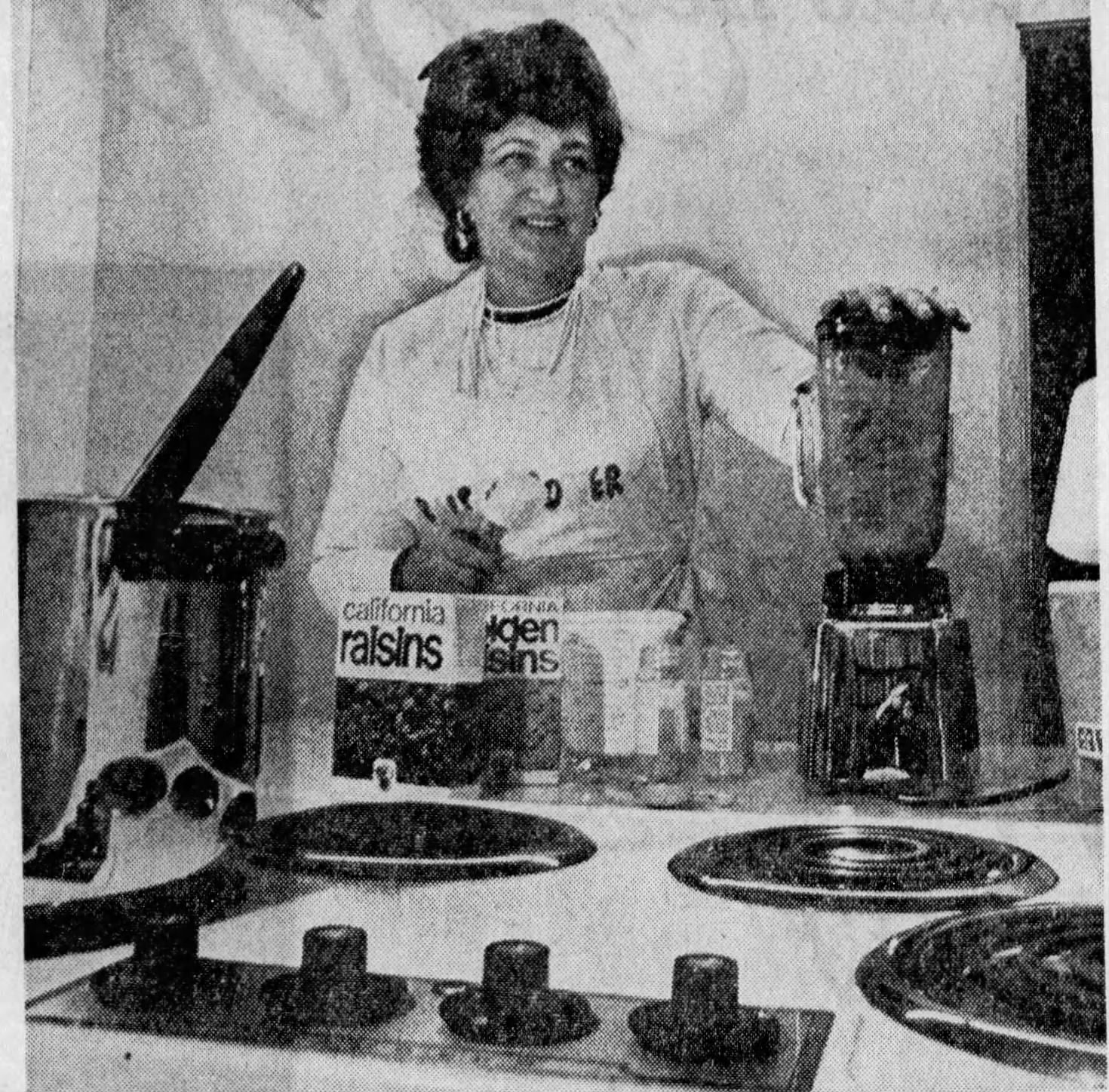
The California Raisin Advisory Board also churned out raisin recipes year-round for newspaper columns from their test kitchen. Photo courtesy of the Sacramento Bee, 1970.

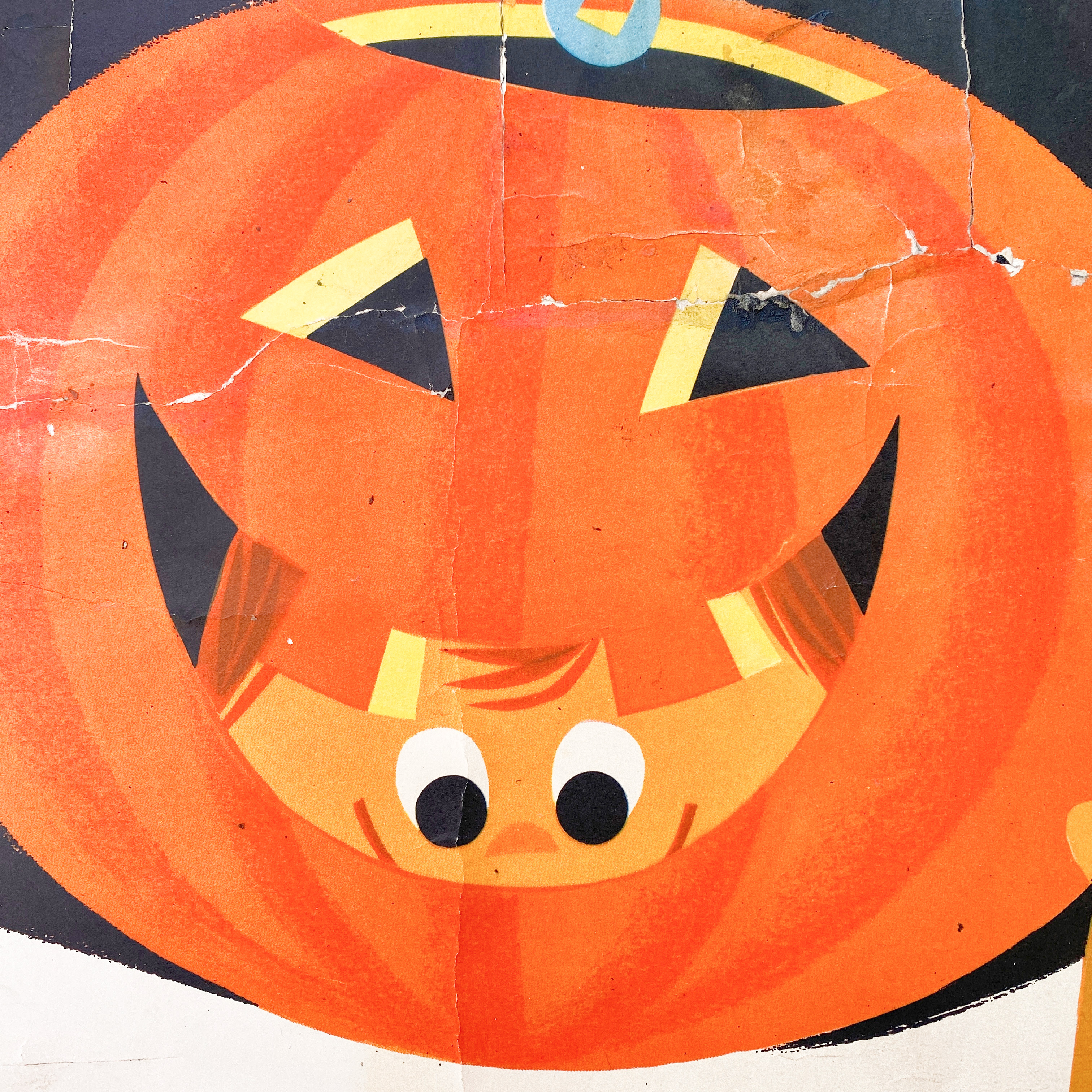
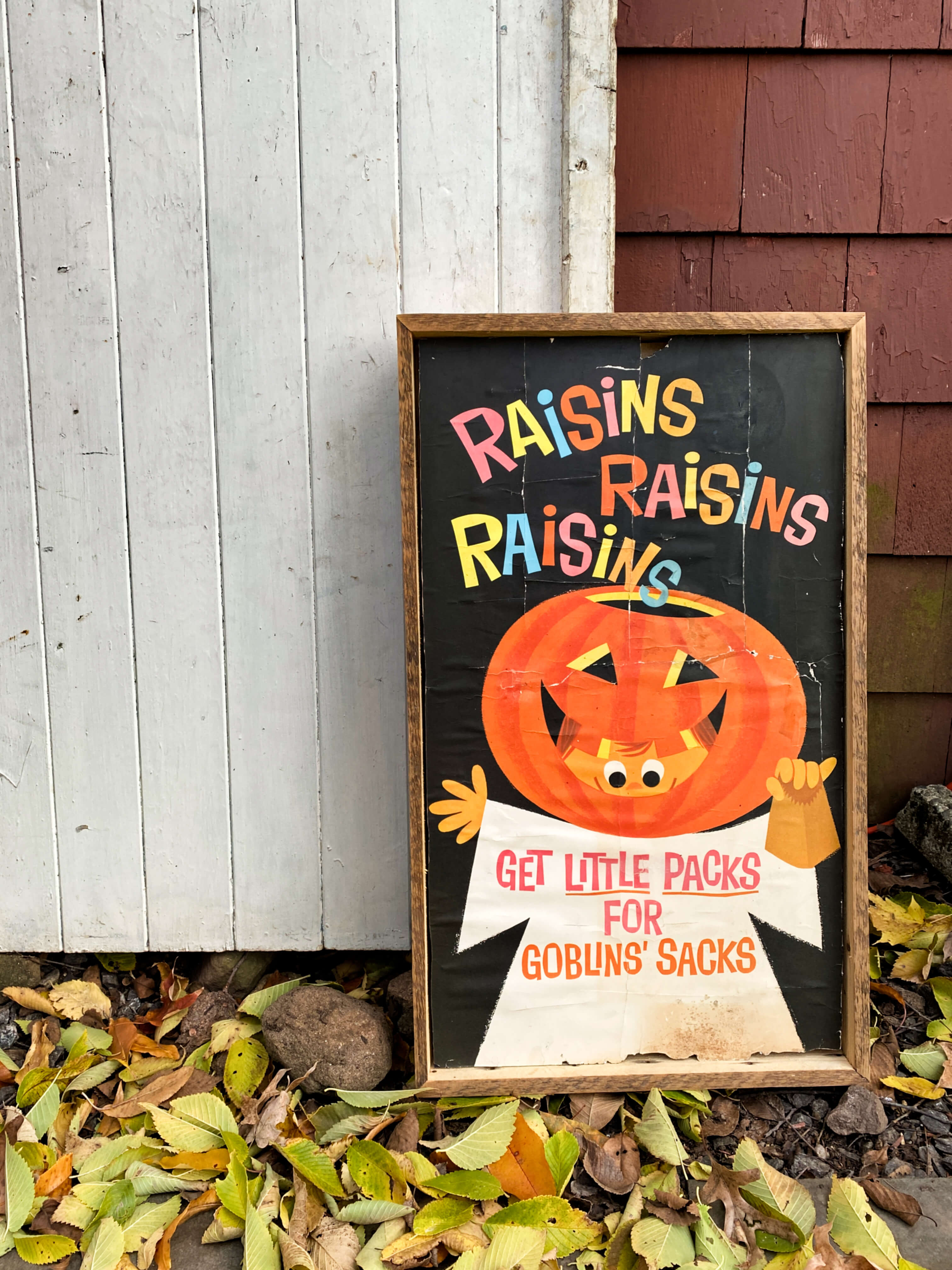
When Halloween time rolled around each year, the holiday provided an additional opportunity to remind parents and kids how sweet a treat, a raisin was. Just like traditional Halloween candy, albeit healthier, during the month of October, the Advisory Board promoted the fact that raisins came in small boxes – a handy size for trick-or-treaters. Posters made for grocery stores and food shops hinted at Halloween excitement. This is an example of a very rare original grocery store poster featuring the California Raisins Advisory Board…

Measuring 25″ inches x 14.25″ inches it is a true survivor of history and a real-life example of the Advisory Board’s cute and colorful messaging. Most food store advertising was discarded in the trash promptly after a promotion ended to make way for new advertising in its place. Printed on thin, inexpensive paper these eye-catching advertisements were not made to last more than 60 days let alone six decades. Oftentimes, they were hung in store windows exposed to heat, sun,, humidity, and temperature changes which would cause them to crinkle and fade over time. When I found this one, it was in fragile and brittle shape and was held together only by hope and a dehydrated rubber band. Ripped and torn in so many places it was impossible to unravel it without it completely breaking apart. A quick peek down the interior of its rolled-up shape, yielded the image of a pumpkin face smiling back. How fun! Home to the Kitchen it came for further investigation and repair.

Carefully rolling out the paper, rehydrating it with a warm, ever-so-moist-paper towel, and then gluing it to acid-free archival poster board took a couple days of attention. Each time a ripped section was flattened out and smoothed over it was a small victory in revealing the bigger picture. Little by little, inch by inch, the poster’s overall image went from bits and pieces to one whole poster.

Finally put back together, for a year, the poster sat just like that – attached to the thick archival poster board with a big wide border surrounding it. Waiting to see if it would stay secured, retain its bright colors and not disintegrate, it was wonderful to see that 360 days later the poster looked exactly the same. Removing the excess matting by cutting it down to its original size, a wood frame was built for it using antique wood remnants from the 1750 House. Floating the poster inside the wood frame allows for all the imperfections along the top nad bottom edge of the poster to show – a visual record of its fragile history. The poster, although greatly improved from its original found state, still bears its wounds in Frankensteinish patchwork.

But what I love most about this poster now, is how despite all its rough and tumble elements, it still manages to radiate joy and a sense of enthusiasm. That was the power of the Advisory Board’s campaign. Raisins are fun.

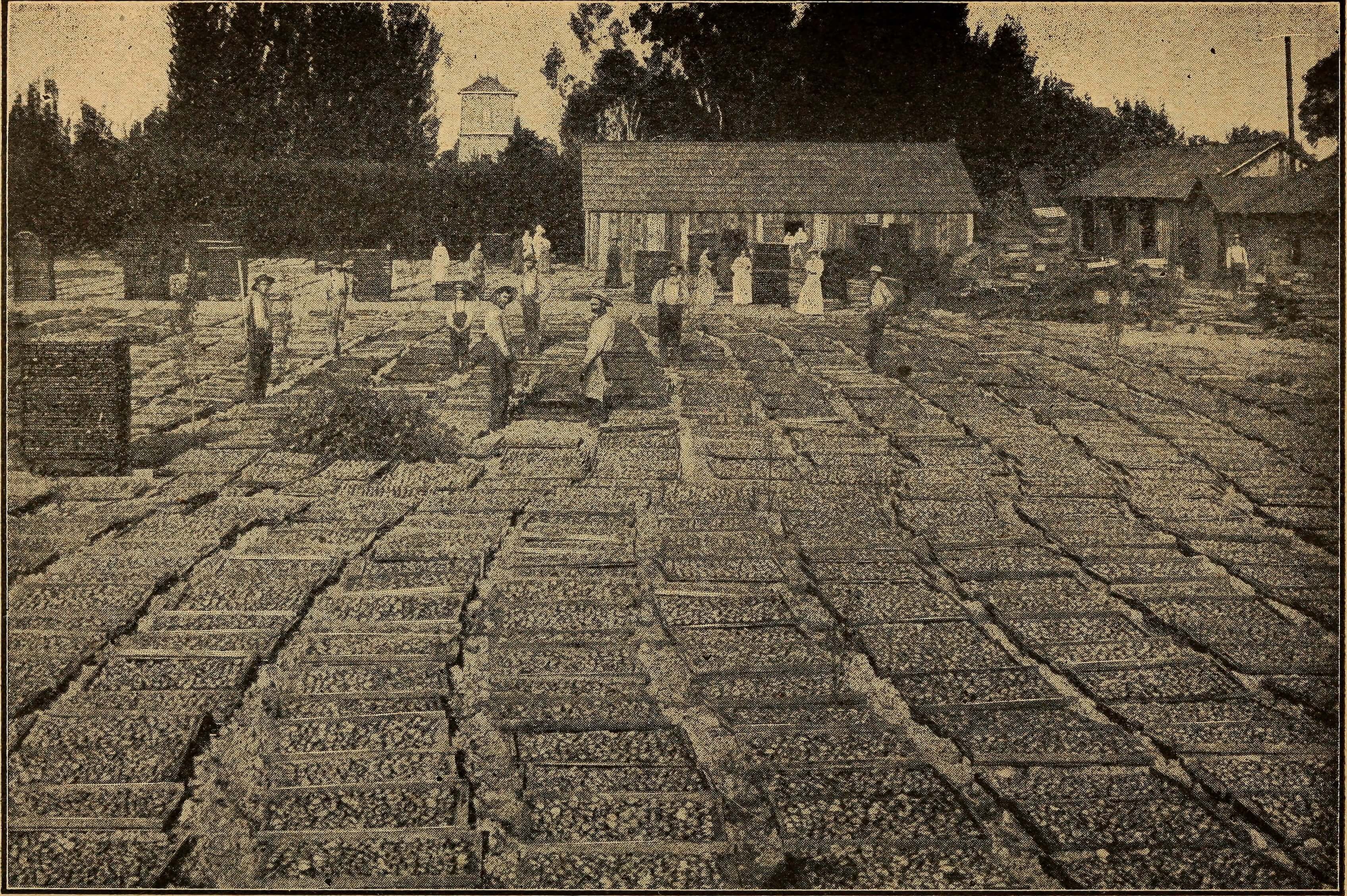
Raisin drying racks. Fresno, CA. 1901. Image courtesy of the Library of Congress

The first raisin farms in Fresno were started by a group of female schoolteachers in 1876. They decided to set aside four acres out of one hundred acres that they purchased so that they could grow grapes for a raisin harvest. Two years later, the first batch (30 boxes) was ready for market and a West Coast industry began.

In the early 1900s, Raisin growers in Fresno would make anywhere from $50-$125.00 per harvested acre.

By the 1960s, the US produced 250,000 tons a year, mostly from farms in the Fresno area. Foreign competition was tough though and the raisin growers were struggling to keep afloat. That’s when the Advisory Board stepped in with their breads and their cookies and their sweet, colorful, clever campaigns declaring raisins raisins raisins a wonderful thing.

As cute as the pumpkin goblin face was on the poster, it was not the imagery that launched the raisins to worldwide fame. That would happen in the mid-1980s when the Advisory Board approved an idea from a Foote, Cone, and Belding advertising executive who pitched an idea about raisins and a band and a signature song.

The California Raisins, singing Marvin Gaye’s 1968 Motown hit, Heard It Through The Grapevine was born. Indicative of the Advisory Board’s continuous efforts to pitch their product in clever ways, the California Raisins soaked into the fabric of mainstream society like no other fruit campaign had done before. This is the first commercial that started the success…

Making up a whole world of claymation figures and storytelling, the California Raisin band was an immediate hit and could be seen everywhere – on tv, in print ads, and on cross-promotional advertising products across grocery store shelves. This was the kind of big-splash notoriety that the Advisory Board was after in the 1960s. With more and more customers buying raisins in the 1980s and 1990s, thanks to the singing sensations, the Advisory Board was fulfilling its mission.

Photo courtesy of Crazy for Costumes.

In 1986, the California Raisin became the most popular Halloween costume of the year. The Raisin band members were reproduced in figurine form and Heard it Through the Grapevine reached the top 100 song charts. When the Smithsonian acquired the original California raisin claymation figures in 1991, it firmly sealed the success of the Raisin Advisory Board. Their singularly beloved product was now beloved by all.

Unfortunately, the sweet taste of success didn’t yield the type of monetary compensation that was hoped for when it came to the raisin growers. The Advisory Board disbanded in 1994 after struggling to balance the costs between promoting the raisins and keeping the growers profitable. Creativity can be harsh that way. Sometimes clever doesn’t equal capitalism. But in this case, it sure did produce some fun art and a new way to look at the world, even if it was discovered decades later than intended.

Cheers to joyful advertising, loving what you love completely, and to our little rescued poster whose celebrating its 60th Halloween this year! Hope it added a little something sweet to your holiday. Happy Halloween!

Cheers to All Souls: Our Annual 40% off Sale Is Next Wednesday

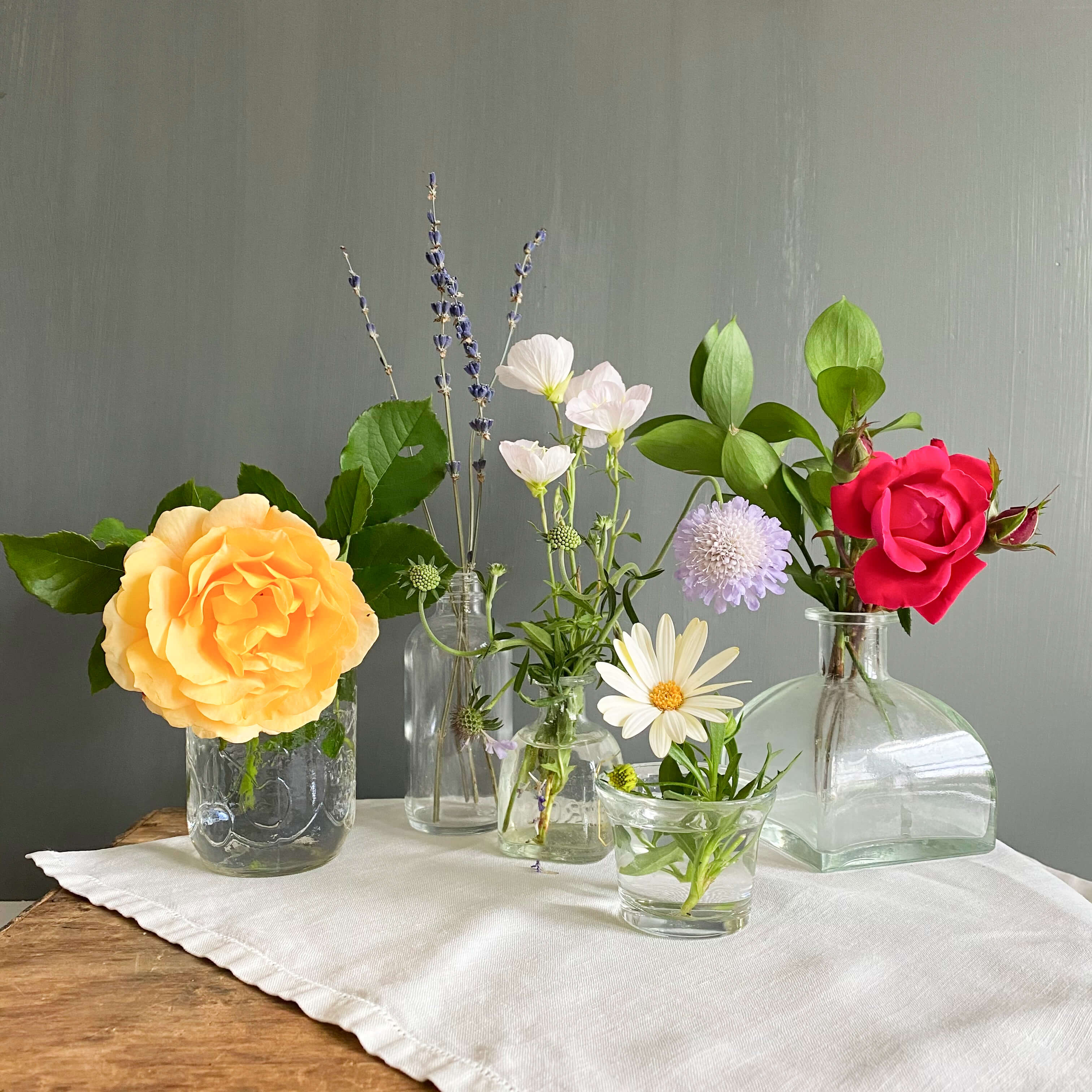
The last bouquet of summer included the final flourish of zinnias, dill, okra, daisies, cosmos and nasturiums.

The leaves are falling, the pumpkins are picked, the last of the summer tomatoes have been plucked. The zinnias were clipped for a final garden bouquet. The okra stalks were added to the compost pile. The herbs moved from the garden to the greenhouse and the rockery raised beds are full of autumn leaves. October is waving goodbye. And that means something exciting is just around the corner… our annual one-day-only 40% off sale.

If you are new to the blog or the shop, you might not know that we always host this sale on All Souls Day, which falls on November 2nd every year. Technically a Catholic holiday, we selected All Souls Day not for its religious connection, nor its aura of spookiness (being so close to Halloween), but for the sheer fact that it is one of the few holidays in the calendar year that pays tribute to deceased ancestors. We wouldn’t have a shop full of wonderful heirlooms had they not traveled through other people’s lives, other people’s hands for generations, collecting stories and memories along the way. To us, all Souls Day seems like the perfect day to celebrate vintage style.

It’s also a lovely time of year to start preparing not only for the holiday season but also for the winter ahead where cooking adventures, gift-giving, and craft time await. Autumn doesn’t officially end this year until December 21st. If you’d like to hang onto the season as long as possible you’ll find many fall-favored pieces in the shop that will carry you all the way through…

If you are ready to start gathering ideas for Thanksgiving, you’ll find an assortment of items ideally suited for Turkey Day 2022 and beyond…

Christmas in the Vintage Kitchen always comes in little details. Red and white restaurant ware, a mini Christmas tree, an antique green striped serving plate or a shimmery candelabra that we are sure has seen some magnificent parties in its day. In the shop, you’ll discover a sampling of festive treasures waiting to add a little sparkle to your celebrations…

The sale begins at 12:00am on Wednesday, November 2nd, and ends at 11:59pm that same day. All items in the shop will automatically receive the 40% discount at checkout, so there is no need to fuss with coupon codes or discount names. We encourage you to use the wishlist feature on our site if you have multiple items that have caught your eye. Just click on the heart under each listing title and it will automatically add the item to your favorites list where you can then add them directly to your cart.

Since it is our only sale of the year, shoppers in the past have been known to set their alarms for the moment the sale starts at midnight. If you have fallen completely in love with something in particular, please keep that in mind. New (old) items continue to be added to the shop daily, so stop by for fresh finds leading all the way up to the sale. One of the items coming to the shop today is this set of six vintage Czechoslovakian luncheon plates full of pink, purple and cranberry-colored flowers.

.

As always, if you are looking for something that we no longer have in stock or you can’t find in the shop, please send us a message. We’ll be happy to add your name and needs to our waitlist. Having said that, I hope on this year’s sale day you will find something truly magical that makes your heart sing with joy. Cheers to all the old souls. And to all the cherished items that they have left for us to enjoy. Happy shopping!

A New Home for the Vintage Kitchen!

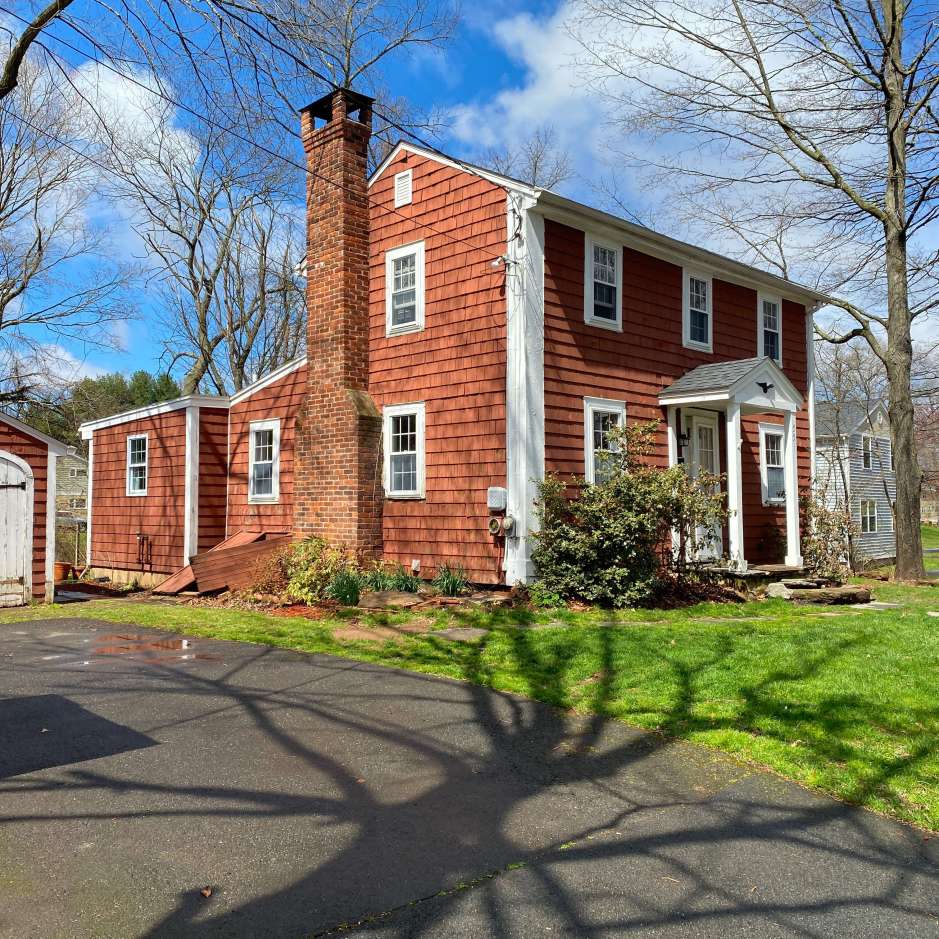
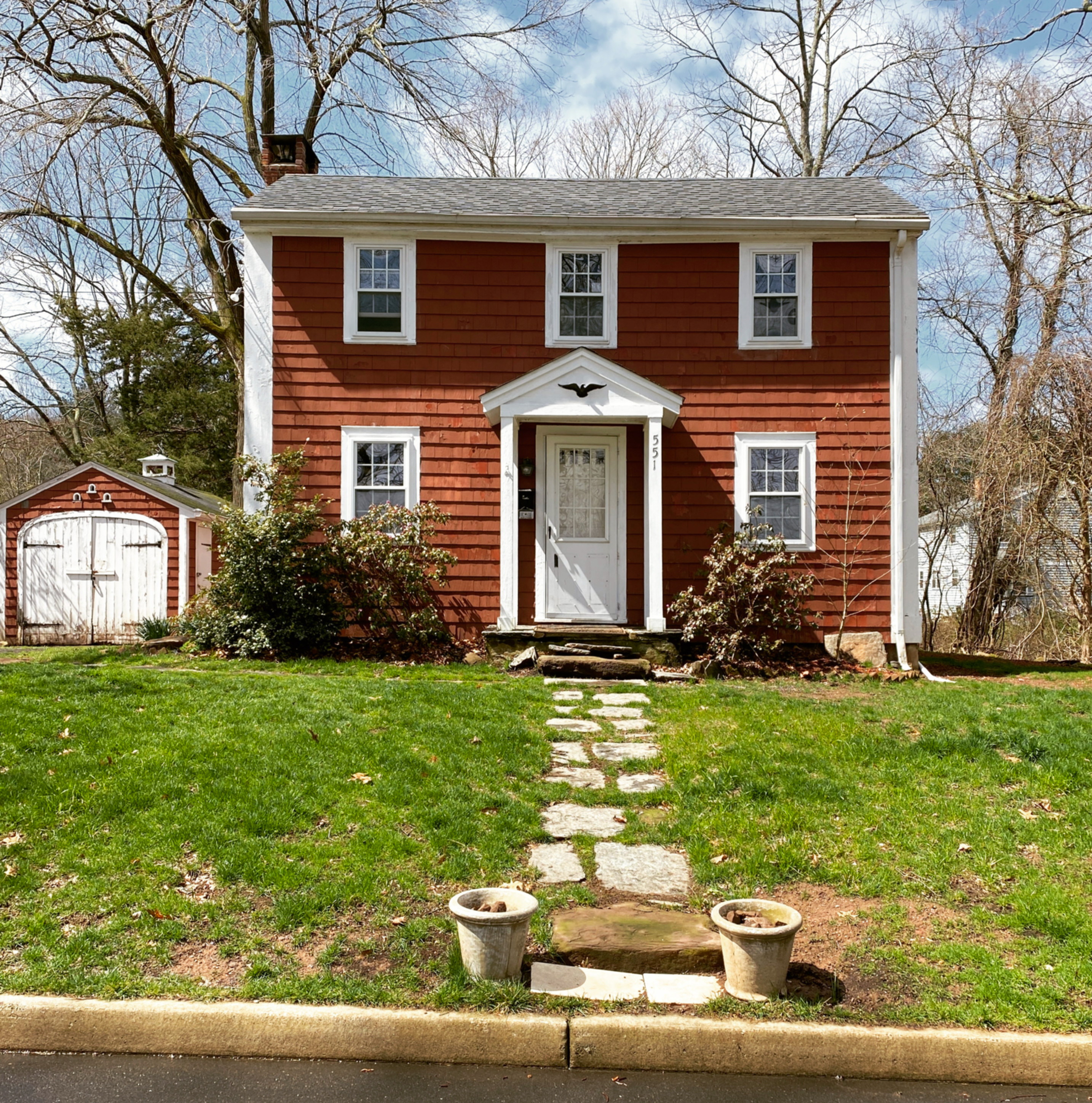
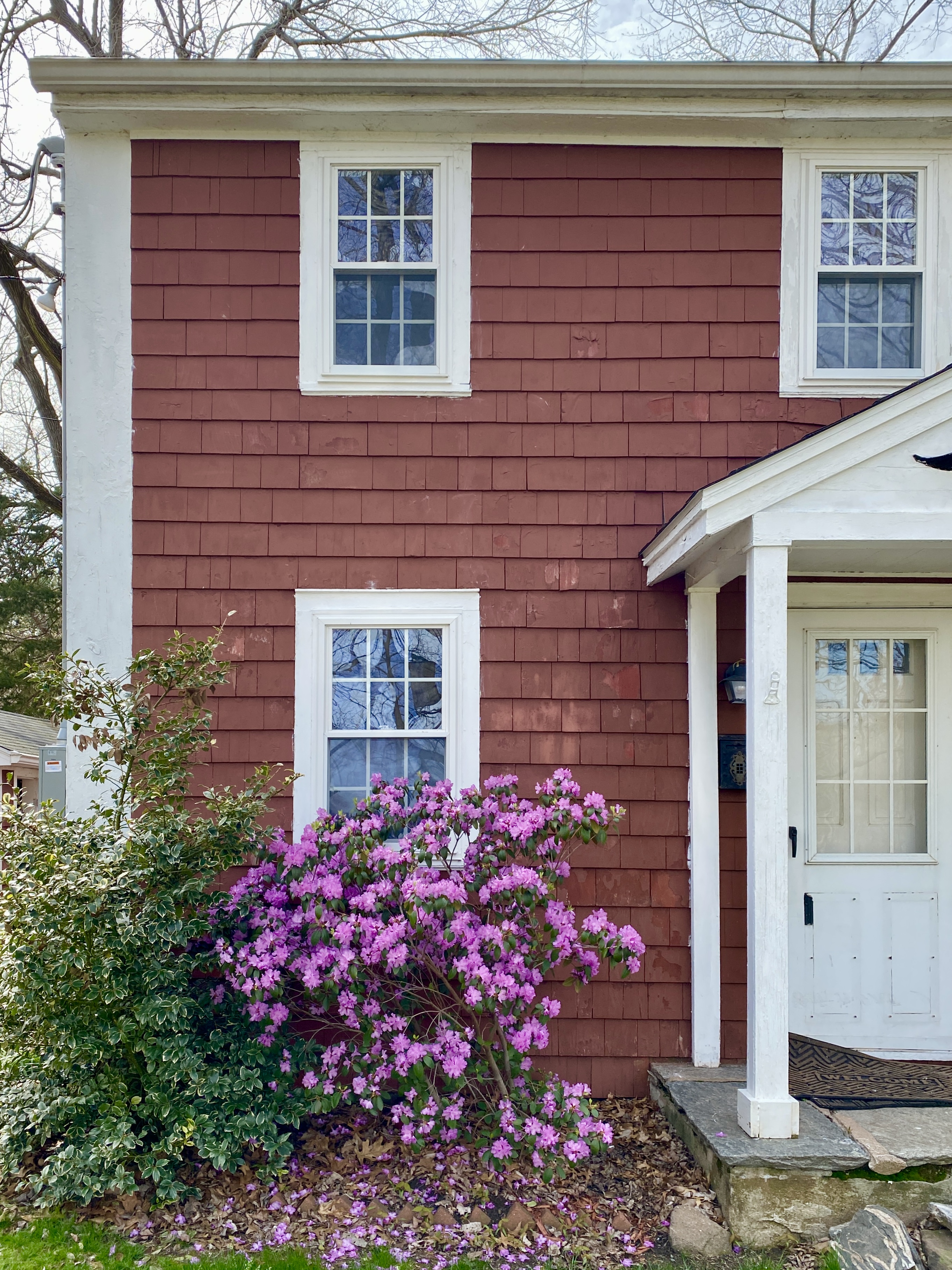
Cheers to new beginnings and big news. I’m so excited to share that the Vintage Kitchen has a new home! After two years of online real estate hunting and six months on the road in search of just the right house, just the right city, and just the right amount of green space to launch a new chapter in the life of the Vintage Kitchen, we have finally landed in the beautiful state of Connecticut. Located on a tree-lined street, in a historic river town that was once one of New England’s busiest trading and sailing ports, stands this almost 300-year old-charmer…

Built in 1750, this early American colonial contains a wonderland of history that spans over 270 years. It is dizzying to think about all the culinary conversations that have bounced around these plaster walls from then til now. But to give you a little perspective, it was built twenty-six years before the Declaration of Independence was signed, nine years before Guinness brewed their first batch of beer, and forty-six years before the first American cookbook (American Cookery, Amelia Simmons, 1796) was published.

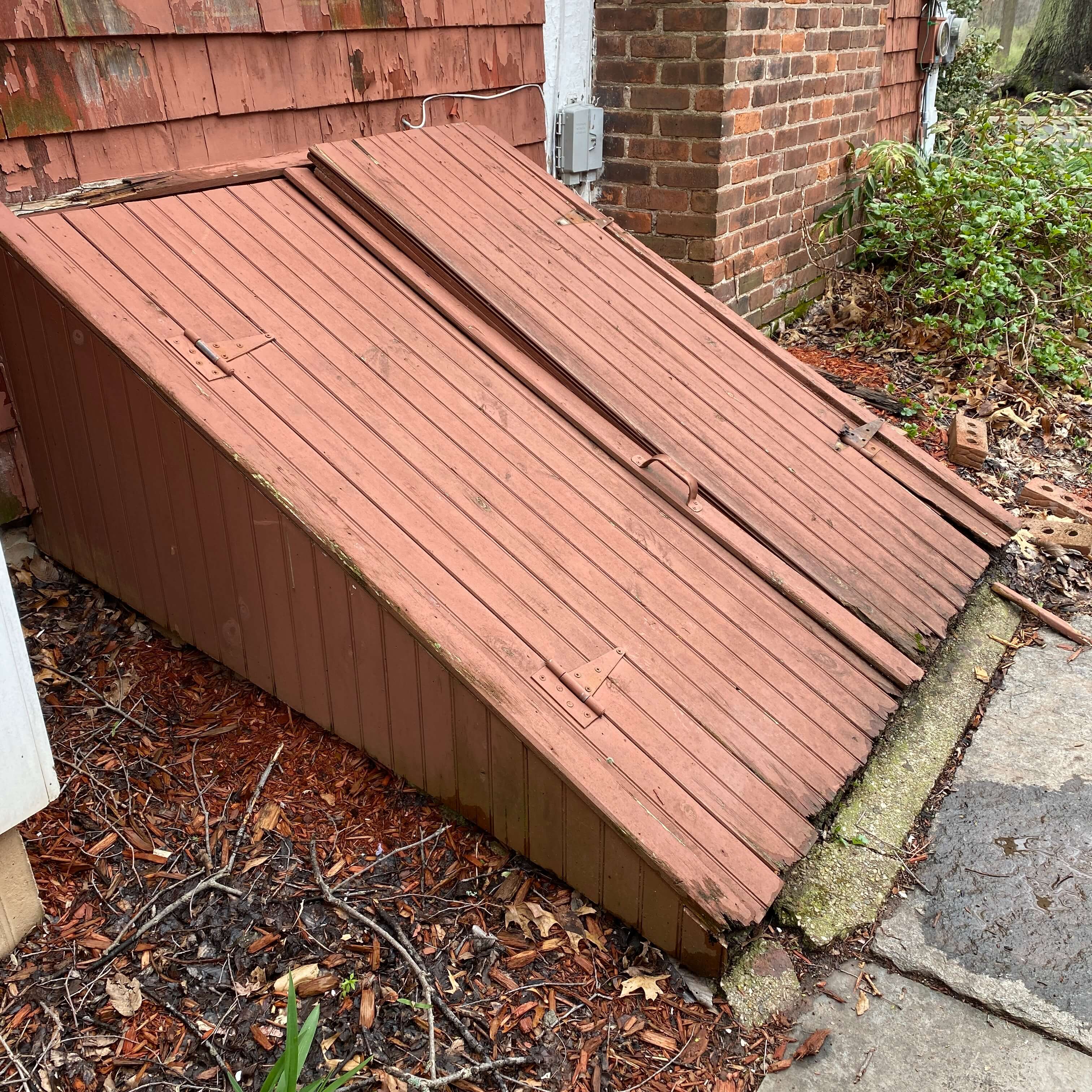
Representative of traditional Georgian architecture, it was built using a symmetrical two over two layout containing two rooms on the bottom floor and two rooms on the top floor with a center staircase running up the middle. A fireplace on one side that was used for cooking and heating purposes, and a stone foundation basement with exterior cellar doors completed the architectural footprint.

Each century afterward brought new features and new additions. In the 1800s, a bathroom was added upstairs and a kitchen was added off the back of the house. Sometime around the 1940s, electricity came to town and outlets were carved into support beams both upstairs and down. In the late 1990s, another bathroom was added on the ground floor at the back of the house along with a mudroom. I love all the angles of the graduated rooflines, especially on the sides.

In the next coming weeks, I’m hoping to find out some of the house’s early history so that a date plaque can be added to the shake siding in front with attribution to the original owner, builder or the known name of the homestead itself. We see these plaques on old houses all over Connecticut. I think they are such remarkable reminders of all the people that settled in this landscape long before us. I’m hoping with the help of the local library and historical society that there will be a bevy of interesting information discovered (more on that topic coming soon).

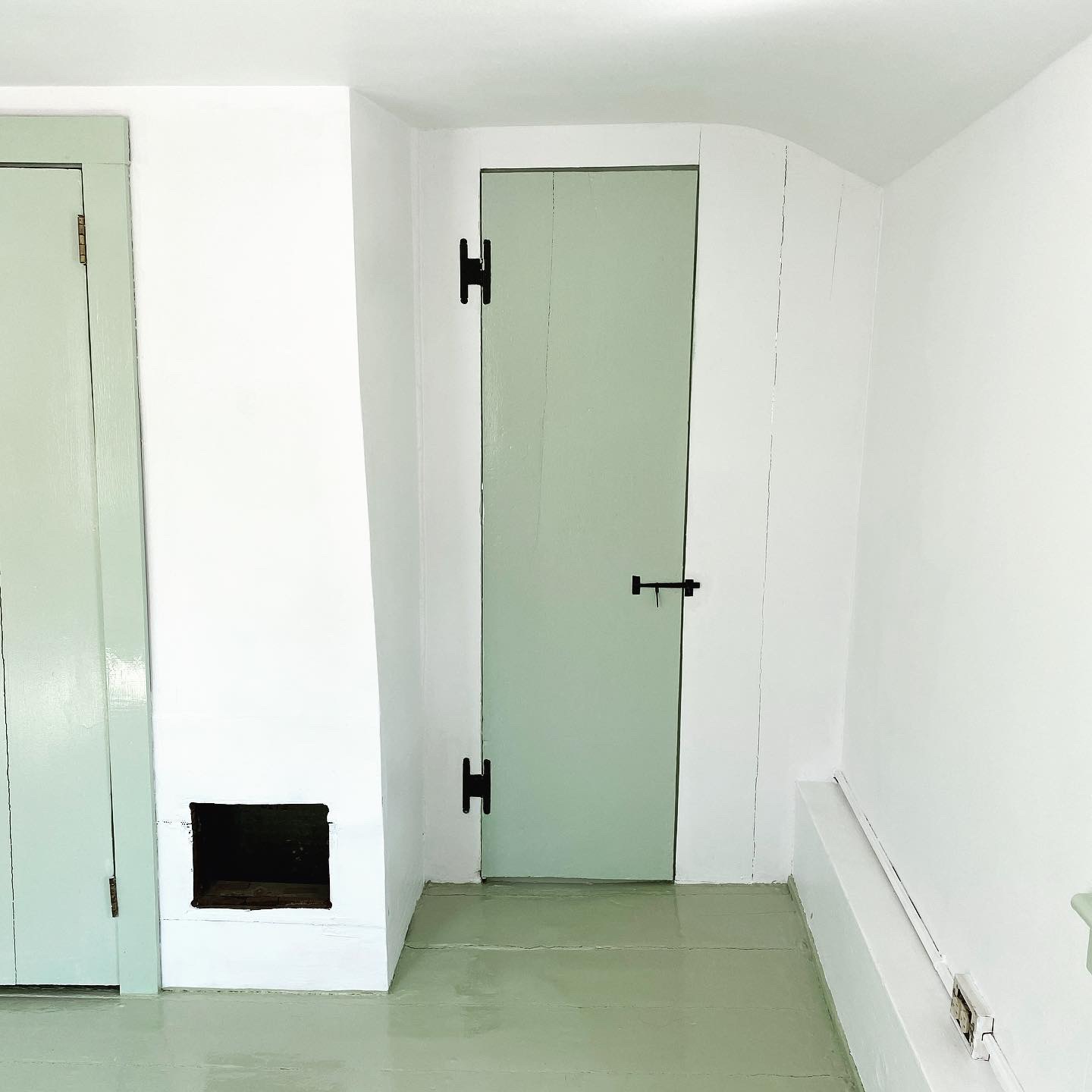
In the meantime, the house itself offers up its own stories in little ways every day. Many of the original 1700s features have been retained including the entire structural support system, the stairs, the fireplace, almost all the interior doors and hardware, the upstairs flooring, the exterior front door and porch, and the interior trim on all doorways. Evidence of adjustments and modifications made along the way by former occupants in the 1800s can be seen in the downstairs flooring and in the detached garage, as well as the 20th-century replacements windows, entry hall flooring, exterior doors, and the two room additions at the back that made the house a bit more convenient for modern living.

While the whole house is a marvelous example of domestic progress as American homes evolved over the course of three centuries, and structurally it is in great shape, as is the case with most historic homesteads, it does need a bit of extra care, love and attention these days. Luckily, all the previous occupants who have spent time within these walls have kept their improvements relatively simple and in keeping with the house’s history, so there is nothing that needs to be demolished or taken down. Some cosmetic changes, electrical updates, and renovation work will freshen things up a bit and ensure that this piece of history will be enjoyed for another three hundred years.

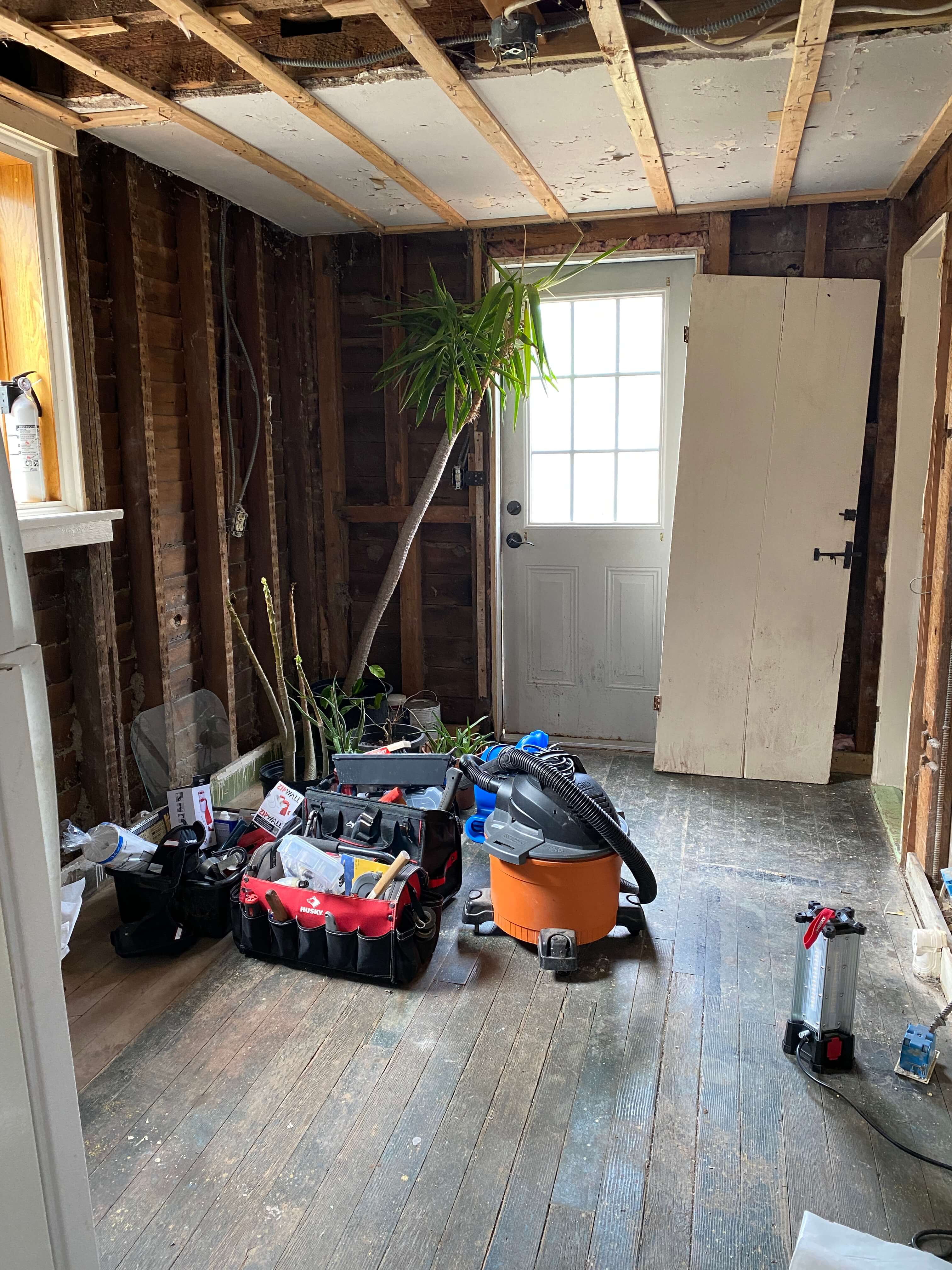
The most dramatic changes will come in the kitchen and the garden, as there are BIG plans for both. In a funny twist of irony, as my husband and I searched all over New England, Pennsylvania and New York for the ideal house for the Vintage Kitchen, we wound up falling in love with a home that had no kitchen. Technically there is a kitchen (two, actually if you count the fireplace – also known as the original kitchen!) but the room that was added onto for cooking in the 1800s is currently not operating as such at the moment. Taken down to the studs by the previous owner, this gutted room now offers a playground of design possibilities.

We are really excited for the challenge of making it functional for modern-day cooking while also keeping the house’s historical footprint and charm intact. Before we tackle that renovation project, in today’s post, I thought it would be fun to share some of my favorite architectural details both inside and out that make this house a unique time capsule. One of the most visually impactful aspects can be seen in the kitchen in the very last image.

Front door mailbox
Cellar doors… how many canned goods and food bushels have passed through there in 272 years?
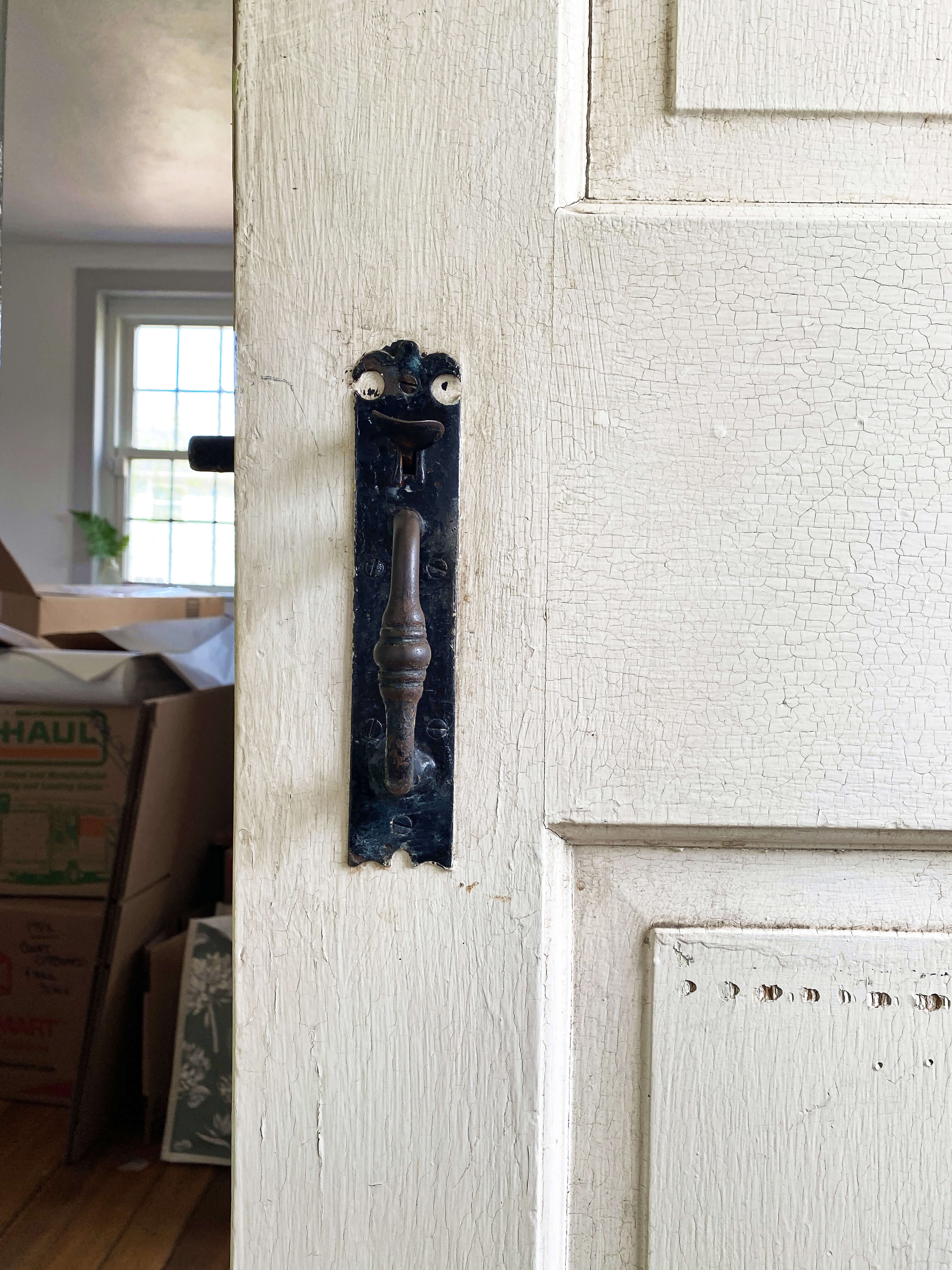
Original interior doors and hardware circa 1750
Ultra-wide original 1750 floorboards
A property boundary marker from 1904
Original 18th century front door and hardware
Original 1750 staircase
The weathervane needs a little repair but it’s still a beauty no matter what direction it points.
Original 1800s era kitchen flooring

One of my most favorite parts of this old house is being able to see (and touch!) the transition of wood that has held up the entire structure over the past 272 years. Had the kitchen already been renovated before we bought the house, we would have never been able to get a glimpse of the inner structural workings of three different centuries.

As each room in the house gets painted, renovated and refreshed there will be many blog updates about our progress along the way with all sorts of before and after photos. Also, if you keep up with the Vintage Kitchen on Instagram, you’ll find occasional videos posted there as well.

While there still will be a few more weeks to go until we are up and running in the cooking department and able to share new batches of vintage recipes, I am happy to announce that the kitchen shop is now back up and running. A new collection of vintage and antique items will be available beginning this week including cookbooks, coffee pots, storage containers and the cutest 1930s era cast iron doorstop, so if you haven’t visited the shop in a while perhaps you’ll find something new yet old that captures your heart.

Also, I just wanted to say a big thank you to everyone who stuck with us while we transitioned from our old Southern city to our new New England home. This migration took a lot longer than anticipated and presented a multitude of obstacles, but now that we are settled in our new spot that we absolutely love, the Vintage Kitchen is ready to explore and share all sorts of new and exciting culinary history. I have a feeling there will be many colonial-inspired stories to come.

If you have any helpful design ideas or advice pertaining to old house renovations please share it with us in the comments section. We welcome all information around here.

Cheers to new adventures in the 1750 house!

Market Bags, Mother’s Day & Some Newsy Bits

Happy May! Hope everyone’s new month is off to a lovely start. Around here, all the trees are proudly sporting their leafy greens and the city flowers are unfurling so many colorful shades each day brings a new sight of delight in the neighborhood. These long waited pops of color remind me of Janice in her book, A Paris Year, when she walked around the City of Light scouting out items of a specific color to photograph. Starting out at the onset of each journey, Janice would pick a particular color, say red or yellow or turquoise, and then look for things to photograph that were made up primarily of that hue during her walk. This past weekend, I did the same thing when I walked to the farmers market. Before I started out I decided on the color peach. This is what I saw along the way…

It’s too early for peaches at the market so there were no color-themed fruits to photograph in that department quite yet, but while we wait for summer crops and our next blog post coming out this week (a special Mother’s Day themed story and interview!) I wanted to share, in the meantime, some new changes that are occuring in the Vintage Kitchen, so that you can be kept abreast of all the latest news.

New Products

Most excitedly, the Vintage Kitchen is growing! Over the next few months, we’ll be expanding our vintage product range in the shop to include some newly made yet very classic kitchen essentials all based on historic designs or nostalgic stories that have been personally tried and tested for years. This is in an effort to introduce fun and unique finds to your space that will not only augment your love of the vintage aesthetic, but will also be of very helpful assistence in the kitchen. The first of these new products arrived in the shop this past week…

Introducing the French market bag! Imported from Europe, this is the best way I have found to tote vegetables home from the farmers market.

The bags, made of handwoven palm leaves, are light-weight yet very durable. The long leather straps rest comfortably on your shoulder and the funnel shaped design (wider at the top than it is at the base) allows for longer and more fragile items to be stowed away securely without being crushed or tossed about. No more broken baguettes or decapitated flowers with this beauty!

There are two different styles of the market bag available in the shop. One has long leather shoulder straps (pictured above) and the other has hand-held rolled leather handles (pictured below). Both are convenient for grabbing and going and they are both the same size as far as bag capacity. The preference, of course, is totally up to you, but I recommend the shoulder strap version if you generally tend to walk to your market or live in a more urban environment where you gather your groceries primarily on foot. It’s such a comfortable way to tote your items around town. The hand-held bag…

… I would recommend for shoppers who drive to their market since the bag sits up right on its own and stows away really well in the car. Tucked into the back seat or the trunk it does not topple over easily, and will keep all your market finds secure while you drive home.
In addition to being helpful, these market bags also bring a bit of Parisian style and joie de vivre to your shopping experience. Each bag holds quite a bit of items, so if you get carried away at the market, your bag will be able to handle all your whims. For example all this fits in one bag with plenty of room to spare…

I have used my market bag (the very same one with the long straps) for over 4 years now. It has become so indispensable, it adventures with me on a daily basis. At this point, it feels not only like a bag but also like a true and cherished companion! I can’t say enough wonderful things about it. I hope you will love the bags just as much too. There are limited supplies of each style and they are selling quickly, so if they strike your fancy don’t hesitate. You can find them in the shop here and here.

Email Newsletters

If you would like to be made aware of new items listed in the shop each week, along with special promotions and added seasonal content, then please sign up for our new email newsletter which will be going out once a week (starting next Friday). Unlike many of these blog posts, this newsletter is designed to be a quick read, featuring mainly photographs and a few links to some fun content. In response to many shoppers asking how they can be kept aware of new items coming to the Vintage Kitchen, and after testing out many avenues over the past few weeks, I’m excited to finally have a good solution that will help collectors find what they love quickly. Sign up for the email newsletter by clicking the subscribe now button on the left-hand side of the shop’s home page here. It looks like this…

Sold Items in the Shop

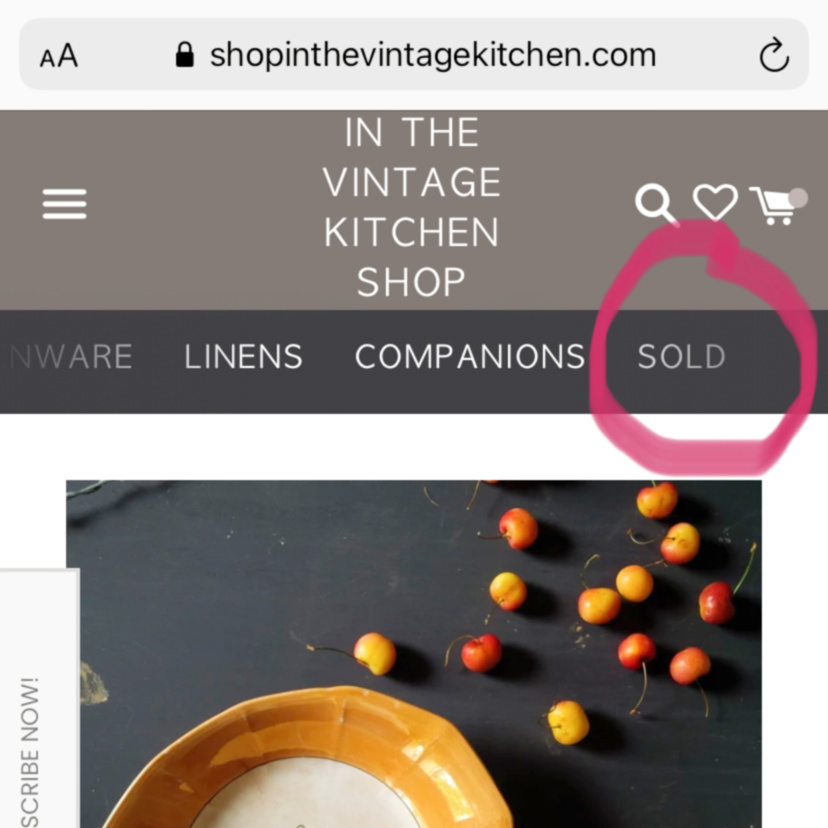
Another improvement for the shop this past week came in the form of relocating sold items to a new category all their own. This transfer, which removed all listings that were sold out from the general inventory of available items, came at the request of a few shoppers who were frustrated in not being able to easily navigate around the site to see what was actually available to purchase. But with many historians and researchers accessing the shop for informational purposes (due to all the history we include with each item’s listing) I didn’t want these sold items to be completely removed from the shop all together. In an effort to make it a pleasant experience for everyone spending time in the shop, I hope this new solution will help. From here on out, see all the sold items in this category (found in the header section) here…

Mother’s Day

I hope you’ll come back to the blog this week to read our upcoming Mother’s day inspired post about a talented seamstress in Minnesota who led a really an interesting and dynamic life. Through an interview with her daughter, who generously shared family photographs, their family linen collection, and many stories about her mom (including a recipe!) we’ll learn how one spirited woman lived a passion fueled life and defied many stereotypes that tend to be attached to women of the mid-20th century.

Until then, of you are looking for any last-minute Mother’s Day gifts, there’s still time left to find something just as unique and treasured as Mom is. From the shop, I recommend these items…

From top left: Vintage 1950s Maurice Urtillo Art Print, Antique 19th Century Steamship Chairs, Embroidered 1950s Pillowcases, Vintage Peacock Wall Pocket Planter, French Market Basket

What makes these particular items so wonderful for mom? All of the mothers in our lives deserve to spoiled on their special day. These carefully selected items will add a little dose of symbolic beauty to her every day, while also presenting her with a unique bit of history. French artist Maurice Utrillo (1883-1955) learned to appreciate the beauty of flowers from his mother, Suzanne Valadon who was also a painter. The his & hers set of antique steamship chairs signifed luxury and comfort aboard cruise liners of the late 1800s. Breakfast in bed never looked prettier in the 1950s than with a pair of embroidered pillowcases, which were often gifted as wedding presents. Peacocks throughout history have been considered the most beautiful bird in the avian kingdom and signifies power, protection and elegance. And finally, the market bag will add chic Parisian style and a little extra joie de vivre to each and every one of her days.

Find each one in the shop here print, chairs, embroidery, peacock, market bag. Hope they offer a little extra inspiration should you need it.

Until the next post… cheers to celebrating May, new growth and vintage-inspired joy! Hope you have a great rest of the weekend!

So Timely: All About Wishlists, Quick Cooking and the Biggest Sale of the Year…

It seems like a bit of a rush to talk about the holidays already. Autumn has just arrived and it’s not even Halloween yet. But time flies faster this last quarter of the year, and I didn’t want it all to blaze by without sharing some fun things that have been brewing in the Vintage Kitchen recently. Especially since they might be of help when it comes to celebrating the holidays this year.

Add to Wishlist

It’s here! It’s here! Your very own Vintage Kitchen wishlist is here! Launched just last month, you’ll notice a heartshaped icon on all product pages in the shop, both in the upper right corner and underneath every specific item’s title on each product page. If clicked, the item will be saved to your own personal wishlist where it will sit until you decide to remove it. Whether you are deciding about a vintage or antique piece for yourself, or you want to share your favorite gift ideas with friends or family, this will keep everything you love all in one organized place.


Shop Sale – November 2

Our BIG shop sale day is just three weeks away! Enjoy 40% off site-wide on Monday, November 2nd during our annual one-day-only All Souls Day sale! This is the only sale in the shop all year, so if you have your eye on something special, November 2nd is the day to capture deep discounts and get a head start on your holiday shopping. Discounts will automatically be applied upon checkout which means no coupon codes are needed. The sale begins at 12:00am, November 2nd and ends at 12:00am, November 3rd. Hope you find something that speaks to your soul or reminds you of a dearly departed loved one from days gone by:)


The Quick Cooking Chronicles

For all the busy cooks out there who are short on time these days, but still long for interesting, home-cooked foods, I’m excited to announce a new series of fast-acting heirloom recipes – The Quick Cooking Chronicles.

Not every fantastic vintage recipe I make in the kitchen actually makes it to the blog. This is a true travesty and something I have been trying to figure out a way to remedy for over a year now. So many marvelous heirloom recipes get left behind just because there is not enough time to research and write about their history in a thoughtful manner.

In an effort to continuously share good food, especially during hectic times, these not-enough-time recipes will now have a new home on the Vintage Kitchen Pinterest board, aptly called The Quick Cooking Chronicles. All the vintage recipes featured here are made with simple ingredients and simple steps. They are heirlooms that have been around for decades and have been sourced from old cookbooks, or passed down from family members, or shared between readers here on the blog. They are the good foods, the new (old) favorites, the time savers, the uncomplicateds. All made with just a handful of everyday ingredients yet arranged in interesting, unexpected ways. Super helpful, they are foods made for days filled full with gift wrapping and snow shoveling and turkey prep and hanging lights and decorating trees and clinking glasses and celebrating life. It’s a continual work-in-progress so check back often here if you are in the search for some quick, good recipes. I hope they will help bring ease to your kitchen and keep you fed and fueled! Here’s an example of such a meal… the recipe that instigated it all…


And finally,

The algorithms have been changing again on Instagram, which means that the Vintage Kitchen content is getting covered over. I have no interest in being a slave to these constantly ever-changing metrics with their unpredictable highs and lows and their peaks and valleys. I just want to bring good stories and good food to you:) The best way to help shed light on vintage kitchen history is to comment and to share posts if you feel so inclined or generally like the content. This will help our community of cooks and readers grow more vibrant each and every day and for that I’m so grateful! There are a couple of VERY EXCITING things in store for the Vintage Kitchen, all which will be unveiled soon. I can’t wait to share the news! In the meantime, cheers to Autumn and to appetites and to schedules that keep us on our toes 🙂


A Happy Holidays Shop Sale – 25% Off Now Thru Dec. 25

So excited to announce a very merry holiday sale in the shop! From now thru December 25th, enjoy 25% off store-wide. For the first time ever, you don’t need a coupon code as the discount will be automatically applied at checkout. Cheers to uncomplicated shopping!

If you are new to the blog or haven’t visited the shop in awhile, you’ll discover a new batch of vintage and antique treasures that will add a little one of a kind personality to your holiday kitchen this year. Some of my most favorites include these…

A very rare 1930’s carving platter made by Harker Pottery…

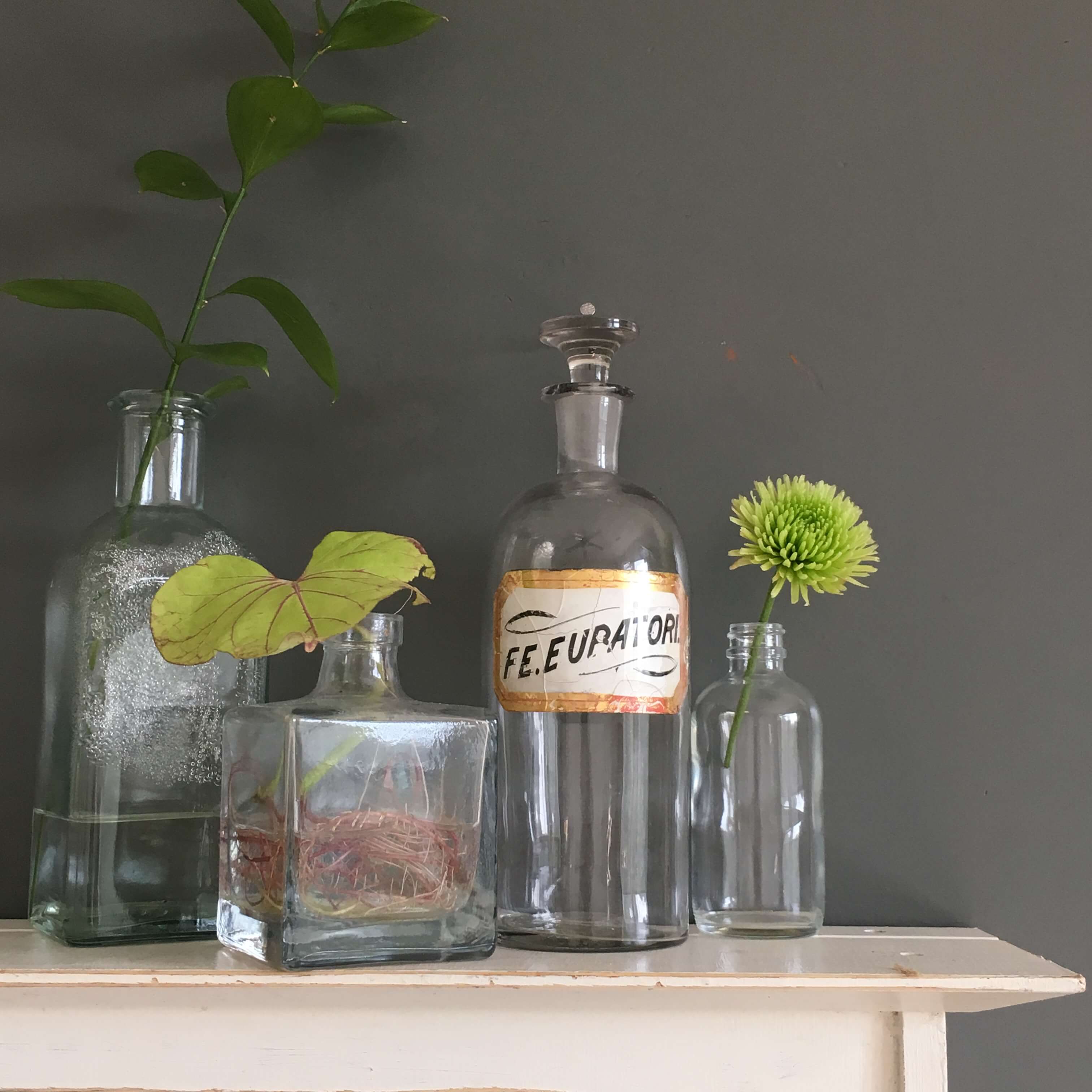
An antique 1800’s apothecary bottle that once held herbal remedies from the Aster family of flowers…

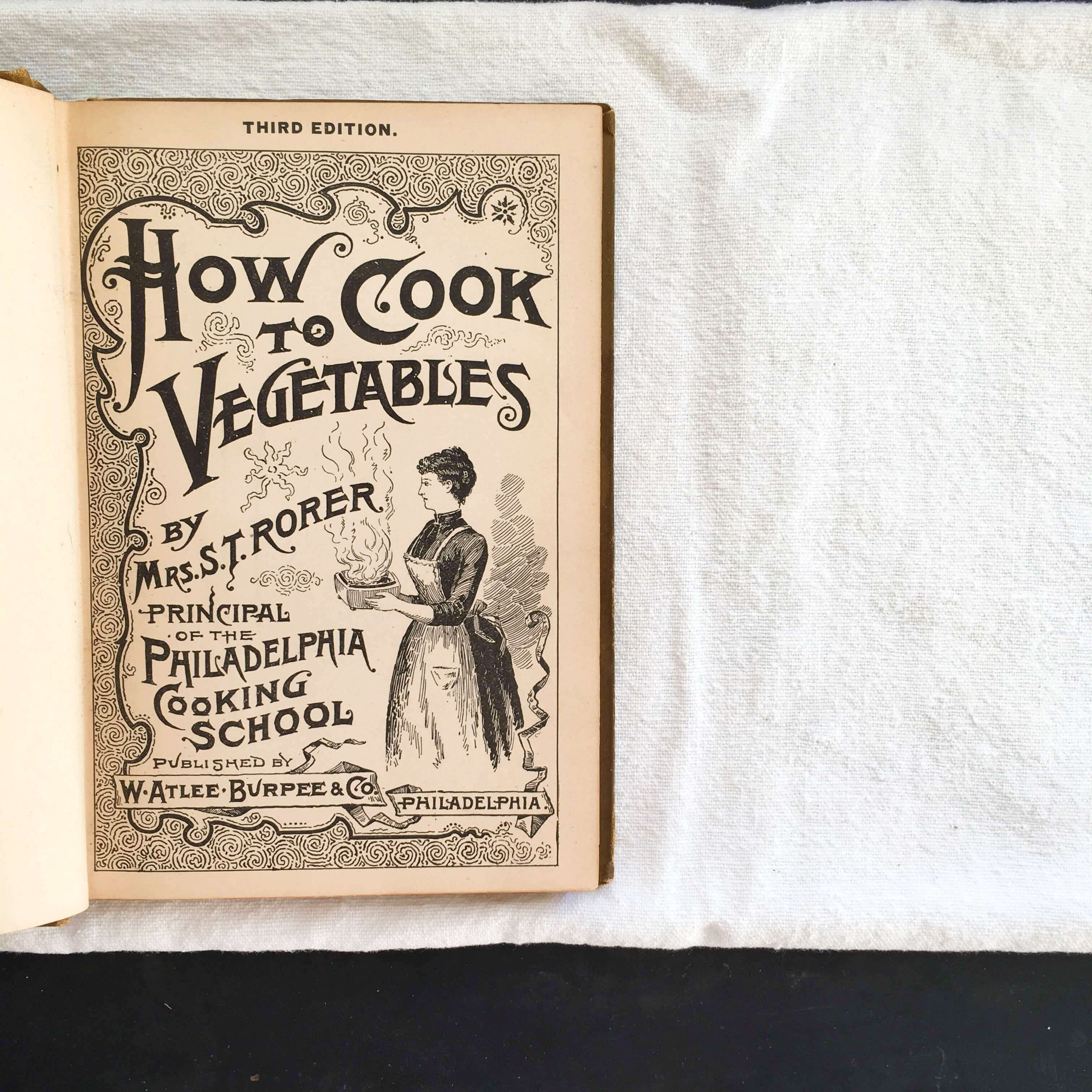
A rare antique vegetable cookbook published in 1892 by Burpee Seed Company and written by Sarah Tyson Rorer (1849-1937) of the Philadelphia Cooking School. Sarah was also known as America’s first dietitian…

A 1936 floral kitchen bowl made by Paden City Pottery which was granted the seal of approval by the Good Housekeeping Institute…

A very rare 1920’s era Nippon porcelain Japanese sugar bowl featuring a black dragon pattern that also comes with a photograph and story of the original owner…

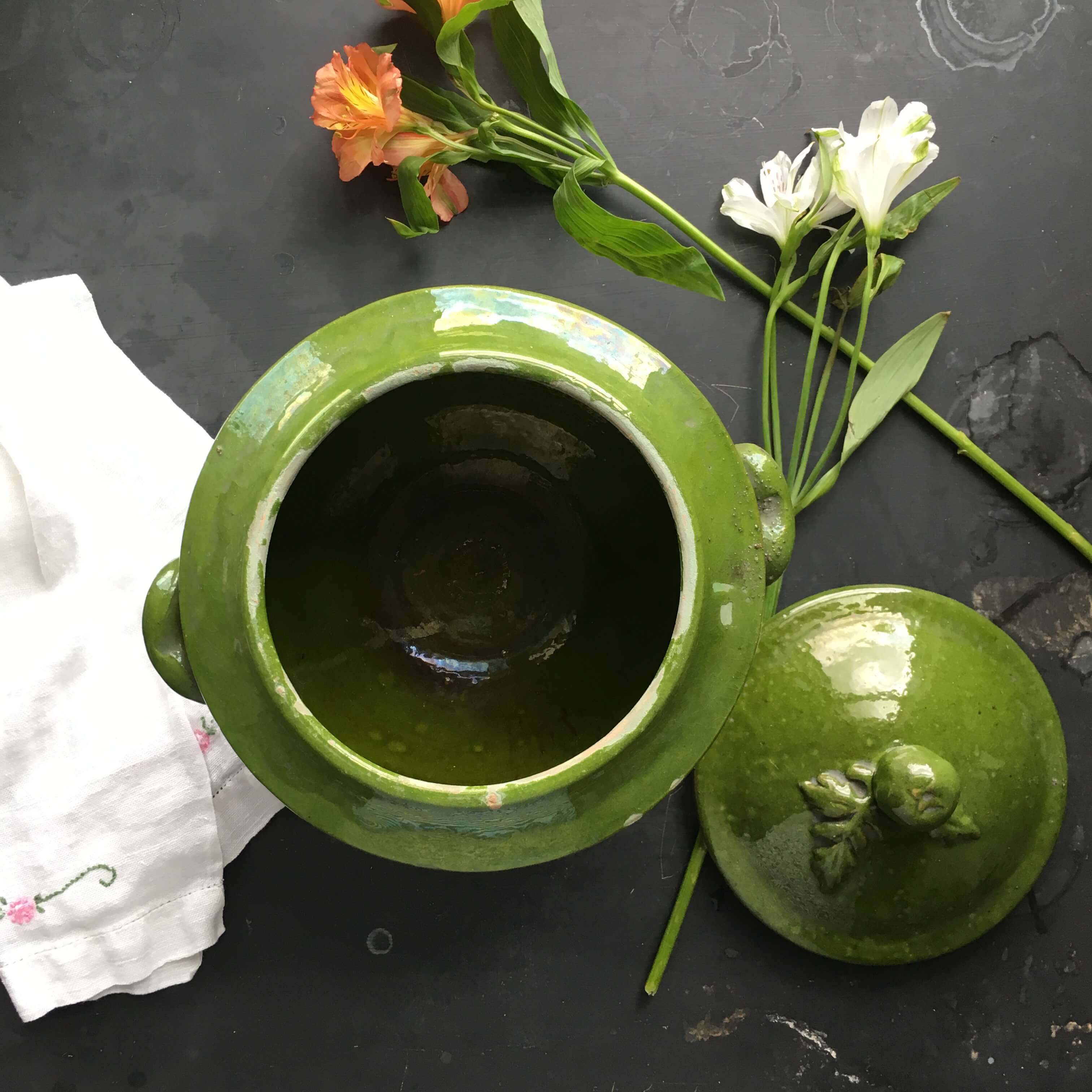
A vintage French pottery soup tureen in the prettiest shade of green…

A collection of various 1950’s state souvenir serving trays that add an extra dose of happy to happy hour…

{A little note:  The following states are available: Georgia, Maine, Utah, Wisconsin, West Virginia, Oregon, Nebraska, New Mexico, Vermont/New Hampshire and Louisiana. These trays are still being added to the shop so if you are smitten with a particular state but don’t see it listed in the shop, please send a message and I’ll be happy to reserve it for you.}

A 1950 first edition of the one of America’s most iconic and beloved cookbooks – Betty Crocker’s Picture Cookbook which includes a menagerie of scrapbook-style clipped recipes incorporated within its pages by a previous owner…

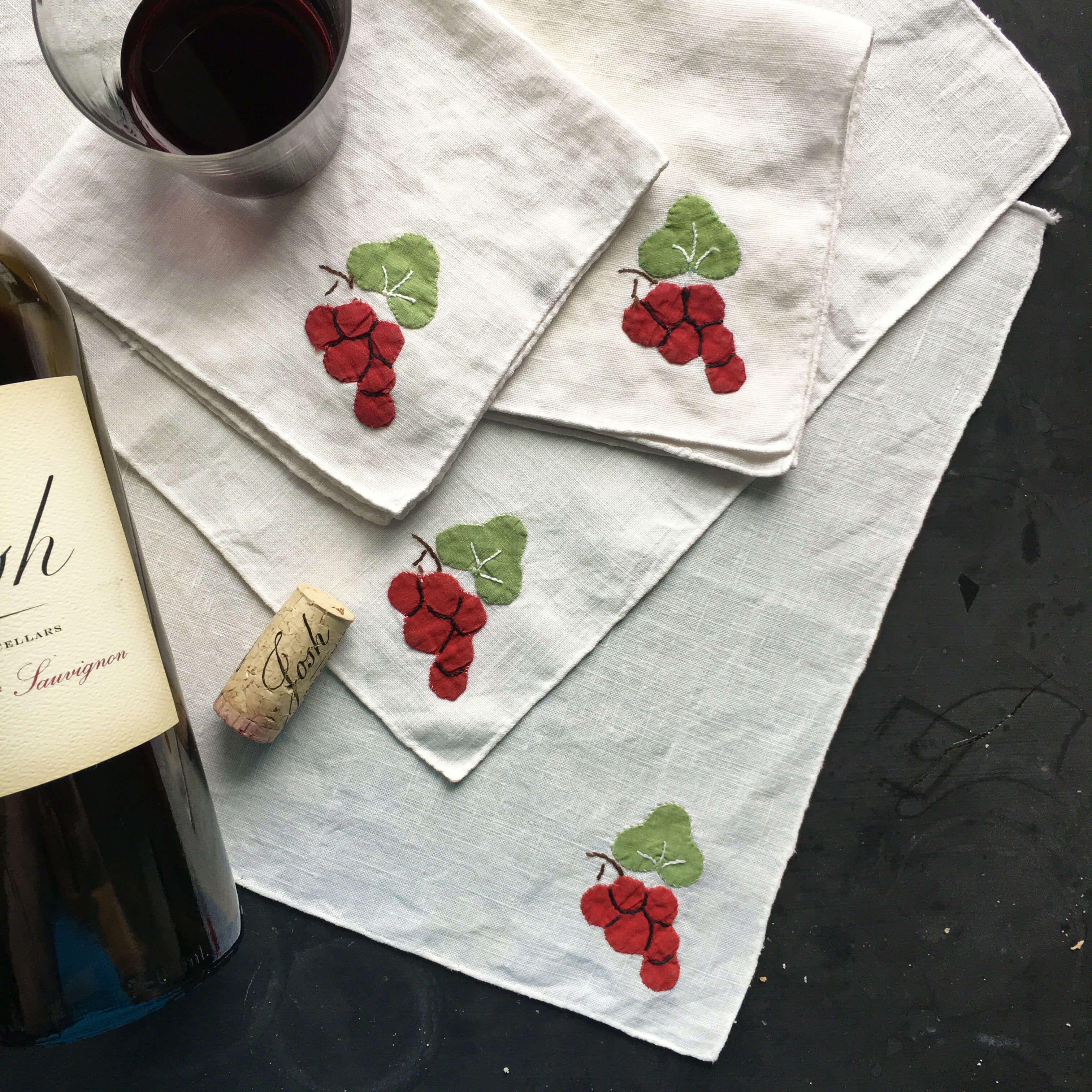
A set of four vintage embroidered grape applique linen cocktail napkins…

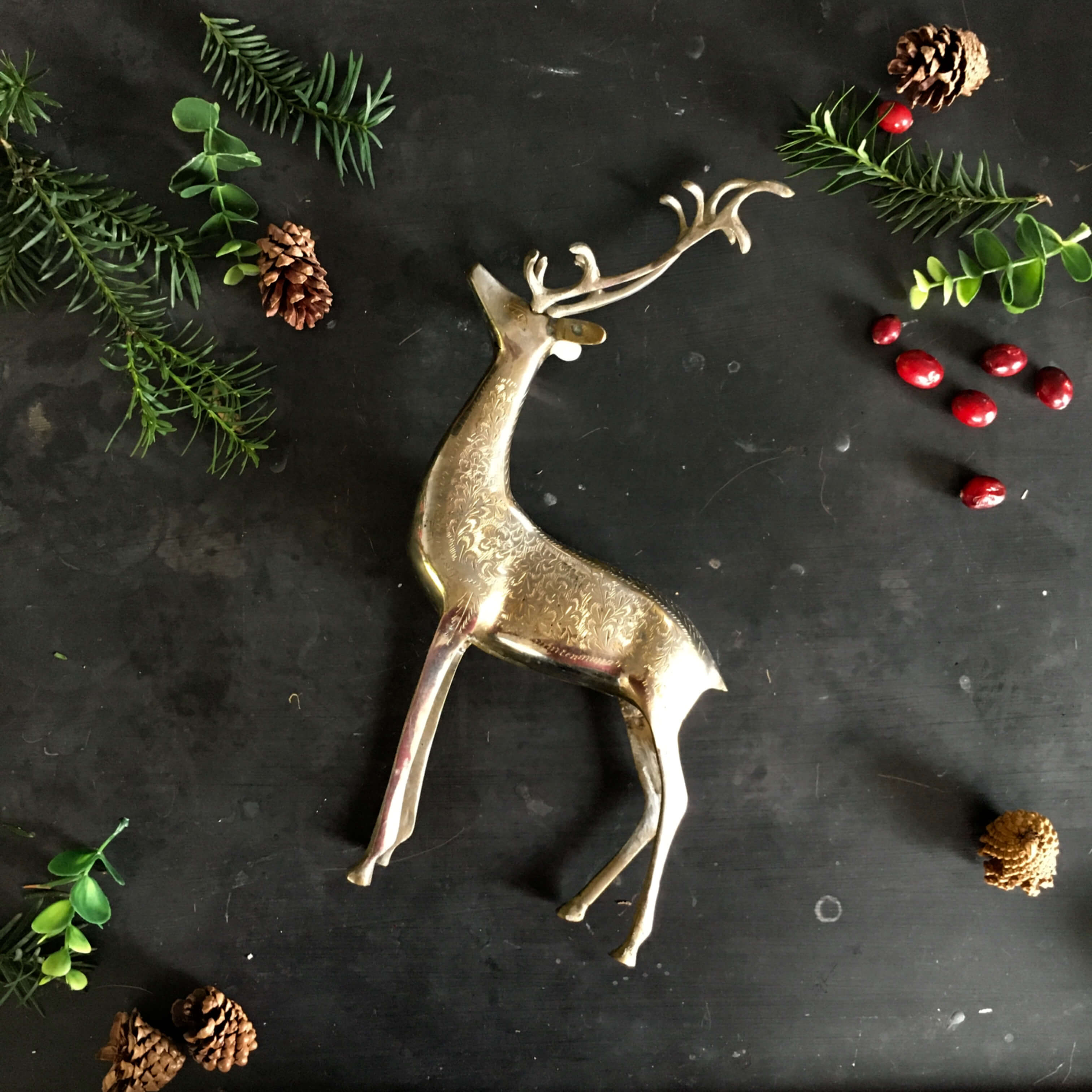
A beautifully detailed nickel plated vintage brass reindeer that handsomely sets the scene for snowy Christmas mantles, festive holiday tables and shiny holiday decor…

And a stunning antique hot chocolate pot set with matching cups. This set was made between 1911 and 1920…

That was just a little sampling of some of the items you’ll find in the shop. To explore more, please visit here.

Whether you are buying a little treat for yourself or gifting a piece of history to someone else, your package will arrive gift-wrapped in seasonal paper so that it can be removed from the mailing box upon receipt and head straight for a spot underneath the Christmas tree. Hope you find some treasures that make your heart sing with joy.

Happy weekend and happy shopping!

Big, Bold and Blandings: The Dreamiest House of 1948

Last week I went in search of Mr. Blandings. More specifically I went in search of Mr. Blandings’ dream house. A challenging feat on both fronts since Mr. Blandings is a fictional character and his real-life dream house no longer exists. This adventure of the seemingly impossible was all sparked by a little snippet of information about a clever marketing campaign produced by Hollywood in 1948. The movie company was promoting this film…

a romantic comedy starring Cary Grant, one of the most beloved actors of the twentieth century. But before we get into the story of searching for a nonexistent man in modern day,  we must first travel back in time to the 1940s,  an era when creativity flourished, outside-of-the-box thinking was encouraged and unusual situations were captivating the country. The first half of the decade was spent in World War II. On the home front that meant conservation, frugality, victory gardens, rations, fundraisers, and bond drives. It was a test in patience, positivity, confidence, and emotional endurance as people lived day to day waiting to hear the fates of their loved ones away at war.  In those first five years of the 40’s people got used to making do, going without, and utilizing every last bit of everything. Thankfully, in 1945 the war ended and Americans adjusted once again to a new normal as they recovered from years of uncertainty. By 1948, two and half years after World War II ended, America was ready for some fresh air and some new perspectives. A glance at that year’s pop culture highlights speaks volumes about the country’s enthusiastic push for progress and for ideas that were new, and stimulating, and fun.  Post-war, post-trauma, post post-sacrifice, 1948 embraced some big ideas that were remarkably different, refreshingly new and spectacularly exciting. Let’s look…

It was the year that Land Rover debuted, bucking tradition with their new all-terrain vehicles, complete with a steering wheel that was located in an unusual spot – the middle of the front console. Tailfins showed up on Cadillacs, a nod towards sleek aviation design and a feeling that your car could take you anywhere. Monkeys were welcomed into NASA’s elite as they became astronauts bravely rocketing into space in order to test conditions so that men could make it there themselves a few years later. America’s affable laughable cartoon bird, Woody Woodpecker had a top 40 hit song on the radio, sharing the same spotlight with singing legends Doris Day, Perry Como, and Ella Fitzgerald. Brand new air ferries started shuttling around the sky, transporting people and their cars from one city to the next. And most exciting of all, on the kitchen front at least, was a man named Blandings who built his dream house.  And then he built 73 more.

While all of these interesting pop-culture tidbits of 1948 are worthy of their own individual blog feature, it is Mr. Blandings who is the topic of our post and our road trip through history today. He created a sensation that took up the last four years of the 1940s, filling people’s heads with dreams of possibility on the home front. It all starts in 1946, when he was the subject of the runaway bestseller called Mr. Blandings Builds His Dream House, a fictional account of a real-life adventure experienced by the author Eric Hodgins. In the book, Mr. Blandings embarks on the ultimate quest  – the American dream of the 20th century – buying a house for his wife and family.

To Mr. Blandings of 1946, a dream home meant extra closets, a private bath in each bedroom,  a game room for him, a sewing room for her, and plenty of outdoor space for the kids. It meant everything that his cramped Upper East Side New York City apartment lacked – peace, security, space, and a good dose of nature.  One day, when he just can’t stand the close city quarters a minute longer, he adventures out to the country to have a look around. One thing leads to another and a new domestic life comes into sight. In the book, it looks something like this, thanks to illustrator William Steig…

The Blandings choose the Connecticut countryside as their ideal homestead, and a historic house that was loved for both its shabby, need-of-repair appearance and its supposed storied place in American history. What develops as the family starts planning their move from NYC to Connecticut (just a train ride away!) involves a series of new house woes that they never expected including demolition and reconstruction.

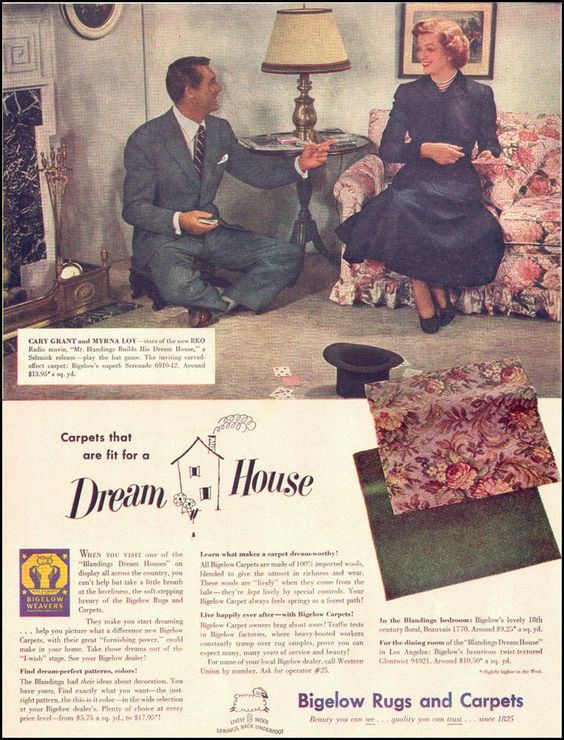
Throughout the story, mishaps and unanticipated scenarios test the metal of all that makes up Mr. Blandings, the man and the mission. At every corner, he and his wife are met with a new challenge. Nothing goes quite according to plan. There are time delays, contractor issues, escalating costs, tricky neighbors, and all sorts of digging, drilling, and hammering surprises.  An everyman story, a timeless tale, an homage to hope, optimism, and the struggle to succeed, Mr. Blandings Builds His Dream House resonated strongly with the heads and hearts of the American public of the mid-20th century. Many of whom were experiencing their own construction trials and tribulations, as the building industry boomed during the post-war years. The book was such a hit that two years after its debut, Hollywood made a movie out of it starring Cary Grant and Myrna Loy.

Just as entertaining as Eric Hodgin’s story, the movie was also an incredible success. Practically all of America fell in love (again!) with the Blandings and the predicaments they encountered. In addition to dealing with the baffling world of home construction, Mr. Blandings also frets over a questionable relationship between his wife and a long-time family friend while simultaneously juggling a deadline for an advertising campaign at work. The trailer doesn’t really do the film much justice, but it does give you a glimpse of the humor that peppers both the book and the movie…

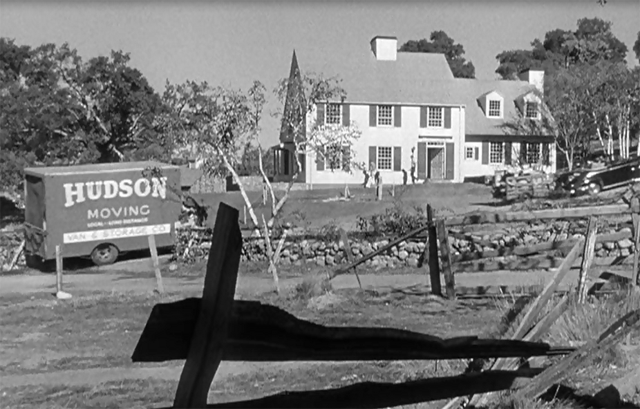
We never really get a good sense of the house the Blandings wind up building until the very end of the movie when the finished product is revealed. It turns out to be a beautiful colonial-style farmhouse set on a few dozen acres of rolling countryside…

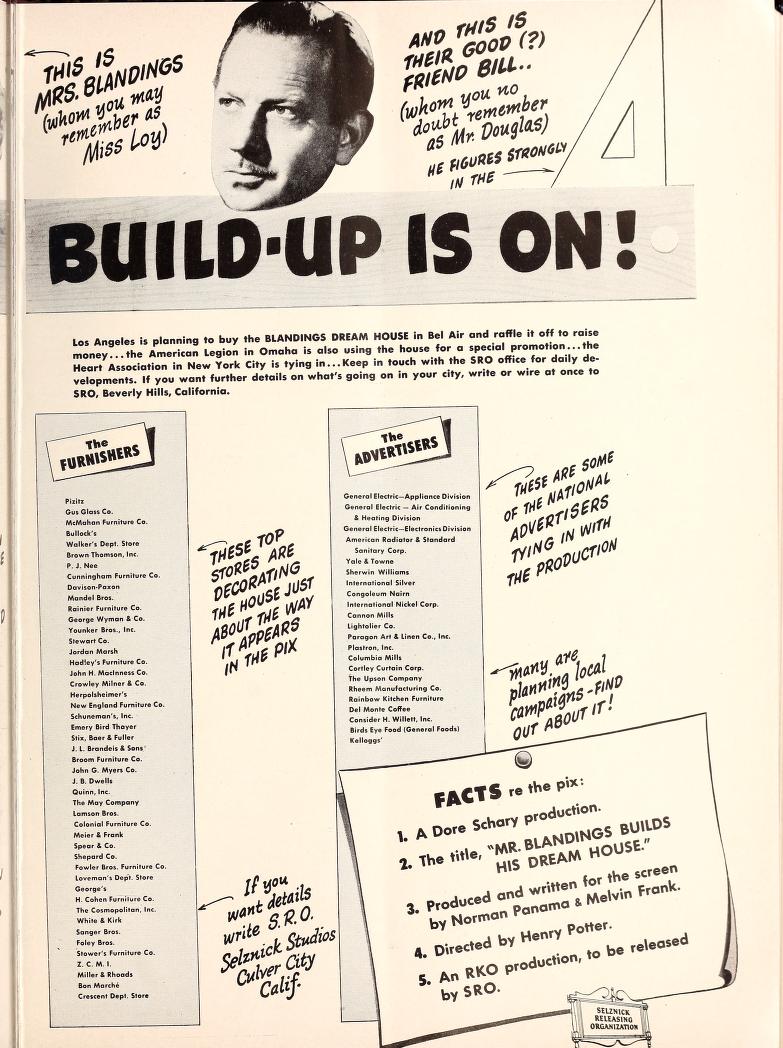
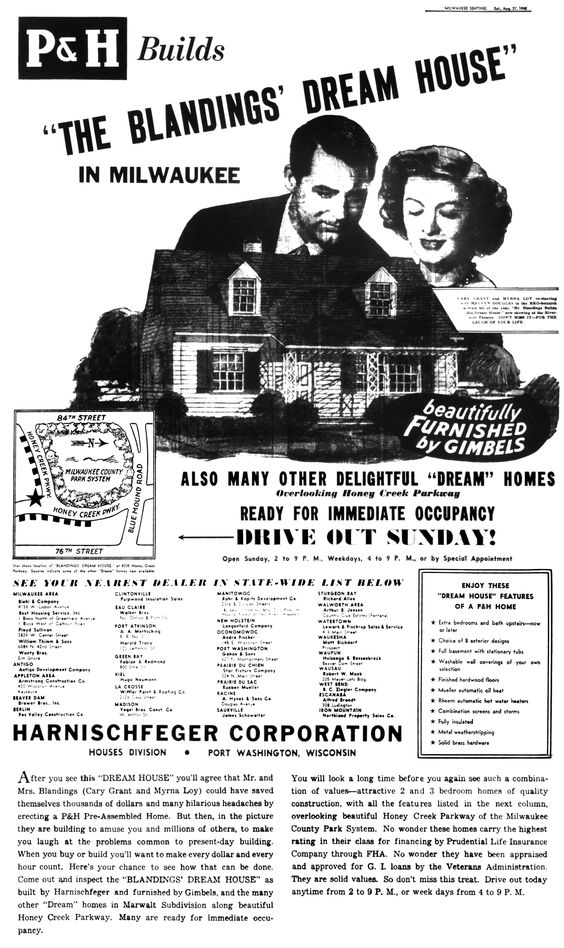
The real-life house that Eric Hodgin’s book was based on was built in Connecticut in the late 1930s. The real-life house featured in the movie was built on pastoral studio-owned property in Malibu, CA in 1947. That makes two real-life houses built for the telling of one story. But by 1948, an astounding 73 more houses were added to that real-life list.  These houses were built in 60 different cities across the country thanks to a very clever and very generous marketing campaign put together to promote the film.  RKO Pictures and SRO Distribution Company teamed up with contractors, construction crews, designers, utility conglomerates, and furniture companies all over the U.S. to build not one… not two… not three… but seventy-three (73!) Blandings Dream Houses that were then raffled off in local contests. Not only was it epic promotion for the movie and the time period, but it was also an exciting opportunity for advertisers to showcase new products and cutting-edge technology for the modern home.
General Electric was a big national sponsor advertising all their latest products including wiring, appliances, air conditioning,  and even electric blankets. Many of their innovations greatly affected the kitchen and laundry areas, turning those rooms into two of the most technologically advanced places in the entire house.

Imagine how exciting and inspiring this campaign must have been back in post-WWII days when everyone was trying to get back on their feet and recreate their own semblance of home and shelter. The average house price in 1940 was about $3,000.00  (equivalent to $32,000.00 today).  The median household income was $956.00 a year (equivalent to about $17,000.00 today). Not totally unaffordable by modern comparisons.  Today, the national median income is $59,000 and the average U.S. home price is $230,000. But the Blandings dream houses in 1948 all came equipped with the most modern features, stylish interiors, and the latest innovations which greatly extended their value.

For people who loved to cook, the idea of winning such a modern home would have been fantastically exciting, as the Blandings Dream Kitchen was one of the most modern and efficient rooms in the house.

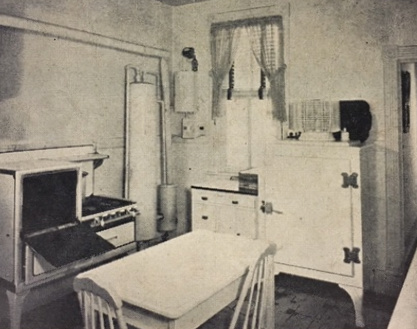
In the 1930s and early 1940s, most American kitchens looked something like this…

… a collection of precariously placed appliances and furniture of all styles that mingled with exposed heating, cooling, electrical, and plumbing fixtures.  While these 1930s kitchens were perfectly functional they weren’t necessarily set up for ideal ease, comfort, or organization.  By the time the Blandings declared their dreams in the 1940s, kitchens were becoming much more aesthetically pleasing and helpful. Built-in cabinets, long countertops, hidden utilities, ventilation hoods, picturesque windows, bright colors, and designated dining nooks made cooking more efficient, enjoyable, and aesthetically pleasing. You’ll notice that these 1940s kitchens below also utilized corners, shelving, and seating to maximize floor space.

When the movie first premiered in New York in March of 1948, ad campaigns began rolling out across the country announcing the Dream House Build-Up, so that by June when the Blandings were in theaters nationwide, the excitement and anticipation was at a fever pitch.

The Skokie. Illinois Dream House. As of 2025, this house is still standing, beautifully maintained, and looks very much the same.

Each of the cities that participated in the big build invited the local public in to view their custom version of a modern dream house.  What was especially intriguing about this promotional campaign is that not all of the houses built in each city were an exact replica of the Blandings dream house or its colonial style. Some cities chose to build houses that were more suited to their own local climate or aesthetic. The one built in Knoxville, TN was a one-story rambler…

This one in Milwaukee was a smaller cape-style cottage…

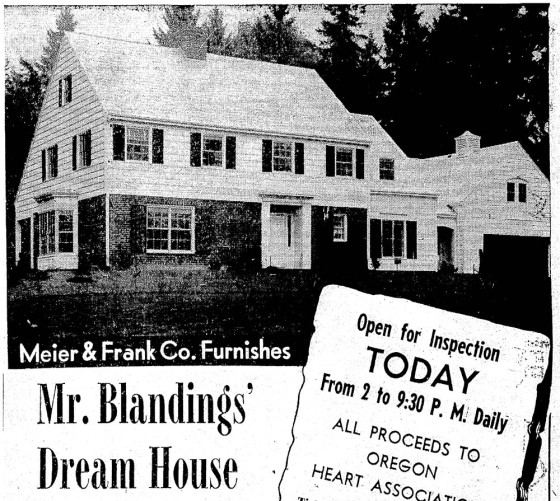
In Oregon, the dream house contained elements of brick and siding…

Read more about the Portland version of Mr. Blandings’ Dream House here.

Most of the Blandings promotional houses were built in suburbs  – the big city shadows where land, space, and freedom offered opportunities for the American dream to grow and spread. From Jacksonville, Florida to Seattle, Washington; from the Eastern Shore of Maryland to the Pacific Coast of California; from the top of Minnesota to the bottom of Texas fictional dreams were determining real-life destinies. That brings us back to the modern-day road trip that I embarked on last week.

This is the complete list of all the cities that participated. Is there one in your town?

Excited to see that Nashville was listed as one of the “Dream” cities, I went in search of Blandings in my own neck of the woods. This is what the Nashville dream house looked like in 1948…

Unlike the one built in Knoxville, the Nashville house was built in the exact same style as the one in the movie. Located in a very pretty section of town, noted for its gorgeous old-growth landscaping and stately historic homes, I was excited to see what the Blandings dream house would look like now. As I drove there, I pictured the house as it had appeared in the newspaper in 1948… the graduated rooflines, the shuttered windows, the dormers, the picket fence sectioning off a garden area highlighting the shrubs and the flowers and the trees newly planted. All those freshly landscaped 1940s plantings surely have grown into stately trees and mature gardens by now.

Here is what I found…

Pretty! But not exactly the same house as the one pictured in the newspaper advertisement…

As it turns out, unfortunately, the original Blandings house was torn down in the 1970s. This new house occupying the spot now was built in 2016 and then promptly sold for $1.6 million. Quite a price difference from the 1940s cost of a Blandings colonial.  Although this new house is not of historical design, it is fun to see that the roof line, dormer window, and landscaping are quite similar and complimentary to the original Blandings style. Perhaps this house designer was a 1940s fan too.

As I was about to drive away, an elderly man came out from the garage of the house located directly across the street.  Emerging from a much more modest home in size and scope, this old gentleman was shuffling down his driveway with the help of his cane, wearing a wool cardigan, pajamas, bedroom slippers, and a determined look.  I suspected he was headed towards his mailbox, perhaps a daily jaunt taken for exercise and fresh air. Immediately, I thought of Mr. Blandings and of Cary Grant and of Eric Hodgins and I waved to the man shuffling down his driveway in an act of good cheer and neighborliness.

I was hoping he’d respond, perhaps with a knowing glance or a nod of understanding that said yes, he did live across the street from a famous film industry-inspired house. But the elderly gentleman didn’t wave back. Obviously, he wasn’t our hero of book and screen. But in that moment I imagined that this stooped-over grey-haired guy, trembly and slow with age, was once an invigorated young man bent on building a dream house of his own for his wife and children. I imagined that he once lived in a small, cramped apartment in a big city and that one particular day he too got fed up with the close quarters and set out to become master of his own domain. I imagined that his idea of domestic bliss was indeed the very house, the sprawling brick ranch, that he had just emerged from. Obviously, he wasn’t Mr. Blandings. But then again… maybe he was.

Cheers to dreamers and to real-life houses that inspire books that then inspire movies that then inspire more dreamers and more houses. And cheers to Mr. Blandings, who is not real, but feels very much so.

If you are interested in reading the book that sparked this nationwide love affair seventy years ago, find it in the shop here. If you live in one of the dream cities that built a Blandings house please comment below and tell us all about your famous local icon. We’d love to hear more about it!

Turning Servers into Succulents: A Vintage Re-Invention


Eight. That’s how many days there are to go. It’s almost here! Then one thing turns into another. We end and we begin. We change and we grow.  This year, the day falls on a Monday. The exact date – September 23rd.  Then it’s official. The first day of Autumn arrives. How exciting! To celebrate the season, I have a fun new gardening project for all you do-it-yourself-ers out there who like to keep your hands busy in the dirt in the off-season when summer turns to fall and fall turns to winter and the outdoor garden is at rest. It doesn’t require much effort, time or expense but it does call for a little imagination. It will last forever if you want it to and it will make you look at things in your cupboards in a whole new way. Most importantly, it gives new purpose to old items that sometimes get left behind on a shelf or forgotten about in storage.

I’m so excited to introduce the succulent set…

vintage-serving-dish-succulent-planters

…real plants growing out of old china serving pieces. If you’ve inherited pieces of your family’s china and are not quite sure what to do with them or how to incorporate them into your daily life, or if you just want a planter with a little bit of one-of a-kind personality then designating a vintage sugar bowl or a creamer or a serving dish as your new garden vessel is a fun way to go. Let’s look…

This Japanese Majolica creamer is from the 1940’s. Due to some cracks on the bottom it no longer holds water (or cream!) so it makes an ideal container for varieties of succulents that prefer well draining soil. All it needs is a little water once a week and it’s ready to grow. Keep it in the sink for a few minutes and the water drips out through the cracks, then it is good to go until its next watering seven days later.

Vintage sugar bowls like this one above, made in England, fit perfectly into shelves or small spaces. Your very own unexpected mini garden greenspace place!

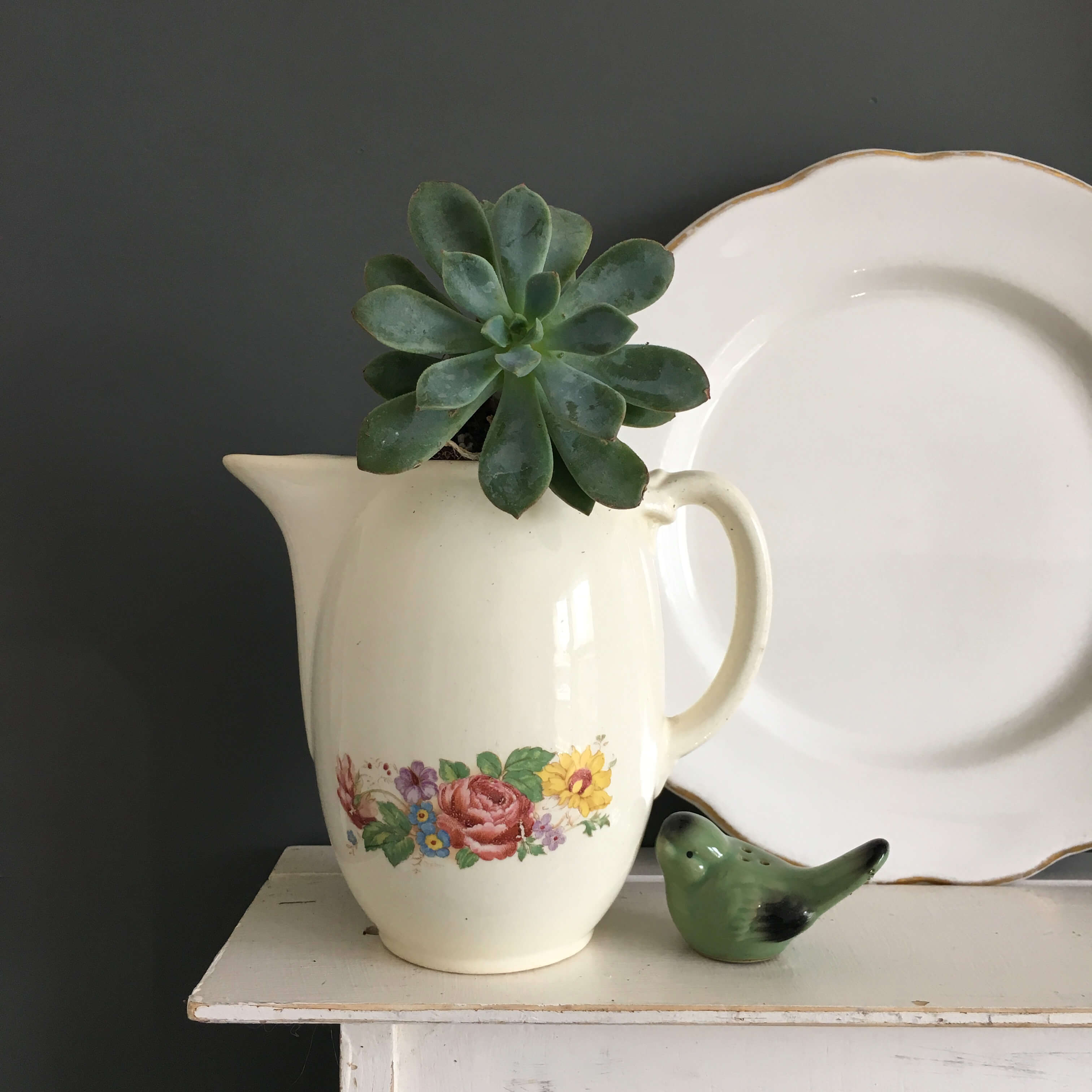
This vintage coffeepot from the 1940s lost its lid somewhere along its 75 years of travels. That makes it no longer the most suitable vessel for hot coffee but it certainly makes a pretty container for eye-catching flower power in the form of a petal shaped succulent.

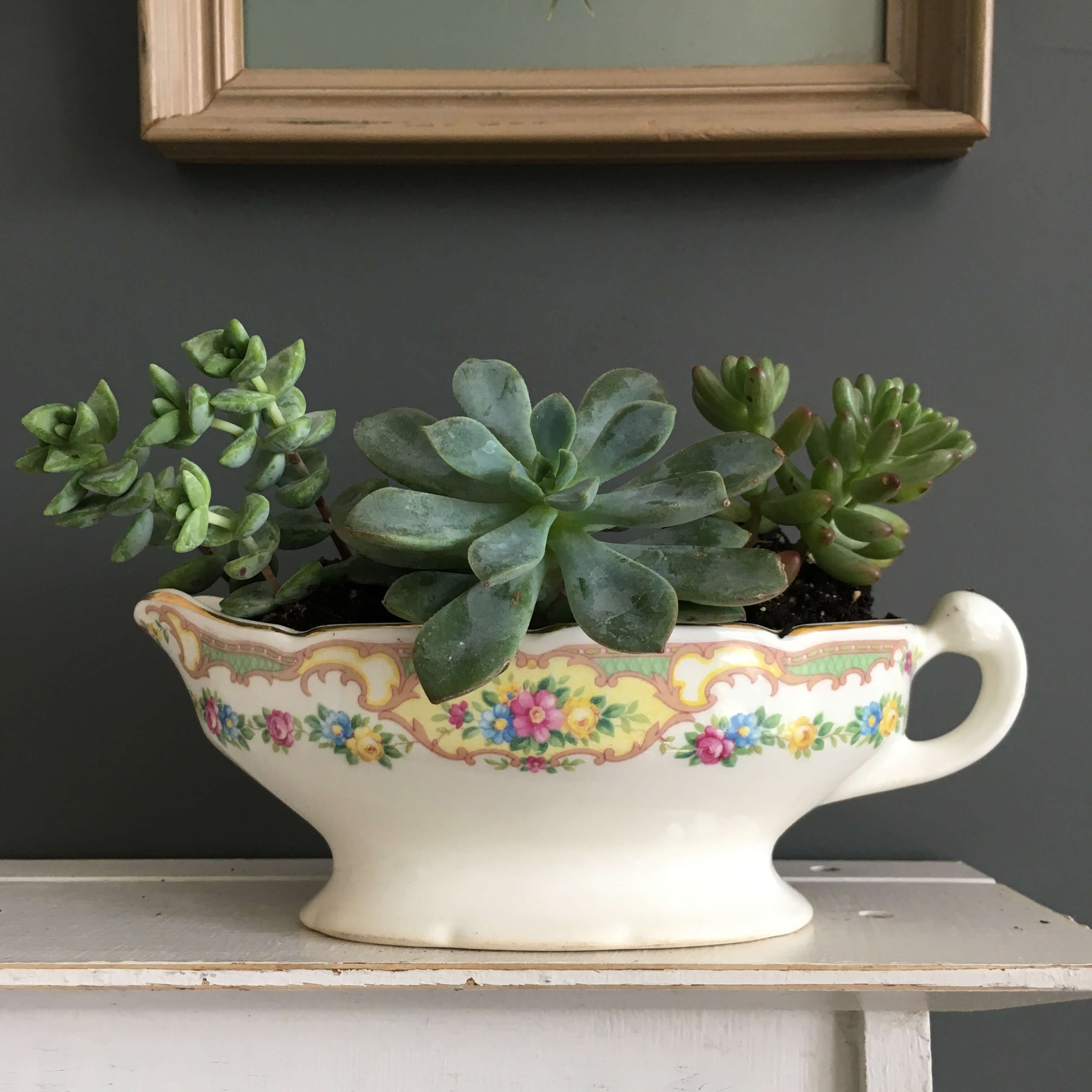
With their long shape and roomy width, gravy boats make great table centerpieces. They can usually accommodate more than a couple of mini plants depending on size. For wedding reception decorations, they offer the symbolism and sentimentality of “something old, something new, something borrowed, something blue.”

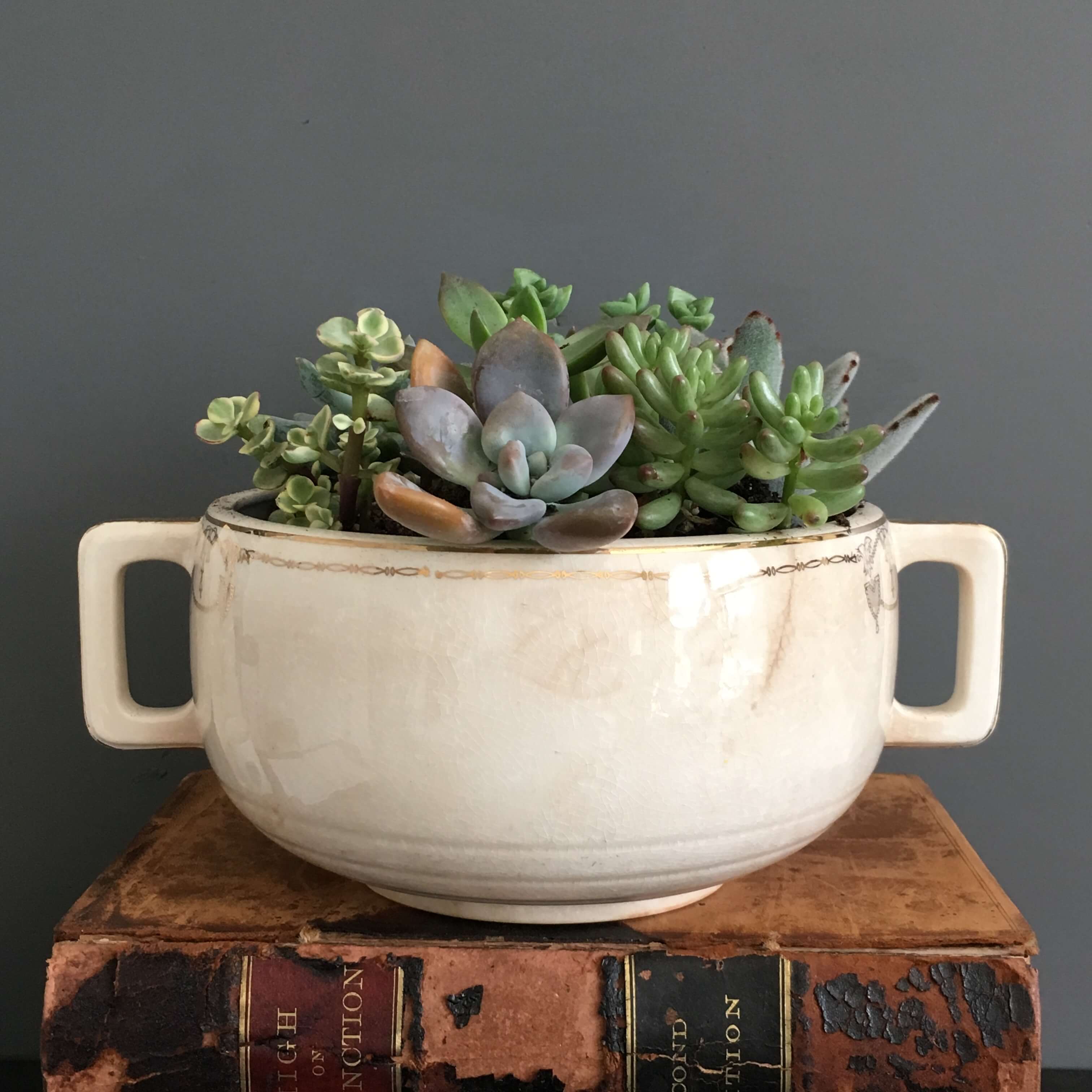
Ideal plants for this type of pairing project, many succulents don’t require a lot of watering and come in a variety of sizes, colors and shapes. As they grow, the plants can be transferred to larger and larger containers like this one – a two-handled vegetable dish from Salem Pottery’s Commodore pattern which debuted in the 1940’s. Because of its larger size it can accommodate up to seven 2.5″ inch succulents or just a few bigger individuals that have outgrown their smaller holders…

vintage-mini-succulent-garden

Authentic crazing, staining and chippy details add interesting, quirky personality to your space that you can’t find in modern day planters. They also easily fit on window sills, ledges, mantles and counter top nooks. Choose one that matches your interior aesthetic, or the colors of your kitchen, or reminds you of a good memory and you’ll instantly add a bit of happy energy to your space. Old dishes love to remain useful helpers. Matching the old with the new creates balance and harmony and reminds us that imperfections are the stuff of life. Beautiful! This antique gravy boat below is over 100 years old but still looks as fresh and pretty as ever thanks to its classic shape.

The trio below have no cracks to worry about so they are ideal holders for succulents and cactus that prefer to be spritzed with water, rather than doused, every now and again. Add some some pea gravel to the bottom of each vessel before adding dirt and certain succulents will be happy with just a tiny bit of water every now and again.

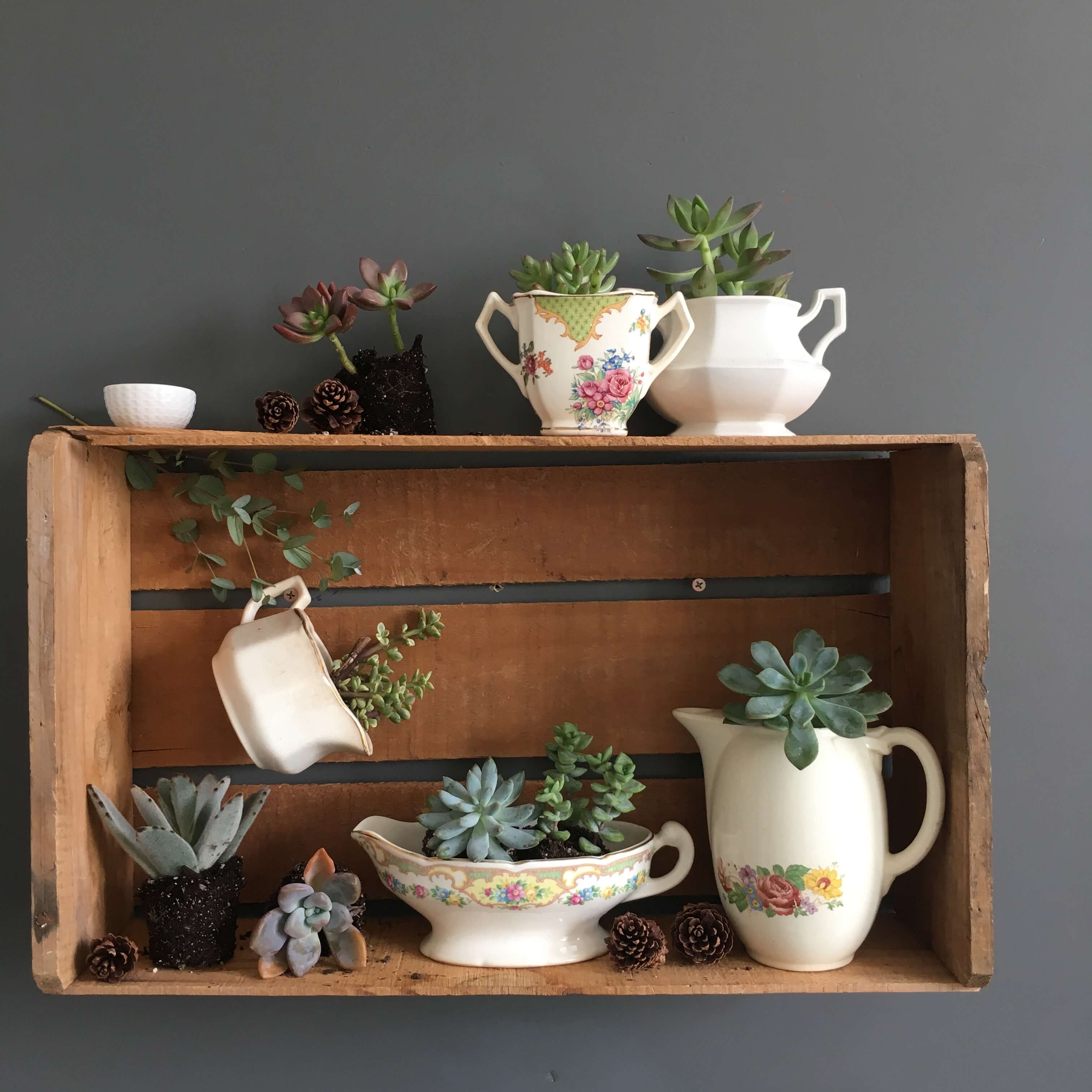
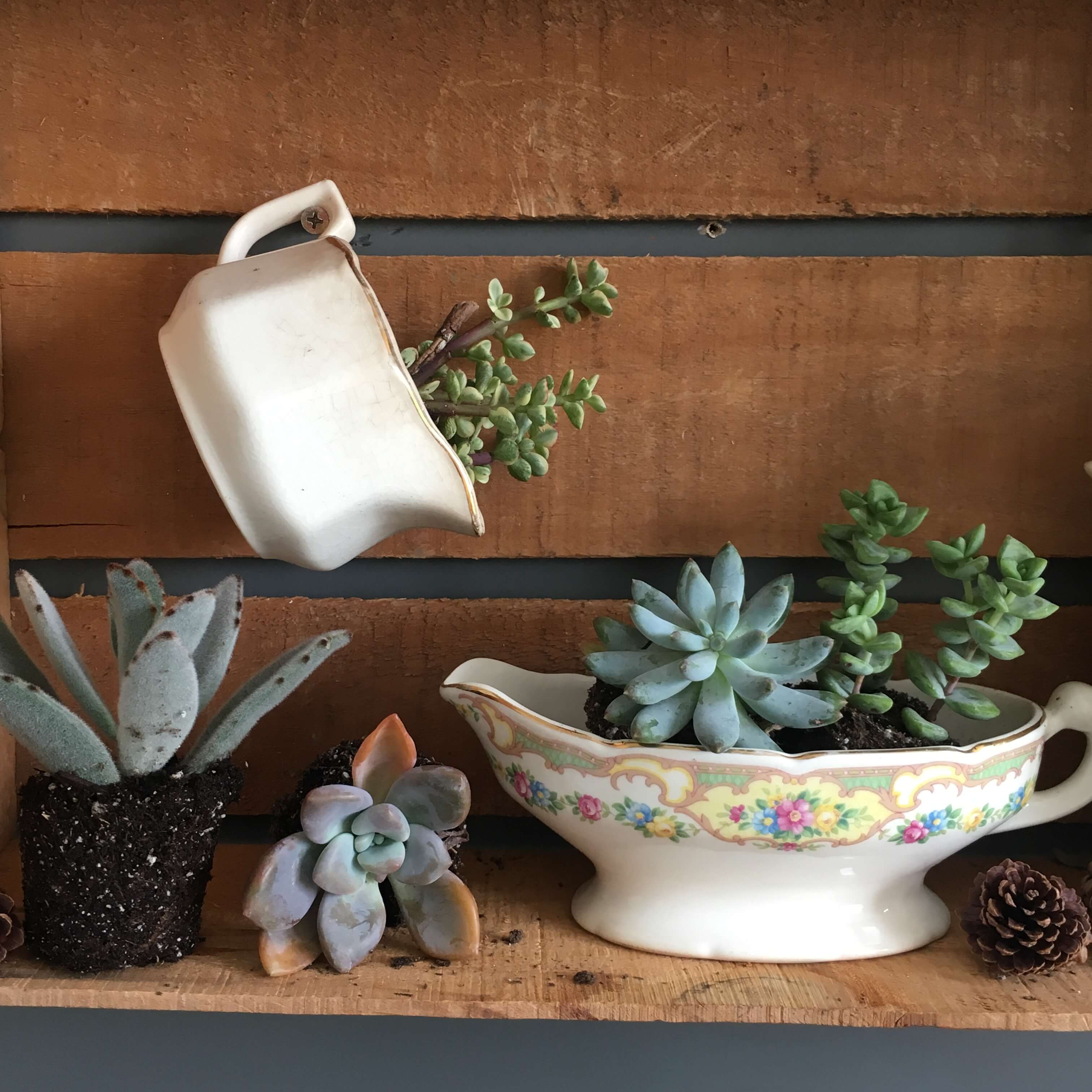
Another possibility is to gather them all up and make a hanging wall display with the help of a crate…

vintage-serving-dish-succulent-planters

That makes an instant collection and an engaging garden that you can cultivate and tend to all year round. Usually all that is required for succulents is bright natural light, a sunny alcove or close proximity to a window.

With all their color choices which range from light gray to soft pink, bright green to dusty blue there is great fun in matching plant to planter and then watching them grow and sprout new additions.

If you need a vintage serving piece to start your garden you can find the ones above in the garden section of the shop. Succulents are available at most garden centers, nurseries, farmers markets or sometimes even the floral section of the grocery store. I recommend getting your planter first, then your succulent second, so that you can determine the appropriate drainage condition, color and shape for plant and planter.

Hope this brings a little fun your way on our second to last Sunday of summer. Cheers to new gardens, old dishes and the joy they both provide:)


Authentically Artisan: A Fun New Food Collaboration

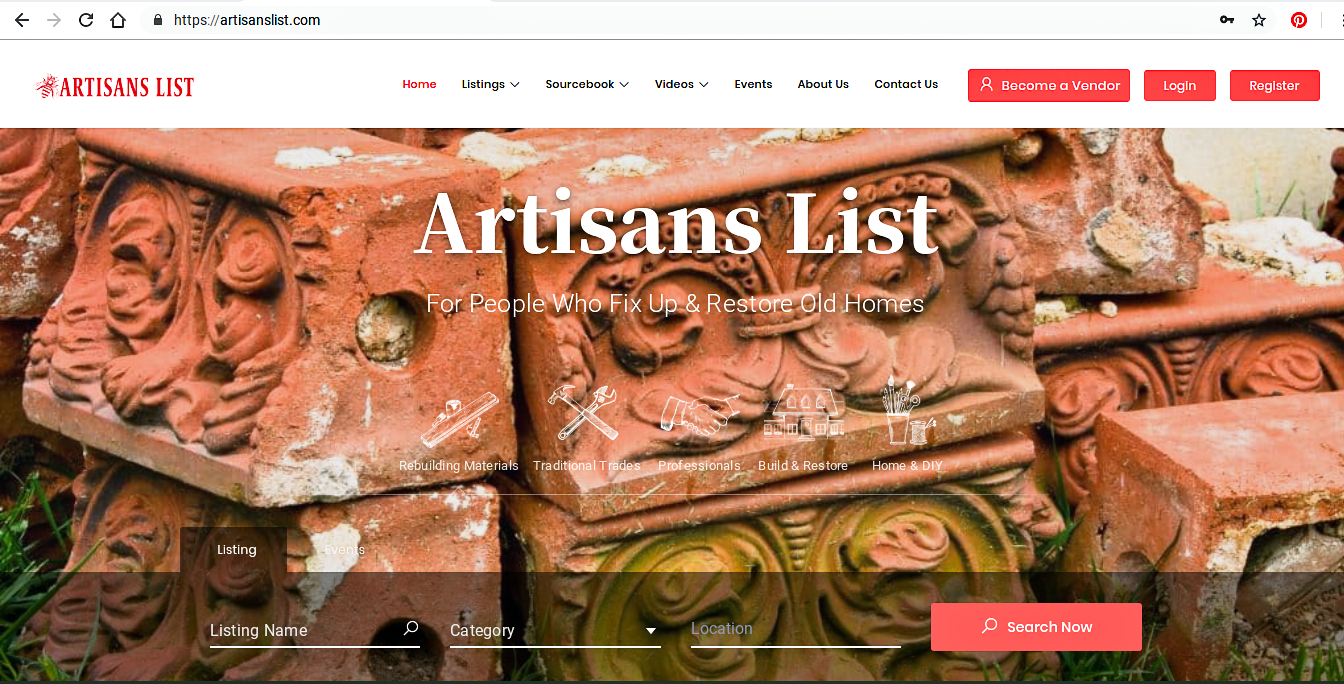
One of the highlights of the summer so far has been the start of a new collaboration with a fellow history-centric company. I’m so pleased to introduce you all to Artisan’s List, a nationwide directory geared towards the historic home improvement enthusiast or anyone interested in defining their space with handmade touches and artistic refinements.

Just a few of the talented vendors I discovered at Artisan’s List! Clockwise from top left: Natural orchard and landscape design by Janice Parker ; handmade copper cookware by House Copper & Cookware; beautiful backyard chicken coup designs by The Chicken Coop Company

As a go-to resource for niche projects, Artisans List is a dream come true for people who just want to get stuff done. If you have a vintage sofa to reupholster (me!), a backyard fruit orchard to plan, an addition to add onto your house or are trying to hunt down a blacksmith for hand-forged drawer pulls, you’ll find just the right expert to work with at Artisans List.

There, in the dynamic world of creative pursuits, you’ll discover makers of handmade pots and pans, landscape architects, historic home renovation consultants, furniture makers, blacksmiths, stone masons, roofers… basically all the people that can help turn your home project ideas into realities – from the roof line all the way down to the basement floor and everything in between.

Skilled tradesmen include examples like these (clockwise from top left) Historically accurate reproductions of architectural millwork by Architectural Components Inc.; antique and vintage stove restoration by The Antique Stove Hospital ; hand-forged decorative metal work made by traditional blacksmiths

As a resource guide made up of traditional craftsmen and skilled tradesmen AL is a beehive of interesting information, ideas and inspiration that continues to grow more dynamic each day. The whole concept of the directory was born out of the lack of an online community that catered specifically to the local home restoration marketplace state by state. So the founders of Artisans List are very intent on making the site an informative, educational, and useful tool for people all over the country. Each of the AL vendors are vetted to make sure that their business and/or skill is authentically produced and professionally handled. Most of the companies have been around for decades, and even generations which means vast portfolios, passionate voices, and trusted relationships. Exactly the kind of care and expertise you need when it comes to planning and executing a project for your treasured space.

Amidst this talented pool of professionals, you’ll also encounter an active and interesting community of do-it-yourselfers who are looking for ways to build a more thoughtful and storied lifestyle. That’s where the Vintage Kitchen comes in. Every other month, I’ll be writing a piece for the magazine portion of the Artisan List  site that features a vintage recipe and the history behind it.

The first piece came out at the end of  June and is all about picnicking. If you missed the mention of it on social media a couple of weeks ago, no worries, I’ll be re-posting the entire article here on the blog in the next few days. But before that happens, I just wanted to share the news with you and to say surprise! the Vintage Kitchen is popping up in a new place.

I think this collaboration is especially fun since we have so many old house lovers and owners (and readers!) that participate in the world of the Vintage Kitchen. It’s with you in particular that I share this information, in case you are looking for some expert help with your own home projects this year. I hope this recommendation helps! If you wind up connecting with one of the Artisan List vendors or find a particular piece of home restoration information useful, please share your story in the comments section, so we can all learn together. In the meantime, stay tuned for a bevy of Artisan food articles coming out soon!

Cheers to new friends, expert helpers, and a wonderful weekend ahead!