The Snow Day and The Simmering Stove: Ruth Reichl’s Chicken Fricassee

There is something magical that happens when your cooking and your reading and your weather all line up together. It’s 14 degrees today (for the high!) and it’s snowing big, fat flakes in every direction (for the second time this week!). With pure delight, I write this because it has been a very long time coming. Winter weather in the South is never usually this charismatic, so for an eternal snow lover like myself, these past few days have been absolutely fantastic.

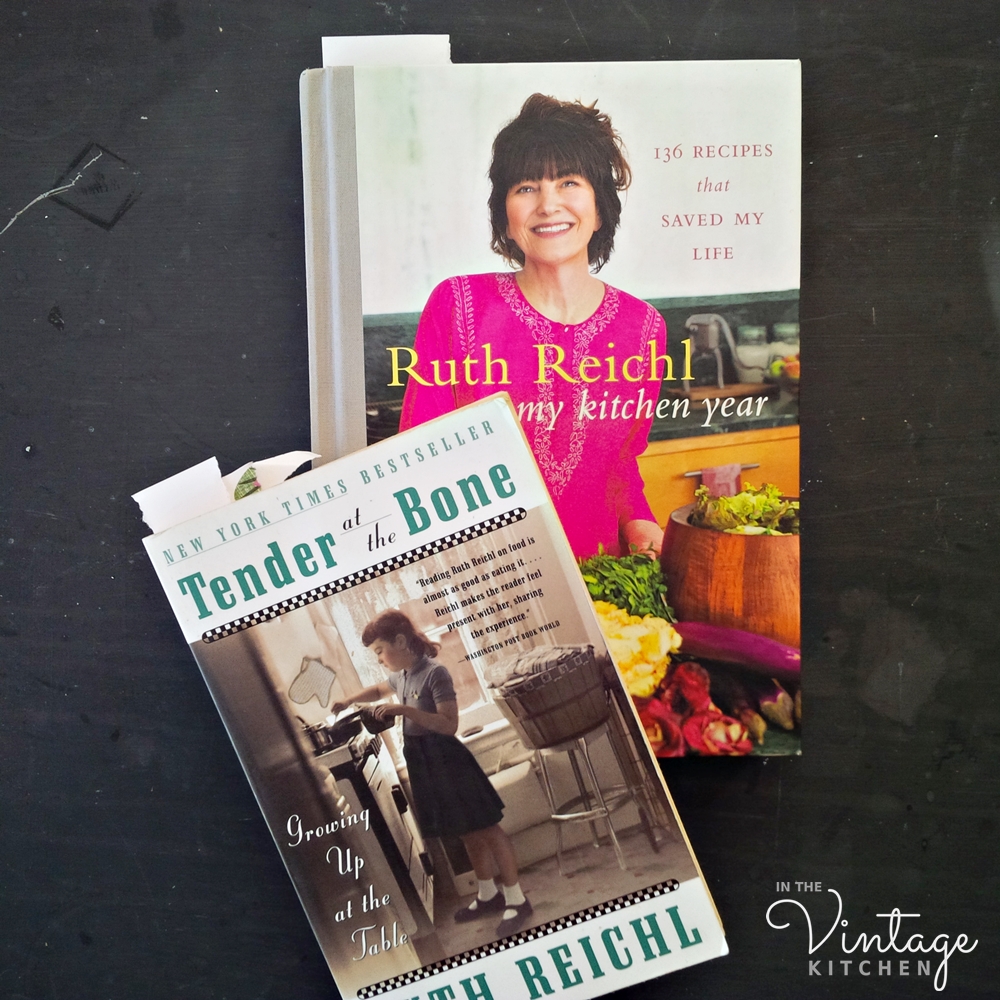
I’m eighty pages into Ruth Reichl’s latest cookbook, My Kitchen Year, where it is also winter. Ruth is writing about the freezing temperatures and the snowy landscape in upstate New York and how the seductive aromas of long-simmering onions and butter and chicken and wine have the ability to both warm the stomach and the spirit.

From Ruth Reichl’s latest cookbook, My Kitchen Year, published in 2015

Today, its Ruth’s birthday, so we thought it would be fun to make one (or two) of her recipes to compliment both the winter landscape we are reading about and the winter landscape we are actually experiencing. If you are unfamiliar with Ruth Reichl,  she has been around the food scene since the 1970’s as a writer, chef, food critic, host and magazine editor in all realms of media from print to television to radio.

Ruth Reichl

I first heard of her when I was a teenager, riding up the West Side Highway with my dad and my sister. At that point, in the early 1990’s, Ruth was the food critic for the New York Times. Her restaurant reviews would air on the morning commute segment of the local classical music station favorited by my dad as he battled his way through New York City traffic. The spot, sponsored by Veuve Clicquot, contained her latest restaurant review and was, to put it politely, very honest. More often than not, she disliked a restaurant or the food or the service and she wasn’t afraid to say so. She’d sign off every review saying “I’m Ruth Reichl” and my sister and I used to mimic her voice in the car.

Growing up in New York, where most endeavors get scrutinized on a daily basis, I was used to reading about reviews and hearing criticisms on a variety of subjects when it came to the creative arts and emerging trends. But the way Ruth talked about food and service and presentation was elevated to a whole new level of description. Her words were candid but also sophisticated and humorous when it came to observation.  Each review was a brave, opinionated tale of her own experience that flew through the air seemingly without care as to whom it might affect at the restaurant of concern or what impression it might make of herself. The three us, my dad, my sister and I  thought she was pretty audacious. We used her name as our own descriptive tool when it came to trying out restaurants in the city…”Well it’s no Ruth Reichl…” and all of us made special note to remember the names of the restaurants she lauded because certainly, they didn’t come around often.

Fast forward a decade and a half later, I spotted Tender at the Bone, a memoir she had published in the late 1990’s, for sale at an outdoor book stall in Philadelphia.  I bought it,  took it home and immediately called my sister. “I’m Ruth Reichl”  she said and we both laughed over memories of driving with our dad on the West Side Highway. And then I actually read the book, which was marvelous and to my surprise, very vulnerable and humbling. There was no restaurant critic in her voice in these pages. It was all heart and humanity when it came to discussing family, food and growing up. And there were recipes – good ones, homey ones that everyone enjoyed – brownies, deviled eggs, pot roast, fruit tarts etc.  I loved it so much, I immediately read her other two books which followed – Comfort Me With Apples and Sapphires and Garlic. Those books covered her young adult years in food, job and relationship explorations and then those famous years as a restaurant critic when her job was no easy slice of pie.  These stories slashed through all my pre-conceived notions of who I thought Ruth was when I was a teenager and she was sponsored by a champagne company. And most importantly her books were my first introduction into reading food memoirs… not so much for the recipes but for the stories behind them.

For a long while, lots of things coming out of my kitchen stemmed from Ruth either in the form of recipes from her books or ones from her magazine, Gourmet, where she held down the fort as editor-in-chief.  The food she featured always contained simple elegant ingredients that looked pretty on a plate and satisfied all the senses in a most appealing way. Even though I’ve never met her, Ruth has been a reliable companion in my kitchen, which brings us back to this post featuring her birthday celebration on today’s cold winter’s day. I selected these two recipes because, like the lively lady herself, they are full of depth and require some care and attention in a fun and fulfilling way. Also, they make the kitchen smell like heaven.

Chicken Fricassee and Show-Off Salad

The vintage recipe, Show-Off Salad (aptly named because you prepare the whole thing at table in front of your fellow diners) is from Tender at the Bone and the classic yet modern day recipe Chicken Fricassee is from her latest cookbook My Kitchen Year.

Both recipes are a great representation of my memories of Ruth – they might seem a little fussy at first but at their core, they are just real, simple and basic dishes that have universal appeal. Hope you enjoy them just as much!
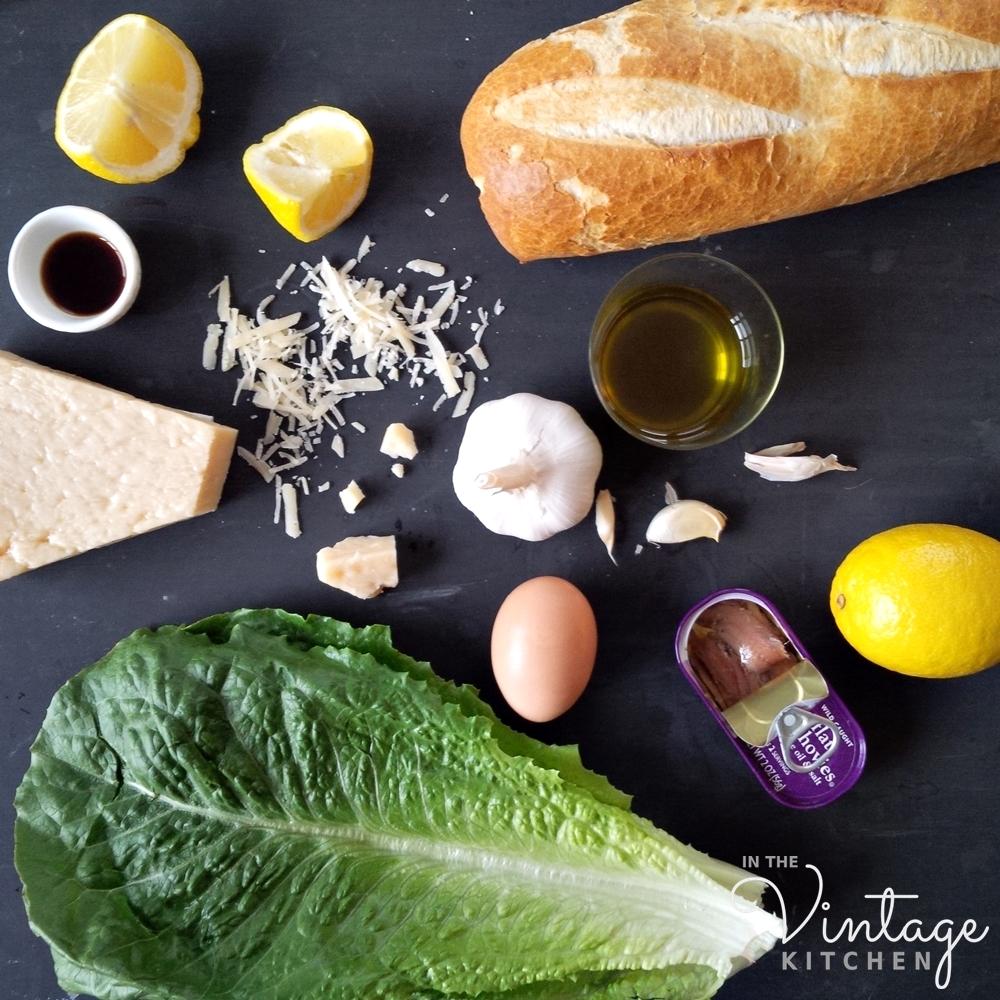
SHOW-OFF SALAD – Serves 4

2 cloves garlic

1/2 cup olive oil

1 cup cubed stale French bread

1 egg, organic, farm-raised

1 small head of romaine lettuce

1/2 teaspoon Worcestershire

1/2 teaspoon salt

pepper to taste

1/2 of a large lemon

4 anchovy fillets, cut into quarters

1/4 cup freshly grated parmesan cheese or more if desired

Make the croutons. Crush one clove of garlic and add it to two tablespoons of olive oil in a medium size pan over medium heat. Add the bread cubes and saute until the bread is crisp and golden on all sides. Drain on a paper towel and set aside.

Set a small pot of water to boil on the stove. Once the water is boiling, coddle the egg by dropping the entire egg (in its shell) into the water and boiling it for 1 minute. Remove the egg from the water and set aside.

When you coddle an egg for a salad dressing like this you are heating it  (but not cooking it) really fast just below the boiling point, so it’s important to use a trusted organic farm egg as opposed to generic grocery store eggs for salmonella reasons.  Uncooked eggs are dangerous carriers of bacteria, so make sure your eggs are from clean, natural and reputable sources. Otherwise skip the egg part altogether.

Wash and dry the lettuce and then tear into bite-sized pieces.

This next step can be done in your kitchen – or in front of guests, it doesn’t matter either way. If you prepare it in front of guests, put all the salad components on a tray and carry it out to the table to make.

Ruth Reichl’s Show-off Salad

Peel the remaining clove of a garlic, cut it in half and crush one half in the bottom of a big salad bowl. Add lettuce leaves and remaining olive oil. Toss thoroughly until each leaf is coated. Add the Worcestershire,  and then the salt and pepper to taste. Break the egg over the lettuce and toss until leaves glisten. Stick a fork into the lemon half and squeeze the juice over the salad. Toss the leaves until the dressing begins to look creamy. Then toss in the anchovies and mix again. Adjust the seasonings (salt, pepper, lemon juice) if need be before adding the cheese and croutons.

Now that the salad is ready, consider serving it on individual salad plates rather than next to the Chicken Fricassee which is saucy and is more suited for the crunchy bread as far as plate companions go. In addition to a dinner side, this salad also makes a lovely meal just on its own too.

CHICKEN FRICASSEE – Serves 4

(A small note: I varied this recipe a little bit just because of what we had on hand as far as ingredients in the Vintage Kitchen. Find our modifications in italics)

1 whole organic, free-range chicken, cut into 10 pieces or 1 package organic, free-range skinless boneless chicken cutlets 

1 medium carrot, diced

1 celery stalk, diced

1 cup white wine

1/2 pound mushrooms, quartered

salt

pepper

5 tablespoons butter or 1 tablespoon butter + 4 tablespoons olive oil

1 onion, diced

2 tablespoons flour

2 cups chicken broth

fresh parsley

1 bay leaf

2 egg yolks

1/4 cup heavy cream

1 lemon

Shower the chicken with salt and pepper. If using a cut-up whole chicken: Melt two tablespoons of butter and a tablespoon of olive oil in a large casserole over medium-high heat. Place the chicken skin-side down and brown for five minutes on each side. Remove to a plate. (If using boneless skinless chicken cutlets… melt one tablespoon butter and two tablespoons olive oil over medium-high heat. Add chicken and brown about 3 minutes on each side. Remove to a plate.)

If you choose the skinless boneless cutlet version, this is what your chicken will look like after the quick saute.

In the same pan where you cooked the chicken, add the onion, carrots, and celery and cook until vegetables are fragrant and soft- about 10 minutes – stirring occasionally.
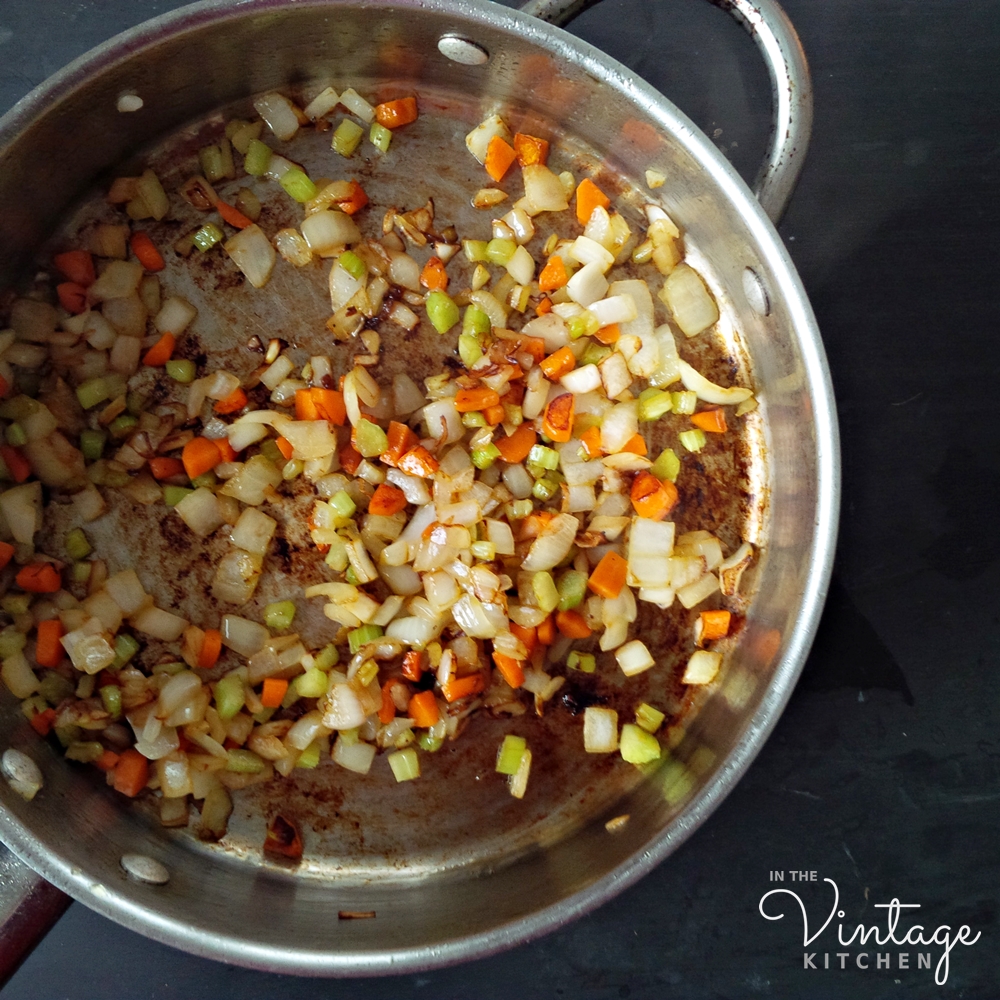
Add two tablespoons of flour and cook, stirring continuously until all the fat has been absorbed. Add the white wine and stir until the liquid has thickened slightly. Return the chicken to the pan. Add the broth. Add a few sprigs of parsley, salt and pepper and a bay leaf. Bring to a boil and then reduce to a simmer. Partially cover and cook for about 30 minutes – 45 minutes until chicken yields when you pierce it with a fork.

In a separate pan, melt two tablespoons of butter (or two tablespoons of olive oil) and saute the mushrooms. Salt to taste and set aside.

When the chicken is ready, remove the lid and remove the chicken to a separate plate. Discard the herbs. Let the sauce mixture simmer for few more minutes.

In a small bowl, whisk the egg yolks and cream together. Slowly add a small amount (about 1/2 cup) of the hot liquid to the eggs and cream and whisk quickly to temper it. Stir the egg mixture into the pan mixture, stirring constantly for about a minute. Add the mushrooms and the chicken. Add the juice of the lemon. Add one tablespoon of butter (or one tablespoon of olive oil).
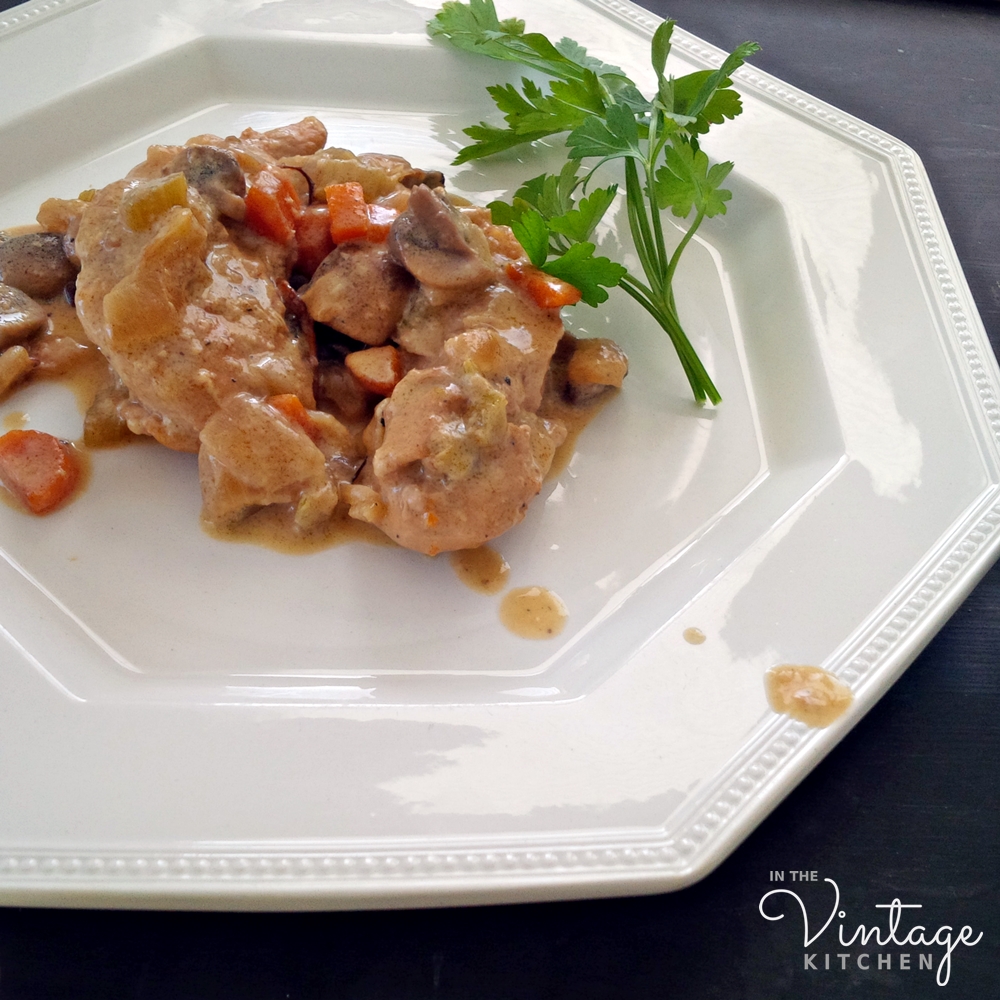
Ruth Reichl’s Chicken Fricassee

Remove from heat and serve in a large bowl for the table or plate individually. Pool extra sauce around the chicken. Garnish with fresh parsley sprigs. We served this with warm crunchy French bread, the show-off salad and chilled  Pinot Grigio.

In My Kitchen Year, Ruth said this recipe reminded her of when she was living on an island (Ile d’Oleron) off the coast of France in the 1960’s. This recipe will forever now remind us of the back-to-back snow days that finally arrived after many years of anticipation. Cheers to good memories, good cookbooks, and long acquaintances. Happy birthday Ruth Reichl!
{Old} House Stories: An Interview with Ken Staffey

The Ephraim Burr Beers House, circa 1810 – Clapboard Hill, Westport CT. Read more history about this house here. Photo by Ken Staffey.

Nora Roberts once wrote “it was a mistake to think of houses, old houses, as being empty. They were filled with memories, with the faded echoes of voices. Drops of tears, drops of blood, the ring of laughter, the edge of tempers that had ebbed and flowed between the walls, into the walls, over the years. Wasn’t it, after all, a kind of life? They carried in their wood and stone, their brick and mortar a kind of ego that was nearly, very nearly, human.”

Recalling those faded voices, those human experiences, those memories, the forgotten details and the covered over contributions of the places that Nora nuanced, in today’s post we are tackling a discussion about the very interesting life found in and around old houses of early America as discovered by a modern day history lover. If you are a fan of any old house photo feeds on Instagram, chances are you have come across Ken Staffey’s gorgeous account simply called House Stories.

Ken features primarily photographs of historic homes in the Northeastern United States and dives into the interesting family histories behind them with a mix of interesting facts, personal details, and quirky insights. Most often he features houses from the 18th and 19th century that tell the story of how New England grew up. The places where merchants, farmers, sea captains, doctors, writers, politicians, extraordinary people and everyday citizens raised their families and found their footing among the blooming new frontier called the United States.

Located in Marblehead MA, the Sandin House was built in 1714 for fisherman William Sandin and his wife Joanna. Marblehead was once deemed the greatest town for fishing in New England.

From the bones that make up the frames of these centuries-old places, Ken has pulled stories about past occupants, owners, and architects; about city plans gone awry and country enterprises gone right; about dreams found and opportunities lost, about big events and tiny details, all of which remind us how the past is still very much present in our modern daily lives. We’ve caught up with Ken interview-style to learn more about his passion and his process of bringing history home. Included are his top-picks of places to visit for any architecture enthusiast and his thoughts on where current trends are headed when it comes to living with old houses in a new world.

{Note: Ken’s house photos have been featured throughout this interview. Click on each image to read Ken’s Instagram enties.}

In The Vintage Kitchen: What ignited your idea of posting house stories on Instagram?

Ken Staffey: In the beginning, I posted random photos like everyone else. I found that the house photos seemed to get the best response.  Then I started to add a bit of history along with each home and eventually it evolved into what it is today, House Stories – history told one house at a time.

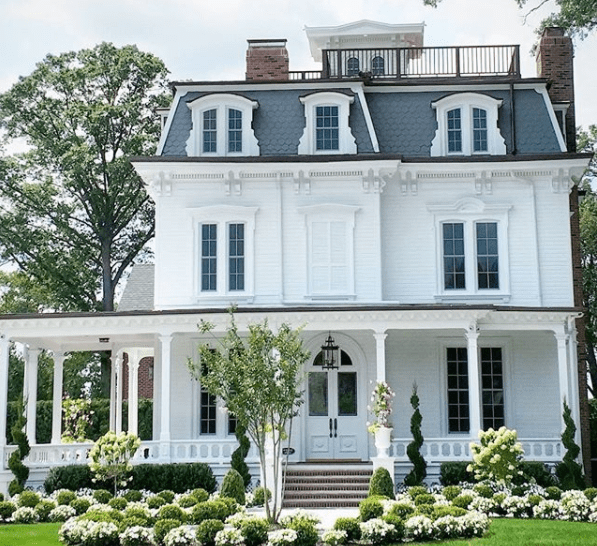
This house was part of a planned community built in the 1870’s as imagined by Alexander Turney Stewart, a dry goods entrepreneur who emigrated from Ireland to New York.  Read more about this house here.

ITVK:  How do you decide which houses to feature?

KS: I pretty much photograph whatever catches my eye.  Later the challenge of finding some history that goes with the home is a big part of the fun. Just about all the homes I have featured date from the colonial period to about 1920.

In Ken’s post about the 1871 Wells-Catlin House, in Brookline, MA  he talks about the history behind the name of the town. Read more about it here.

ITVK:  Explain a little bit about your process of researching these old houses. Do you find that their histories are pretty easy to obtain or do you find yourself knee-deep in archive vaults and old records?

KS: Thankfully, I am never knee deep in archive vaults and old records, but I am often in deep with virtual equivalents, which is much easier thankfully.  Many old directories and records have been scanned and are now online.  Usually, I will just start with the address and see what I come up with there. Often once I get past the online real estate listing for a home, I can find something interesting about the home or its early occupants.  And thank God for historical societies and preservation groups that have not only saved these wonderful old homes but also recorded a good deal of their history.

Yale graduate Nathan Hale taught school in this shingled house in New London, CT in 1774, a few years before he was accused of being a spy and hung by the British Army during the Revolutionary War. The schoolhouse has been moved several times around town but through the support of the Connecticut Society of the Sons of the American Revolution it is being well maintained and offers tours for visitors.

ITVK: Do you ever speak with the property owners to learn more about each house? If not, do you think that most homeowners are aware of the interesting histories their homes have?

KS: Typically I do not speak with the property owners, but I have had a good handful of requests from owners to feature their homes.  They often know a bit of the history about their homes, but that sometimes can be inaccurate. One family had been retelling stories from their home’s history.  Once I dug a bit, I found that the history had been twisted in the retelling over the years, so it was fun to set the record straight for the owners.

City streets and neighborhoods, in particular, are home to a slew of fascinating stories with so many people moving in and out and coming and going. Ken writes about the history of this street in NYC’s West Village here.

ITVK: Do you live in a historic house yourself? If so, does your house have a fascinating story too?!

KS: I grew up in a house that was built in 1940 and since college, I have always been drawn to apartments in older buildings, most of them over a century old.  The home I now own is 89 years old and was built as part of a wave of new housing to accommodate the thousands of factory workers who found work in the once-thriving factories here in Bridgeport, Connecticut. My home is not historic and the funny thing is that I have never even tried to find any history. I do know that the same family owned the home for decades and people have told me a bit about them here and there.

ITVK:  What are three things that modern architecture lacks that all these great old houses contain?

KS: I am a big fan of all types of architecture, but I am partial to the homes of the past.  I think modern architecture has a style all its own, but what modern homes lack is a history and stories about the people that lived there and the surroundings.  Over time even the most modern of homes will have a story to tell.

One great example of a modern house having a fabulous “new” story to tell was Ken’s post on the First Year Building Project designed by students at the Yale School of Architecture. One hundred years from now (fingers crossed that it survives that long) this house will have made a  marvelous contribution to its neighborhood. Read more about the project here.

ITVK: If you could live in (or own) any one of the houses you have featured to date, which would you choose and why?

KS: I am not sure about a particular house, but I was enamored by the recreated New England village circa 1820-1830 at Sturbridge Village. It is a living museum with interpreters who go about their business as New Englanders did two centuries ago.  The buildings were moved there from around New England, so you can see a village that is free of modern structures and vehicles, which gives you a good idea of life in that era.  Also, you can watch the interpreters engage in activities like farming and weaving as they would in Early America.

Old Sturbridge Village – an 1830’s living history museum.

ITVK:  If you could have cocktails with any famous person, living or dead, in any house in the world, who and where would you choose and why?

KS: It would be interesting to have drinks with someone from the colonial era.  Many of the colonists brought the tradition from England of having beer as a drink instead of whatever and a review of their habits show that it was not unusual for them to have a beer with breakfast, lunch, and dinner.

The White Horse Tavern in Newport RI was founded in 1673 making it the oldest operating bar in the US. See more historic libation stations on the oldies list here.

ITVK: One of my most favorite houses you’ve featured so far is the Jonathan and Abigail Starr house in Guilford, CT that was built in 1732…

The Jonathan and Abigail Starr House, Guilford CT built in 1732.

You shared this information about the house:

“This Church Street home was built for Jonathan and Abigail Starr in 1732 on land obtained from Jonathan’s father, Comfort Starr. Jonathan was a fourth generation New Englander. His great- great-grandfather was a surgeon, also named Comfort Starr, from Ashford, England, who sailed to America aboard the ‘Hercules’ in 1634. Joining him were his wife, Elizabeth, their three children and three servants. Dr. Starr’s parents clearly had a preference for unique names. His sisters were Suretrust and Constant and his brothers were Joyfull and Jehosaphat. The Starrs of Ashford lived a comfortable life with an estate about 60 miles southeast of London, but their move may have been motivated in part by grief as the grave of their son was said to be “not yet grass-grown” when they set out from the port of Sandwich for the “Plantation called New England in America.”

Do you have any other fun details about this house in particular?

KS: I do not, but I did love the names of the Starr children.  I featured the Comfort Starr house (below) a few days after the Jonathan and Abigail Starr post.

Portrait of Comfort Starr and one of his daughters alongside Ken’s photo portrait of Comfort’s house built in the mid 1650’s and a detailed side view sketch of it’s traditional saltbox style.

While known as the Comfort Starr House, this Guilford home was actually built for Henry Kingsworth around 1646. Mr. Starr, a tailor, purchased the home from Kingsworth’s heirs in 1694. He and his wife Elizabeth raised eight children here: Abigail, Elizabeth, Hannah, Comfort, Submit, Jonathan, Jehoshaphat, and Amy. The home was in the family for almost 200 years. Among the last to live here were seven Starr sisters, who were nicknamed ‘Pleiades’ for the seven sisters constellation. When the last sister, Grace, died at 83 in 1874, the home was sold outside the family. Today it is one of the oldest homes in Connecticut that is still a private residence.

ITVK: Is there one New England town, in particular, that should be on every house enthusiasts must-see list?

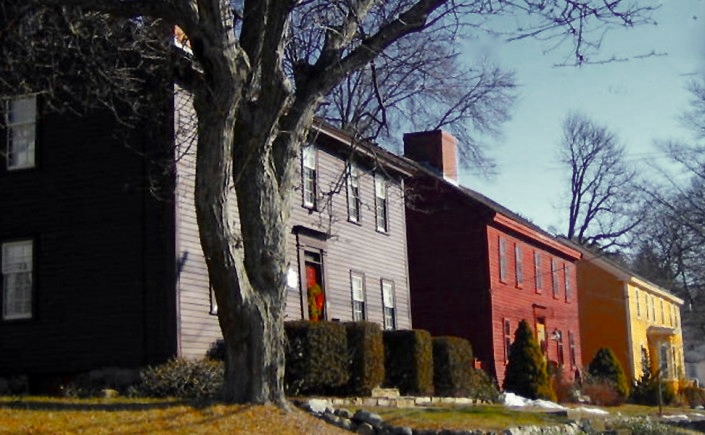
KS: I think that depends on what type of architecture you like. If you are a fan of first-period homes (1625-1725), Ipswich, Massachusetts has the highest concentration of those homes in the country.  There are enough clustered together that it is not too hard to imagine what the area looked like centuries ago.

Ipswich, MA. Photos courtesy of the Ipswich Visitor Center.

If Victorian architecture is your thing, you could head to Willimantic, Connecticut.  The town saw rapid growth as the textile mills expanded there.  Because Victorian architecture was in style at the time, there are many Queen Anne homes along with other Victorian treasures.  In both cases, the prevalent style reflects a period of growth followed by an economic downturn, which is why the homes were not updated or replaced with more recent styles.  But those are just two examples, you can find architectural gems just about anywhere.  Once you start looking, you’ll be surprised how much you’ll find.

A collection of Victorian, Greek Revival and Queen Anne styles houses that can be found in Willimantic, Connecticut

ITVK: What is your most favorite style of architecture, and why does it appeal to you?

My tastes have definitely changed to favor the simple early American homes.  If you had asked me two years ago, I would have said Victorian homes, but I have grown to appreciate plain design with few distractions from the colonial period. Also, the history from that period is fascinating.  Life was harder in so many ways in terms of having to work hard to get things done, but there was also simplicity to life without all the distractions of today. That being said, I enjoy modern conveniences as much as anyone else, but I can appreciate a simpler existence.

In addition to telling house histories, Ken also incorporates fun facts and other interesting tidbits relating to holidays or customs or historical pop culture which keeps each post from being formulaic.  Read more about this 1720 Brookfield, CT house here.

ITVK:  Have you had the opportunity to look inside any of the houses you’ve featured? And if so, do you have any memorable kitchen stories from them?

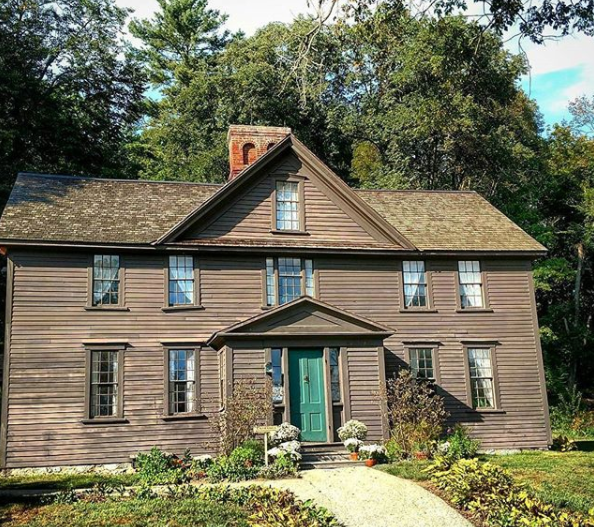
A visit to Louisa May Alcott’s family home, Orchard House, in Concord, Massachusetts is a treat. Because 80% of the furnishings are original to the home when the Alcotts lived there, you can see how the author and her family lived.

Orchard House – home to Louisa May Alcott. Read more about her and her house here.

They often endured lean times, but Louisa and her sisters enjoyed putting on shows for guests right there in the parlor. Upstairs, you can see the small desk where Louisa wrote her best selling books. It’s really nothing more than a shelf along the window, but it was there that she produced works that touched readers the world over.

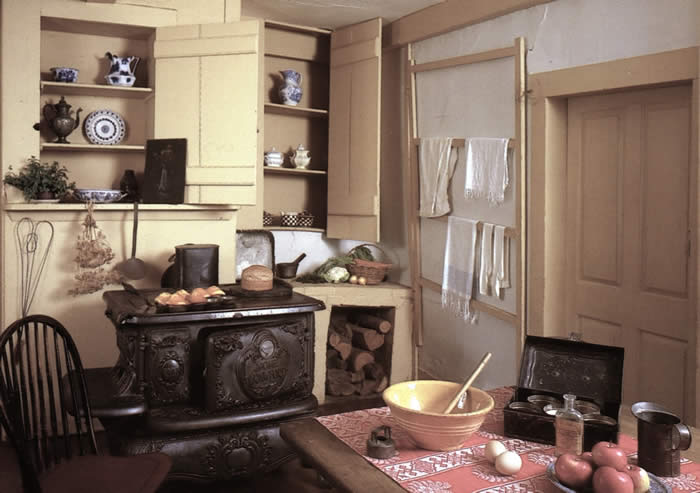
The kitchen at Orchard House where the entire family spent time together. Photo courtesy of louisamayalcott.org

The kitchen is another wonderful window on the past. It was here that the Alcott women cooked, cleaned and drew water from the pump beneath the trap door in the kitchen floor.  The author herself says, “All of the philosophy in our house is not in the study, a good deal is in the kitchen, where a fine old lady thinks high thoughts and does good deeds while she cooks and cleans.” I highly recommend a visit to this house museum.

ITVK: So many old houses revolve around the idea of family, whether they were built to accommodate them, or given as wedding gifts or passed down through generations. Because we are such a transient society these days, and on average only stay 7-10 years in a house before moving on, do you think we are slowly losing a sense of place in our modern day world that connects us to the history of our land? Do you think this is why, fundamentally, old houses still hold so much appeal and nostalgia for us?

KS: Overall we have definitely shifted to a more disposable society, but if you look more closely, there is a quieter celebration of the past. People are still restoring our treasured antique homes and many others will furnish their homes in a throwback style such as farmhouse, colonial or even midcentury modern.

This house was built in Fairfield, CT in the 1990’s but the exterior contains elements of classic French chateau, colonial and federal styles that could give the impression that it is older than it actually is. Read more about it here.


This house in Westport, CT was also built in the last 20 years. New to look old, it was modeled after early colonial designs. Read more about it here.

Also, there are more people drawn to be what we now call “makers.”  They may be crafters, foodies, or designers and together they have recreated an echo of the cottage industries of our ancestors.  Two centuries ago, artisans worked and sold their goods out of their homes and today there are plenty of people working, living and creating from their homes.  So, I think we are more connected to our homes than we realize today.

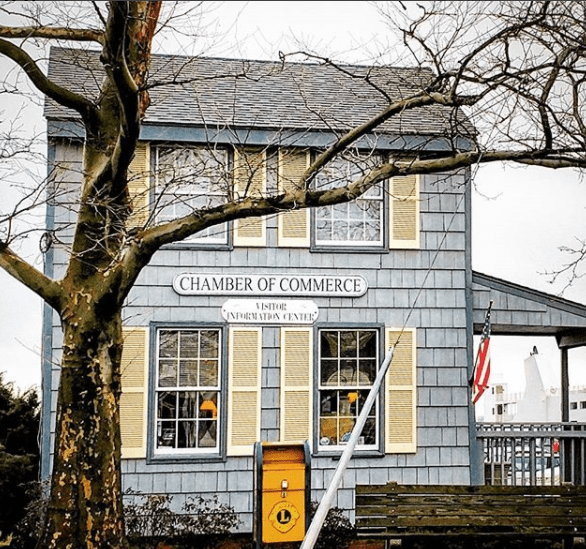
The Roe House, built in the 1680’s, now serves as the Port Jefferson, New York Chamber of Commerce. Read more about it here.


In New York City’s Soho neighborhood this building originally hosted a tobacco shop in the early 1800’s. Now it’s a clothing store with a 19th-century murder story to tell. Read more about it here.


This house built in 1781 in Litchfield, CT has been home to a number of cottage industries throughout its life including an apothecary shop, a grocery store and now a doctor’s office. Read more about it here.

Does place dictate who we are or who we have the potential of becoming? Not always.  But it certainly does have the opportunity to indulge us and to nurture our life’s pursuits just like Orchard House had done with Louisa May Alcott who drew so much of her own environment into her works of fiction. Had Louisa never grown up in that brown clapboard house would Little Women have been the same book we know today?

Orchard House photographed sometime between 1860-1920. Courtesy of the New York Public Library Digital Images.

Like dipping your toe into the pool of history and watching the ripple effect the entire body of water, Ken’s House Stories are mini in content but mighty in impact. He shows us that behind every person stands a physical structure that was impacted by them or for them. He reminds us that a person’s individual history, although singular at the time eventually becomes our collective history as a nation. One country formed by billions of individual contributions. Big, small, humble, grand.. the old houses stand as truth showing us where we have been and where we have the potential to go.

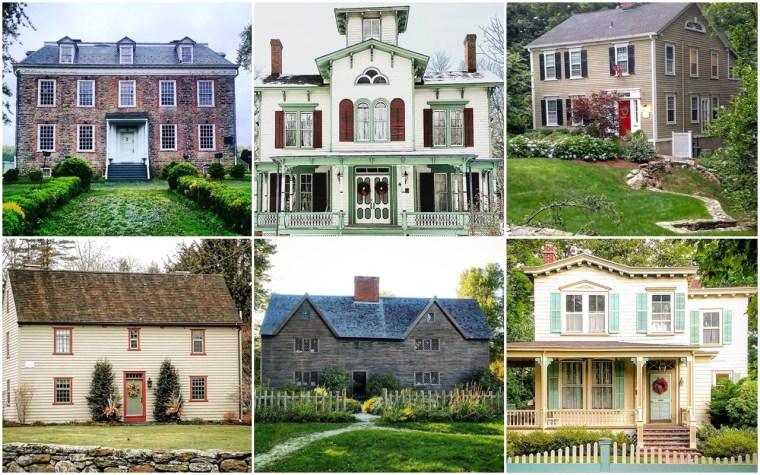
A sampling of houses Ken has featured on House Stories that range in age from the 1670’s to the 1860’s.

A very big cheers to Ken for spotlighting the stories of our country’s founding families. Find him on Instagram here. And cheers to all the people who loved, saved and protected our early American architecture from re-development and decline and continue to do so every day.

Other historic architecture-related posts from the Vintage Kitchen can be found here…

Other interviews by artisians, craftspeople, collectors and interesting characters from around the world can be found here.

Bringing Zest to the Viands: Dinner Giving Advice & Etiquette from 1902

The Victorians had their love of family and chivalry and formal presentation. The Edwardians had their love of nature and get-togethers and burgeoning athleticism. Combine the best elements of those two eras for a dinner party and you get a cacophony of advice on how to throw (and attend) the most enjoyable evening of the year as deemed perfect in 1902.

It’s Thanksgiving week and kitchens are busy across the country as we cook and eat and celebrate the holiday with friends and family. Here in the Vintage Kitchen, we thought it would be fun to pull out the do’s and dont’s list of what was considered proper partying in the first few years of the 20th century to see just how many elements we have retained over the course of 115 years. It’s cliche to say that good manners never go out of style, but do they evolve to fit our modern lives or are we still putting our best Victorian/Edwardian foot forward when it comes to entertaining? In this post, we’ll discover how our ancestors prepared to feed a crowd, how they decorated their tables to reflect a festive atmosphere and how etiquette guided eaters through the event. Is it all that different from what we do today? You might be surprised by the list below. Let’s dive in and see…

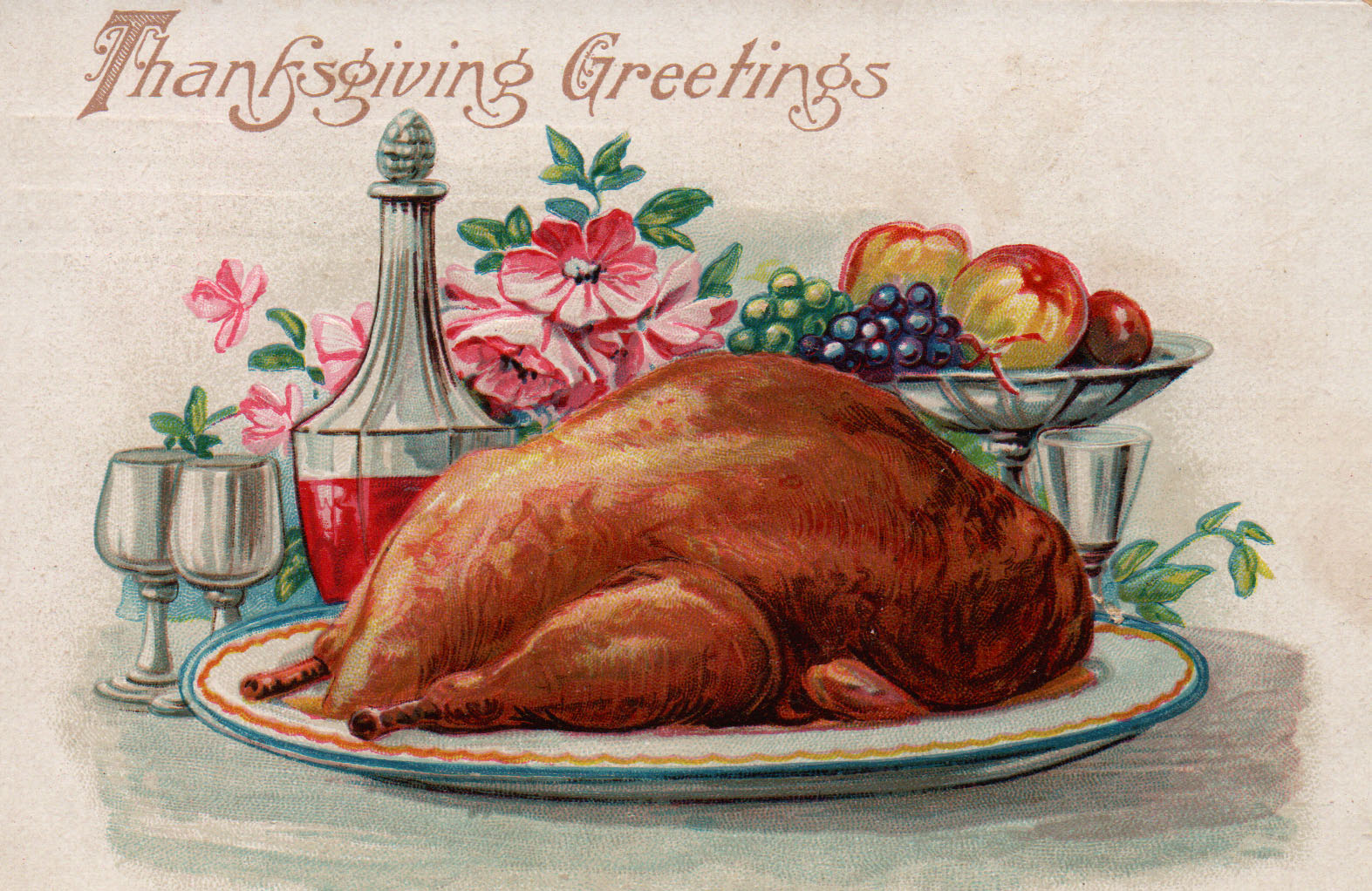
Preparing turkey in a kitchen from long ago…

How to Throw A Successful Dinner Party circa 1902…

  1. Send your dinner party invitations by mail or personal messenger at least 10 days in advance. Sending via messenger is more ideal in order to ensure accurate delivery.
  2. Study your guest list. Seat opposites together…  talkers with listeners, strong opinionators with yielding dispositions, etc.
  3. Select a color scheme and harmonize everything on the table within that palette.
  4. Dishes with a background of white appeal to the eyes of all.
  5. Never starch your napkins.
  6. Each table setting requires four forks (placed on the left) and three knives (placed on the right) between each plate. Oyster forks begin the fork parade on the outside. Among the grouping of the three knives, steel knives for meat rest closest to the plate.  Napkins are placed directly in front of each guest and soup spoons lie next to each napkin.
  7. Individual salt, pepper and butter dishes should accompany each place setting.
  8. Ideal flower centerpieces include roses, lilies, carnations, lilacs, ferns and smilax which should be arranged in a low, flat edged cut glass bowl. If you are using roses in your bouquet scatter petals artistically around the table.
  9. Battenburg lace table clothes are the most ideal cloth covering but if you cant afford one- a simple doily style is recommended.
  10. Hang satin ribbons, bows and smilax from your chandelier for a visual effect of fresh, dainty beauty.
  11. Autumn leaves threaded on a string make an eye-catching border when tacked around the perimeter of the entire table.
  12. Any natural bit of vine found in season produces a wonderful opportunity to make a crown for every single guest. Autumn offers the chance to incorporate pumpkin vines in such a manner.
  13. Lighting should be kept to subdued shades. Use of colorful gas lamps and transparent globes produce a dreamland in the dining room.
  14. For a snowy table scene, dip evergreen fir branches in a weak solution of glue and roll in coarsely crushed alum to create an enchanting winter wonderland.
  15. If your dining room is not carpeted, use large rugs to deaden the sound of footsteps.
  16. Dinnertime is most commonly observed at 7:00pm.
  17. Dinner is announced just after the last guest arrives.
  18. It is recommended to have at least one servant available to attend to the needs of every six guests.
  19. Sideboards should be neatly stacked with all the pieces (dishes, cups, glasses, and flatware) needed for the entire meal so that when the servant staff (or hosts) are clearing dishes from a finished course they can easily access the appropriate dishes for the next course without causing undue chaos and uneccsary noise.
  20. Menu guidelines for a  traditional 11-course dinner party are as follows … FIRST COURSE: Contains oysters or littleneck clams. Oysters are only served in the months when the letter “R” occurs. SECOND COURSE: Contains soup along with crackers, bread or celery. Clear soups are most preferred. THIRD COURSE: Contains fish that is either boiled or fried and served alongside small boiled potatoes or radishes. FOURTH COURSE: Contains fancy main entrees that do not require carving. This course is served with bread and small garnishes like olives and nuts. FIFTH COURSE:  Features a roast of beef, veal, lamb, venison, turkey, goose or other wild game and is served alongside two vegetables. SIXTH COURSE: Contains punch or sherbert. SEVENTH COURSE: Features poultry such as chicken or pigeon. EIGHTH COURSE: Contains salad and cheese wafers. NINTH COURSE: Features dessert served either hot or cold like ice cream, pudding, cake etc. TENTH COURSE: Features fresh fruit and bonbons. ELEVENTH COURSE: Wraps the entire dinner up with coffee.
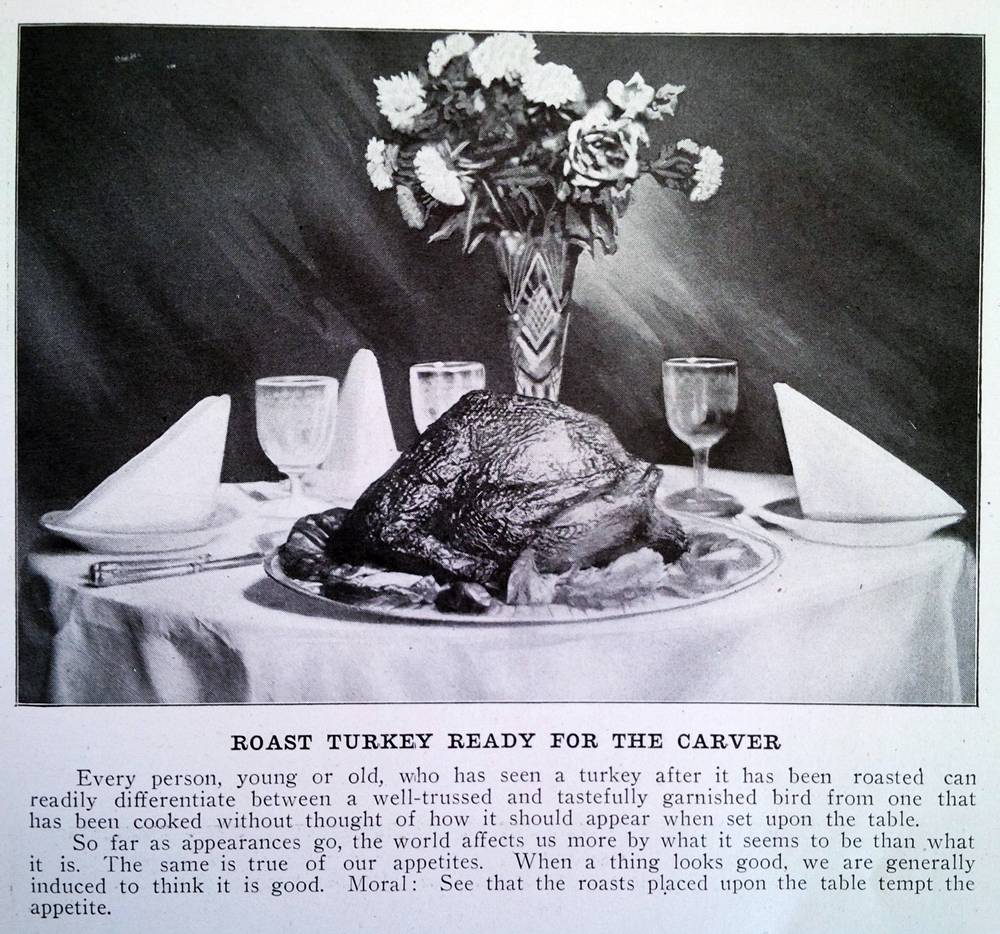
Roast Turkey from Woman’s Favorite Cook Book published in 1902

How to Master Good Manners at Table circa 1902 –

(As A Guest)

  1. Ladies always take their seats first.
  2. Do not overload your dinner plate.
  3. Never rise from your chair to reach anything, request what you need and then wait for it to be passed.
  4. Never eat anything with a spoon that can be eaten with a fork.
  5. Do not hesitate to take the last piece.
  6. Never overload your fork or spoon.
  7. In the case of restaurant or hotel dining, a lady always rises to greet another lady who has stopped to visit at the table, even though the visitor will not be eating with them.
  8. At the start of the meal, napkins should always be unfolded below the table.
  9. A gentleman folds his napkin in half and places it on his left knee.
  10. Never touch any part of your face with your napkin except your lips.
  11. If food is being carved at the table do not wait to begin eating until all the food is served.
  12. Spread soft cheese on a cracker with a knife. Eat hard cheese with your fingers.
  13. Do not break crackers or bread into your bowl of soup.
  14. If strawberries are served with stems intact, eat them with your fingers.
  15. Never touch potatoes with a knife except to butter them. Forks should be the only utensil involved when eating potatoes of any kind.
  16. Immediately pass anything that is requested (salt, butter, cream, etc) to your fellow tablemates.
  17. Do not refold your dinner napkin when you are through eating.
  18. Never talk with your mouth full and never leave the table with food in your mouth.
  19. Do not spread your elbows when cutting meat, keep them securely tucked at your side.
  20. Do not reach after a knife, fork or spoon that has dropped, instead, ask for another.
  21. When asked what cut of meat you would like answer promptly and confidently. Never leave it up to the host to consider your preference for you.
  22. Do not continue eating after passing a plate for a tablemate until that plate has been filled and returned back to the guest.
  23. Do not twist your feet around the legs of your chair.
  24. Never touch your face or head at the table.
  25. Never take a larger mouthful than will permit you to speak with ease.
  26. Never loll back in your chair or press forward against the table but sit upright to aid digestion and present yourself with controlled decorum.
  27. Never lift a glass by the rim. Goblets should be held by the stem and tumblers near the base.
  28. When addressing anyone at the table or asking for anything to be passed, mention the guest’s name to whom you speak.
  29. Do not leave the table until everyone has finished eating.
  30. When invited to a formal dinner party in which you have worn an evening dress and gloves, do not take your gloves off until you have been seated at the table.
  31. Guests who bring simple, homemade, monogrammed gifts are far more admired by hosts and hostesses than gifts that are expensive, elaborate or store-bought.
This is an Edwardian dinner party photograph from the early 1900s. Even though this is a Halloween photo you can see that they carried the theme in their decorations with a witch hanging from the chandelier, a hanging garland of fall leaves and a low floral centerpiece on the table.

(As a Host)

  1. First and foremost, as host, it is your job to ensure that every guest is well cared for and attended to at all points of the evening.
  2. After dinner has been announced at the start of the evening, the host leads the way to the table with the lady guest he wishes to honor. The hostess comes last with the gentleman guest she wishes to honor.
  3. Dinner plates should be arranged attractively. Any part of the meal that includes vinegar should be placed in its own separate bowl or plate. Bread should also be served on its own separate plate but beware of having too many plates on the table. Then it becomes cluttered and takes on the appearance of a boarding house-style meal.
  4.  The task of carving meat at the table is always conducted by the host. If no male host is present, then the hostess may carve the meat herself or select a gentleman guest to do so on her behalf.
  5. Ladies are always served before men.
  6. Do not ask anyone at the table whether they would like “more roast or more salad (or more of anything).”  Instead, ask them if they would like “some roast or some salad, etc” so as not to imply that they are eating too much or that excess effort is being put forth to serve them.
  7.  Never make introductions after the guests are seated. This should have already been done as each guest arrived for the evening before everyone proceeded to the dining room.
  8. Gentlemen who are remaining at the table for cigars following the meal should stand when the ladies rise and stay standing until they have all left the room.
  9. If all dinner guests are leaving the table at once, then ladies should group together and exit the dining room first.

We were surprised to see that so many commonsense manners from the list are still very much in play in regards to today’s table etiquette (is there even such a universal thing as this these days?!),  like serving women before men, not talking with your mouth full, and sitting up straight at the table. But some things seemed foreign like keeping your elbows tucked in when cutting meat, never using knives to cut a potato, tucking into your meal while food was still being carved and not being hesitant to take the last piece. And then there were the more curious bits like selecting guests to honor and escort into dinner and the situation with the ladies and their gloves.  Where did the gloves go once they were removed them at the table? In your lap? Under your chair? In your evening bag? Perhaps we need to re-watch a few episodes of Downton Abbey to see where Mary stored hers!

On the table decorating front it was also interesting to see how white-centered dishes are still popular as well as the notion of incorporating elements from nature into table centerpiece displays. But head garlands and chandelier decorating and extensive place settings are a less common sight these days. So many houses don’t even have dining rooms or chandeliers anymore. Head garlands are fun though – I could imagine that a table full of guests wearing beautiful wreaths of autumn leaves or pumpkin vines would lend a wonderfully theatrical sense of whimsy to the party.

I think having good manners is lovely. I also think in our busy modern lifestyle with so much interrupting us while we eat, it is easier to forget or fall out of the habit of eating deliberating with the company we are keeping. Good table manner etiquette hasn’t really changed all that much in one hundred years but our awareness of it has.

Sometimes, now it seems we pull out our best manners only on the holidays or when eating at a super expensive restaurant or a wedding reception or only when we are trying to impress someone. This is not to say that the majority of Americans now eat like animals at home, but its the fact that there is not as many people looking over our shoulders reminding us to tuck our elbows in or keep our napkins in our lap or to serve the ladies first.  In the Victorian and Edwardian days they had hours to enjoy a meal and socializing was treated like a cultural event that could be extended for days. Now we are not as indulgent with our time and focus more on quick preparations and easy recipes so that we can eat fast in order to get onto the next event or activity filling up our busy schedules.

In 2018 one of our goals in the Vintage Kitchen is to slow down dinner time (at least a few nights a week), so that we can sit down and have a conversation with our dinner mates free of phones and screens and television and outside distractions. Perhaps that will help us practice and keep good manners so that mealtime will feel a bit more decadent in the leisure department and more fulfilling on the socialization front. What do you think dear readers about this topic of manners? Do you employ them at home? Were you surprised by this list? Do you think there is still a place for them in our modern landscape? Please share your thoughts in the comments section below!

In the meantime, hope your kitchen is full of good food and good friends in the days leading up to Thanksgiving! Cheers to all you, ladies and gentlemen!


Katharine Hepburn’s Lace Cookies

Red meat, big salads, tea, butterscotch pudding, ice cream, meatloaf, homemade cookies… those were some of Katharine Hepburn’s most favorite foods. Whether she was staying at her Turtle Bay residence in mid-town Manhattan or at her family’s compound in Old Saybrook,  Connecticut, Katharine liked most entertaining people at home with a homecooked meal.

Kate in her natural element… cleaning up the kitchen of her Connecticut waterfront home, Fenwick,  and dining outdoors in the courtyard of her Manhattan townhouse.

If you were lucky enough to be invited to dinner at either of Katharine Hepburn’s houses, you’d arrive promptly at 6:00pm and leave by 8:00pm so that she could be in bed by 8:15pm. A notorious early riser, Katharine lived by her own clock, bustling through the hours of her day with an admirable endurance that lasted her entire life.

But needless to say, even the most energetic of crusaders experiences a point in each day when blood sugar runs low and a brief rest is welcomed. For Lady Kate that small break in her schedule came at tea-time, her most favorite part of the afternoon, which she’d serve in antique teacups collected from her travels around the world. The saucers hardly ever matched the cups, the handles were sometimes repaired in one or two spots and there might be a chip in the rim, but none of that mattered. They were perfectly lovely serving pieces for a perfectly lovely time of day.

These are some of Katharine Hepburn’s serving pieces that she collected throughout her ninety-six years of life. In 2010 they were up for auction at Sotheby’s.

“Nice things are meant to be used,” said Kate when it came to living with antiques. The older the item the better it seemed. And because she was sentimental and somewhat thrifty she saw no harm in repairing a broken dish so that it could return to its previously useful state.

Along with a strong batch of freshly brewed tea, she would also always serve a homemade sweet treat believing that dessert tasted better in the afternoon than it did at night after a full meal. One of the dessert recipes she was most well-known for was her Lace Cookies which take their name from their paper-thin constitution and delicate web-like appearance.

This past week, the Vintage Kitchen moved to a new space and like Kate our energy was running on high as we packed and unpacked in a dizzy array of busyness. But now finally that we are settled and the moving boxes have been emptied, our own tea-time has come calling. We don’t get the luxury of having Katharine Hepburn come join us, but at least we have her recipe and a good imagination to make up the rest.  Tracy Lord (The Philadelphia Story), Ethel Thayer (On Golden Pond), Tess Harding (Woman of the Year) … if we could somehow magically invite these Hepburn characters along with Kate this surely would be a tea-time of legend. If you are unfamiliar with Kate’s movies here is a little clip from our most favorite, The Philadelphia Story, where she plays a bride-to-be whose dealing with cold feet and a complicated heart.

When Katharine was on set or on stage she was known to give helpful training and technique suggestions to less-experienced cast members who were struggling with a scene or a role. She was careful never to tell them exactly step-by-step how to get from point A to point B because she thought that would just yield a copycat performance. What she did offer instead was advice and recommendations that would help shape the parameters of a character or the foundations of a scene so that actors could confidently put their own personality into the performance. In essence, she offered helpful broad strokes and left the details up to the individual to interpret. The same can be said for her recipe sharing.

The first thing you’ll notice about her cookie recipe is how simple it is.  But we all know simple things can sometimes turn out to be most complicated. Kate’s approach to acting was often described as enigmatic, precise, contagious, controlling, all-consuming, accommodating and effortless. Her lace cookies share all those same attributes. They were absolutely delicious but they can be a little finicky, so before you whip up your own batch please note the following bits of advice from the Vintage Kitchen.

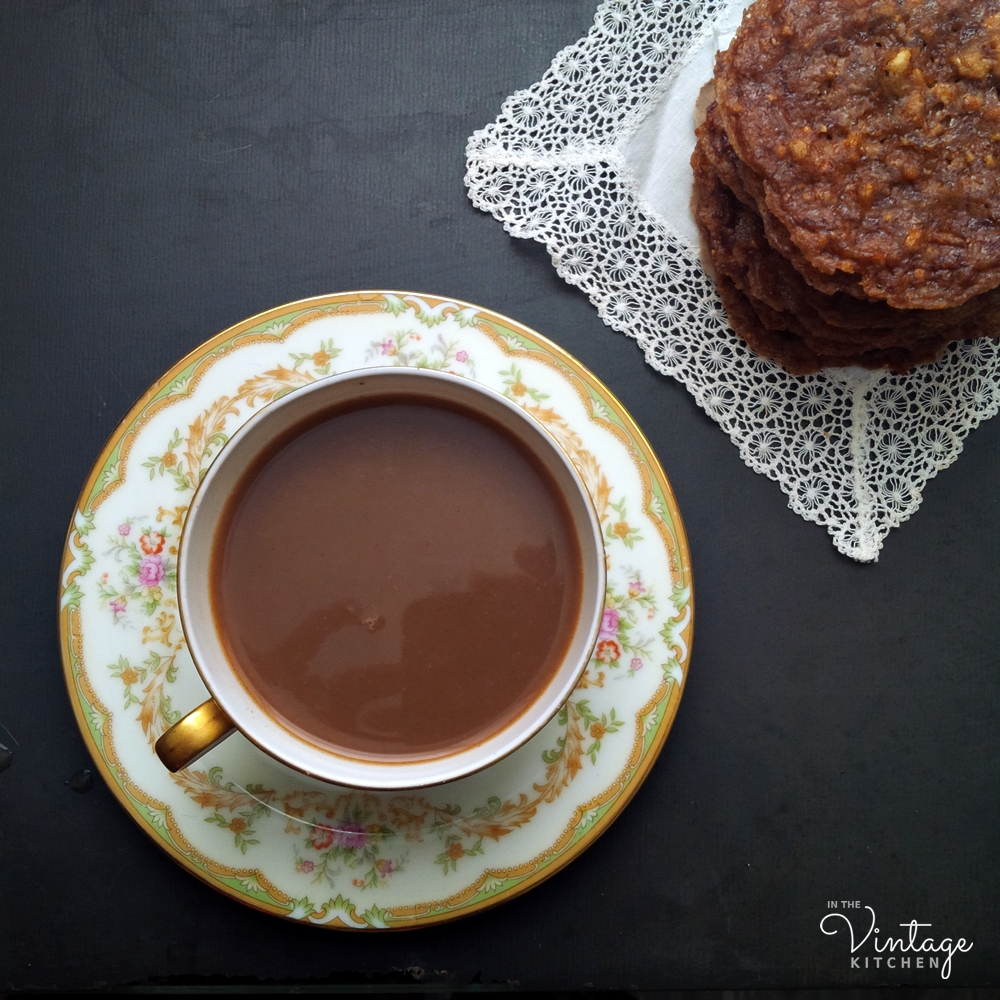
  •  Do not use anything bigger than a teaspoon to drop your dough onto the cookie sheet. (We first made tablespoon sized cookies, thinking the bigger the better,  and once heated up in the oven each separate cookie  spread out to meet up with the others and form one giant cookie that covered the entire baking sheet and never fully cooked.)
  • A disposable foil cookie sheet works better than a metal non-stick cookie sheet because of the raised perforations in the disposable sheet design.
  • Don”t forget to grease your cookie sheet in-between each batch or the cookies will stick like glue to the pan.
  • It’s best to serve these within 30 minutes after they’ve come out of the oven.  That’s when they are crispy like a potato chip. Over an extended amount of time, they relax to a more limp and chewy state (although still delicious!)

Also, Kate made her cookies with finely chopped walnuts, but we used roughly chopped peanuts because we thought the cookies would stack in a more whimsical way for the photograph. We were right – rough chopping adds a little more volume to the stack. So depending on your preference, nuts and chopping style these cookies call for a little of your own creativity as well, just like Kate would have encouraged.

Katharine Hepburn’s Lace Cookies

1/4 cup butter, softened

1 egg, room temperature

1/2 teaspoon vanilla

1/3 cup raw sugar

2/3 cup firmly packed brown sugar

1 1/3 tablespoons all-purpose flour

1 cup finely chopped walnuts (or roughly chopped peanuts or any nut of your preference)

Beat butter, egg, and vanilla together until smooth. Add sugars and flour to egg mixture, mix thoroughly. Stir in nuts. Drop dough by teaspoonfuls on greased baking sheet. Bake at 350 degrees for 7-8 minutes. Cool on baking sheet. Makes about 30 cookies.

With a consistency like very thin peanut brittle and a taste like toffee, these cookies are delicate coasters of caramelized sweetness. And because they contain so little flour, they are a crisp and light dessert alternative to something dense and gooey. Keep in mind, they don’t travel well because of their fragile nature, so these treats are best enjoyed at home with friends and family and a late afternoon pot of tea just like Kate would’ve have done.

Cheers to Kate for her delicious recipe and to finding a little sweet respite in your busy schedule!

* This post was originally intended to appear as part of the Spencer Tracy & Katharine Hepburn blogathon hosted by In The Good Old Days of Classic Hollywood. Unfortunately, our move interrupted our ability to participate, but you can still catch up on all the fun posts featuring the great Kate here.

Cocktails and A Movie: Discussing Censorship, Bar Nuts and Breen on the Set of Casablanca


This week’s post has us traveling all the way back to a cosmopolitan city in exotic 1940s North Africa, thanks to a lovely invitation from the Pure Entertainment Preservation Society. This weekend, October 13th – 15th marks the date of the Great Breening Blogathon featuring Joseph Breen, an influential, but seldom remembered figure in filmmaking during the glamorous days of old Hollywood.

Joseph Breen (1888-1965)

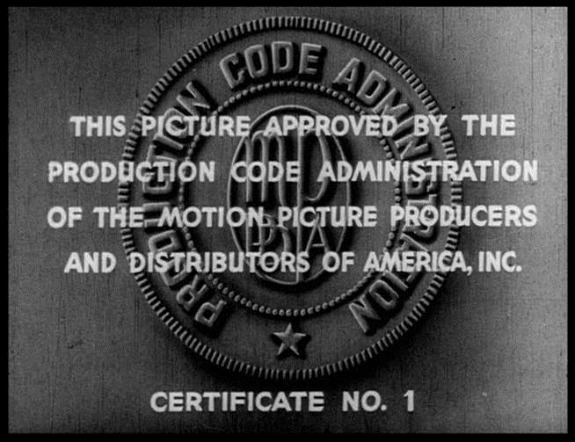
Joseph was the enforcer behind the Production Code Administration, set up during the 1930s, which acted as a morality censor for all film scripts, scenes, and storylines in the motion picture industry. Bolstered by his own Catholic beliefs and the bishops who originally wrote the code, Joseph was not interested in seeing sexy, sensual imagery on the big screen and the PCA wasn’t interested in exposing such immorality to the American movie-going public.  The thought of being subjected to plotlines involving extra-marital affairs, obscene language, excessive violence, or varying degrees of nudity was offensive. Family-friendly American-made films were not the place for such suggestive behavior according to Joseph and the PCA.

With line-by-line lists of can’t-do’s and won’t-permits attached to each script that the PCA reviewed, screenwriters and directors were challenged with creative ways to express characters’ motives and actions while also keeping their plots plausible and compelling. How do you portray magnetic chemistry without showing a steamy, passionate kiss? How do you elude to compromising situations without showing corrupt scandals? How do you make your central location not look or sound like the most unethical, debaucherous place in the world yet still convey to watchers that shady dealings are happening right and left? And ultimately, how do you tell one of the most romantic and dramatic love stories of all time without showing anyone caught up in the physical throes of passion?

The answer is Casablanca.

Many noteworthy movies from the Golden Age of Hollywood were questioned by Joseph and the PCA. The Outlaw (Howard Hughes’ 1943 western) showed too much of Jane Russell’s cleavage; the “damn” in Rhett Butler’s famous “Frankly, my dear, I don’t give a damn” line in Gone With the Wind was flagged for unnecessary profanity; and the fact that Casablanca’s Ilsa was married at the time she first met Rick was altogether too salacious for the PCA to greenlight.  All three movies managed to overcome these sticky spots eventually, but not without some major behind-the-scenes defense tactics for creative license.

The PCA and Joseph’s staunch deployment of it was frustrating but important to movie studios because it balanced political correctness with the expectations of what movie audiences wanted to see.  What was considered entertaining and appropriate to movie-goers in mainstream America in the 1930s and 1940s was laughter, light-hearted romance, and noble sentiment.  So if movie studios wanted to sell tickets, they had to comply with what watchers wanted to see. And the PCA was there to make sure that decorum and good manners reigned supreme as far as what was being showcased on the big screen.

On the morality level, Casablanca in particular, seemed like it was doomed from the beginning. It was set primarily in a bar, Rick’s Cafe Americain, where alcohol continuously flowed. It was fueled by desperation with characters willing to do anything and everything to garner exit visas to leave the country. It contained a smoldering, forbidden romance, murder, and contempt for government officials.  All major issues when it came to the Production Code Administration.

The legendary ending of Casablanca

By the time the script came back from the PCA review office, it contained several red flags and numerous notations from Joseph Breen. No bed was ever to be shown in Rick’s apartment, (such an object would have signaled an intimate encounter with Ilsa).  The dubious character of Captain Renault (who was in charge of granting exit visas from Casablanca) was not allowed to verbally suggest or show that he was granting visas to women only in exchange for sex. And Rick and Ilsa’s fated love affair? Joseph found it highly immoral that Ilsa met and fell in love with Rick years before in Paris while she was married to her husband Victor Lazlo. This long-simmering love business between Ilsa and Rick had to be cleaned up in order for the movie to go on. Even though sex does sell, in conservative 1940’s America these scandelous situations were considered way too over-the-top for the eyes and minds of mainstream movie-going audiences.

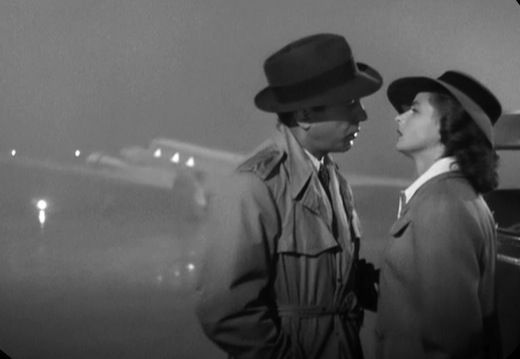
The smoldering attraction between Rick and Ilsa.

So how did Casablanca’s production team manage to get around such roadblocks and ultimately propel the film towards three Academy Award wins and iconic movie status? Through good writing and good direction and good acting. So much of the storyline that seemed PCA in-appropriate – the excessive drinking, seduction, womanizing and volatile emotions were so expertly staged and nuanced that the script eventually passed approval with Joseph Breen. Once Humphrey Bogart (Rick), Ingrid Bergman (Ilsa), and Claude Rains (Captain Renault) delivered their performances there was no mistaking the precarious situations that the scriptwriters originally intended. Movie audiences still got the idea loud and clear even if wasn’t visually or audibly spelled out.

In today’s depict-anything-you-want movie plot experience, it seems so foreign to have such a morality cloud like Joseph Breen hovering over a film production. But I wonder if the beauty and ultimate success of Casablanca came in the act of being challenged to subtly hint at each impropriety. Perhaps that is what makes it timeless and still translatable in today’s cinematic scope. It leaves room for our own imaginations to sort out and further dissect the specifics of the relationships between characters.

I’m not a big fan of censoring art in any way. I think you lose the point of it then. I once lived in a town where plays were censored for language or risque content and it felt very limiting. Art is intended to provoke reaction and expand horizons so I’m not sure if Joseph Breen and I would have been on the same page in the philosophy department, but his impact on Casablanca was influential, so maybe his enforcement of the Production Code Administration ultimately helped the movie in the long-run.

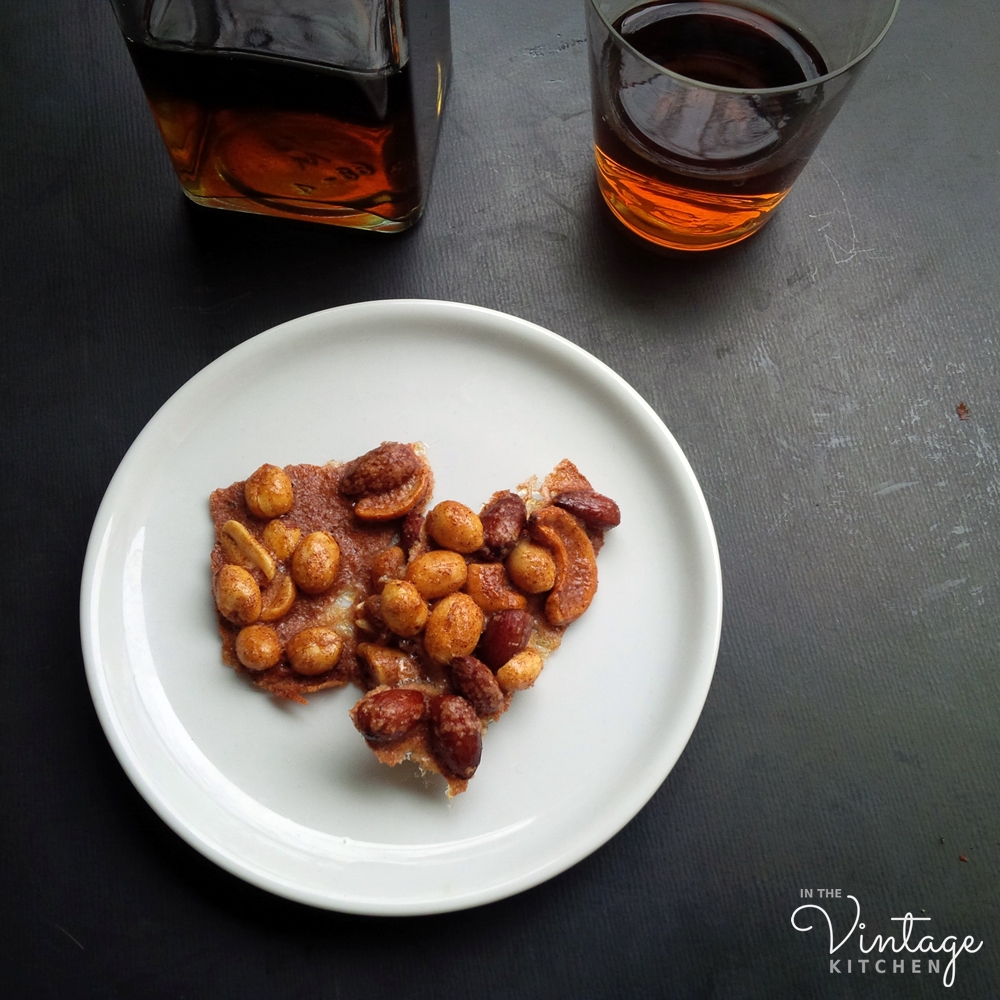
For all the spicy current passing between Ilsa and Rick throughout the movie, there is not a lot of spicy food being passed around Rick’s cafe.  Originally I thought it would be fun to write a dinner and a movie post and feature some aromatic Moroccan food of the likes that would have been served at Rick’s. But apparently, the main thing on the menu at Cafe Americain, the bestseller of all bestsellers, was a cocktail or two or three or half a bottle. Champagne, bourbon, scotch, gin, whiskey are present in almost every scene. Alcohol swishes and swirls and sits in glasses while Rick broods, Captain Renault schemes, and Ilsa builds courage.  So in lieu of a traditional North African dinner, here in the Vintage Kitchen, we are staying true to the spirit of Casablanca by serving up a food accompaniment with this post that pairs best with your favorite cocktail…Sweet Spiced Nuts circa 1967.

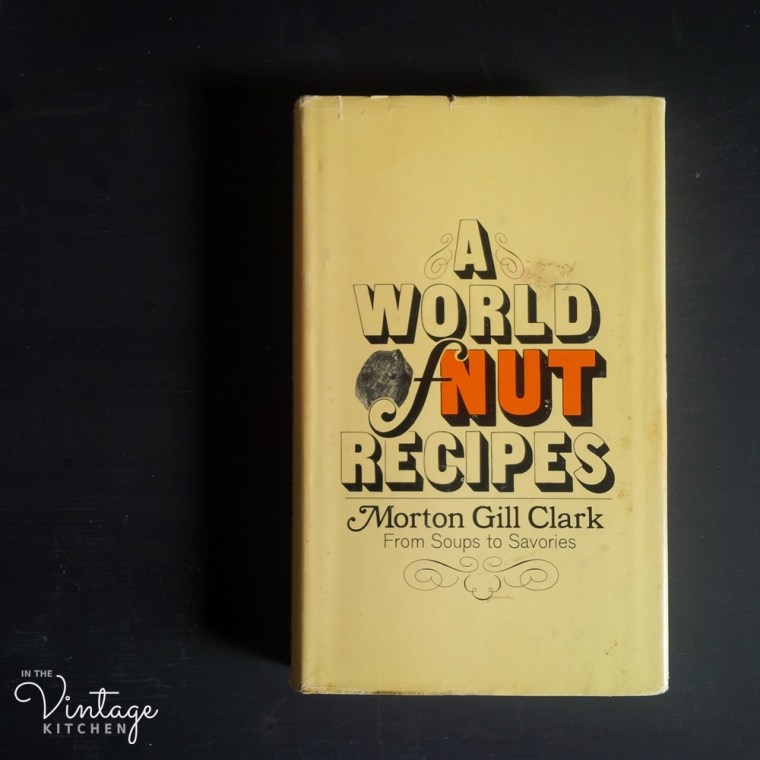
This recipe comes from the vintage cookbook, A World of Nut Recipes by Morton Gil Clark and features three ingredients essential to Moroccan cooking: cloves, cinnamon, and nutmeg. This is a super easy recipe to make for cocktail hour, parties, or late-night snacking. The flavors are subtle, accommodating, and interesting and with nut season now in full swing, you have a variety of options to choose from. For this recipe, I used a variety of mixed nuts which included peanuts, walnuts, almonds, cashews, and Brazil nuts but pecans, pistachios, macademias, etc all would make delicious alternatives as well.

Find this cookbook available in the Vintage Kitchen shop here.

Sweet Spiced Nuts

Makes 1 Cup

1 cup nuts

1/4 cup fine granulated sugar

1 teaspoon cinnamon

1/8th teaspoon ground allspice

1/8th teaspoon ground nutmeg

1 egg (egg white part only)

Place the nuts in a small bowl and pour over them the slightly beaten whites of 1 egg. Mix so that all the nuts are evenly coated. In a separate bowl combine the sugar and spices and then toss with the nuts, mixing well again so that all the nuts are evenly coated. Spread seasoned nuts out into a single layer on a baking sheet and bake at 300 degrees for 25 minutes. If you prefer ultra-crunchy nuts bake them about 10-15 minutes longer, but keep your eye on them so they don’t burn. Once done, let them cool on the baking sheet until ready to serve. Pair with your favorite cocktail and some lively conversation.

Pair with your favorite cocktail and some lively conversation. And while you’re at it, raise a toast to Joseph Breen, who made his mark, for better or worse, on one of the world’s most beloved movies of all times. Here’s look’n at you, Joe!

To learn more about Joe Breen and his influence on old Hollywood, catch up with other blogathon related posts here. 

For more dinner and movie posts from the Vintage Kitchen, pull up a chair here.

And last but not least, find 200 more pages of interesting nut-related recipes in the World of Nut Recipes cookbook available in the shop here.

The City of Lighters and Other Paris Fun Facts

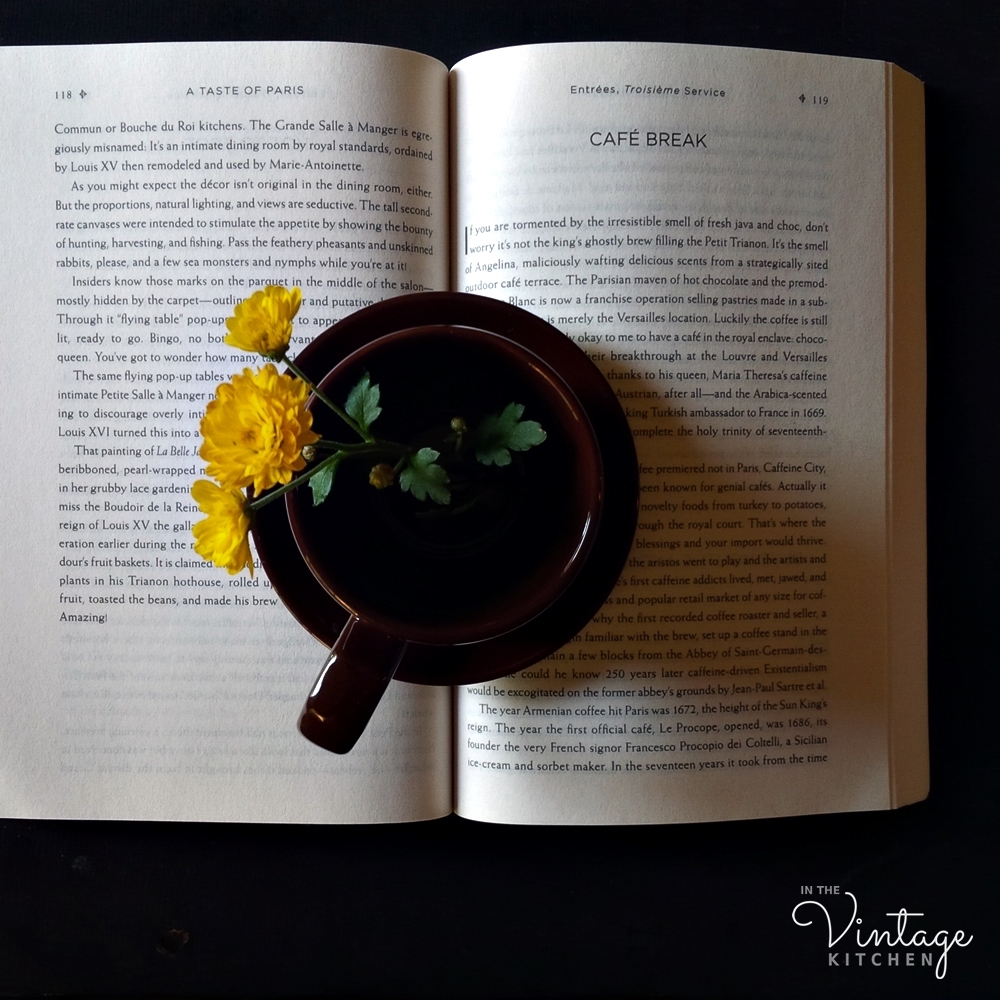
Everyone knows that French food is one of the most well-crafted and esteemed cuisines in the world, but not many people know why or how it came to be. In David Downie’s new book, A Taste of Paris, he dives into the history behind the food with a researcher’s wild abandon for discovery and a humourist’s eye for fun.

Last time we were reading about the City of Light here on the blog, we were exploring it through the paintings and photographs of writer Janice MacLeod in her book, A Paris Year.

Janice and her Paris Year!

This time around, we are deep in the archive vaults of Parisian history alongside author David Downie as he takes us on an epicurean tour of the food that made France famous. Magically, in just 280 pages, David manages to condense centuries worth of feasting into a tidy timeline that begins in 53 B.C. and ends in present day.

“What is thrilling at least to me,” David declares in the starter portion of the book, “is to speculate on how in modified and sometimes-hard-to-recognize forms many foods and food-related habits have survived the ravages of time, the invasions and massacres and floods and fires, the plagues and changes in religion or political and economic systems, and live on in Paris today.”

It is with that keen interest that David dissects how, when, where and why the French have cooked, created, dined and dallied their way to the top of the menu board. Along the way, we learn about colorful characters like…

Queen Caterina de Medici – wife of King Henry II (1519-1589)

Queen Caterina, wife of King Henri II who chewed tobacco leaves to relieve her headaches which started French women’s universal love affair with nicotine.

We also learn about the histories behind an assortment of interesting neighborhoods, buildings, and restaurants that all contributed to the food scene both ancient and modern…

Clockwise from top left: Le Marais historic district, Palace de Versailles, Hotel de Cluny dating to the 1300’s, Verjus restaurant

…and we learn fun facts galore on a myriad of kitchen topics like these…

  1. Butter knives were invented so that people couldn’t pick their teeth at table.
  2. During the Middle Ages, long before the invention of plates,  bread was baked in cutting board shapes and used to hold piles of food for individual eaters. Once the food on top of the bread was consumed, the bread was given to peasants or animals to eat.
  3. Artichokes are considered an aphrodisiac, especially in Italy.
  4. One in three French people smoke (hence the city of lighters!)
  5. In-home cooking spaces in most French houses didn’t exist until the late 18th century.
  6. Below is one of President Obama’s favorite restaurants near the Eiffel Tower…
La Fontaine De Mars

Paris is a city continuously simmering in centuries of tradition. A delightfully unique aspect of David’s book is that he shifts back and forth between present day and the past, so you absorb plenty of history along the way but you also directly understand the correlation between what’s changed and what hasn’t.

While you don’t need to be a European history scholar or a devout foodie in order to tuck into this culinary aspect of the city, it helps if you have a special interest in old world events and a basic understanding of the fine-tuned culture of the Parisian lifestyle because David presents so much interesting, thoughtful information.  You’ll want to marinate in his chapters for a bit instead of rushing through them in one quick read. I was lucky enough to receive this advance copy of the book several months ago. One of the fun aspects of reading it over the summer was keeping Pinterest close-by so that I could look up the people and places of Paris while I was learning about them through David’s eyes.

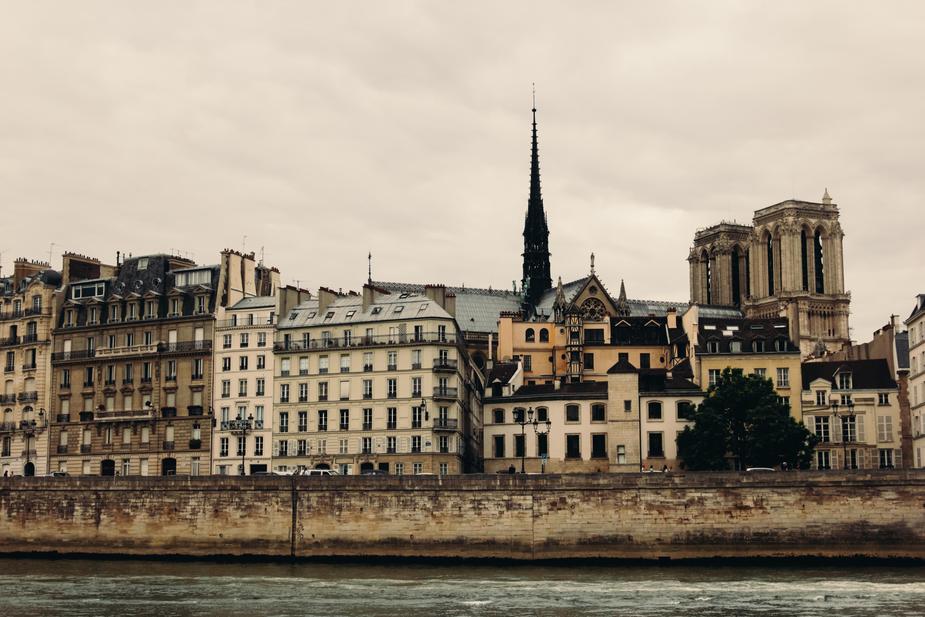
With a wonderfully engaging voice and an ability to colorfully (and often times humorously) describe a building or a banquet, David treks you around town with insight and intimation. One of my favorite lines in the book came forty pages in when he writes about the 3rd-century Roman bath complex at Cluny as “a charming jumble that looks like a mouthful of broken molars repaired with elaborate fretwork crowns.” Admittedly, I had no idea what the Cluny bath house looked like, but thanks to David’s description I could get a pretty good impression of it.

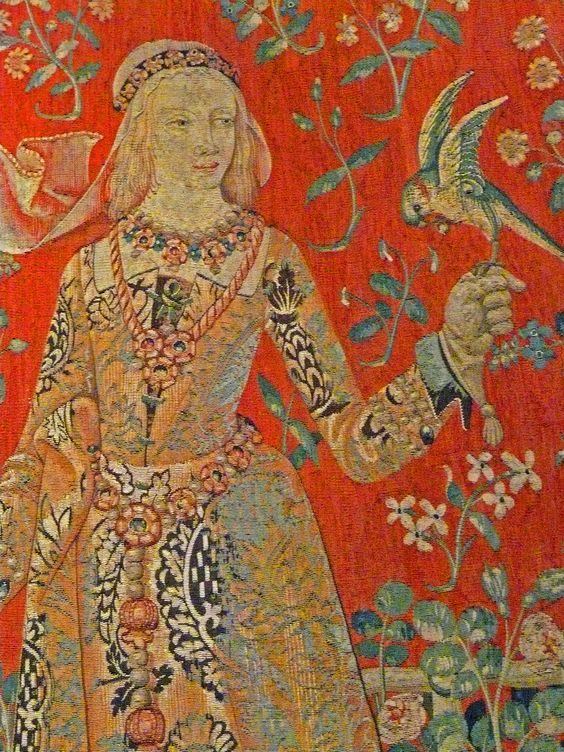
Other intriguing sections in the book included the eating habits of Versailles’ residents, the symbolic imagery found in The Lady and the Unicorn tapestry,  and the gregarious life surrounding French food writer, Maurice Edmond Sailland a.k.a Curnonsky (1872-1956).

A snippet from the Taste panel of the Lady and the Unicorn tapestry created in 1500.

But not everything is champagne and caviar and easily expressed. Amidst all of these fascinating history lessons, David also dives into his own food experience which began in Paris in the 1970’s. With his modern eyes, he retraces his food steps taken four decades ago to see how, and if, the landscape he once personally adored still holds up to the memories he stored. He also talks about the future of French food among the booming explosion of other newly exalted food scenes in other cities. Can Paris hold up to the competition?

Described best as  part guidebook, part history class and part personal memoir, A Taste of Paris pushes you to make notes, take notes, look for more, explore more… which brought me to quickly wish for two things that the book did not have – detailed maps of the areas where David traveled and an index for quick reference.  Then I discovered, as I finished the last page that David does offer both maps and an index of sorts. He and his wife offer walking tours of Paris through his website where they take you on all sorts of off-the-beaten-path adventures. That’s ten times better than a paper map and a list of page numbers! You get the guy (and the guide) in person, all to your yourself!

While we often don’t even think about the fact that millions of people have experienced both good and terrible situations treading upon the very ground we also walk upon so nonchalantly every single day,  David reminds us that the veins of history are deeply wound up in the practices and procedures of our modern lives. That flaky croissant, that steaming cup of hot chocolate, that celebratory pop of champagne were all born a long time ago yet they continue to intrinsically impact us as we move towards the future. In detailing the anatomy of a cuisine, David dissected a city whose culture has influenced a collective conscious of eaters around the world and that is pretty remarkable.

Whether you get the chance to meet up with David in Paris and peruse the food scene together or you simply read about his city in your city, A Taste of Paris is as satisfying as falling in love with a new museum exhibit. It will broaden your point of view, make you think, ask questions, ponder your own country’s evolution of food practices and ultimately make you appreciate how far we have come, as a civilization, from the days of heaping breadboards and kitchen-less houses.

Cheers to David for peeling back the layers of French food culture in such an interesting way!

Find A Taste of Paris available here. Learn more about David and his other Paris based books here. And if you find yourself in the City of Light(ers) take David’s tour and watch the book unfold before your eyes.


Our Favorites: Five Wonderfully Whimsical Things about Julia Child (And A Recipe!)

Her old cookbooks teach us new tricks. Her methodical approach to food never fails us. Her infectious joie de vivre still inspires us. She may have passed away 13 years ago but the spirit of Julia Child is still very much alive and well here in the Vintage Kitchen.  Yesterday marked Julia Child’s 105th birthday.  In celebration, we’ve compiled a list of five whimsical things that we absolutely adore about this great lady.

1. The Photograph – December 1968, France

This is my most favorite picture of Julia Child. It was taken in December 1968 while she was staying at her summer house, La Pitchoune, in Plascassier, France. I love that she is laughing so hard she’s practically tumbling off the counter. I wonder what the situation was at the moment this image was captured. Was her husband, Paul, standing just out of frame telling a joke? Or maybe one of those crab claws just reached up and started playing tug-of-war with her fork. Or maybe it was Julia herself just hamming it up for the camera. Spontineanity ran wild in Julia’s kitchen and I have feeling there were many days in many kitchens around the world that witnessed a moment like this with the engaging lady laugher.

2. The TV Appearance – David Letterman

On December 22, 1986 Julia Child was scheduled to demonstrate how to cook with a blowtorch on the Late Night with David Letterman show. The segment starts out as planned but quickly goes awry and both Julia and David wring all the humor they can out of this unexpected situation. It’s a fly-by-the-seat-of-your-pants funny piece – both of them cleverly improvising with the comedy at hand.  Julia is famous for saying “No matter what happens in the kitchen, – never apologize.” You can see her sticking to that advice with aplomb here.

3. The Decorating Choice – La Oubliette

In Julia Child’s memoir, My Life in France, she describes moving into a French apartment that was already furnished.  It was full of old antiques that were musty, broken down and too small for her tall stature.  The shabby scene depressed her so much that she rounded up everything that she disliked in the apartment,  put them into a closet, and shut the door tight, never to encounter that stuff again. She named that closet La Oubliette or the Forgettery. Anything that displeased her from that point forward for the duration of the time that she and Paul lived there went into that closet.  Out of sight, out of mind.

After reading that passage years ago and falling in love with that idea, I established my own Forgettery in whatever place we’ve lived in. Not all of our spaces have had the luxury of spare closets, but a cupboard or a drawer or a hidden shelf works just fine too.  Sometimes we use it not only for physical objects but also for words. There is something very gratifying about walking into your own Oubliette, saying out loud whatever injustice happened to you that day, and then walking out, shutting the door and leaving all that negativity and all those bad vibes closed in there instead of in you. Julia. She was a cook and a therapist all in one!

4. The Random Cambridge, MA Kitchen Comforts

This past May, we had the exciting experience of visiting Julia Child’s kitchen at the Museum of American History. I had seen pictures of it online before so I knew that I’d see the yellow tablecloth and her big restaurant stove and the pots and pans hanging from the pegboard, but what I didn’t realize I’d see was a host of everyday items that had nothing to do with the kitchen.

You know, those other errant household objects of daily life that just seem to migrate their way into the kitchen but have nothing to do with food or cooking? Things like keys, wallets, shoes, books, tape, paint cans, bags, notebooks, etc.? Julia’s kitchen was full of that sort of stuff too. A Rubix cube, a pile of papers, jars of pens and pencils, a calculator, some sort of glowing orb-like light, bird identification books, a signal mirror from World War II.   Julia was all about keeping things close by that she loved. She even had a junk drawer packed full of odds and ends. And a slew of giant, oversized cooking tool props that appeared in funny stories on her cooking show.  She wasn’t into staged or professionally decorated or aesthetically styled perfection. She was into comfort and function and fun entertaining in a casual environment. Even though Julia and Paul hired architect Robert Woods Kennedy to redesign the kitchen after they purchased the house,  all the decorating of their most favorite room was left up to them.  And it shows in the eclectic menagerie of items they collected and colors they loved.

5. The Book – Jessie Hartland

I recently discovered this fantastic children’s book Bon Appetit! The Delicious Life of Julia Child, at a local book sale. Written and illustrated by Jessie Hartland and published in 2012 it is technically considered a children’s book but really anyone of any age could easily appreciate and enjoy it. Jessie tells Julia’s life story in a vivacious arrangement of words and pictures that is so enchanting you’ll want to read it out-loud while imitating Julia’s voice.  It is such a sweet, good-natured and fun-loving approach to the life of this extraordinary culinary icon, you’ll feel like you’ve met Julia Child herself by the end of it.

On the last page of the book, Jessie shares her own adaptation of French crepes inspired by Julia’s recipe. Since it is Julia’s birthday week, and she shouldn’t be cooking for her own celebrations, we made Jessie’s version instead which turned out to be delicious. Julia would definitely approve.

The only ingredient differences in Jessie’s vs. Julia’s recipe is salt and water. Julia’s has a little of both and Jessie’s has none. And to be totally honest we like Jessie’s version better.

One of the things that Julia Child liked most about French cooking was that it was “careful cooking” meaning that you had to spend time with it and keep a thoughtful eye on the procedure of it. She treated all her recipes at first like mountains that needed to be climbed and then, once conquered, like friends that needed to be nurtured and shared and appreciated.  If you have never made crepes before, it may sound a little scary when it comes to flipping these thin style pancakes, but once you’ve conquered it, you’ve mastered this multi-functional breakfast/lunch/ dinner and dessert appropriate food like a champion.

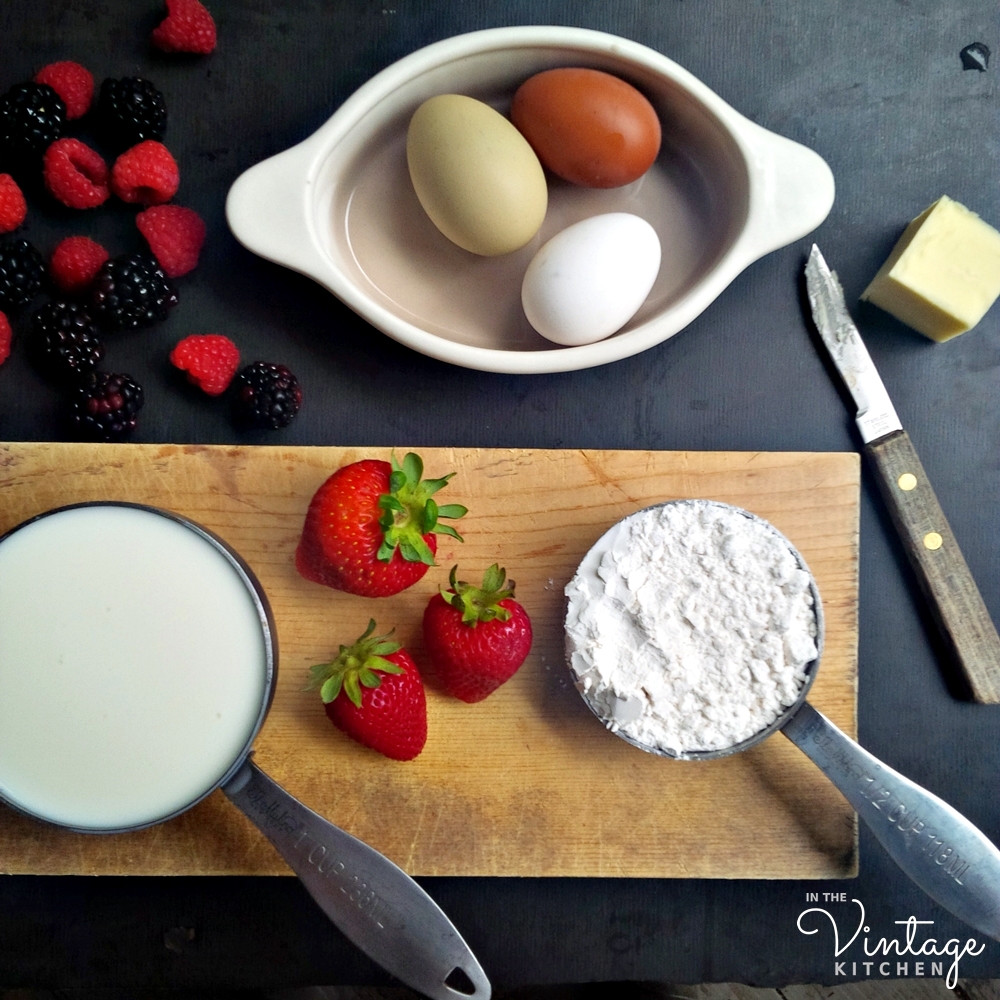
The ingredients are very simple and straight forward. I used free range organic farm eggs, organic whole milk and organic butter in this recipe. Like Julia Child always says – the better quality your ingredients, the better your food will taste.  And if you store your eggs in the refrigerator let them warm up to room temperature before you use them.

Jessie’s Crepes

(makes 5-6 crepes, each about 6.5″ inches in diameter)

3 eggs

1 cup milk

3/4 cup flour

butter (about 1/8th cup)

In a medium sized bowl, beat the eggs with a whisk. Add the milk and whisk again. Add the flour and whisk one more time. Next Jessie recommends pouring the batter through a fine strainer into a glass measuring cup. I don’t have a strainer so I poured the mixture through cheese cloth wrapped around the fine side of a cheese grater. That worked just fine.

This step removes any large flour lumps and makes the batter silky smooth.  If you don’t have a glass measuring cup you can just strain the batter into a mixing bowl and scoop it with a soup ladle.

Melt 1 teaspoon of butter in a frying pan until it is hot (medium high temp) but not smoking. Whisk the batter one more time and then pour about 1/4 cup into the frying pan. Holding the handle twist and rotate the pan to make sure the batter evenly coats the entire bottom of the pan. Wait about 30 seconds (there should be no more loose or runny batter on the top of the crepe – if there still is cook it a little longer) and then, if you are feeling brave flip the crepe in the pan to cook the other side for about 15 seconds.

There are a couple of other options regarding flipping if you don’t want to toss your crepe up in the air.

Option #1: Carefully slide a spatula underneath the crepe and flip it to the other side.

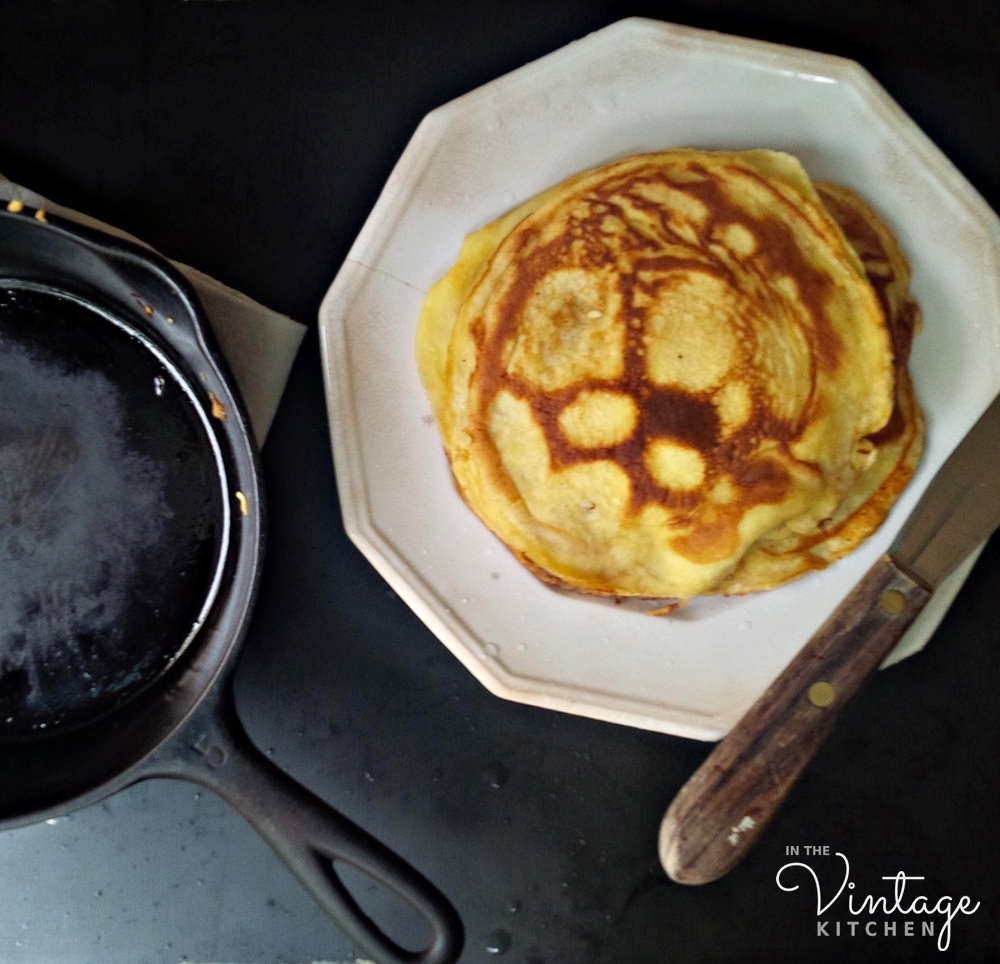
Option #2:  My personal favorite –  use a cake frosting knife, and slide it under the pancake and quickly flip it.  The goal of all this cooking and flipping is two fold… don’t wait too long to flip it so that the bottom burns and don’t tear the crepe in the process of flipping. The first one might not make the table – and that’s okay – if it burns, or tears or winds up on the floor just start again with more butter and a new scoop of batter. Practice makes perfect. And one general rule of thumb – more butter is better than less butter when it comes to making sure the crepes don’t stick, so when in doubt add more not less. This is what your crepes should look like once they are ready…

Repeat this step until you have made all your crepes. You can keep them warm by placing each one on top of the other, stack-stile, on a plate covered with aluminum foil as each one comes out of the pan. Or covered in a dish in the oven on the lowest temperature setting.

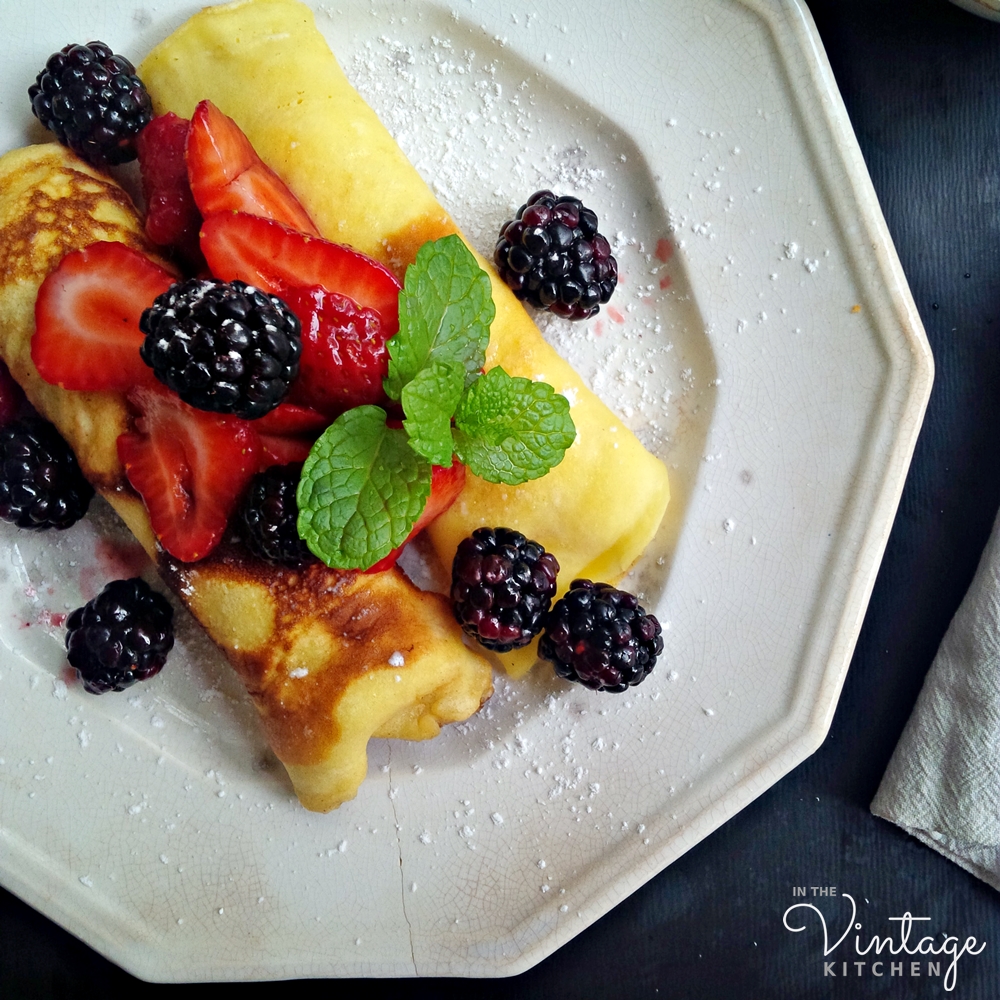
Crepes are a foundation piece that can be served in a number of different ways for breakfast, lunch, dinner or dessert. When we make ours for breakfast, we sprinkle powdered sugar on a warm crepe, roll it up and then top it with a mixture of seasonal fruit in the summer or a warm fruit compote in the fall and winter. But you can just about add anything you like to a crepe and it will be delicious.

One thing to keep in mind when serving crepes is that they contain no sugar so if you like them sweet don’t forget to add sugar or honey, maple syrup, chocolate sauce, whip cream or your own fruit medley.

French Crepes ala Jessie via Julia!

And of course, the very best companion for this festive French dish is a good book like Bon Appetit, which you can find here.

If you are a big fan of Julia, like us, please share your favorite things about her in the comment section below. We’d love to learn more about how she inspires you!

In the meantime cheers to the lady who keeps inspiring us to find the fun in the food! Happy Birthday Julia!

On This Day in 1930: A Behemoth Was Born

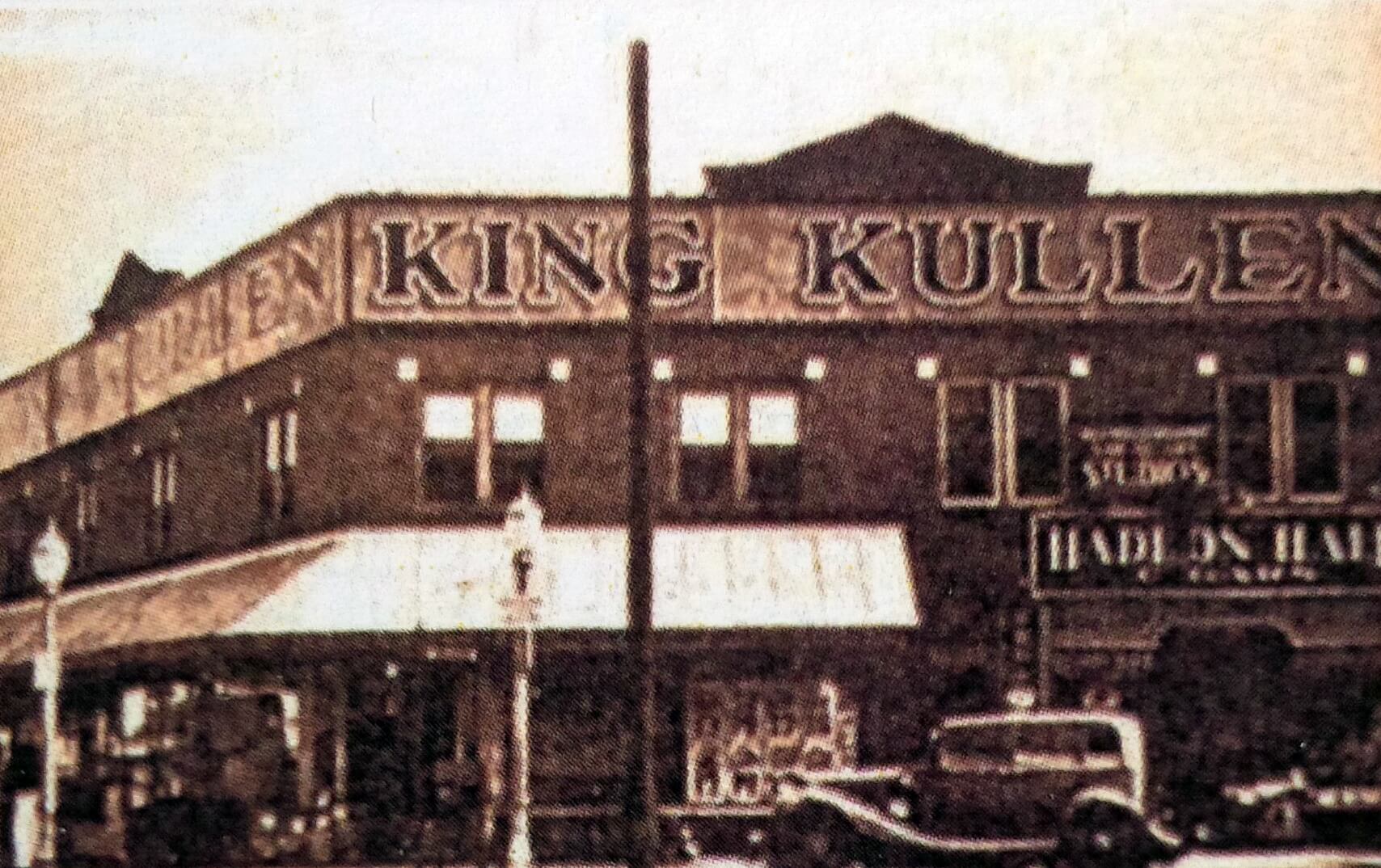
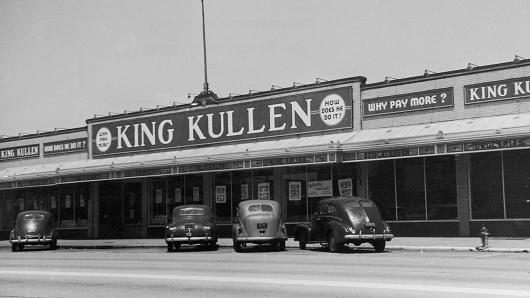
On this day – August 4th, 1930 –  a giant marvel of a masterpiece was unveiled on Jamaica Avenue in Queens, New York. It involved a big building, a big parking lot and a plethora of products that extended far beyond what anyone could have imagined before. Aptly named King Kullen, it was King Kong-ish in size and scope and quickly took over an industry in a way only a behemoth of a good idea could.  It was the birth of the super market – the very first large space grocery store that contained not only food items but also hardware, paint, automotive, cosmetics, shoe shine, kitchenware, confectionery and drug departments all under one roof.

Michael J. Cullen (1884-1936)

The brainchild of grocery store employee, Michael Cullen (who spent half of his adult career working at The Great Atlantic & Pacific Tea Company and then grocery retailer, Kroger) imagined a better, larger, less expensive shopping experience that would cut grocery prices in half for the customer and allow more space for the store to sell bulk items in mass quantity. Essentially it is the same concept that our modern American grocery stores still follow to this day.

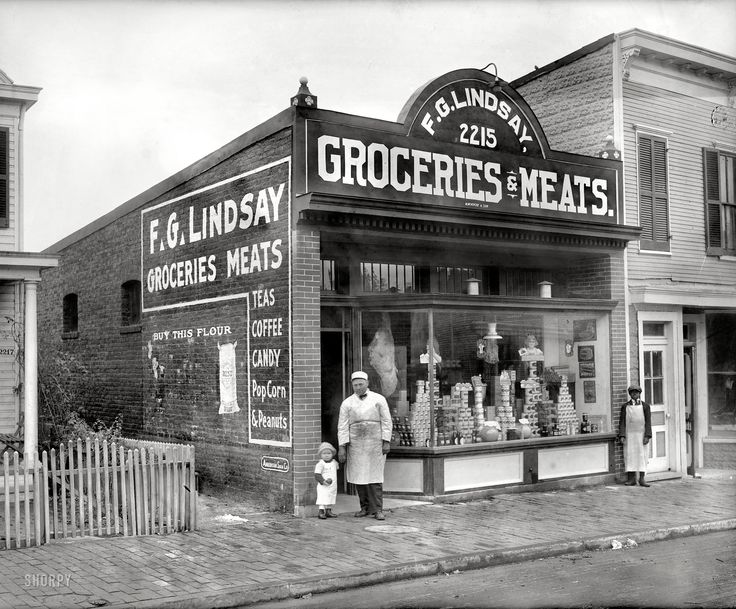
Before Michael and his big-brained idea came along, people grocery shopped in small pocket stores like this one photographed in the 1920s…

These independent stores definitely filled a need and were vital businesses to the community but they were also very limiting and not very private. Space was an issue for the store owners which meant that many items had to be special ordered for customers on a need-by-need basis,  extending the shopping transaction by days or sometimes even weeks.  Service was also an issue as items were frequently stored up high or behind counters making it necessary for grocery employees to gather specifically what was needed.

This one-on-one buying model may have helped develop customer relationships but it also created lengthy wait times for other shoppers while each order was filled.  Speculation and gossip seeped into the buying process too as the whole store could see (and hear!) what everyone was buying. Combined with the fact that meat was purchased from the butcher, bread from the baker, fish from the fish monger and specialty cans and shelf stable items from the grocery, meant that the whole shopping experience could take hours out of the day.

Refrigerators of the late 1920’s provided enough storage to stock foods for up to a week.

Michael took note of all these clunky patterns, accessed the growing rise of refrigerators popping up in American homes and started jotting down ideas for something easier and faster involving less commotion and less expense. While he flushed out his thoughts he was still working at Kroger. He brought up his ideas to his boss who didn’t give Michael’s thoughts any merit. So Michael left Kroger and opened King Kullen Grocery Company independently months later. Michael knew he had a great idea – the right concept at the right time. He had worked in the grocery business for 28 years at that point, long enough to see where the consumer experience needed improvement and how profits could be made.

By building a bigger store in a bigger space, King Kullen initiated the self-serve shopping concept where all products were in easy reach of the customer with a large quantity of the same item available. So you could zip in and out of the store much more quickly. No more waiting, no more special ordering, no more gossip.

King Kullen also eliminated the idea of credit registry systems, another time sucker, by only dealing with cash transactions. And they axed the local delivery system which for small, independent grocers meant additional employees and additional expense. Combining all these elements – bigger store, easy to reach items, large selection of product and a faster payment system was much more efficient and empowering to shoppers.  Independent groceries were old-fashioned and pokey where King Kullen, in 1930,  was up to the minute modern.

And then there was the significant pricing system. Upon opening, King Kullen boasted that they could reduce your average grocery bill by 10-50% which during the Great Depression years was a major attraction for struggling wage-earners. By offering everything from house paint to ham (the “super” market concept)  under one roof, King Kullen became a one-stop shop. You can see the price difference between Kroger in the 1920’s and King Kullen in the 1930’s in these advertisements…

Late 1920’s Kroger grocery advertisement on the left, 1933 King Kullen Advertisement on the right

Some of the significant savings included:

  • Tea –   $0.29 per 1/2lb at Kroger vs. $0.39/per 1lb at King Kullen
  • Boiled Ham – $0.33/lb at Kroger vs. $0.21/lb at King Kullen
  • Catsup – $0.15/bottle at Kroger vs. $0.10/bottle at King Kullen
  • Whole Chicken – $0.33/lb vs. $0.19/lb at King Kullen
  • Beans – 4 cans for $0.23 at Kroger vs. 6 cans for $0.25 at King Kullen

Finally, by providing a large parking lot able to accommodate a vast amount of cars, King Cullen changed how people shopped. Families went together, some traveling up to 100 miles away from home so they could fill their car with foodstuffs and stock their shelves for a lengthier period of time. The super market also hosted all sorts of product events and giveaways making each shopping trip to King Kullen unexpected and engaging. It was a seamless, adventuresome outing, easy to navigate and fun to participate in.

King Kullen caught like wildfire in the hearts of the American public. Thousands flocked to the new Jamaica Avenue store on opening day, leading a trend that other grocery stores (like Michael’s previous employer, Kroger) noted and then soon replicated. Throughout the 1930’s store after store opened under the King Kullen brand. Unfortunately in 1936 tragedy struck when Michael died just six years after debuting his first Jamaica Avenue store from complications following an appendectomy.

With the help of his wife and his sons, Michael’s legacy and the King Kullen brand continued to thrive. Today there are 32 King Kullen grocery stores still in operation, proving that Michael was a true visionary. The motto of the brand from the beginning was “We are here to stay and to please the public.”  Eighty-seven years later and still going strong, they have definitely accomplished their mission and in doing so affected change across the entire grocery industry.

Just listed in the shop this week is a cookbook published in 1955 celebrating the 25th anniversary of the supermarket. Titled the Silver Jubilee, it contains over 500 pages of recipes utilizing ingredients easily found at King Kullen-sized stores.

It is hard to imagine this being a novelty cookbook now but if you think about having to stop at 5-7 different food stores to pick up ingredients for one recipe you can understand how enormous this concept really was between the 1930’s – 1950’s. We take so much for granted now in the form of food buying and what we expect from the process. The Silver Jubilee really helps us understand the marvel behind the modern just like Michael helped us experience the efficiency behind the industry.

Cheers to Michael and his revolutionary idea and a happy birthday to King Kullen!

Later this month we will be featuring a few recipes from the Silver Jubilee cookbook in our first ever cross country cook-a-thon. Stay tuned for that!  In the meantime, find the celebratory Super Market Cook Book in the shop here.

MFK: The Street Artists and the Food Writer

There is a group of graffiti artists in our city called the Metal Fingers Krew. They make these spectacular giant wall murals of their initials all over town on the sides of industrial buildings. Every time I pass one I think of the food writer MFK Fisher who shared the same initials.

Mary Frances Kennedy Fisher (1908-1992)

The work of the Metal Fingers Krew is elaborately designed and really beautiful. They make their mark mostly on warehouses that are nondescript or in a state of shabbiness, so they add a bit of pizazz to the landscape with their color and their big 4-5 foot tall font faces.

MFK Fisher (1908-1992) made her mark on the 20th-century literary scene writing about food and how it looks and tastes and feels over the course of 30 books. Considered one of the most beautiful prose writers still to this day, she wrote her way through her own experiences… of men and marriages, of cross-continent moves, of motherhood and memories and of making food to eat.

The Metal Fingers Krew works like traditional graffiti artists – under the cover of night. One day you pass a blank brick building and the next day it is magically decorated. In a city that has a lot of murals but not a lot of graffiti, street art really stands out. The thing I notice most is not that this talented batch of artists defaced a building (which may or may not be exciting to the property owner) but that they’ve added a layer of creative flourish to what is otherwise a very linear and industrial part of town.

MFK Fisher also added her own flourish. Writing about food and life with such poetic, descriptive detail you can practically taste her words, she was famous for saying that she just wrote the facts of things.  But in doing so she also wrote the feelings of everything. Even the unglamorous sides of cooking… the dirt, the dishes, the heat, the nonsense, the dueling perspectives, the disasters.  Like when you are canning fruit in the summertime without air conditioning you get hot and sweaty. Or like when you pull butter and lettuce out of water from the spring house storage you get cold and shivery. That was all just part of the process of eating and experiencing, not an indelicate act or sensation that should go overlooked or unnoted because it was unattractive to talk about. Every bit was important.

The Metal Fingers Krew talks the same language in their own way too. They point your gaze at a typically unattractive building and make you look at the detailed beauty of it simply by adding a swatch of color. They call attention to the plain-Janes of a shed row, or the slow decay of a factory, or the burnout of a building left vacant in the same way that MFK Fisher draws attention to eating the everyday foods that we mostly take for granted.

I think MFK Fisher would have loved the passion behind the Metal Fingers Krew graffiti art just as much she liked describing her passion with food. They were two artists working in two different mediums but had the same initials and the same sole purpose of expressing oneself.

“One of the pleasantest of all emotions is to know that I, I with my brain and my hands, have nourished my beloved few, that I have concocted a stew or a story, a rarity or a plain dish, to sustain them truly against the hungers of the world.”  MFK Fisher

What do you think? Do you see other stories or other artists in the face of graffiti? If so, please share your comments below!

In the meantime, cheers to painters and food preparers and the perspectives they bring!

The Colorful World of Collecting: A Vintage Tea Towel Interview

Martex Textile Champagne Tea Towel, 1950’s

Chances are you probably haven’t given much thought to your kitchen linens. You’ve got them tucked away in a drawer somewhere that you access only when you have a party, a holiday or a big giant spill to clean up. They sit in those drawers in an assortment of sizes from small to large. Place mats, tablecloths, towels, drink coasters, napkins, tray coverings either plain and functional or decorative and delicate. They are hand-me-downs your grandmother made back in 1920 or they are ones you bought last week on sale at Target. They are in pristine condition because you barely use them or they are spotted and shabby because that one celebration that one time was the wildest party of the year.

Kitchen Towel featuring Household Staples, 1940s

You haven’t thought about them much because they are always there – new and old and reliable. You use them to impress and inspire and make an impact on a bread basket or a tea tray or the handle of your oven. They sit under drinks and dessert plates,  line the cocktail cart and add some color to the picnic basket. You gift them and grab them in a last minute flurry of preparations and like any good coat of paint, they instantly brighten up the atmosphere, and you think to yourself… why don’t I use these more?

Main Street Table Cloth 1950s

Designed to sit pretty and decorate and then clean up afterwards,  kitchen cloths are the unsung heroes of cook spaces around the globe.  In today’s post we discuss the colorful world of mid-century kitchen linens with Cindy from Neatokeen, the internet’s best-kept vintage linen shop and discover her passion for mid-century tea towels. This is a bright and whimsical slice of the vintage kitchen that showcases the creative, quirky styles of the 1950’s and 1960’s that have evolved with charm and individuality to fit modern day appeal.

Iconic American chair designer Charles Eames  once said…”The details are not the details. They make the design.” This is particularly true of the bold graphics and jaunty sentiments of mid-century fabrics. Today, Cindy explains her favorites, what she looks for when stocking her shop and why these vintage kitchen helpers are still so compelling to our modern sense of style.

What are some common misconceptions about vintage linens? 

Linens were mass-produced in the mid-century and there is an assumption that they are plentiful and easy to find. If you look on Etsy and Ebay, that appears to be the case; however, it is extremely difficult to find them in excellent or mint condition. Most of them that saw heavy kitchen duty were relegated to the rag pile. Many linens that you see today are flawed with spots and holes. The real trick is to find those that were unused and stored away in a drawer or cupboard for 50 years. I am super picky about the linens I buy and probably pass by 99.9% of those I see. 

Do you have a favorite designer? 

It’s difficult to choose one! I will name my top three:


George Wright


Milvia


Tammis Keefe

I also have to give a shout-out to all of the uncredited artists and in-house designers who created amazing designs but were not able to sign their work.

Is there a type of linen or a specific company that you prize most and, if so, which and why? 

I began collecting all types of vintage linens: tablecloths, tea towels, napkins, handkerchiefs and table runners. Storage space for my collection was at a premium, so I had to make a difficult decision. I decided to hang onto my tea towels. I love the compact printed designs. I am particularly fond of the cheeky designs from the Dunmoy Linen Company and the detailed designs of the Ulster Company.


Dunmoy Linen Company, Flower Truck Delivery, 1960’s


Ulster Linen Company – Medieval Renaissance, 1960s


Tell us a little bit about caring for vintage linens. Do you have to store them differently or use special washing procedures? 


I learned early on that I was rubbish at removing spots in spite of the copious amount of stain removal advice and tips on the internet. This is what lead me to collect linens in near mint or perfect condition. I typically do not wash my linens and simply press them gently, if needed. I store them in a closet with open shelving covered by white cotton cloths. I know a lot of people store them in plastic bins, but I’m a bit skeptical of contact with plastic over time.


Which are the top three favorite items in your shop right now?

I love the London People towel – the characterization of 55 people and animals is charming. Another favorite is the “Wine & Spirits” towel by George Wright for the interesting composition and bold color choice. I really enjoy Hilary Knight’s angel towel. He was the illustrator of Eloise and I believe it’s the only towel he ever designed.


Wine & Spirits Series by George Wright, 1950s


Hilary Knight Christmas Angels, 1950

Why are vintage linens so appealing to people?

 They evoke a feeling of nostalgia and the printed designs can be gorgeous, whimsical, striking or even comical.


In your shop bio you mention that you sell to a wide variety of customers from gift-givers to celebrities to collectors. What is a fun buyer story that you can share?


I’m fiercely protective of my customer’s privacy, but I’ve sold linens to several movie and theater companies. They always need the items “yesterday” and have requested express shipping every time. In fact, the shipping has been a lot more expensive than the items themselves!


Dinner Party Scene Tea Towel, 1950s
Rare 1950’s Mid-Century Modern Tablecloth

If you could invite any person to luncheon (living or dead) and serve them on one of the tea towels currently offered in your shop which would you choose and why?

I would invite my late father and serve him dinner on the amazing Calder-esque mobile tablecloth that is in my shop. We would talk about the abstract design and then we’d discuss the act of collecting. My dad was an inveterate collector of many things and I never collected anything while he was alive. I’m fairly certain the collecting gene was transferred to me when he passed away. I now completely understand his compulsion to find the next best thing, the perpetual upgrading of a collection and the quest for a holy grail. He would get a big kick out of my passion for linens.

Cindy with her dad in 1964

Were linens a prized possession in your family growing up?

 My mother sets a beautiful table and has some lovely lace tablecloths, but printed linens were something I discovered much later in life.


Matching Linen Placemat/Napkin Set – Red Cherry Design, 1950s
Would you prefer to see one of your vintage tea towels in active daily use or framed behind glass?


When I started selling my linens on Etsy, I was taken aback at what people did with perfectly good linens; however, I have really mellowed and now enjoy learning about the creative ways my linens are used. I’ve seen pillows, children’s clothing, tote bags, quilts and even copies printed on canvas. Most people buy them to collect or use and I’m happy they are being enjoyed and not languishing in a forgotten drawer. Framed behind glass is good too!


Which types of linens are your bestsellers? And what makes them a bestseller – is it fabric, color, graphic appeal, size, age etc.?


I’ve sold 99% of my tablecloths and hankies and steer away from buying more because there are so many sellers that carry them. I specialize in vintage tea towels which is a more unusual category. Tea towels are my bestsellers. I think the colors and graphic appeal of the designs are what attract people initially.


Floral Linen Tea Towel, 1950’s
Other than traditional serving/entertaining purposes, framing and gift wrapping have you come across any non-traditional ways in which we could use vintage linens in our modern-day lives?


I mentioned a few above, but the most inventive use of linens I’ve seen is a winged armchair upholstered with vintage souvenir tea towels from London. The effect is a feast for the eyes.


Alternate ways to use vintage tea towels (clockwise from top left): as an apron, windows curtains, framed wall art, market bag/tote, footstool cushions.
When you are sourcing your materials for your shop do you generally find them one at a time or do you uncover treasure troves of personal collections?


I usually find them one at a time or occasionally in pairs. I’ve actually never found a big collection of linens which is the stuff of my dreams; hence, the hunt continues. I look high and low from estate sales to flea markets, near and far from coast to coast and I will continue to seek linens as long as it remains fun!


Tammis Keefe Angel Tea Towel, 1950’s

One of the things I like about vintage linens is that each and every one seems so unique. I don’t think I’ve ever come across the same design twice (matching sets not included of course!).  Have you seen a lot of repeat patterns come through your shop?

 I primarily sell duplicates of towels that I have in my own collection. Some designs are relatively easy to source e.g. the Tammis Keefe angel towel is common, but there are several designs that I’ve run across exactly one time in my 12 years of collecting. Since I’ve been collecting a relatively long time, it’s become easy for me to tell if the design is rare or fairly commonplace.


Are there any types of vintage linens that don’t appeal to you and if so, why?


I like all types of linen, but I’m partial to printed linens. I steer clear of damask, lace and embroidered linens. There are plenty of experts in those categories. Also, I think floral linens are lovely, but my eye tends toward unusual or quirky designs. Thankfully, they are often the ones left behind.


Mother’s Apple Pie Ingredients, 1950’s
According to the school of thought that one thing always leads to another – have you discovered any new interests or passions (or collections!) that have stemmed as a direct result from your pursuit of seeking out vintage linens? 


Yes! I really like the kitschy mid-century graphics found on vintage wrapping paper and novelty fabrics. I felt myself slipping down the collecting rabbit hole again but was literally saved by Pinterest. I started “pinning” items to designated boards. Pinterest feels like having an organized collection but without spending a dime…brilliant!


Modernist Textile Fabric, 1960s
I don’t know about you dear readers, but I’d be fine following Cindy along on her trail of discovering vintage wrapping paper and more vintage fabrics. She has a wonderful eye for the lighthearted unusual – the fun side – of finding old artistic illustrations that still seem so relevant today. Perhaps in the future we’ll be lucky to see more along those avenues. In the meantime I hope this post encourages you to take a look at your own kitchen linen drawer and march all those retro patterns out into everyday use regardless of their age. Don’t save them for a special occasion or a holiday, give your kitchen space a happy exclamation point by incorporating your tea towels and tablecloths, napkins and tray liners into everyday life.  If you have yet to own any vintage kitchen linens, I hope this post inspires a new collection.


Vintage Bridge Score Pads from the 1920’s
In addition to decorating your own space, vintage kitchen linens also make great gifts. As we roll through the month of May with Mother’s Day and Memorial Day just around the corner, Cindy is offering readers of the blog an additional 20% off all orders using the coupon code VINTAGEKITCHEN.  In her shop you’ll also find delightfully interesting mid-century (and earlier!) collectibles and paper ephemera with fantastic retro graphic appeal like the art deco bridge score pad above.  Keep up with Cindy on Pinterest, Instagram and in her shop. You won’t regret any moment spent learning more about vintage linens.
 If you have any additional questions or comments for Cindy or thoughts on vintage linens themselves please post a message below.


This was the set design for Julia Child’s kitchen for the movie Julie and Julia. Notice the proud display of kitchen linens!