Happy (post) 4th of July! It was a rainy one here in Ms. Jeannie’s neck of the woods, so instead of traditional fireworks, she and Mr. Jeannie watched fireflies, grilled in the rain and made frozen lemon mousse for dessert (recipes coming soon!). It was a magnificently delicious day.
It has been so stormy here for the past week, but luckily, this afternoon, there was a brief break in the clouds and the sun appeared for a little bit. And do you know what , dear readers? No one seemed more excited about this occurrence than the birds, whom immediately took to the birdbath. This seemed sort of ironic to Ms. Jeannie – but who is she really, to question the bathing habits of her feathered friends.
Anyway, it was a bevy of activity. A veritable line up of birds, waiting patiently to get in. Some opted for a full fledged bath…
CardinalBrown ThrasherSparrow
While another bird just opted just to get his feet wet and wade about…
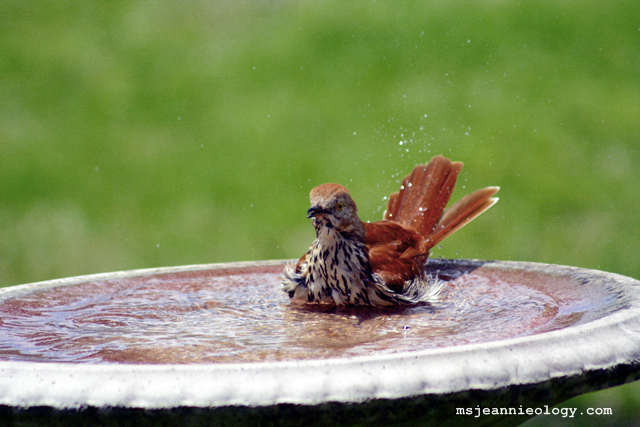
Mockingbird
Mockingbird was making a big production of his pool time. The others were in and out in a flash…
In, Dunk, Shake, Out.
But that Mockingbird, he just wanted to take his time.
Sort of la-de-dah-ing away the afternoon.
The other birds thought they could share the pool – but Mockingbird would have none of it. “Wait your turn,” he said.
I’m not done yet.
But Mother Nature knew how to reprimand his inability to share, for as soon as he chased Brown Thrasher away, the sun disappered, the thunder rumbled and the rain came down again…
Bath time’s over. The pool is closed.
Now Mockingbird is nowhere to be seen. But you can bet he’s close by. Ms. Jeannie is just sure that he’ll be the first one pack in the pool once the sky clears again:)
On another bird front…Ms. Jeannie is pleased to announce that she has joined the great big blue bird’s nest on the internet…Twitter!
She’s not quite sure how to use it all yet – but she’ll get there eventually. You can keep up with her here if you are around the neighborhood. She looks forward to expanding her horizons and reading all that you post. So of course, if you are on Twitter as well, please let Ms. Jeannie know so that she can follow along with you.
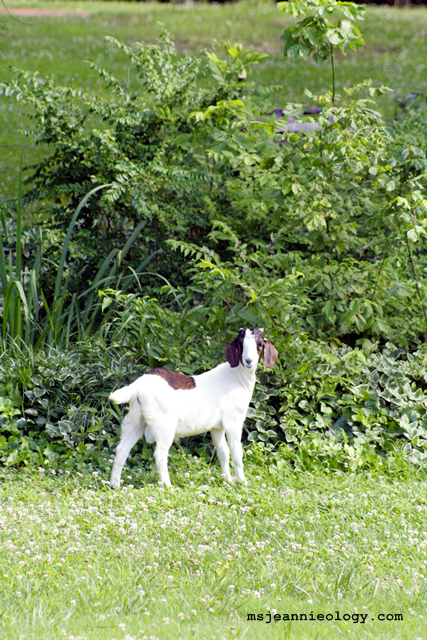
The other day Ms. Jeannie came home to this scene…
A visitor.
That’s Nyle, as you’ll recall from a previous post, the neighbor’s goat. The flora and fauna feast he’s enjoying are Ms. Jeannie’s scrub bushes in her side yard.
On first glance she thought “Oh look how handsome that goat is!” A second later she realized that seeing Nyle standing there in her yard chewing on her bushes, meant that he had jumped the fence and decided on a visit.
Ms. Jeannie called her neighbor to let him know that Nyle had a bit of wanderlust and was traveling southbound via the sideyard shrubbery.
While she waited for her neighbor, Ms. Jeannie went out to visit with Nyle, who of course, was perfectly pleased to share stories of his adventure…
Hey, Ms. Jeannie!
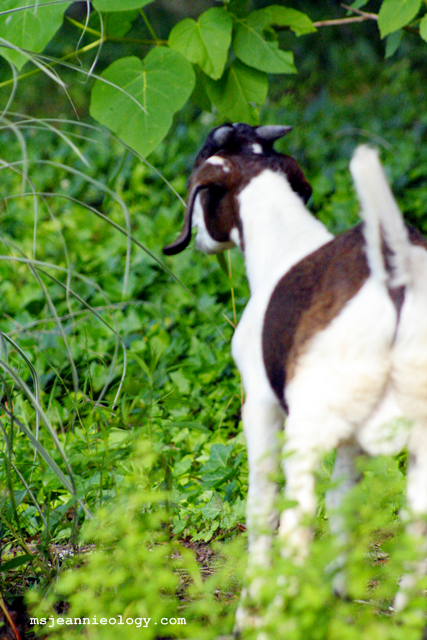
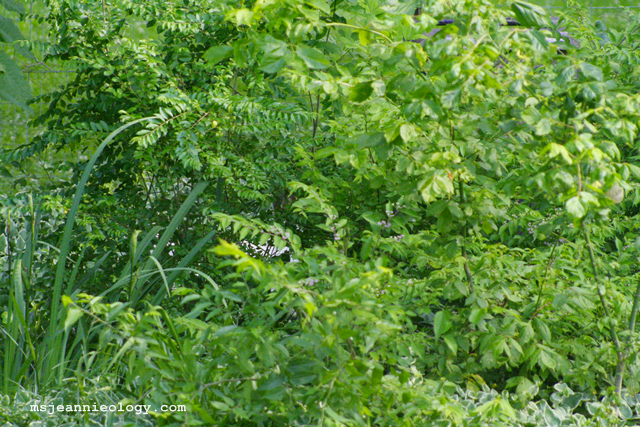
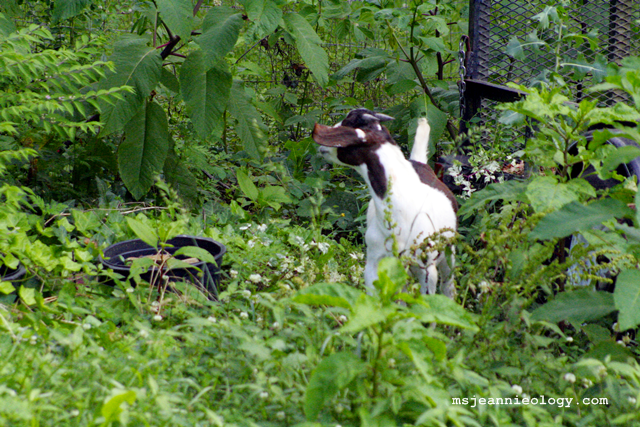
After recounting the experience, hoof by hoof, Nyle decided that the ice cream topper on this festive occasion would be a good old fashioned game of hide and seek.
“Here I go , Ms. Jeannie. I’ll hide and you find me,” said Nyle.“Can you see me now?”“How ’bout now?”
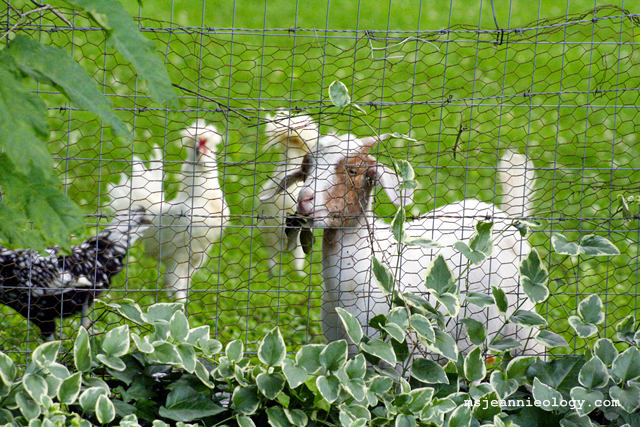
Nymph looked on from her side of the fence (the right side!) like she was watching a movie unfold.
“These leaves are just as tasty as popcorn. “
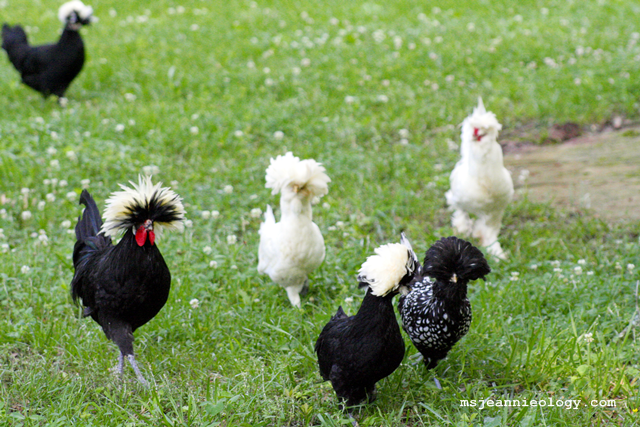
Even the chickens were captivated…
“Just where will Nyle hide next?”“Can I fit in a bucket?”
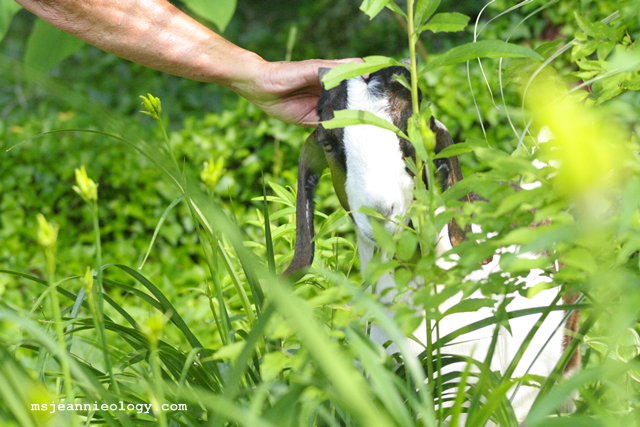
Just as Nyle was debating such proportions, Ms. Jeannie’s neighbor came to collect him.
There’s no hiding from the hand that feeds you.
Back over the fence went Nyle.
See ya later, Ms. Jeannie.
“That’s one special character,” said Ms. Jeannie to her neighbor.
“Yeah that Billy Bob, he’s just about as friendly as goats get.”
And that’s the moment when Ms. Jeannie learned that her Nymph and Nyle are actually named Billy Bob and Betty Boop. She also learned that they go bananas for Saltine crackers, that before the end of the year Nymph (aka Betty Boop) will be a mom and (thankfully), that these two are bound for breeding and not table food. So we can all rest assured on that point. Ms. Jeannie can hardly wait to see the little tiny baby goats these two produce!
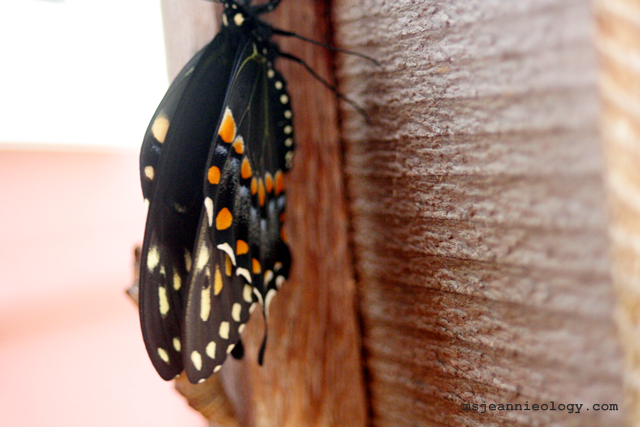
The butterflies, dear readers, are born! Here’s their first photo shoot. Each butterfly emerged on a different day so Ms. Jeannie named them appropriately.
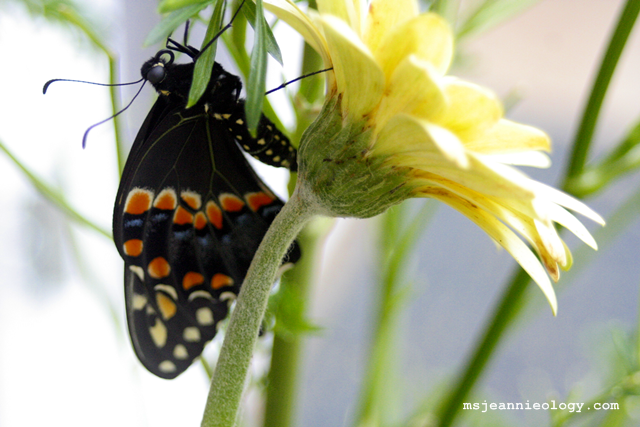
Meet Wednesday – the first butterfly…
Brand-new!
Wednesday was the one, if you recall, who chose to cocoon underneath the flower petals of the gerber daisy. A most pretty spot.
Ta-dah!
Here she was stepping out of the cocoon. Ms. Jeannie just missed her actual emergence by sheer minutes. She had just checked on all three of the cocoons (status quo) and had gone around the corner to cut some herbs for dinner. Five minutes later – here was Wednesday fanning out her new wings.
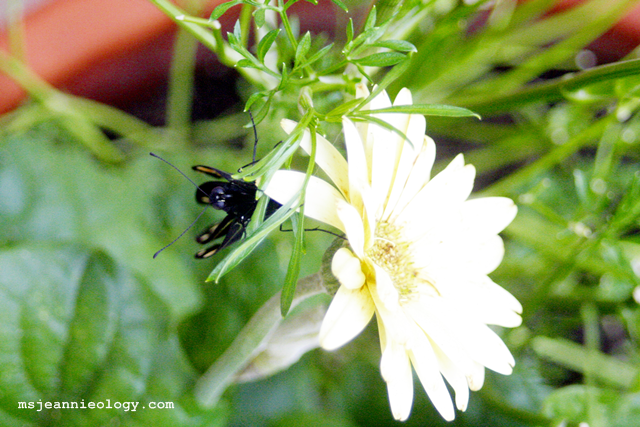
It was a slow-going little journey up the stalk of the flower while she figured out her legs and the tricky business of holding on. But by the time Ms. Jeannie took this aerial view, Wednesday was an expert!
Hello butterfly!
Because Ms. Jeannie had missed the actual moment of Wednesday unzipping the cocoon doors, she was determined to at least catch Wednesday’s first moment of flight on camera. She didn’t how long this would take. So she waited. And she waited.
Ms. Jeannie’s cat, Satchem (incidentally named after a butterfly, herself) even waited with her for awhile.
oh the anticipation…
This gave Ms. Jeannie some time to explain to Satchem that there would indeed be no butterfly dinners in her future. She seemed to understand. Eventually though, she lost interest in the butterflies altogether and fell asleep underneath the tulip tree.
Meanwhile, Wednesday just stayed in her same spot, fanning those wings and taking in her new surroundings.
After 25 minutes of waiting, Ms. Jeannie got side-tracked and went on to other projects – but she came back to check every few minutes. Going into the second hour, Ms. Jeannie came out to check and there was Wednesday on her petal and then in a flash of a second, there she wasn’t.
She flew off into the garden so fast it was all Ms. Jeannie could do to frantically photograph her flying through the air. Unfortunately this is the best photo she got…
First flight!
You can just make out the fuzzy swatches of orange as Wednesday flapped her wings. So long pretty girl!
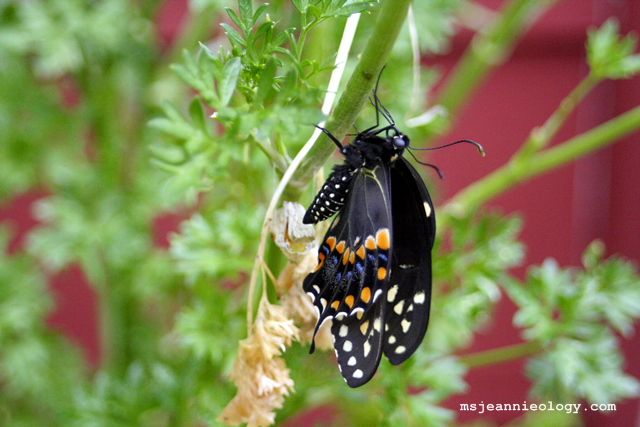
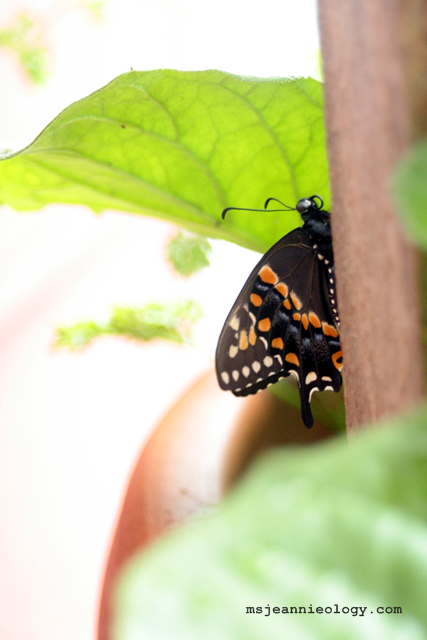
The next butterfly to emerge was Thursday…
Like Wednesday, Thursday also chose the afternoon hours to emerge – although this little butterfly decided to come out just as the storm clouds started to rumble. The wind picked up considerably, and Ms. Jeannie feared that Thursday would get blown away before he had any sort of chance to get his bearings.
You can see him sort of half-hanging there – it looked perilous for a moment…
But Thursday knew what he was doing. He was being blown about quite a bit – but he para-sailed through the high winds like a champ. Apparently, those stickly little legs are a lot stronger than they look!
Then the rains came – torrential downpours so heavy Ms. Jeannie considered clipping the stalk he was on and bringing it onto the screened porch just to give him a chance to get his act together.
But again, Thursday, adapted. Although this time, he crawled back down to his cocoon and hung onto both the casing and the stalk for extra support.
The rain came down for hours and Thursday hung on. The moment the sun came out, he fanned his wings out a few times and went in search of sunnier skies. Again – Ms. Jeannie managed to grab her camera in time for the first flight – but Thursday was fast – so this is the best she could do…
Only a slight improvement was Wednesday’s photograph!
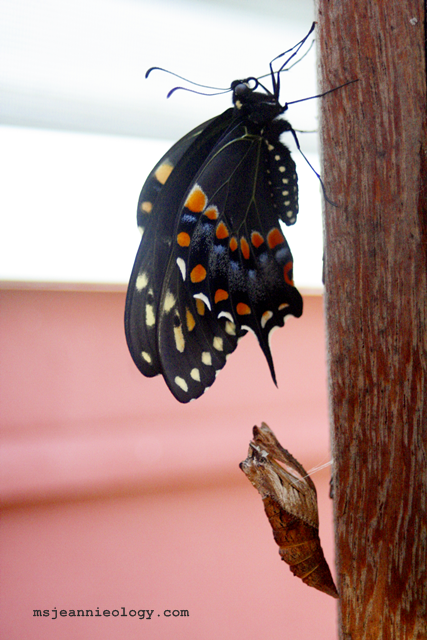
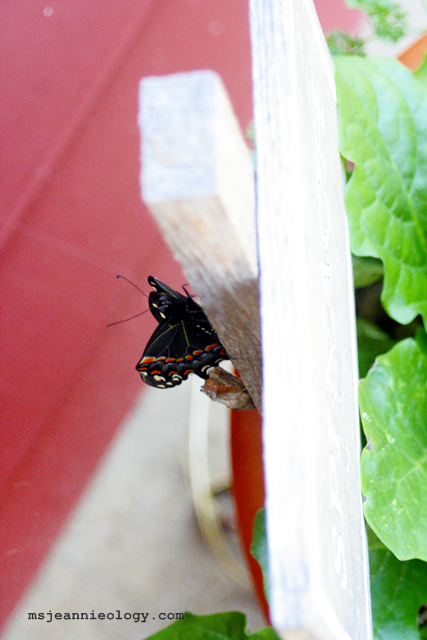
The next day it was back to full hot Georgia sunshine and Friday decided that this was his day to join his pals. Friday was the one who chose to cocoon behind the wooden spinach sign – in what Ms. Jeannie thought was the most disguised location of the group.
Ms. Jeannie was most curious about this one’s color pattern since he had a different color cocoon than the others. But he turned out just the same!
If Friday picked a shy spot to nest, he certainly wasn’t shy about coming out. He immediately started climbing up the wood spike…
So long cocoon, Friday’s on a mission!He climbed…
…and climbed…
and climbed…
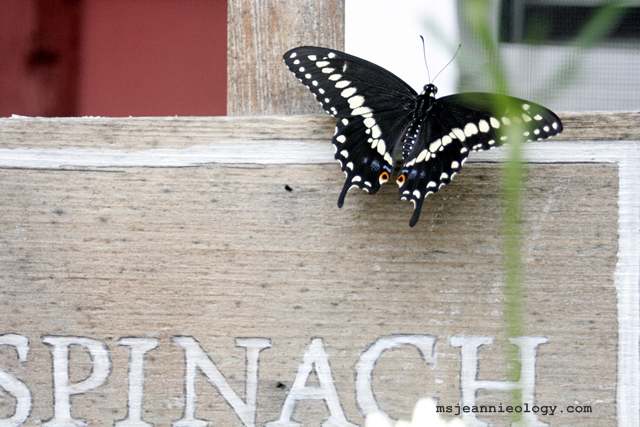
All the way to the top of the sign, he climbed. And then do you know what he did?
He climbed over the other side and gave Ms. Jeannie the most beautiful display…
Ohh…
So handsome and so perfectly balanced, he almost looked fake. Like someone had positioned him there on purpose!
And then, just like the others he was there one minute and off exploring the world the next. This time, Ms. Jeannie was sort of ready – but boy is it hard to capture these little fellas when they are flying!
Definitely, the best of the flight pictures – but no photo awards for Ms. Jeannie on this front:)
So there it is – the tale of the three black swallowtails. Most likely, Wednesday, Thursday and Friday will stay close to the garden enjoying a bevy of summer flowers before finding their own loves and making more swallowtail babies. Ms. Jeannie hasn’t seen them since their birthdays – but she feels like they could be close by. Of course, if she sees any fluttering about the garden, she will photo them for you to see too. Hopefully by that time, she’ll have improved upon those flight photos!
Watching these little guys grow was a completely amazing experience for Ms. Jeannie, packed to the brim with hope and wonder. If you missed the previous posts, read about the beginnings of the butterflies (as caterpillars) here and (cocoons) here.
The other day, Ms. Jeannie’s next door neighbor came home with two new additions.
New neighbors!
Ms. Jeannie heard them before she ever saw them. Crying and bleating for two days straight, Ms. Jeannie thought that what she was hearing were actually small children playing in the yard. Relatives, she assumed visiting their family. As it turns out – it was a different kind of kid altogether!
To give you an idea of what they sounded like, Ms. Jeannie found this video on youtube. They sounded exactly like that (minus the chickens!).
Poor things. These two were making so much noise because they are little baby goats and they were missing their mom and trying to adjust to their new surroundings. On day 3 though, calm came, they settled in and were as quiet as can be. Which is the preferred way to keep goats. Apparently a silent goat is a happy goat!
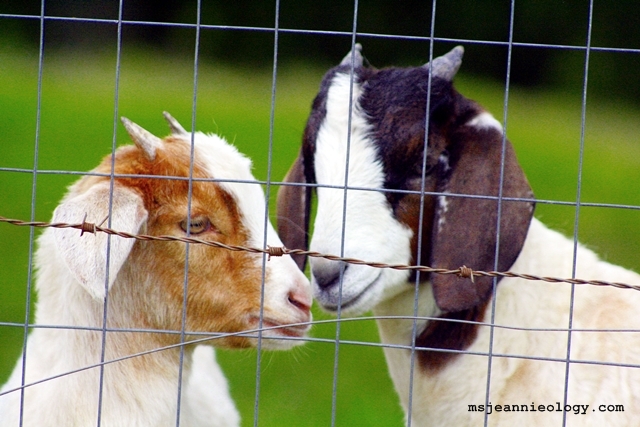
It always look likes they are smiling!
These two are Boer goats which is a meat goat, as opposed to a milk goat, that originated in South Africa. Ms. Jeannie really hopes that her neighbor has no intention of putting these two on the dinner table. They’ve only been in the neighborhood for less than a week, but already Ms. Jeannie loves them.
At first they were very shy and skittish and stayed back near the tree line on the other side of the pasture, far from Ms. Jeannie and the fence. But it just took a little bit of time and some natural curiosity before they made friends. Now whenever they see Ms. Jeannie, they come hopping, like bunny rabbits, over to the fence and let Ms. Jeannie scratch their noses. She hasn’t spoken to her neighbor to see if they have names yet – but Ms. Jeannie has given them pet names of her own. Nymph on the left, Nyle on the right.
Boer goats have only been in the United States since 1993, so they haven’t been around long. But they are gaining fast in popularity because they easily adapt to their environments, have docile temperaments and grow quickly. Ms. Jeannie was surprised to learn that these two will weigh anywhere from 190lbs. to 340 lbs. pounds once they fully mature. That’s one big goat! (or two in this case!). Right now they are the size of a medium sized dog and weigh in the 30-50 pound range. It’s hard to imagine them growing five to six times bigger!
Because Ms. Jeannie shares a fence-line with this neighbor, she sort of feels a little bit like these are her goats too. It’s fun to have new faces in the side yard! Ms. Jeannie will keep you posted all summer long on the progress of Nymph and Nyle as they grow up. Until next time, they both send a few bahhhs your way!
Just as Ms. Jeannie said the other day “it’s amazing what a month can do” … well, it is equally amazing just to see what a a week can do when it comes to the wonderful workings of Mother Nature.
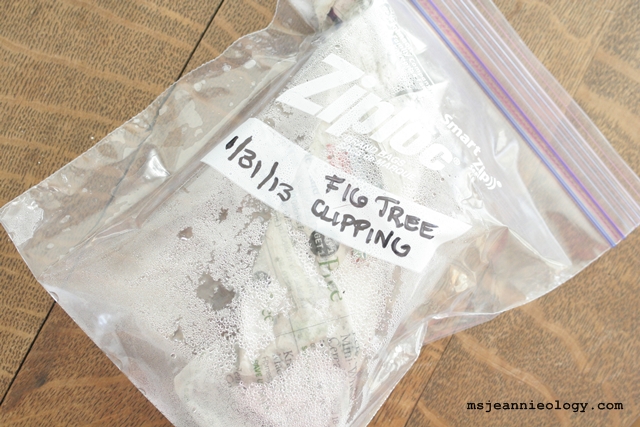
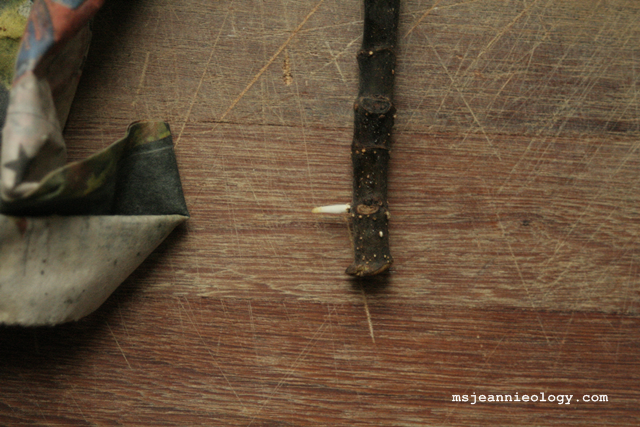
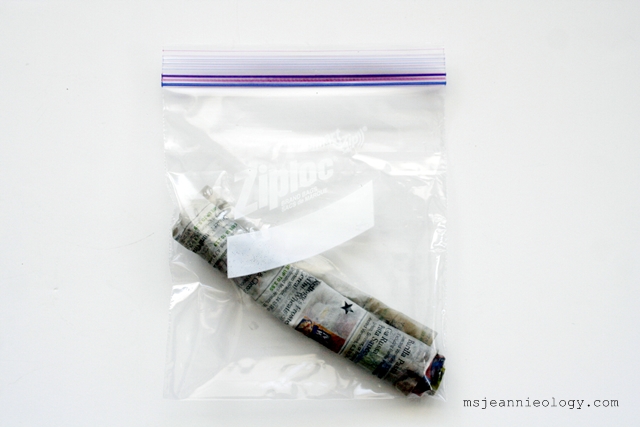
This was a picture of our fig tree cutting 11 days ago, having been snuggled into a moist grocery circular and tucked in a plastic Ziploc bag for just under a month…
After 4 weeks in a ziploc bag!
Do you see the little the root sprout jutting out there near the base?! A good sign that our fig clipping was getting a new start! Ms. Jeannie was so proud of little fig. She thought it might be best to wrap him back up into the Ziploc for another week or two to see if he could grow some more shoots. After that he was going to be transplanted to a plastic cup filled with vermiculite, as recommended by the NewEnglandGardener.
Well, wouldn’t you know dear readers, as Ms. Jeannie was showing off her new gardening feat to a friend – she somehow managed to break off the new sprout. That’s right – completely broke it off – right at the base. Ms. Jeannie thought this was a reminder about vanity. Had she not been showing off – she would have had a strong and sturdy sprout!
Oh well. Back to the Ziploc the clipping went. If Fig could grow one sprout – surely he grow another!
Back to bed…
For 10 days, Ms. Jeannie left it untouched. Yesterday, on Day 11, she (carefully this time!) unwrapped her clipping to see what , if anything was going on with it. This is what she saw…
Sprouts! Not just one but FOUR!
How exciting! The fig tree is on its way!
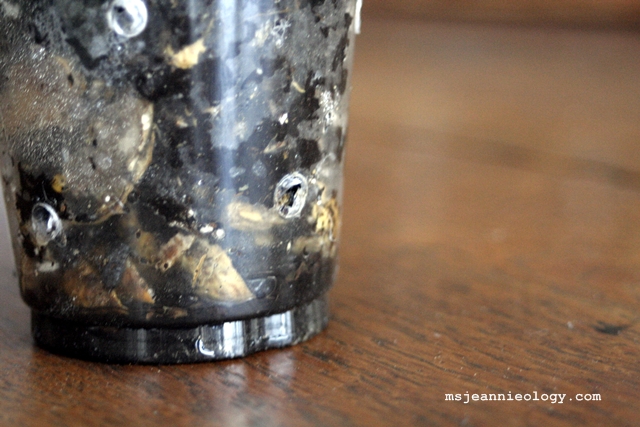
So the next step, according to the NewEnglandGardener, was to transplant the clipping to a plastic drinking cup filled with vermiculite. Ms. Jeannie allocated a plastic cup, Mr. Jeannie melted a few drainage holes in it, and Ms. Jeannie prepared for the transplant. Only there was one slight problem.
Ms. Jeannie didn’t have any vermiculite on hand. No problem, said the NewEnglandGardener. Thanks to his video, he also mentioned that you could use perlite. But, drat, again. Ms. Jeannie didn’t have any of that either.
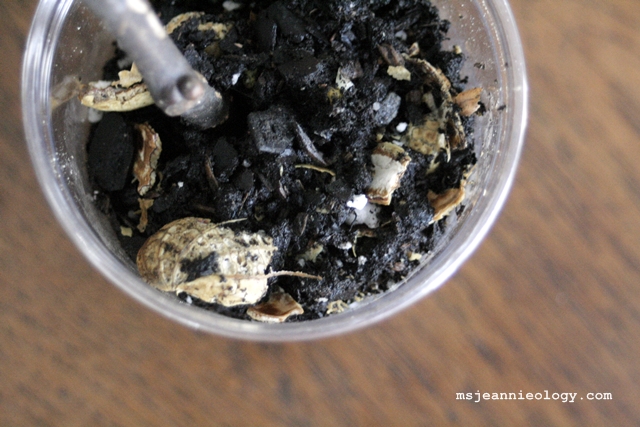
So she she went online and found a potting soil/peanut shell alternative. She had both of those! She shelled about 10 peanuts, and mixed those shells with a handful of potting soil and made a new home for her clipping…
The NewEnglandGardener recommended using a clear plastic cup so that you can see the roots as they start to grow long and wrap around the inside of the cup.
Peanut shells act as lightweight soil aeration chips since they are big and cavernous.
Hope you like your new house, Fig! Now it is back to the shelf, where you’ll sit (out of the direct sun, of course!) for quite a bit of time while you grow roots and eventually leaves.
“I never saw a discontented tree. They grip the ground as though they liked it, and though fast rooted they travel about as far as we do. They go wandering forth in all directions with every wind, going and coming like ourselves, traveling with us around the sun two million miles a day, and through space heaven knows how fast and far!” ~John Muir
Happy Growing!
To follow the fig tree clipping journey from the beginning, start here.
After carefully cutting, wrapping, storing and dating (January 31st, 2013) her fig cutting as the NewEnglandGardener instructed, Ms. Jeannie was a little disappointed when she checked the clipping a week ago, only to see that nothing happened.
For three weeks the clipping had been tucked inside it’s plastic Ziploc, stored in a warm spot (on a shelf in the stairwell) and left unbothered to grow, grow, grow. But as of last week, the twig still looked exactly the same as when she started. No sprouts, no new green, no shoots. In the NewEngland Gardeners video, he already had sprouts after three weeks, so Ms. Jeannie worried that, perhaps, she had done something wrong and that she may have led her readers down a rocky garden path.
In speaking with a friend of hers about this matter, Ms. Jeannie learned another way that you could grow a fig clipping.
Method 2: Rooting a fig twig in a container of water.
In water! So Ms. Jeannie went out, cut another twig and placed that one in a jar of water and set it on her sill away from the sun.
This morning, she checked the status of both the Ziploc bag and the jar. This would now now be week 4 for the Ziploc bag and week 2 for the jar.
She was delighted to find this in her bag:
After 4 weeks in a ziploc bag!
Look closely and you’ll see a sprout at the very base of the twig…
A sprout!
Yey! Ms. Jeannie must have been a little impatient last week. This is a good reminder that you can’t rush Mother Nature. She is ready, when she’s ready!
The grocery circular that Ms. Jeannie wrapped the twig in is still moist, even though she has never added any more water since the start, and it is a little spotted with mold…
Still damp!
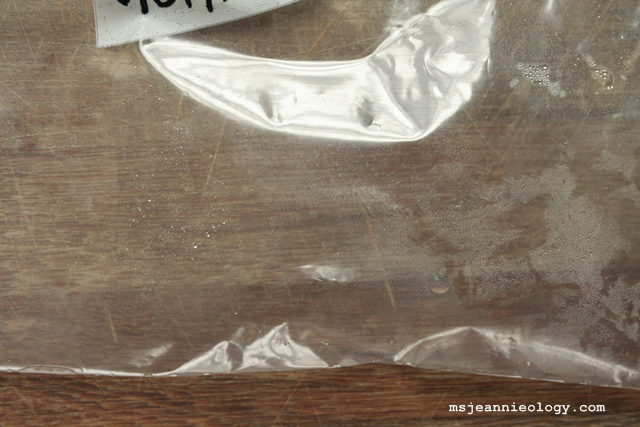
The Ziploc bag also contains condensation…
Condensation bubbles
…so essentially, Ms. Jeannie created her own little greenhouse!
Nothing’s happening with the twig in the jar of water yet, but now Ms. Jeannie knows just to give it time!
So what’s next for the sprouted twig? Well, Ms. Jeannie is going to keep it in the Ziploc for one more week to see if any new shoots will form and then transfer it to a shoe-box size plastic container with potting soil as the NorthernGardener suggested. In the meantime, she’ll keep her eye on the water twig to see what happens.
Until next time, dear readers, grow fearless!
Grow Fearless Art Print by Feed Your Soul Art on Etsy
And don’t forget! You have until midnight tonight to enter to win this photograph (click on the ladies for contest information)…
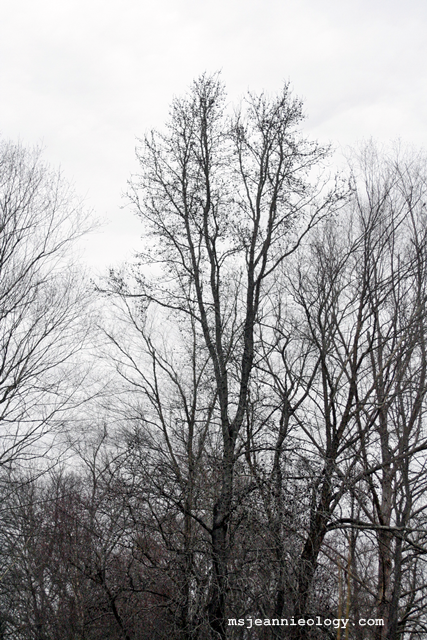
All of November and December, Ms. Jeannie was waiting for this one particular tree in her yard to drop its seed pods…
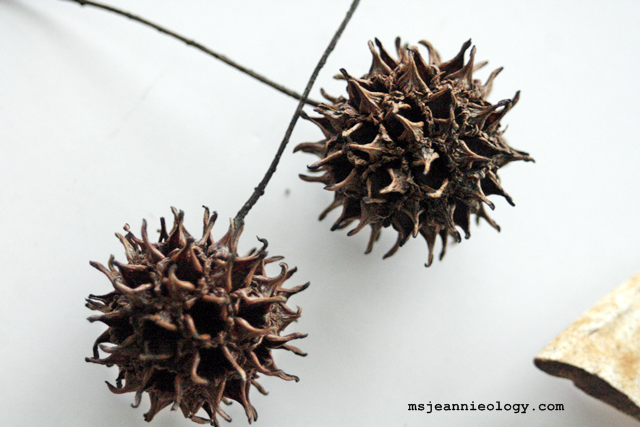
They have these wonderful round pods that Ms. Jeannie thought would look fabulous strung together in garlands for her mantel, on her Christmas tree as part of her natural ornaments and maybe on a wreath for her front door. This is what the pods look like up close…
They sort of reminded Ms. Jeannie of stars, especially when she was looking up at them hanging so high in the trees! Unfortunately, Mother Nature had other ideas, because these little stars didn’t fall until just two days ago, long past holiday time.
Now there are hundreds upon hundreds covering the ground. Ms. Jeannie could have made a million miles worth of garland!
Curious as to what type of tree these little beauties belonged to, Ms. Jeannie did some research and as it turns out, they are from the Sweet Gum tree, which is indiginous to North America, Mexico and Central America. The gum tree has been around since pre-historic times and is actually classified as a living fossil. It is one of the oldest recorded trees in history. Goodness gracious.
Ms. Jeannie found this information fascinating because the shape of the pods reminded her of some other-wordly items like the spiked wrecking ball weapons from the Middle Ages…
Ironically, you can buy these on ebay for $20.00!
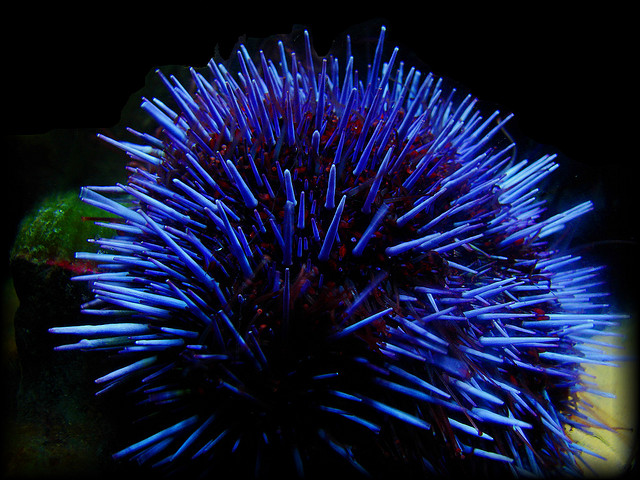
Or those crazy underwater sea urchins…
Sea Urchin from the Getty Collection
The sweet gum pods (or gum balls, as they were nicknamed) are actually known as the tree’s fruit and contain one to two seeds within each pod. The trees can grow up to to 120′ feet tall and the leaves turn beautiful colors in the fall. Ms. Jeannie estimates her tree to be about 80′ feet and is indeed one of the tallest in her yard.
Here is an example of a sweet gum in the summer…
Sweet Gum tree photo courtesy of scstrees.com
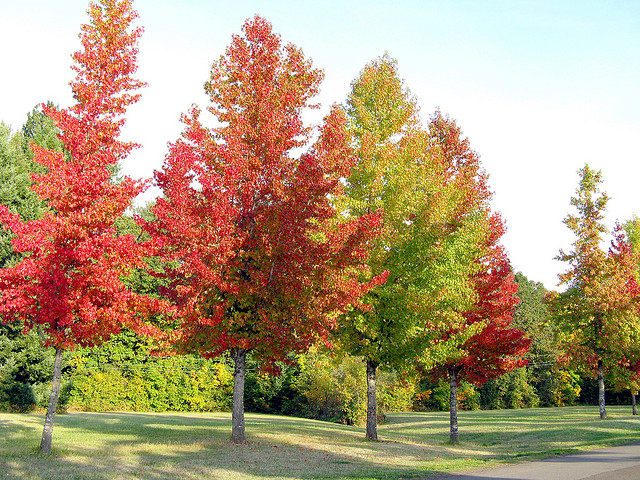
and in the Autumn…
Sweet Gums in Fall photo courtesy of flickr.com
This species of tree was first recorded by Spanish naturalist, Francisco Hernandez de Toledo in the 1500’s.
Spanish naturalist and physician Francisco Hernandez de Toledo (1514-1587).
Francisco was the court physician to the King of Spain and in 1570 was sent to the New World on a botany trip specifically to study medicinal plants. In his journals, he noted the sweet gum tree bark as having a fragrant juice resembling liquid amber. Indeed, this liquid amber is where the tree got its name. Native Americans taught pioneers in America how to peel the resin from the bark and chew it in order to quench thirst, thus making it one of the first chewing gums in America.
The sweet gum tree was introduced in Europe in the 1600’s, planted in the gardens at Fulham Palace in London by way of Reverend botanist John Bannister, who had traveled to Virginia to bring back exotic tree cuttings like the magnolia, black walnut and cork oak among others – all of which are still represented in the palace gardens today.
The gardens at Fulham Palace, London. Photo courtesy of geograph.org
Throughout history the resin found in the gum tree has been used homeopathically to heal a host of ailments from skin conditions to bronchial infections. Likewise, it’s wood has been used commercially in the manufacture of low-grade hardwood products, plywood, crates, furniture and as an ebony wood alternative.
Ms. Jeannie had no idea, her tree was so useful! Now having learned all this , she is going to go out with a plastic bin and collect all the gumballs so she will be sure to have enough for her 2013 holiday crafts…
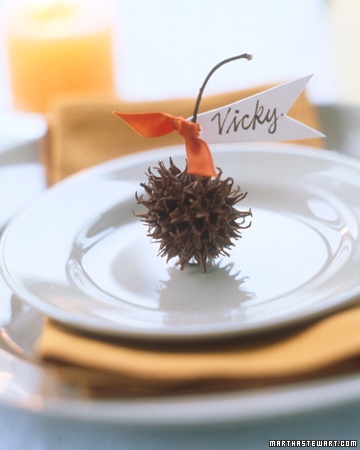
Place CardsHoliday wreath lightly spray painted white makes it look frosty!Garland!
Ms. Jeannie pinned these pictures above to her Historic Holiday board on pinterest, plus a few others. Stop by and see them here. She can’t help but think that these would be lovely spring wedding decorations for table decor or used in bridal bouquets – especially if you were having a spring outdoor wedding. These sweet gums are full of rustic charm and potential!
If you have any creative ideas about other ways Ms. Jeannie can use the little beauties, please send a message!
The two fig bushes in Ms. Jeannie’s yard, as pictured last summer.
In preparation for some spring gardening projects, our dear blog reader, Amy, sent in a gardening question about fig trees and whether or not she would be able to grow them from cuttings in her neighborhood, which happens to be arid Arizona.
Instantly, Ms. Jeannie thought sure, why not grow them in Arizona since figs first originated thousands of years ago in Arabia. But she wasn’t sure about the cutting department, so she did a little investigation on Amy’s behalf.
Lucky for us, Ms. Jeannie learned that since they are one of the oldest fruit trees in the world, they have now been adapted and modified to grow in just about any climate. Which is good news for all fig lovers! So first order of business is to determine which type of fig tree that will grow best in your neck of the woods…please consult this list.
Next, once you’ve found the right variety, you can visit your local nursery or garden store and either buy a small fig tree that has already been started or you can order a cutting online and start your own. Ms. Jeannie found this great video on youtube from the NewEnglandGardener which takes you step by step through the cutting process…
Ms. Jeannie was so inspired by the video – she decided to try her own clipping project, following the NewEnglandGardeners helpful guide. Here is what Ms. Jeannie used…
1. Garden Scissors 2. Publix Grocery Flyer 3. Quart size Ziploc bag 4. fig tree cutting (this one is 7″ inches)
She clipped a section that had a green sprout already (in hopes that it will encourage more!)
Close-up of clipping
Here’s the finished product. Now we wait for a few weeks and see what happens. Ms. Jeannie is going to keep the bag in her kitchen stairwell, which seems to collect all the heat in the house.
Grow big, little fig!
Please keep in mind, as noted in the video – growing trees does not happen over night. It will take a few years to get your cutting tree well established. However – they are fairly fast growers, so you’ll see changes over the course of months instead of years, like some other trees.
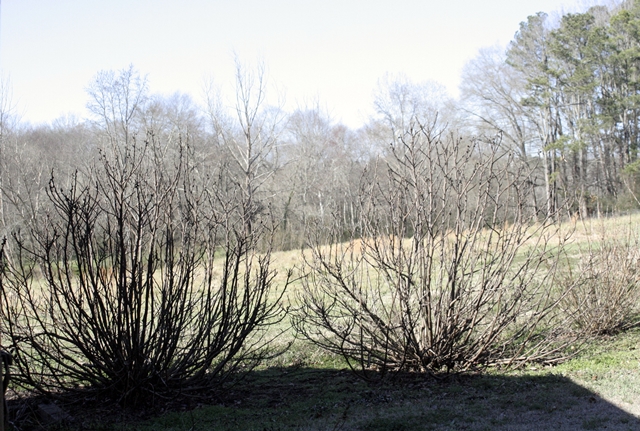
This is what the fig trees in Ms. Jeannie’s yard look like now, in the middle of winter (aka the dormant season, as the NewEnglandGardener refers to in the video)
A picture of Ms. Jeannie’s fig trees taken today. Stickily looking things in winter, but they still retain a nice shape.
If you look closely, you can see they already have buds emerging even though it is only January. This is a perfect stage now, to take a clipping.
You can see two of last year’s figs now dried on the twig. Ms. Jeannie wonders if this is inspiration for the new shoot!
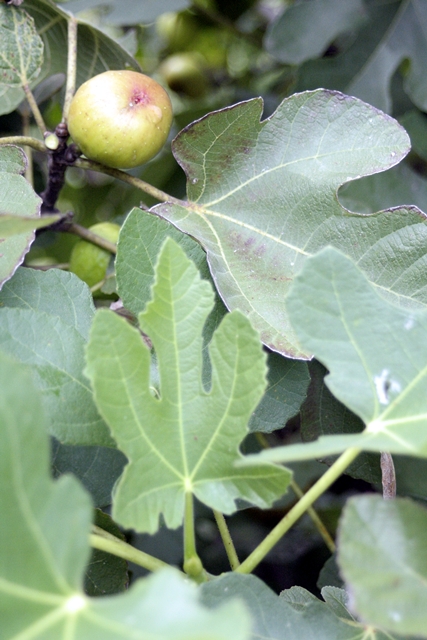
Isn’t it amazing that this little sprout will grow from a tiny little wonder into this, in only about 3 short months…
The fig trees in Ms. Jeannie’s yard are over 12 years old and reach about 10′ feet high x 8′ feet wide. They’ve been pruned every once in awhile but otherwise, are incredibly low-maintenance. You may recall, last summer, the two fig bushes in Ms. Jeannie’s yard had a banner production season. There must have been hundreds of figs that plumped up from July thru September.
Mostly she passed buckets along to her friends, ate a few cups each day and froze gallon bagfuls for a jam lesson that never quite came into fruition. No problem though, as of late, Ms. Jeannie has been enjoying the frozen figs in her morning yogurt shake. Why add ice cubes when you can add some frozen figs instead?!
All you do is just pick, rinse and air-dry the figs and then pop them into a freezer bag and stick them in the freezer.
Ms. Jeannie tosses these little frozen delights right into the blender, straight out of the freezer in this state. They make the shake cold and add extra vitamins to the start of her day. Figs are high in vitamin K (good for blood clotting), vitamin E (protection from cell damage) and vitamin B6 (good for the nervous system, the breaking down of glucose and for cell energy).
They also contain the minerals manganese (good for your bones) and potassium (good for your blood pressure) and are also really high in dietary fiber. A delicious superfood! This is Ms. Jeannie’s recipe for her morning shake, if you are so inclined to try it…
Yogurt Fruit Shake
Makes two 8oz. glasses
1/2 cup organic 2% milk
6 whole frozen figs
1 banana (broken into 4 sections)
1 cup fat free vanilla yogurt
1 quarter fresh cantaloupe (rind removed and roughly chopped)
Add all ingredients in the blender and pulse on low until all the figs break down into pieces (about 30 seconds). Then put the blender on crush and let it mix for about a minute, which blends all the fruit and incorporates air to make it light and fluffy. If the shakes seems too thick, you can add more milk. Otherwise pour and enjoy! You can also add different types of fruit if you like. This is a really basic recipe and can be modified eighty million different ways!
Ms. Jeannie hopes this mini fig lesson will blossom into something wonderful for Amy and anyone one else with figgy aspirations. If you decide to start a fig tree from a clipping, keep us posted on how your progress goes. Ms. Jeannie in turn, will keep you updated on hers as well. Happy growing!!!
This morning, Ms. Jeannie woke up to this on one side of the yard:
Frost as thick as a blanket!
and this on the other side of the yard…
the blooming of the crocus’!
Isn’t it amazing that two conditions like this can co-exist at the same time? She could almost hear Mother Nature asking – “…and which do you prefer Ms. Jeannie? The gift of winter or the gift of spring?”
Ms. Jeannie picks Spring! She’s looking forward to new year of gardening adventures! What about you?
If you have been a part of Ms. Jeannie’s blog since the summer, you’ll know that Ms. Jeannie enjoys the fun of gardening (minus April’s poison ivy outbreak, of course!). Her small summer crops were full of crunchy cherry tomatoes, crispy green peppers, snappy garden peas, buckets of sunflowers and more jalapenos then Mr. Jeannie Ology knew what to do with!
After she had harvested all her plantings and tilled her garden back down to the soil again, Ms. Jeannie half-heartedly decided to plant a fall garden in a neighboring patch that was overwhelmed with weeds. She says half-heartedly, because after the zealousness with which she approached her summer garden, (designing her own patch, layout and fencing) Ms. Jeannie felt sort of confined working in the perimeters of this already established bed. It was a funny shape too. Sort of like a squashed trapezoid or a flattened kidney bean, and was flanked on both ends by azalea bushes. But it did back up to garden fencing (ideal for fall peas!) and had a pretty brick border, so…
She carried on anyway and planted two rows of peas, several rows of alternating onions and carrots and a border of zinnias. She was using old seeds, some over five years old as an experiment of sorts to see if they would actually still grow.
The weeds returned almost instantly. Some of the seedlings started to sprout. Fire ants began to picket. Apparently, being fond of the neighborhood, they were not keen on Ms. Jeannie’s idea to relocate their home. And then there were the mosquitoes – so big and so bold, Ms. Jeannie began to think she, herself, was their only source of sustenance.
For weeks Ms. Jeannie battled nature. But, as it turns out 5 year old seeds in combination with weeds, fire ants and mosquitoes does not make for a garden great. The peas bloomed then promptly withered, the onion shoots sent up green antennas from the ground, surveyed the location and then disappeared – never to be seen again. And the zinnias nevr even showed up at all. Ms. Jeannie was depressed. Halfhearted gardening was no fun. No fun at all.
But there was one bright spot among all this sad state of affairs. The carrots! Dear readers, the carrots…the carrots gave it their all! They sprouted, they grew long lacy foliage, they hummed happily. All autumn. Growing, growing, growing in the ground undisturbed. Like a bad mother, Ms. Jeannie paid them absolutely no attention. She didn’t water them, she didn’t weed around them or cover them on frosty nights, she didn’t even visit them on a weekly basis. Frankly, my dears, she just sort of forgot about them.
Until yesterday. When a faint memory tickled her mind. A long lost thought…plantings in the fall…carrots for Thanksgiving dinner (Ms. Jeannie’s original idea for the garden in the first place)… vegetables throughout the winter. Dreamy eyed, Ms. Jeannie wondered what might have become of those carrot seeds from so long ago…
So with shovel in hand, she headed out to the garden to investigate. Expectations were low – incredibly low. After all they’d been in the ground for 5 months. There had been many, many handfuls of cold 30 degree weather. There had been times of drought and times of flooding. And there had been that issue of lackluster attention.
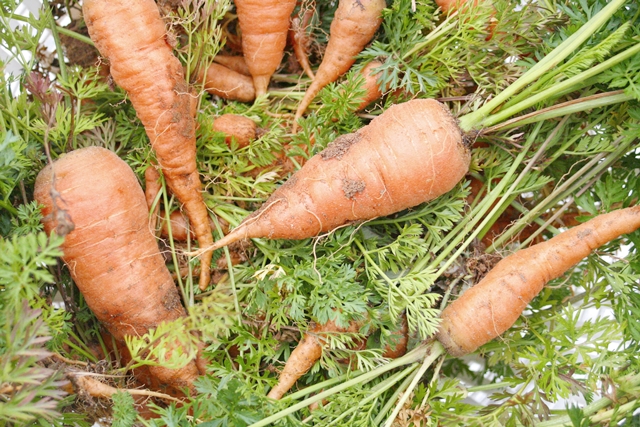
But alas! The carrots didn’t care! No worries, they shouted. The green lacy sprouts greeted her like a long lost friend. They practically sang to her as she pulled them, one by one out the ground. Here’s a picture of the chorus…
Full fledged carrots! Maybe a bit on the small side, some, but with such low expectations, Ms. Jeannie was practically overjoyed with the perfection of them all:) Such beauties they seemed!
Who would have thought you could enjoy such pretty vegetables in December? And with absolutely zero effort. Carrots may just very well be Ms. Jeannie’s new favorite vegetable.
This event called for celebration, so Ms. Jeannie found herself in the kitchen last night making a parmesan and carrot risotto. It was a chilly night – in the mid 30’s – and this was a warm, filling dinner full of autumn sunshine (thank you carrots!).
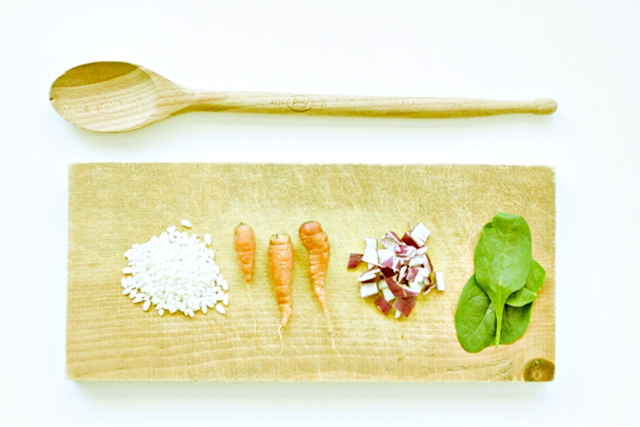
The ingredients!
A lot of people shy away from making risotto because they think it is tedious or complicated, but really it couldn’t be a more simple recipe. The often thought tedious part just means you have to stay by the stove for about 20 minutes and stir frequently so the rice doesn’t stick. If you haven’t ever tried risotto, it is an Italian style rice based dish, that is filling like pasta and can be cooked a million different ways but always includes 3 ingredients: parmesean cheese, white wine and chicken broth.
Ms. Jeannie always likes to use homemade chicken broth but you could used canned or carton broth as a substitute too.
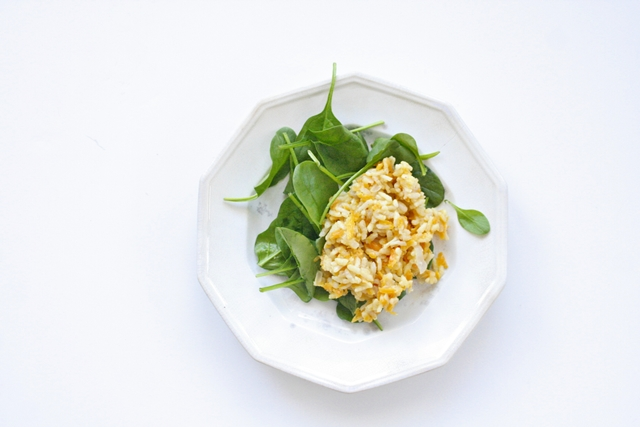
Here’s the recipe, which was adapted from a Martha Stewart recipe that had called for long grain rice in place of risotto. This is a picture of Ms. Jeannie’s finished product with a serving suggestion (see bottom of recipe for details).
Ms. Jeannie’s Parmesean Carrot Risotto served on one of the antique ironstone plates from her collection.
Parmesan Carrot Risotto (serves 4)
Ingredients
3 1/2 cups homemade chicken broth
2 tablespoons butter
1 medium red onion, finely chopped
6 medium carrots, grated
Coarse salt and ground pepper
1 1/4 cups arborrio rice
1/2 cup dry white wine
1/4 cup grated Parmesan
Directions
In a saucepan, bring broth and 2 cups water to a bare simmer over medium.
In a large saucepan, melt 1 tablespoon butter over medium. Add onion and carrots; season with salt and pepper. Cook, stirring occasionally, until softened, 5 to 7 minutes. Stir in rice. Add wine; cook, stirring, until absorbed, 1 to 2 minutes.
Add 2 cups hot broth; simmer over medium-low, stirring frequently, until mostly absorbed, 10 to 12 minutes. Continue to add broth, 1 cup at a time, stirring occasionally, until absorbed before adding more. Cook until rice is creamy and just tender, about 20 minutes (you may not need all the broth).
Remove risotto from heat. Stir in Parmesan and 1 tablespoon butter, and season with salt and pepper.
Ms. Jeannie served her risotto on top of a bed of raw baby spinach. She just grabbed a handful of spinach for each plate. The heat of the rice wilts the spinach a touch and adds a bit of bright color to the plate. Ms. Jeannie paired her dinner with Smoking Loon Sauvingnon Blanc, which complimented the sweetness of the carrots. She could have also served this with a crusty baguette too – had she not forgotten to get one at the store!
Here’s a close-up so you can see the texture…
Risotto close-up!
Thank you sweet carrots for growing so great over all these months!!! See you again this spring for sure!









































 In the Vintage Kitchen: Where History Comes To Eat