At last, at last our dear Ms. Jeannie has surfaced! Yesterday found us with a quick letter and a photograph detailing where she has been spending her last few weeks. How exciting!
“As promised,” she writes…”I’ve been spending time on land and sea in worlds that Rudyard Kipling would be so very fond of. I’ve seen mountains that contain every shade of green and gold and gray that has ever been known. And sunrises! Dawns that do indeed come up like thunder just as R.K. promised. My latest mode of transportation is this boat I met one afternoon in harbor which I have secretly named The Cormorant after the bird who floats and dips and glides so gracefully along the waterline….”
She goes on to apologize for not getting in touch sooner detailing that her schedule has been so rigorous she couldn’t find any time to stop and write. As is true to character, Ms. Jeannie doesn’t get into much specific personal information about where she is or what she’s doing except to say that she would be setting foot on more sturdy ground within the month. The postmark on her envelope came from Kashmir so there is no doubt that Ms. Jeannie has been spending time in India as well as sailing the Asian seas in that magical junk boat. Where could she be landing next? We’ll just have to wait until we hear from her again. If you have any guesses of her next landing spot post them in the comment section below and we’ll start a little game of Where in the World is Ms. Jeannie?!
In the meantime, we’ll be cataloging Ms. Jeannie’s journey and following her globe-trotting adventures in the Field Notes section of the site which you will find here. Stay tuned for more reports as she reports from here, there and everywhere.
It’s been two months since we last checked in with Renee and Michael on their 1940’s colonial house kitchen renovation. According to the original plan laid out in February, by this point in the game, they should be more than halfway through the construction project. Their eyes should be twinkling with the excitement of a foreseeable finish line. Their bellies should be full of the creative, outside-of-the-box meals they’ve been making with limited equipment. And the countdown to the end of all that ham-ham-hammering should be coming to a close.
Is it? Are they well on their way to a brand new kitchen? Are they feeling happy and healthy and homely? Let’s find out with this update in Renee and Michael’s own words…
Hi again!
Remember how last time we talked about how excited we were to finally begin our renovation project after 4 months of delays? And that we were supposed to start on February 15th? Well, that didn’t happen. Now, we’re looking at breaking ground sometime in April (if we are lucky). Why, you might ask? Well, let me tell you a story about the worst thing to ever happen to mankind – LOCAL GOVERNMENT! I won’t go into details, but essentially our local Zoning Board had a bone to pick with our contractor, and took it out on us by finding a measurement error of 3 inches on our plans, and is making us hire a surveyor, re-measure everything and potentially reapply for the very simple variance that we need.
The bright spot is that it looks like a lot of our kitchen-less time will now occur during the summer months. That means that we’ll be able to grill outside a fair amount instead of having to make due with “cooking” on a hot plate or getting takeout.
We’re also using this extra time to work on perfecting some of our food-preservation techniques. Today, we spent a cold and rainy Sunday in our vintage kitchen making a whole ton of chicken stock and some really awesome granola, the recipe for which we share below with you, the readers of In The Vintage Kitchen.
We were going to post the chicken stock recipe too, but we thought “put chicken in a pot with some veggies and simmer it for 5 hours” was a bit of a cop-out.
The granola is Renee’s own recipe and has gone through a whole bunch of iterations over the years from chewy and sweet to crunchy and a bit savory. This batch is particularly good, and despite its ability to last a long while on the shelf I have a feeling it will be gone pretty darn quickly. It’s got a nice cinnamon warmth, and an almost brittle-like bark that contrasts amazingly with the chewy oats. Sprinkled on top of some good yogurt (like our favorite from SOHHA: www.sohhayogurt.net) with a nice drizzle of local honey it makes the perfect breakfast, snack or dessert. We hope you enjoy it just as much.
Renee’s Homemade Shelf Stable Granola
3 tablespoons of oil (for this batch, we used one tablespoon each of olive, walnut and coconut oil, but use whatever you like or have on hand)
2 tablespoons of honey
2 tablespoons of maple syrup
2 tablespoons of nut or seed butter (we used almond, but you can use peanut or sunflower butter – whatever you like)
½ teaspoon of vanilla extract
½ teaspoon cinnamon
1 tablespoon of chia seeds
1 tablespoon of hemp seeds
1 tablespoon of flax seeds
1 tablespoon of sunflower seeds
1 tablespoon of shelled pumpkin seeds
¼ teaspoon flaky sea salt
2 tablespoons of unsweetened shredded coconut
¾ cup of nuts of your choice, roughly chopped (we used ¼ cup of almonds, ¼ cup of hazelnuts and ¼ cup of pecans)
1 ½ cups of old fashioned rolled oats
Preheat your oven to 250 degrees F.
In a large bowl, mix the first five ingredients until well combined. Add the cinnamon, all of the seeds, salt and coconut and mix well. Add in the chopped nuts, followed by the oats and mix until all the ingredients are incorporated.
Line a large baking sheet with a sheet of parchment paper (cool trick we learned to keep the parchment paper from shifting – crumple up into a ball first, then unravel and place on sheet). Spread the granola mixture on the sheet, distributing as evenly as you can. Bake for 45 – 50 minutes, checking and turning sheet pan every 15 minutes. When the granola is slightly browned, remove from the oven and let it cool completely in the pan. Break up into pieces and store in a glass container. Enjoy!
It is so poetic how Renee and Michael’s messy pre-construction situation yielded a messy recipe. There must have been some serious satisfaction in getting the big knife out and chopping away at all those nuts and seeds. It must have felt rewarding to tame a mass of unruly ingredients into an any-time sweet treat. In a followup conversation with Renee, I learned that their new zoning meeting has now been scheduled for the end of April, which hopefully will grant and greenlight the whole start of their construction project. That means they will be looking at an end date closer to August than the originally anticipated month of May. In the interim, as far as the healthy cooking challenge has gone Renee and Michael are still for the most part on track despite having this major lull in their plans. Renee explains further here…
♦ InTheVintage Kitchen: Since the project was delayed but essentially you had already packed up all your equipment in anticipation of the February start date, did you wind up unpacking any of the boxes so you could do more cooking?
Renee:Yes – we did unpack a few things that we needed in order to continue cooking at home. We didn’t pack up the entire kitchen (we were waiting until the very last day) so most of the essentials were still there for us to use in the interim.
♦ ITVK: How has it been going using a pared-down amount of dishes and pots and pans and such? Has it changed your eating habits in any way so far?
Renee:Surprisingly, it’s been OK – or maybe we’ve adjusted?!?! We already pared down (threw away/gave away/donated) many of our old and duplicate kitchen items and kept only the essentials in the kitchen to keep the packing and unpacking light. We’ve been preparing for a kitchen reno in the back of our minds for quite some time now, so we’ve been really good about what we really need and don’t need! As far as new habits – we’ve started adapting to our new electric hot water kettle to boil water (to make coffee/tea. etc.) and have been prepping food items that will keep without refrigeration in our spare time over the weekends.
♦ ITVK: Has the delay impaired any other cooking situations other than not having your boxed up items readily available and your patience tested?
Renee:Mostly the ability to throw a dinner party or have guests over to the house – we love entertaining, and it’s been really difficult to do at this point between the empty walls and piles of boxes… and lack of serving platters, etc… ugh!
♦ ITVK: On a 100 percent scale, at this stage in the game, how would you break down where you are eating?
Renee: 80% at home
10% at friends/family’s houses
10% out and about (restaurants, coffee shops, etc)
0% order-in/delivery
We are still trying to cook at home as much as we can – we know that any day now we won’t be able to – so we are taking advantage of the extra time that we have.
♦ ITVK: Did having the kitchen in a semi-state of upheaval for this delay time give you any new insight into how the next three months might go once the construction begins?
Renee: In a way – yes! It’s made us realize what we really need/don’t need for day-to-day cooking to create healthy meals. But, since it’s now dragging out the 3-month timeline, it’s definitely been a downer. Perhaps that will just make the new kitchen all that more loved and appreciated:) I’m sure when we are actually in the thick of it – nothing can really prepare us for what it’s going to be like, especially given how many surprises we’ve already had… who know’s what’s to come!
Michael admitted that this post was off to a sour start but wound up being sweet in the end. Next time they pop-in for an update these two hope to share actual pictures of actual construction occurring in their old/new kitchen. Fingers crossed that those days are right around the corner. If only local government ran on granola…
—
Did you miss Part One of Cooking Under Construction? If so catch up here.
Photo Credit: Granola photos provided by Renee and Michael.
There’s some new (old) sounds coming out of the Vintage Kitchen this weekend. Bah-da-da-dah daaaa… can you hear it?! Click on the old radio above or in the right margin and you’ll be magically transported back to the 20th century where you’ll hear a range of music from the 1920’s -1960’s via the Vintage Kitchen playlist on Spotify.
The playlist is called Sunny Side Up because it is a peppy collection – the first in a series of vintage playlists curated for different moods of the day. Sunny Side Up features fun classics from these faces…
Clockwise starting from top left: Louis Armstrong, The DeCastro Sisters, Rosemary Clooney, Perry Como, The Chordettes, Harry James & His Orchestra, Etta James, Elvis, Frank Sinatra, The Andrews Sisters, Eddie Condon and Ella Fitzgerald.
and covers a mix from genres including ragtime, big band, blues and orchestral. Spotify gives you two options as far as listening goes – you can sign up using their player or you can download the playlist to your device and listen wherever you like.
One of the most favorite songs in the collection includes this one recorded in 1944 by the Andrews Sisters…
More playlists will be debuting soon so stay tuned. In the meantime, if you have any favorites that would be a fun addition to Sunny Side Up please post your request in the comments below and we’ll add it to the playlist.
1956 was quite a year for iconic pop-culture. Elvis was singing about his blue suede shoes, Norma Jean officially changed her name to Marilyn, the Yankees won the World Series, Bob Barker stepped out onto his first televised game show set and Grace Kelly married a real-life prince.
On the home front, the mid-1950’s kitchen was also going through some equally exciting and interesting design improvements in the convenience department. With more than 35% of women working outside the home by 1956 multi-tasking became “the” trend of new innovations promising both ease of use and the ability to conquer more than one job at a time. Some of these inventions were a bit quirky (like the oven insert that roasted meat like toast), some paved the way for modern mainstays that we use regularly today (the automatic Redi-Baker) and some (the mobile dishwasher) could totally make a comeback in our modern mini-home craze.
In today’s post we are heading back to the pastel wonderland of 1956 and all the mechanical marvels that hit the mid-century kitchen market with a flurry of magical appeal. Let’s look…
1. The Mobile Dishwasher
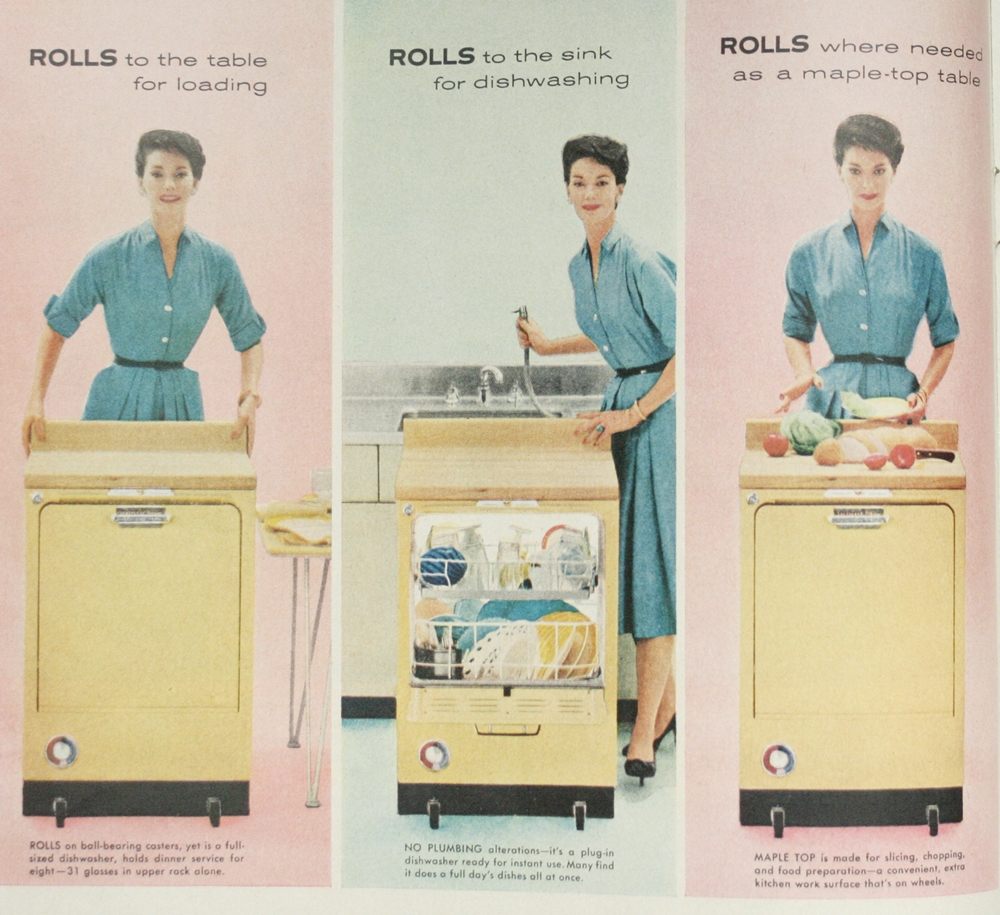
Hotpoint Mobile Dishwasher, 1956
Part cutting board, part dishwasher and all on rollers, this totally functional piece of kitchen equipment was meant to be wheeled around from prep counter to table and then back to the sink offering kitchen cleaner-uppers the ability to cut out some extra steps by loading dirty dishes right from the kitchen table. The new mid-1950’s concept of front loading baskets left room for a chopping board on top which was the ideal helper for any kitchen too tight on counter space. By throwing a cloth over the whole thing this handy appliance could even turn into a rolling hors d’oeuvres cart or impromptu bar area for entertaining, fulfilling three jobs in one – dishwasher, sous chef and butler. Completely functional, this seems like a piece of the vintage past that could definitely come gallivanting back into our world today, especially for city dwellers and tiny house lovers.
2. Separate Fridge and Freezer Units
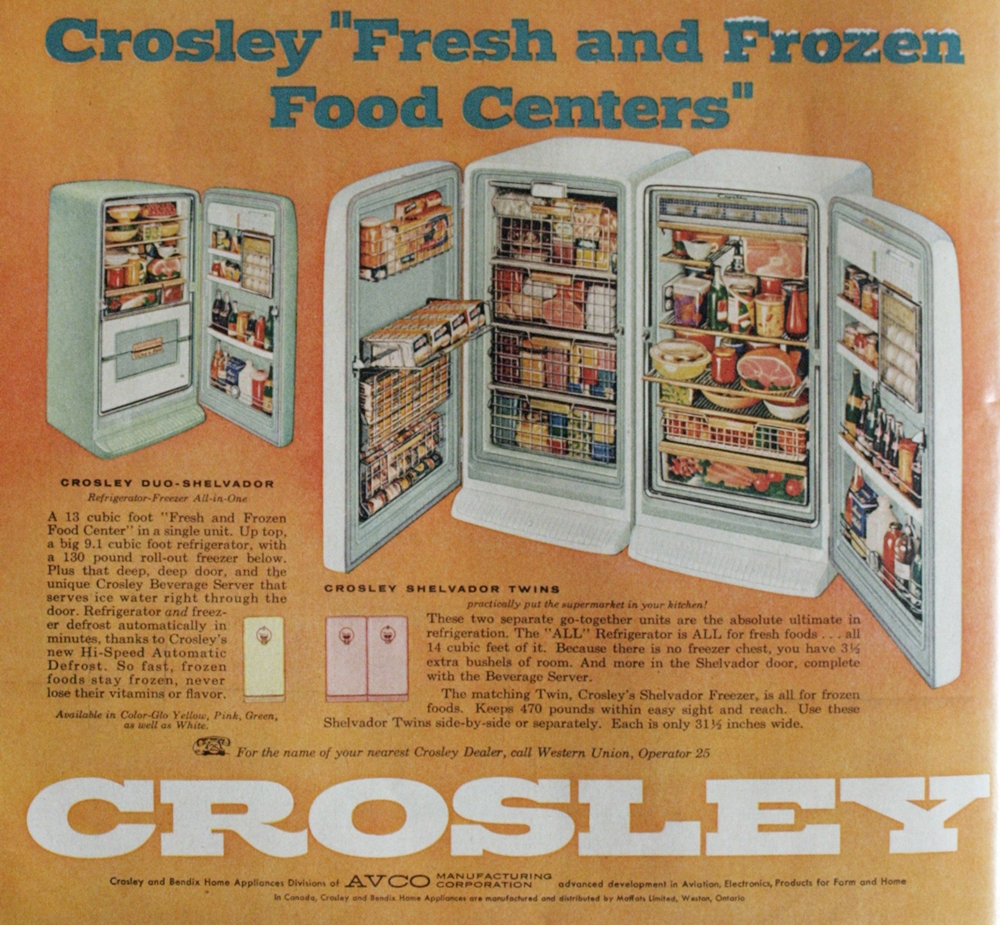
Crosley Presents their Fresh and Frozen Food Centers with Shelveador Twins
About the width of a standard contemporary bookcase, the 1956 Shelvador (shelf-in-a-door!) Fresh and Frozen Food Center Twins by Crosley had the ability to hold up to 450 lbs of food and contain fresh and frozen assorted perishables in two completely separate unattached units. One for cold products, one for frozen products. Pitched as the “most convenient food-keeping service ever designed,” owning Shelvador Twins meant less frequent trips to the supermarket thanks to their large storage capacity. It also meant more creative kitchen design. Offering two units for room balance and a series of mix and match colors opened up of bevy of options in the decorating department. Crosley’s were a matter of convenience and creativity.
3. Ultra-Organized Food Bins
Crosley was the company that first pioneered the idea of installing functional storage compartments in the doors of refrigerators and freezers back in the 1930’s, but their idea was so practical that all the major food storage manufacturers immediately began incorporating the compartment concept into their own designs as well.
In order to set everyone apart, individuality came to the design teams of all these manufacturers in the form of unique arrangements within the compartmentalized cold cabinet. When the 1956 version of the Fabulous Foodarama by Kelvinator was unveiled it was the ultimate organizer’s dream. Offering a bevy of bins, boxes, trays and baskets it was like the Taj-Mahal of efficient food-keeping systems focusing on the nitty gritty details of good design.
Bacon, eggs and juice went into the Breakfast Bar section on the upper right side of the door. Waxed papers went into a non-refrigerated dispenser located in the freezer, ice cream got its own gallon-sized compartment specially regulated to keep it at the ideal consistency and bananas flew off the counter and into a room temperature bin just below the freezer papers. Separate spaces for vegetables, cheese, canned fruit and ice cube trays were all designated as well making the Foodarama distinct in its ability to put that there and this here.
4. Toaster-Like Cooking Devices
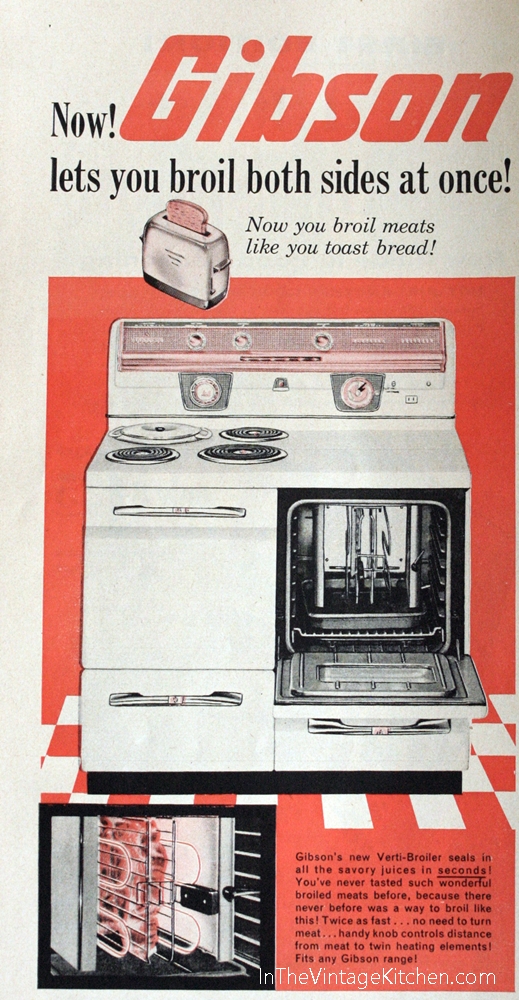
Gibson, who manufactured air conditioners, refrigerators freezers and electric ranges had a wonderful marketing team (or perhaps it was the design team) that came up with all sorts of colorful names to call the unique details of their stove-tops and ovens. The Thermatic Kookall, the Tel-O-Matic Light Source and the Verti-Broiler are just three examples that dazzled potential range buyers but mostly they were glitzy names for ordinary features that other popular ranges came with too. Until the exclusive Gibson Verti-Brolier was born.
Inspired by the close heating elements of the common, everyday toaster the Verti-Broiler turned the meat industry on its side (literally) buy taking the same directional cooking concept as a slice of bread but exchanging it with a slice of beef. With the pronounced ability “to seal in savory juices in seconds” this proposed method was supposed to cut cooking time in half making it a helpful necessity for busy working men and women. In a future post we are going to experiment with this cooking method (steak on the vertical) to see what happens. Stay tuned for more on that this summer.
5. Linen-Like Paper Napkins
It may seem a bit difficult nowadays to get excited about a paper napkin – but in 1956 they were indeed a source of novelty among meal planners. By giving women a plausible, non-guilty excuse for setting aside their traditional cloth napkins, these paper cousins eliminated the need for excess laundering and large linen closets. Thanks to the 1956 invention of the Scotkin – Scott Paper Company’s introduction of the super strong and absorbent 2-ply paper napkin, these elegant yet disposable damask designed napkins boosted all the beauty of linen without all the upkeep. No more washing, starching, and ironing needed with a Scotkin – just use and toss out. They were available in two sizes – dinner and family and were destined to become an ever-useful staple paving the way for similar products still on the market today.
6. Washable Wall Canvas
Wall-Tex Washable Wall Canvas
The Columbus Coated Fabrics Corporation began introducing washable wall canvases in the early 1950’s but by 1956 they were hitting their stride and gaining such popularity that dozens of new designs were being unveiled each year under the Wall-Tex brand. Prized for their easy ability to wipe off grease, dirt and drawings (as seen above!) this durable wallpaper-like covering sped up housecleaning and allowed for a somewhat more relaxed atmosphere when it came to looking after the messy effects of energetic kids, pets and cooks. Hung with paste just like traditional wallpaper, Wall-Tex canvases were baked with a layer of plasti-chrome that produced smooth, easy-to-clean surfaces ideal for kitchens, bathrooms and play areas. Columbus Coated Fabrics Corporation and the Wall-Tex brand went out of business in 2001 but recently peel and stick wallpaper has come back into fashion again so perhaps we will head down the highway of washable wall canvases yet again.
8. Under the Sink Storage
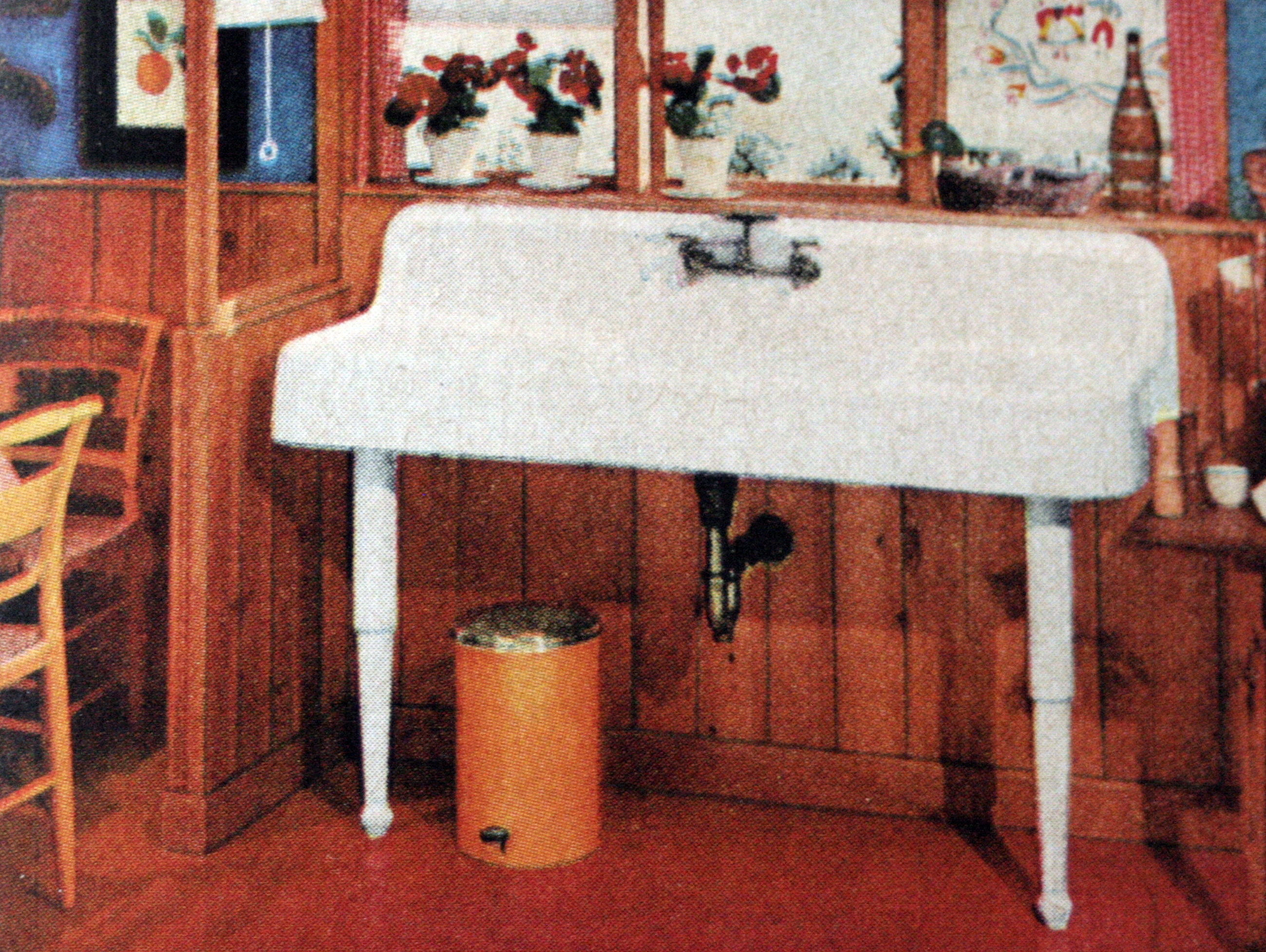
Kitchen cabinetry first debuted in the 1930’s, and was improving by functionality and appearance with each decade. If you wanted to keep pace with all the latest interior design trends in 1956 you would have most definitely upgraded your kitchen sink. Out went the old leggy farmhouse trough style…
…and in came the organized cabinets and drawers…
Popular Youngstown brand (the leader in mid-century cabinetry) hid the plumbing, added sleek steel drainboards, a garbage disposal and pull out drawers and shelving. Deluxe models even included two sinks, pull out cutting boards and a cutlery drawer transforming the ordinary sink into an extraordinary piece of furniture.
9. Mini Tabletop Ovens
.
A pre-cursor to our counter-top toaster ovens, the Knapp-Monarch Automatic Electric Redi-Baker was the mini oven you needed to bake small portions right at the kitchen table. As a cost-saving device you no longer needed to heat up the big main kitchen oven in order to enjoy single serving items like breakfast sausages or biscuits, and as a convenience measure you could tote it anywhere around the house as long as you had an available electric outlet. This essentially took baking out of the kitchen and into other rooms of your choosing or even to the patio. While a great idea at the time, the Redi-Baker was in competition with a lot of other emerging small appliances eventually becoming overshadowed by bigger, more well known brands. It was out of the market altogether within the decade.
10. Built-in Big Pots
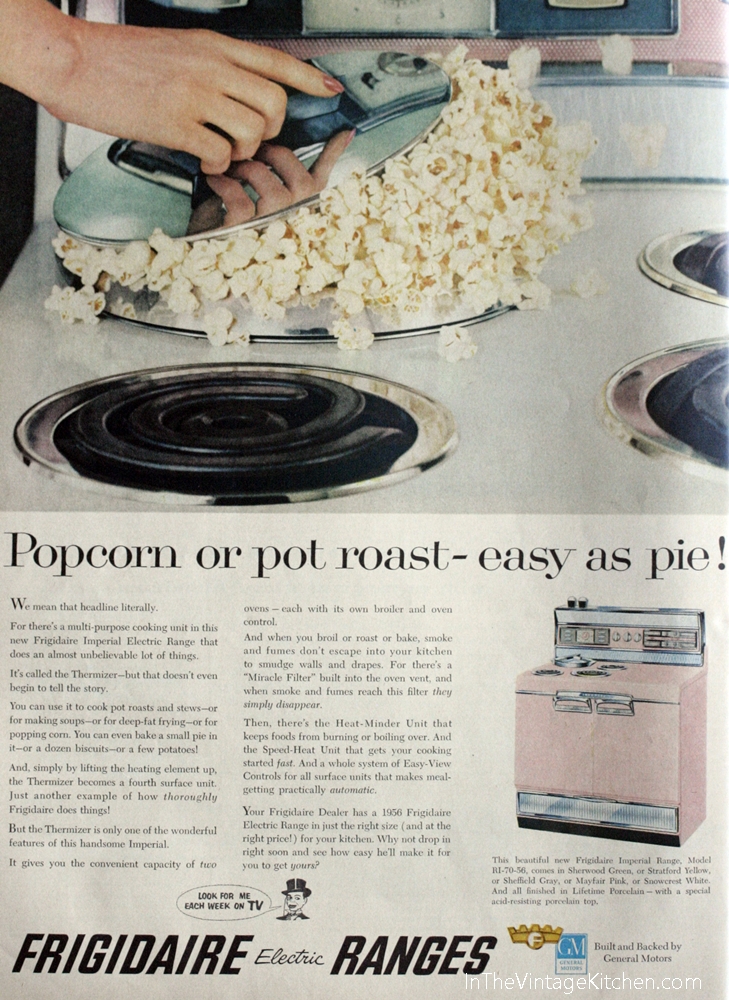
In the traditional place of four burners on a stove-top Frigidaire Electric Ranges introduced a new concept in cooking equipment with their 1956 unveiling of the Imperial Range… a built in Thermizer. Essentially it was like a big pot sunk into the stove that could be used to boil, roast, fry or slow-cook an assorted number of dishes from soups and sauces to pot roast, dumplings, desserts, and even popcorn. With a removable 6 quart pot that fit inside the well of the Thermizer you could even use it to sterilize canning jars, steam vegetables and bake small pies or individual sized desserts. A true novelty in the productivity department, it helped cut down on the expense of heating large ovens for small projects while also giving home cooks the ability to prepare and pre-plan large meals effortlessly.
Italian designer Mossimo Vignelli (1931-2014) believed that good design was a language not a style. It is easy to forget that all the bells and whistles on what we consider to be normal kitchen equipment (fridge, freezer, stove, dishwasher, sink, cabinets, etc.) first started out as novelties and innovations. They were all experiments destined to stick or stink.
We’ve come a long way from the caveman days of cooking over open fires in the wild but in the 61 years that have passed between 1956 and today it is interesting to note that we are still requiring the the same sets of demands from our ideal kitchens – time saving shortcuts, multi-tasking equipment and maximum storage. We are still a society juggling time. We are still a society talking about the most effective ways to produce a product and fulfill a specific need. And ultimately we are still trying to sort out our most efficient eating and cooking habits. Mossimo is right. The good bones of functional kitchen design began to form fifty years ago but the conversation isn’t over yet and the language is still being translated. Everyday ahead gets us one smidge closer to improving the landscape we learned about yesterday.
Would you like to see any of these vintage kitchen trends embrace our modern spaces today? If so, post a comment below!
In the meantime, cheers to past designers who made their marks and to future innovators who sustain them!
Happy Happy St. Patrick’s Day! Welcome to The Vintage Kitchen and the new re-design of the blog! Today is definitely a cause for celebration around here both for the festive holiday and for the bevy of changes occurring around this place. Nothing says celebration more than a glass of sparkly champagne, so we are kicking off the first official post from The Vintage Kitchen with an old Irish cocktail featuring champagne and Guinness and we are serving up a recipe that stems from this 17th century castle in Ireland…
Adare Manor County Limerick, Ireland
Before we dive into dinner you’ll have noticed that there is a bright new look here on the blog which officially launches The Vintage Kitchen. While Ms. Jeannie is away on her extended travels (read more about that here) everything has been switched over to the Vintage Kitchen including all social media platforms, so if you have followed Ms. Jeannie in the past on pinterest, instagram and twitter you’ll still be connected to the same account – it just has a different user name now. A few more changes will be unfolding here on the blog in the weeks to come including a dedicated spot for correspondence from Ms. Jeannie while she is away. So stay tuned in that department.
The vintage Black Velvet – the spritzer for beer drinkers!
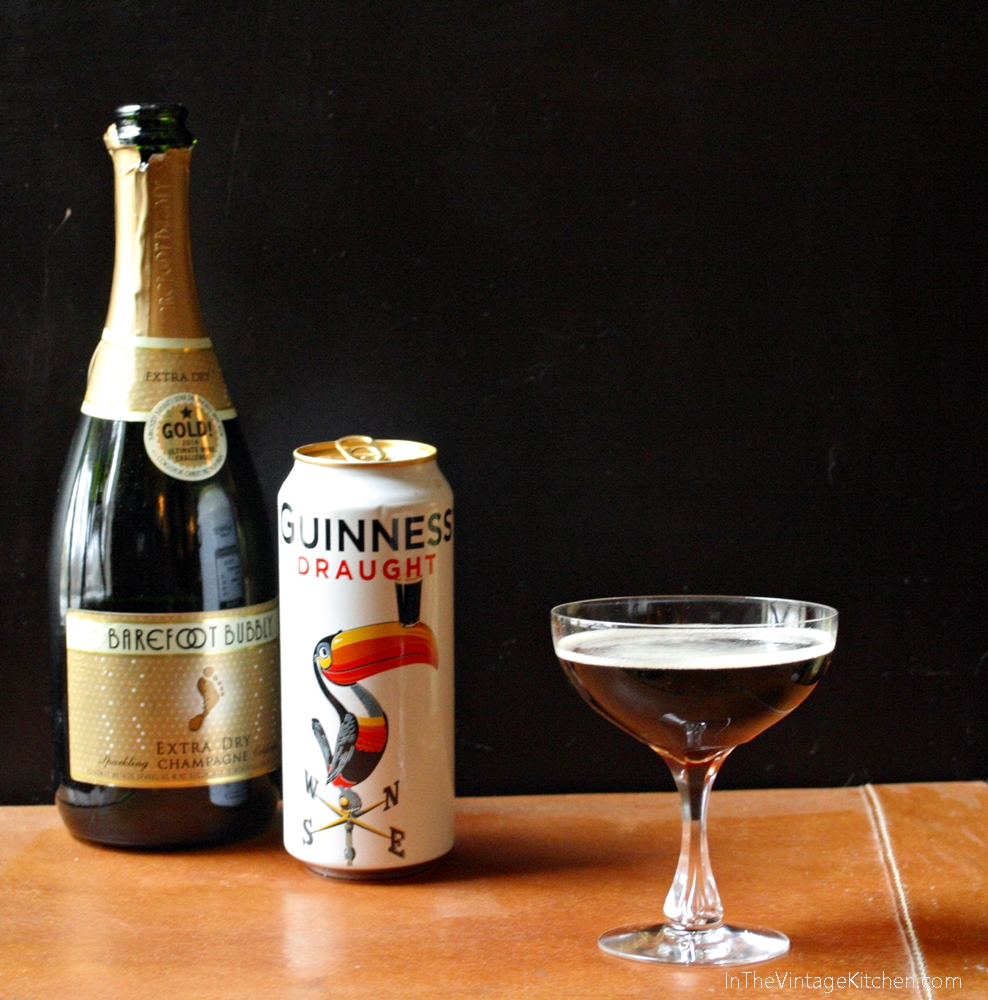
In the meantime, we are popping corks and pouring a rich dark drink that was popular on the British mid-century cocktail scene. Named the Black Velvet, it is a half and half combination of Guinness beer and extra dry champagne.
The combination of the two flavors tastes like a smooth, creamy, light and airy molasses which is lovely if you fall into the camp of people who think that Guinness is too heavy a beverage on its own. If you are enjoying this cocktail on the home front and therefore not having it on tap from the pub, you’ll see the fun retro artwork on the Guinness cans. This one features a toucan and is an image snippet from one of their early 20th century advertising campaigns back in the day when everyone thoroughly believed that Guinness was good for you.
This was the whole picture of the original campaign. So cute!
There is no doubt that the interior of Adare Manor has seen it’s fair share of Guinness drinkers. Perhaps visitors have even enjoyed a Black Velvet or two while strolling among the grounds. The country castle that makes up Adare Manor was originally part of the Earls of Dunraven lineage and managed to stay in the family from the 17th century through 1986. When expenses and upkeep got to be too much for family members to shoulder it was sold to a hotelier who turned the former home into a luxurious beacon of upscale tourism.
Like The Vintage Kitchen, Adare Manor is currently undergoing a transformation in the forms of upgrades and remodels, which is why a dinner menu from a former executive chef at this hallowed estate seemed so fitting for the launch of our first official Vintage Kitchen post. From way down in the belly of this beautiful building comes an outside of the box St. Patrick’s Day menu that eliminates the crock-pot and brisket and sets aside the cabbage for a light and lively springtime meal that looks at traditional Irish ingredients in a nontraditional way.
Smoked Salmon and Goat Cheese Roulade with Champagne-Chive Dressing
On the menu tonight it is Smoked Salmon and Goat Cheese Roulade with Spring Greens and a Champagne-Chive Dressing.
Capitalizing on all things seasonal, this recipe is great for this time of year because it features chives, spring lettuce and scallions all which are now in season at the farmers market. A little note about prep time: while this recipe is fairly easy to make and contains basic easy-to-find ingredients, the roulade requires seven hours of refrigeration time before cooking so you may want to get this recipe ready in the morning if you want to plan on having it for dinner. That being said, the finished dish is well worth the wait and all that extra fridge time.
We’ll start with the roulade recipe since that takes the most time to prepare…
Smoked Salmon and Goat Cheese Roulade (serves 6)
2 tablespoons butter
2 large white skinned potatoes, peeled and very thinly sliced
4 ounces goat cheese
4 ounces thinly sliced smoked salmon
In a medium saute pan heat one teaspoon butter over medium heat and saute the potatoes (turning regularly with a fork so they don’t burn) until tender but not browned (about 2-3 minutes). Note: You’ll see as you are cooking the potatoes that they will go from white to translucent. When you can see your fork tines underneath the potato slice that is when you know they are ready to be removed from the heat. Place cooked potatoes on a sheet of parchment paper to cool.
Cooked potato slices.
Continue working in batches adding more butter by the teaspoonful when needed until you all potatoes are cooked.
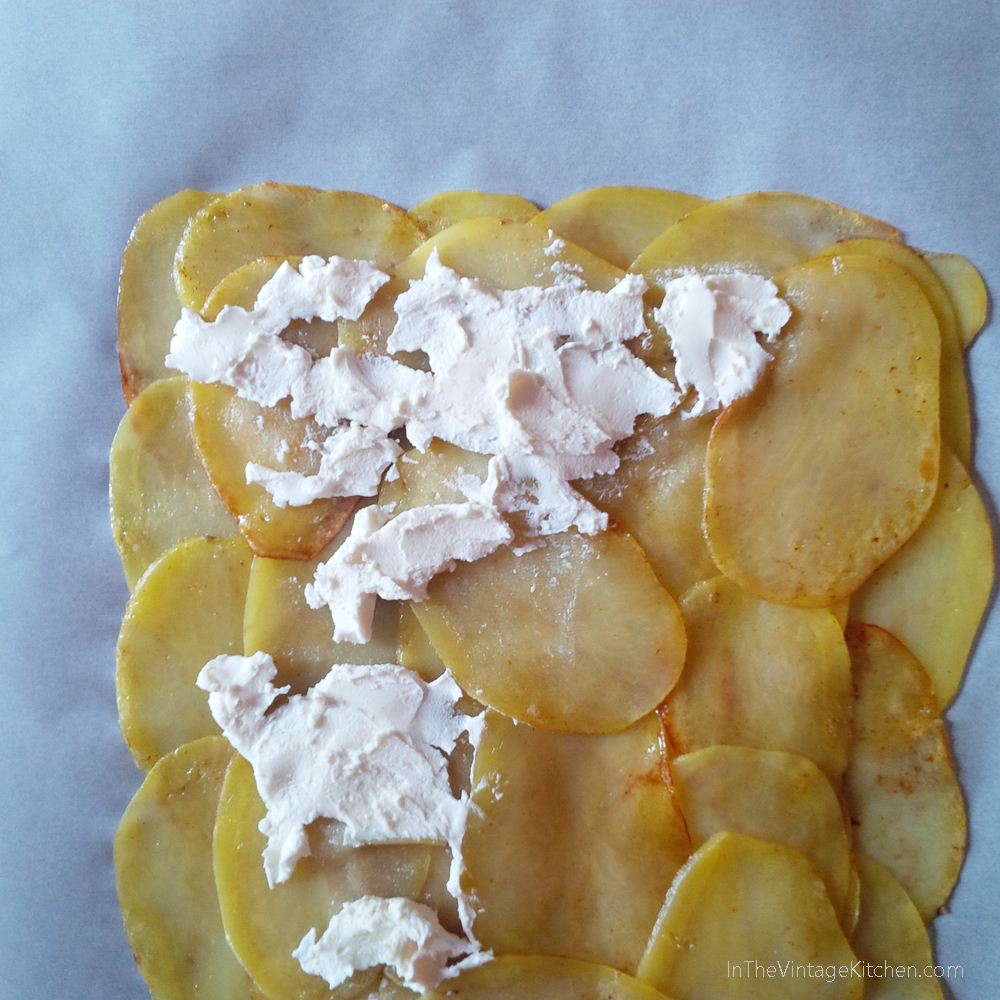
When all the potatoes have cooled to room temperature, lay them out on a new sheet of parchment paper in a square shape with slices slightly overlapping.
Cheese on top of potatoes.
Next add the goat cheese on top of the potatoes – spreading it in a layer all over the potatoes. Note: this is much easier if your goat cheese is also at room temperature. A frosting knife works well for this task or your fingers!
On top of the cheese place the layer of smoked salmon slices.
Salmon on top of cheese.
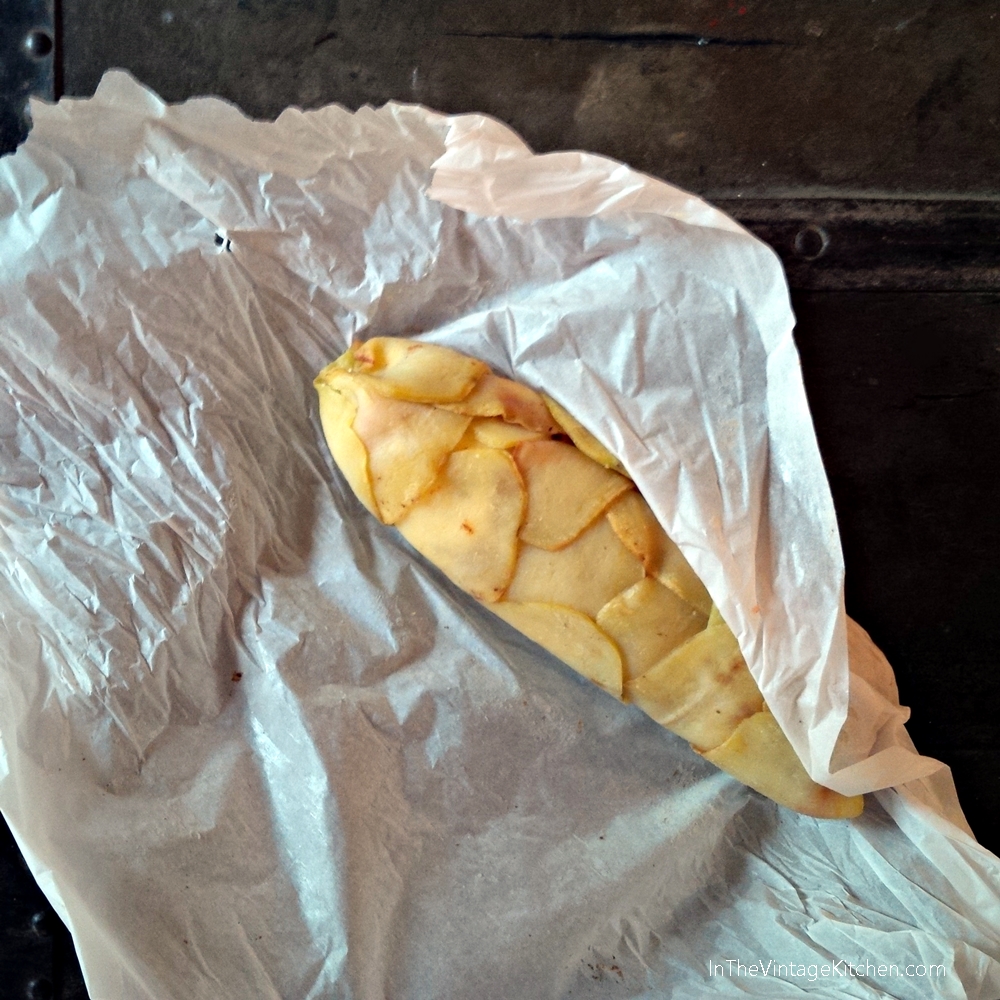
Using the edge of the parchment paper as a guide, carefully roll up the potato cheese salmon mixture to form a log. Twist the edge of the parchment and stick the whole roll in the fridge for 7 hours.
This is what the roulade roll will look like once you unwrap it from its 7 hour rest in the fridge.
While the roulade is in the fridge, make the dressing for the salad, it can sit for as long as you like before serving…
Champagne Chive Dressing
Champagne Chive Dressing
2 tablespoons champagne
3 tablespoons olive oil
Minced fresh chives to taste
1 scallion, sliced
A pinch of sugar (I used organic cane sugar )
Sea salt and fresh pepper to taste
6 handfuls of mixed baby greens
In a small bowl whisk all the ingredients together except the baby greens. Set aside the dressing and the greens until just before serving the roulades.
After the seven hour rest in the fridge, remove the roulade roll and unwrap it. It should feel very cold and firm. Cut the roulade into one inch thick slices . Heat a saute pan over medium high heat and add a half teaspoon of butter to coat the pan.
Warm up the roulade!
Quickly saute the slices until crisp and bubbling brown on both sides (about 3-4 minutes). Remove the pan from the heat. Toss the dressing with the spring greens and place a handful of salad on each plate. Top with roulade slices and a dash of salt and pepper and serve immediately.
Smoked Salmon and Goat Cheese Roulade with Champagne Chive Dressing
Keep the festive atmosphere going by indulging in a glass of champagne with your dinner and you’ll discover a nice savory sweet pairing of subtle spring flavors here. Both the roulade and the baby greens offer a satisfying crunch but if you’d like to include some fresh crusty bread with your meal that would also be delicious. Next time, you make this you could even experiment with other ingredients like replacing the smoked salmon with thinly shaved corned beef brisket or ham and replacing the goat cheese with blue cheese or baby swiss. The possibility for extra creativity when it comes to this Irish dinner is vast and varied, which makes it endlessly interesting.
Cheers to a most celebratory St. Patrick’s Day night, dear readers! May you laugh as much as you breathe and love as much as you live.
The passport is out. The suitcase is filling up. Ms Jeannie is getting ready to embark on an extended trip.
Caught up in a sleuthing adventure that will take her around the world, Ms. Jeannie will be wearing her best detective hat as she scours big cities and small towns for clues to one giant mystery of history. It is not certain how long she’ll be gone or what exactly she is working on, but it will be a long while before she returns and depending on her location she might not always be able to stay in touch regularly.
In the interim, while she is away, there will be a new (to you) name and face managing the vintage landscape and holding down the history fort that has been the world of Ms. Jeannie Ology for the past five years. Hello, dear readers, my name is Katherine! While you may not have known me by name all these years, you have known me by words as the voice behind Ms. Jeannie, the writer of this blog and the interpreter of the muse that is MJO. As you all know by now, Ms. Jeannie prides herself on keeping a bit of anonymity regarding her identity. And in working with her for all these years now, my identity has also been somewhat mysterious too. But now that Ms. Jeannie is off on her own, an independent traveler out on the oceans of discovery, I too, am embarking on a new adventure myself.
Like Ms. Jeannie, I have a passion for all things vintage but there is one particular area that holds a high level of fascination – the kitchen. When Ms. Jeannie was battening down the proverbial hatches, covering the furniture and boarding up the windows in preparation for her long trip aboard she left one room of her vintage house open and untouched – the kitchen. Ms. Jeannie and I have spent a lot of happy and fulfilling time in the vintage kitchen, as you have read about so many times here on the blog. So when Ms. Jeannie announced her plans for departure, the evolution of the blog seemed to naturally reveal itself. Our vintage world dear readers is getting a bit more specialized.
You’ll remember in 2015, we went through a narrowing of the vintage lens once before with a focus on vintage books. That distinction led to an unexpected yet completely enthralling love of vintage cookbooks which then led to our new found specialty and the future subject of our blog. With that being said, Ms. Jeannie and I are very pleased to welcome you to our new focus…
The Vintage Kitchen – where history comes to eat! This direction, although new, will still be quite similar to the same types of writing approaches we have taken in the past. I’ll be discussing all the various components that make up the vintage kitchen from cooking techniques and recipes, to interior design and decoration, to music and art and all things that food has inspired. There will still be interviews and movie nights, cookbooks and countdowns, field trips and travel getaways, gardening posts and fashion pieces to work with but from here on out things will all be connected and centered around that one food-centric room in the house that everyone has loved for centuries. And there will be postcards. Sent from any and all available ports of call, Ms. Jeannie promises to pop in and say hello from time to time with tidbits about her travels, hopefully some photographs and if time permits her possibly even some lengthy letters.
The store (coming very soon!) is being stocked as we speak with a curated collection of vintage kitchen-themed treasures including original art and handmade objects refurbished from antique materials. So while it may seem like things are changing in a big way, they really aren’t changing that much – just narrowing the focus a little bit more.
Stylistically, the blog will be evolving over the next month and you’ll see changes in appearance that reflect the new theme, as well as the launch of a new storefront. There will be a special page just for Ms. Jeannie’s far-flung correspondence and there will be a much more easy to navigate recipe section that allows for simplified ingredient searches and printable pages. There are future plans too for some really innovative and interactive components, should Ms. Jeannie’s travels extend for years, but each new element will be unveiled one at a time to ensure a smooth transition.
I hope dear readers that you’ll be as excited as we are about this new direction and that you’ll continue to keep in touch. If there are any topics that interest you regarding the vintage kitchen please post a message below and I will be happy to dive right into discovering some interesting stories surrounding your suggestions.
In the meantime, please join me in sending Ms. Jeannie off on her travels with best of luck wishes. Maybe she’ll be popping up in your neck of the woods on her sleuthing adventure. You never know where our mysterious Ms. Jeannie might land. Keep your eyes peeled for a woman in an orange headscarf and cat eye sunglasses.
Today spirits are soaring in the land of Ms. Jeannie as we celebrate the fifth year birthday of the blog. Can you believe it dear readers? Five years! A major accomplishment for a perpetual on-the-goer like Ms. Jeannie, it feels like both a whirlwind and also a very long, slow dance around the tree of fulfillment.
When the blog was born on February 27th, 2012 there was no clear cut plan or outline as to what would be discussed post by post, month by month, year by year other than a some-what vague determination to bring forgotten stories of the past to light once again. There was never even any inkling of assurance that the blog would stick around and make it to a one year birthday and then a two year birthday and then a three. But now over 225 posts and over 900 readers later this blog has traveled around the world wrapping up centuries of history into one tidy bundle. There have been interviews and cooking experiments, nature walks and road trips, books and movies, art and fashion and the sale of over 1000 antiques all dissected and discussed through the lens of history here on the blog. We’ve learned a lot in five years!
In covering such a wide variety of topics a narrower focus has come into view, and a new passion has been ignited, which means a very big (BIG!) change is coming to the land of Ms. Jeannie. It’s an evolution of the most exciting proportions and a realization that would have never come about had these past five years of experience not existed. Stay tuned over the course of this next week to learn about the all-new adventures ahead!
And as always thank you (THANK YOU!) dear readers for traveling through history alongside Ms. Jeannie. Your enthusiasm and your engagement have kept the flames of curiosity fed for all these years. Cheers to you!
There has been a lot of talk about recipes here on the blog as of late but so many interesting food-related topics have been popping up recently in the historic land of Ms. Jeannie, it seems a shame not to share them. So here we are back in the vintage kitchen with a newly discovered almost 100 year old recipe that came from Ms. Jeannie’s great -great Aunt. This week’s post takes us to the heartland of America – a middle state where young newlyweds ventured via covered wagon in the the 1860’s and set up life, spreading their roots so deep in the soil they practically built up the foundation of a small township.
Albert and Martha (pictured on each side of the flower arrangement) in Vinton, Iowa surrounded by their children and grandchildren.
We have talked about the Edwards’ family a few times previously on the blog so if you are a regular reader you’ll remember the adventurous Albert and his wife Martha who married in Johnson County, Indiana in 1865 and then immediately (the very next day in fact!) got into a covered wagon and headed west towards a new frontier. Three months later, Albert and Martha settled in Benton County, Iowa in a small town east of Cedar Rapids.
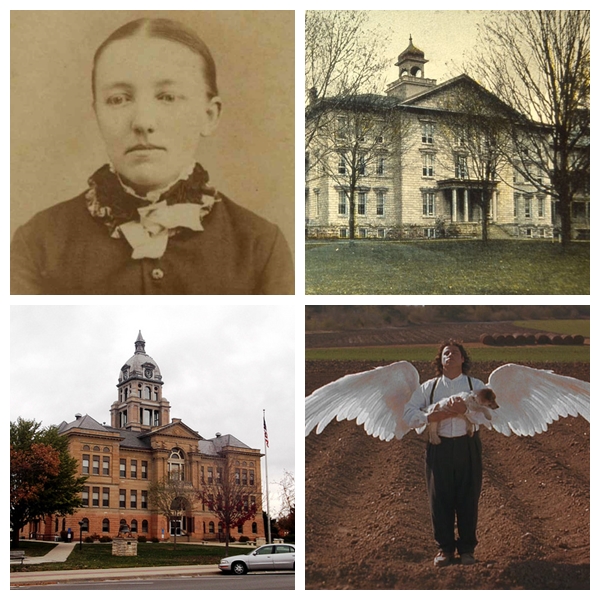
If you are familiar with Little House on the Prairie and are up on your John Travolta movies you’ll know Vinton, Iowa for two reasons. It is where Mary Ingalls attended the Iowa School for the Blind (also known as the Iowa Braille and Sight Saving School) between 1881-1889 and it is where they filmed many scenes of the movie, Michael, (including the final courthouse scene) starring John Travolta, Andie MacDowell, William Hurt and Oliver Platt.
Vinton, Iowa is faomus for these faces and places.
Known primarily for its burgeoning agricultural opportunities in the mid-1800’s, Martha and Albert had two goals when they moved to Vinton – farming and family. In true pioneer spirit they got down to business right away working out their farmplace and starting a family dynasty that would eventually produce 11 children and 45 grandchildren. Their first baby, Anna was born during the crispy days of October 1866 just 19 months after their arrival in Iowa.
As the oldest of her 10 brothers and sisters, Anna learned a lot about farm life, babies and family relationships. By the time she was 4 she saw the birth of two brothers and then the sad death of one those brothers who was in her life for just 7 short months. The next five years brought three new sisters and then the death of her remaining brother Cornelius. So by the time Anna was nine years old she had already witnessed the death of two of her siblings.
When Anna turned 18 in 1885 and married Selmon T. Whipple she had six sisters in total ranging in age from 2-14. Immediately following their wedding Anna and Selmon set up their own farm in Benton County and got to work on their own family. At this point in the late 1880’s and early 1890’s, babies were coming into the family from all directions.
Anna’s mom, Martha was still having her own kids and Anna was just starting to have hers, which means mom and daughter were preganant and giving birth at the same time. So the the first few years of Anna’s marriage went something like this… a baby boy for Anna, and then a baby brother for Anna, a baby girl for Anna and then a baby sister for Anna. It’s a whirlwind of confusion and name sharing where all the aunts and uncles are close in infantile age to their nieces and nephews but brothers and sisters have almost two decades between them. And then add in the fact that Anna’s six sisters were starting to marry and have their own families and it was just kids everywhere.
Selmon and Anna’s house in Vinton, Iowa.
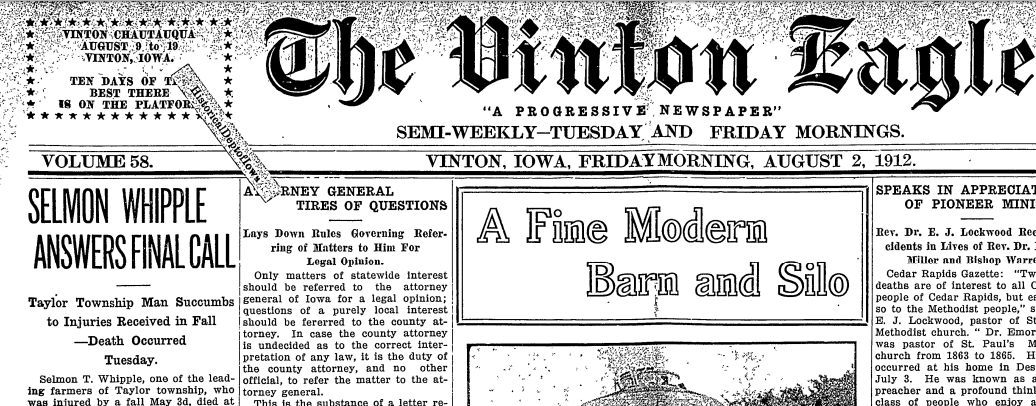
Basically for the first twenty years of Anna’s marriage she was pregnant and raising babies. Her fifth son Frankie died the day he was born but all the other little ones made it through to adulthood. A year and a half after her last baby, a little girl named Nellie, was born, Anna’s husband Selmon fell off a shed and became paralyzed. For three long months he lay immobile at home before he died leaving Anna, aged 45, the entire responsibility of managing the farm, twelve kids and her large house.
Selmon’s death notice printed in the Vinton Eagle, 1912
But Anna was a strong woman and she came through this tragic circumstance with courage and a loving heart still intact. In addition to all this newly placed responsibility she even managed to take on the care and raising of her infant grandson, whose mother (Anna’s daughter-in-law) died from tuberculosis.
As the wife of a farmer with over a hundred acres in crop production and the mother of thirteen children Anna knew her way around the vegetable garden and the kitchen. In 1928 she submitted a recipe to the Vinton Cook Book which was compiled by the First Division Pastor’s Aid Society of the Methodist Episcopal Church. With a little help from the ladies at the Vinton Historical Society, Ms. Jeannie was able to acquire a copy of the recipe that Anna submitted.
The recipe is for tomato soup. It is a very simple one with few components but it does contain one unusual ingredient – baking soda. Today in the vintage kitchen we are recreating this 89 year old recipe to see what cooking in the 1920’s tastes like and to see if it still appeals to our modern palettes.
Tomato Soup circa 1928
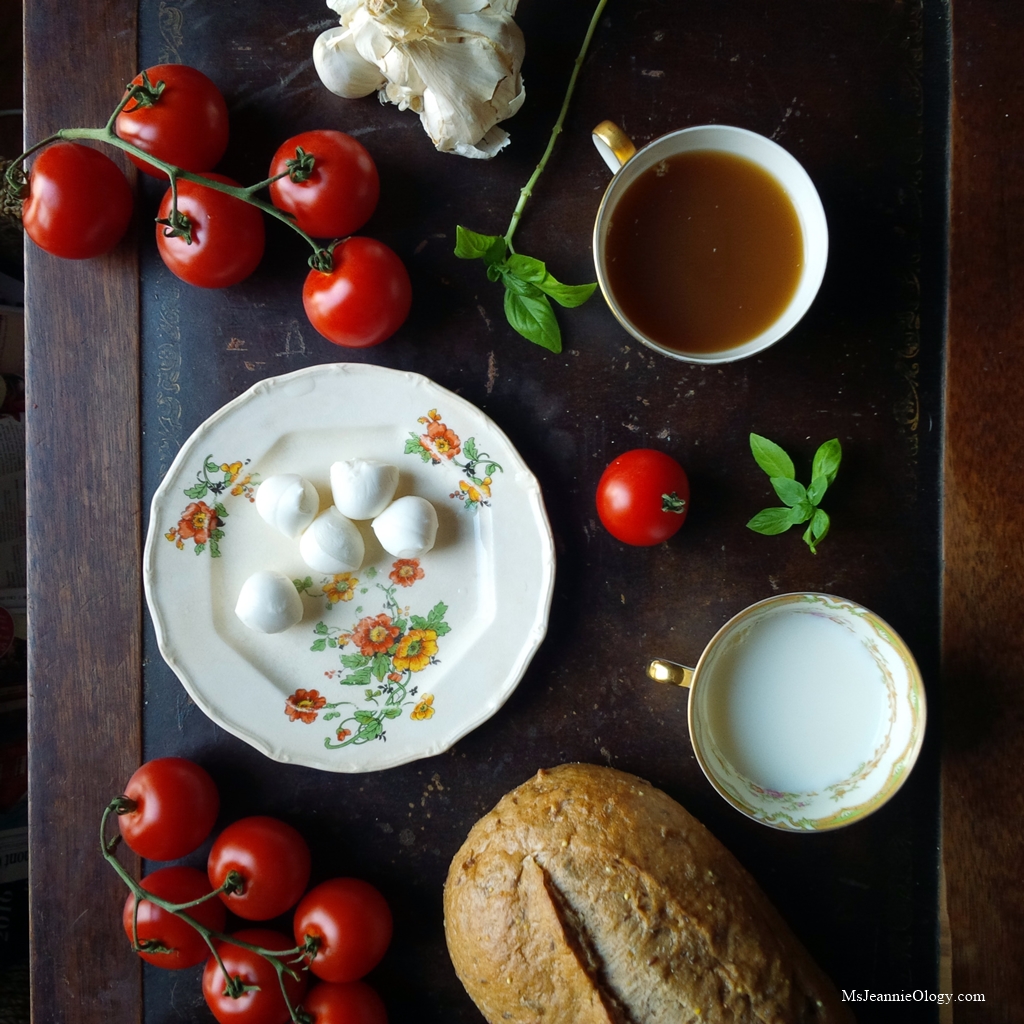
Most likely Anna would have used previously canned summer tomatoes from her garden in this recipe or she would have made it fresh during the summer months and possibly canned the soup for winter consumption. Either way, it is February and Ms. Jeannie does not have any leftover summer tomatoes on hand nor does she have any fresh in the garden. So instead we are relying on fresh hot house tomatoes that were grown in Chile. Ms. Jeannie did not have high hopes for flavor with these guys even though they looked absolutely beautiful in the grocery store.
But she was very pleasantly surprised at both the sweetness and firm fleshiness of these traveling love apples. Anna served her soup topped with a sprinkle of crushed crackers, which most likely would have been soda crackers or saltines. But Ms. Jeannie wanted to pair her soup with something a little more exciting so she made rustic Caprese-style toast to partner. Look for that recipe following the soup. She also added 1/3 cup tomato paste at the end, which is not in Anna’s original recipe (as you’ll notice from the picture above) – an explanation for that addition follows the final step. Other than that, the recipe was made as-is.
Anna’s Tomato Soup (circa 1928)
1 quart tomatoes (about 4 -5 cups)
1 pint milk (about 2 cups)
1 pint water (about 2 cups)
1/2 teaspoon baking soda
1 pint beef broth (about 2 cups)
2 tablespoons butter
1/3 cup tomato paste
4 crackers (optional- see second recipe)
Salt & pepper to taste
Remove seeds from tomato (Note: there is no mention as to whether the skins of the tomato should be on or off – most likely they would be skinless, but Ms. Jeannie left them on and they rolled themselves into thin toothpicks which added a little bit of texture to the overall soup in the end. Next time she will try making it with the skins removed. So it is your preference on this aspect.)
Add the tomatoes and water to a large pot over medium-high heat and bring to a boil.
Add the baking soda and stir – like those lava volcanoes you used to make in third grade science class, this tomato /baking soda combo does foam up quite a bit, so keep stirring it until it comes to a boil. Then add the milk, butter and beef broth and bring to a boil again.
At this point, Anna mixed in some salt and pepper, called it done and ladled the soup into bowls, topping each with some crushed crackers. But the soup at this stage was very thin and tasted rather plain and uneventful so Ms. Jeannie added 1/3 cup tomato paste and let it simmer on low heat for about 20 minutes. By adding the paste it gave the soup a much more tomato-y flavor and thickened it up a bit. The purpose of adding the baking soda was to neutralize the acid in the tomatoes, which it did beautifully. By the time it was ready to serve this soup had a gorgeous, silky consistency, bright flavor and a rusty orange hue.
Garlic, Basil Cheese Toast (makes two slices of toast)
1 clove garlic, roughly chopped
6 fresh basil leaves, chopped
2 mini mozzarella balls, sliced thin
2 slices of multi-grain braed
2 teaspoons olive oil
dash of red pepper flakes
Slice bread and smother each slice with one teaspoon of olive oil. Add the cheese in a polka dot style fashion and intersperse the garlic. Sprinkle the basil leaves, red pepper flakes and a dash of salt on top.
Bake in a 400 degree oven for 8 minutes and then broil for 1-2 minutes until edges of crust start to brown slightly.
Back in the late 19th century and early 20th century farm meals were big because family members and workers needed sustenance to get them through their chores. Apple pie was often served at breakfast alongside eggs and bacon and fried chicken and casseroles and fresh bread. Most likely this soup would have accompanied many other dishes on the table, which is why it is not made of heartier stock. In our modern world, this makes a lovely light lunch or quick snack if you are pressed for time. And like any good foundation recipe it can be augmented with lots of other elements including onions and fresh basil, garlic, sour cream, Parmesan cheese… you get the idea. It is quite lovely on its own but Anna wouldn’t mind at all if you wanted to add your own creativity to the mix.
After Anna’s husband died in 1912, she managed the farm for another 9 years growing corn and oats and reporting regularly in the newspaper as to their qualities and quantities. She raised her kids and grandkids and kept her house bustling with love and care. Eventually she said goodbye to farm life and moved into town to live with one of her daughters. Active in various community organizations and her local church she was referred to as being noble, generous and kind. When she passed away in the 1940’s at the age of 81, she left behind a family dynasty that included 10 children, 31 grandchildren, 20 great-grandchildren and one great recipe.
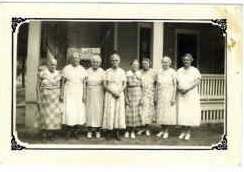
Unfortunately this tiny photograph is the only identifiable image of Anna. Pictured on the far left, she is posing with her sisters in front her farmhouse when she was in her 70’s. Anna also appears in the family portrait at the top of this post but she is unidentifiable along with all the other women. One day soon hopefully we can place a name with a face!
Cheers to family cooks, the recipes they make and the love they pass on!
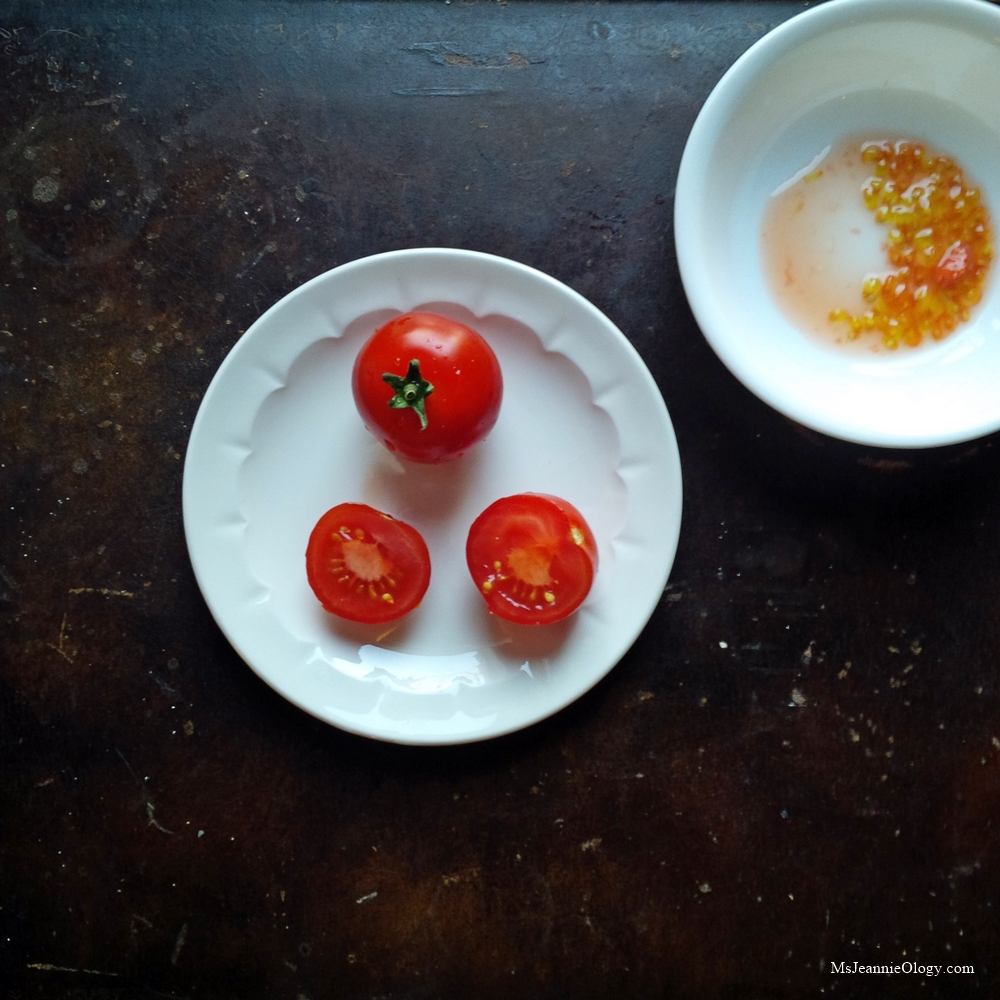
*** UPDATE 2/24/2017 *** One of our readers sent a question regarding measurements of pints and quarts and how many tomatoes actually made up one pint. Ms. Jeannie used all the vine-ripened tomatoes you see in the photos (12 in total) which were each roughly the size of a plum. If fresh tomatoes aren’t an option in your neck of the woods, substitute them with 4-5 cups of canned tomatoes (make sure the seeds have been removed).
Also to make things simpler, ingredients calling for pints and quarts have been measured out into cups as well (see ingredient list), since that is a more common unit of measurement in today’s world of cooking. These new updates will take out all the mathematical guess work making this recipe even easier and faster to make!
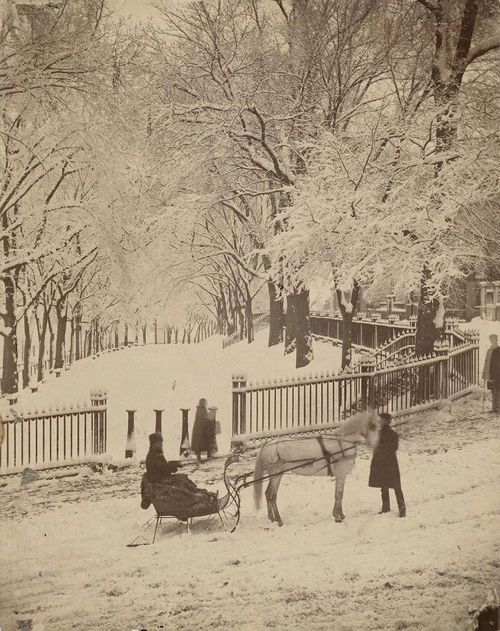
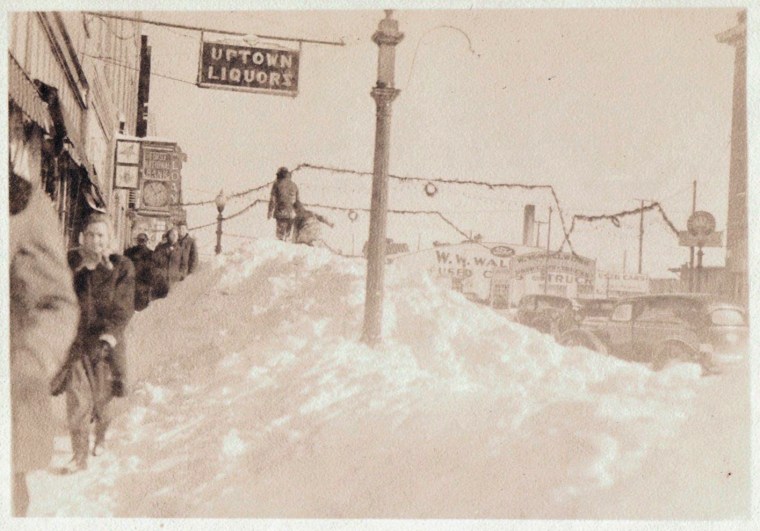
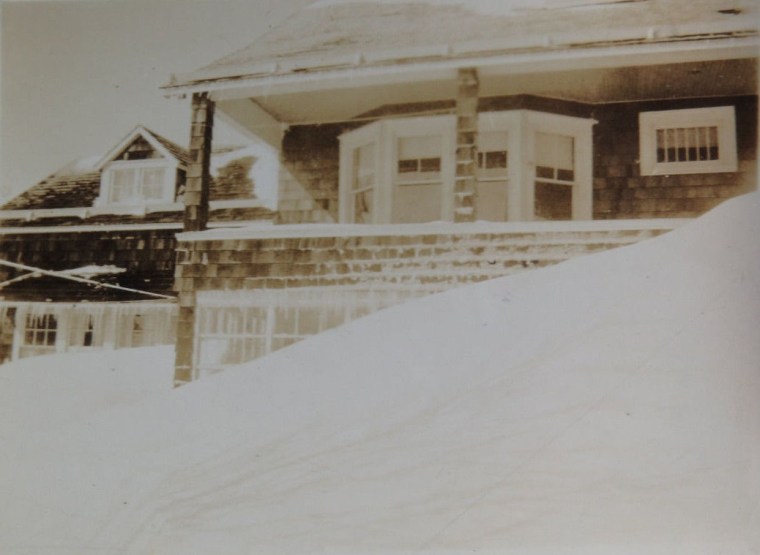
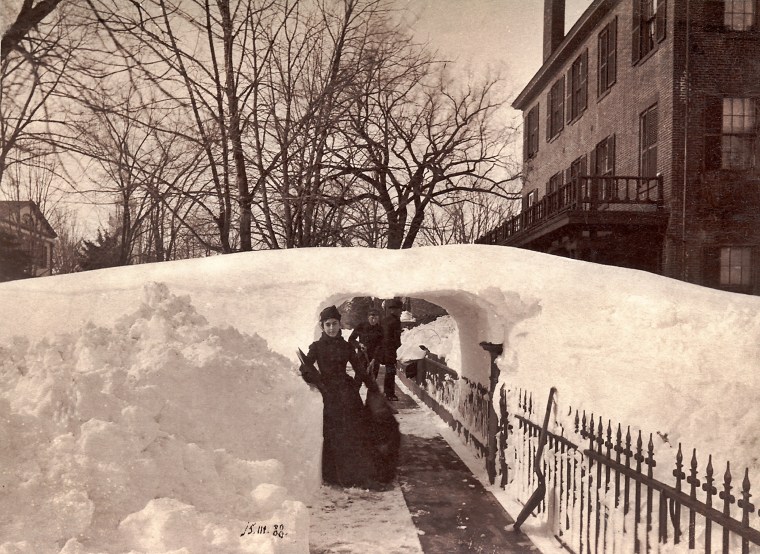
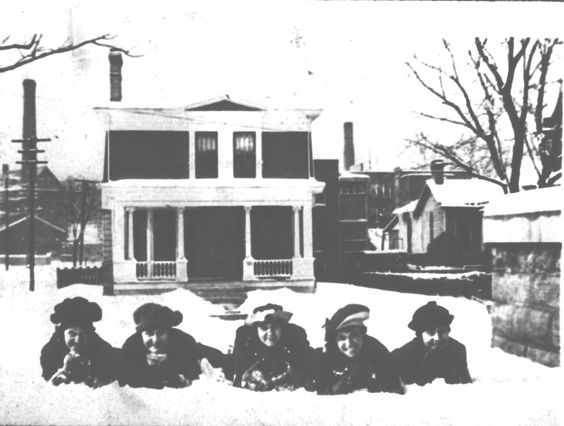
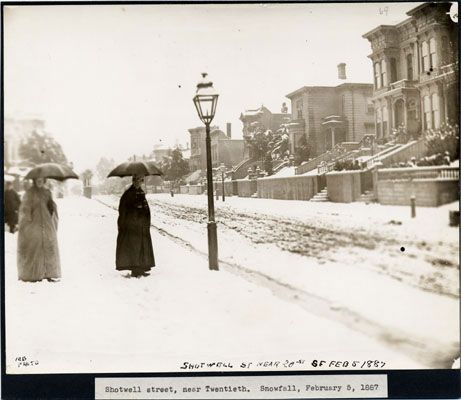
How very exciting this week has been for snow lovers around the U.S.! With all this winter white floating and flying around the country, February is chalking itself up to be one of prettiest winter months on record. Sadly there has been no snowy weather to report from Ms. Jeannie’s city but that’s okay because today snow scenes are not hard to come by as we travel back in time to some of the biggest snowstorms of the 19th and 20th centuries.
This post is all about the beauty of the blizzard as experienced from all sides of the States, north to south, east to west. We are also introducing two new (but actually old) snow songs that every once in a while get lumped into Christmas song rotation but actually have nothing to do with the holiday itself. Instead, these two whimsical melodies express all the hap-hap-happy joy found in a good day of snow. So grab your mug of hot chocolate, turn up the volume and enjoy the snowstorms to come…
Suzy Snowflake debuted in 1951 and quickly became a popular hit for Rosemary Clooney for the next three decades.
New York City, 1917
Boston, 1875
Detroit, early 1900’s
Possibly this is Suzy Snowflake herself circa 1963!
New York City, 1892
Minnesota, 1940’s
Kentucky Mountains – early 19th century
Chicago, 1956
Eagle River, Wisconsin, 1911
Belfast, Maine, 1952
Chicago, 1908
New Jersey, 1926
New York City, 1905
Seattle, 1916
Washington DC, 1922
Mckenzie Pass, Oregon, 1929
Connecticut, 1888
It’s A Marshmallow World was first recorded in 1949 and was performed by Bing Crosby. This version (Ms. Jeannie’s favorite!) by Brenda Lee debuted in 1964.
Wisconsin, 1925
Vermont, 1940
Ohio 1952
Colorado, 1906
1950’s
Alaska, 1910
Tennessee 1918
Buffalo, New York 1977
San Francisco, CA 1887
Harrisburg, PA circa early 1940’s
Cheers to happy snowmen and winter site-seers! May your snow day, however you are experiencing it, be merry and bright!
All photos courtesy of pinterest and ebay. Click on each for more detailed info.
An artistic rendering of Michael and Renee’s vintage house on the outskirts of New York City.
Today we are announcing a very exciting multiple part series here on the blog based on real-life history-making circumstances that are facing two of our readers. You’ll remember these familiar faces, Michael and Renee as winners from our Sparta giveaway last November. In communicating during their prize winnings and exchange of recipes they shared exciting but daunting news that they would soon be undergoing a kitchen renovation in their 1940’s New York colonial. Not new to the reconstruction game (these two have been updating their house for the past several years) this kitchen project in particular kept getting put off because it was going to take three months. Three long months for two people who are crazy about cooking.
The thought of 90 days of food preparation among tarps and tape and sawdust and drills and hammers and workbenches during cold, wet winter sounded anything but appealing. But alas with a firm “Let’s begin,” from their contractor, the project could be put off no longer. The time had come for Michael and Renee to embrace the chaos that is a historic house kitchen renovation.
In submitting finally to this process a challenge has been posed. Can these two epicureans figure out what and how to cook when a fully functional kitchen will not be accessible for the next 270 meals? Can their sanity keep up with their ideal determination not to eat out or order in during the entire phase of construction? What will these two gourmet cooks and farmers market foodies make during this three month stretch that will keep their hearts happy and their stomachs satisfied? Can they stay true to themselves and approach food in their normal, healthy, excited-to-cook-for-you kind of way? Or will they succumb to the frustrations and inabilities of not having continuous access to the proper prep space, cooking equipment, storage facilities or clean-up stations?
Will they slip out to Starbucks for breakfast on the go? Will they develop reasons for in-city lunch meetings or after work “networking” cocktails? Will friends and family take pity on them and invite them over to enjoy someone else’s home cooked meal? How will their enthusiasm towards healthy eating be affected? How will their culinary creativity be tested? And most importantly, of all the challenge questions, what happens if the construction plans take longer than 12 weeks?
Over the next several months, Michael and Renee, will share in their own words how things are going. They’ll report on what they are making and how they are feeling. They’ll talk about how the construction is evolving and about how their initial hopes and aspirations have been received by the physical parameters of the construction process itself. And if everything goes south (no pun intended!) and they find themselves without the ability or the desire or the space to properly cook they’ll share those thoughts as well. It’s a food lover’s journey trekking across a bumpy pumpernickel road that stretches out over a quarter of a year. Will it sprout new innovations or will it turn their minds into toast for a dozen weeks? Let’s jump right in and see!
We begin this series with an introduction from Michael and Renee and a special, sentimental send-off recipe from their soon-to-be-old kitchen marking the start of their culinary construction adventure…
When we moved out of the West Village and bought our house in our “micro-urban” town in southern Westchester County, NY we did so with a firm and well-defined 5-year plan. Nine years later, we are about to embark on what should’ve been our year two project. To quote the sage Mike Tyson, “everybody has a plan until you get punched in the face.” Thanks, life.
Joking aside, we really like living here and we really love our home. We have a better commute than most people that live in the confines of the Five Boroughs, and we get all the perks of the ‘burbs…the car, the trees, the backyard, the nosy neighbors…well, maybe not everything is a perk. So, when we recently decided that it was time to either trade-up or up-grade we came to a fairly quick decision that we would do some serious renovating and stay put. When we say “serious renovating” we’re not kidding – we’re talking new kitchen, extension off the back of the house, new siding, new family room, and a new deck. We got the ball rolling back in October and quickly found a contractor, got the plans in order and started looking for appliances and materials. We figured that by late February we’d be done. As of today, the anticipated start date on the project is February 15, with a 12-week estimated duration. Given that we started out 7 years behind schedule, that’s not so bad.
One of the key sacrifices we’re going to have to make is being without a kitchen for a few months. We are the type of people that have almost every single meal we eat come from our kitchen. Breakfast at home every day. We take lunch to work every day. We cook dinner at home almost every night (gone are the days of restaurant hopping in the West Village, but we still get out sometimes).
We are honored that our good and great friend Ms. Jeannie has asked us to chronicle this process for you, Dear Reader, on her amazing blog. We hope that we can do justice to her gracious request, and we hope that we don’t scare too many of you away from the joys of home improvement.
For this first blog post, we are paying homage to the first meal we cooked in our home almost nine years ago – Roast Chicken and Risotto. Our palates and our influences (and, for one of us, our cholesterol levels) have changed considerably since those bygone days, so our “updated” chicken dish is a little Israeli, a little Moroccan, a little Spanish, and a little local Farmer’s Market.
In subsequent blog posts, I expect that our recipes will reflect the state of (or complete lack of) our kitchen, but for now happy cooking! We encourage comments, requests, suggestions and commiserations from other renovation survivors.
Israeli Inspired Chicken
Based on Israeli Inspired Chicken from Frankie Cooks
Ingredients:
3 – 3 ½ lb. organic free-range chicken (preferably from a farmer you know)
2 tbsp. each of za-atar, paprika and turmeric
¼ tsp. saffron
1 cinnamon stick
Salt and black pepper
2 Tbs. Olive Oil
1 cup of jasmati rice
½ bulb of fennel, sliced thin
4 cloves of garlic, smashed
1 leek, thinly sliced
2 cups of chicken stock (homemade is best)
1 small orange, sliced
Zest from one lemon (reserve the juice for serving)
Pomegranate arils (optional – we did not use, but felt that it would have added a freshness and zing at the end to the dish) and fresh chopped parsley or cilantro, for serving
For the brine:
1/3 cup kosher salt
1/3 cup apple cider vinegar
1/3 raw cane or coconut sugar
4 cups of filtered water
Up to two days before, spatchcock your chicken. Combine the first three ingredients of the brine in a large bowl and whisk well. Add the 4 cups of water and whisk until fully combined. Add the chicken to the bowl, cover and refrigerate overnight.
The next morning, remove the chicken from the brine and pat dry. Discard the brine. Transfer the chicken to a rack breast side up. Season the skin with kosher salt and black pepper and return the refrigerator, uncovered for 8 – 24 hours.
Remove the chicken from the refrigerator and sprinkle both sides with the za-atar, paprika and turmeric. Set aside.
Place a rack in the center of your oven and preheat to 325 degrees.
Heat a wide dutch oven or large sauté pan with a tightly fitting top on medium-high heat. Heat the olive oil and add the chicken, skin side down, and brown for about 4-5 minutes without moving.
Meanwhile, warm the chicken stock in a saucepan on low, or in a microwave, and add the saffron and cinnamon stick to bloom.
Remove the chicken and reduce heat to medium low. Add the fennel, garlic and leek and sauté until soft and translucent, about 5-8 minutes.
Add the rice and toast until fragrant, about 3-5 minutes.
Add the chicken stock and saffron mixture and citrus to the pan. Increase heat to high, and bring to a boil. Then reduce to a simmer, add the chicken and cover.
Move the pan to the oven and cook for approximately 35 – 40 minutes, or until the rice is cooked and a thermometer inserted into the thickest part of the breast reads 165 degrees.
Remove chicken from the pan to rest. Fluff the rice and plate, garnishing with pomegranate arils, herbs and a fresh lemon juice.
Carve the chicken and plate on top of the rice.
Such a fitting farewell meal to all the fun times Michael and Renee have enjoyed in their vintage kitchen. Cheers to another 70 years of good times to come when all the renovations are complete!
Next time we catch up with these two bravehearts we’ll learn about the specifics of their construction project and see how this whole fresh food situation is faring. In the meantime, if you missed Renee and Michael’s other recipes featuring Greek olive oil and oregano find them here. And if you have any words of advice or helpful suggestions as these two get-going, please post a comment below!
Photo credit: All photos for this post are courtesy of Michael and Renee.