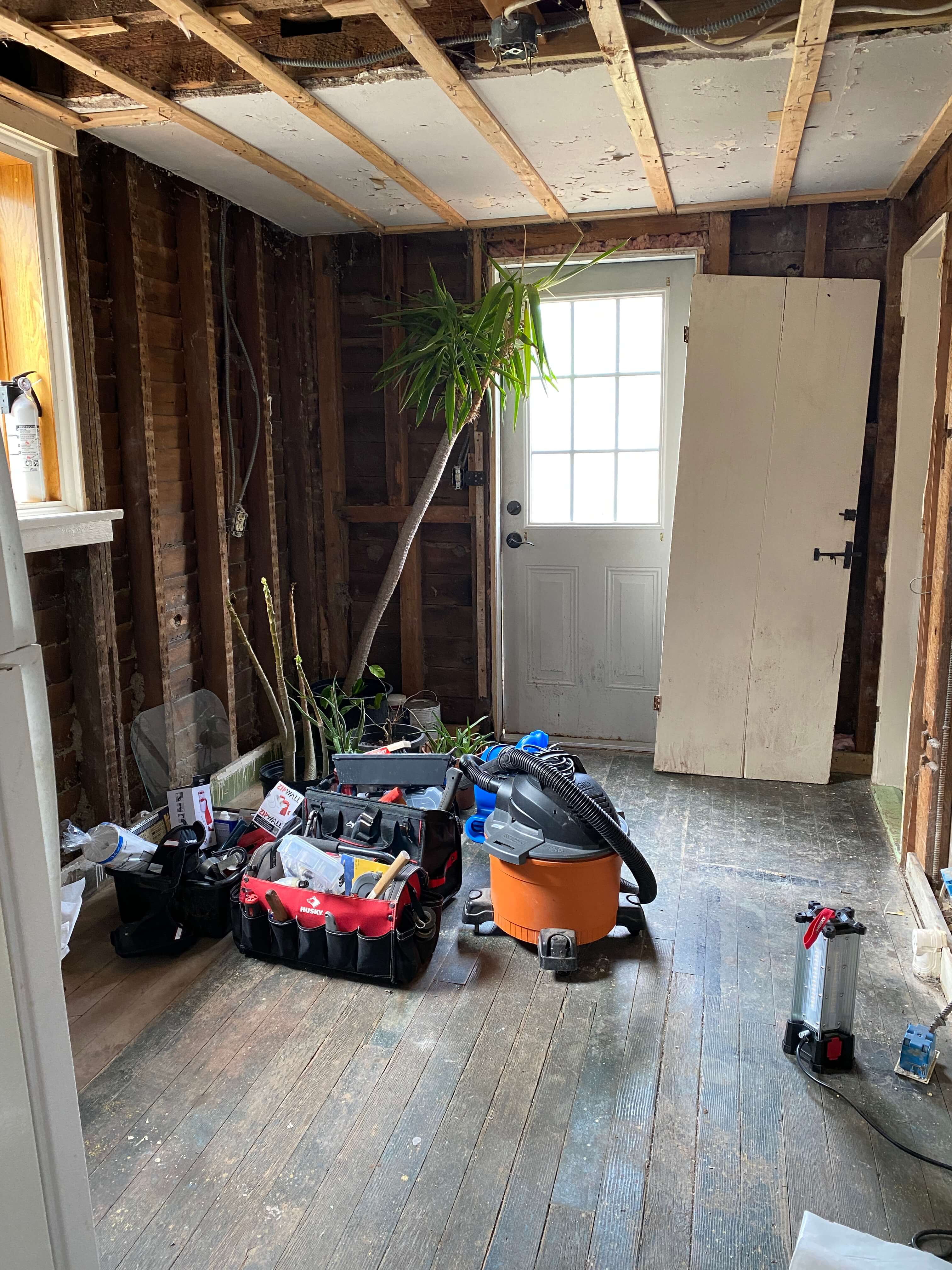
Little stories are popping up everywhere these days. Renovations on the kitchen are underway, but there is nothing flashy and exciting to show quite yet since it’s mostly been electrical work, beam support, plumbing upgrades, and insulation clean-up. Once the kitchen gets framed out and the walls go up, the tiles go on, and the appliances get installed then we’ll be ready for more exciting room photos.
In the meantime, during all this cleaning up, clearing out and repair work the kitchen is beginning to share some secrets. I haven’t had a chance to research the origin story of the house yet, but the following items and information we have discovered during the renovation of this room over the last couple of weeks definitely gives us some insight into the lives of previous owners.
Trapped in between layers of blown insulation in a west-facing kitchen wall we found these three objects on the same day in the same area…
a spoon, a bullet, and the shearing half of a pair of scissors. All from different eras of history, they each offer a glimpse into the domestic atmosphere of life lived centuries ago.
The Antique Teaspoon {exact age unknown}
This antique silverplate teaspoon has a really detailed pattern with wheat sprigs, a scroll (most likely where a monogram would have been placed) and a fleur-de-lis type embellishment. Well weathered, but in one whole piece, this spoon is really quite a work of art…
No easy teller of time and talent, it is, unfortunately, unmarked as to maker and manufacturer. After many hours pouring over antique silverplate patterns, I can’t seem to find any exact matches, but I suspect that it dates to somewhere around the late 1800s. It seems like quite a fancy spoon for a simple style house so it has piqued my interest as to who it belonged to and how it wound up stuffed inside the kitchen wall. I’ll keep researching it, but if any of you lovely readers recognize the pattern design please share your thoughts in the comment section.
The Bullet {pre-1936}
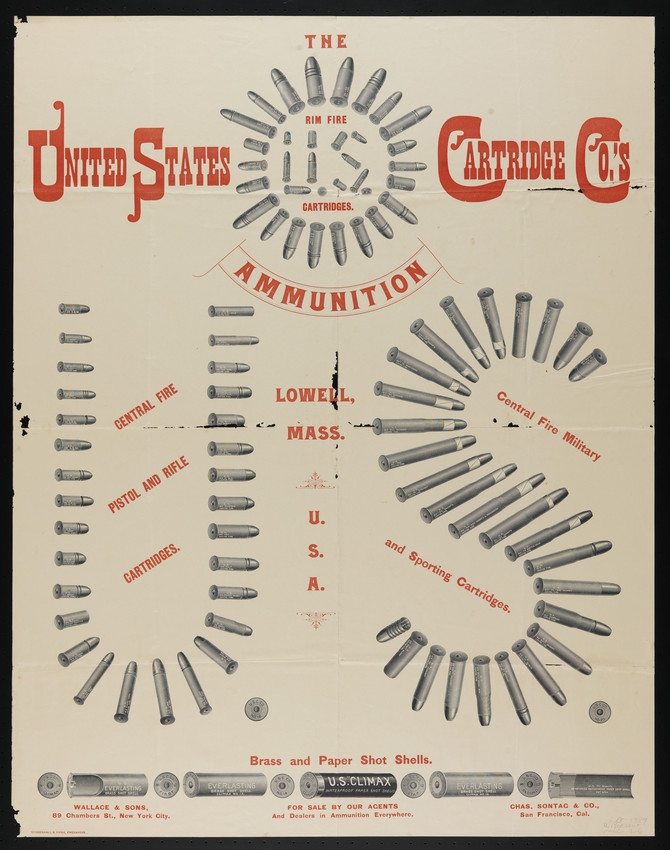
Never having researched guns or ammunition before, this was a real deep dive into the world of historic firearms. This bullet, officially referred to as an ammunition cartridge, was made by The United States Cartridge Company. Located in Lowell, MA from 1869-1927, USCC was one of the largest suppliers of ammunition during WWI, and produced ammunition for both the military and civilian use. This type of ammunition in particular is called a rimfire cartridge, with gunpowder located in the middle section and the bullet located at the tip. The design is known as a pineapple (vintage kitchen theme approved!) because it explodes in multiple directions once it hits its intended target.
Rimfire was used in rifles and pistols mostly for small game-hunting, and marksmanship. A very popular style of ammunition during the late 1800s and early 1900s, it was even used by the Boy Scouts to garner merit badges in shooting.
After The United States Cartridge Company was purchased by Winchester Repeating Arms in 1927, production moved to New Haven, CT which is just 30 minutes down the road from the house. Geographically, it is fitting that a locally produced bullet would be found here, but there is no way to tell if this particular bullet was made in Massachusetts pre-1927 or in Connecticut. Either way, Winchester stopped making USCC branded ammunition in Connecticut in 1936.
Perhaps this was part of someone’s military memorabilia or maybe this one was part of a pack of similar cartridges that were used in hunting the land around here. So far in the yard, we have spotted one deer, five turkeys, several doves and a family of rabbits so I can only imagine what a diverse food source this area would have offered for hunters and gatherers.
The Scissors {exact age unknown}
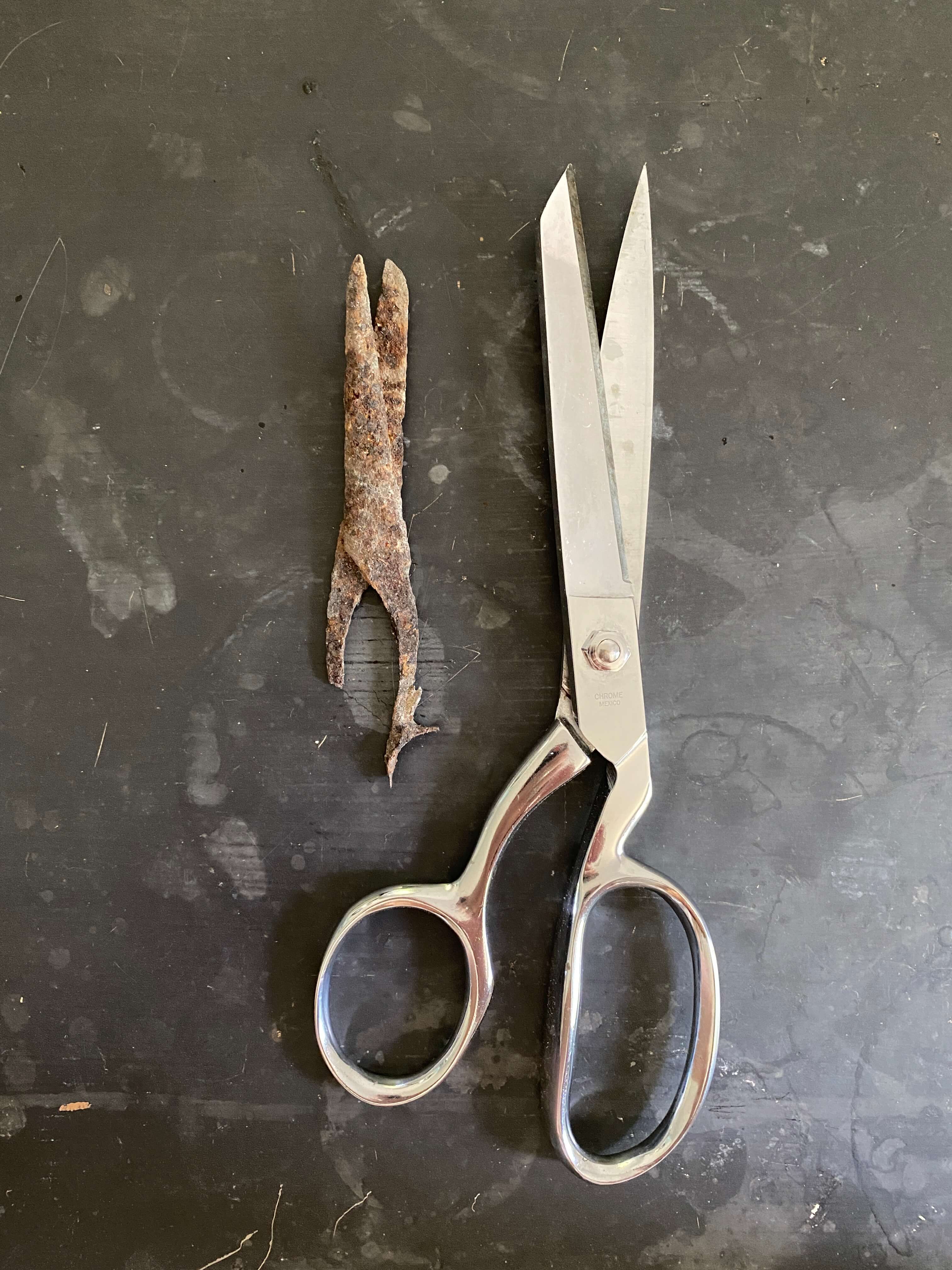
Although quite rusty, these primitive scissors look to be hand-forged and pretty old. Like the spoon, there are no marks or labels to help identify a maker or a year of manufacture but they are intact enough to see that they are short scissors, measuring just 4.5″ inches from the tip to the first turn of the handle. Here you can see them next to a pair of standard fabric sewing scissors to get an idea of size and shape.
Long considered a domestic industry, scissor-making encapsulates the design of over 150 different styles of scissors that run the gamut from small and delicate to large and mighty depending on the task at hand. Given the smaller, more fragile shape of these, I suspect they were made for more delicate tasks like sewing, bookbinding or papercrafts.
The Handforged Nails {circa 1800s} and The Wooden Pegs {circa 1750s}
Before nails held houses together there were wooden pegs that did the job. In the kitchen, we uncovered several areas in the rafters where you can see these wooden pegs. They date to 1750, the year the house was built.
If you recall from the previous post, we think the kitchen was added onto the back of the house sometime in the 1800s. That would explain the presence of antique nails in place of pegs found in the rest of the room. These three antique nails are square-cut box nails in 3″ inch and 1.25″ inch lengths. Known as a general, multi-purpose nail, square cuts were used for a variety of projects including flooring, framing and even box making.
We see them mostly in wall supports in the kitchen and plan on saving all of them for some future project. While doing all this cleaning and clearing it’s been fun thinking about who built this house and this kitchen addition. Was it a master carpenter? The original owner? A team of people or one family over many generations? I can’t wait to find out!
The H-Hinges {circa 1750}
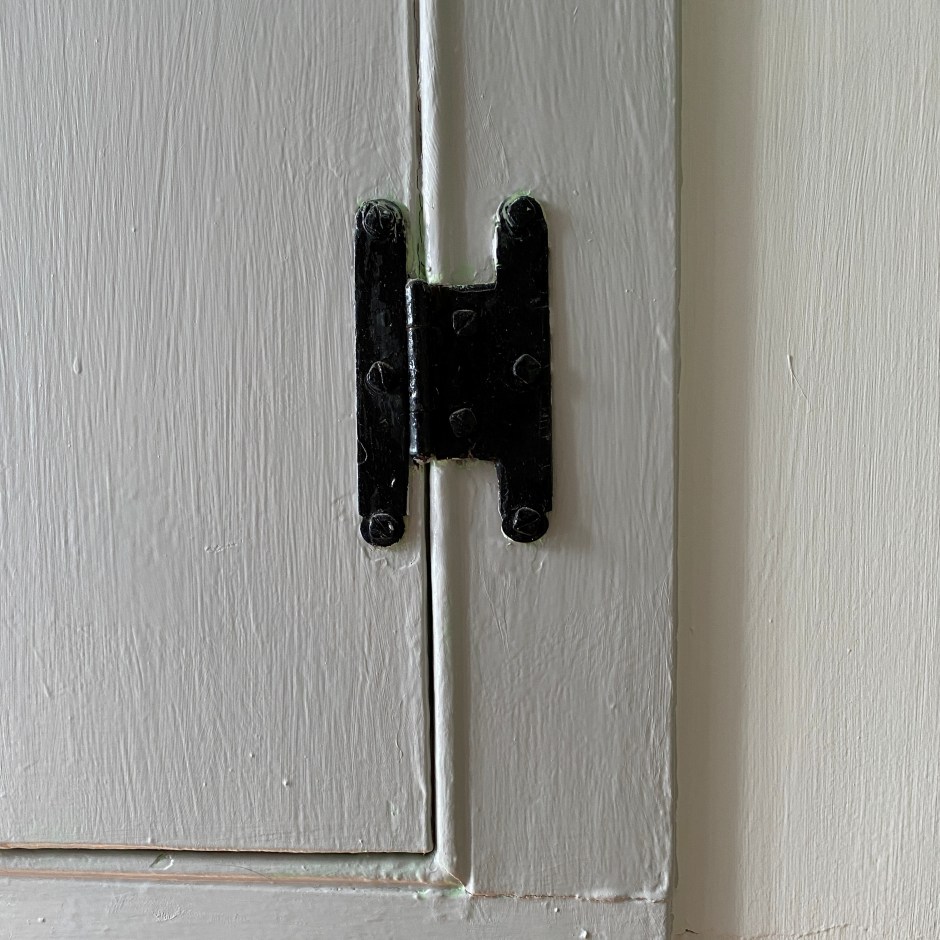
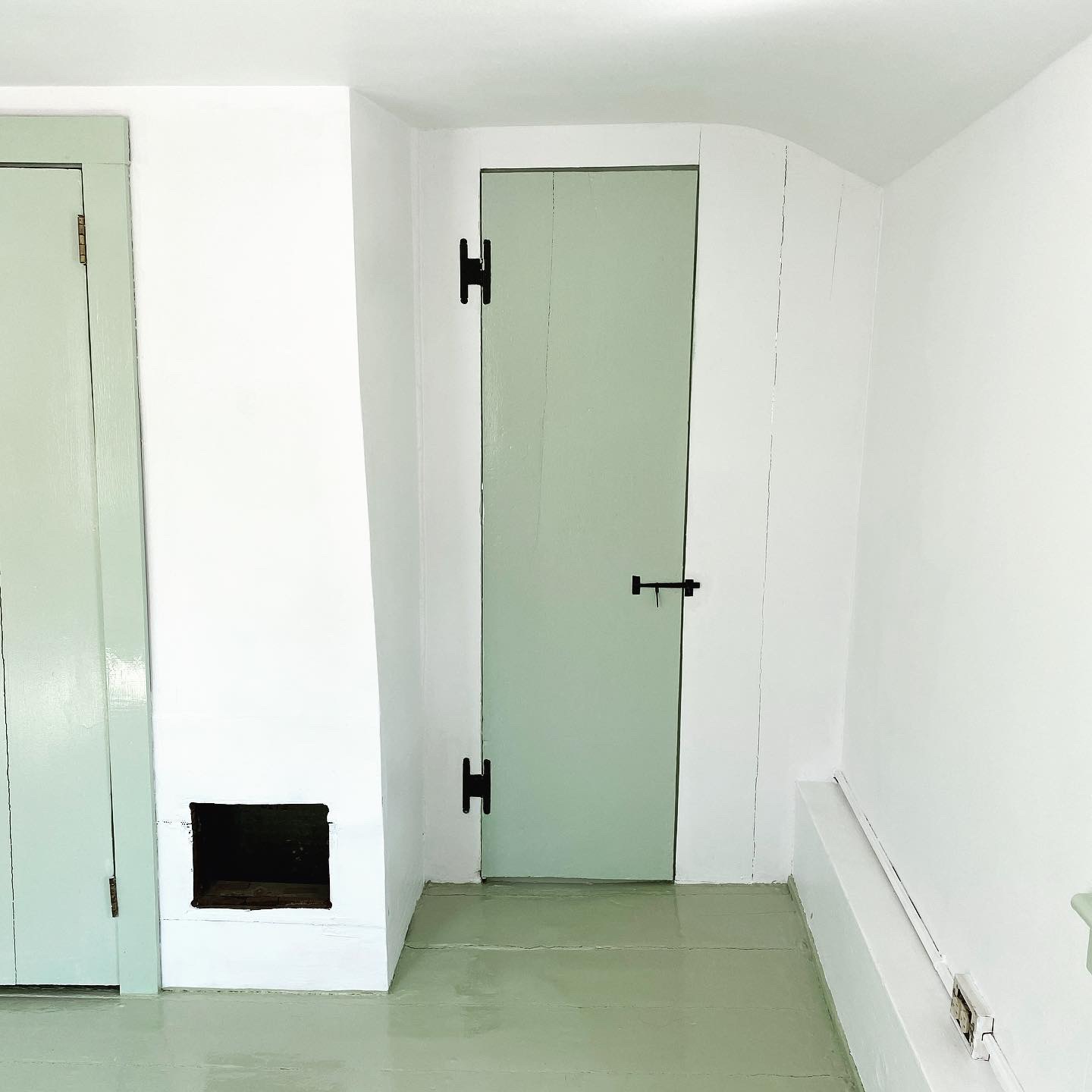
All over the house, including the kitchen, original wrought iron hardware is fastened to original doors and cupboards. The type of hardware that holds it all together is called an H-Hinge. An incredibly popular style of hinged bracket used during colonial times, there is a bit of superstition wrapped up in its form and function that suggests why it was a favored domestic carpentry detail. According to legend, the H stood for holy and acted as a symbol of protection. Against witchcraft.
Don’t be nervous about all those paint splatters on the hinges – they haven’t been cleaned up in decades but we are up for the task!
Oh my. Once learning this info, I immediately refamiliarized myself with the Salem Witch Trials. They occurred in Salem, MA sixty years before our house was built but Connecticut also had their own similar witch trials that were held in Hartford from 1647 to 1663 and in Fairfield in 1692. The last recorded witch trial in Connecticut was conducted in 1697 – fifty-three years before the wooden pegs were hammered into place in our place. Hopefully, by now, any and all nefarious spirits have long been put to rest, but I’m glad to know the kitchen (and all the other rooms of the house!) will be safeguarded just in case the “possessed” happen to return:)
In addition to these items found inside, we have also found quite a few treasures out in the yard and garden too (more coming on that in a future post) that offer equally compelling glimpses into life once lived around here. It’s not enough to put a complete story together yet just based on what we have found so far, but it’s a start. With a little bit of luck and some dedicated research, more of a narrative will unfold. Cheers to history and to long-form storytelling!
A little preview at one of our outside discoveries – a rock named Hilda.
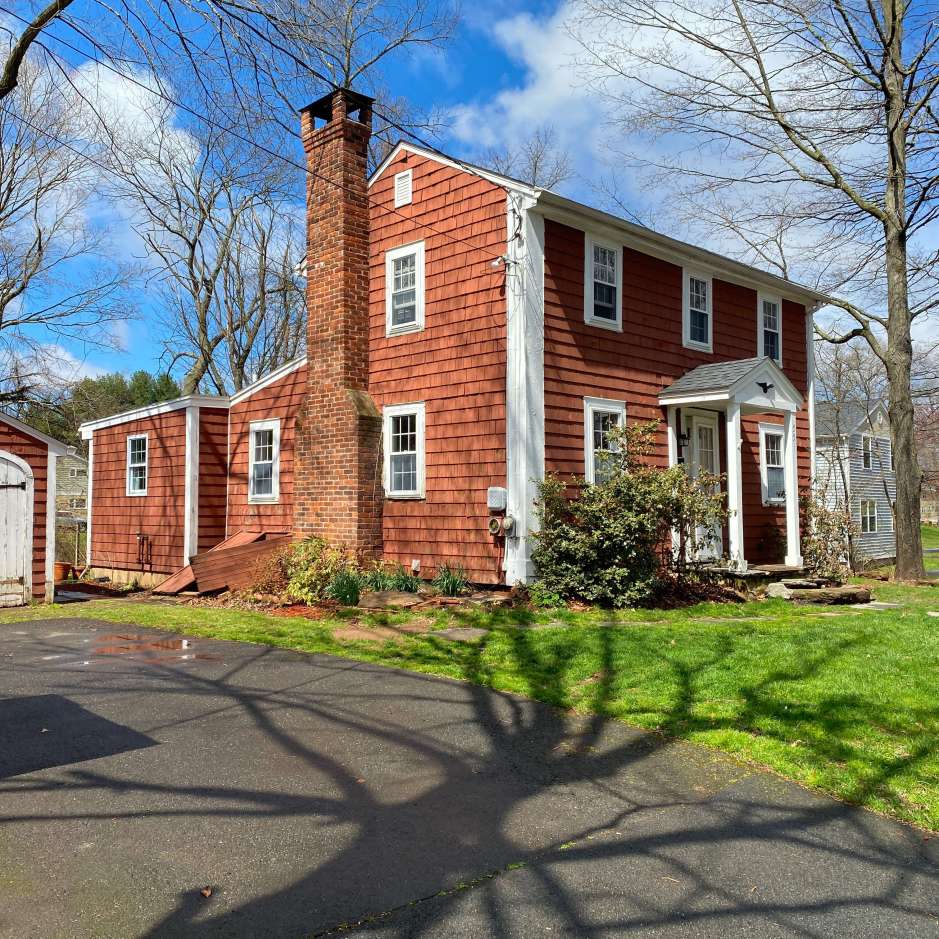
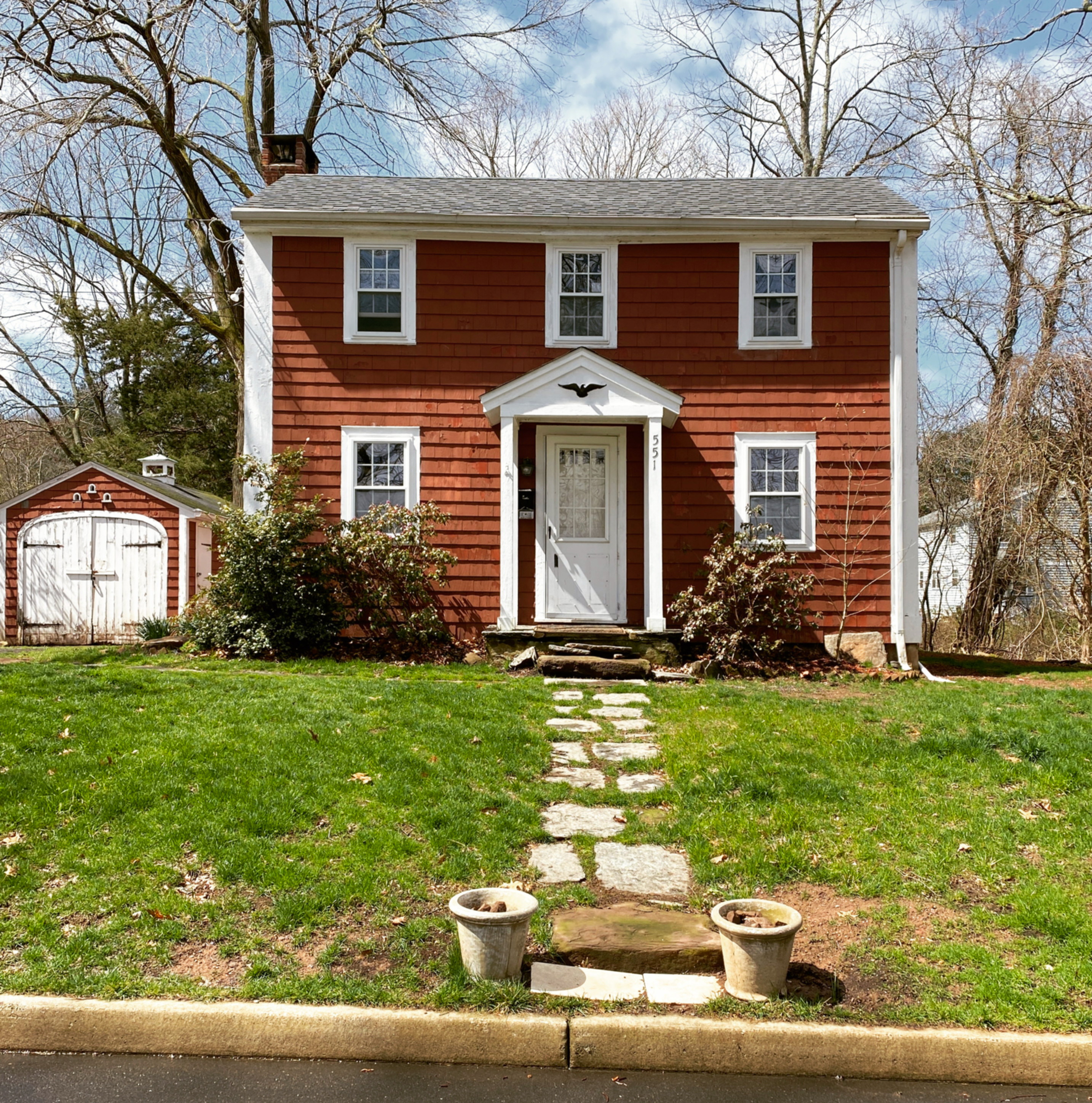
Cheers to new beginnings and big news. I’m so excited to share that the Vintage Kitchen has a new home! After two years of online real estate hunting and six months on the road in search of just the right house, just the right city, and just the right amount of green space to launch a new chapter in the life of the Vintage Kitchen, we have finally landed in the beautiful state of Connecticut. Located on a tree-lined street, in a historic river town that was once one of New England’s busiest trading and sailing ports, stands this almost 300-year old-charmer…
Built in 1750, this early American colonial contains a wonderland of history that spans over 270 years. It is dizzying to think about all the culinary conversations that have bounced around these plaster walls from then til now. But to give you a little perspective, it was built twenty-six years before the Declaration of Independence was signed, nine years before Guinness brewed their first batch of beer, and forty-six years before the first American cookbook (American Cookery, Amelia Simmons, 1796) was published.
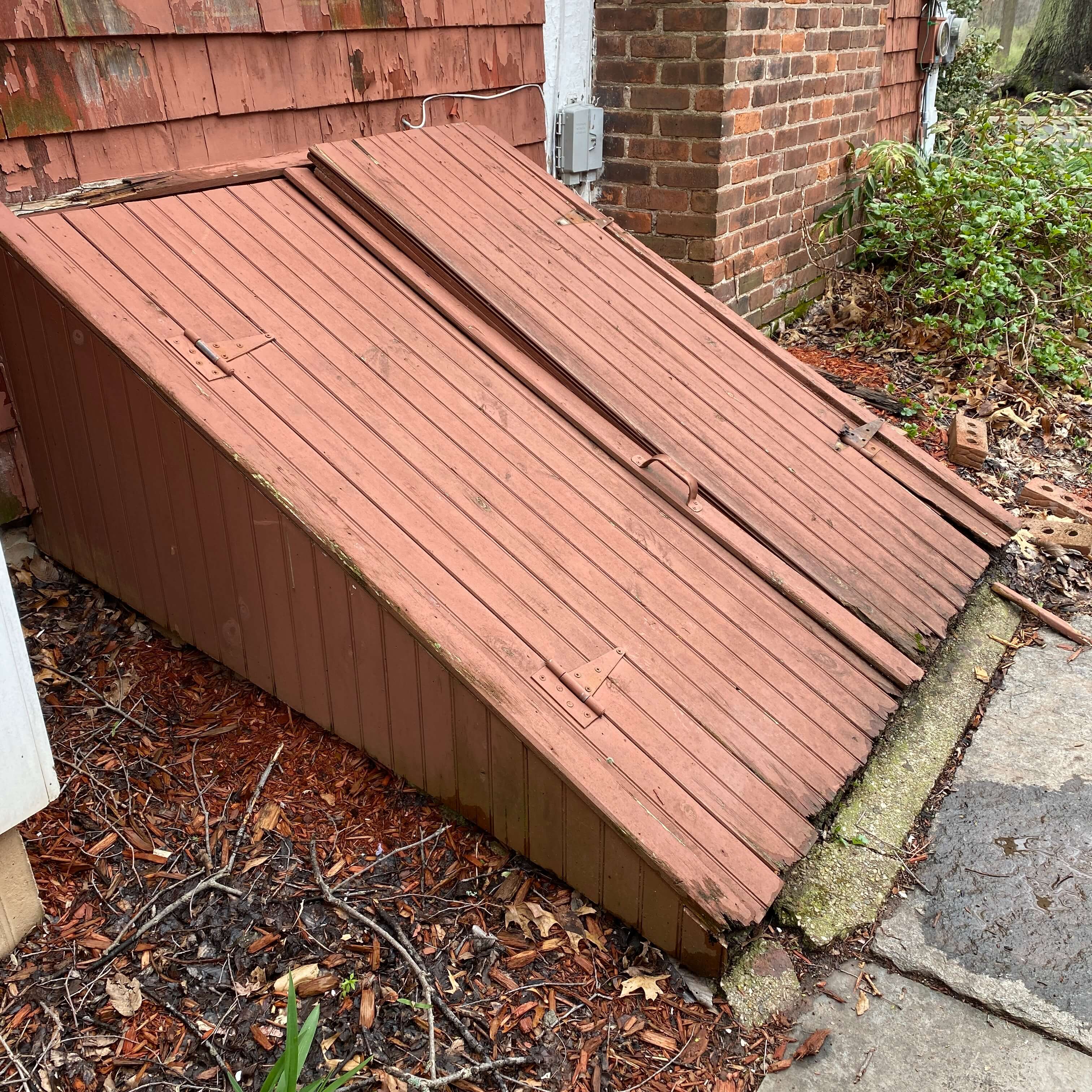
Representative of traditional Georgian architecture, it was built using a symmetrical two over two layout containing two rooms on the bottom floor and two rooms on the top floor with a center staircase running up the middle. A fireplace on one side that was used for cooking and heating purposes, and a stone foundation basement with exterior cellar doors completed the architectural footprint.
Each century afterward brought new features and new additions. In the 1800s, a bathroom was added upstairs and a kitchen was added off the back of the house. Sometime around the 1940s, electricity came to town and outlets were carved into support beams both upstairs and down. In the late 1990s, another bathroom was added on the ground floor at the back of the house along with a mudroom. I love all the angles of the graduated rooflines, especially on the sides.
In the next coming weeks, I’m hoping to find out some of the house’s early history so that a date plaque can be added to the shake siding in front with attribution to the original owner, builder or the known name of the homestead itself. We see these plaques on old houses all over Connecticut. I think they are such remarkable reminders of all the people that settled in this landscape long before us. I’m hoping with the help of the local library and historical society that there will be a bevy of interesting information discovered (more on that topic coming soon).
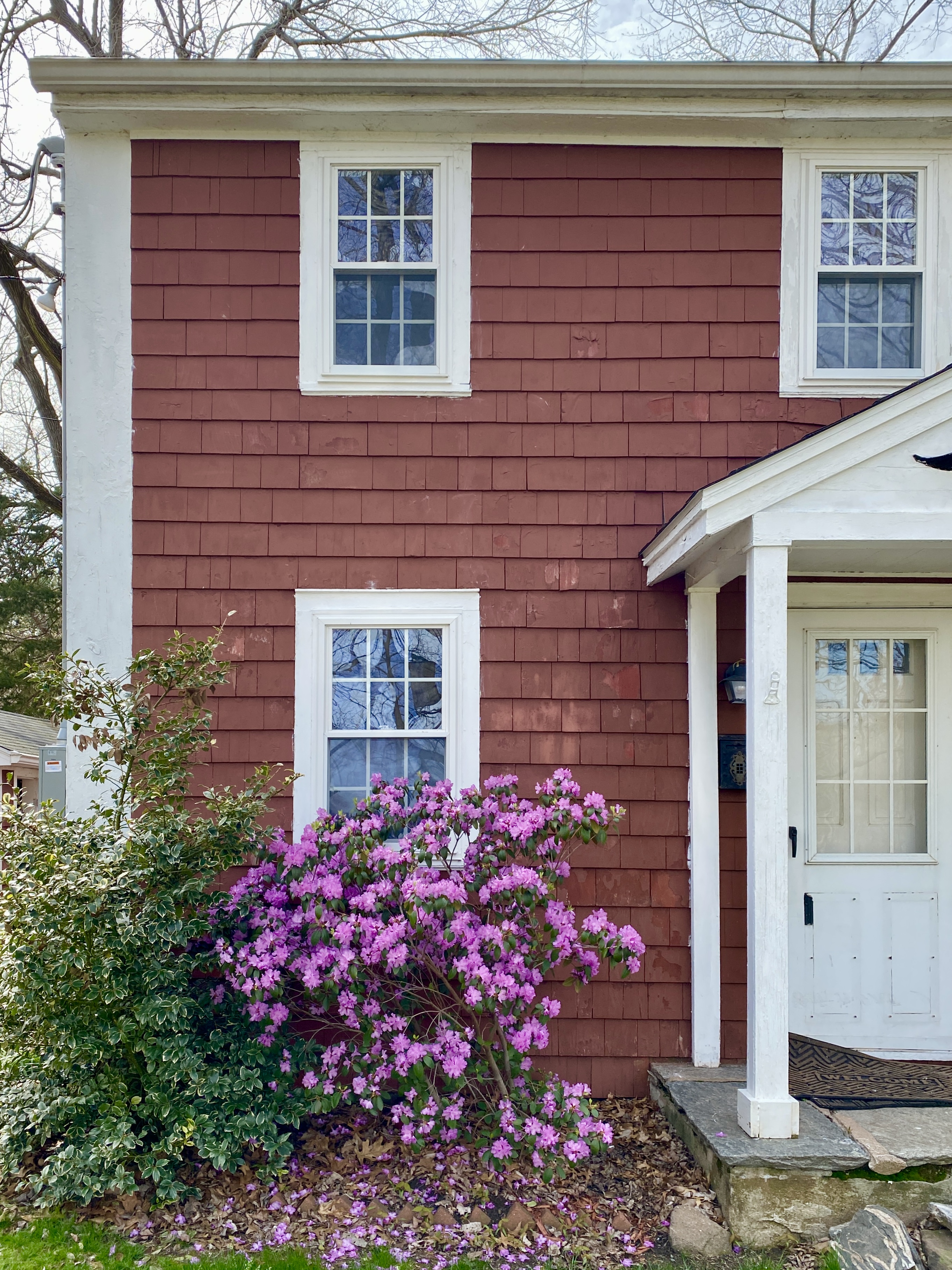
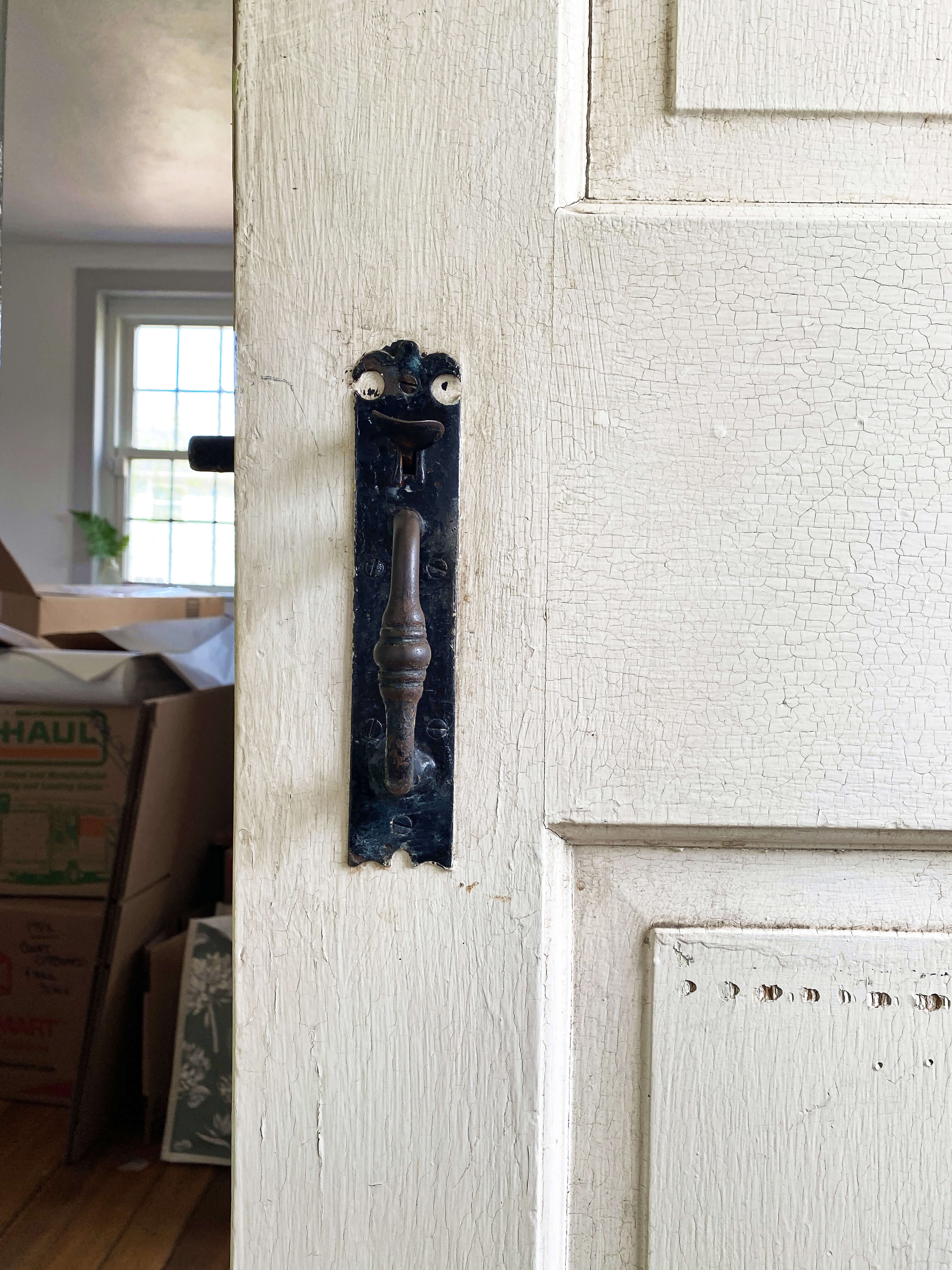
In the meantime, the house itself offers up its own stories in little ways every day. Many of the original 1700s features have been retained including the entire structural support system, the stairs, the fireplace, almost all the interior doors and hardware, the upstairs flooring, the exterior front door and porch, and the interior trim on all doorways. Evidence of adjustments and modifications made along the way by former occupants in the 1800s can be seen in the downstairs flooring and in the detached garage, as well as the 20th-century replacements windows, entry hall flooring, exterior doors, and the two room additions at the back that made the house a bit more convenient for modern living.
While the whole house is a marvelous example of domestic progress as American homes evolved over the course of three centuries, and structurally it is in great shape, as is the case with most historic homesteads, it does need a bit of extra care, love and attention these days. Luckily, all the previous occupants who have spent time within these walls have kept their improvements relatively simple and in keeping with the house’s history, so there is nothing that needs to be demolished or taken down. Some cosmetic changes, electrical updates, and renovation work will freshen things up a bit and ensure that this piece of history will be enjoyed for another three hundred years.
The most dramatic changes will come in the kitchen and the garden, as there are BIG plans for both. In a funny twist of irony, as my husband and I searched all over New England, Pennsylvania and New York for the ideal house for the Vintage Kitchen, we wound up falling in love with a home that had no kitchen. Technically there is a kitchen (two, actually if you count the fireplace – also known as the original kitchen!) but the room that was added onto for cooking in the 1800s is currently not operating as such at the moment. Taken down to the studs by the previous owner, this gutted room now offers a playground of design possibilities.
We are really excited for the challenge of making it functional for modern-day cooking while also keeping the house’s historical footprint and charm intact. Before we tackle that renovation project, in today’s post, I thought it would be fun to share some of my favorite architectural details both inside and out that make this house a unique time capsule. One of the most visually impactful aspects can be seen in the kitchen in the very last image.
Front door mailboxCellar doors… how many canned goods and food bushels have passed through there in 272 years?Original interior doors and hardware circa 1750Ultra-wide original 1750 floorboardsA property boundary marker from 1904Original 18th century front door and hardwareOriginal 1750 staircase The weathervane needs a little repair but it’s still a beauty no matter what direction it points. Original 1800s era kitchen flooring One of my most favorite parts of this old house is being able to see (and touch!) the transition of wood that has held up the entire structure over the past 272 years. Had the kitchen already been renovated before we bought the house, we would have never been able to get a glimpse of the inner structural workings of three different centuries.
As each room in the house gets painted, renovated and refreshed there will be many blog updates about our progress along the way with all sorts of before and after photos. Also, if you keep up with the Vintage Kitchen on Instagram, you’ll find occasional videos posted there as well.
While there still will be a few more weeks to go until we are up and running in the cooking department and able to share new batches of vintage recipes, I am happy to announce that the kitchen shop is now back up and running. A new collection of vintage and antique items will be available beginning this week including cookbooks, coffee pots, storage containers and the cutest 1930s era cast iron doorstop, so if you haven’t visited the shop in a while perhaps you’ll find something new yet old that captures your heart.
Also, I just wanted to say a big thank you to everyone who stuck with us while we transitioned from our old Southern city to our new New England home. This migration took a lot longer than anticipated and presented a multitude of obstacles, but now that we are settled in our new spot that we absolutely love, the Vintage Kitchen is ready to explore and share all sorts of new and exciting culinary history. I have a feeling there will be many colonial-inspired stories to come.
If you have any helpful design ideas or advice pertaining to old house renovations please share it with us in the comments section. We welcome all information around here.
In 1966, these words described her cooking… creative, imaginative, inventive, eclectic, beautifully presented, and internationally inspired. Craig Claiborne, the New York Times food editor and a beloved favorite here in the Vintage Kitchen, said “anyone who truly cares about cooking is fortunate indeed that such a talent as hers can be shared on the printed page.” James Beard called her “the finest cook I know.” Newspaper columnist Elizabeth de Sylva deemed her the “free spirit of cooking,” and food writer Gaynor Maddox labeled her “one of the most exciting, competent, and delightful guides to better dining.”
Today, here in the Vintage Kitchen, we are featuring a thoroughly modern-minded yet vintage recipe from the culinary repertoire of Paula Peck (1927-1972), who was a phenomenal but now forgotten cook popular during the mid-20th century. I use the word forgotten carefully. Since professional chefs today consider her cookbooks classics and since she still has a quiet army of devoted fans, she’s not lost to a select group, but Paula is definitely, surprisingly not part of mainstream cooking conversations like other famous names that traveled in her circle. Why is that? Was she overshadowed by bigger personalities like Julia Child or James Beard? Did her culinary prowess get dismissed over time? Her recipes simply forgotten?
In order to try to figure out why Paula Peck is not a household name today, we need to start at the beginning and explore the details of how she came to be the topic of conversation in mid-20th century kitchens.
It all started with her spouse.
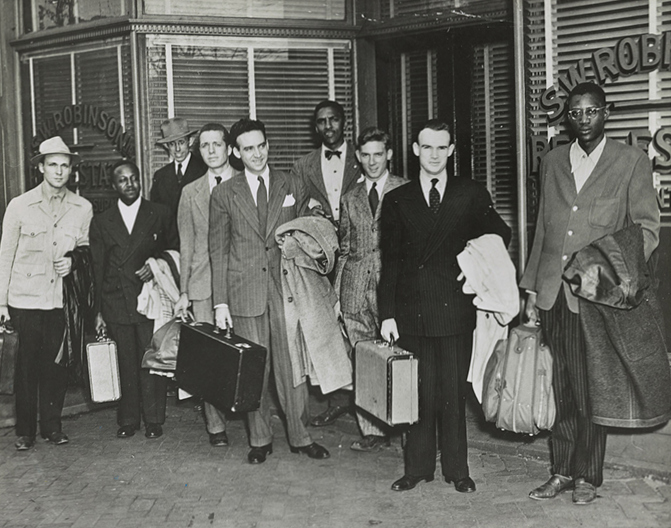
Among the many causes he supported, James Peck participated in the Freedom Rides in 1961, which protested the segregation of African Americans on public transportation. He was attacked and badly beaten for his involvement, but continued to defend the civil rights of African Americans. He is pictured here, fourth from left. Learn more about this experience in a 1979 interview here.
Paula’s husband, James Peck, known as Jim, was a newsworthy civil rights activist who worked his entire life trying to bring people together for noble and decent causes. Involved with the War Resistance League, the American Civil Liberties Union, and the Congress of Racial Equality among others, it was Jim who first inspired Paula to dive into the world of cooking after they were married in 1950. Up until that point, Paula knew little about how to create a meal. This was a bit of a tricky situation since she married a foodie. Unless she wanted to lose her husband to the local eateries of New York City night after night, she knew she was going to need to learn to cook. So as a young bride of 23, she set out on a mission to tempt her husband and his adventurous gourmet palate away from the restaurant scene, which he adored, and into the kitchen of his own home.
Paula Peck in her kitchen in December 1966. Photo: Newsday
As Paula started experimenting with food, she fell more and more and more in love with cooking. In trying to appeal to her husband’s enjoyment of international cuisine, in particular, she studied foods from all around the globe. She began collecting cookbooks, keeping track of recipes in a file box and gathering ideas about food preparation with friends. With every passing bite, Jim encouraged her explorations. Eventually, she gathered enough courage to take a cooking class with one of the country’s most celebrated gourmands, James Beard. From there, her culinary star rose bright and shiny, as the two struck up a friendship. One opportunity led to another. Paula became James’ apprentice and then his teaching partner. And then she went on to teach her own cooking classes.
Eleven years into her culinary journey, she published her first cookbook The Art of Fine Baking in 1961. After that, she was hired to work on the baking portion of the mega Time-Life Foods of the World cookbook series along with a host of respected chefs, food writers, and culinary experts. In 1966, she published a second cookbook, The Art of Good Cooking, in which she espoused the physical beauty of the kitchen, of quality ingredients, of simple equipment, of the breath-of-fresh-air joy that became her signature cooking style.
Her recipes began to appear with frequency in newspaper columns nationwide. She did live in-person cooking demonstrations for various events. She conducted interviews. The industry was achatter with news about Paula, about her recipes, about her unique approach to food. By 1970, Paula, the twenty-something girl who was not so skilled in cooking two decades earlier, arrived in the form of an accomplished, confident culinary teacher. Swathed in accolades, with nothing but a field of potential and possibility in front of her, surrounded by skilled peers and influential connections, Paula’s trajectory was on course for iconic status. And then something terrible happened. Paula died. Sadly, she was just 45.
In the 1960s, Paula circulated in the culinary world a bit differently than her comrades. Unlike most well-known cooks of her day, she wasn’t necessarily focused on age-old techniques. She questioned things. She wondered about established facts of cooking, curious if there were other ways or reasons to approach techniques beyond the traditional. She wasn’t concerned as much with how things were done, had been done, or should be done. Instead, she gave herself, and then her students, permission to experiment with food intuitively and to play around with taste, texture, and time.
Taking little bits and pieces from other cuisines, from other places and adapting them in ways that were unique and interesting, Paula worked with food from the foundation up, building a recipe like an artist builds up a scene in a painting. Taking into account, color, subject matter, texture, time, origin, flavor, and the relationship between one ingredient to another, her food was dotted with elements of surprise and flourish. It was those bits of unexpected detail that wound up setting her apart from all the gastronomes of her day. And I think it was those bits of detail that make her food still very relevant today.
Take pizza for example. Everybody knows the age-old basic pie with its flour crust, tomato sauce, a sprinkling of cheese, and perhaps a topping or two. But in Paula’s midcentury mind, the word pizza could mean something else entirely too. It could look something like this…
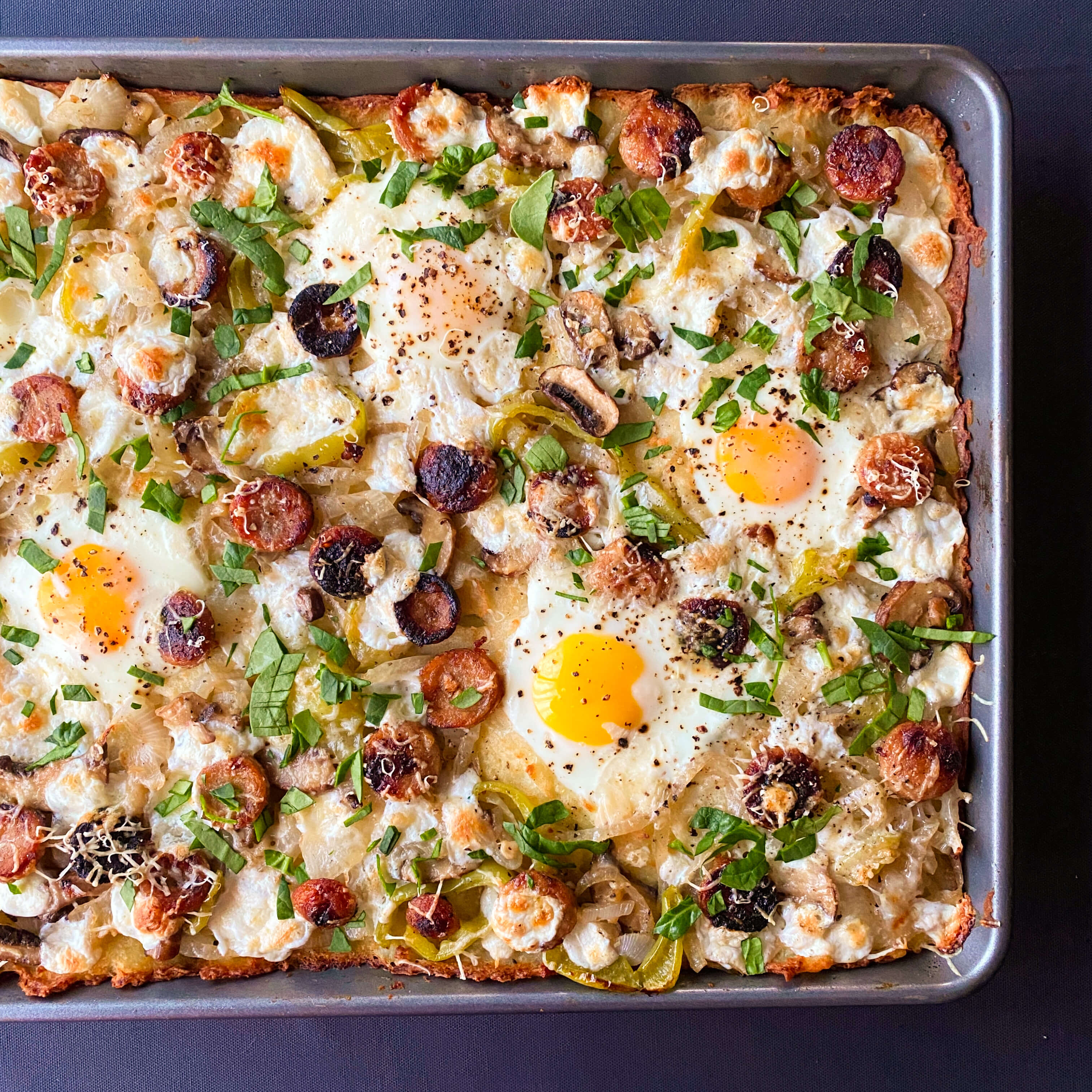
Paula Peck’s Egg & Potato Pizza
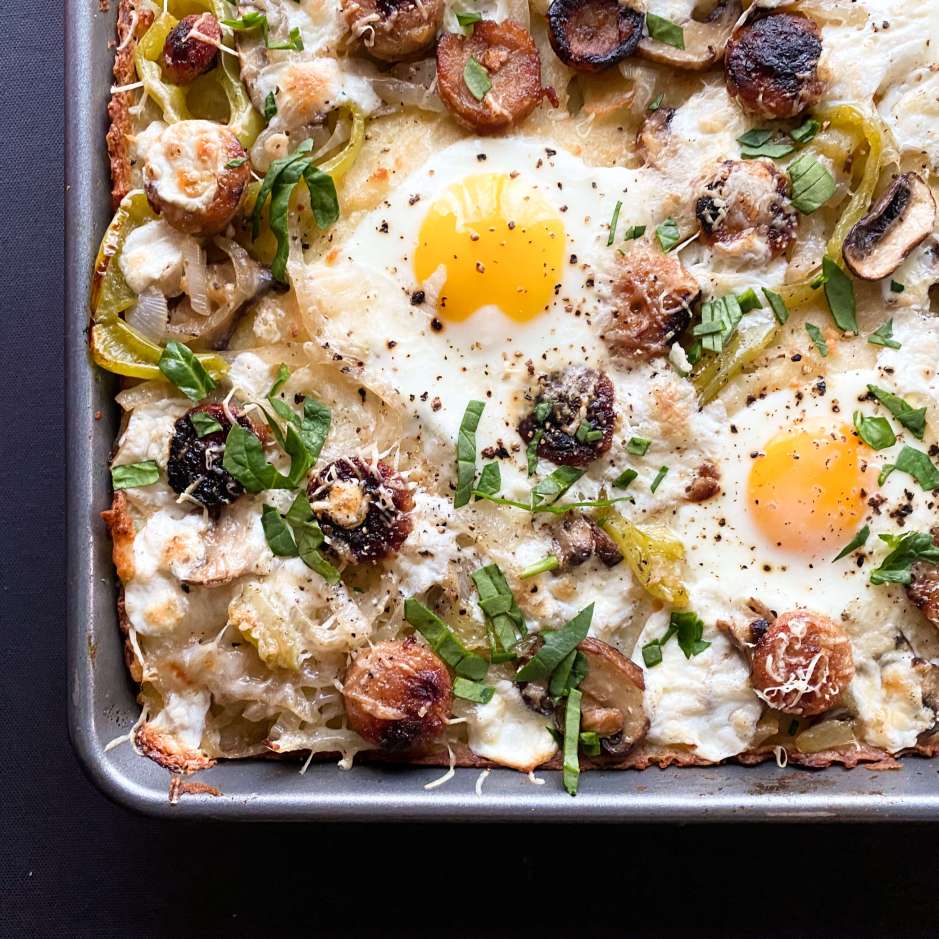
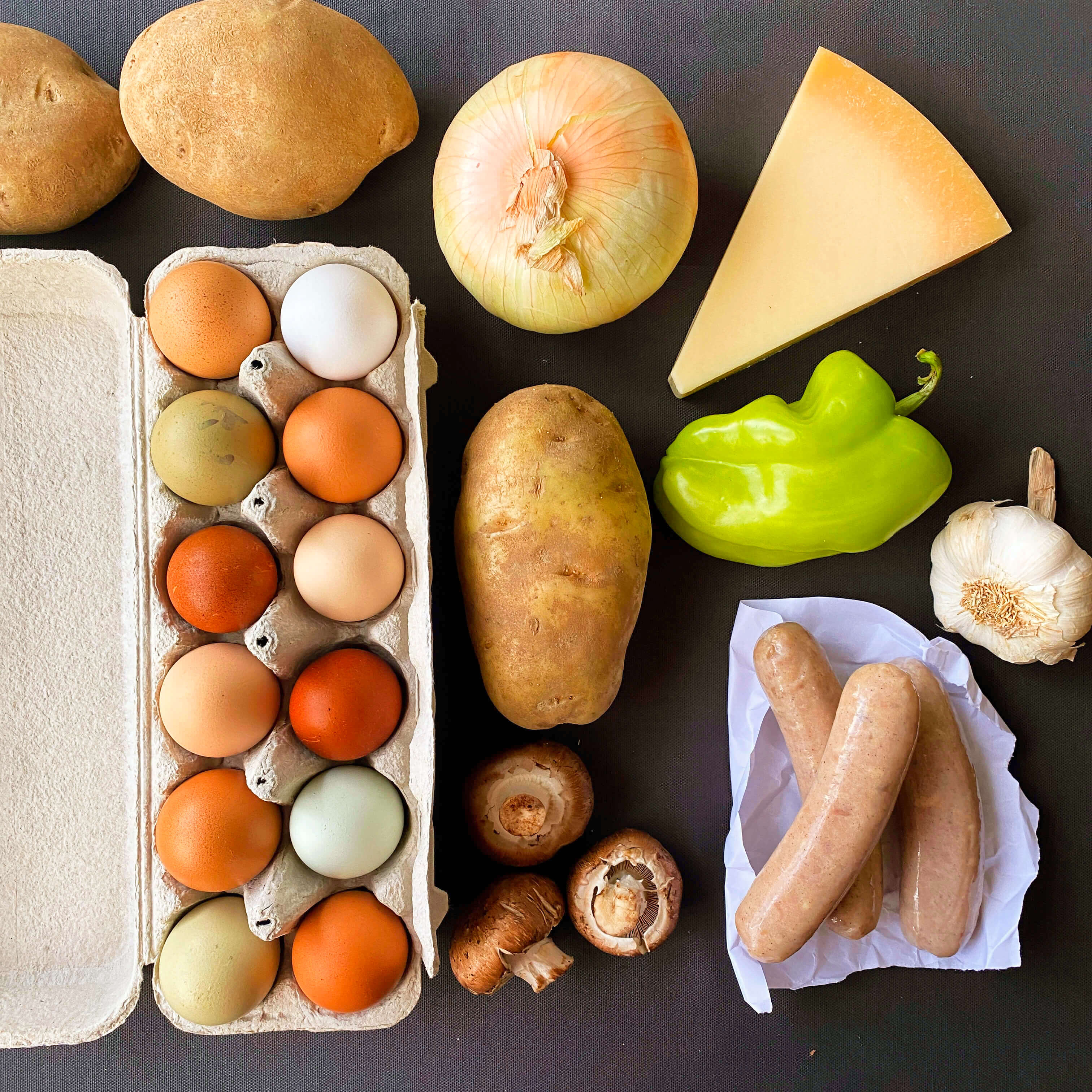
As a prime example of Paula’s creativity in the kitchen, it is her recipe for Egg & Potato Pizza from her 1966 book, The Art of Good Cooking, that is being featured here today. Using mashed potatoes as a base, sauteed onions, peppers, garlic, and mushrooms in place of a tomato sauce, and sausage and two kinds of cheese as toppers, this entire dish is polka-dotted with raw eggs and then popped into the oven for a brief bake. Surprise, whimsy, and a delicious combination of flavors are the result.
In a decade when casseroles were king of the dining table, the presentation alone of this recipe most definitely must have felt like a delightful break from the ordinary in 1960s America. More like a popular modern-day sheet pan meal than a traditional pizza, this fun-to-make any-time-of-day appropriate dish has contemporary comfort food written all over it. Made with simple ingredients and easily prepared, it feeds six people, is satisfyingly filling, and is fun to present table-side. In other words, it contains all the hallmarks of a perfect Paula dining experience.
I made this recipe as-is except I substituted chicken sausage for Italian sausage. And one thing to note before you begin… this recipe is best served immediately when it comes out of the oven. If you leave it to sit for a minute or two the eggs will continue to cook to a hard-boiled consistency and will eventually turn rubbery, if you wait to serve it much longer after that. If you like your eggs runny, cook the potatoes and toppings minus the eggs just until the cheese begins to melt (about 17 minutes) and then crack your eggs in their allotted divots and stick the whole tray back in the oven for about 3 minutes.
Paula Peck’s Egg & Potato Pizza
Serves 6
1/2 cup olive oil
3 cups well seasoned mashed potatoes
1 large onion, peeled and sliced
2 cloves garlic, minced
2 cups mushrooms
1 green pepper, seeded and sliced
4 cooked sweet or hot Italian sausages (I used maple-glazed chicken sausage)
6 eggs
1/4 cup grated Parmesan cheese
2/3 cup diced mozzarella cheese
Freshly chopped spinach for garnish (optional)
Preheat the oven to 400 degrees. Grease a large flat baking tray generously with olive oil. Spread the mashed potatoes evenly covering the entire pan. With the back of a spoon, make six indentions in the potatoes for the eggs which will be added later.
Bake the potato-lined pan in an oven for 30-40 minutes or until the potatoes seem slightly crisp on the bottom. Remove from oven.
While the potatoes are baking, slice sausages 1/4 inch thick and brown them in a pan on the stovetop. Set aside. Next, saute onion, garlic, mushrooms, and green pepper in remaining olive oil until soft.
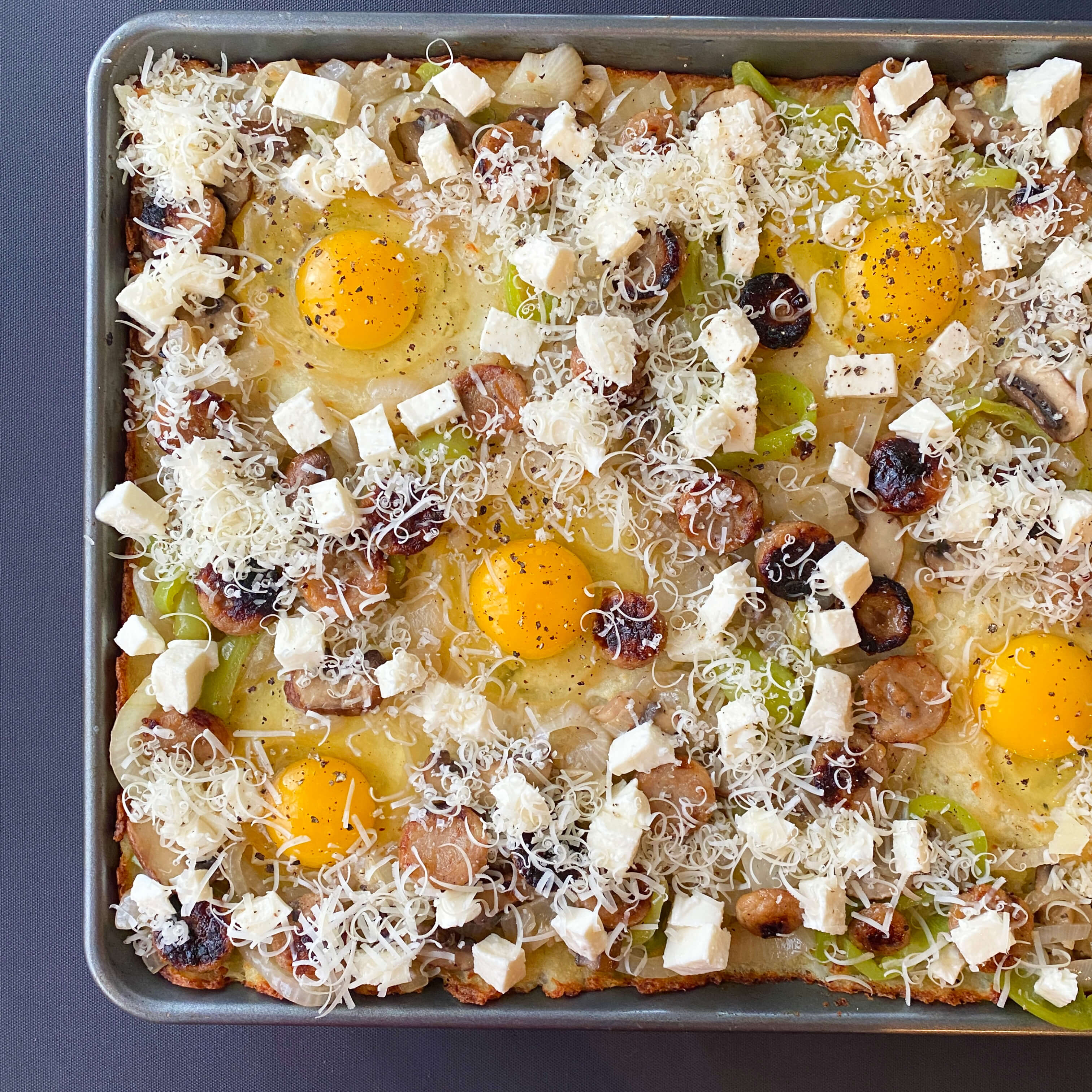
After the potatoes have been removed from the oven, spread top of it with the sauteed mixture and sliced sausage, leaving indentations clear.
Break eggs into each of the indentations. Sprinkle with Parmesan cheese and dot with pieces of mozzarella cheese.
Return to oven. Bake for 20 minutes or until eggs are set and the cheese is bubbly.
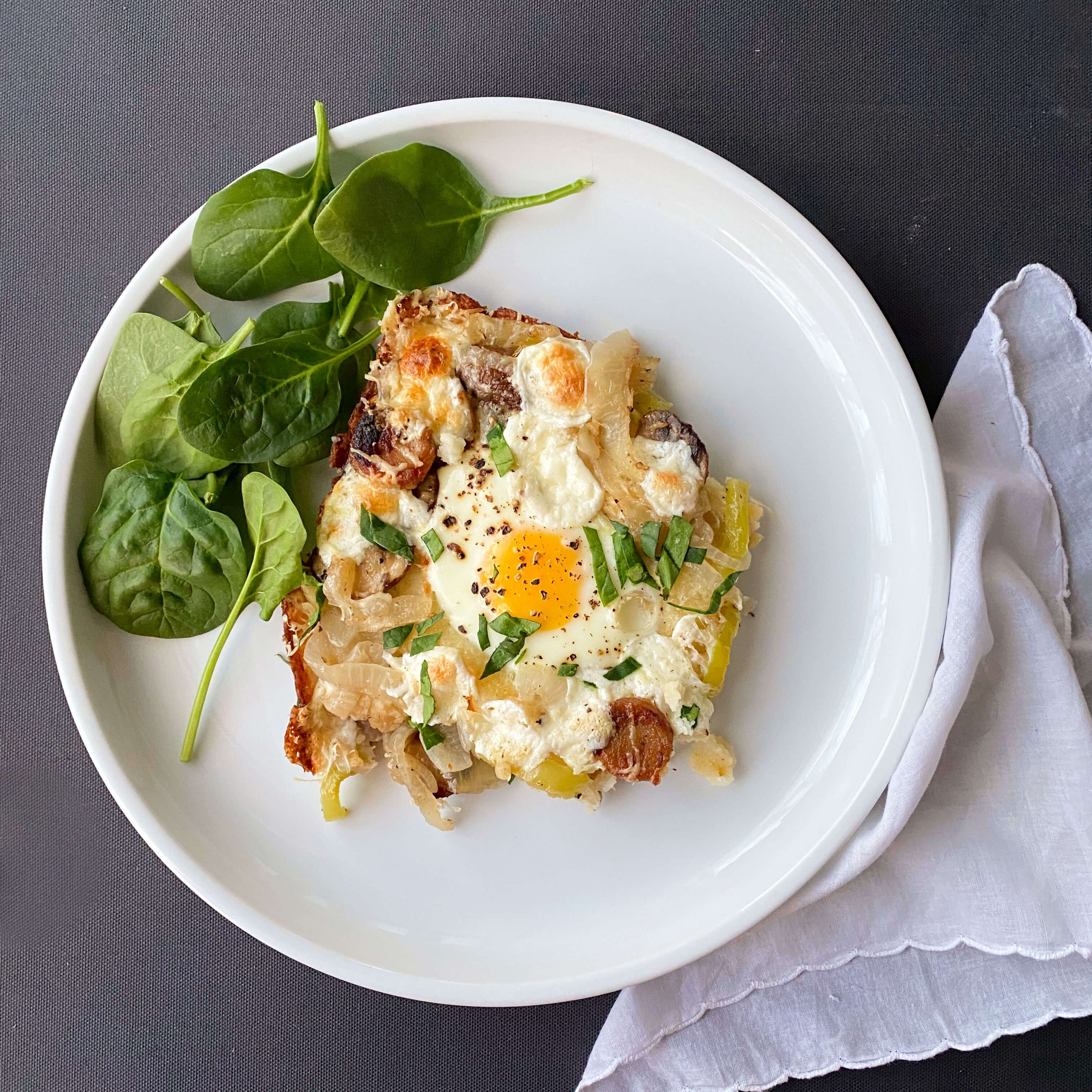
Cut the pizza up into squares or wedges and serve immediately. Paula recommended a green salad as a side dish which is a great choice if you are making this for brunch or dinner especially.
Ideal for upcoming spring holiday breakfasts like St. Patrick’s Day, Easter or Mother’s Day, when onions and spinach are in season, this egg and potato pizza is a blank slate for your creative interpretations too. Add purple onions in place of yellow onions for additional color. Garnish with fresh herbs or scallions on top in place of spinach. Replace Italian sausage with prosciutto or smoked salmon. Serve it for breakfast, for brunch, for lunch, for dinner. Call it a pizza or a sheet pan meal or a one-dish wonder. Paula would be the first one to tell you to take this recipe and run with it till your heart is content. Interpret it as you like. That’s what cooking was all about in the Peck family kitchen.
“My belief is that tradition should not hamper us if we find a better way of doing things,” Paula wrote in 1966. Perhaps that very attitude is what has kept Paula’s recipes out of the widely circulated limelight of modern-day kitchen conversations. Instead of being stubborn, restrictive, and definitive about only one be-all-end-all way to approach food preparation, Paula encouraged exploration. She encouraged hands-on learning. And she encouraged continual education.
That type of exploration and freedom tends to breed a sense of confidence that builds over time through experience. A new cook might start out making one of Paula’s recipes exactly as she described, but then over time, feeling secure at the eventual mastery would adopt Paula’s methods of questioning and discovering. The recipe would get tweaked, augmented, adapted, enhanced. As it evolved, it would take on new forms, new ingredients, new flavors, a new identity. Attribution back to its original source, over time, would get muddied, fuzzy, forgotten, and then lost to history completely. I think that’s what happened to Paula and her creative approach.
In modern-day multi-cultural fusion cooking, in outside-of-the-box presentation, and in the pairing of unusual yet complementary flavors, I think today signs of Paula’s style of cooking are all over our culinary landscape. We just don’t realize that she was the source from which it all began. Paula Peck by name might not be on the tip of everyone’s tongue these days, but her inspiring style of cooking still is.
I hope you enjoy this recipe as much as we did. If you decide to add your own flourish to this dish please send us a message or a photo of your finished affair. We’d love to learn how Paula inspired you!
Cheers to creativity in the kitchen! And to Paula for showing us what fun cooking can be when you add a little splash of imagination.
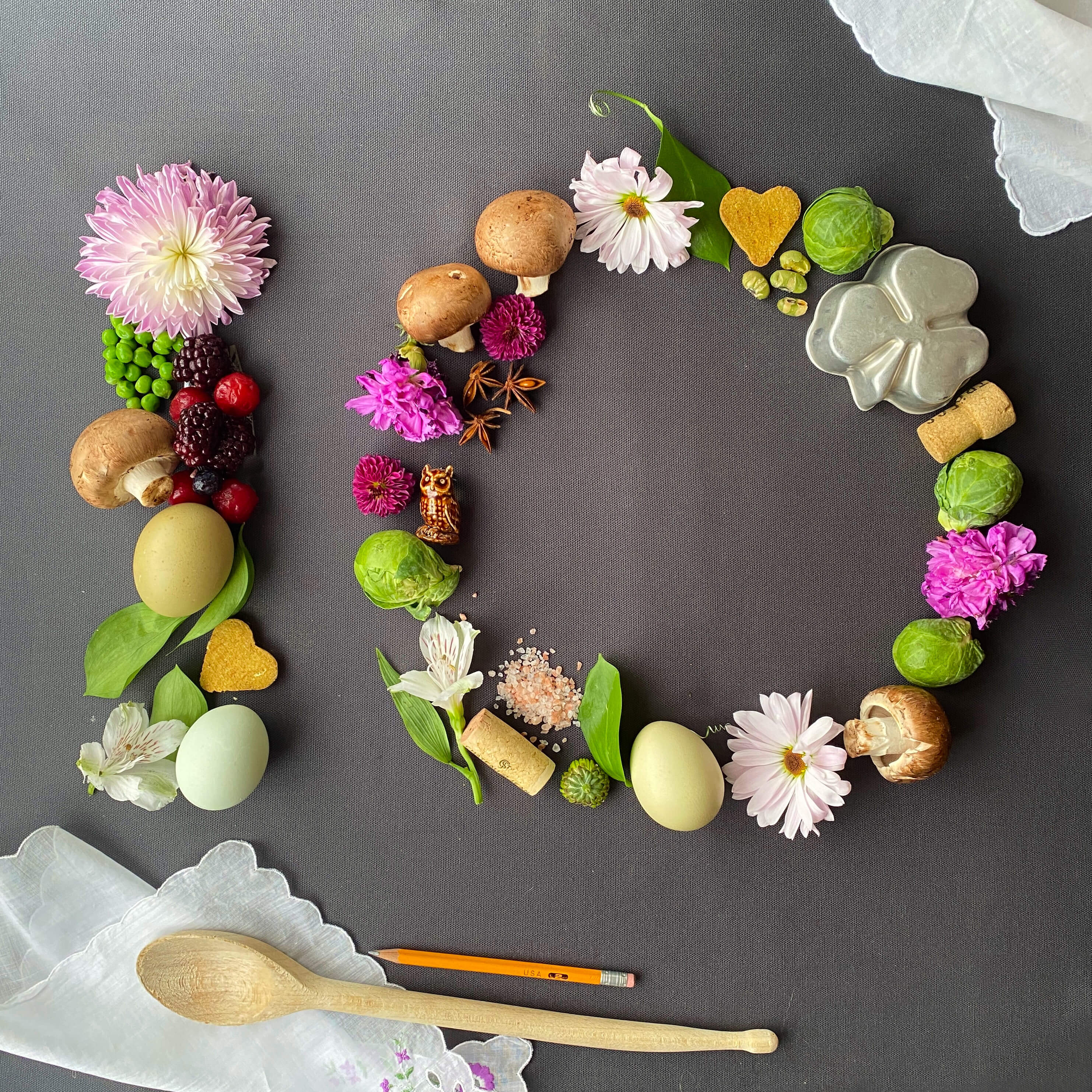
Today we are celebrating a milestone. It’s February 27th, 2022 and that means… (cue the drumrolls and kazoo horns, please)… the blog turns 10 today!
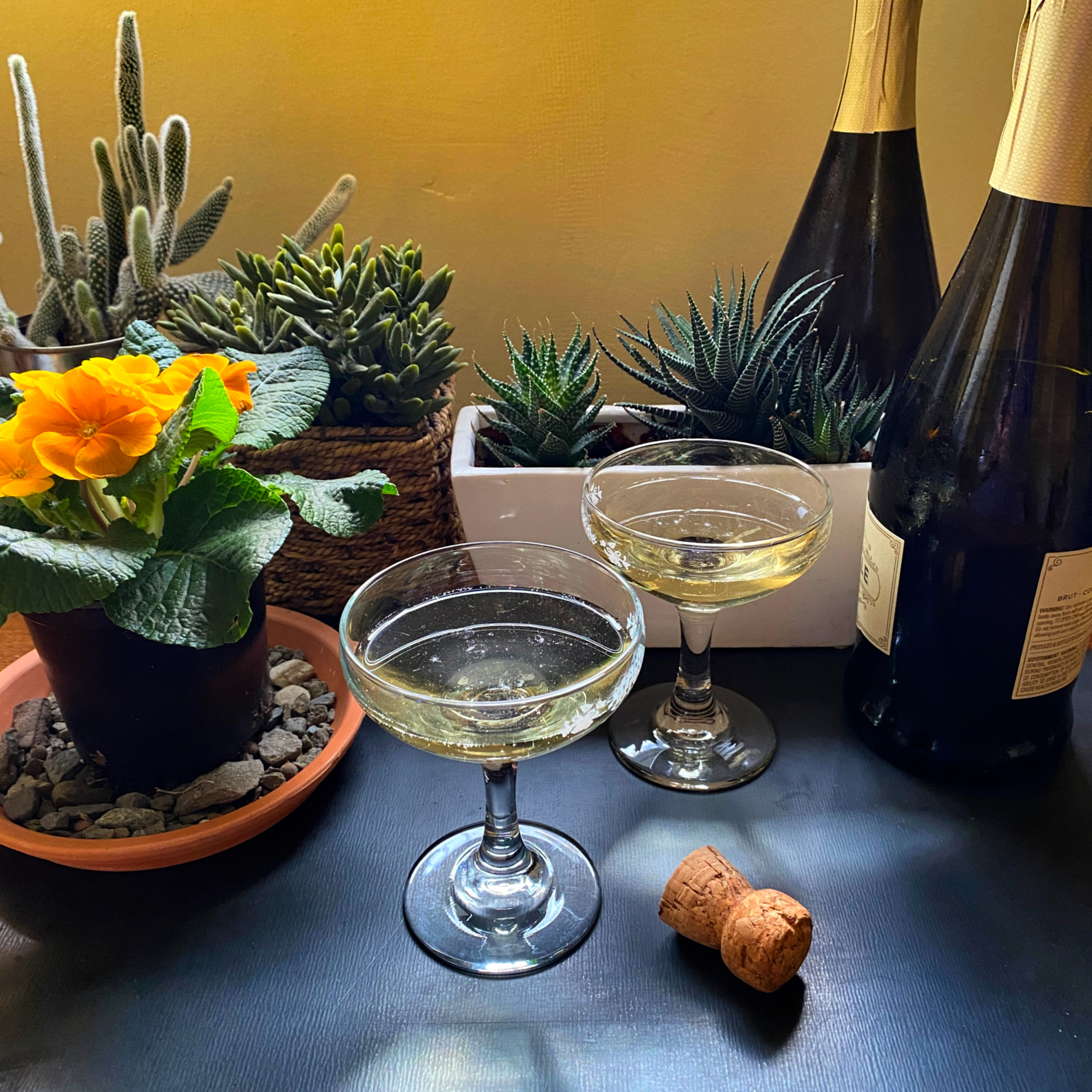
There was lots of discussion about how to celebrate. A cake? Champagne? A bouquet of balloons? And also lots of discussion about how to photograph the big day. How do you sum up ten years of writing, cooking, research, field trips, interviews, and daydreaming in one image or one post?
For the entire month of February, I thought about these questions. Yesterday, I decided on a compilation of items that would form the number we were celebrating today. If this ten-year chunk of time has taught me anything, it’s that creativity is a faithful partner and will always show up when and where you need it.
Each small element laid out to form the shape of the number 10 in the photo above offers a bit of symbolic significance of how things have played a part in this writing life from 2012 to 2022. There is a shamrock for luck, an owl for knowledge, spices for surprise. Mushrooms represent organic growth both during light and dark days. Brussels sprouts signify compact clusters of thought that grow on a single stem. Flowers call attention to the beautiful parts of history. And peas and beans represent the power of food. Berries are there for sweetness, wine and champagne corks for good cheer, eggs because they represent stories inside stories. And finally, there are hearts which represent love. It was love that started the blog and love that will continue to see it through another 10 years.
Atlanta,GA skyline. Photo: Mariana Smiley
The very first blog post was written in a hotel room in Atlanta on February 27th, 2012 during the first vacation getaway I had had in more than a handful of years. I had just opened an Etsy shop the month before, selling vintage homewares for all rooms of the house and I thought a blog would be a fun way to talk about history via the items I was selling in my shop. You might not think that blogging and vacation are two words that go together but the purpose of that long weekend in Atlanta during a frenzied start to the year, was to take some time to recognize the things I loved. And writing was one of those things.
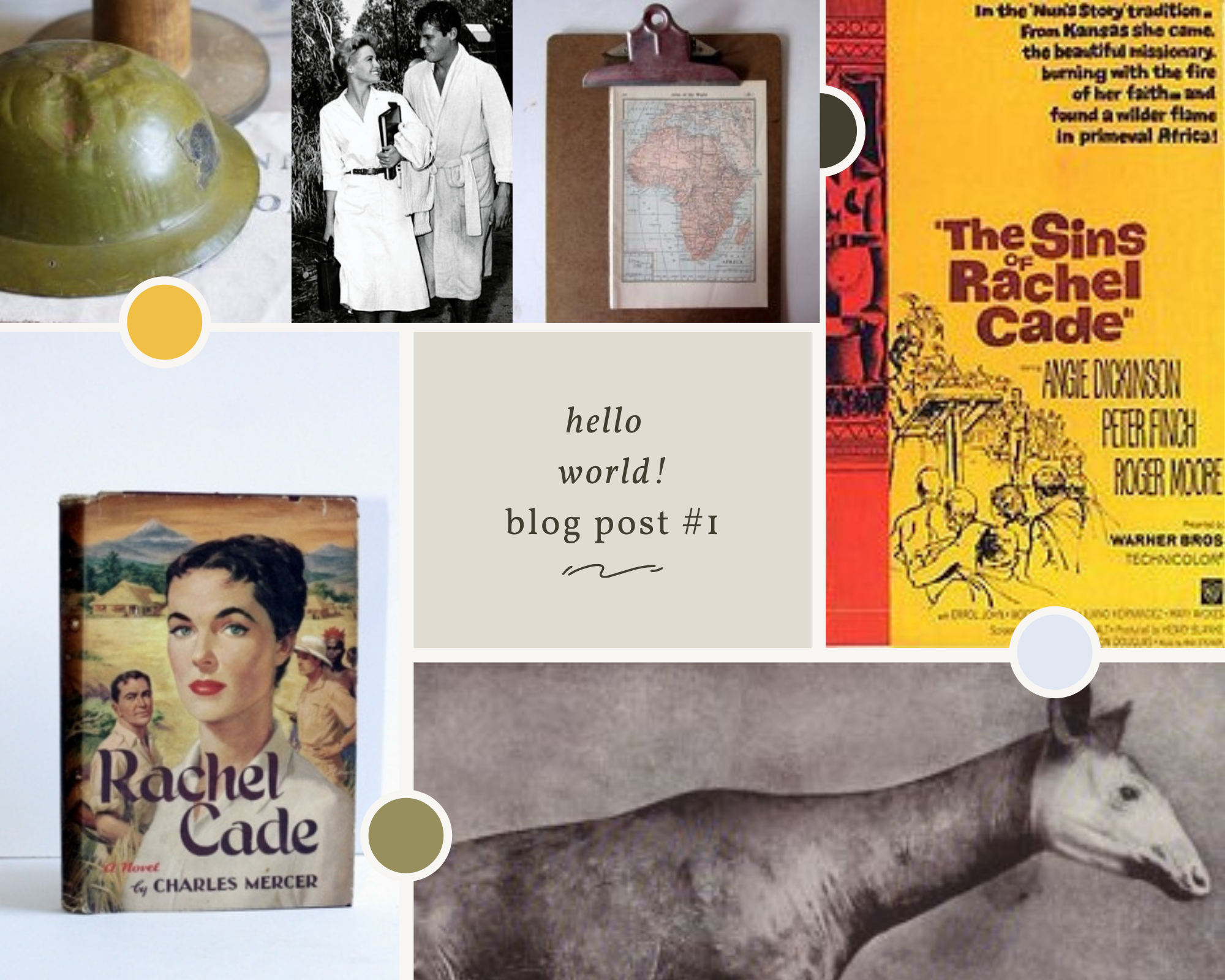
When you first start a blog, WordPress automatically suggests the title – Hello World – for the first post as a way to not only introduce yourself to the blogging community but also as a way to launch yourself easily into a familiar and personal style of writing. The title isn’t mandatory, you can choose to keep it or change it. As I wrote my first post in February of 2012, I had intentions of keeping it. I loved the enthusiasm and the optimism of those two words – hello world. But just before I pressed the publish button on completed blog post #1, I changed the title to reflect the subject matter I was writing about.
That post was about a 1950s fiction book called Rachel Cade. In it, I shared information about the storyline of the book and the Hollywood movie that followed. Hello World got replaced with Featured Shop Item: Rachel Cade – A Glimpse into Vintage Africa and I included vintage items from other Etsy shops to paint a visual story of Africa in the 1930s, the decade in which the story was set. Even though I changed the title at the last minute on that very first blog post, my mind has not strayed far in these past ten years from that initial sense of excitement and enthusiasm at the prospect of those two suggested words – hello world. Although I wound up not using them, they set the tone unknowingly for what was about to unfold over the next decade. In the 364 posts that have been written since, each time I click publish on a finished piece there is still a wave of excitement and energy, a flutter of joy, a silent shout that sends out a big hello to the world.
Initially, I thought it would be fun in this milestone post to feature a “best of” list along the lines of most-read post, most cooked recipe, most commented story, etc. But that would break the blog down into analytical data. And there is nothing more unromantic than a series of performance metrics. This blog isn’t about numbers. It’s about love and adventure and passion all discovered and coddled and curated over the course of a decade. From day one it never set out to break records or be the best or become a job. Since 2012, it’s been a playground to learn more about life, past and present. And what a playground it has turned out to be.
Over the course of ten years, the blog has twisted and turned, narrowed and bulged, refined itself and redefined itself. It’s stayed with me through moves, deaths, excitement, bordeom, joys and tragedies. And in a world that is constantly changing it has been a reliable throughline that has kept me connected to things I love.
Originally it started with a different name, Ms.Jeannie Ology and I wrote in the voice of a muse named Ms. Jeannie who was a history detective bent on uncovering forgotten stories of the past. Five years in, Ms. Jeannie set sail on a faraway sleuthing adventure and the blog re-launched with a definitive passion. Instead of focusing on stories surrounding all rooms in the house, one was picked, the favorite one, the heart of the home where meals and love and conversation are served up each and every day. The blog was renamed In The Vintage Kitchen in 2017 and from that day forward, an inherent love of all things culinary have come to take center stage. A shop component was added shortly after – not one that was connected with Etsy like back in 2012, this shop is its own completely independent entity, but that same symbiotic relationship first explored in the early years between blog and shop and the inspiration they both offer each other continues today.
In 2012, the blog was like a wiggly puppy full of excitement, energy and a wild desire to gain a sense of solid footing in the world. There was a lot to learn about writing, photography, storytelling. It’s humbling now to look back and see how the blog has grown naturally, at its own pace and improved with each passing of a February. It would be easy to run away from those early years, to delete them and never look back, but then the entire point of stretching and trying and playing and growing would be missed completely. A blog gives you room to grow.
It is often said that writers live lonely or solitary lives. While it is true that most, myself included, need peace and quiet to gather and produce a string of sensible words and coherent thoughts, I have found in these past ten years that blogging has not singled me out or separated me from others, it has only done the opposite. It has connected me with more people, more places, more ideas and more understanding than I ever thought possible. In 2012, I said hello to the world and miraculously over the course of ten years, the world has continued to say hello right back.
What follows are links to some of my favorite posts from the past decade. In no particular order, they are ones that continue to stand out most in my mind or hold a sentimental place in my heart. Whether they were written in the voice of my original muse, Ms. Jeannie Ology or my own, they are representative of the vibrant type of content I have endeavored to share about the people, places and objects that have inspired this corner of the world thus far.
It is with big heart-felt cheers and an enormous amount of gratitude that I say thank you to each and every person who has read, engaged, encouraged, participated, promoted, cooked, commented and/or been a part of the blog in one way or the other over the past 10 years. It has been such a journey of discovery and I hope the next ten years is just as exhilerating.
Cheers to ten and to another ten more! And cheers to Emily Dickinson who said… That it will never come again is what makes life so sweet.
The San Francisco Bay area may be most well known for its sourdough bread, Ghiradelli chocolate, and all things aquatic found at Fisherman’s Wharf, but in my family, we have another favorite to add to the list too. It’s an heirloom recipe that comes from the kitchen of my adventurous epicurean aunt, Patti, who lived thirty miles south of the Golden Gate Bridge in a foggy seaside utopia called Half Moon Bay.
Always known as an agricultural town, Half Moon Bay, was first settled by the Ohlone Indians and then by Mexican, Portuguese and Spanish transplants in the mid-1800s. Since its early days, this hamlet has been home to commercial tree farms, flower fields, nurseries, and vegetable farms that serve the local, regional and national communities.
There, in her light-filled kitchen decorated with antique blue and white dishware, Aunt Patti experimented with all sorts of wonderful recipes over the course of the latter half of the 20th century. Many meals were inspired by her backyard garden and all the things that she could grow in this cool California climate, but she was also interested in just making good food that prompted smiles and a fun dining experience. Hand-tossed pizza, homemade layer cakes, marshmallow frosting, from-scratch waffles, grilled hamburgers stuffed with all sorts of pizazz – those are just a few highlights of mealtimes at Aunt Patti’s table.
Happy New Year vintage kitcheners! Since the world is still struggling through the pandemic and a multitude of other crises, I thought it would be fun to start 2022 off with a fun food from the family archives that has universal comfort appeal. Today, we are making Aunt Patti’s baked macaroni and cheese recipe that was passed down from her mom, Dorothy sometime during the 1960s.
Aunt Patti was the best kind of gourmet cook – curious, generous and always willing to try new things. If you are a regular reader of the blog, you might remember her handwritten recipe for Citrus Chicken that was featured here in 2018.
Just like the popular comfort foods of bread and chocolate that are embedded in San Francisco’s culinary landscape, this recipe that has danced around Aunt Patti’s kitchen for more than six decades is a reliable crowd-pleaser that’s been known to bring enjoyment even on the lousiest of days. And it’s no wonder – this classic food has been a salve for bad days and good appetites for centuries.
The idea of macaroni and cheese – a pasta baked in a saucy bath of melted dairy proteins – has been recorded in cookbooks since the 1700s. Elizabeth Raffald was the first to print it in book format in 1769. She made hers on the stovetop using macaroni, cream, flour, and parmesan cheese.
Elizabeth Raffald, an 18th-century English domestic worker, cooking instructor and author was the first to bring macaroni and cheese to the printed page in 1769.
Even though the recipe’s origins lay in the cuisines of England, Italy and France, macaroni and cheese nowadays, surprisingly, is most often associated with American cooking. We have Thomas Jefferson to thank for that. In the early 1800s, he was so fascinated by this dish after first trying it abroad, that he recreated it at Monticello and proudly served it at dinner parties. That helped to propel its popularity and expand its reach to other areas of the country. He even went so far as to work out the mechanical properties required to make, cut and dry the pasta just like he had seen it done in Italy.
Fun facts of culinary history aside, once baked macaroni and cheese tantalized the American palate it became a mainstay on the menu of popularity forevermore.
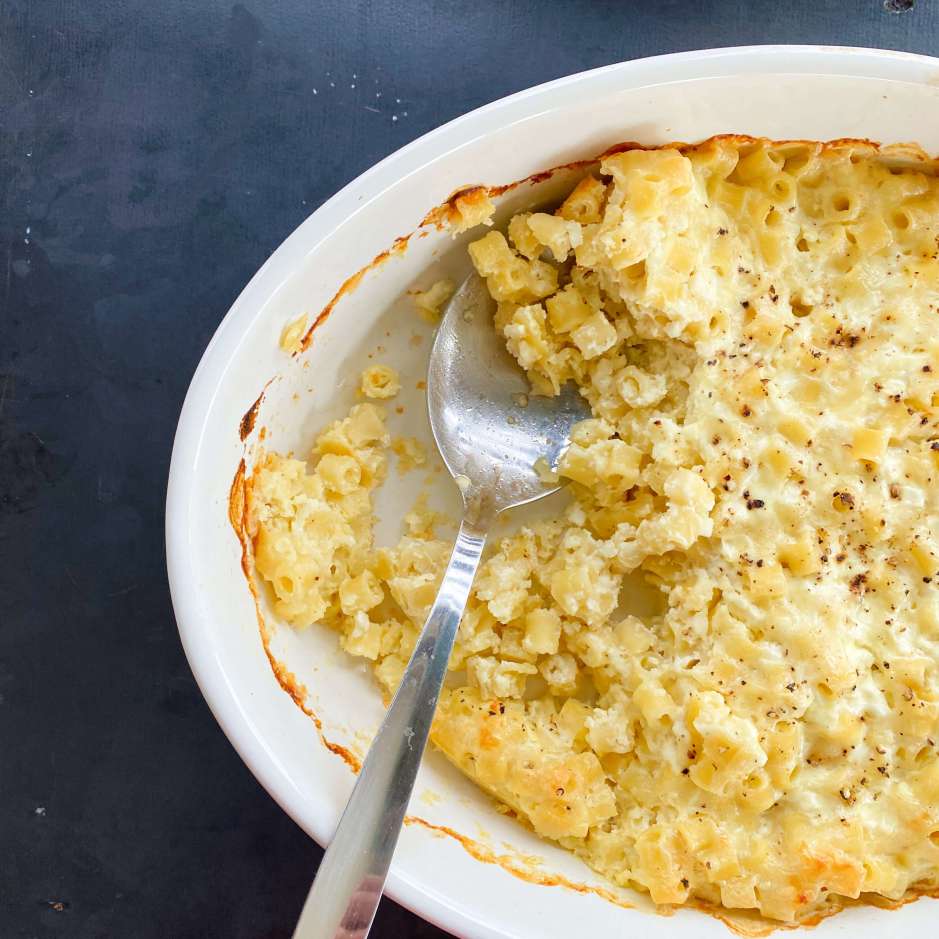
From Aunt Patti with love – Macaroni and Cheese – an heirloom family favorite.
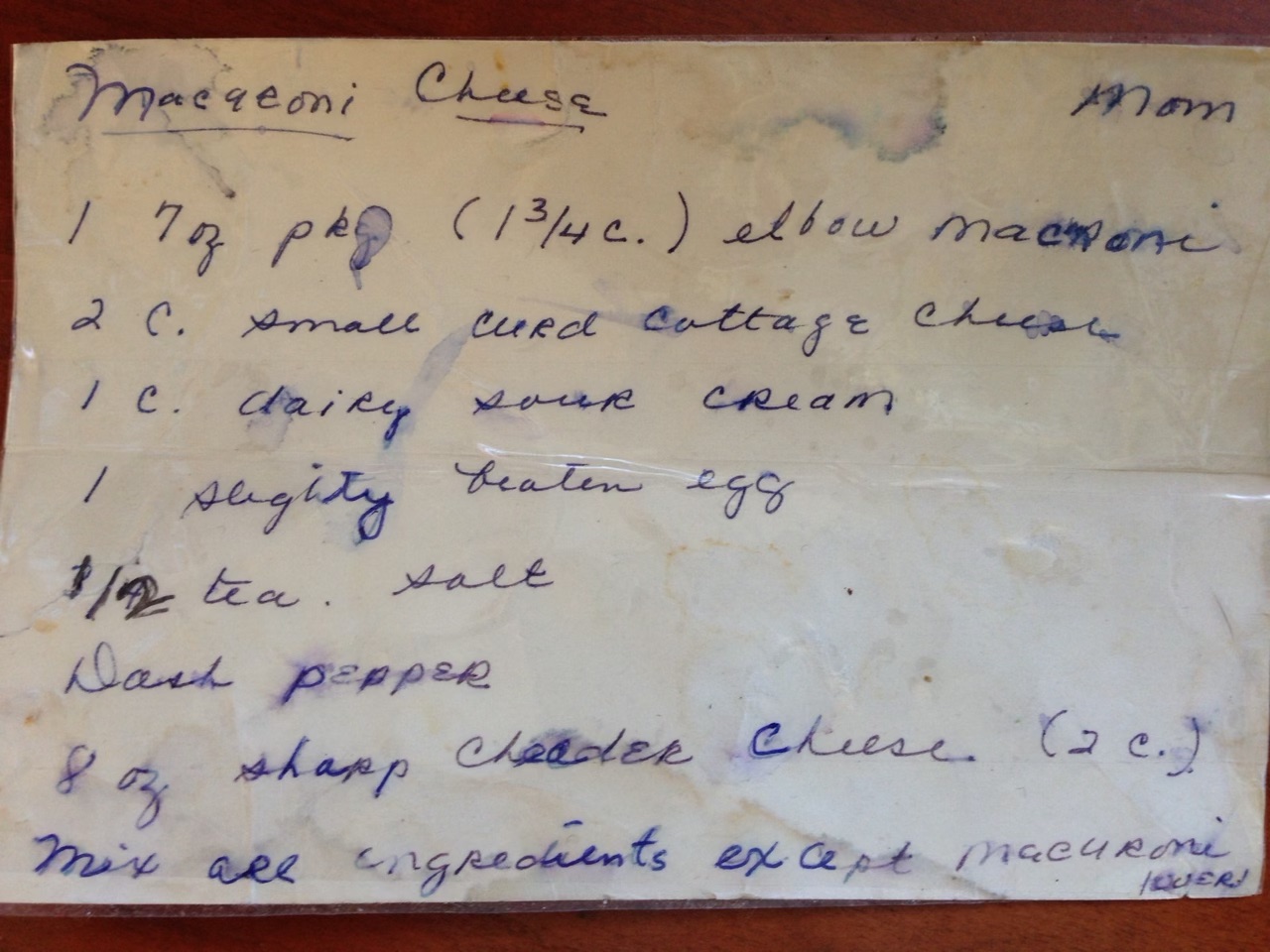
Aunt Patti passed away in the late 1990s, so we don’t have her as a hands-on cooking consultant anymore but thankfully, my family still has all of her handwritten recipes, which makes it feel like she hasn’t altogether left us. When her recipe for macaroni and cheese resurfaced via my cousin this past Christmas season, it was a wonderful reacquaintance with her cooking style, her spirit and her son. And it sparked many discussions. More on that below, but first I wanted to point out the beauty of the actual recipe itself.
I love several things about its physical appearance in particular. 1) That the recipe is written in my Aunt’s hand. 2) That it is splattered and stained with over sixty years of use. 3) That it has the no-frills title of Macaroni Cheese and contains a few humbling spelling errors. 4) That it references my grandmother, Dorothy, in the top-right corner.
Grandma Dorothy, who lived between the years 1914-2012, was a great cook in her own right, but she was shyer than my aunt when it came to talking about food and how she prepared it. Luckily, Aunt Patti was a great recorder and when she fell in love with a recipe she liked, she wrote it down and filed it away in her recipe box. Did Grandma Dorothy invent this recipe, using her thrifty Depression-era cooking skills and staples she had on hand? Did Aunt Patti tweak it a little bit in the 1960s to make it her own? We’ll never know. But the fact that it has been made again and again in the same California kitchen for the past 60 years is proof enough that’s it’s a good one to keep hold of.
There are a bevy of different ways to approach baked macaroni and cheese … from the basic (cheese, milk, butter, flour, pasta) to the fancy (gourmet cheeses, spicy aromatics, infused butter, thick cream, specialty pasta). Aunt Patti’s recipe falls somewhere in the middle. It doesn’t contain any pricey ingredients or hard-to-find flavors but it does combine two more unusual components not often associated with a cheesy casserole.
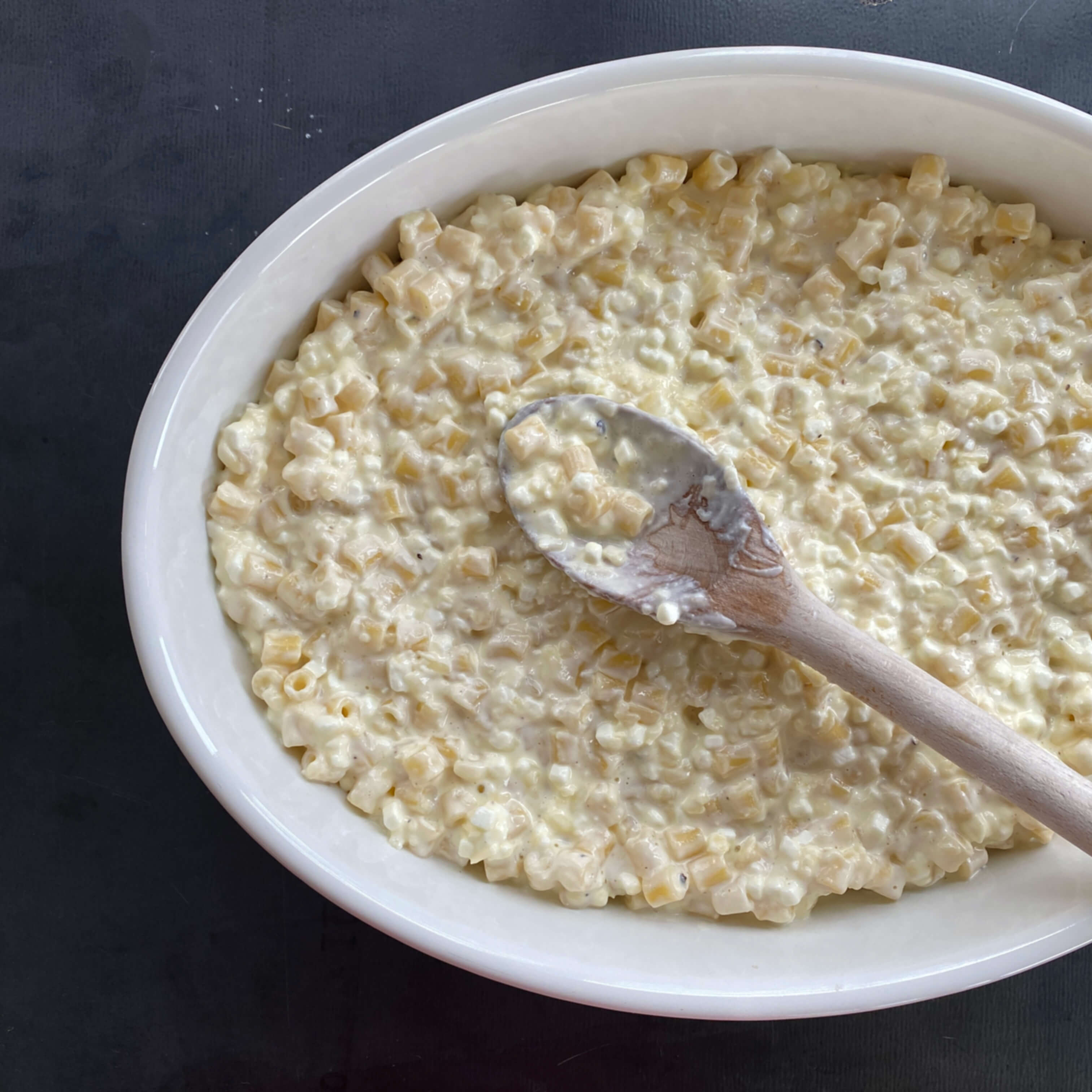
The inclusion of sour cream and cottage cheese gives this recipe a rich, tangy flavor and fluffy consistency. It’s cheesy without being greasy and filling without being dense. It reheats beautifully and freezes even better, so if you wanted to make a big batch, double the ingredients and you’ll have a comforting casserole (or two!) for many winter meals to come. And since this recipe is connected to both my aunt and my grandmother, I’m taking the liberty to retitle it to include my grandmother’s last name and my aunt’s maiden name so that they will both be credited. This way, from here on out, the recipe will act as a tribute to two 20th century women who inspired each other in the kitchen. In turn, I hope their recipe inspires you too.
Macaroni Cheese of the Ladies’ Race
Serves 6-8
7 oz (1 3/4 cup) elbow macaroni or ditalini pasta
2 cups small curd cottage cheese
1 cup sour cream
1 egg, slightly beaten
1/2 teaspoon salt
dash pepper
8 oz (two cups) sharp cheddar cheese, grated
paprika (optional)
Preheat oven to 350. Cook macaroni on the stovetop in boiling salted water for 12 minutes. While the macaroni is cooking, mix all the other ingredients in a large bowl.
Fold in cooked pasta. Spread mixture evenly in a casserole dish. Top with paprika or cracked black pepper or neither – whichever you prefer.
Bake in the oven for 45 minutes or until the top of the casserole begins to turn golden brown. Let it rest on a cooling rack for just a few minutes before serving.
Aunt Patti would have suggested pairing this casserole with a simple side salad of home-grown lettuces, but it’s really delightful just enjoyed on its own too. The sharpness of the sour cream in combination with the creaminess of the two cheeses offers a silky flavor profile that is a dynamic, satisfying meal unto itself.
Since this recipe festively made the rounds in the kitchens of almost every single one of my family members and then their friends and their family this Christmas, it has sparked quite a few discussions.
I’ve learned that macaroni and cheese means a lot of different things to a lot of different people. I’ve learned that there are two camps – those who prefer a homemade recipe like this one and those who prefer a boxed stove-top kind. I’ve learned that some people like extra cheesy, extra creamy macaroni swimming in sauce, and I’ve learned that some people prefer a lighter more souffle-like texture. I’ve learned that some people like to add a bunch of flavor enticing extras like bacon, chives, jalapenos, buttermilk, herbs and even apples to the mix. And I’ve learned that some people are purists and prefer nothing more than the likes of the original four ingredients first prescribed by Elizabeth Raffald’s 18th-century recipe. Like, pizza and all the zillion different ways you can top it, I’ve learned that strong opinions swirl around the kitchen when it comes to this type of comfort food.
I’ve also learned things about my own preferences and how I like to approach food these days. I love that this recipe is connected to a particular place and a particular set of women. I love that an old piece of paper with its compilation of interesting ingredients still continues to connect family and now you, here on the blog, sixty years after it was written. And I love that this recipe acts as an impetus to storytelling for the cooks who came before us. That to me is the real comfort of this comfort food.
If you try this recipe, I encourage you to comment below with your thoughts on this whole matter of macaroni and the cheese it swims with. Both Aunt Patti and Grandma Dorothy would have been pleased as punch to hear your thoughts, just as I am now. Passions and opinions are most welcome here!
Cheers to favorite family recipes, to the kitchens that keep them, and to the conversations that continue to float around them. And cheers to 2022. I hope your kitchen greets you with joy every day of this brand new year.
If I could comb through all the posts this year where I wrote the actual word “joy,” it would probably be embarrassing. Overuse of anything is never exciting. That usually signals that a dependence or an artifice or a crutch is involved. A thing that is trying to act as something else… a salve or a mask or a comfort. Could the kitchen really have provided all that this year?
The Oxford dictionary defines joy as both a noun and a verb. It’s defined as a person, a place, a thing. But also it is defined as an action, an occurrence, a state. It’s a tangible word and a guiding light all in one. It’s an immediate touchpoint and a faraway beacon. It’s a feeling. It’s an aspiration. It’s an anticipation. It’s joy. JOY!
In other words, it is as easy and as complicated to describe as any three-letter word can be.
This year, the Vintage Kitchen said hello to our biggest year yet. Our blog posts met more new readers from around the globe than ever before.
And the kitchen shop grew in leaps and bounds. In just one extra special day, of all the days, the shop welcomed over 15,000 visitors and grew in awareness and engagement tenfold over the course of twelve months. So much kitchen love!
We sent packages as far away as New Zealand this year and as close as 10 miles down the road in our home city of Nashville, TN. We globetrotted our way around the kitchen from Hungary to India, to Ireland to Indonesia to Israel and back home again to America. We prepared fish dishes, chicken dishes, dessert dishes, brunch dishes, and vegetarian vegetable dishes. We answered a plethora of questions about dishes. About your dishes. How much, how old, how rare? And we had the pleasure of learning more about unique artifacts from New Mexico, Minnesota, North Carolina, Florida, Georgia and California as fellow vintage lovers shared their personal collections and the stories behind them.
Read about the enigmatic Rico-Ward family and their linen collectionhere.
This year, we celebrated with several enthusiastic press mentions …
and we reveled in each and every one of the comments that shoppers sent to us upon receiving their vintage packages in the mail. With each new journey and each new milestone, my cup of joy runneth over. It’s not only a celebration of effort acknowledged but also a testament to the genuine care and stewardship of our community’s love of history and the objects in it. Whether it be a story, a recipe, or a tangible object, each item that passes through the Vintage Kitchen finds not only a new home but also a new layer of story, one that will ultimately mark, affect and carry forth a fresh perspective of old character for new generations to come.
In November, we had to make the very tough decision to temporarily close the shop down for the holiday season while we embarked on our biggest adventure of the year – a South to North move. This temporary pause in shopkeeping not only reminded me how much I truly love this land of the Vintage Kitchen and all the aspects of it, but it also reminded me that once you find true joy and purpose it will never completely leave you. I was so happy to see that even though the shop was closed for a bit and a big source of my creativity was stunted because of it, communication from this lovely vintage kitchen community never let up. You kept in touch.
While we are staying in a temporary waterside cottage awaiting some big plans for a big announcement coming soon, I knew everything was going to be okay in regards to leaving the shop unattended for a bit when, on the very first day that we arrived, I spotted a beacon in the cottage bookshelf. Tucked in between the potted plants and the Polish pottery, there was a cookbook. And not just any cookbook. There was…
Joy of Cooking! Irma Rombauer knew her own series of trials and tribulations throughout her life but she cast those aside in her middle years and went after the pursuit of a passion. She found it in the kitchen. It was the one place she would come to know best in the world. And in that kitchen, following that passion, she made joy…
All the editions of Joy of Cooking through the years.
Throughout the rest of her life, Irma witnessed firsthand, the endless amounts of joy that good food and good cooking brought not only to herself but also to every kitchen it touched. Maybe it was just a coincidence that this cookbook just happened to be in the cottage, just at the right time taht I needed to see it, but given the fact that there are millions of cookbooks floating around in the world, and the cottage could have been the holder of any one of those, the notion that it was a vintage JOY was pretty comforting. I like to think that it was a little sign from Irma herself, sent with love and a little message about joy in cooking, of cooking, for cooking and how it prevails always, no matter what kitchen you find yourself in.
So it is with complete love and gratitude, that I say THANK YOU so much to everyone who contributed to bringing joy to our little section of the world this year. Thank you for being both the noun and the verb. Thank you for keeping in touch. Whether you submitted a comment, made a recipe or purchased a piece of history from the shop, thank you. I hope you’ll always be a part of our joyful landscape and that we can continue to inspire each other year after year after year.
Cheers to a new year full of new potential and bright possibilities in the kitchen and beyond.
Sea and sky. Blue and white. Stars and snow. Dinner and dessert. That’s the theme of our next stop on the International Vintage Recipe Tour 2021. Destination #24 in this multi-year series takes us to the holy land of Israel for a bit of holiday festivity, Hanukkah style!
I thought that Israel was going to be right up there at the very top of the list of the oldest countries in the world, but surprisingly there are some discrepancies when it comes to naming the oldest places around the globe, and then also the specific order in which they should appear. That’s because there are quite a few ways to calculate this information and it all differs. Based on records, archeological findings, the official forming of civilized governments, one list could say that China is the oldest country in the world while another list says that it’s Greece.
The pastel color palette of Israel acts as a timeless backdrop to the bold and dynamic culture of this storied country.
But particulars aside, there are a few countries that keep popping up on everyone’s top tier lists depending on which site you are consulting and for what reason. Japan, Iran, China, Greece, Egypt and India usually make the top ten agreed-upon selections. Israel, France, Italy and San Marino sometimes get included too, but not always.
This is a model replica of Jerusalem during the time of Jesus that is on display at the Israel Museum in Jerusalem.
Granted, the landscape of Israel is centuries old with ancient cities like Jerusalem and Jaffa always at the ready to offer historic context, but it wasn’t until 1948 that Israel declared its independence, becoming the first Jewish state in over 2000 years. 1948 is also the same year the Israeli flag, as we know it today, became official even though the design was first created in the late 1800s. That makes Israel both wonderfully ancient and modern all at once.
The first version of the Israeli flag was designed by a Lithuanian-American rabbi, Jakob Askowith and his son, Charles in 1891 for a temple in Boston, MA. They selected the blue and white colors which represented benevolence and purity, included the Star of David, and a Hebrew word for a specific warrior in Israeli history. Other versions designed by other people emerged in the 19th century too, including a flag that featured lions and stars, but it was the Askowith’s design that resonated with people most. Little tweaks here and there would be made to the flag and the Hebrew writing would be dropped from the original layout, but by the time, the Askowith’s flag was flown at the World’s Fair in St. Louis, Missouri in 1904, it was a cherished icon recognized by the Jewish community worldwide.
View from the Tower of Electricity Building during the 1904 World’s Fair, St Louis, MO. Photo courtesy of the Library of Congress.
Since it’s Hannukah, I thought it would be fun to tie this food post in with a homemade craft project that celebrates one of Israel’s most iconic symbols of faith and flag – the Star of David – an instantly recognizable emblem deeply associated with Jewish culture.
The last time we combined a craft project with a recipe from the International Vintage Recipe Tour it was during Week 9 when we traveled to China via the kitchen in March of 2020. That was just when the Coronavirus was gaining steam, the country was going into lockdowns, and when a major tornado blew through my city streets and destroyed half the buildings in my neighborhood.
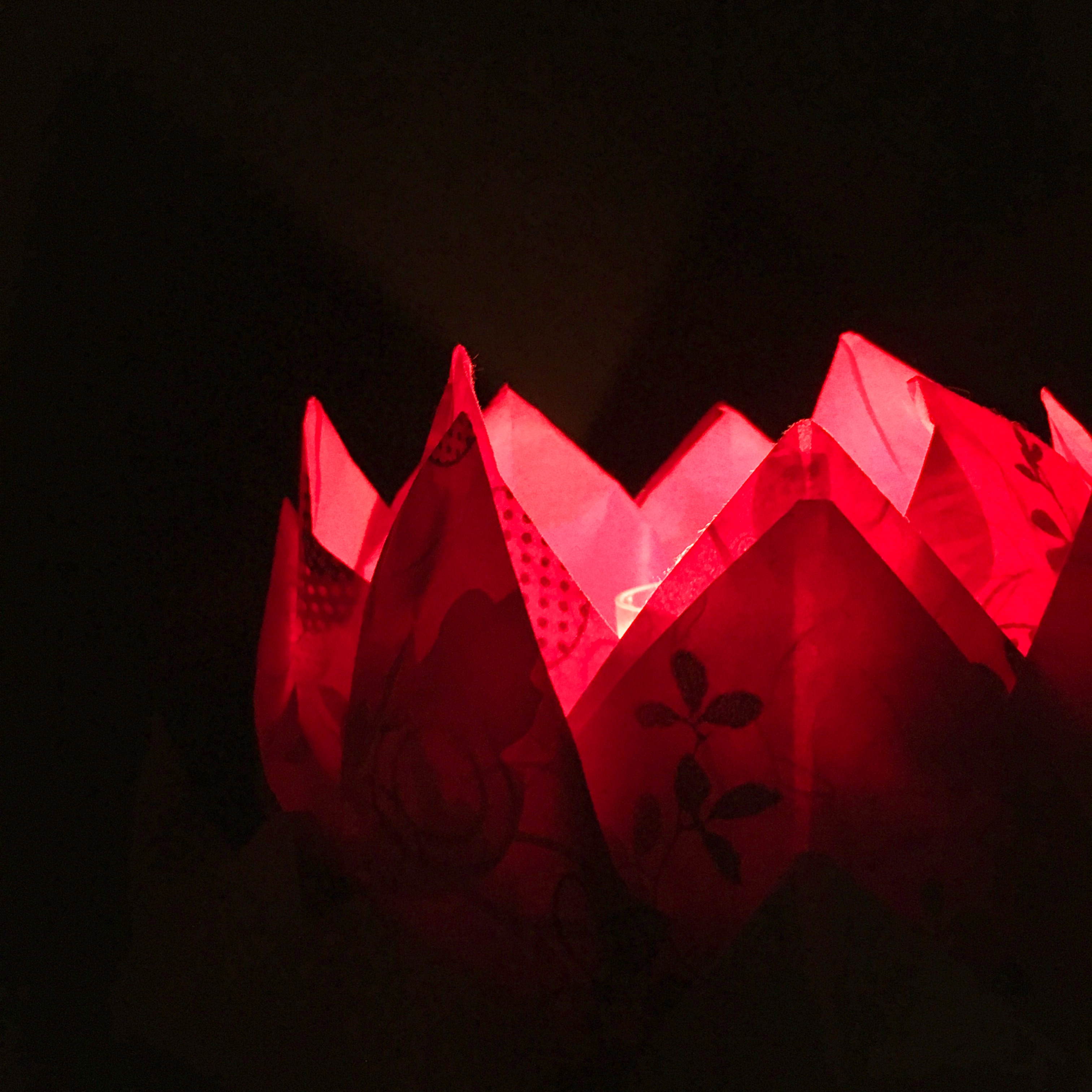
Chinese floating paper lanterns
In that turbulent post, we made floating lanterns based on an annual Chinese celebration, known as the Hungry Ghost Festival which honors the spirits of departed ancestors. As the world was losing loved ones to the virus and losing freedom to lockdowns, and my neighborhood was grieving the destruction of a broken-down landscape, I clung to the idea that memories of love and light could guide us through the dark in the form of an actual, physical light. The paper lantern may have been fragile in appearance but it was mighty in hope and sentiment.
This time, our craft project also centers around light and strength and spiritual guidance. It comes at a time when things in the world are still universally difficult due to the continuing pandemic, and it comes at a time when the Vintage Kitchen, is going through a big change as we relocate to a new space. I love how art from two very different cultures can become a beacon of comfort during chaotic times. Especially when tied in with cooking and creativity in the kitchen.
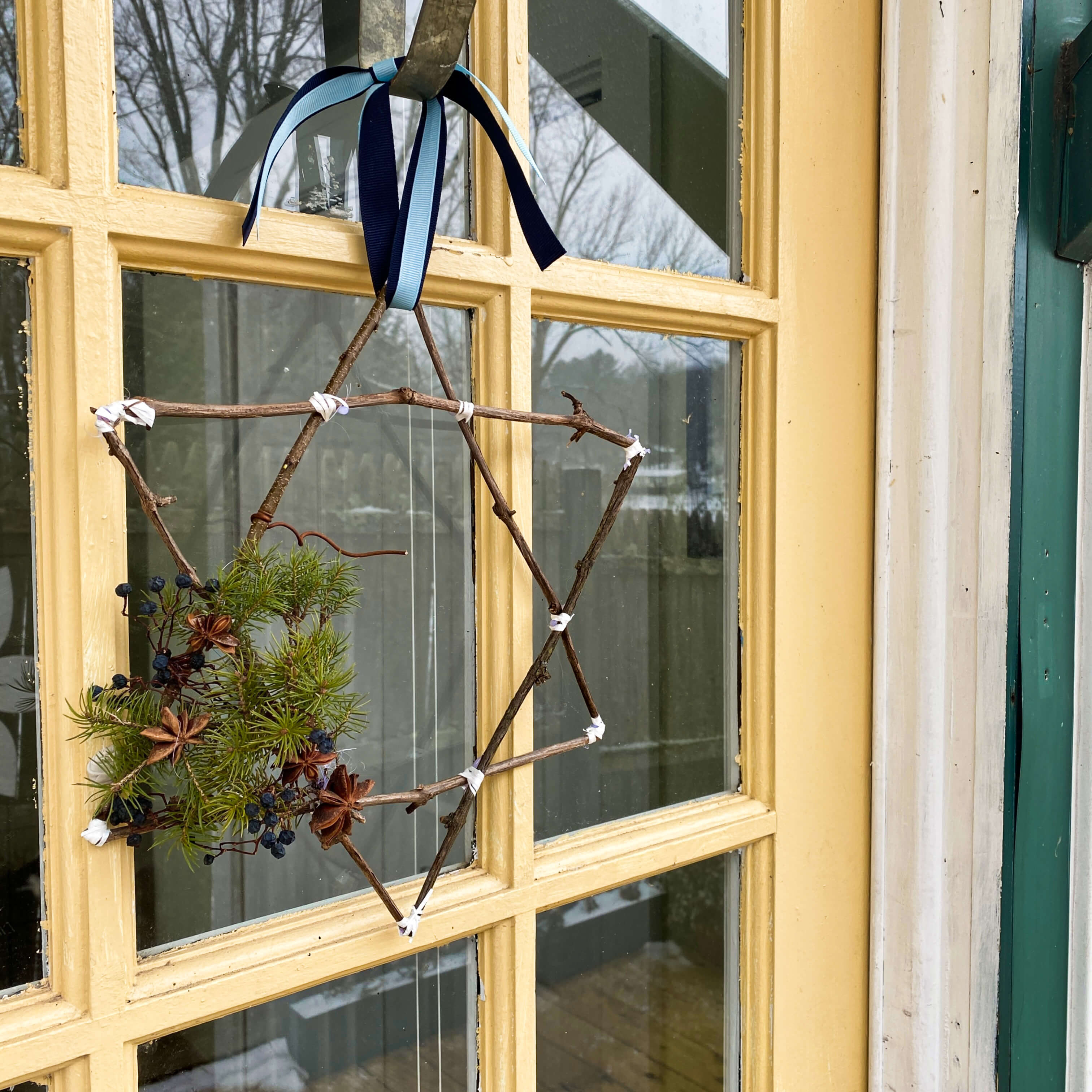
Today, we are making a Star of David wreath out of winter twigs, fresh greenery, and grosgrain ribbon. It’s a simple project that is suitable for all ages and skill levels and can be made in under 30 minutes. While it is ideally suited for the Hanukkah holiday, it also can be displayed all winter long both indoors and out as a reminder of faith, hope, community, and care. Make a big one for your door or a series of small ones as place settings on your table and you offer all who enter your home or relax at your table, a bit of love and (star)light this holiday season.
First recorded in the 3rd century in Italy, the Star of David was a universal symbol that was also referred to as the Shield of David. During the Middle Ages, the Star was believed to contain mystical and magical powers and by the 1600s was adopted into the Jewish community as a decorative mark of distinction.
Clockwise from top left: A gold pendant from Spain, antique Star of David shutters in Jericho, resurrection sculpture in Israel, star of david on a temple in Indiana, glass window in Germany, and ancient jug fragment with impressed Star of David
Even though it originally started out not being connected religiously to any one group or another, the Star of David, with its six points and two intertwined triangles, is now most commonly associated with Judaism, and the Jewish community as a whole. In the 20th century, it also became a powerful symbol of heroism in relation to the Holocaust when Jewish people were forced by the Nazis to wear the Star of David like a badge on their clothing. It takes courage to be an icon, to display an icon and to believe in an icon. The Star of David manages to be a reminder of the past and a symbol of the future all in one.
When it comes to making your own Star of David wreath, creativity reigns supreme especially if you wanted to incorporate this festive week of Hanukkah. But the two most important components to include are the colors blue and white. Since it is the holiday season, I added accents of juniper berries and star anise for scent and color. Once the initial framework is built, the sky is the limit when it comes to decorating.
To make this Star of David wreath, all you need is…
kitchen string
six straight twigs or tree branches all cut to the same length (this wreath was made using twigs that were 10″ inches in length)
a hot glue gun
fresh greenery, winter berries and/or fresh herbs/spices for decoration
grosgrain ribbon in shades of blue
Start by clipping your twigs to equal size.
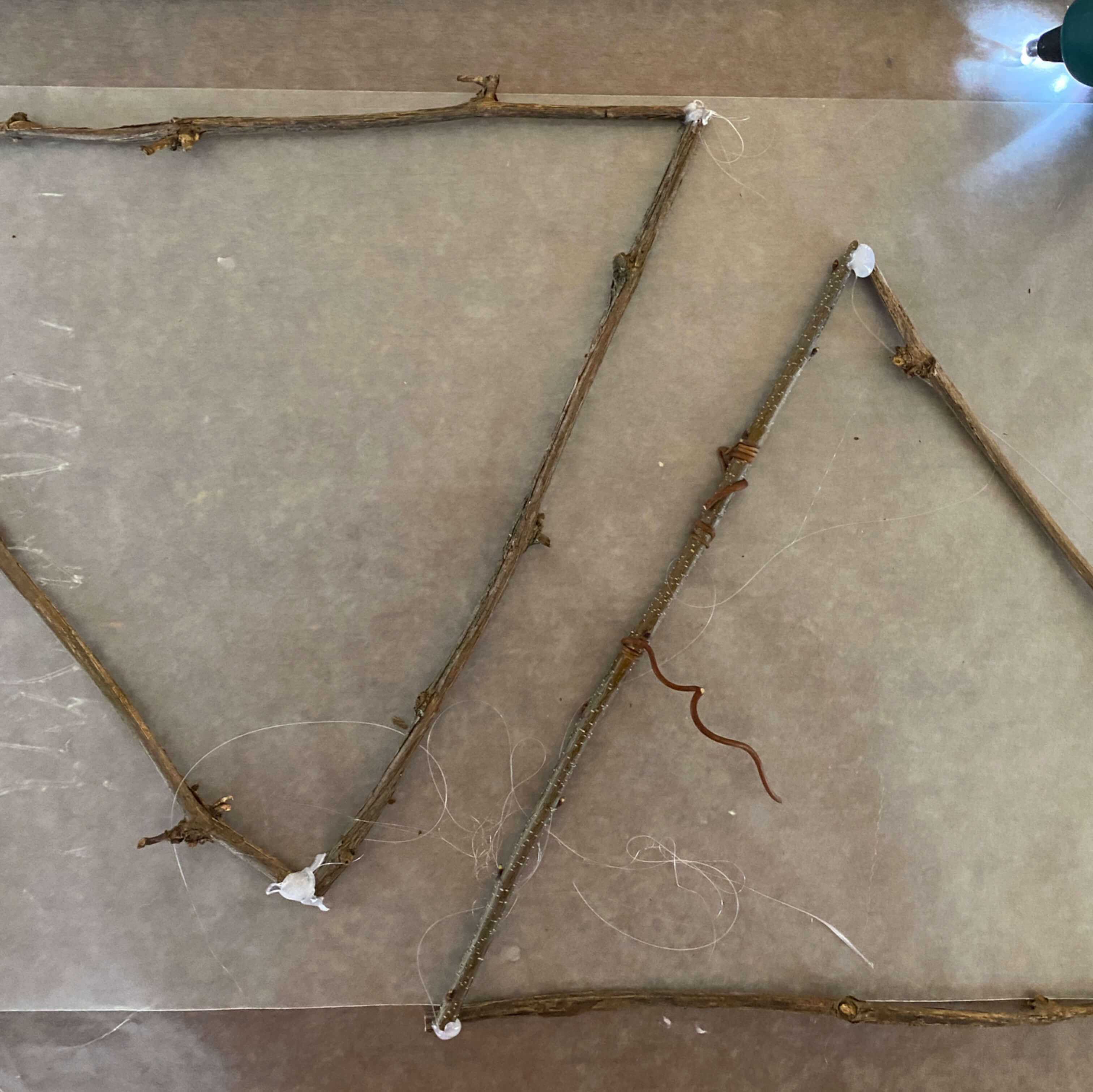
Next, make two triangle shapes with the twigs…
Glue each end of each twig together to permanently form the shape and then place one triangle on top of the other in opposite directions and glue the triangles to each other wherever they touch.
Next, wrap each joined section (wherever you dabbed a bit of glue) with kitchen twine to cover the glue spots and add extra support to your star. Glue decorative greenery (or whatever embellishments you would like to add) to the bottom left corner of the star. Let the glue dry for a few minutes. Attach the ribbon at the top of the star and you are ready to hang up your wreath.
vintage
Simple, natural and easy to style both indoors and out, a Star of David wreath looks just as wonderful hanging from the knob of a kitchen cabinet as it does from a front door. Make a few stars and hang them on the wall in your kitchen or from the light over your dining table and you’ll have a starry scene to inspire this next part of the post… the cooking of two vintage Israeli recipes.
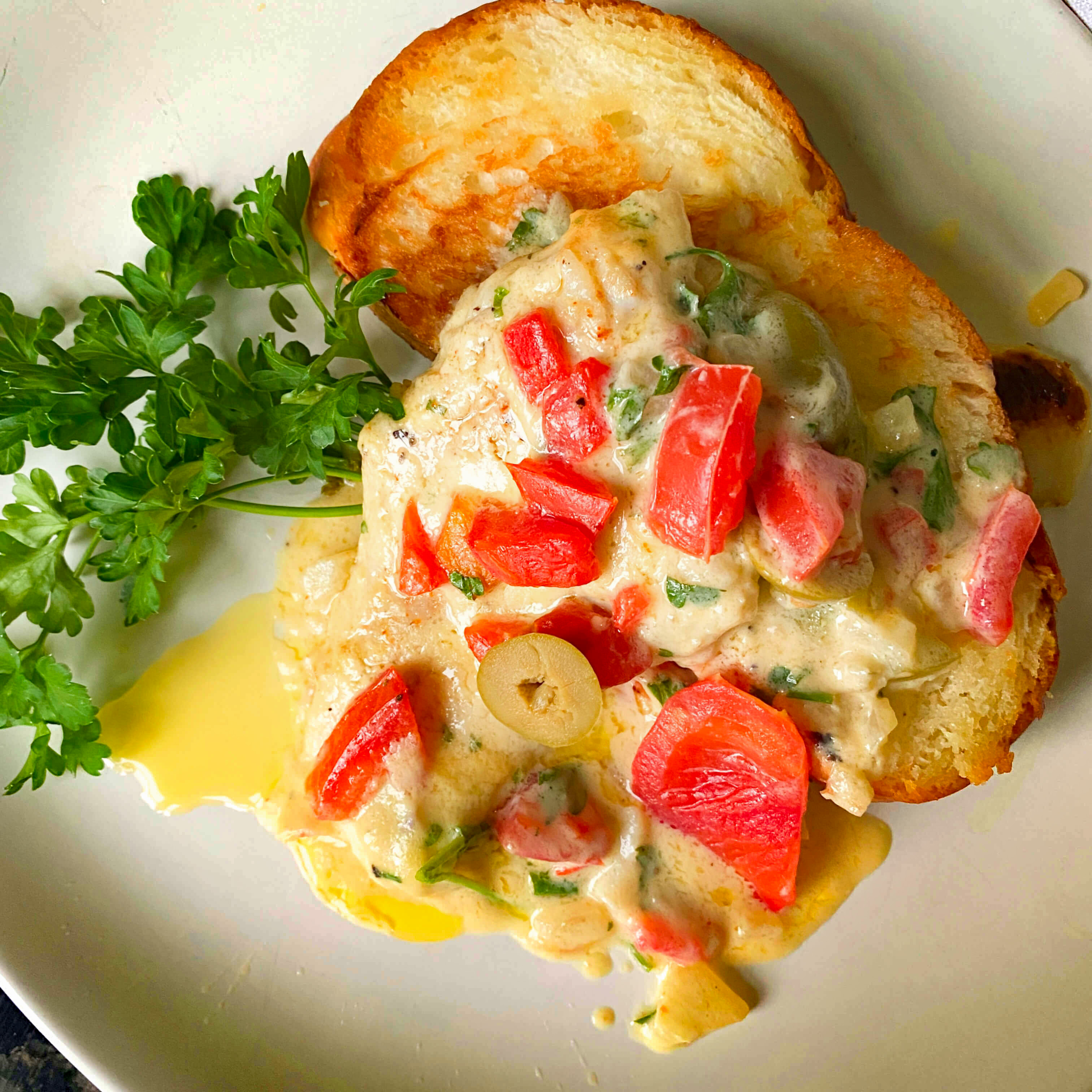
Israeli-inspired Meditteranean Fish circa 1970.
On the menu today, it is saucy Mediterranean Fish for dinner and a homemade lighter-than-air Walnut Torte for dessert.
Like the Star of David wreath, both recipes are simple to make. What is lovely about both foods, and most Mediterranean cooking, in general, is that each dish is light yet flavorful and can easily be shared with a crowd if you are entertaining friends and family for the holiday season.
The farmers market in Tel-Aviv, Israel
Throughout time, Israeli food has been inspired not only by staples gathered and grown in the local landscape but also by the millions of immigrants that have populated the country from Eastern Europe, Africa and its neighboring countries. Poverty in the middle half of the 20th century, and the scarcity of certain types of food during those decades (mainly meat products) encouraged more creative and colorful cooking using more accessible ingredients like grains, fruits and vegetables as a substitute for animal proteins.
This Mediterranean fish dish features the best of all those influences. It contains olives (one of the seven ancient agricultural products that still serve as a foundation for the traditional Israeli diet), local fish from the Mediterranean sea, the middle Eastern condiment tahini, and wine (ideally made from local Israeli grapes). The combination of all these unique flavors is light, creamy, and nuanced. Similar to crab dip, this Israeli-inspired fish dish is warm and saucy in composition, comfort and consistency, and is absolutely delicious when served with challah bread.
Mediterranean Fish
serves 4
1/4 cup olive oil
1 cup finely chopped onion
1 green pepper, cored, seeded, and chopped
4 individual fish fillets such as salmon, flounder, or cod (I used cod)
2 tomatoes, cored, seeded, peeled, and chopped (if making this in the off-season use whole, canned tomatoes)
1/2 cup fish stock (if you can’t find fish stock substitute with vegetable stock and a few dashes of fish oil)
3 tablespoons tahini
1/4 cup dry white wine
2 egg yolks light beaten
2 tablespoons chopped parsley
8 stuffed olives
4 slices bread (I recommend challah bread)
Vegetable oil for frying
1 clove garlic
Heat half the oil in a large skillet and cook the onion and green pepper until wilted.
In another skillet heat the remaining oil and cook the fish until lightly browned on each side.
Transfer the fish into the skillet with the onion mixture. Sprinkle with salt, pepper, and cayenne to taste and half the lemon juice.
Spoon the tomatoes over the fish and add the fish stock. Cover with aluminum foil or parchment and cok over low heat for ten to fifteen minutes. Be careful not to overcook the fish.
Combine the tahini and remaining lemon juice in a small mixing bowl. Beating with a whisk, add the salt, and pepper to taste. Add the wine. Carefully pour the liquid over the cooked fish into the tahini mixture and beat well.
Beat in the egg yolks and parsley and spoon the mixture over the fish. Place the entire pan under the broiler until the mixture just begins to brown. Scatter the olives over the fish.
Quickly fry the bread in oil and rub lightly with garlic. Place a slice of bread on each plate and smother with fish. Serve immediately.
Satisfying in all the ways that a saucy smothered bread can be, this fish dish looks remarkably creamy yet contains no actual cream. I really loved it for the way each ingredient brought its own pizazz to the ensemble. The olives offer salt, the tomatoes – color and acidity, the parsley a bit of fresh green, the tahini – a roasted earthiness, and the wine brilliantly married all the flavors together. Festive with its red, white, and green color palette, this is a fun dish to share amongst friends and family during the holiday season, as well as a quick fix if you find yourself short on time.
Likewise, dessert promises to be just as effortless…
Oranges are a popular citrus fruit grown in many backyard gardens in Israel. As a result of being fruit lovers and home baking aficionados, many Israeli home cooks creatively incorporate ample amounts of local fruit into their culinary endeavors.
Similar in consistency and texture to zucchini bread, this walnut torte is light and delicate with a fluffy consistency. Not too sweet, and slightly tangy thanks to the citrus, *it contains matzoh meal which can be hard to find in typical grocery stores. If you have difficulty like I did, just purchase a box of plain matzoh crackers and grind them to a fine powder and use that as an equal substitute for the flour. It comes out perfectly either way.
Israeli Nut Torte
Serves 8
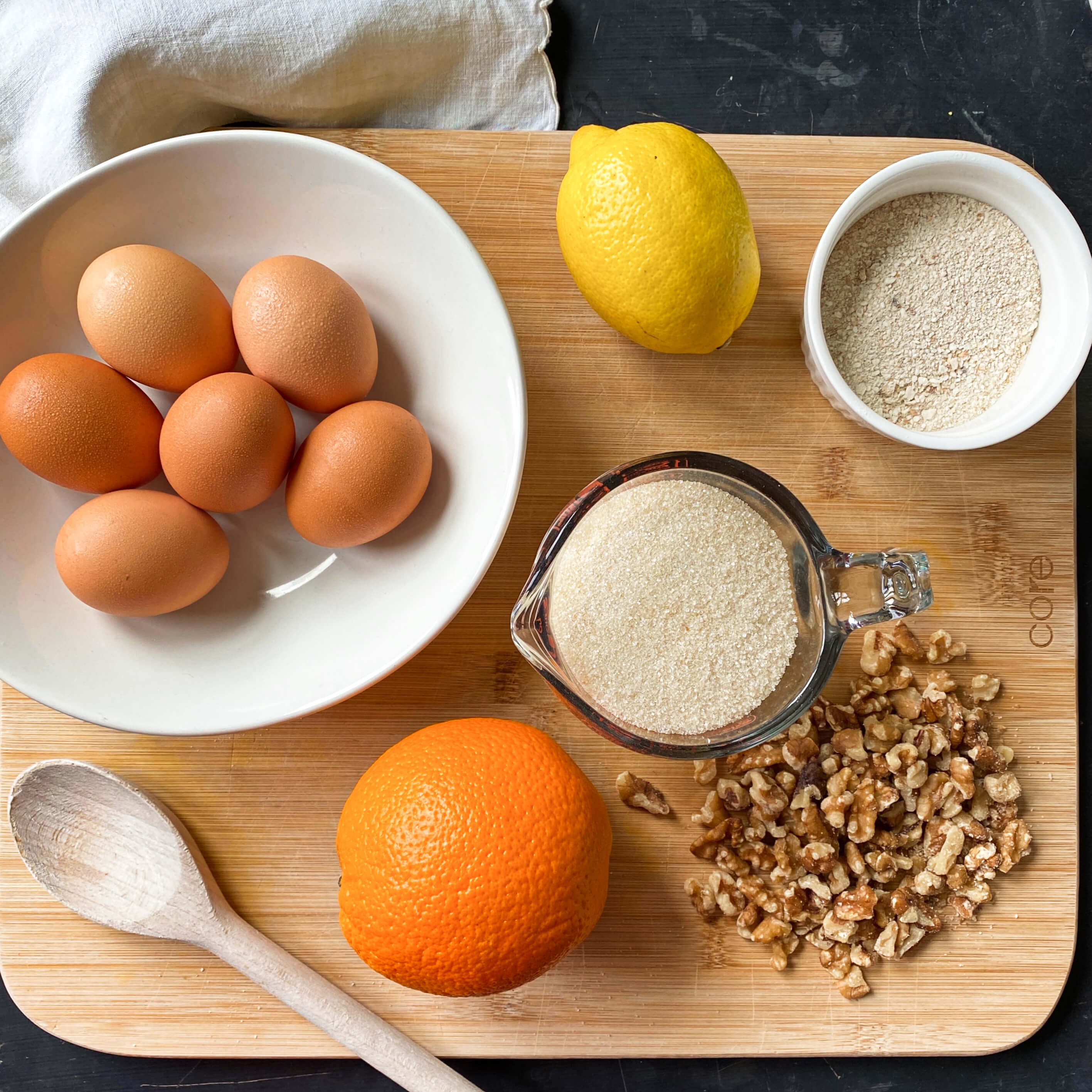
6 eggs, separated
1 cup granulated sugar
Juice of 1/2 lemon
Juice and grated rind of 1/2 orange
1/2 cup matzoh meal (*see note above)
2 tablespoons cake flour
1/2 teaspoon salt
1 cup walnuts, finely chopped
Preheat oven to 350 degrees
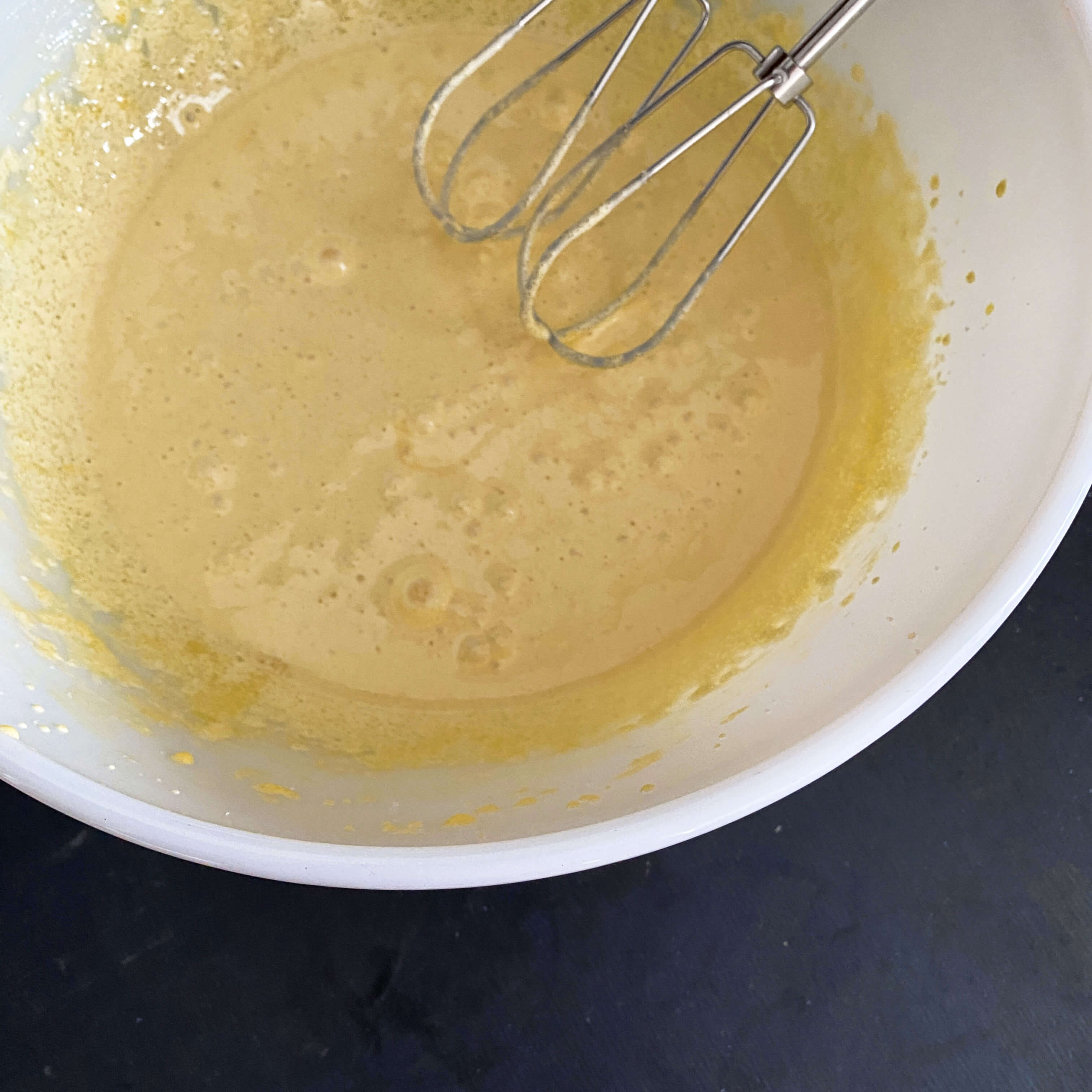
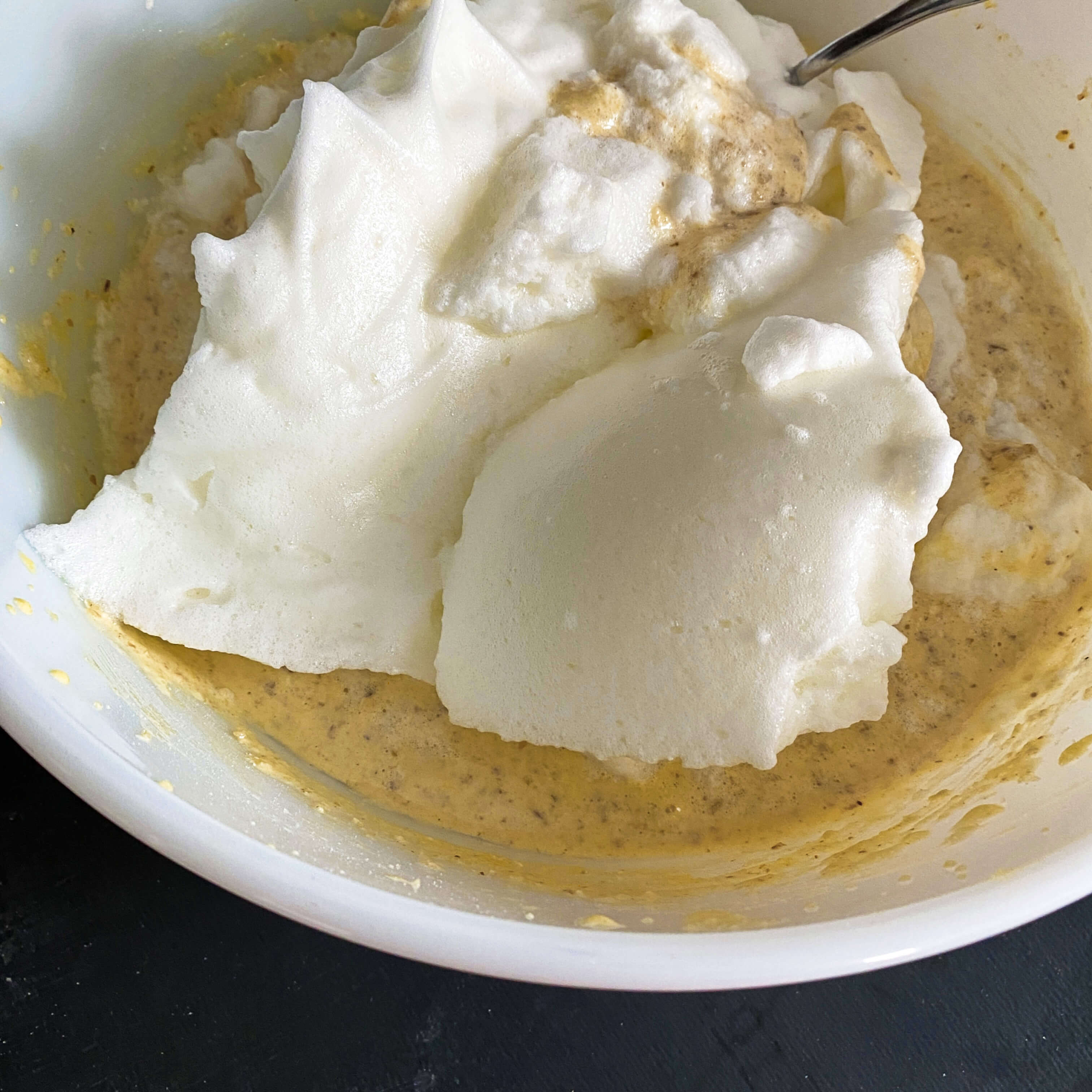
In a medium bowl, beat the egg yolks, add sugar gradually, and beat until the mixture is light in color. Add the lemon juice, orange juice, and orange rind. Mix in the meal, flour, salt and walnuts.
Beat the egg whites until stiff, but not dry. Fold into the walnut mixture.
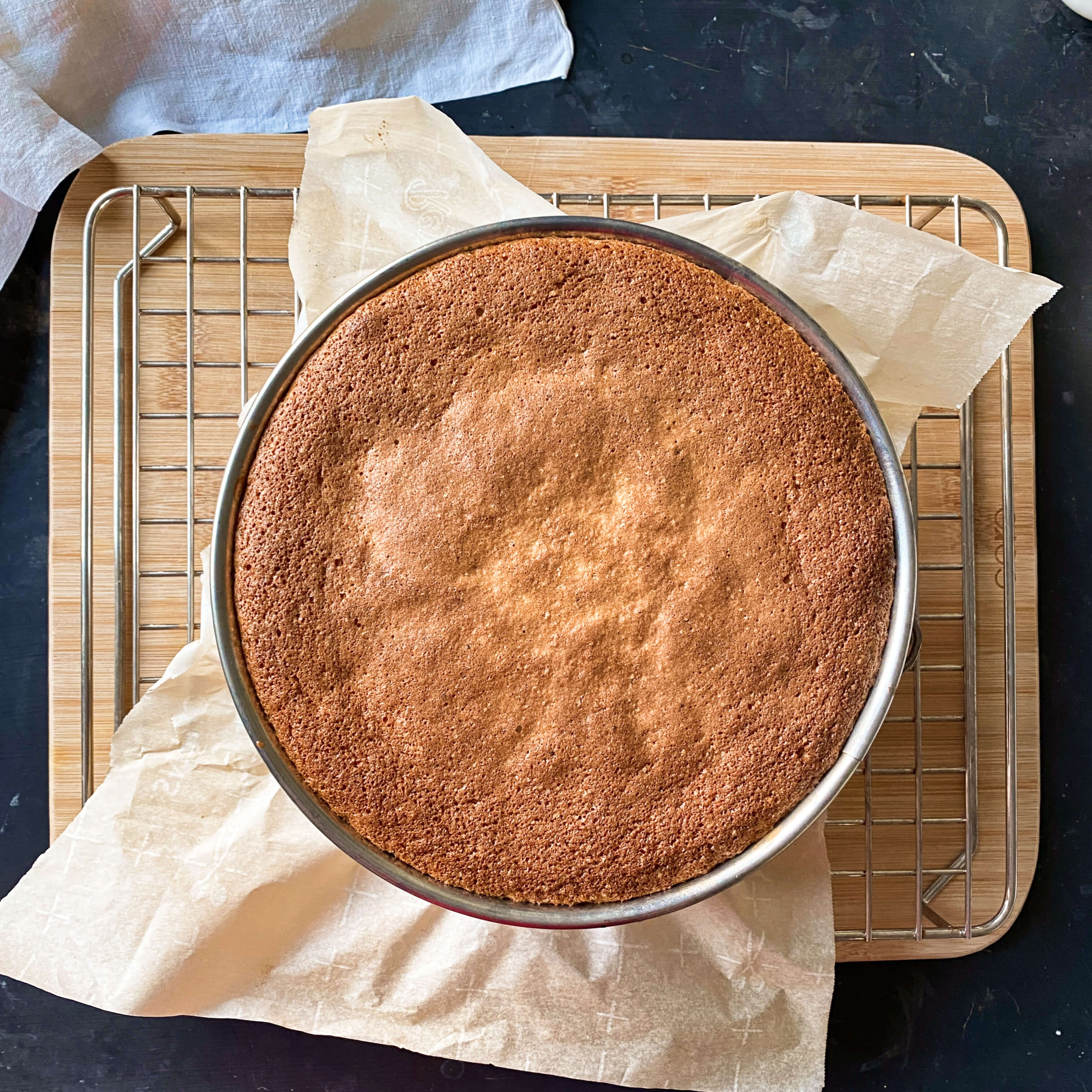
Bake in an ungreased pan, eight-inch springform pan for forty-five minutes or until the cake rebounds to the touch when pressed gently in the center.
Fruit is such a lovely addition to the holiday menu. Not only does it offer a break from the more rich flavors of cookies, pies and pastries but this cake, in particular, is especially enjoyable because it gives you a break from butter. Gathering its fat solely from the walnuts and the eggs, it is one of those desserts that adds just enough at the end of the meal to sweeten your night.
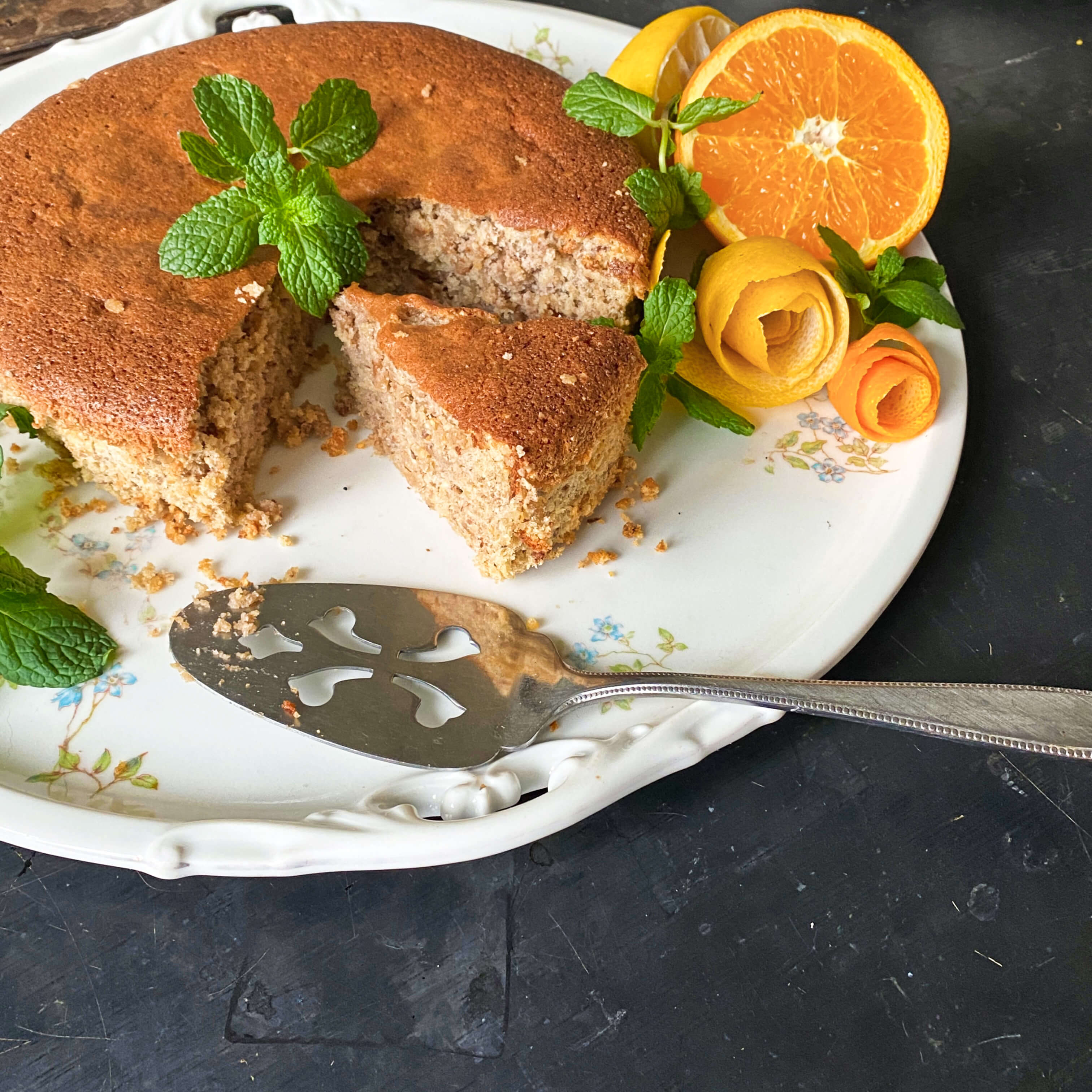
Because less is sometimes more, especially when bombarded with all things holiday at this time of year, I especially liked that this cake recipe did not call for a frosting or a glaze or a drizzle of anything on top. Of course, you could get creative and add your own extra flourish in the way of a sweet topper, but I opted to remain true to the vintage intentions of this recipe and just garnished the cake with fresh mint leaves on top and a few orange and lemon rind roses on the side.
If I made this next time, in the early fall for example, when walnuts are just coming into season, I might mix up a small bowl of confectioners sugar and orange juice and pour a thin drizzle over the top of the cake to glaze it. I might add a teaspoon of cinnamon or nutmeg to the batter to add some tantalizing aromatics to each bite, and perhaps I would add a ribbon of crushed walnuts around the side of the cake. But for the time being, at this moment in this holiday season, this cake recipe is just fine and lovely just as it is. Simple, easy, delicate. A classic star of the Jewish table. I hope you’ll love it just as much!
Cheers to the Askowiths for designing a flag that featured a star that continues to shine and inspire, to Israel for its light and lively food scene, and to all the Hanukkah celebrators out there. Chag Sameach!
Join us next time for Week 25 in the International Vintage Recipe Tour as we head to Italy in search of food, family and a good book!
Even though we are not operating at full capacity this holiday season due to our relocation, our gratitude for this little community of vintage kitcheners is ever-present.
The love and support that was felt through the sharing of recipes, the showing of heirlooms and the inspirational stories gleaned from the cooks that came before us, helped keep our hearts light and our spirits high throughout the year. For that, I am forever grateful. Thank you so much for making each day a joy, here in the Vintage Kitchen, throughout 2021.
Hope your Thanksgiving is full of delicious moments and delightful recipes. We look forward to celebrating a brand new space with you next holiday season!
“For each new morning with its light, For rest and shelter of the night, For health and food, for love and friends, For everything Thy goodness sends.”
– Ralph Waldo Emerson (1803-1882)
Cheers to gratitude and to Ralph Waldo and to you for making life better and brighter here in the Vintage Kitchen.
For the past three nights it has been flurrying. It hasn’t been cold enough during the day at the cottage yet for the snowflakes to stick around or to pile up, but three miles up the road it is a different story. There, the slight rise in elevation provides the slightest advantage – a few extra degrees of cold temperatures yields a fairytale frosting on all the trees.
A week into adapting to our new northern climate, it is starting to feel somewhat strange and far away when we say that we used to live in the South. There, as soon as the weather dipped to 50 degrees we were ready to celebrate cold weather season with abandon… sweaters, scarves, soups, stew and all the hot chocolate one could drink in a semi-tropical city. Tonight it’s going to be 28 degrees in Pennsylvania. This is the frigid and fitting pre-Thanksgiving weather we’ve been waiting for for over a decade. So what’s on the menu? A hearty New England-style soup? A big bowl of chowder? Boston baked beans? No way. Tonight we are making something Southern.
Irony aside, two components that make this a distinctly Southern recipe as opposed to a more traditional New England apple cider are the inclusion of a few additional citrus fruits and fact that the recipe came from a vintage cookbook called Wild About Texas.
Published in 1989,Wild About Texaswas put together as a fundraising endeavor by the ladies of the Cypress Woodlands Junior Forum, a philanthropic group that was (and still is) dedicated to improving the lives of children, senior citizens, and the disabled in the Houston area. Representative of the varied cuisine that makes up the Lone Star state’s food landscape, this cookbook combined a range of recipes that included Tex-Mex, creole, cowboy cooking, southern fare, southwestern flavors, and south of the border spices, along with highlighting local fruits and vegetables that grow naturally well within the Texas landscape.
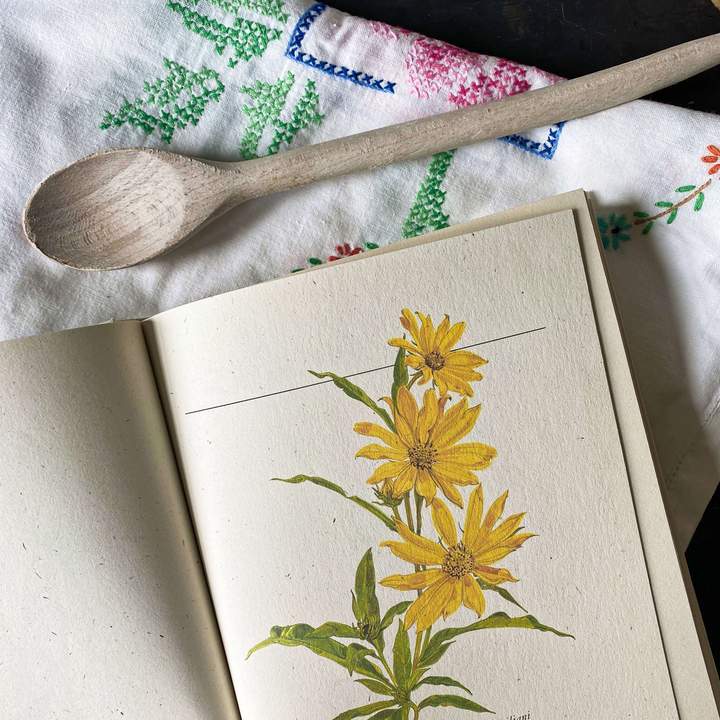
What was especially fun about this cookbook, apart from the beautiful watercolor illustrations of wildflowers peppered throughout, was the Forum’s focus on selecting local recipes that were ideal for sharing and entertaining. Many of the dishes featured serving sizes suitable for a crowd and also smidge of storytelling. A favorite recipe of Lady Bird Johnson’s made an appearance (spoon bread!), easy to throw together party pleasers were included, curious concoctions like Hillbilly Bean Soup were shared, and a discussion on local wines encouraged further exploration.
Watercolor wildflower illustrations painted by Austin artist Rosario Baxter.
It was in the beverage section that I ran across the apple cider recipe. Beautifully described as a holiday simmer, it’s an especially lovely drink for this time of year when friends and family are visiting for the holidays or neighbors are dropping by to say hello and you’d like to have something hospitable on hand. Similar to a party punch, it was recommended to make this recipe in a large batch (serving for 25), but if your get-togethers aren’t quite as elaborate, you could half this recipe and keep it in the fridge for quite a few days. Either way, it’s a warm welcome on a cool day, a versatile indoor/outdoor treat, and a cup of cheer that can be served hot or cold depending on which type (or temperature!) of climate you live in.
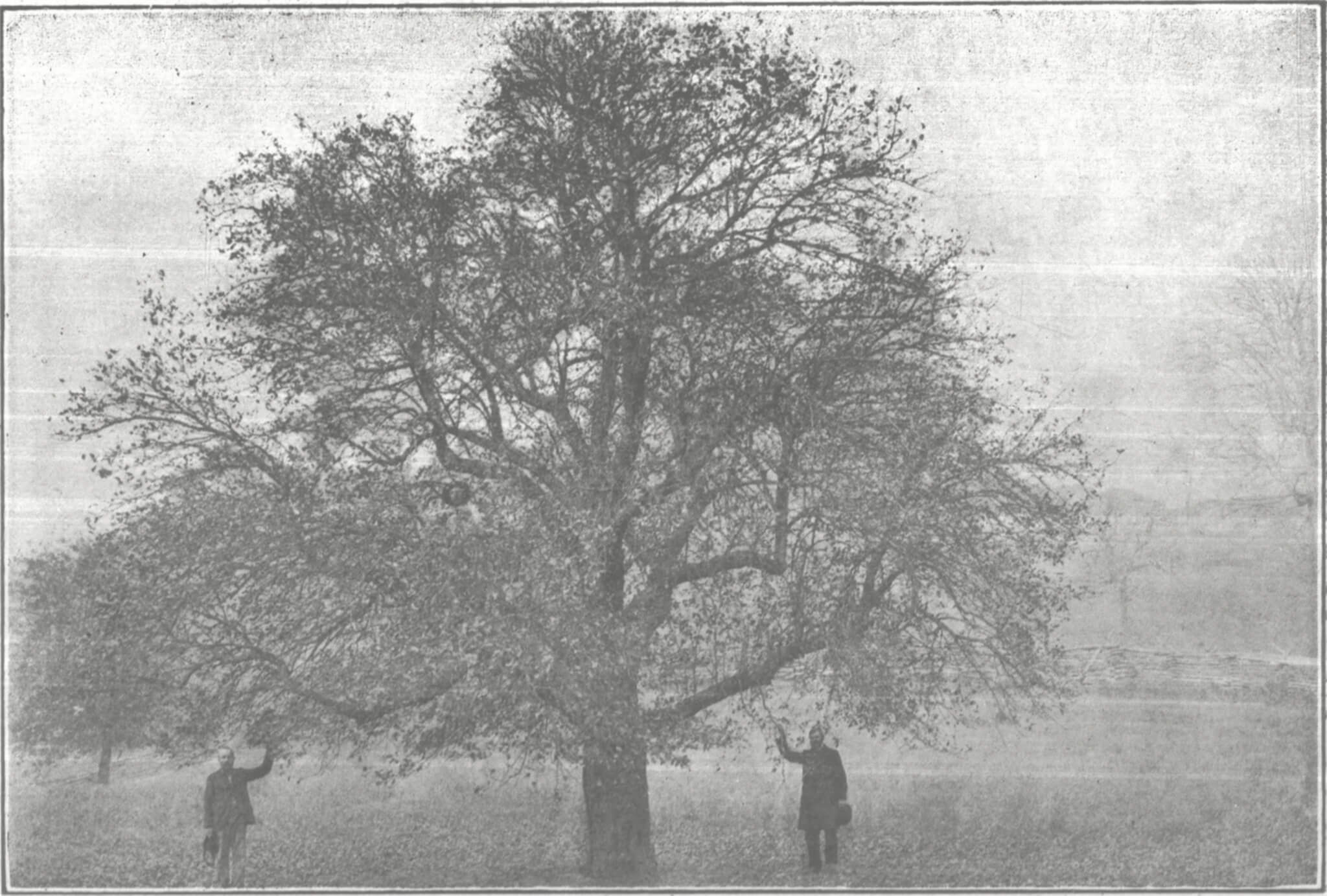
Considered a national beverage, the founding flavor of this recipe is apple cider which has been a part of the American culinary landscape since the early settlement days when water was feared to be contaminated and cider and beer were the most common drink available. In those days, the first apple trees of North America were saplings carefully transported from England by the pilgrims aboard the Mayflower. As a result of their careful treatment and adaptability, apple trees became one of the first revered crops in early America, a must-have staple of homestead gardens around New England. Whether you lived on a sprawling farm or a tiny in-town city lot, an apple tree was a common sight no matter the neighborhood. By the 1900s, apple trees were grown around the country, a source of continued curiosity and study on ways to improve growing conditions and create new varietals.
From the Cornell University Library archives this apple tree was photographed in 1911. Certain varieties can reach up to 30 feet tall!
The oldest, still-operating, still-family run cider mill in the country dates to the early 1880s and is located in Mystic, Connecticut, a stalwart symbol, that America’s love affair with this autumnal beverage has never left our hearts nor dissatisfied our palates.
Photo courtesy of B.F. Clyde’s Cider Mill. Read more about them here.
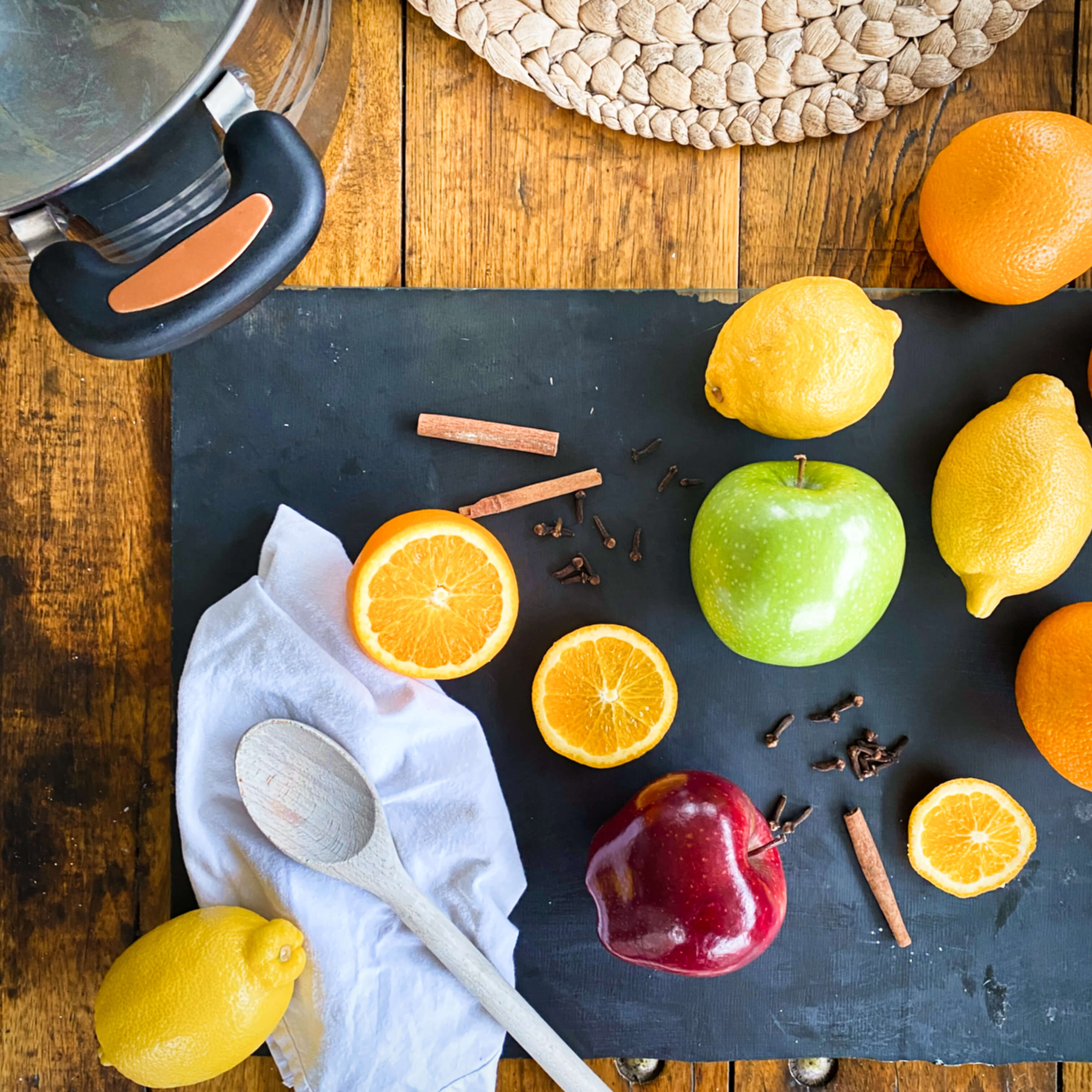
Traditional apple cider is made just from the juice of pressed apples, but spiced cider contains the addition of aromatic spices, most commonly cinnamon, cloves or nutmeg. This vintage holiday simmer recipe contains other fruit juices too. Ones that feature trees commonly grown in the south – oranges, pineapples and lemons, so it’s a delicious mix between two distinct regions in the U.S., each celebrating the combined flavors and scents of the season.
So simple to make, it takes only about 5 minutes to put together and about 30 minutes to simmer on the stove. Guaranteed to warm the spirit and the belly, what is especially great about this recipe is that there is no added sugar. The sweet-tart balance between the oranges, pineapple, lemons, and apples is all that’s needed. It also acts like a natural stovetop potpourri, lightly scenting the air with the fragrance of cinnamon and clove.
Holiday Simmer
Makes 25 cups
2 quarts apple cider
2 cups orange juice
1 cup lemon juice
2 (46 oz) cans of pineapple juice
1 cinnamon stick
1 teaspoon whole cloves
In a large pot over high heat, combine all ingredients and bring to a boil. Then reduce heat to low and let simmer for 20-30 minutes. Remove spices and serve hot.
Kid-friendly in its as-written state, you could also turn this into an adult beverage by adding a splash of brandy to each glass if you prefer an extra dose of cheer to brighten your holiday spirit. Leftovers can be stored in the fridge for up to a week, and reheated as needed. If you live in warm climate, this is also lovely served cold but make sure you initially simmer all the ingredients as directed, as the natural sugars carmelize in the cooking process and dissolve the spices for a more rich, well-rounded flavor.
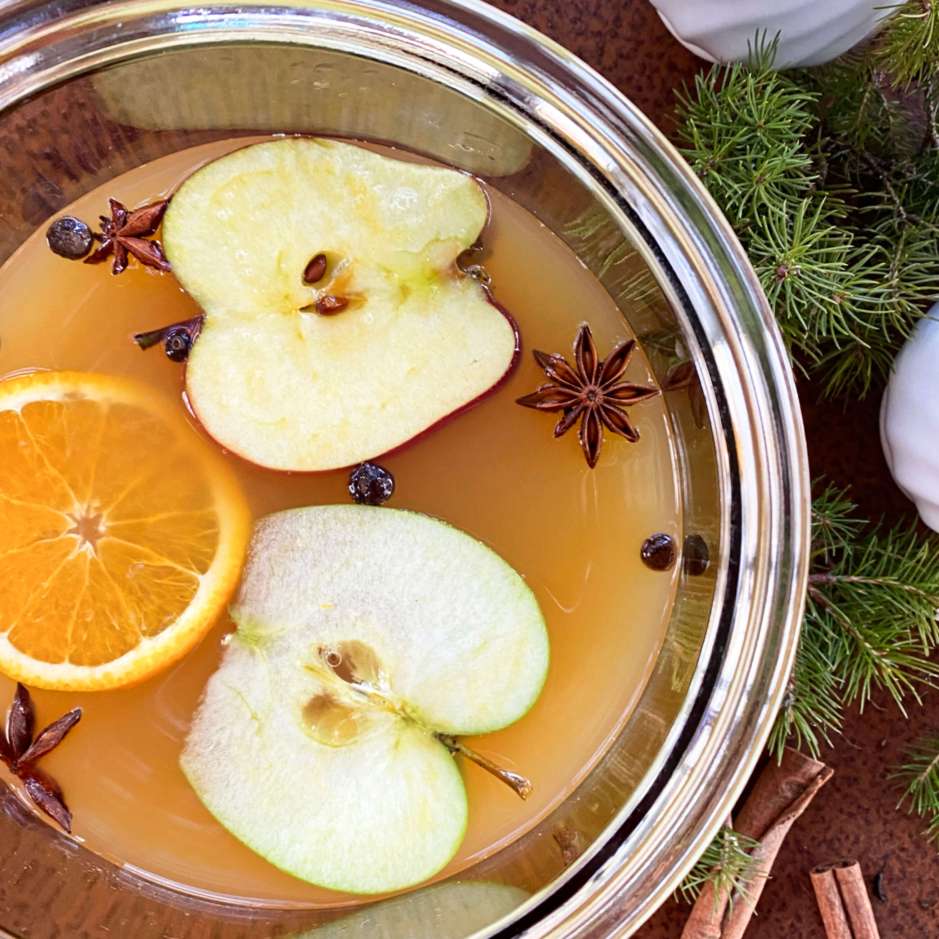
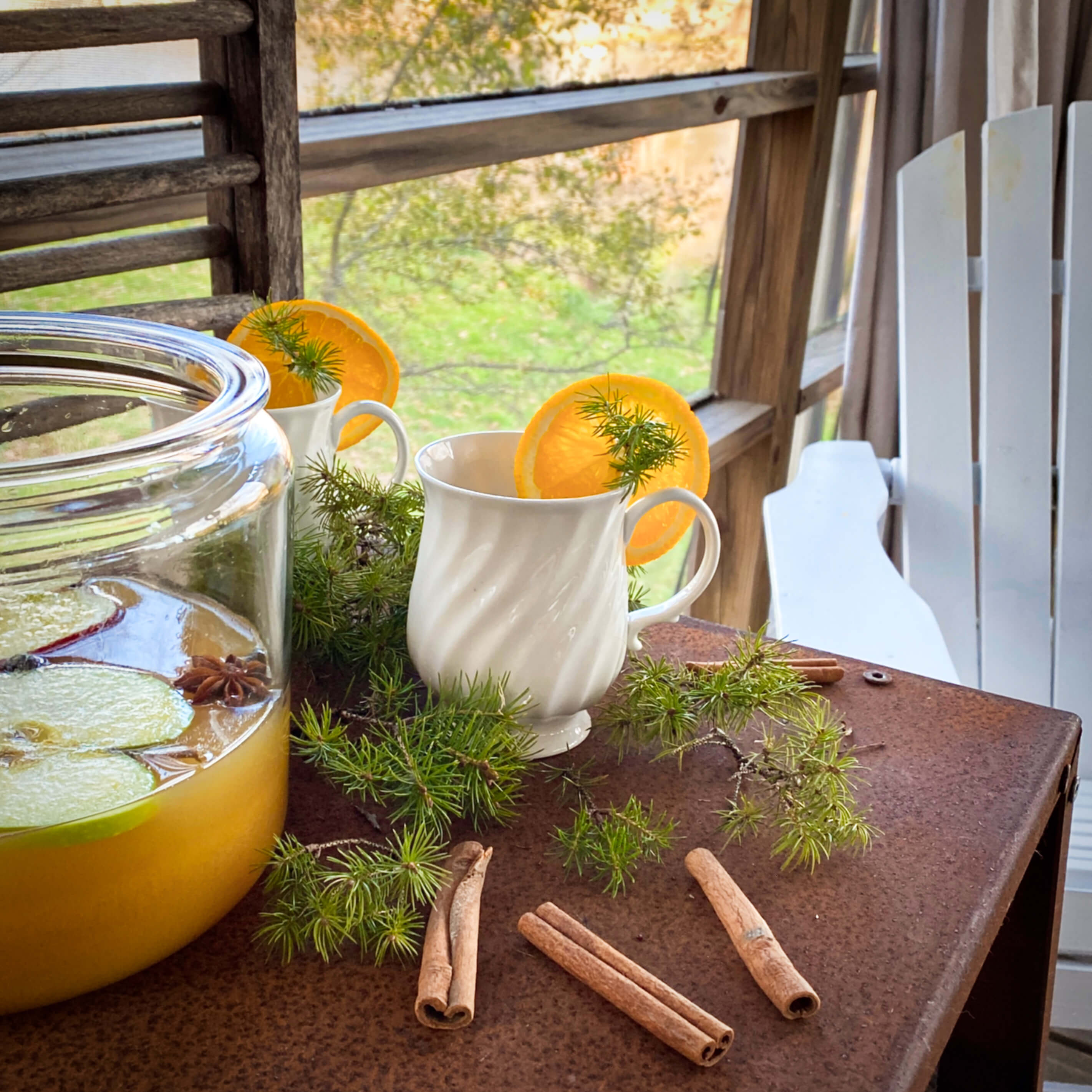
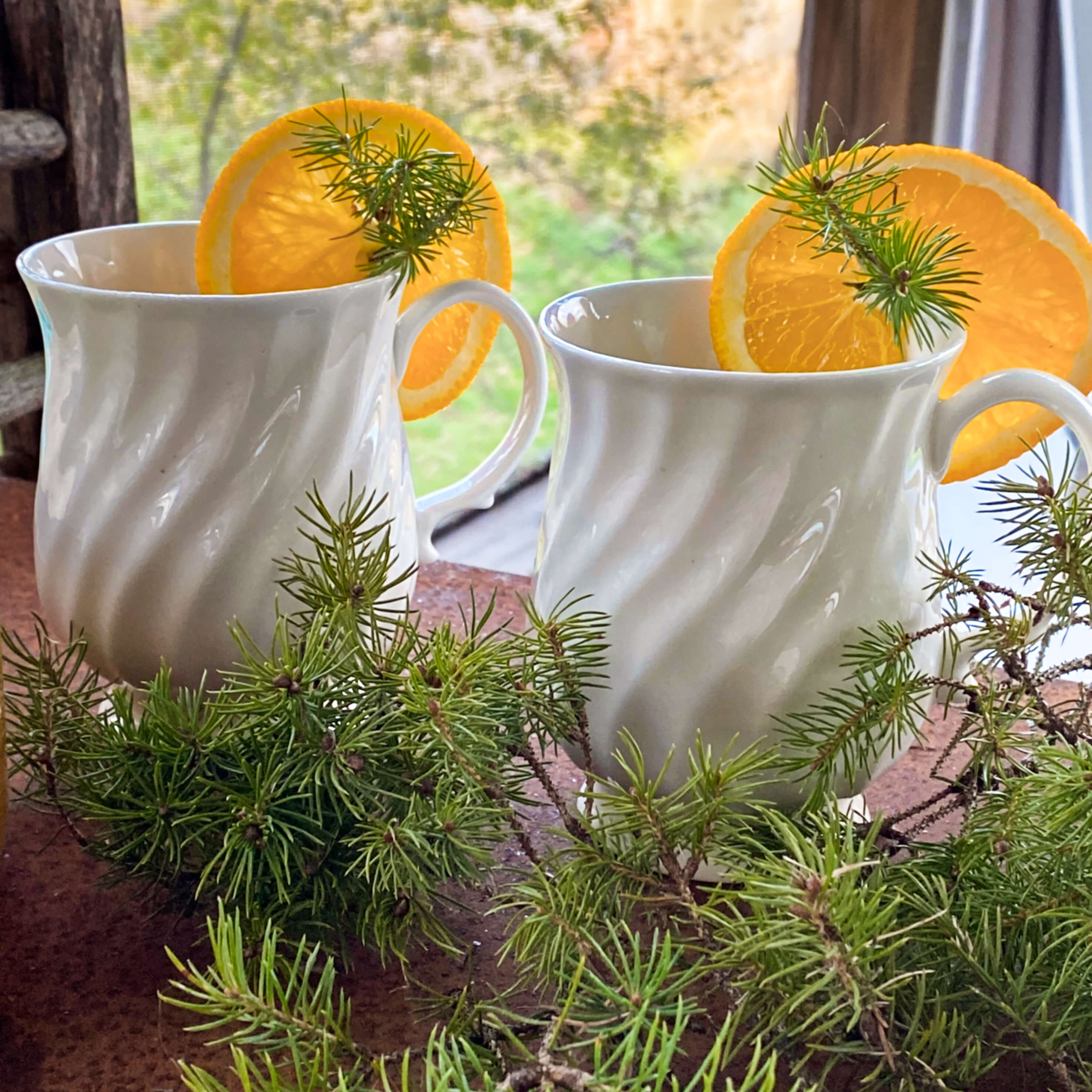
Add an extra bit of holiday flourish on your mugs or glasses with an orange slice and pine spring garnish. Or if serving this for a crowd punch bowl-style, float some apple and orange slices in the bowl along with a sprinkle of star anise, cinnamon sticks, whole cloves and allspice berries for a hint of seasonal color. Whether you are bundled up and huddled around an outdoor fire pit or sitting under a swaying palm tree at the beach, I hope this adds just the right bit of sweetness to your holiday season.
Cheers to the South and the North and all the foods that bring the two together!
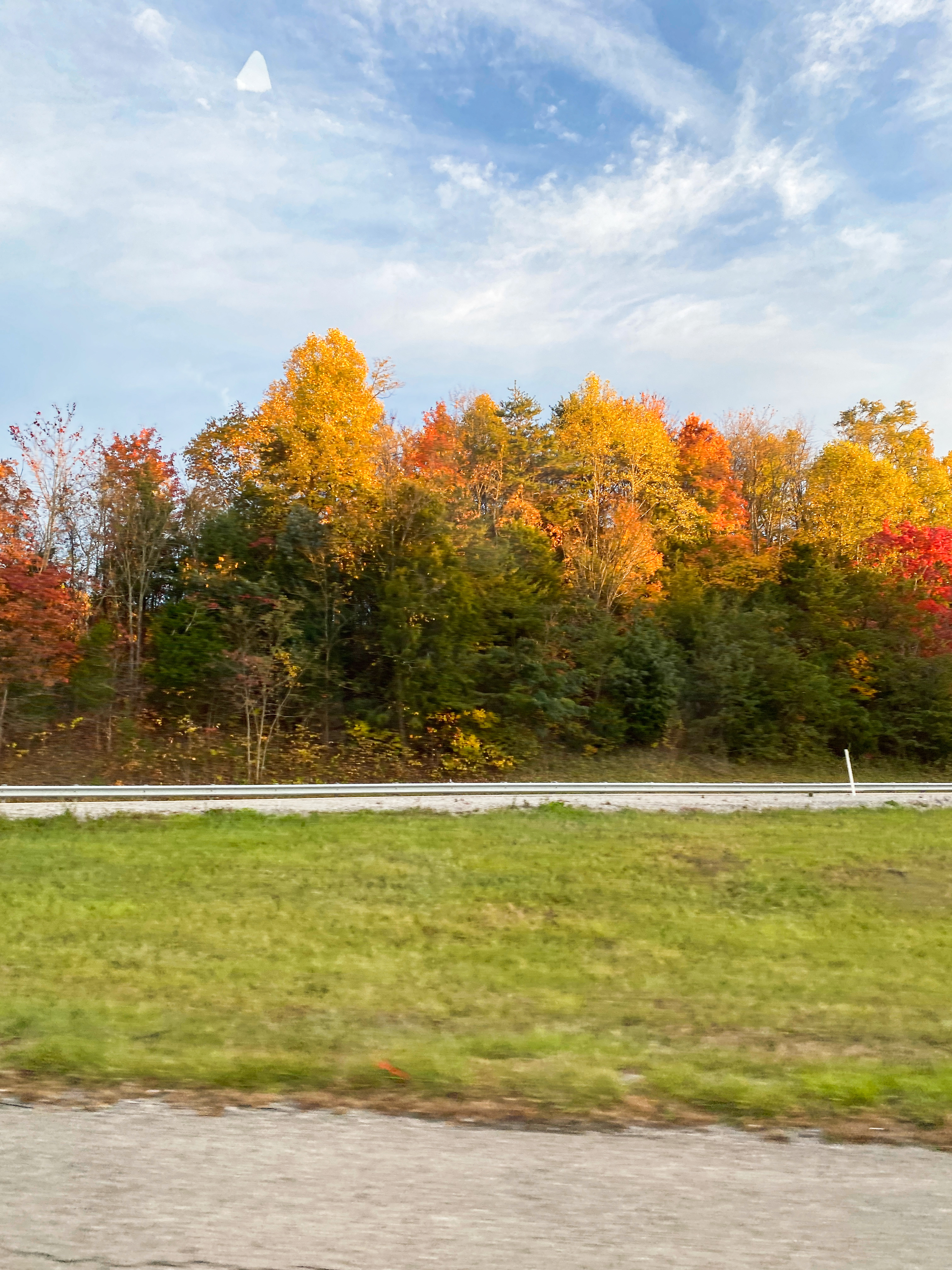
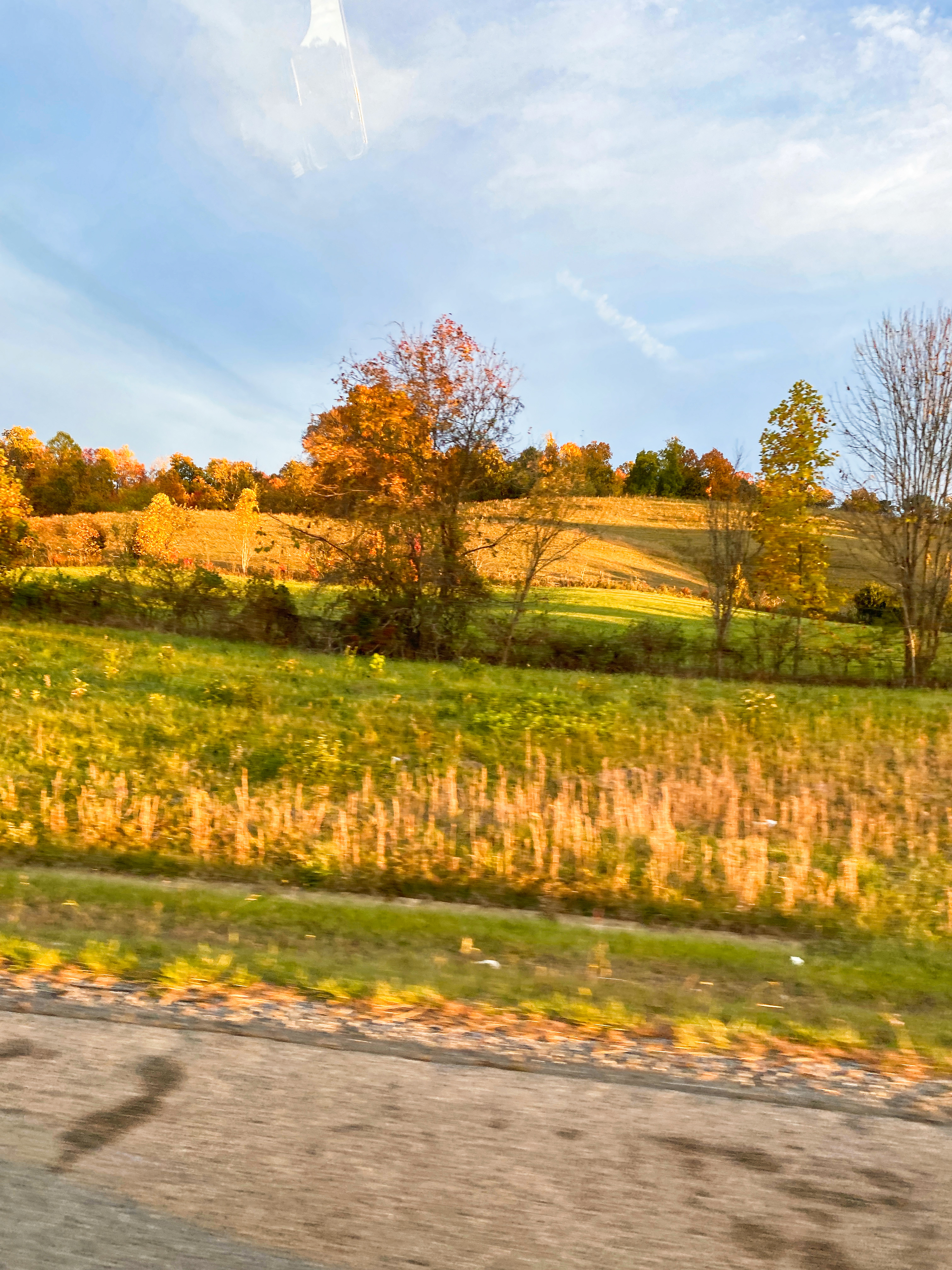
Last weekend, we packed up the Vintage Kitchen, said bon voyage to Nashville and headed north on a big, new adventure. Replacing the city skyscrapers that have been our tour guides around town for the past five years, the tall highway trees fat and billowy with autumn color, escorted us north as we ventured 885 miles towards an exciting new future.
Four states and 15 hours later, we arrived! The destination…camp country. Also known as Phase 1 of a two-part plan, our temporary resting spot for the next two months is a 1940s-era waterside cottage in Pennsylvania. Here, some big little details will get sorted out that will eventually carry us onto Phase 2 – our final destination where a big surprise that has been brewing over the past couple of years will finally be revealed.
In the meantime, the cottage and the lake it sits on, is packed full of interesting things. There are kayaks in the shed, a fire pit in the yard, and plenty of wildlife to keep the binoculars busy. The lake is home to deer, ducks, geese, turtles, herons and a wide variety of songbirds. So far I’ve spotted chickadees, blue jays, cardinals, tufted titmice, woodpeckers and an unidentified grey and black-hatted bird that I suspect might be a nuthatch fluttering amongst the trees. At night, we can see the stars, clear and bright, for the first time in half a decade. The cottage comes with a dock too, which is endlessly fascinating for Indie who hasn’t stopped smiling at the lake since we arrived.
Not alone in her unabashed joy, as it turns out, this area of Pennsylvania is best known for its plethora (literally dozens) of summer sleepaway camps that have been attracting kids from surrounding metropolitan areas like New York City, Philadelphia and Washington D.C. for the past one hundred years. These vintage postcards from the 1930s and 1940s hint at some of the fun that happens here…
I can totally understand the appeal. The rolling hills, the dense pockets of trees and the waterways that wind and weave their way practically around every corner are a paradise for nature lovers of all ages. Even in the off-season on a November day like yesterday, when it was 42 degrees and raining, there was a sense of refreshing exhilaration in the landscape. It might have been the exciting news that snow flurries were in the forecast for part of the day or the fact that its been half a dozen years since I’ve been surrounded by so much nature, but whatever the joy that has buoyed our spirits these days, this part of the state has turned out to be quite unexpectedly enchanting.
The cottage kitchen is a tiny one, but there is room enough to make and share a few vintage recipes while we are here in this pending place between past life and future dreams. So stayed tuned. Even though the shop is on a temporary break while we transition, the blog will be here sharing stories and snippets throughout the season.
Cheers to holiday cooking, cozy cottages and camp country!