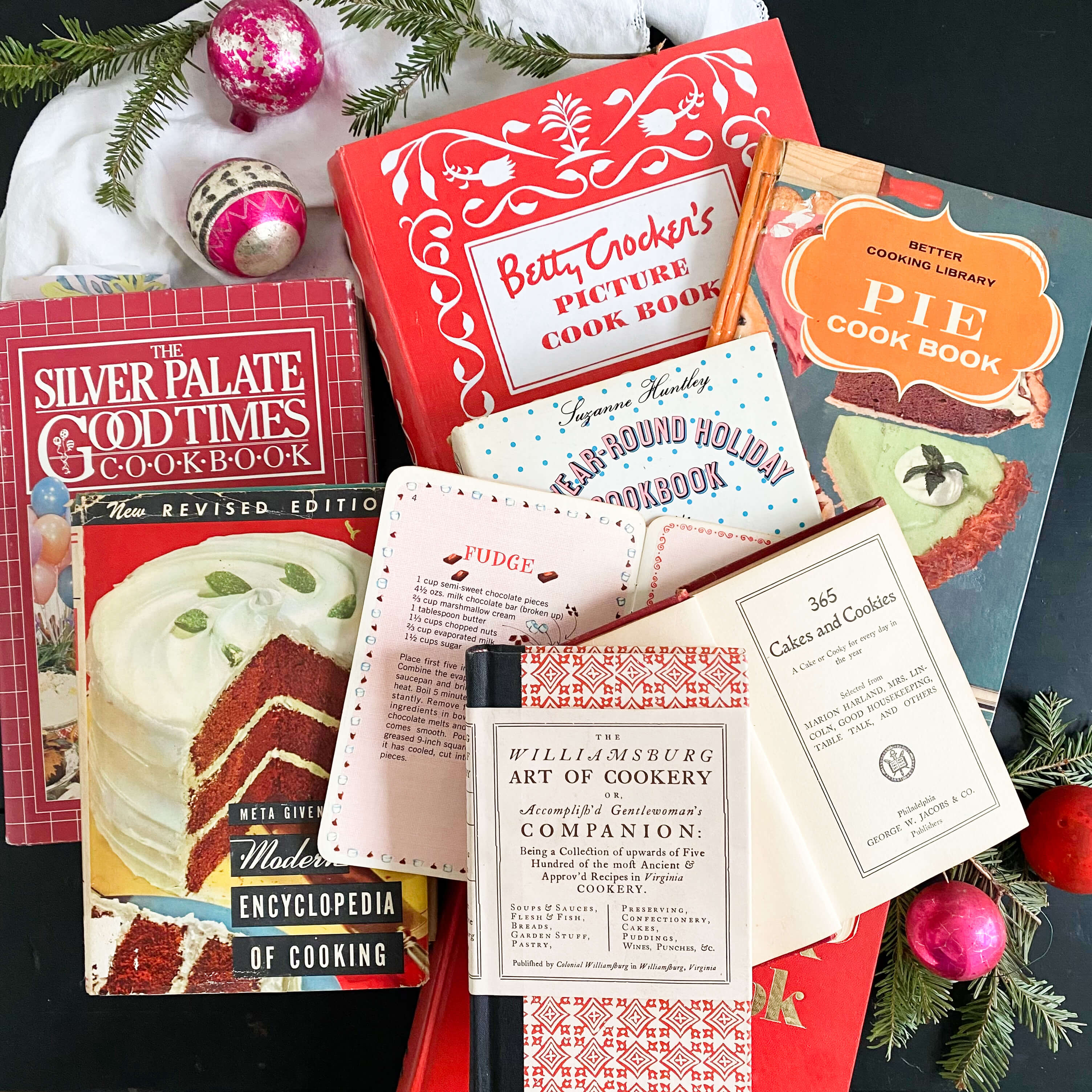
A Cranberry Cake at Christmas

When it comes to dessert at Christmastime, an infinite loop of baking options never fails to greet us at every source. From chocolate to candy canes, cookies to confections, the holiday peppers its sugar plums and santas with all the sweet-natured hallmarks of the baking season. Every year, we are spritzed and sprinkled, fluffed and frosted, whipped and whirled into a cacophony of holiday creativity that delights the eye and feeds the algorithms until it seems like the world might just burst from an overload of sugar-fueled enthusiasms.

Amidst all this intrepid merry baking and decorative dalliances, there’s a favorite holiday cake that stands out. One that’s traveled time and trend for over 100 years, it’s a humble unsung hero of holiday celebrations that requires little effort but packs a lot of flavor and a festive color palette.
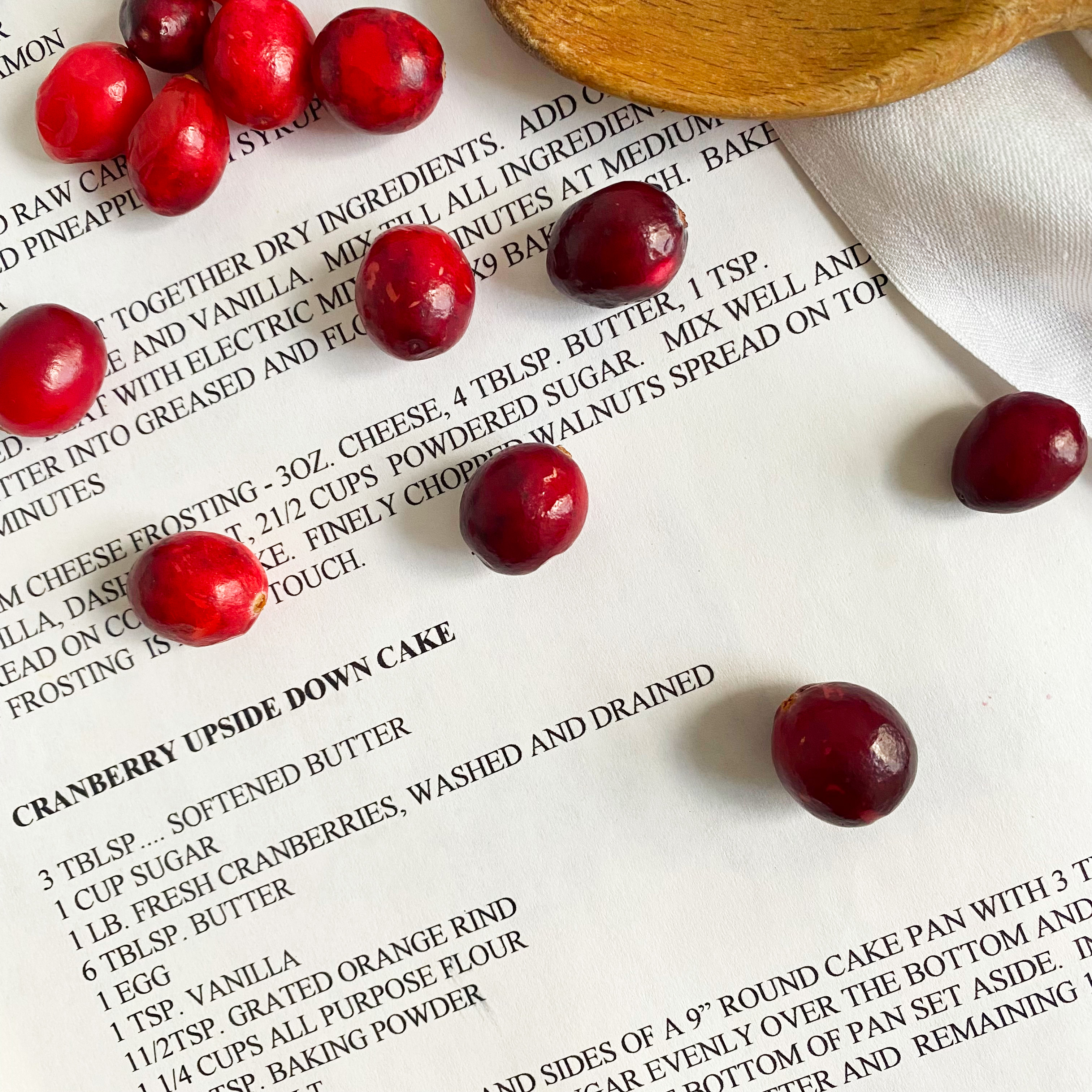
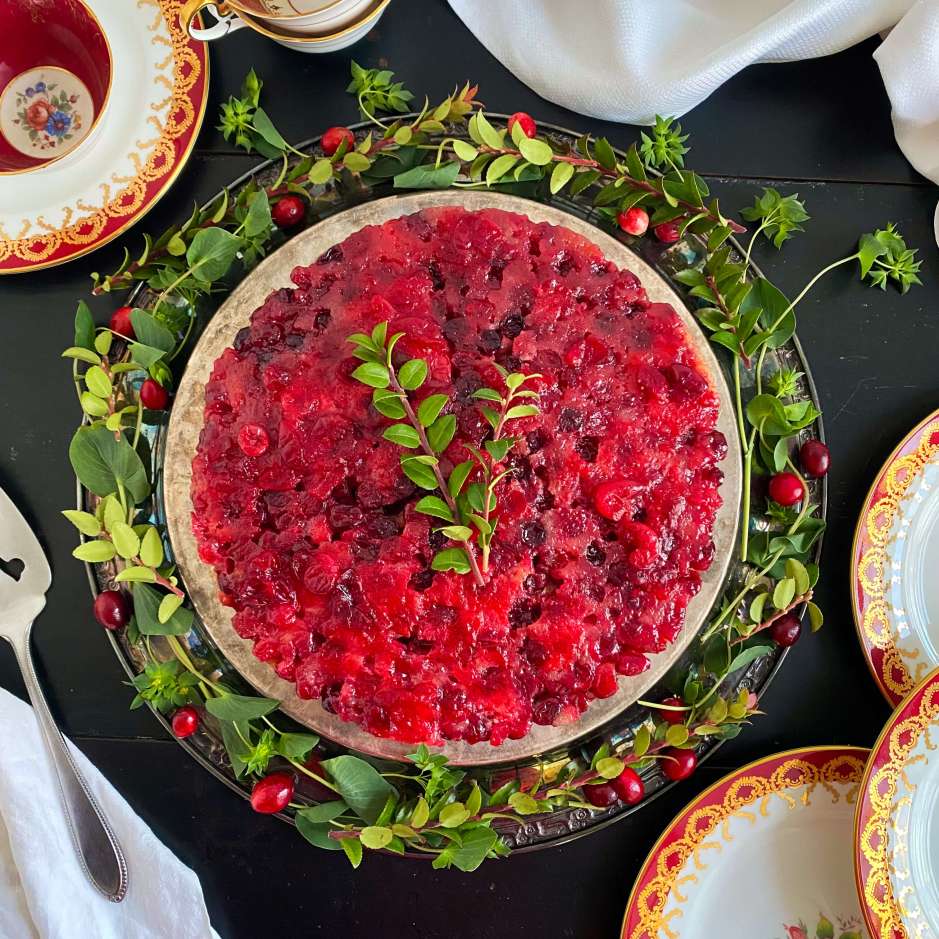
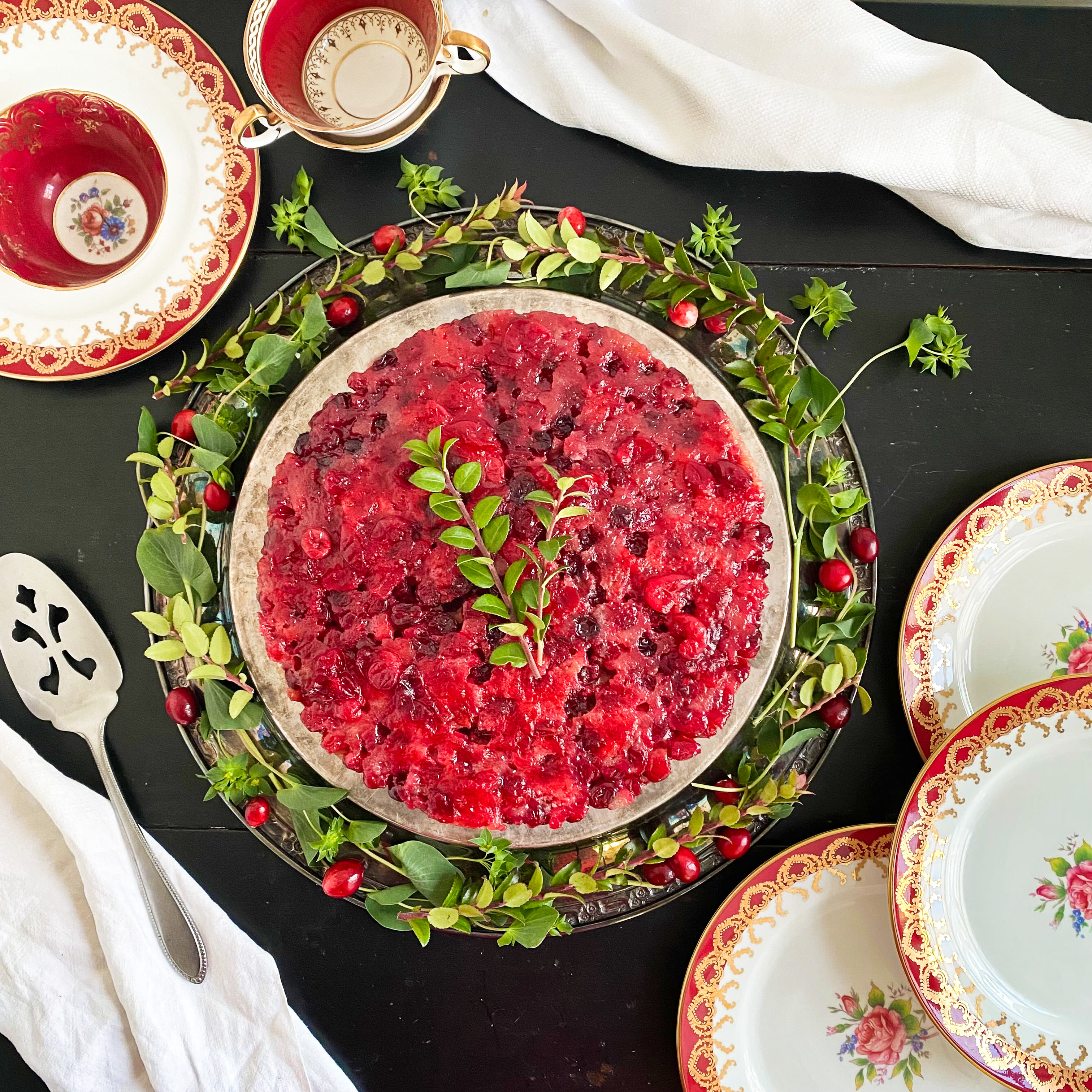
In today’s post, we are making a vintage recipe for cranberry upside-down cake. It’s a cousin cake to the more well-known Pineapple Upside-Down Cake which has graced dessert tables for most of the 20th century. But unlike that golden-circled and amber-shaded citrus cake, the cranberry upside-down version is a deep red, a fitting choice for the colors of the season.
Growing up my mom made this recipe almost every Christmas, or if for some reason she missed serving it over the holidays, it would appear on the dessert table further along in winter for Valentine’s Day or a special dinner or event. Traveling around all the kitchens of my family, both on the East Coast and the West Coast, it’s been a favorite for two generations, and usually makes the list each year when discussing options of what to make and bake for the holiday season. Part of the reliable tried and true batch of recipes that my mom included in a homemade cookbook that she made for me and my sisters and my brother many years ago, it’s got her firm seal of approval for holiday baking.

This note of praise doesn’t come lightly. My mom is very particular when it comes to scrutinizing a recipe. In order for her to recommend one, it has to continuously perform well, time and time again before it makes her tried and true list. The first time she made this cranberry upside-down cake recipe, she loved it for its presentation and its bright red color on the Christmas table. Years into making it, beyond its delicious taste, she loved it even more for its reliability, its sense of the unusual in that not many guests at her table had had it before, and she loved it for the fact that it traveled well in the car so she could easily tote it along to a party. As a kid, I loved this recipe for its sweet tart taste and its syrupy sticky top. I thought it looked beautiful on the table too. As an adult, I still love it for all those same reasons. But now I also appreciate the complimentary marriage of its flavors that blend so well with many lunch, brunch, and dinnertime menus. Especially ones taht strech from Thanksgiving all the way through the end of winter.

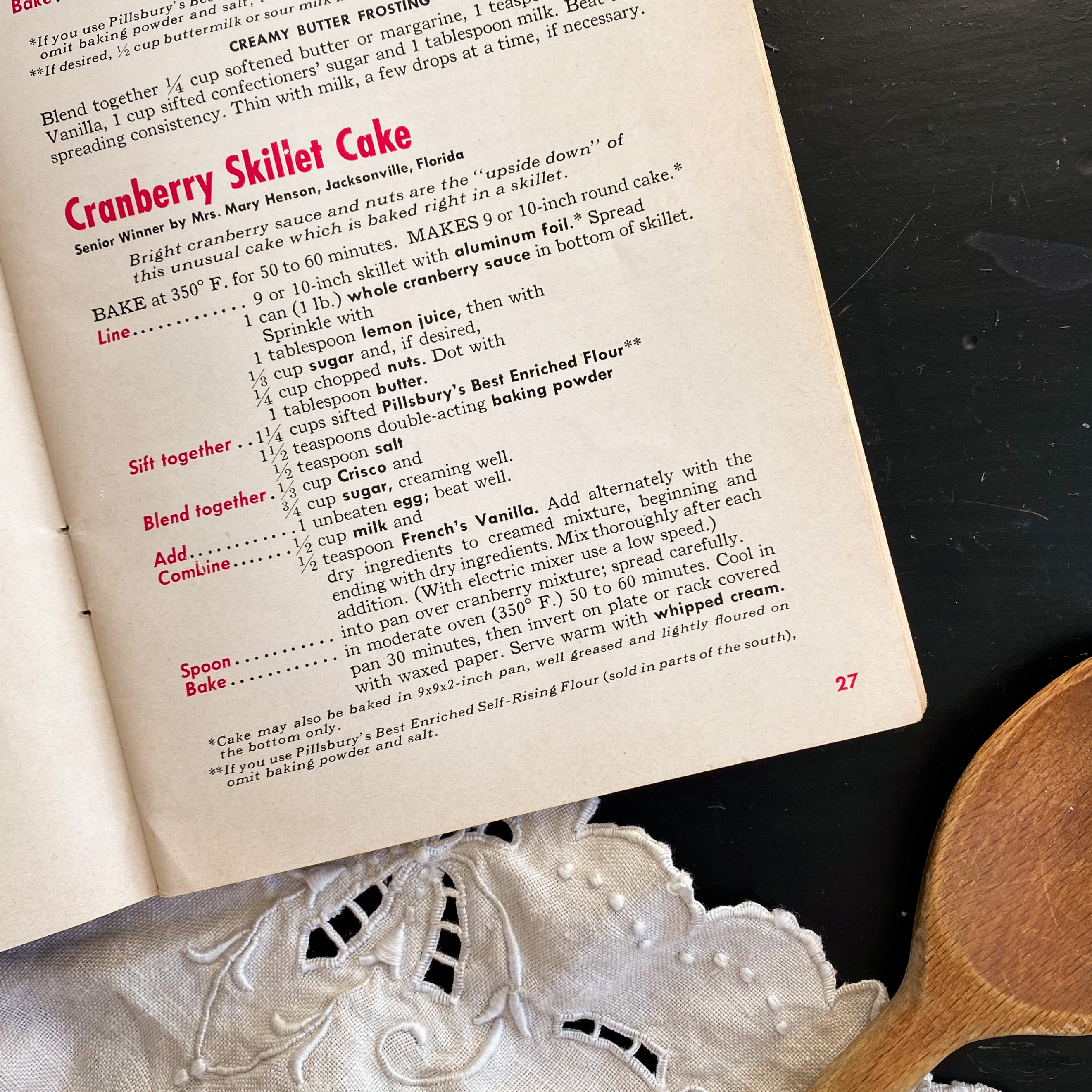
Recently, when I asked my mom where she found the recipe, she couldn’t remember. It was over 40 years ago that she first made it and in her defense she’s tried thousands of recipes between then and now. But my sister thinks, she may have pulled it from the pages of Gourmet magazine sometime in the late 1970s or early 1980s. I couldn’t find any reference online linking Gourmet and this recipe together, but the exact origin story of upside-down cakes in general is a bit elusive, so perhaps it is fitting.

As far as its vague history goes, the earliest mention of an upside-down cake recipe dates back to the late 1800s, the decade when flipped and fruited cakes started creeping into the popular dessert category in kitchens and cookbooks. Sometimes called spider cakes or skillet cakes, they were thought then to possibly have originated from pioneer days when much American cooking was done in a skillet or a frying pan over an open fire or on the stove top. Some culinary historians by-passed this notion and attached upside-down cakes to menus of the Middle Ages, when fruit laden desserts were part of feast days and banquet dinners. Another source, a journalist in the 1920s, credited this style of cake baking to Gail Hamilton (aka Mary Abigail Dodge), a 19th century New England journalist, feminist, and suffragette. But I couldn’t find any correlation to Gail and cooking.
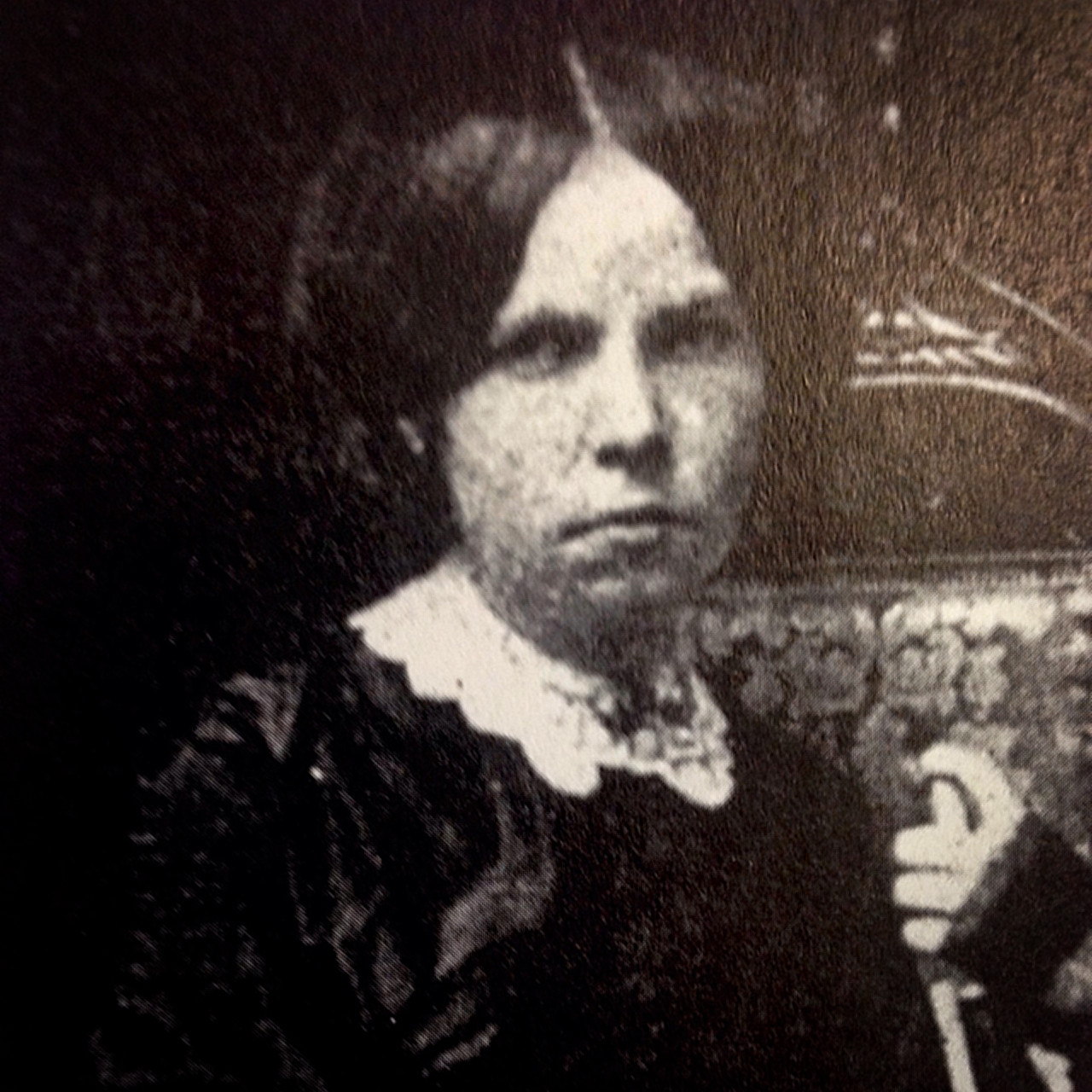
Mary Abigail Dodge aka Gail Hamilton photographed in 1860.

Regardless of when and where upside-down cakes came from, this one pan wonder has always been a marvel for home bakers. Since it had already contained a jam like top, there was no need for frosting or additional decorating. One flip of the cake pan after cooling, and your baked masterpiece was ready to serve.

The Anderson Herald, October 19,1928

The 1920s proved to be a pivotal decade for the upside-down cake launching it into popularity again by touting its enticing apperence, as well as its economy and effortlessness to a whole new set of bakers. In that decade apple, peach, apricot, and pineapple were the precursor fruits to cranberry upside-down cake, with each one having their own singular moment in the spotlight. Although upside-down cakes have remained popular every decade since, it was the pineapple version that’s had the most longevity and garnered the biggest fan base.
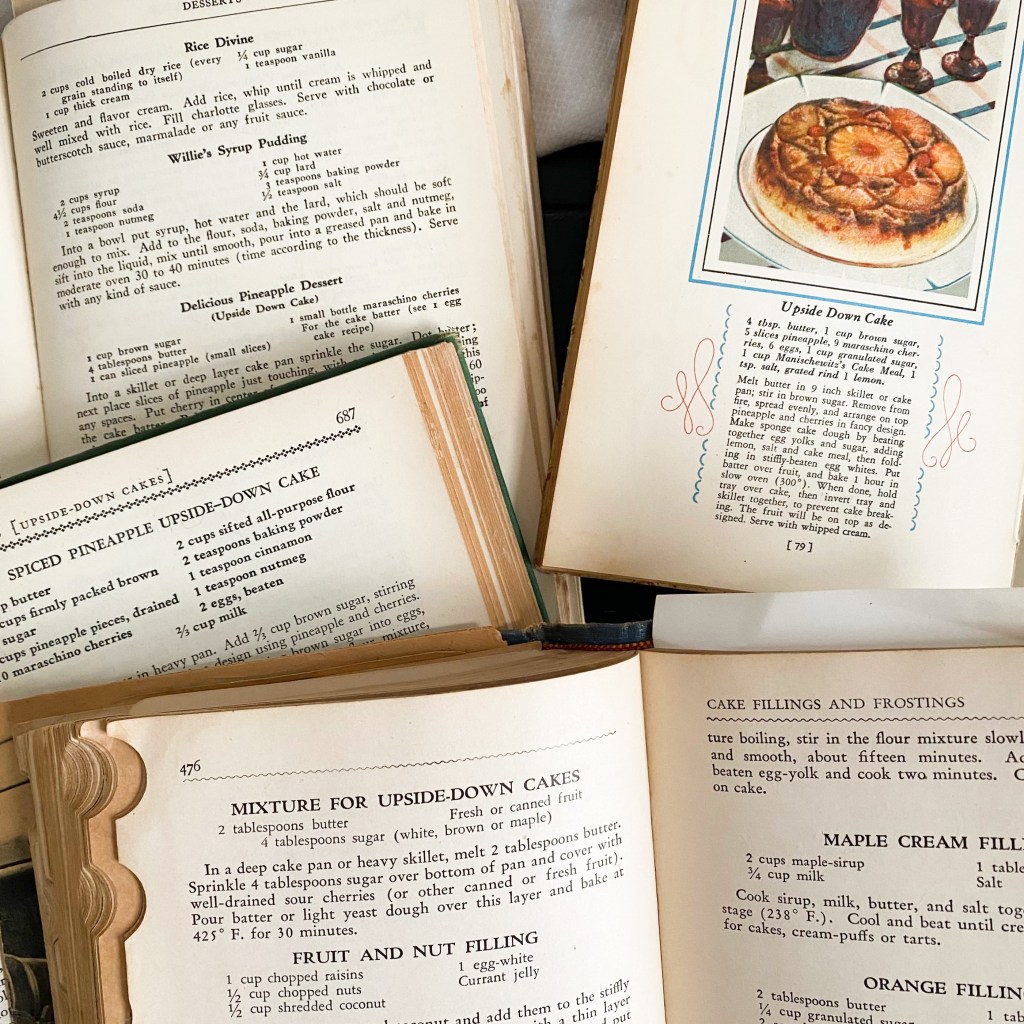
Recipes for Pineapple Upside-Down Cake dating from the 1920s-1940s. Clockwise from top left: Delicious Pineapple Dessert (Upside Down Cake) from Southern Cooking by Mrs. S.R. Dull (1928); Upside Down Cake from Tempting Kosher Dishes by the B. Manischewitz Co (1930); Mixture for Upside-Down Cakes from The American Woman’s Cook Book (1949); and Spiced Pineapple Upside-Down Cake from the Herald Tribune Home Institute Cook Book (1947)

Not as expensive to make as a multi-tiered layer cake, not as heavy to eat as pie, and not as time-consuming to bake as cookies, upside-down cakes are an ideal, elegant, no-fuss wintertime dessert, especially at Christmas when schedules can be harried and baking tasks multiplied. The coming together of this simple dessert requires no more than 90 minutes in the kitchen from gathering of ingredients to finished product.

Over the past century, there has been many different recipes for creating an upside-down cake, each with their own twists and tweaks, but the main cooking principles are always the same: a layer of butter on the bottom of the pan, then a layer of sugar, then fruit, then cake batter. Once finished and flipped, the result is a buttery cake topped with caramelized fruit jam.

The Stockman’s Journal, April 7, 1927

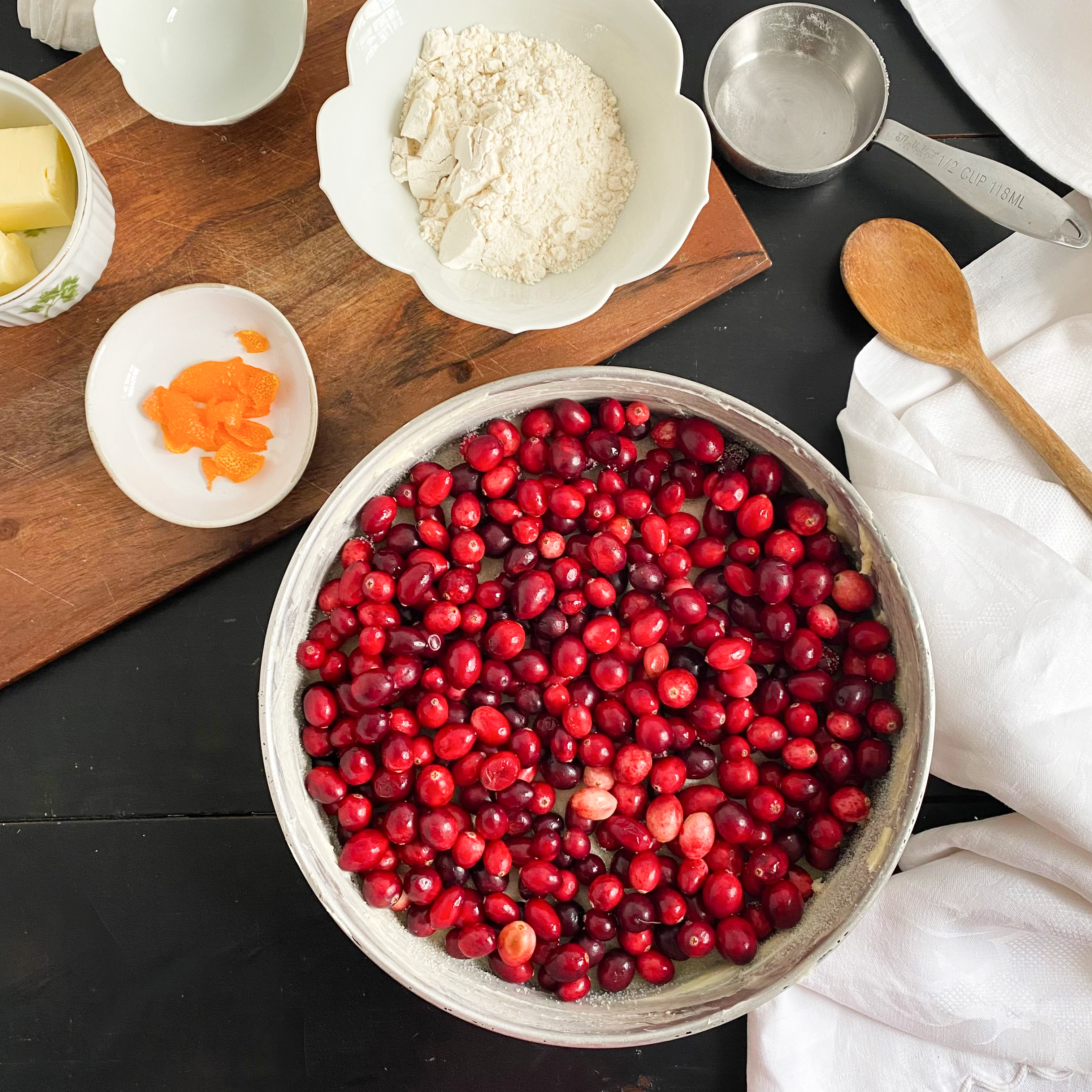
Ideally, the fruit is fresh and either added whole or halved, but the cake part of the recipe can be made many different ways. Some recipes call for boxed cake mixes, some add extra spices like cinnamon and nutmeg, or a boozy bit of rum or fruit liqueur. And some recipes incorporate canned fruit or fruit filling. The cake consistency varies too. Some cakes yield textures that are spongy, springy, crumbly or dense in texture. Some cake batters call for cornmeal, whole wheat flour, pulverized oatmeal, all-purpose flour, or the inclusion of crushed almonds or citrus peel. I’m sure all who love cranberry upside-down cake have their own favorite ingredient combinations, as it is easily adaptable to creative cookery. The one my family likes best includes fresh orange rind in the batter, fresh cranberries on the bottom, and a dollop of homemade whipping cream on top prior to serving.
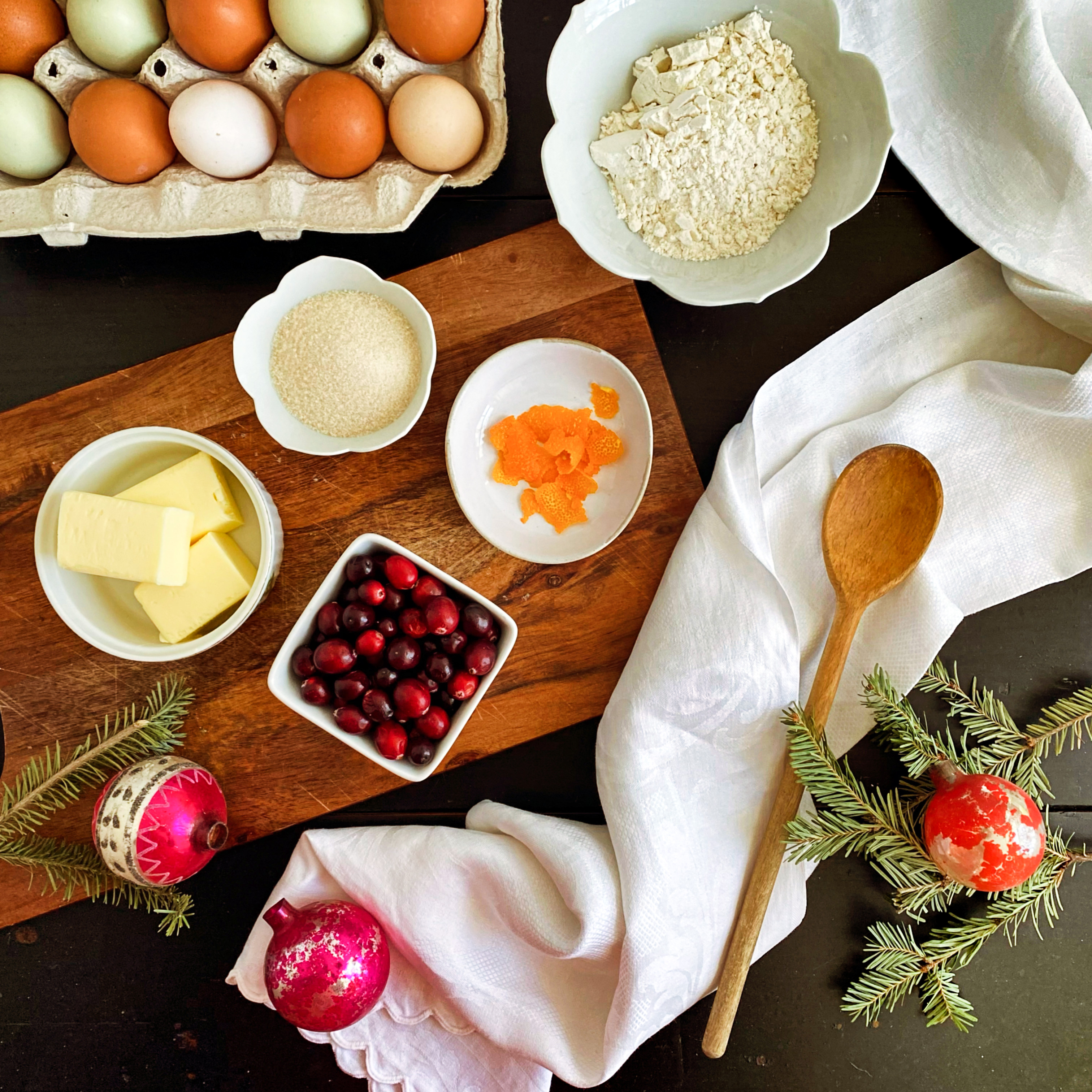
In making this recipe for the blog, I used a 10.25″ inch cake pan. The recipe calls for a 9″ inch pan which will yield a slightly taller cake than what the photos show here. Although not by very much. Similar to a tart, the cake portion of this upside-down creation is a compact layer, not tall and fluffy like a multi-layered birthday cake. Instead, this dessert is thin and delicate with concentrated flavor. A single slim slice offers just the right amount of everything.

Cranberry Upside-Down Cake

Serves 8

9 tablespoons butter (divided)

1 cup sugar (divided)

1 lb fresh cranberries (plus extra for garnish)

1 large egg

1 teaspoon vanilla

1 1/2 teaspoons freshly grated or minced orange rind

1 1/4 cups all-purpose flour

1 1/2 teaspoons baking powder

1/4 teaspoon salt

1/2 cup milk (either whole or 2%)

Fresh whipping cream

Optional garnish step (please see note below)

1/2 cup fresh cranberries

1/3 cup water

2 tablespoons sugar

Preheat the oven to 350 degrees. Butter the bottom and sides of a 9″ inch round cake pan with 3 tablespoons of butter. (Note: this is going to seem like an excessive amount of butter but be sure to use all 3 tablespoons).
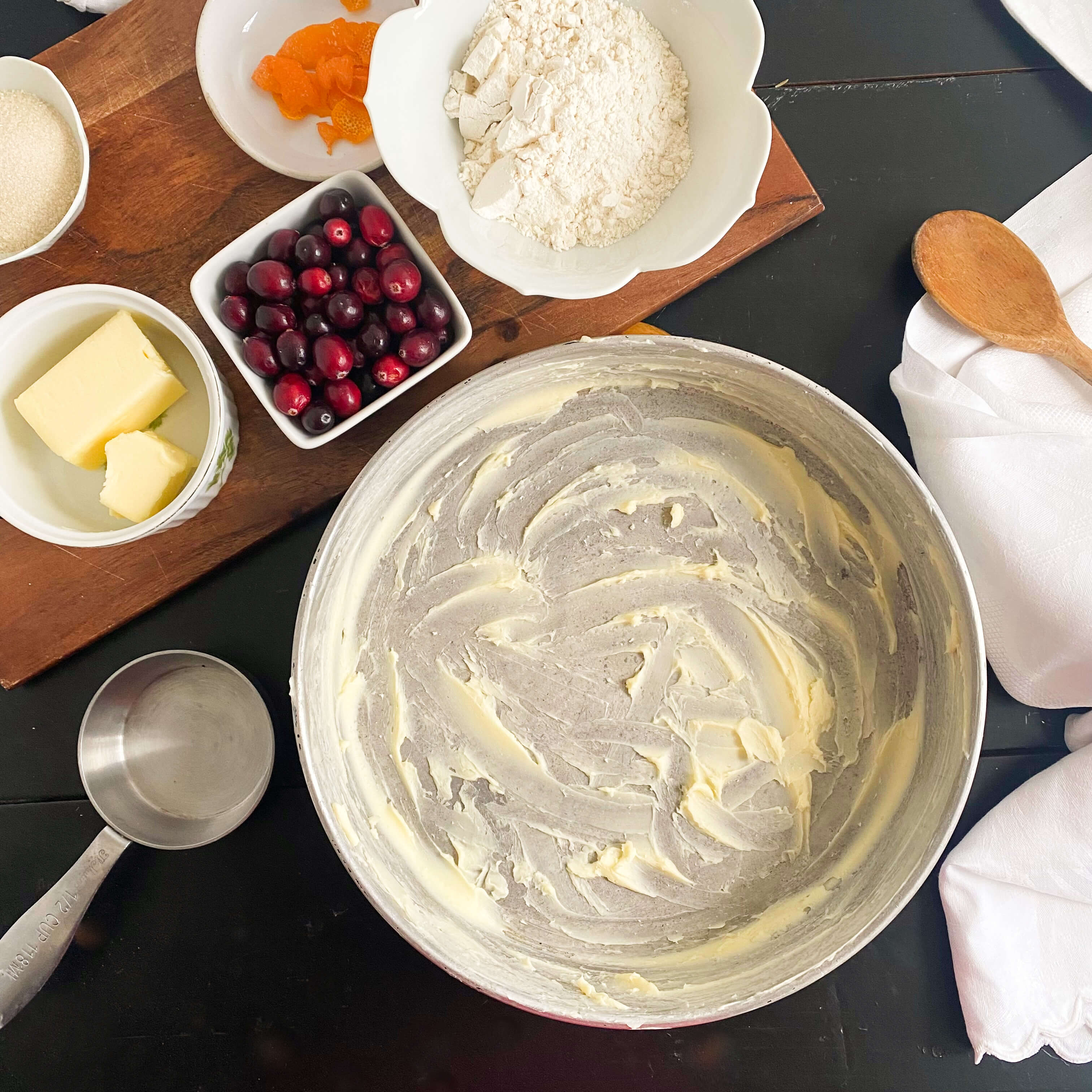
Sprinkle 1/2 cup of sugar evenly over the bottom and pour the cranberries on top, making sure they are evenly settled in the pan.
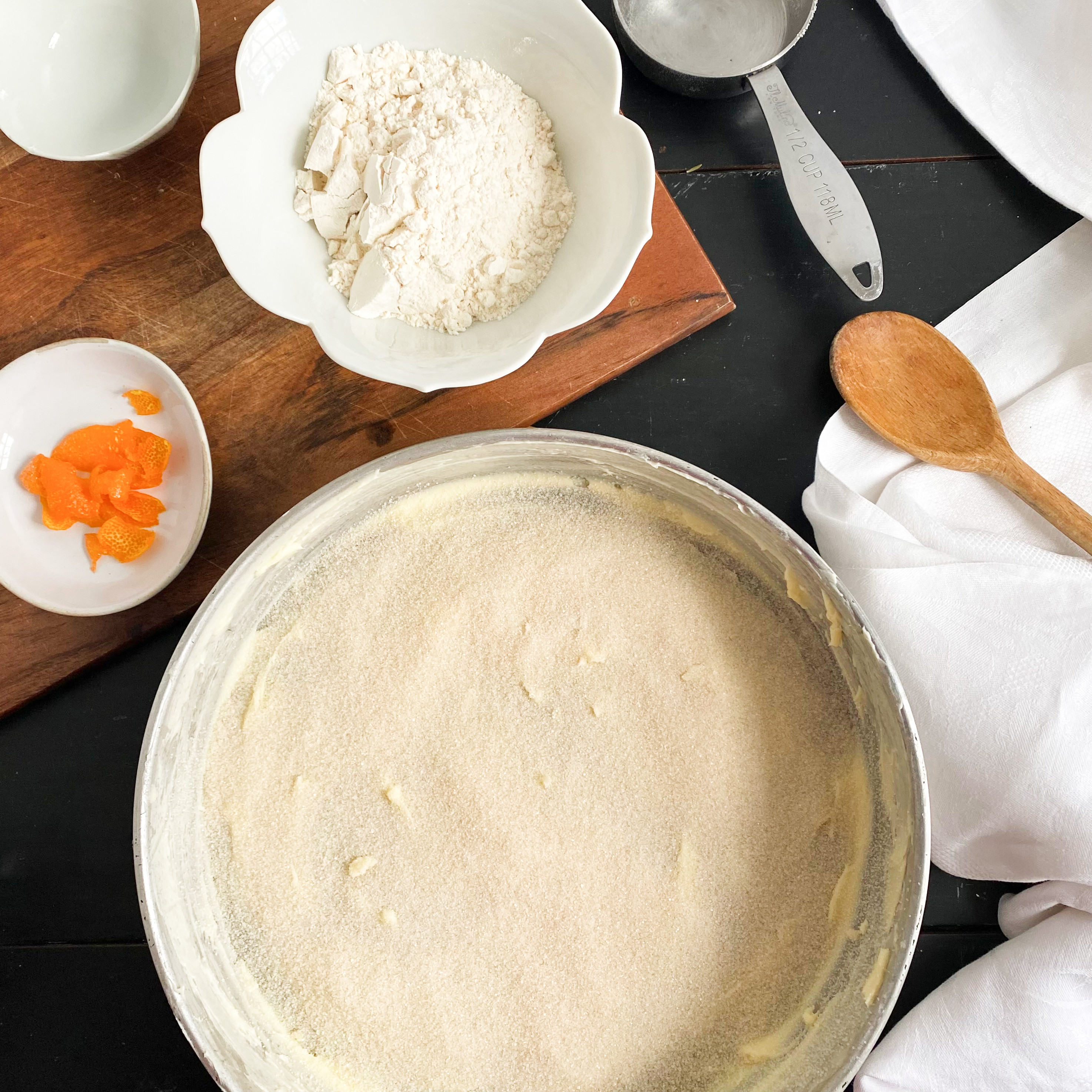
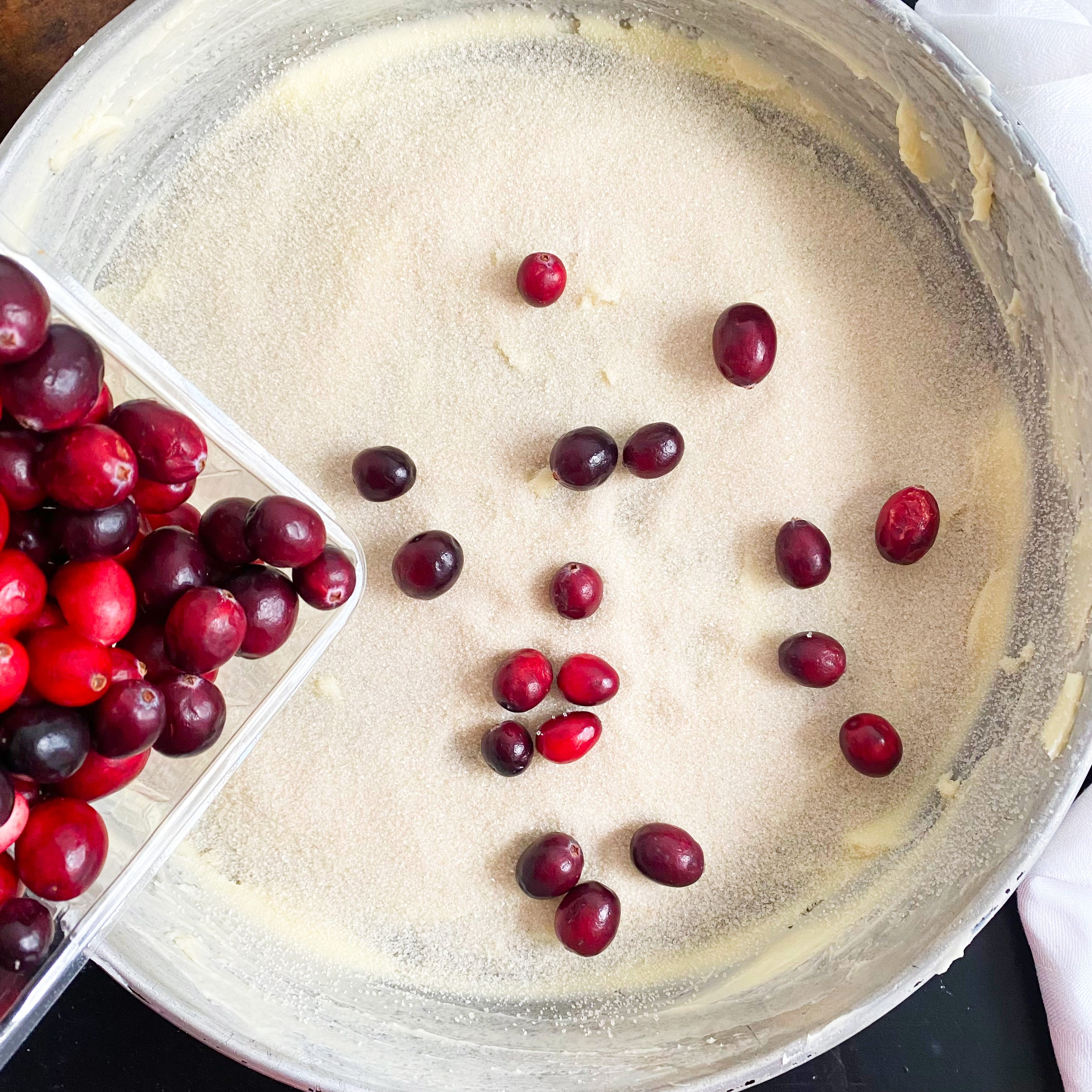
In a bowl, cream together the remaining 6 tablespoons of butter and the remaining 1/2 cup of sugar. Add the egg, vanilla and orange rind. Beat until well combined.

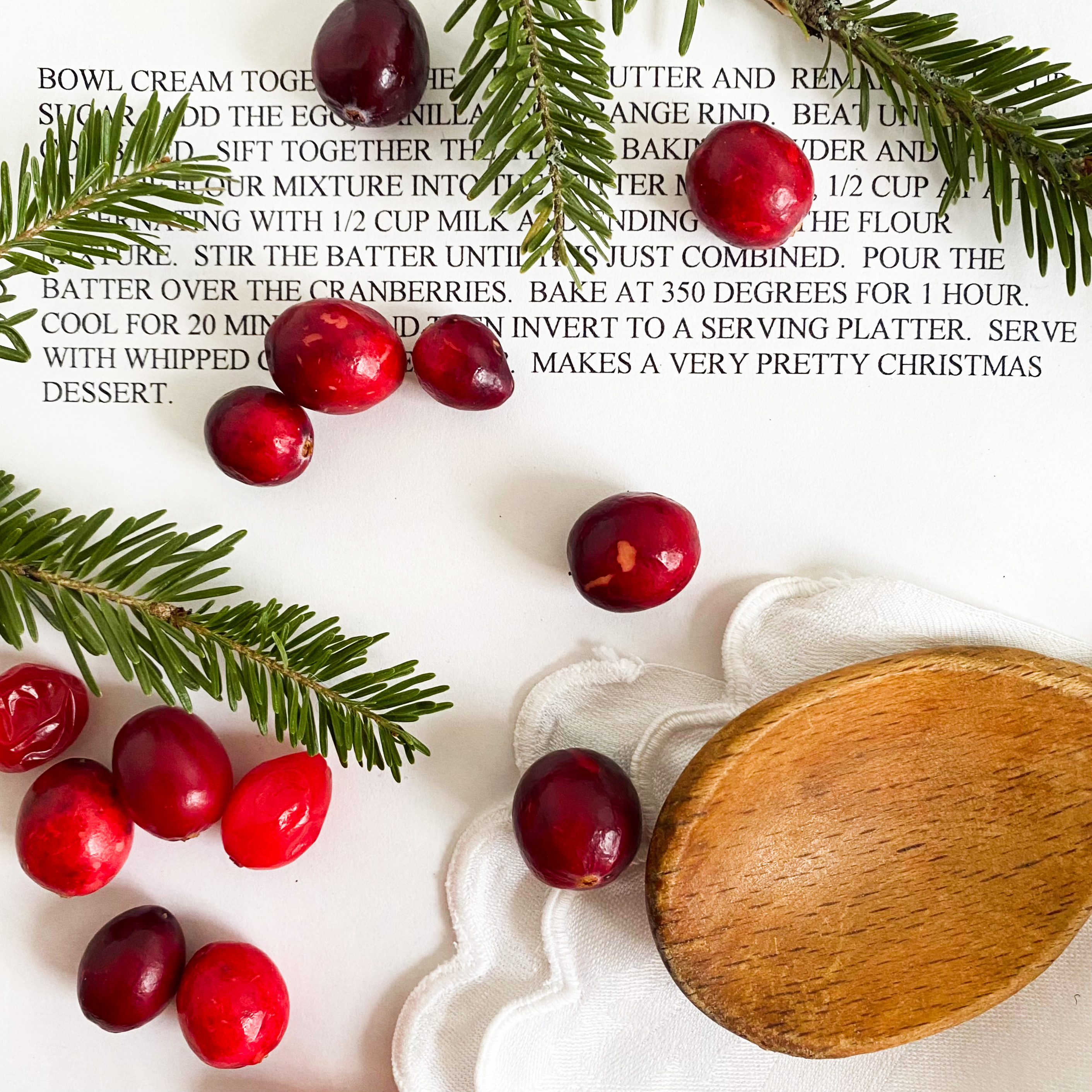
In a separate bowl, sift together, the flour, baking powder, and salt. Stir the flour mixture into the butter mixture 1/2 cup at a time, alternating with 1/4 cup of milk at a time, and ending with the flour mixture. Stir the batter until it is just combined. Pour the batter over the cranberries, spreading and smoothing it around the pan with the back of a spoon.
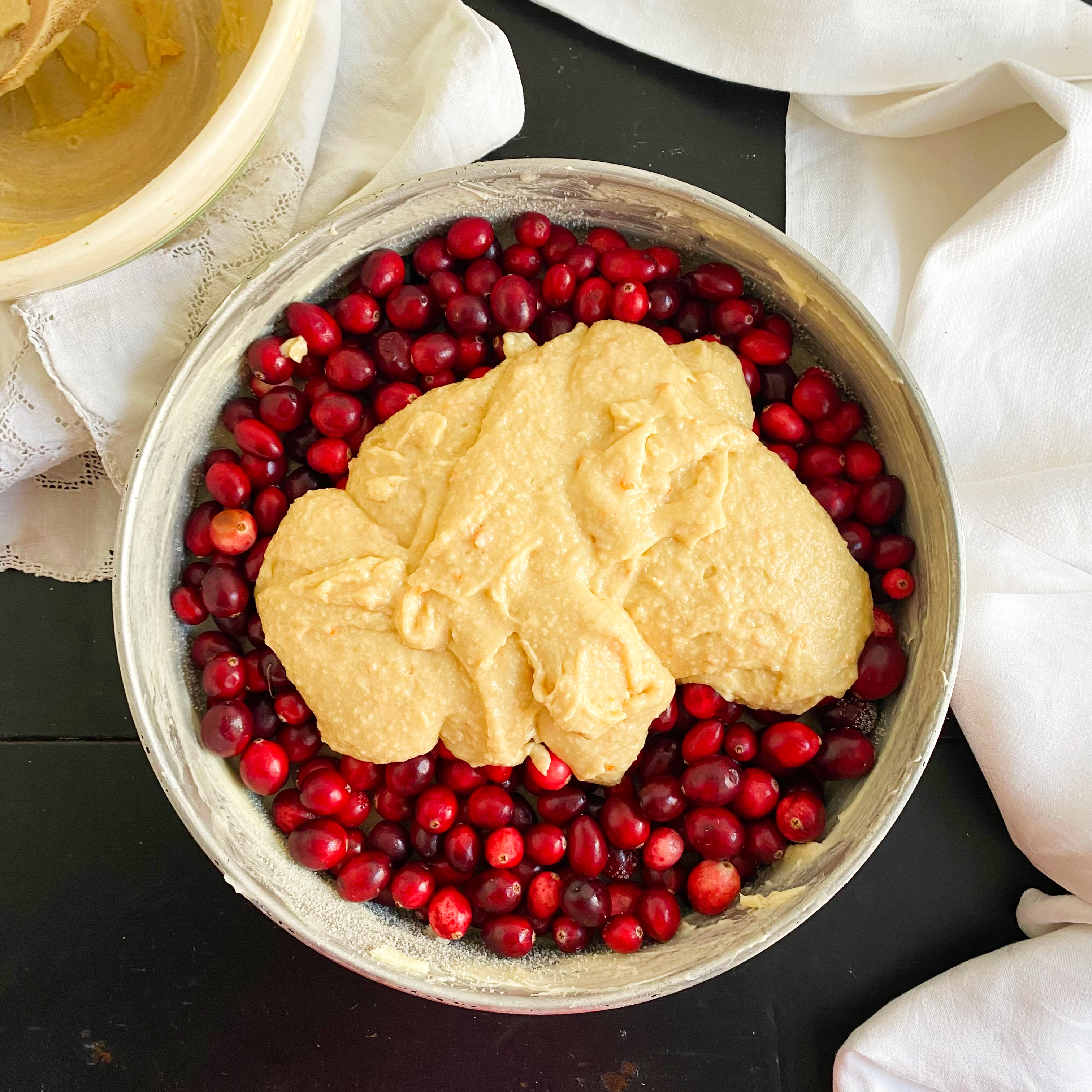
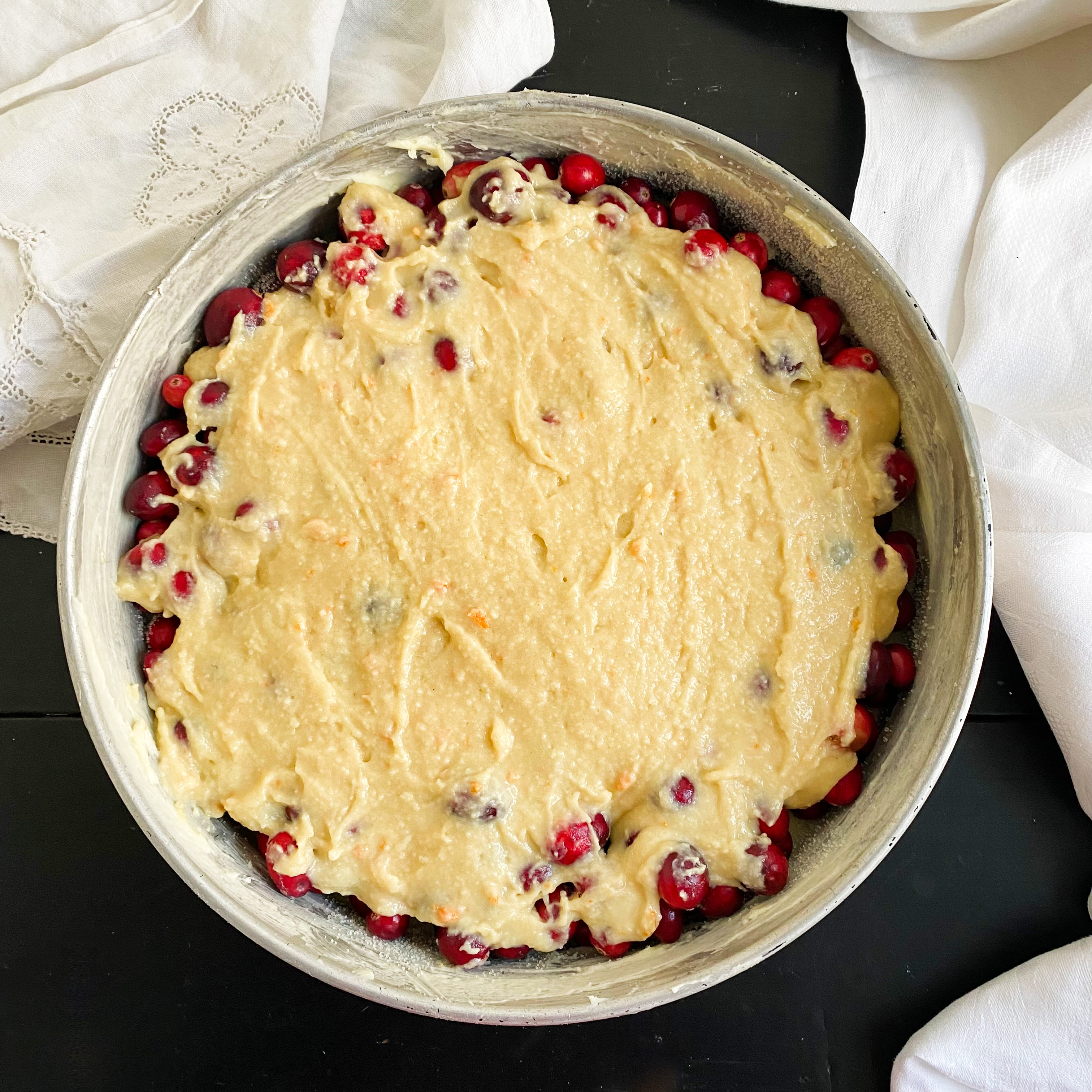
Place the pan in the oven and bake at 350 degrees for 1 hour.
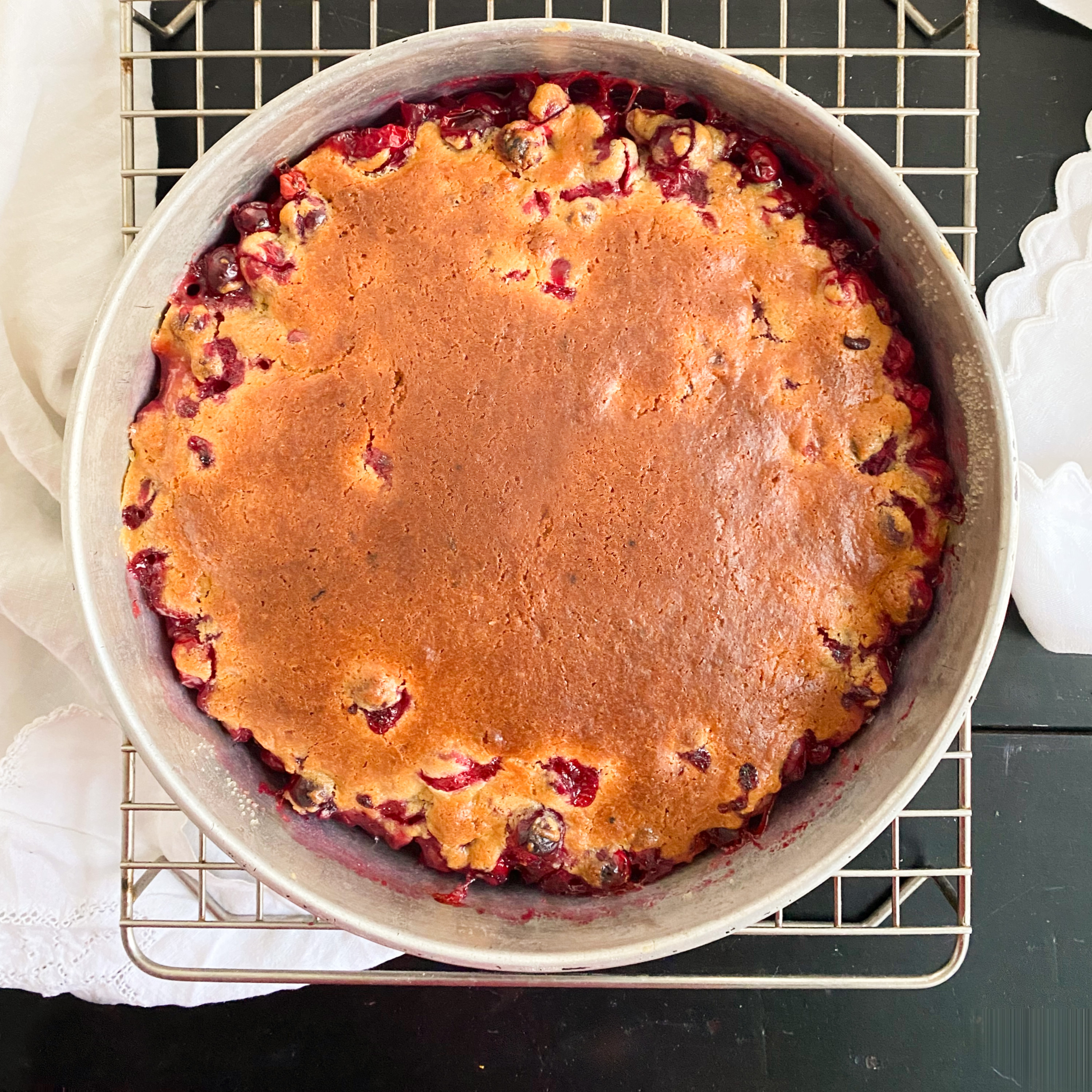
Remove from the oven and let cool on a baking rack for 20 minutes, and then invert the cake pan onto a serving platter in one quick motion.
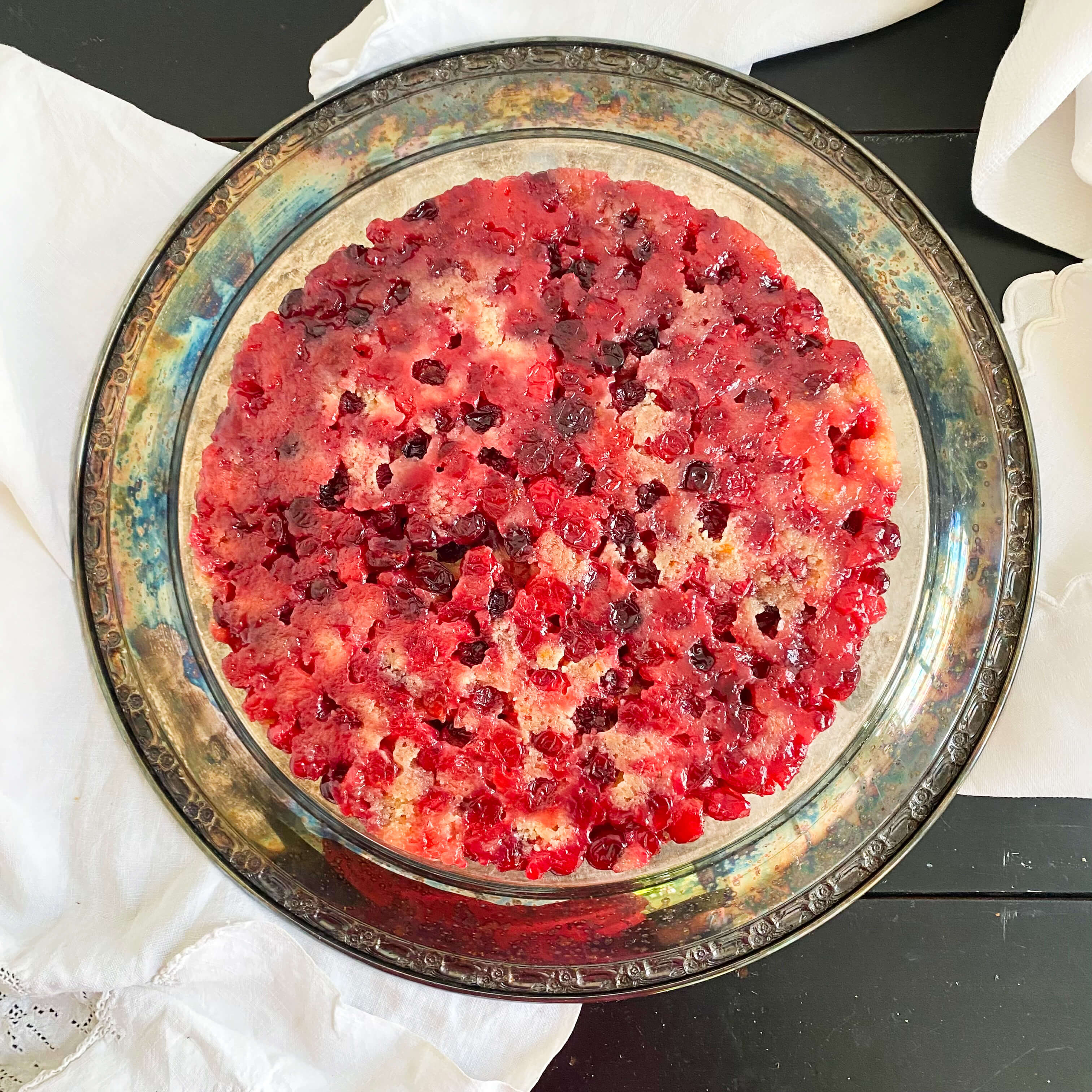
Sometimes, during the baking process, the cranberries will leave little pockets of empty space as they settle and reduce in the oven, as seen above. This is perfectly normal. The cake batter naturally fills in those gaps and forms a completely flat top when flipped over.

You can serve the cake just like this and it will taste great, but if you want to fill in those bare spots with a little more cranberry color, follow the simple steps below to make your cake extra rosy.

Special note: This extra step takes no longer than 15 minutes.
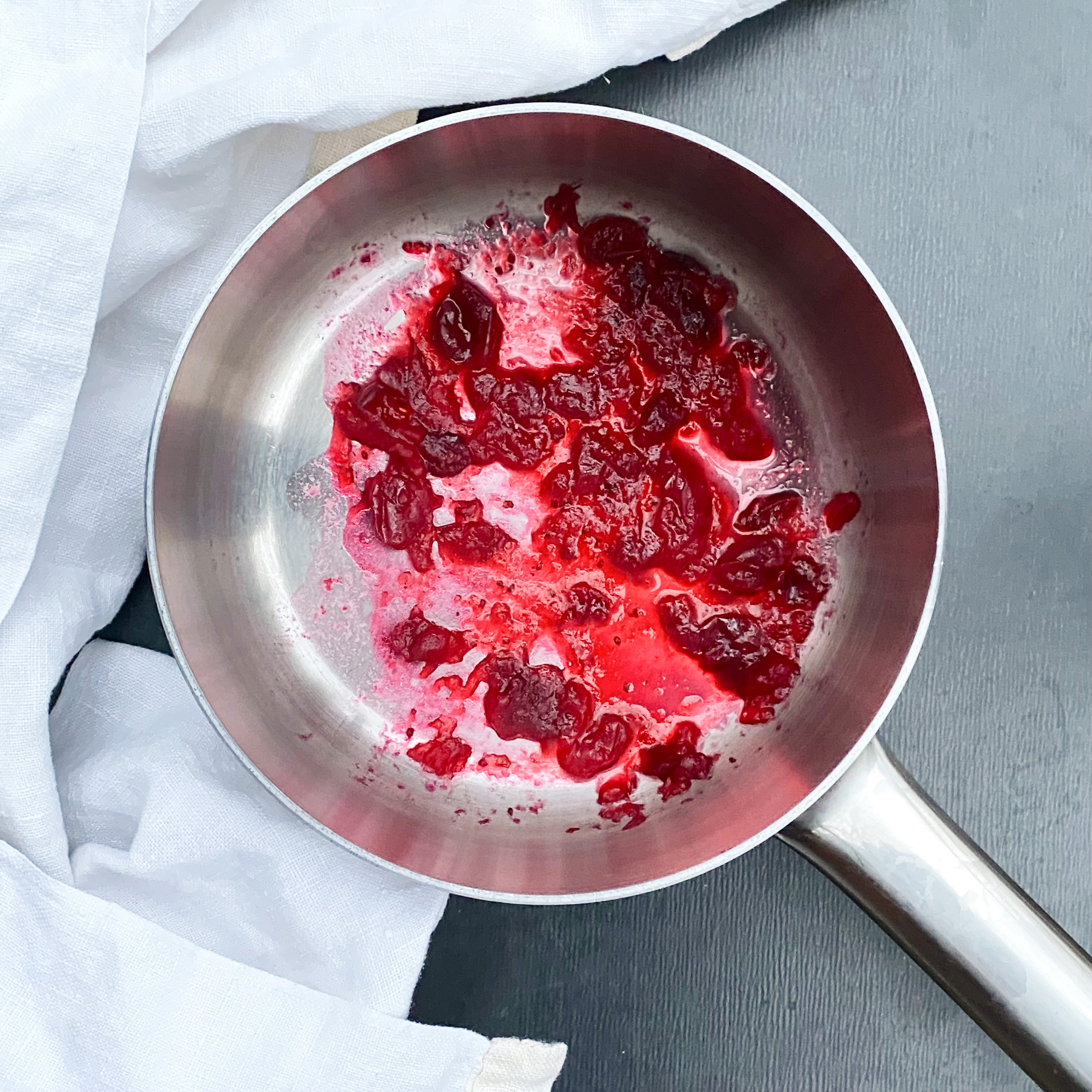
Add 1/2 cup fresh cranberries to a small sauce pan along with 1/3 cup cold water. Bring to a boil and simmer until cranberries begin to pop and soften. Add in 2 tablespoons of sugar and continue to simmer until enough liquid evaporates to form a syrupy consistency with the soft cranberries still somewhat intact or in a semi-crushed state. Remove from heat and let cool for 5 minutes. Then fill in the bare areas on the cake using a soup spoon.
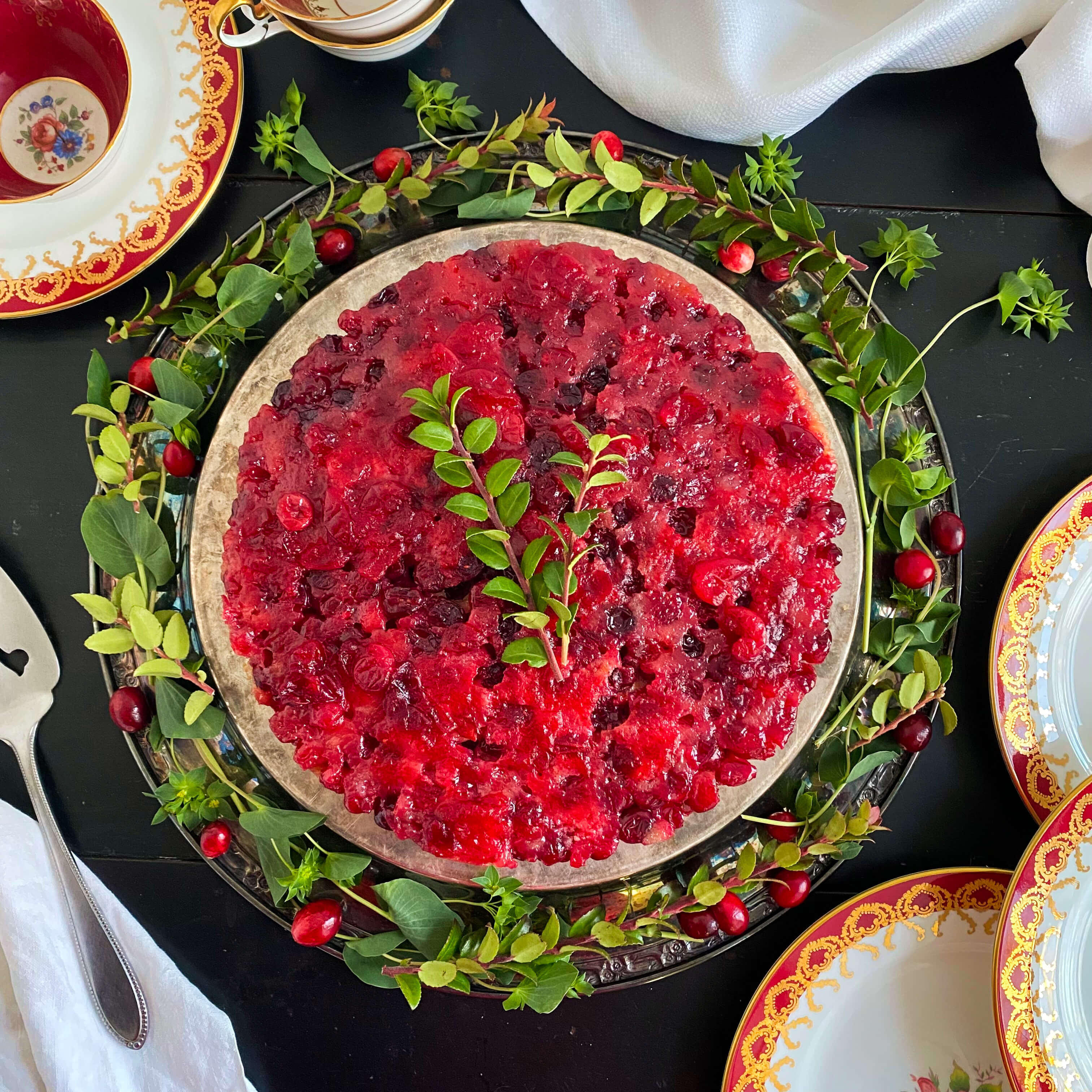
I always like to garnish the platter with a bit of greenery and fresh cranberries for centerpiece presentation at the table. Slice and serve each piece of cake with a dollop of freshly made whipped cream.
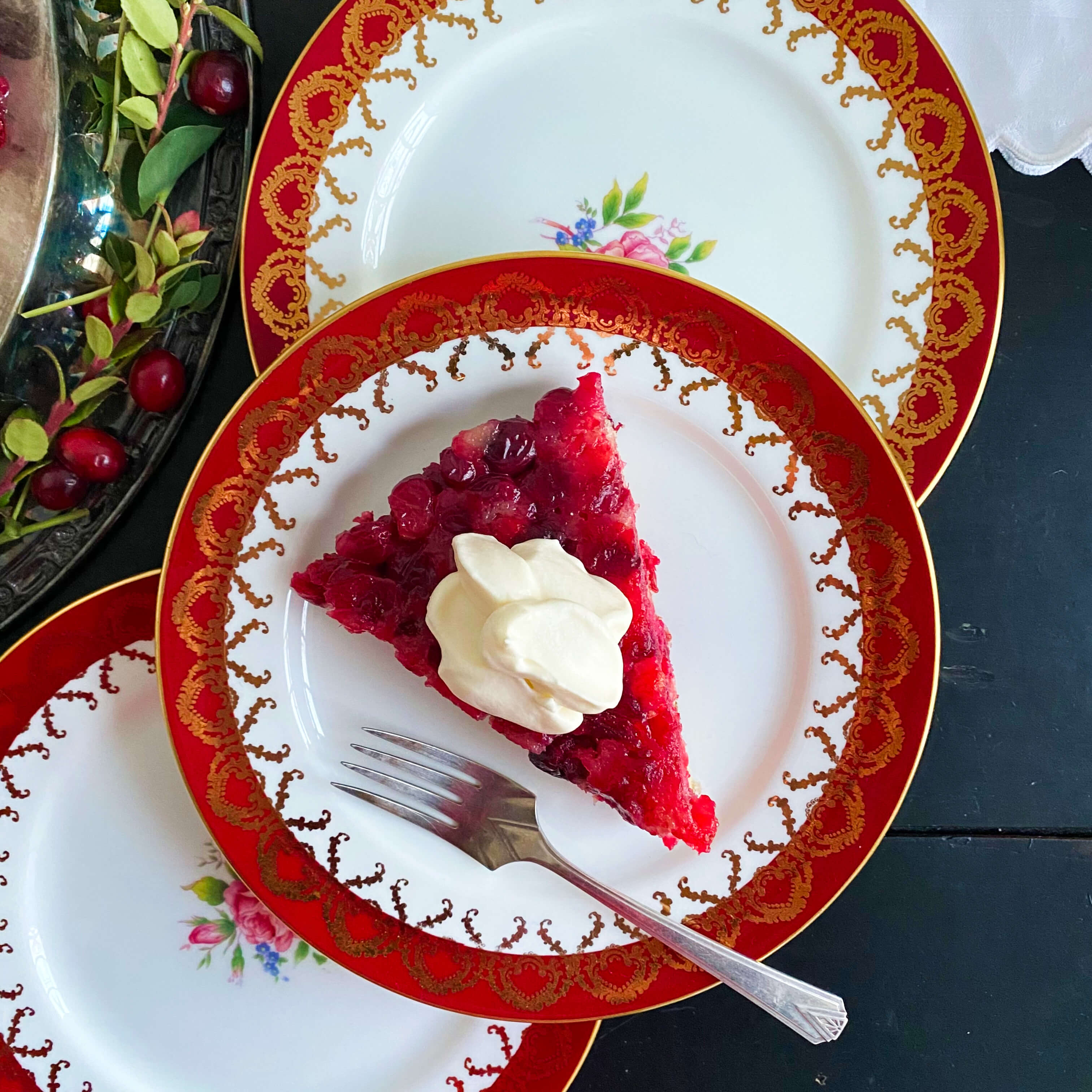
The texture of my family’s version of this recipe is thin with a more substantial cake, similar to the density of banana bread or the top of a muffin that is chewy with a slight crunch to it. Since this recipe does not call for a lot of sugar, it offers a lovely sweet tart flavor profile thanks to the cranberries. The orange rind adds a delicate dose of fresh citrus to brighten the flavor of the fruit and balance the butter. Definitely do not forget to serve it with homemade whipped cream. I like to whip the cream to a consistency of soft peaks rather than firm peaks for this recipe, so that the cream lightly sits on top of each slice of cake like a cloud.
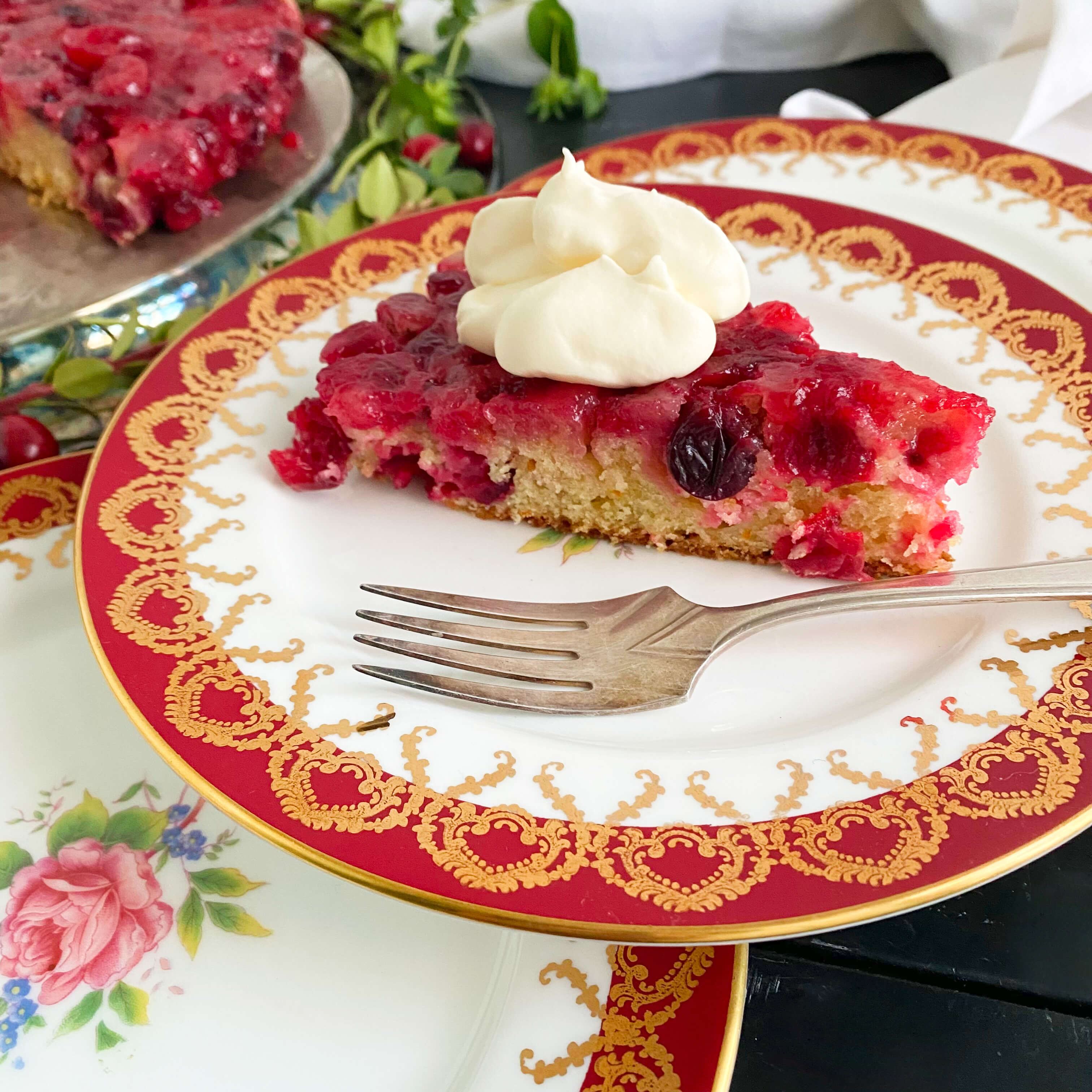
Although Cranberry Upside-Down Cake is the simplest of desserts, it carries intense flavor. If you can find local cranberries, eggs, butter and milk, all the better. Living in New England, I was able to source local Connecticut cranberries and eggs for this recipe, but grocery prices being what they are today, one of the distinct joys of this dessert has always been its economy, so incorporate the best ingredients that you can afford. It will turn out wonderfully regardless of budget.

This cake easily serves eight people, but you can also stretch it to 16 if you slice the pieces thinly. When it comes to a flavorful cake like this one, a petite slice can sometimes feel even more indulgent than a big slice. Portion size aside, it’s great served warm, at room temperature, or cold straight from the fridge, and it is especially lovely when paired with a cup of hot coffee or tea.
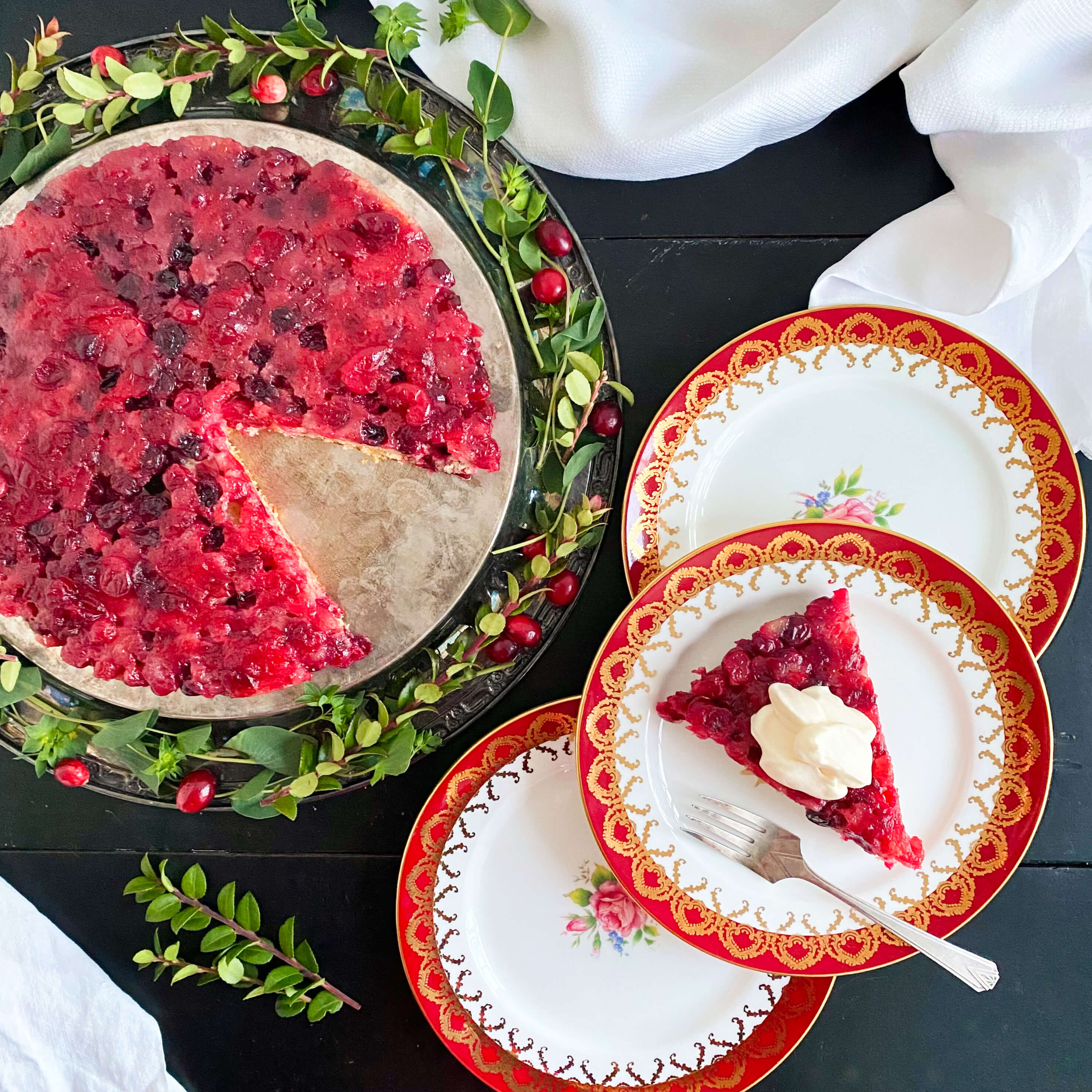
A centuries old symbol of peace and friendship, cranberries were an important part of life amongst indigenous tribes of early America. I like to think they still carry that same power via recipes we make today. I couldn’t think of a more symbolic fruit to wrap up the end of the year with than this small sweet, tart, hearty and humble marble of a bright red berry. I hope this recipe brings a sense of calmness and ease to your holiday kitchen and delight to your dining table and all the companions that surround it.

Cheers to a lovely holiday, to the new readers we have welcomed to the blog this year, to my mom for introducing this favorite, and to our entire culinary community. May peace, friendship, and memorable meals swirl around your kitchen throughout all the days of the new year to come.

Happy Holidays!

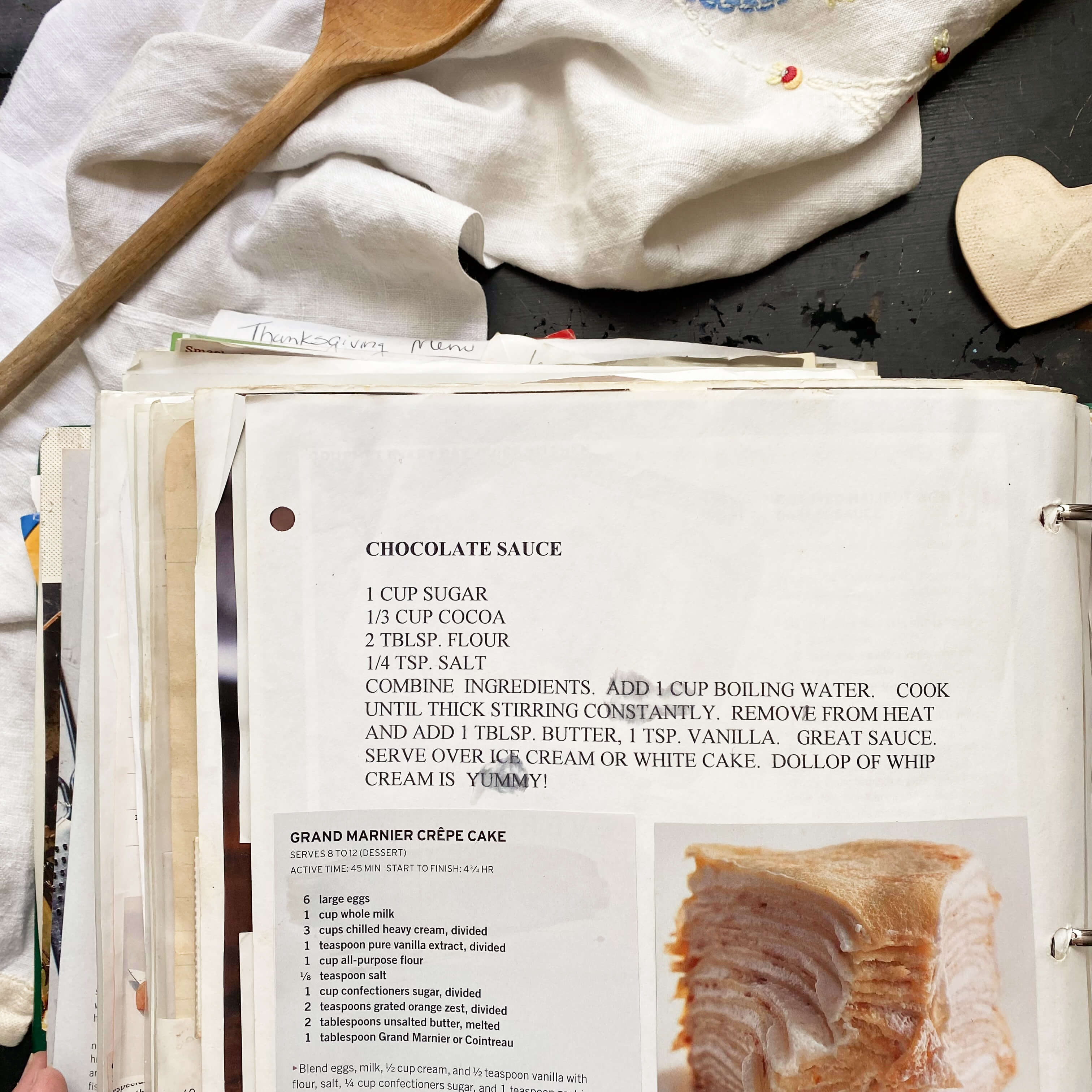
Celebrating Mom: Homemade Chocolate Sauce & The Power of Passed Down Recipes

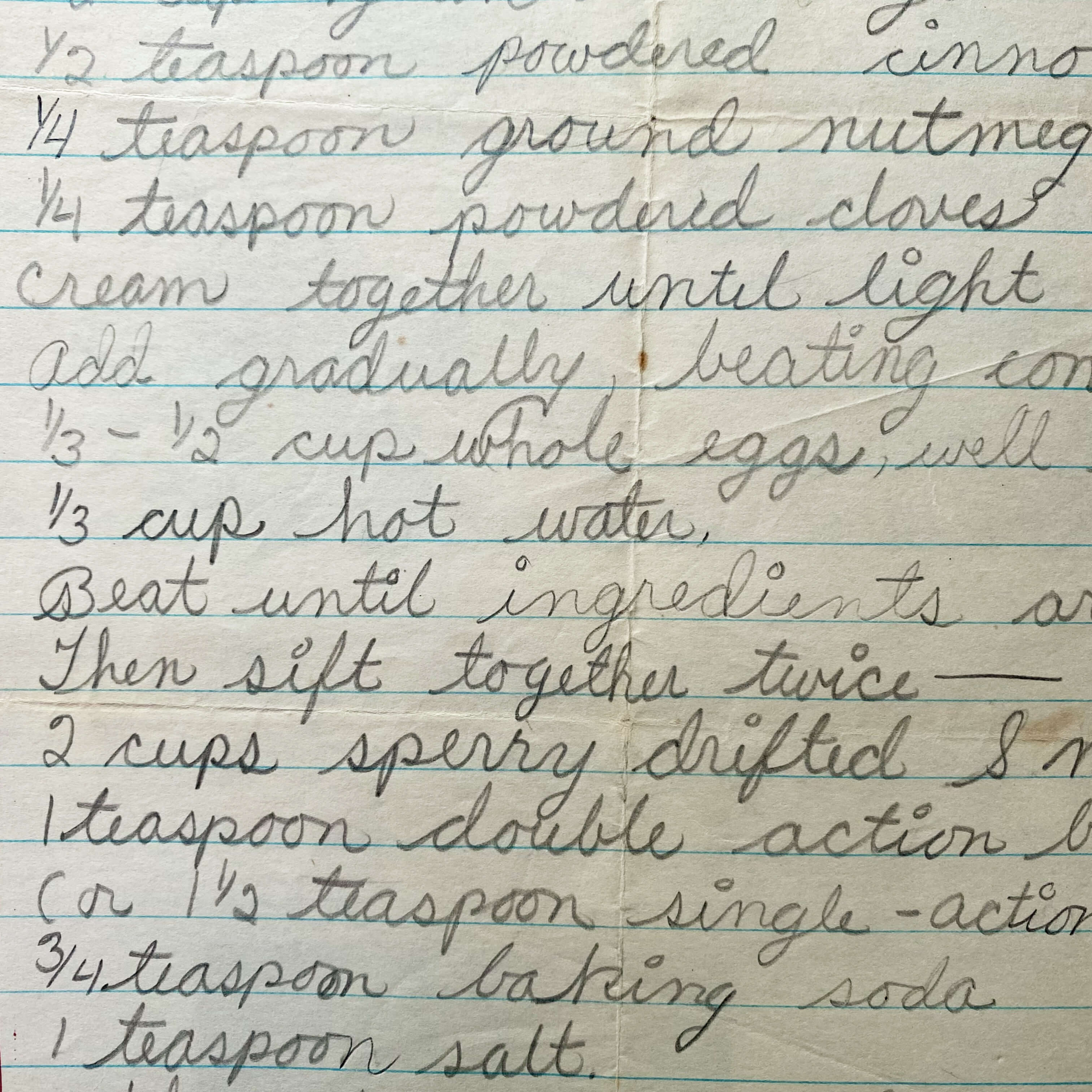
There it is. In all the swoops and swirls, the dips, the flourishes, the misspellings, the slanted letters, the shaky hand. There’s the story and the memory. There’s the cook. There’s the guy, the gal, the friend, the aunt, the spouse, the sister, the dad, the mom. There’s the he, the her, the who, the what, the when. There’s the life.

Handwritten recipe cards and cooking scrapbooks are the heartbeat of the kitchen. They are the record keepers of culinary explorations. The physical testaments of good times and good food. The guardians of memories that ensure that loved ones long gone remain present and that favorites stay afloat.

On a handwritten recipe card, no one ever dies or moves away or leaves the friendship or the family. With every dot of an i, cross of a t, loop of an o, handwritten measurements, ingredient lists, and instruction guidelines pass over illnesses and arguments, ignore long distances and intermittent communications, rise above world events and traumatic upsets. They defy decades and borders, cities and languages, personality clashes and cultures. Hands down, there is no better way, and definitely no more delicious way, to get closer to a memory or a person than through food made from a recipe that has been passed down from one cook to another.

Whip up Aunt Louisa’s banana bread, Grandpa Gordon’s hot fudge cake or Cousin Camilla’s corn chowder soup. Put on a pot of Paula’s poblano chili or Theresa’s heirloom tomato sauce. Mix up a casserole of Betty’s baked brown rice or Sarah’s cheesy egg souffle, and these cooks suddenly appear in exactly the way you remember them. It doesn’t matter if the recipe is two years old, 28 years old, or 200 years old; magic still surrounds the very foods that once made the making of them so memorable.

In the late 1990s, my mom made a slim binder for each of her kids filled with all of our favorite family recipes. At the time, she was just learning how to use a computer, so instead of handwriting each one, which she normally would have done if there wasn’t so many recipes and four sets of copies to be made, she typed them out page by page, category by category, and printed them out. One copy for each binder.

I don’t recall how long it took her to type these recipes into the computer, nor exactly how many she included, but I do remember the excitement that I felt when the binder arrived. My mom grew up in a small town in the Pacific Northwest during the 1940s and was raised on food she often describes as wholesome and nutritional. Her parents valued hard work, resourcefulness, outdoor activities, and homemade food always made from scratch.

My mom and grandmother.

My grandmother would be the first to say that she did not think of herself as a great cook, but everything she ever made that I remember was delicious. Pot roast, twice-baked potatoes, homemade bread… those were some of her specialties. My mom learned the basics of cooking not so much from her mom but from her home ec class in school. When my mom became a mom herself and moved to California, my oldest sister remembers simple recipes and a lot of health food coming from the kitchen while she was growing up in that same from-scratch manner that my grandmother championed too. Fifteen years later, when I came along and the whole family was living in New York, my mom was traveling the world with my dad, courtesy of his airline executive career. Her culinary palate and pursuits expanded to include more international cuisine from the places she was often visiting. France, Italy, Germany, Egypt, Greece, Africa, Asia, the Mediterranean all influenced what she was making at home in one way or another.

My mom in Monte Carlo in the 1980s, shortly before we enjoyed a spectacular dinner of homemade risotto aboard our friend’s boat. Sadly, much to my whole family’s disappointment, we never collected that recipe to share.

Like my grandmother, my mom wouldn’t openly boast that she herself is a great cook. Even though the food she prepares has always been, and still is, undoubtedly delicious, and she’s well known among her friends and family for making lovely meals. But what she lacks in confidence or personal recognition, she more than makes up for in wholeheartedly promoting a good recipe when she sees one.

While I was growing up she was a devout reader of magazines like Sunset, Food & Wine, Bon Appetit, and Gourmet. My parents entertained quite a bit, often treating their NYC restaurant-regular-eating friends to a home-cooked meal at our family house located in a sleepy suburb along the Hudson River. And because my dad did a lot of dinnertime/cocktail party networking, my mom was always trying out new recipes on us kids that would be suitable for party fare or hosting my dad’s European colleagues.

So when her slim binder arrived in the mail just after I finished with college and was ready to start throwing my own dinner parties, it felt like the best, most dependable gift in the world. Thanks to her binder, I had all the good recipes in hand. The ones that always brought comfort, the ones that always received rave reviews, the ones that traveled well for potlucks and picnics, and the ones that looked especially pretty on a plate. The ones that came from her sister’s kitchen (also a wonderful cook) and the ones that came from her mom and dad and their parents. And the ones that my mom had perfected over years of revisions. In the binder were all my favorites… Thanksgiving stuffing, Grandma’s casserole, all the fruit pie recipes, the Israeli chicken, Aunt Patti’s chocolate layer cake, the tortellini summer salad, the three bean casserole, the German-style chicken with the creamy noodle sauce, the much-loved potato salad.

Not long after the binder arrived, my grandmother passed away at the age of 97. One of the things I asked my mom if I could have was some of my grandmother’s handwritten recipes from her recipe box. Back home, I taped each one, a little over two dozen in total, into the blank areas that separated one typed recipe from another in the binder. Those early additions of Grandma’s recipes led to further cutting and pasting inclusions as I, too, discovered and collected recipes from various sources. Friends, food magazines, newspapers, on-loan cookbooks, my brother and sisters, their spouses, their families, my husband, his family and a whole host of people I’ve had the joy of sharing a meal with along the way over these past decades all have a presence via a recipe or two or twenty in the binder.

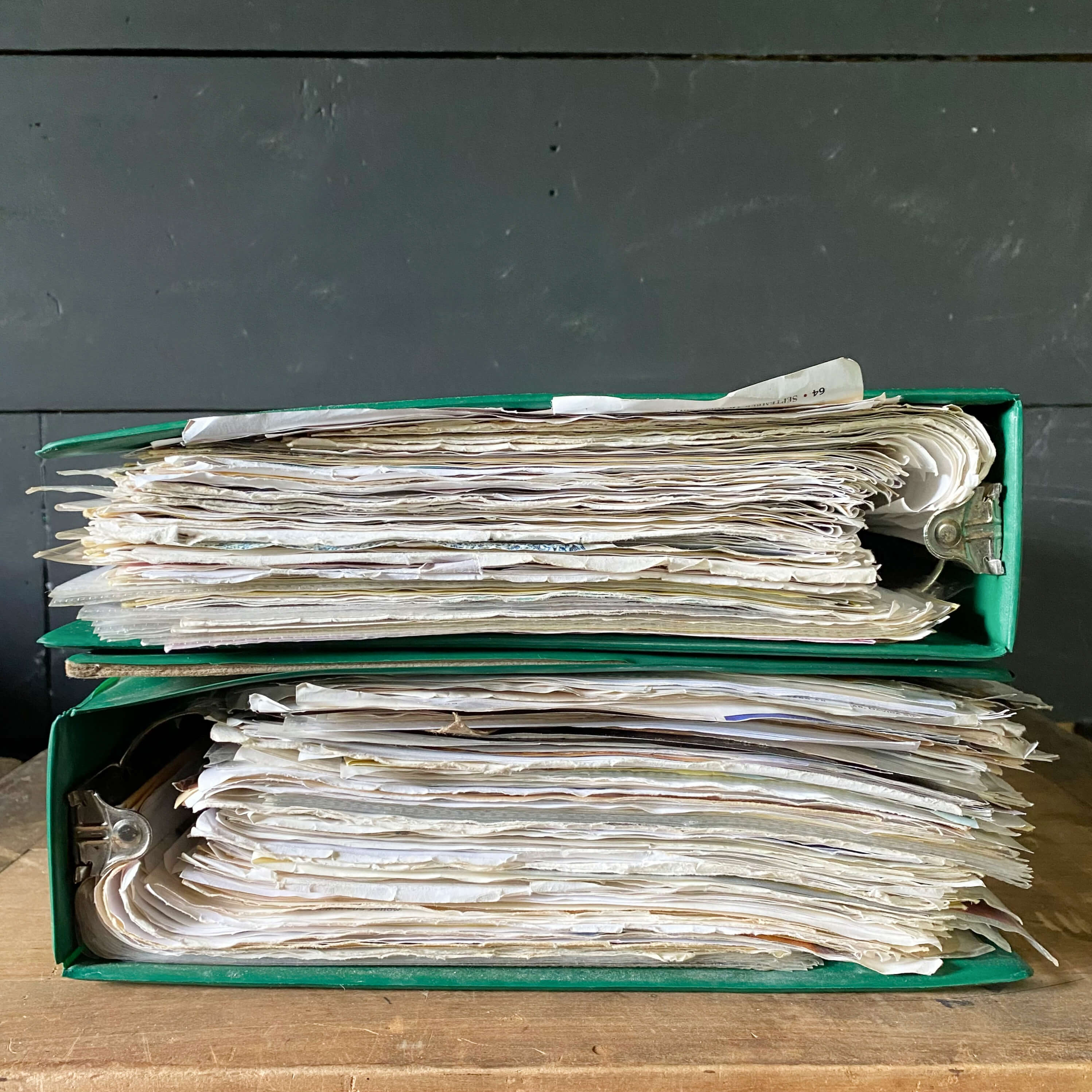
With each new recipe addition, my enthusiasm for cooking grew and grew. The binder grew and grew too. Eventually, it outgrew the slim size that my mom initially packaged the favorites in, and I transferred everything to an extra-large 3-inch binder. Quickly enough, that one filled up and overflowed, too. So a second extra-large 3-inch binder was acquired, and I divided half of my mom’s original categories into one binder and the other half into the second binder, thinking that I had arrived at the ultimate storage solution. But my enthusiasm for cooking and recipe collecting has yet to calm down, and the two binders are now stuffed full to bursting once again.

Despite their stuffed sausage appearance, now when I flip through these two binders, I see nothing but joy in years and years of memories. I see my mom’s handwriting in the original recipe category tabs.

I see my husband’s handwritten recipes for his pork pie inventions.

I see my sister-in-law’s slightly charred recipe card for baking powder biscuits that accidentally got stuck to the bottom of the baking sheet and cooked right along with the biscuits. I see the handwriting of my dearest friend, whom I’ve known since kindergarten, on a recipe for oven-roasted leeks that marks the first Thanksgiving that we cooked together.

There’s a recipe from my dad’s ex-wife written on his airline office stationery taped into the casserole section. There’s my grandmother’s delicate and lacy penmanship, my aunt’s large and loopy handwriting, midcentury recipe cards, tanned newspaper clippings from up-and-coming chefs featured in the New York Times, and hundreds of hand-cut recipes from all the great cooking magazines before they went online, before they created paywalls to access them, or before they folded for good. Recipes from Saveur, Bon Appetit, Gourmet, Southern Living, Cooking Light, Martha Stewart Living, Food & Wine all fill these binder pages, making them like my own homemade version of epicurious.com

The gift that my mom gave me years ago is the gift that has literally and figuratively kept on giving day in and day out. And it just keeps on encouraging more cooking and more collecting. That’s the power of a good passed-down recipe. I have my mom to thank for all this collecting and curiosity. For my love of old recipes and the memories they represent. My mom and I don’t always see eye to eye on everything, but when it comes to cooking, we have a shared interest and a mutual understanding surrounding food and meal-making that can always bring us together.

A lot of people inspire me when it comes to cooking, but it’s my mom’s slender binder of a book that was the original muse that started all this recipe collecting to begin with. I don’t think she could have known the depths to which I would eventually come to love her gift while she was typing away at those recipes on the computer all those years ago. How much her act of recording them would come to mean so much to my culinary journey. But now those recipes are among my most prized treasures. So it’s with a sincere heart on this Mother’s Day, that I wanted to say thank you to my mom for the joy she created in passing down our family favorites.

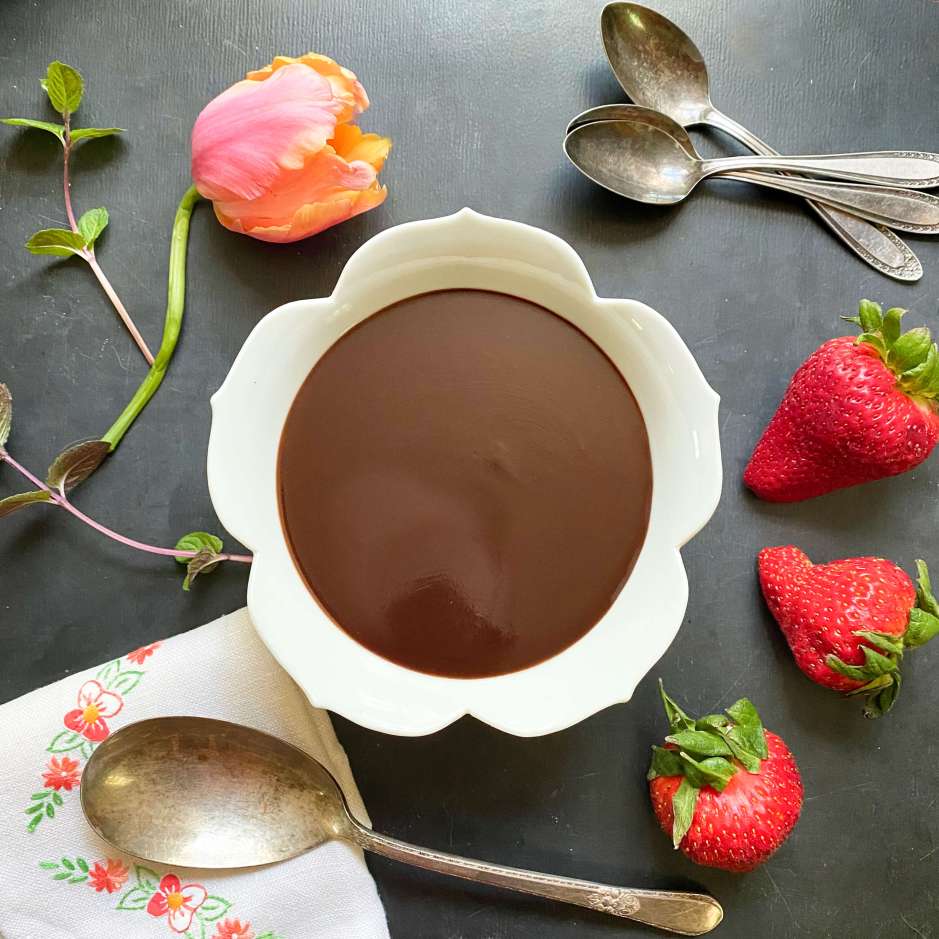
To celebrate the day and the occasion, I’m so happy to share one of the recipes from my mom’s family favorites collection. The recipe is for homemade chocolate sauce. A sweet treat companion that both inspires and complements so many other desserts.

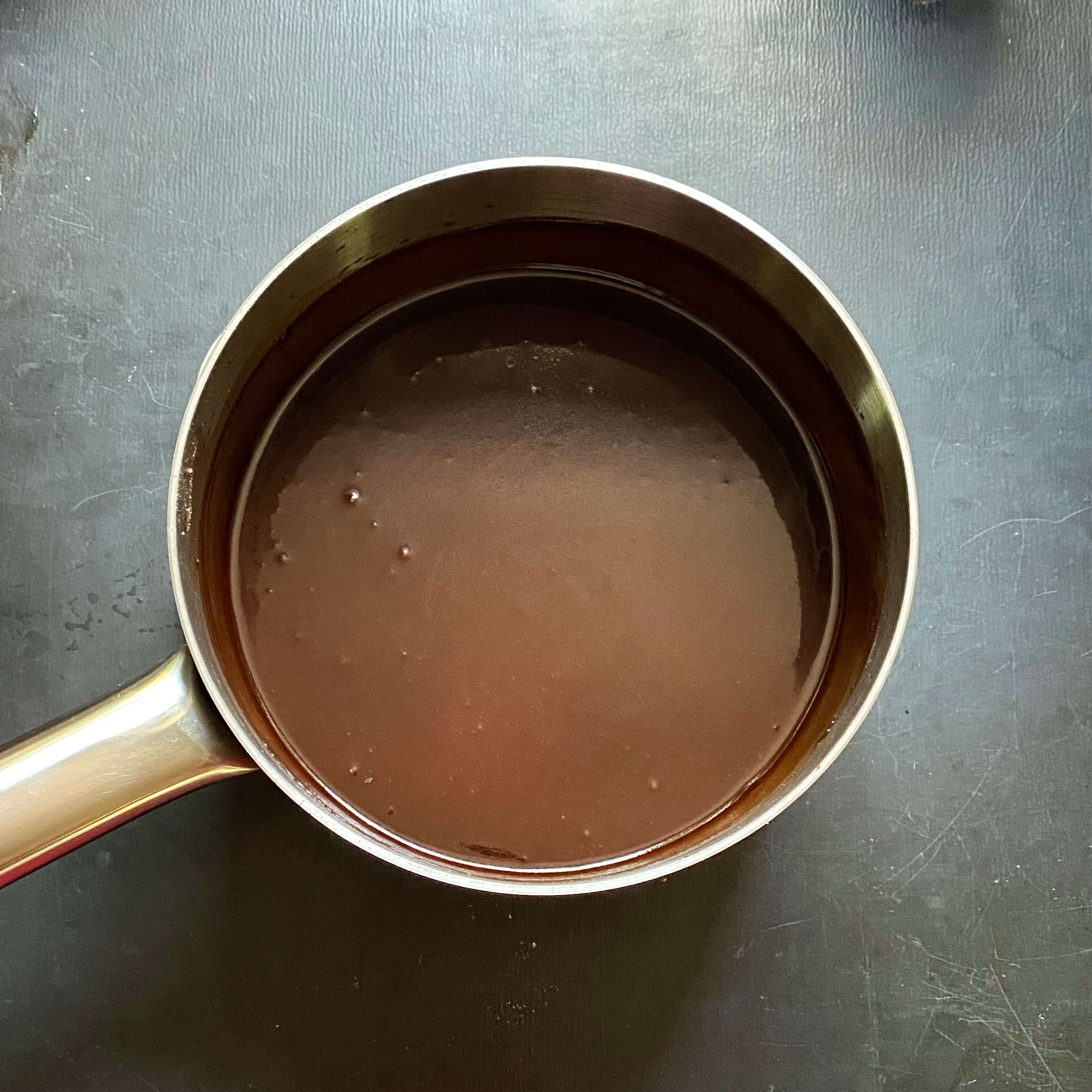
Quick to make (less than 15 minutes) and lovely for all sorts of foods, it is thicker than syrup, yet thinner than frosting in consistency. It can be poured over ice cream like a hot fudge sundae, drizzled over a simple sheet cake like frosting, layered in clear glass stemware for parfaits, or served like a dipping sauce for fresh fruit.

Always a winner in my book, I have made this recipe so many times for so many different holidays from Valentine’s Day to Christmas and every season in between. I’m not sure where my mom got the recipe from – if it was truly a family recipe that was passed down to her or if it was just a favorite that she picked up somewhere along her culinary adventures. I could Google these ingredients and probably find the source pretty quickly, but for once, the provenance doesn’t interest me. I’ll always think of it as my mom’s homemade chocolate sauce. And in turn, whenever I make it, I always think of my mom and her gift of good food. Tried and true.

Chocolate Sauce

Makes 2 cups

1 cup sugar
1/3 cup unsweetened cocoa powder
2 tablespoons flour
1/4 tsp salt
1 cup boiling water
1 tablespoon butter
1 teaspoon vanilla

Mix together the sugar, cocoa powder, flour, and salt in a medium saucepan.

Add in 1 cup of boiling water and stir constantly over medium-high heat while the mixture comes to a slow boil.

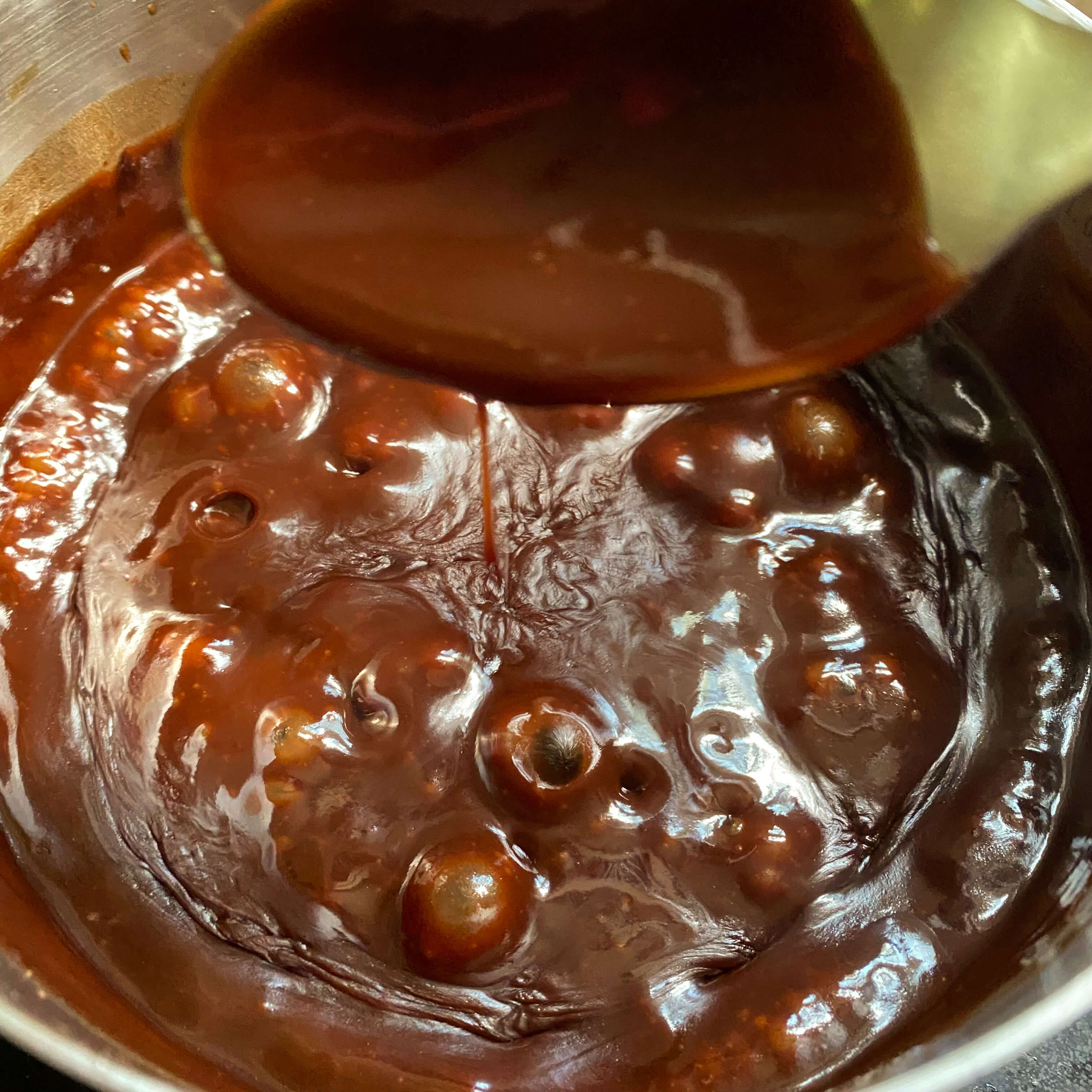
When the consistency thickens enough to coat a spoon but still drips off the spoon in a slow, steady stream, drop by drop, it’s ready to be removed from the heat. This consistency level usually takes about five minutes to achieve. Stir in the butter and vanilla. Serve hot or let cool to room temperature. If you have any leftovers, it stores well in the fridge in an air-tight glass jar for up to five days.

If you serve this as a dipping sauce with fruit, in a parfait, or over ice cream, let it cool to room temperature. If you are serving it over cake, serve it hot. There’s also room to add your own additional accompaniments too in the form of chopped nuts, coconut flakes, or a dollop of whipped cream as my mom suggested in her original recipe. However you choose to enjoy it, I hope it becomes a new favorite family recipe in your kitchen too.

Happy Mother’s Day to all the moms out there who inspire kitchen adventures in more ways than one. And cheers to my mom, for every single home-cooked meal, every single shared recipe, and every single family favorite that was recorded in the marvelous, magical gift that has now become my most treasured memory-keeper in the kitchen.

Italy’s Chicken Canzanese and The Family of Artists Behind The Recipe

It’s just the start of 2024, but here in the Vintage Kitchen, there is a finish line coming into view. This year we will be wrapping up a five-year project that first started here on the blog in 2020. I’m so happy to say welcome back to The International Vintage Recipe Tour.

international-vintage-recipe-tour

What started out as an intended year-long project of cooking 50 recipes from 45 different countries in 2020 has now taken five years to complete just to the halfway mark. A pandemic, a tornado, a big cross-country move and 1750 House renovations have waylaid plans far more than ever anticipated, but this project has always been such a joy I never wanted to not finish it. So here we are, at the start of 2024 finishing things up from 2020.

For a quick recap and for anyone new to the blog, The International Vintage Recipe Tour takes home cooks and readers on an around-the-world adventure via the kitchen, as we cook our way through a collection of recipes featured in the 1971 New York Times International Cookbook.

the-new-york-times-international-cook-book
The vintage 1971 cookbook that launched the Vintage Recipe Tour.

Throughout the Tour, we are visiting 45 countries via the kitchen and making at least one traditional heritage food from each, sharing both the recipe and the cooking experience here on the blog. To add context to the food we are making, and to spark some new conversations around the table, every visit to a new destination is paired with a unique cultural story from that country’s history.

So far we’ve visited twenty-four countries via the kitchen on this tour… Armenia, Australia, Austria, Barbados, Belgium, Brazil, Canada, Ceylon, China, Colombia, Cuba, Czechoslovakia, Dahomey, Denmark, England, Fiji, France, Germany, Greece, Haiti, Hungary, India, Indonesia, and Israel. It’s been a whirlwind of fun, friendship and delicious food.

Highlights from the Recipe Tour!

We chatted with an author and a food columnist via Armenia, met a descendant of the designer of the Statue of Liberty via Germany, and embraced our inner bula in Fiji. We discussed tropical architecture in Haiti, made floating paper lanterns to celebrate the Hungry Ghost Festival in China and donated funds from shop sales to help save the koalas injured in the Australian wildfires. We discussed women’s fashion in India, interviewed a Cuban-American farmer in Miami, and learned about a long-lost African-American dance in Dahomey. On the food front, we curried in Ceylon, baked Queen Mother’s Cake in Australia, made homemade mustard in Denmark, learned that not all fondue comes in a hot pot in Belgium, and took a much-needed virtual vacation to Corfu via Greece.

A visit to Corfu

Our latest stop on the tour was Israel, which lined up with the 2021 holiday season. To celebrate we made a Hannukah wreath, cooked two recipes for dinner, and dove into the history of both the Jewish flag and the Jewish star. Now, our next stop on the International Vintage Recipe Tour takes us to Italy, one of the most beloved cuisines in the world. Here we’ll make a provincial meal meant for sharing and meet an artist whose family recipes formed the basis of a life-long passion with food. Welcome to Italy.

It’s impossible to write about Italy without writing about family. And you can’t write about this recipe, Chicken Canzanese without writing about a specific family. Like France and China, Italy is one of the largest chapters in the New York Times International Cookbook. There are literally dozens of recipes to choose from, a switch from some countries that had less than a handful.

Besides the long wait to get the Tour started again, the hardest part about starting up again with Italy was which recipe to choose and which cultural treasure to spotlight. Contenders in that department were Stanley Tucci’s gorgeous Searching for Italy show, the multi-generational novel The Florios of Siciliy and the genealogy of the love apple (aka the tomato). There were all the pastas and all the sauces, lovely vegetable side dishes, and quite a few desserts to pick from, but the recipe that I kept coming back to was a one-pot chicken dish that was credited to an artist.

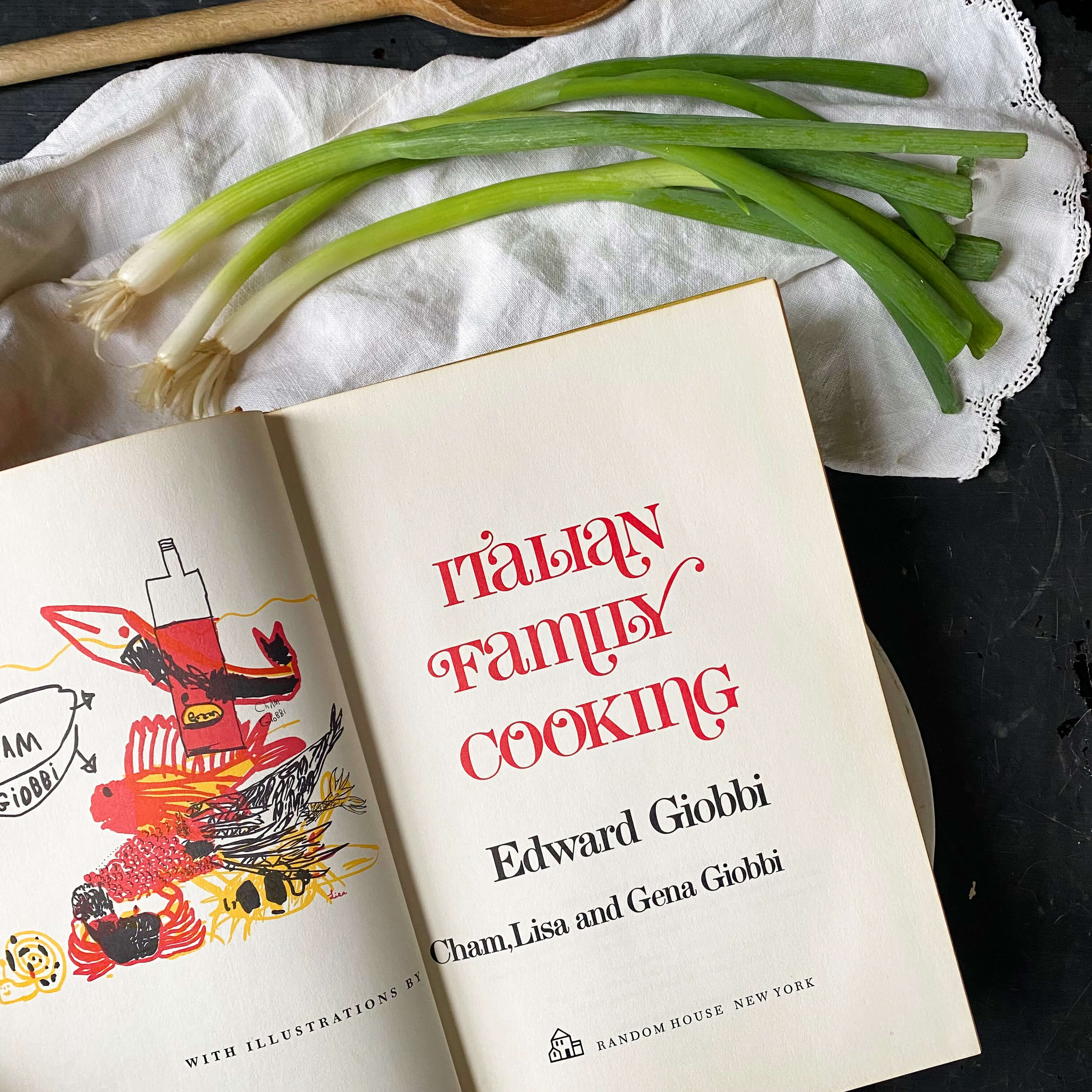
Last fall, while visiting a local bookshop, I discovered a bright yellow 1970s Italian cookbook. To my sheer delight and surprise, it was written by the same artist mentioned in the New York Times International Cookbook. A quick peek inside revealed the same exact recipe that was also featured in the NYTimes cookbook. The same recipe by one artist in two different books. It was a sign. This was the right Italian recipe for the Tour and the right time to tell a story about a creative spirit, who also happened to be an Italian cookbook author.

The artist is Edward Giobbi, a second-generation Italian-American born in Connecticut in 1926. Still painting today from his home studio in Katonah, New York, at the age of 98, Edward’s lived his entire life in pursuit of art and food. The book that made him well-known in the culinary world was his Italian Family Cookbook, first published in 1971. Selling over 30,000 copies by the 1980s, it offered home cooks a sincerity that resonated on multiple levels when it came to preparing economical and creative meals in true Italian style. The recipe featured here today, the one that appears not only in Edward’s cookbook but also in the New York Times International Cookbook, is his Chicken Canzanese, a slow-simmered one-pot made of chicken, herbs, wine, spices, and prosciutto.

A lovely selection for these end-of-winter days when the weather is jockeying back and forth between spring-like temps and snowstorms, this recipe is both light and hearty, depending on the sides that accompany it. It’s easy to prepare, has a warm, rich, earthy fragrance thanks to the prosciutto, garlic, and herbs, and can definitely be labeled a healthy comfort food since it contains no added fat.

The cooking prep is also interesting. There is a cold water brine, a unique set of flavor pairings, and a few very precisely measured spices… twelve peppercorns… six whole cloves… two sage leaves. I always find precise measurements like this fascinating. What was the process that a cook went through to determine that perfect balance of six versus seven cloves or nine versus twelve peppercorns? Would three sage leaves as opposed to two send the whole meal over the edge?

Edward Giobbi, tasting and testing in his kitchen circa 1971. Image courtesy of The News Messenger. Aug 12, 1971

As it turns out, Edward’s style of cooking and how he first learned it was based on quality but also frugality. Growing up during the Great Depression taught him and his family the value of growing your own food and utilizing agricultural resources close to home. Nutrition was key to keeping everyone healthy. Nothing was wasted or under-appreciated. Every bit of joy that you could scrape from an experience mattered. As an adult, Edward approached food in much the same way.

In the NYTimes cookbook, the recipe for Chicken Canzanese is simply attributed to Ed Giobbi, the artist. But in Edward’s cookbook, Italian Family Cooking, it’s attributed to Edward’s mother by way of a woman who lived in Canzano, in the Abruzzi region of Italy.

The Abruzzo region of Italy. Photo courtesy of iStock.

Located in the middle of the boot, Italy’s beautiful Abruzzi/Abruzzo region borders the Adriatic Sea and also the Apennines Mountains, both of which provide ample agricultural opportunity. Canzano is 105 miles east of Rome, and 230 miles southeast of Florence, and although geographically considered central Italy, the culture and food traditions of this area mirror that of Southern Italy.

Abruzzo, Italy. Photo: Sterlinglanier Lanier.

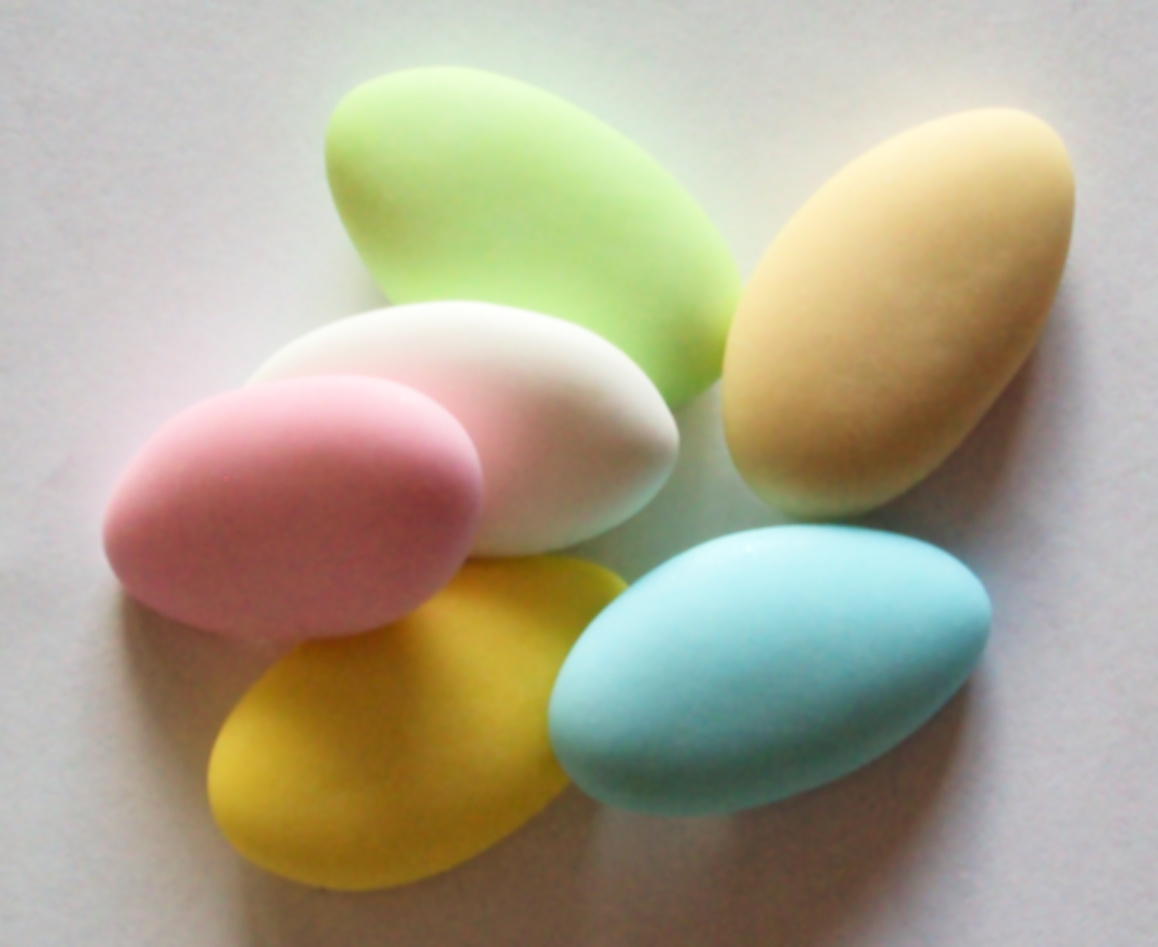
Full of food specialties ranging from provincial fish soups to local lamb dishes to plates of handmade pasta the traditional foods of Abruzzo favor both its maritime and mountain environs. Incidentally, this area of Italy is also known for a food often consumed at weddings here in the US. It’s the birthplace of the pastel-colored, candy-coated Jordan Almond, also called Italian Confetti locally.

All the pretty pastel shades of a Jordan Almond.

Edward’s parents immigrated to the US in the early 1900s first to Pennsylvania and then to Connecticut where they labored in factories and mills. Even though they both just had a third-grade level education, his parents had an appreciation for food, art and music which made a strong impression on Edward during his childhood. The Giobbi family kitchen would come alive at night and on weekends with the scents and flavors of his parent’s home country.

Life with Flowers. Edward Giobbi. 1958

Once he left home to pursue his art, his mom’s heirloom recipes became a vital part of the creative process as he perfected each one in his own kitchen, practicing them over and over again, until they met her standards and his memories. That dedication to good food and good eating, combined with artistic sojourns to stay with extended family in Italy sealed his love of cooking indelibly.

By the time Edward married and had his own family, preparing daily meals was a pleasure equal to painting. In his children, he instilled a similar joy. Art and cooking became a throughline that ran strong in the new generation of the Giobbi family members.

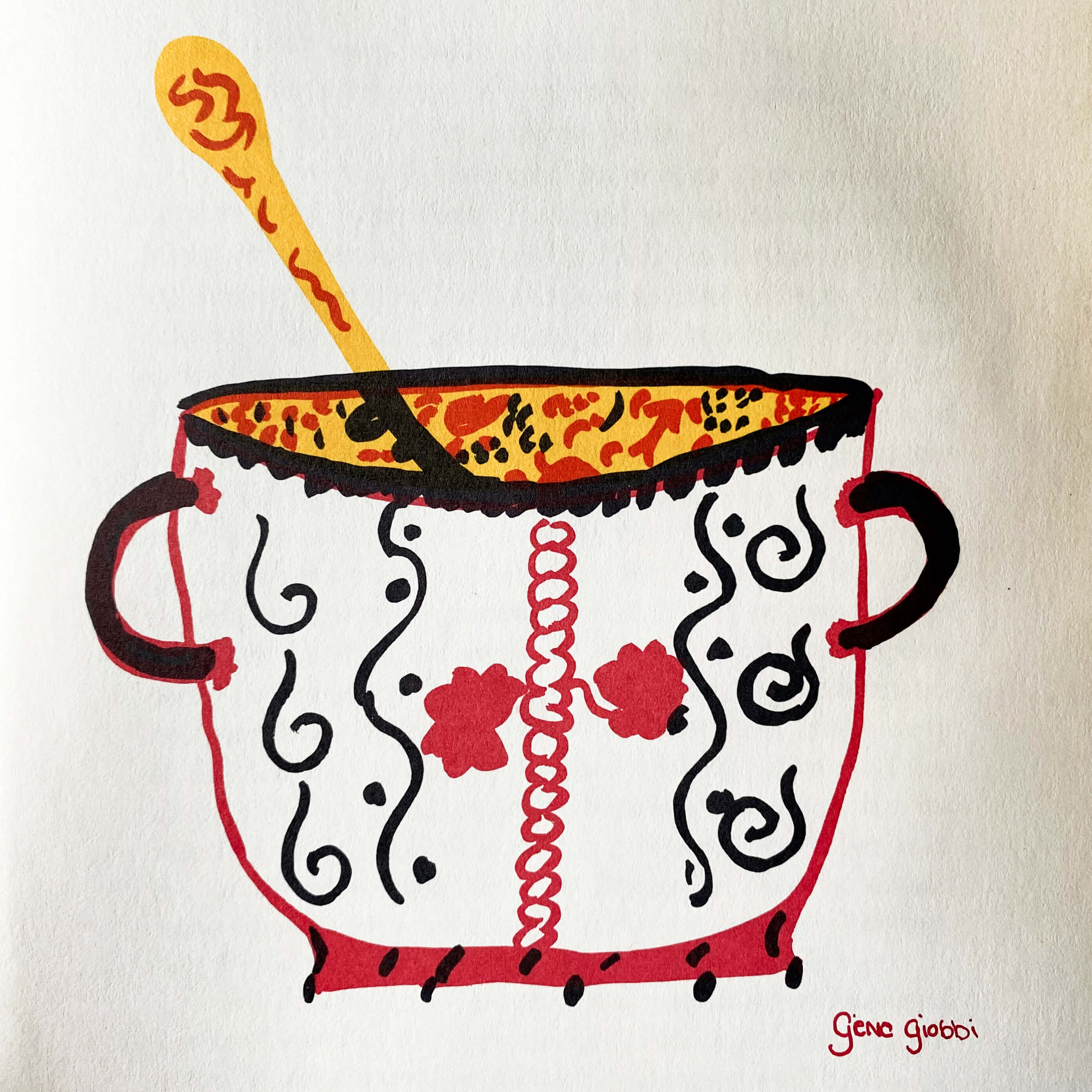
Apart from the myriad of wonderful traditional Italian recipes in Edward’s cookbook, the illustrations stand out with vibrant appeal and eye-catching charm. The art was executed not by a hired freelancer or a publishing industry dynamo. It wasn’t executed by a professional food photographer or a graphic design studio. Instead, the illustrations for his cookbook were illustrated by a collection of painters entirely new to the world – his children, Cham, Lisa and Gena who at the time ranged in age from six to nine.

Edward gave his kids no direction when he asked them to paint pictures for the cookbook other than to say “draw a fish, or a soup pot or a bottle of wine.” Each of his artists offered their own interpretation.

Whimsical and sweet, Edward Giobbi’s Italian Family Cookbook was indeed, in all ways, a family affair from kids to parents to extended relatives. It didn’t stop at this cookbook either. Edward went on to write another successful cookbook, Eat Right, Eat Well: The Italian Way (1985) and his band of illustrators grew up to pursue their own careers in art, dance, music and food science.

In keeping with the Giobbi clan’s combined love of the kitchen, nothing seems more fitting than presenting this recipe on a Sunday night when family dinner rules the kitchen in most Italian households. Named for the town in which it hails, Chicken Canzanese is a meal intended for communal family dining. Simple to make, it’s a two-step process that involves a one-hour wet brine and forty minutes of cooking time. True to Edward’s nature and his mother’s style of cooking, it’s made of simple ingredients and offers a bevy of creativity in the side dishes in which you choose to serve with it. More on those thoughts follow the recipe.

Edward Giobbi’s Chicken Canzanese

Serves 4

One 3 lb chicken, cut in pieces

2 sage leaves

2 bay leaves

1 clove garlic, sliced lengthwise

6 whole cloves

2 sprigs fresh rosemary or 1/2 teaspoon dried

12 peppercorns, crushed

1 hot red pepper, broken and seeded (optional) or 1 teaspoon dried red pepper flakes

1/4 lb prosciutto, sliced 1/2 inch thin or one 4oz package of pre-sliced prosciutto*

1/2 cup dry white wine

1/4 cup water

Salt for brine (see note)

Place the chicken pieces in a mixing bowl and add cold water to cover and salt to taste. *Note: I used a large mixing bowl and 1/8 cup of sea salt to 6 cups of water. Cover with plastic wrap and store in the fridge for 1 hour.

Drain the water and rinse the chicken pieces completely before patting dry with paper towels.

Arrange the chicken pieces in one layer in a skillet. Add the sage, bay leaves, garlic, whole cloves, rosemary, peppercorns and red pepper. Cut the prosciutto into small cubes and sprinkle it over the chicken. *Note: If using pre-sliced prosciutto, remove all the paper or plastic sheets between each slice. Stack the prosciutto one on top of the other, and cube the whole stack at once.

Add the wine and water. Do not add any additional salt, since the prosciutto will season the dish. Cover and simmer 40 minutes. Once the chicken has cooked to an internal temperature of at least 165 degrees. Uncover and cook briefly until the sauce is reduced slightly. Serve hot.
Rustic and earthy, Chicken Canzanese is tender and full of subtle flavors. The broth itself is fairly salty on its own thanks to the simmered prosciutto, but soak it up with a piece of crusty bread, and the briny flavor mellows. There were no serving suggestions mentioned in Edward’s recipe nor the NYTimes, but the broth would be lovely tossed in a warm bowl of pasta, spinach, peas, potatoes or mushrooms. If you are feeling decadent you could add a dash of cream to the broth to balance all the flavors. As Edward says in the introduction…”Cook the food in this book with a free hand, using your own creativity with the freshest ingredients you can get.”

Collected by museums and galleries around the world, throughout Edward’s long art career his style has varied…

Summer Shower, Pescara, Italy. Edward Giobbi. 1951

Dried Flowers #14. Edward Giobbi. 1999

Hanover, Triptych. Edward Giobbi. Exact date unknown – possibly 1970s.

He dislikes labels or being lumped into a certain type of painting, but he one thing Edward consistently strives for in his art instead is honesty. The same could be said for his cooking. All of his recipes are celebrations of local eating. They reflect riding the highs and lows of economy, of balancing cooking constraints with bounty, and the importance of identifying local resources. His recipes are interesting, creative, nourishing. They are of the earth and of the moment. I think that’s what makes Italian food so appealing. It’s a cuisine rooted in a waste-not culture that appreciates what’s right there in front – all the bounty that the earth can offer.

Fall Still Life- Edward Giobbi. Photo courtesy of Chroma Fine Art Gallery. Find out more about this painting here.

My favorite piece in Edward’s catalog of work is this one. I think it’s the most food and family-like of all his art. In my interpretation of it, I can see his whole entire world. His whole lineage in mixed media. There are blue fish in the sea at the bottom right. A mountainous landscape in the middle. There’s red for blood, life, wine and energy. I see flowers, woodland foraging, and garden soil. In my mind, that blob of brown represents all the possibilities that might grow from a simple swatch of ground. And the tree. The beautiful, exuberant tree surrounded by dots of confetti-like splatters and stars. That’s the Giobbi tree. The one that represents the vitality of nature, the sparkle of life, of wife, of children all rolled up in one. I could be reading too much into it. Maybe it’s just what the title says - Fall Still Life. Maybe it’s an autumn landscape in Canzano, Italy. Or a pairing of items Edward arranged in his home studio in Katonah, New York. Maybe it represents a lot more or even possibly a lot less. Or maybe… just maybe… it’s the word, the work, that Edward’s been striving for all along.. honesty.

Cheers to Edward for sharing his family’s Italian heritage with us here in America via books, art and storytelling. Cheers to his kids, Cham, Lisa and Gena for their fantastic illustrations. And finally, cheers to the unnamed woman in Canzano, who passed this recipe along. I wish we knew your name so we could credit you properly for the delicious dish.

If you’d like to catch up with the recipe tour from the very beginning days in 2020, start here or click on any of the country links mentioned above to visit those specific posts.

Next up on the International Vintage Recipe Tour, it’s a trip to Jamaica via the kitchen. Hope you’ll join us!

Comfort Cooking from the Family Archives: A Midcentury Recipe for Baked Macaroni & Cheese

The San Francisco Bay area may be most well known for its sourdough bread, Ghiradelli chocolate, and all things aquatic found at Fisherman’s Wharf, but in my family, we have another favorite to add to the list too. It’s an heirloom recipe that comes from the kitchen of my adventurous epicurean aunt, Patti, who lived thirty miles south of the Golden Gate Bridge in a foggy seaside utopia called Half Moon Bay.

Always known as an agricultural town, Half Moon Bay, was first settled by the Ohlone Indians and then by Mexican, Portuguese and Spanish transplants in the mid-1800s. Since its early days, this hamlet has been home to commercial tree farms, flower fields, nurseries, and vegetable farms that serve the local, regional and national communities.

There, in her light-filled kitchen decorated with antique blue and white dishware, Aunt Patti experimented with all sorts of wonderful recipes over the course of the latter half of the 20th century. Many meals were inspired by her backyard garden and all the things that she could grow in this cool California climate, but she was also interested in just making good food that prompted smiles and a fun dining experience. Hand-tossed pizza, homemade layer cakes, marshmallow frosting, from-scratch waffles, grilled hamburgers stuffed with all sorts of pizazz – those are just a few highlights of mealtimes at Aunt Patti’s table.

Happy New Year vintage kitcheners! Since the world is still struggling through the pandemic and a multitude of other crises, I thought it would be fun to start 2022 off with a fun food from the family archives that has universal comfort appeal. Today, we are making Aunt Patti’s baked macaroni and cheese recipe that was passed down from her mom, Dorothy sometime during the 1960s.

Aunt Patti was the best kind of gourmet cook – curious, generous and always willing to try new things. If you are a regular reader of the blog, you might remember her handwritten recipe for Citrus Chicken that was featured here in 2018.

Just like the popular comfort foods of bread and chocolate that are embedded in San Francisco’s culinary landscape, this recipe that has danced around Aunt Patti’s kitchen for more than six decades is a reliable crowd-pleaser that’s been known to bring enjoyment even on the lousiest of days. And it’s no wonder – this classic food has been a salve for bad days and good appetites for centuries.

The idea of macaroni and cheese – a pasta baked in a saucy bath of melted dairy proteins – has been recorded in cookbooks since the 1700s. Elizabeth Raffald was the first to print it in book format in 1769. She made hers on the stovetop using macaroni, cream, flour, and parmesan cheese.

Elizabeth Raffald, an 18th-century English domestic worker, cooking instructor and author was the first to bring macaroni and cheese to the printed page in 1769.

Even though the recipe’s origins lay in the cuisines of England, Italy and France, macaroni and cheese nowadays, surprisingly, is most often associated with American cooking. We have Thomas Jefferson to thank for that. In the early 1800s, he was so fascinated by this dish after first trying it abroad, that he recreated it at Monticello and proudly served it at dinner parties. That helped to propel its popularity and expand its reach to other areas of the country. He even went so far as to work out the mechanical properties required to make, cut and dry the pasta just like he had seen it done in Italy.

Fun facts of culinary history aside, once baked macaroni and cheese tantalized the American palate it became a mainstay on the menu of popularity forevermore.

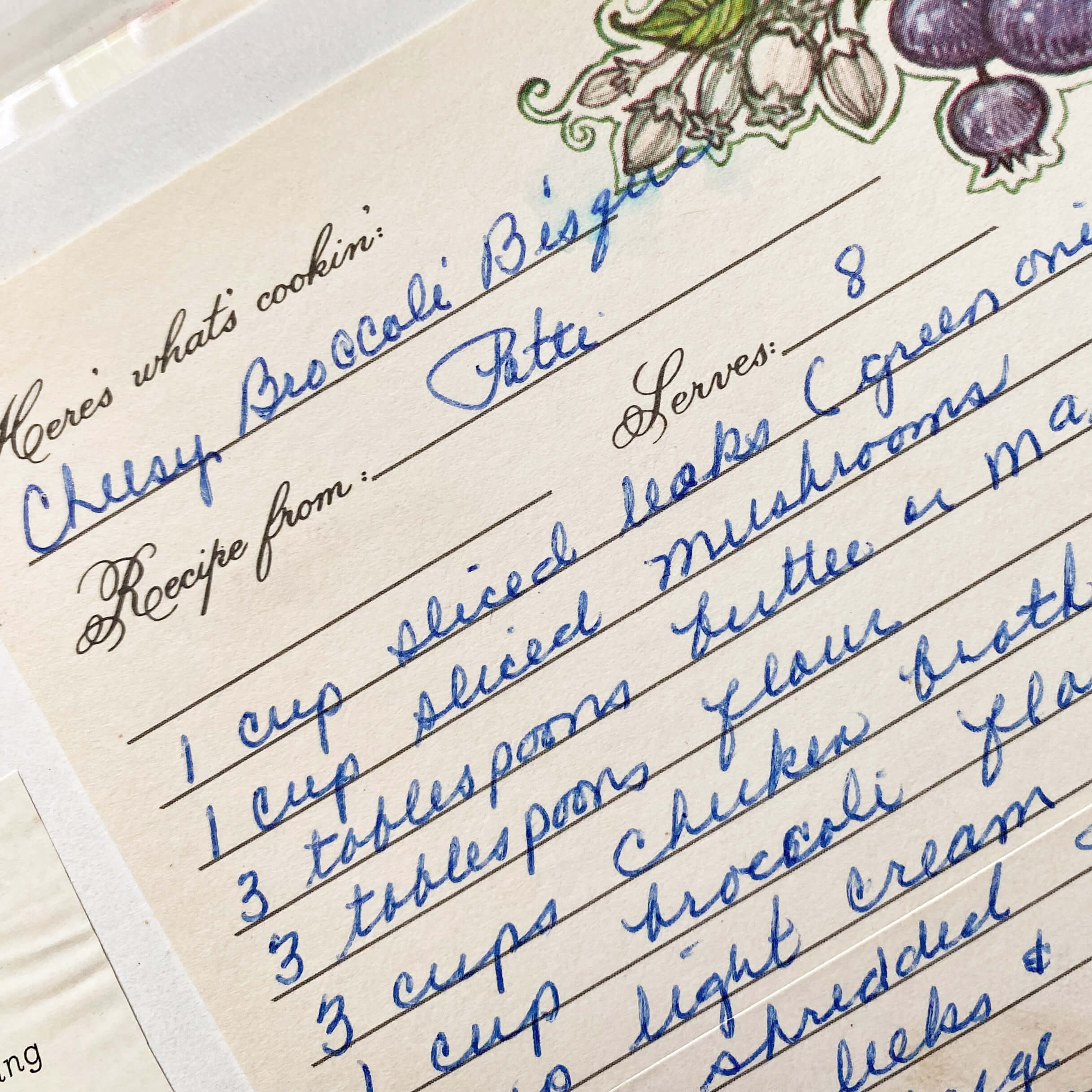
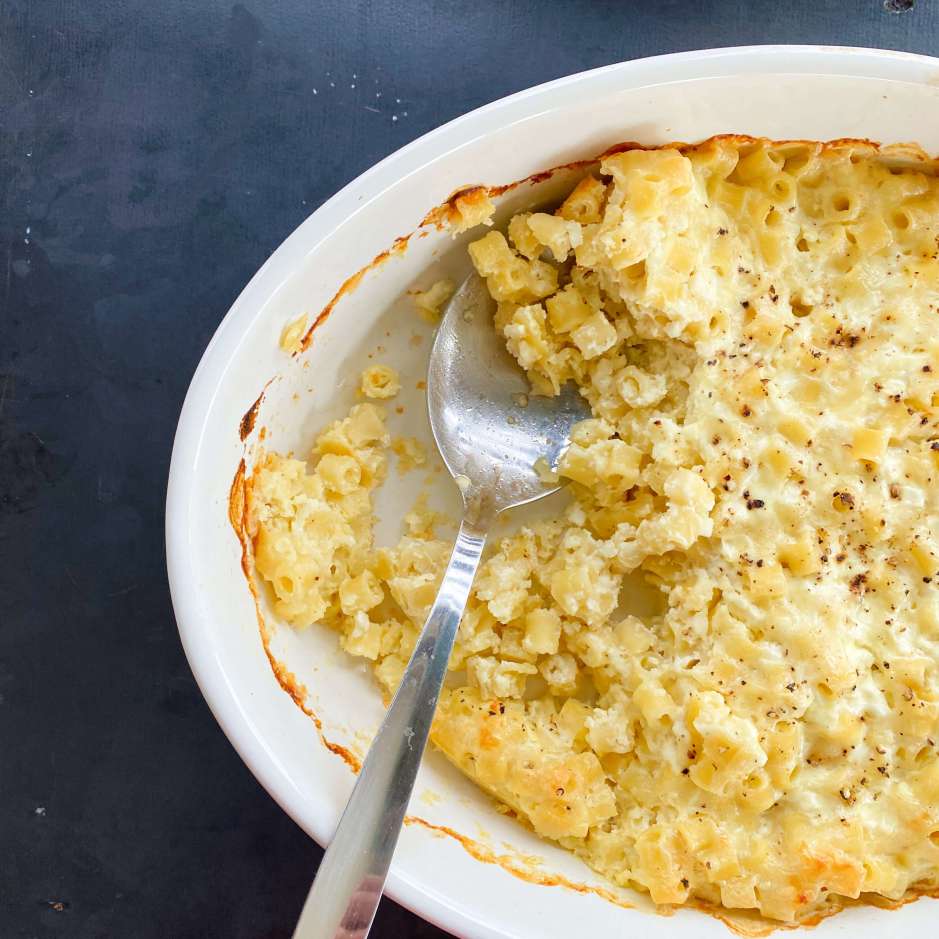
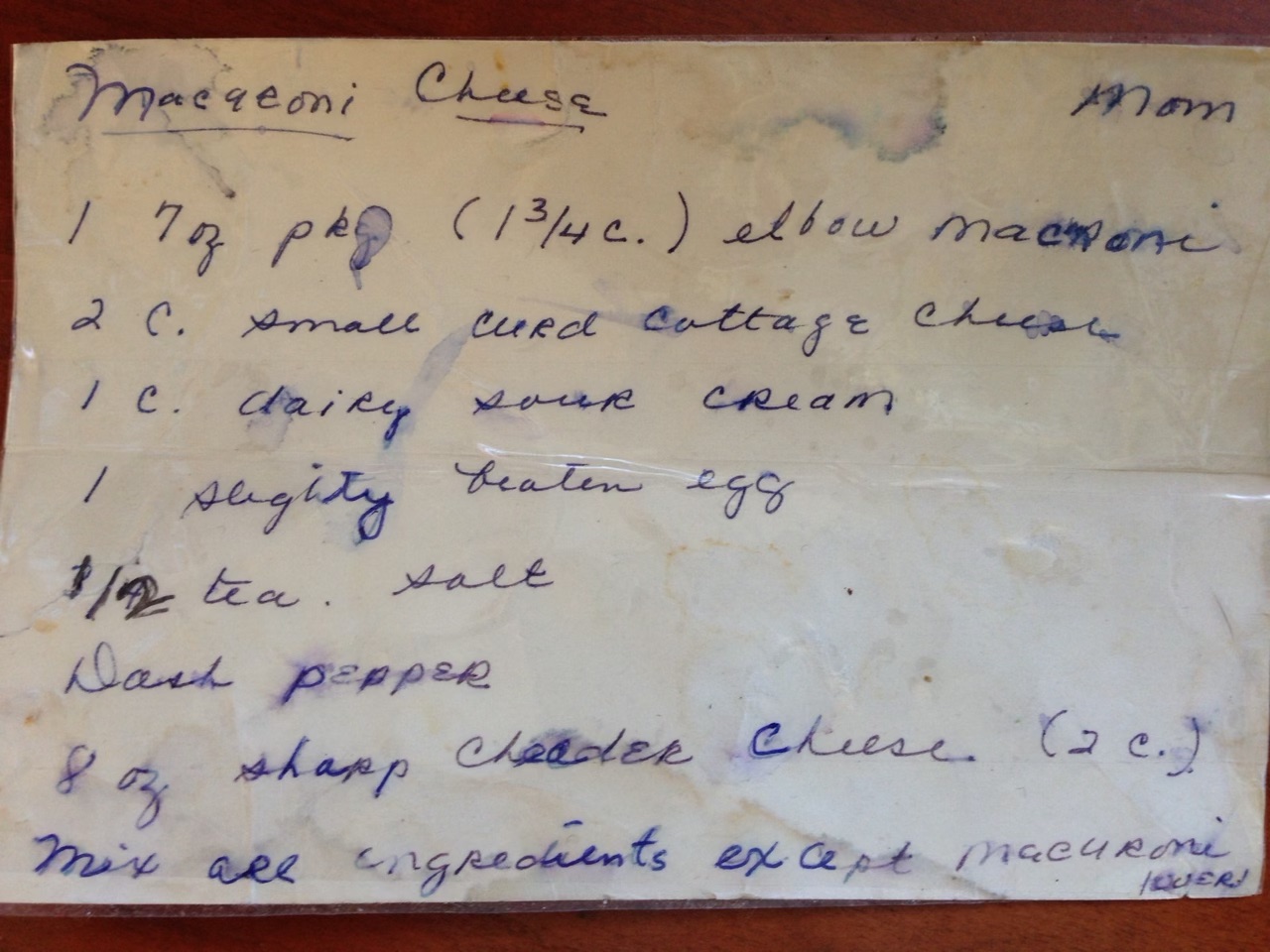
From Aunt Patti with love – Macaroni and Cheese – an heirloom family favorite.

Aunt Patti passed away in the late 1990s, so we don’t have her as a hands-on cooking consultant anymore but thankfully, my family still has all of her handwritten recipes, which makes it feel like she hasn’t altogether left us. When her recipe for macaroni and cheese resurfaced via my cousin this past Christmas season, it was a wonderful reacquaintance with her cooking style, her spirit and her son. And it sparked many discussions. More on that below, but first I wanted to point out the beauty of the actual recipe itself.

I love several things about its physical appearance in particular. 1) That the recipe is written in my Aunt’s hand. 2) That it is splattered and stained with over sixty years of use. 3) That it has the no-frills title of Macaroni Cheese and contains a few humbling spelling errors. 4) That it references my grandmother, Dorothy, in the top-right corner.
Grandma Dorothy, who lived between the years 1914-2012, was a great cook in her own right, but she was shyer than my aunt when it came to talking about food and how she prepared it. Luckily, Aunt Patti was a great recorder and when she fell in love with a recipe she liked, she wrote it down and filed it away in her recipe box. Did Grandma Dorothy invent this recipe, using her thrifty Depression-era cooking skills and staples she had on hand? Did Aunt Patti tweak it a little bit in the 1960s to make it her own? We’ll never know. But the fact that it has been made again and again in the same California kitchen for the past 60 years is proof enough that’s it’s a good one to keep hold of.

There are a bevy of different ways to approach baked macaroni and cheese … from the basic (cheese, milk, butter, flour, pasta) to the fancy (gourmet cheeses, spicy aromatics, infused butter, thick cream, specialty pasta). Aunt Patti’s recipe falls somewhere in the middle. It doesn’t contain any pricey ingredients or hard-to-find flavors but it does combine two more unusual components not often associated with a cheesy casserole.

The inclusion of sour cream and cottage cheese gives this recipe a rich, tangy flavor and fluffy consistency. It’s cheesy without being greasy and filling without being dense. It reheats beautifully and freezes even better, so if you wanted to make a big batch, double the ingredients and you’ll have a comforting casserole (or two!) for many winter meals to come. And since this recipe is connected to both my aunt and my grandmother, I’m taking the liberty to retitle it to include my grandmother’s last name and my aunt’s maiden name so that they will both be credited. This way, from here on out, the recipe will act as a tribute to two 20th century women who inspired each other in the kitchen. In turn, I hope their recipe inspires you too.

Macaroni Cheese of the Ladies’ Race

Serves 6-8

7 oz (1 3/4 cup) elbow macaroni or ditalini pasta

2 cups small curd cottage cheese

1 cup sour cream

1 egg, slightly beaten

1/2 teaspoon salt

dash pepper

8 oz (two cups) sharp cheddar cheese, grated

paprika (optional)

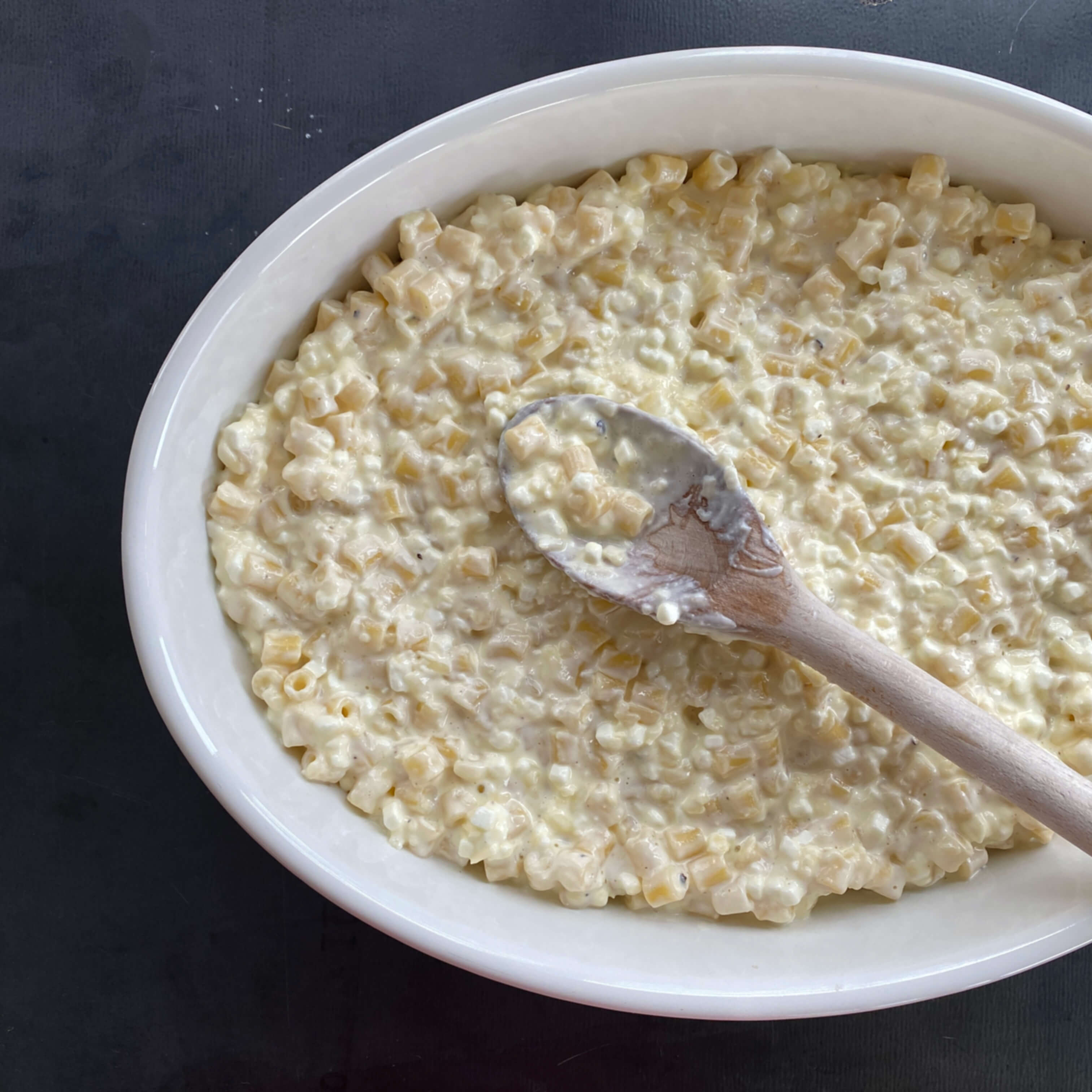
Preheat oven to 350. Cook macaroni on the stovetop in boiling salted water for 12 minutes. While the macaroni is cooking, mix all the other ingredients in a large bowl.

Fold in cooked pasta. Spread mixture evenly in a casserole dish. Top with paprika or cracked black pepper or neither – whichever you prefer.

Bake in the oven for 45 minutes or until the top of the casserole begins to turn golden brown. Let it rest on a cooling rack for just a few minutes before serving.

Aunt Patti would have suggested pairing this casserole with a simple side salad of home-grown lettuces, but it’s really delightful just enjoyed on its own too. The sharpness of the sour cream in combination with the creaminess of the two cheeses offers a silky flavor profile that is a dynamic, satisfying meal unto itself.

Since this recipe festively made the rounds in the kitchens of almost every single one of my family members and then their friends and their family this Christmas, it has sparked quite a few discussions.

I’ve learned that macaroni and cheese means a lot of different things to a lot of different people. I’ve learned that there are two camps – those who prefer a homemade recipe like this one and those who prefer a boxed stove-top kind. I’ve learned that some people like extra cheesy, extra creamy macaroni swimming in sauce, and I’ve learned that some people prefer a lighter more souffle-like texture. I’ve learned that some people like to add a bunch of flavor enticing extras like bacon, chives, jalapenos, buttermilk, herbs and even apples to the mix. And I’ve learned that some people are purists and prefer nothing more than the likes of the original four ingredients first prescribed by Elizabeth Raffald’s 18th-century recipe. Like, pizza and all the zillion different ways you can top it, I’ve learned that strong opinions swirl around the kitchen when it comes to this type of comfort food.

I’ve also learned things about my own preferences and how I like to approach food these days. I love that this recipe is connected to a particular place and a particular set of women. I love that an old piece of paper with its compilation of interesting ingredients still continues to connect family and now you, here on the blog, sixty years after it was written. And I love that this recipe acts as an impetus to storytelling for the cooks who came before us. That to me is the real comfort of this comfort food.

If you try this recipe, I encourage you to comment below with your thoughts on this whole matter of macaroni and the cheese it swims with. Both Aunt Patti and Grandma Dorothy would have been pleased as punch to hear your thoughts, just as I am now. Passions and opinions are most welcome here!

Cheers to favorite family recipes, to the kitchens that keep them, and to the conversations that continue to float around them. And cheers to 2022. I hope your kitchen greets you with joy every day of this brand new year.

Passed Down Recipes: Audrey Hepburn & Her Favorite Pasta

The difference between a lady and flower girl is not how she behaves, but how she’s treated. That’s a quote from George Bernard Shaw’s book Pygmalion which was published in 1912. Fifty three years later that book would become the blockbuster movie, My Fair Lady, starring one of America’s most favorite actresses – Audrey Hepburn. This role as Eliza Doolittle, along with her portrayal of Holly Golightly in Breakfast at Tiffany’s are definitely two of Audrey’s most indelible performances, ones that made her a household name around the world.

Audrey Hepburn as Eliza Doolittle, 1964

For a woman who lived in the public eye, for most of her life, I think there was a real irony in George’s “not how she behaves, but how she’s treated” statement that was fitting for his character but also fitting for the actress who played her. As a woman adored around the world, often referred to as beautiful, fragile, and delicate, there was much more to Audrey Hepburn than people gave her credit for. Thankfully, a new documentary just recently released on Netflix offers intimate insight into Audrey’s life that dispels myths not often discussed in the stratosphere surrounding her celebrity persona.  

In the fashion world Audrey was idealized for her waif-like figure, slim and youthful. She championed the pixie haircut and wearing pants and preferred a simplicity in dress that bordered art house cool. But her thinness was a result of childhood malnutrition, not a diet-riddled aesthetic that she curated throughout her life. Her personal style was a result of simplicity, comfort, and a humble nature not an innate desire to be the fashion maven she became. Her features was determined desireable by the beauty industry yet she never felt very beautiful herself – often remarking that she had insecurities over the size of her nose, her flat chest, her boyish hips, her dark hair all which felt especially apparent to her in the time of Hollywood when the ideal feminine physiques equaled hour-glass curves and blond bombshell hair. 

The documentary depicts,  through interviews with her family and friends, the other sides of Audrey that reveal tenderness balanced with tenacity, love entwined with loyalty, and a steadfast determination to make a difference using the skills she worked hard for and the favorability she gained as a result of her acting career. It shows that she deserves to be remembered for much more than her famous character’s association with a luxury jewelry brand, or for creating the iconic little black dress terminology or for being the innocent, fresh-faced ideal of romantic fantasies.

As a serious humanitarian, a creative artist and a woman trying to humbly navigate the world, Audrey was smart, sincere and authentic above all else. Like a postscript to the stunning 2003 memoir, Audrey Hepburn: An Elegant Spirit that her son Sean Hepburn Ferrer wrote almost 20 years ago, the documentary offers insight into Audrey’s personality and how she unsuspectingly became the icon that she did.  Sean’s book, all those years before, was my first glimpse into Audrey’s personal life. His story began just days after Audrey passed away at the age of 63, and is told from his own sesnsitive perspective of life with a woman who was both loved by him and by the world at the same time. 

To peek inside and read some snippets from the book, click here.

Like the documentary, Sean shares close details about his mom’s life… her thoughts, philosophies, perspectives… and tries to make sense, as an adult, of the two very different lives she lived between her public persona and her private one. If you get a chance to read the book or watch the documentary you’ll learn all the details of Audrey’s life… her hunger years, the fractured relationship with her father,  her desire to be a ballet dancer, the start of her acting career, her marriages, her emotional ups and downs, her personal triumphs and her public trials. My favorite part of Audrey’s story though does not include her movies, or her designer clothes or her glamorous Hollywood connections. My favorite part of Audrey’s life was her favorite part too –  her 18th century Swiss house…

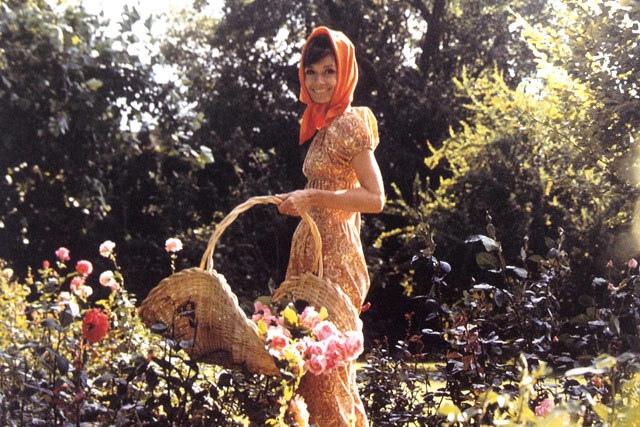
Deemed by Audrey as the happiest place on Earth, she retreated to the small village of Tolochenaz to raise her two children and to rest in the quiet privacy that Switzerland offered. A sanctuary of a centuries old shuttered stone house with a big garden and lots of room for family and friends, the house was named La Paisible (meaning The Peaceful in French). True to its name, it is where Audrey felt most comfortable. Dogs (Jack Russels), flowers, and bright light tumbled out of every room. A highly cultivated and cared for garden dotted the landscape. Rooms stood ready to entertain and to inspire. And even though some photo journalists were invited in occasionally for publicity purposes, for the most part it was a private place where Audrey could revel in the thing that she cared for and craved most… love and affection.  

A photoshoot with her son Luca for Vogue UK in 1971, let fans peek inside Audrey’s bright and airy world at La Paisible. I love the painting of her house above the desk, which was painted by her second husband Andrea Dotti.

It was at La Paisible in Switzerland, that she indulged her love of food and flowers and the joyful simplicity that came with growing both. Sean was quick to point out in his memoir that Audrey was an eater despite what everybody thought about her figure and the ways in which she went about maintaining it. She had cravings too just like everyone else but her philosophy on food always returned to balance and appreciating where it came from and how it was made. A craving for something sweet yielded a square of chocolate not a whole box. Meals were made with things she could cut and clip from the garden just outside her door. Grocery shopping was never a chore, always a joy. Her table was surrounded with laughter and fun and comfortingly familiar faces. 

Her son Luca in an interview in 2013, shared that his mom was a very practical person seeking above all a normal, grateful and gracious life. Acting was her job, but living was up to her to define. In making that distinction, she knew in her core the things she valued most in her life – family, nature, love, education, kindness, and respect for one’s own insticts and motivations. Growing a garden within a fingertip’s reach was Audrey’s way of creating beauty but also securing a viable food supply for her family, so that no one at La Paisible would ever have to know the hunger she felt as a child.

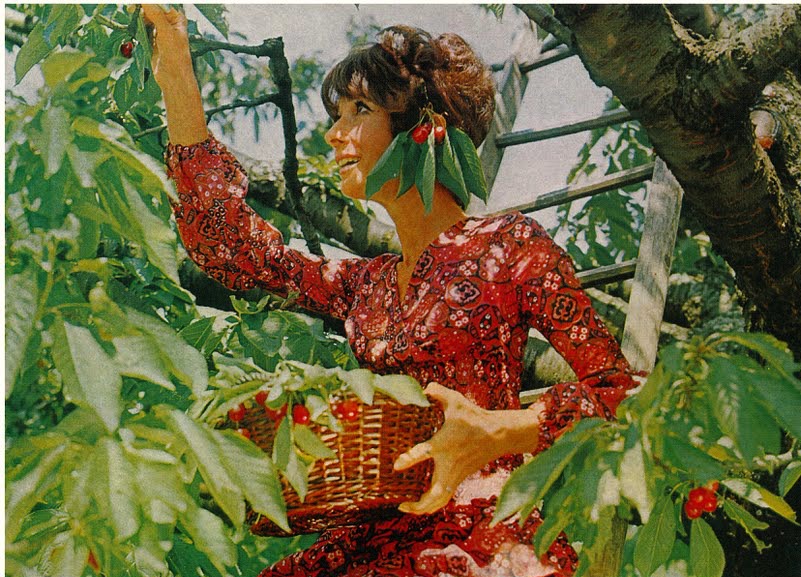
Picking cherries from the garden at La Paisible. Vogue UK, 1971

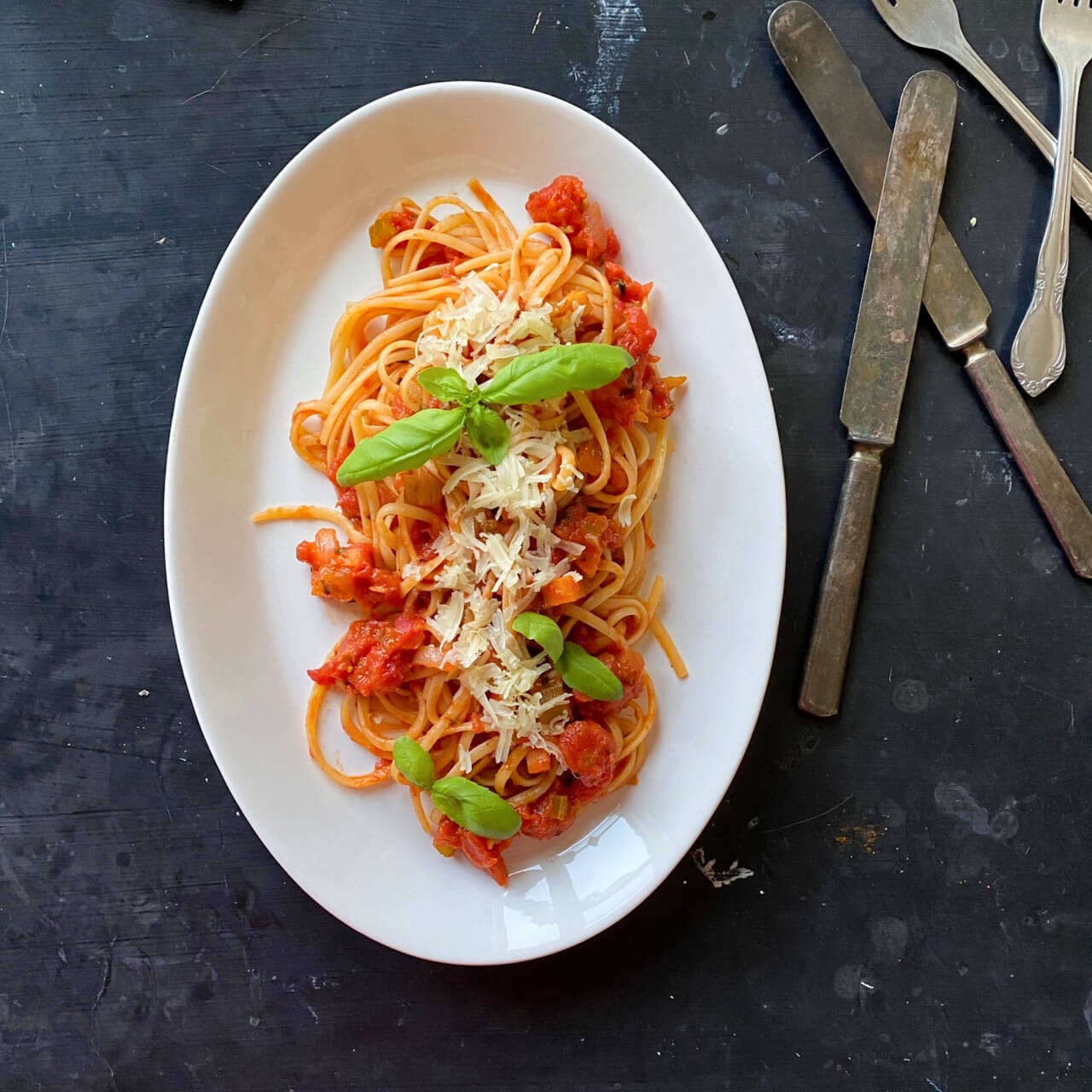
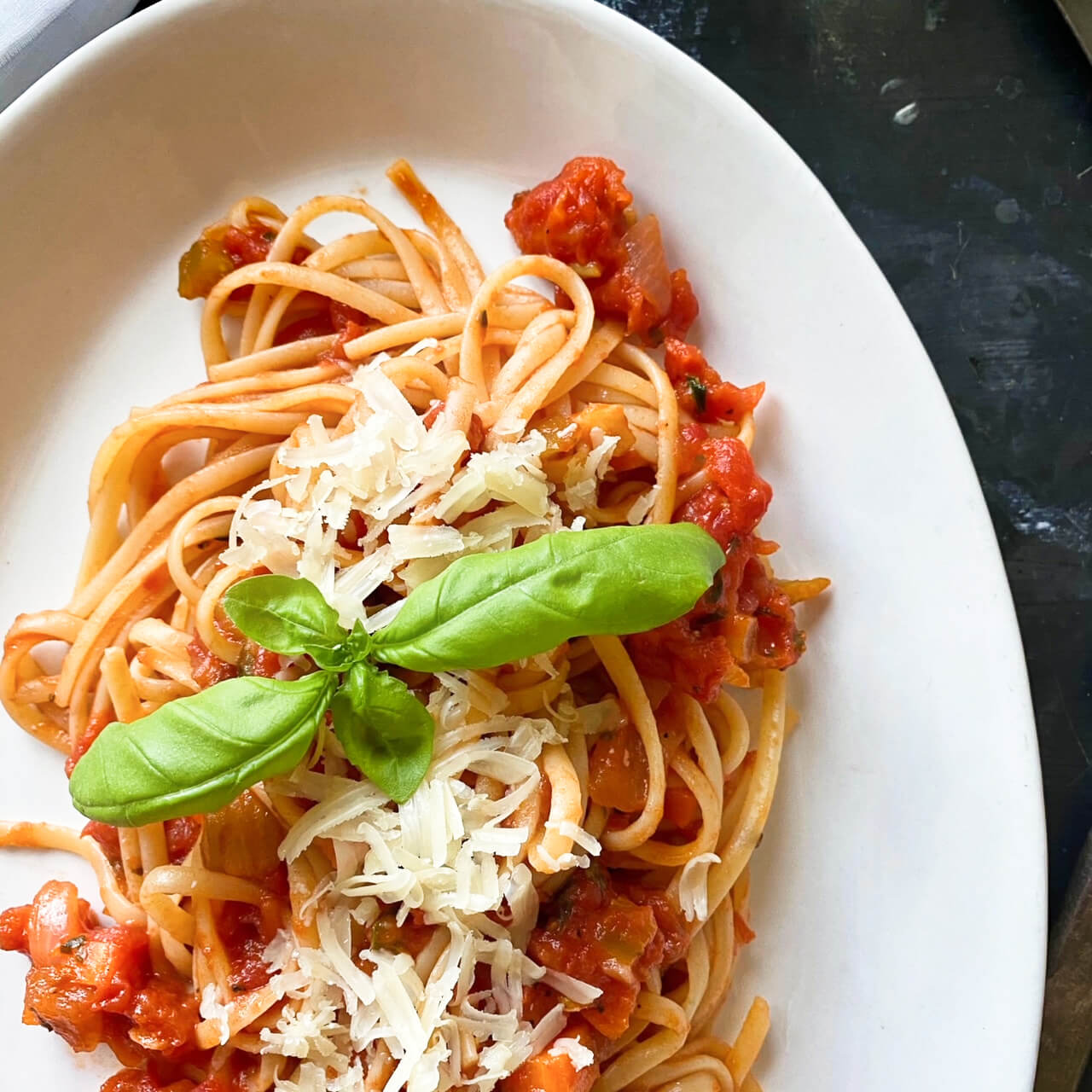
One of Audrey’s most favorite foods, which she ate on a weekly basis, was a simple garden-centric dish that can be thrown together in minutes with barely any technical instruction. In today’s post, we are making Audrey’s favorite pasta recipe, Spaghetti al Pomadoro…

It’s not a recipe that she invented herself, but it is one that she made every week for decades while living at La Paisible. Like Audrey’s loyalty to it, I’ve been toting this version of classic tomato sauce around in my own makeshift recipe book for the past 18 years.

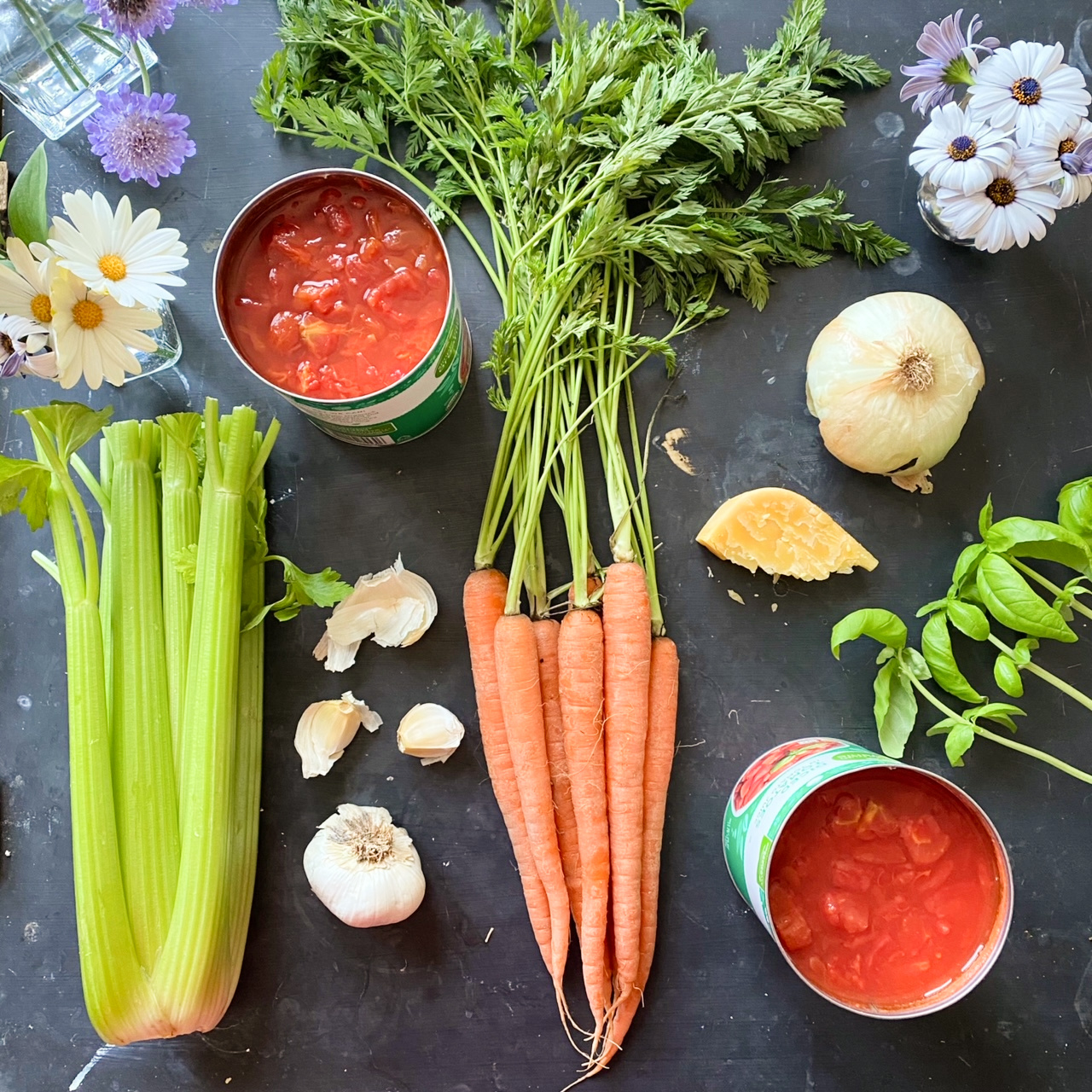
Uncomplicated cooking at its best, this recipe calls for lots of basil, Audrey’s most favorite herb, and just a few other garden vegetable staples. Interestingly, the recipe also utilizes canned tomatoes, (or tinned as they are referred to in Europe!), which is an ideal choice when tomatoes are not in season. I like to make this recipe most in spring (with canned tomatoes) in anticipation of the vibrant season about to come and then again in high summer when homegrown tomatoes, just plucked from the vine come into the kitchen, fat and heavy and still warm from the sun. I like to imagine that this is how Audrey would go about preparing this sauce too – jockeying back and forth between using cans and her own homegrowns depending on the season. In either circumstance, the best way to experience the true beauty of this simple recipe is by acquiring ingredients that have been picked at peek flavor. If you can find them fresh at your local farmers market, or even better, pull them all from your own garden, then you’ll have a true Audrey Hepburn dining experience, just like the lady herself would have enjoyed. 

Audrey Hepburn’s Spaghetti al Pomodoro

1 small onion

2 cloves garlic

2 carrots

2 stalks celery

2 large cans of diced tomatoes

1 large bunch of fresh basil, separated in two equal bundles

3 – 5 tablespoons olive oil (also known a a long drizzle!)

1 box of spaghetti

Parmesan cheese, freshly grated

Salt & Pepper to taste

Peel and dice onion, carrots, garlic and celery. Put in a large pot. Add two large tins of Italian roma tomatoes and the basil. Add a long drizzle of olive oil and simmer on low for 45 minutes. Turn off heat and let sauce rest for 15 minutes. Serve over 1 box of pasta cooked al dente, with fresh parmesean and the other half of the basil cut in pieces with scissors.

I love this recipe for the way it was written. In casual, loosey goosey direction, like all good Italian food, it relies on cooking with your own instincts and offering just light suggesstions as outline for the finished end result. Sometimes I let the onion, carrot and celery mixture carmelize for few minutes in the olive oil before adding the tomatoes. Sometimes I bring the whole sauce to a boil before turning it down to simmer. Sometimes I add more garlic or a sprinkle of sugar or a dash of white wine or some oregano if the herbs are overflowing in the garden. Or sometimes I make it just as Audrey directed. Regardless, whenever I pull out this stained and spattered recipe from my makeshift book, I like to think of Audrey Hepburn, the glamorous interantional icon now turned regular, every day home cook, standing at the stove in her beloved kitchen in Switzerland, making this very same sauce in the very same way that we are making it now.

During her life, Audrey was never sensationalized as a good cook. Oftentimes, people assumed that she never ate or that she had little interest in food given her thin figure. As George Bernard Shaw wrote of his character… she was treated differently then she behaved. But her boys have set the record straight in their books and in their interviews and in the documentary just released. Audrey loved to cook and loved to eat. Most notebaly for and with her friends and family. And now, in the beautiful way of passed down recipes, she can cook for her fans too.

Cheers to Audrey for staying true to her spirit and for privately being so much more than the public ever knew. Cheers to her boys, Sean and Luca, who bravely confronted all the misconceptions that surrounded her. And to this humble pasta recipe for always reminding us that life doesn’t have to be extravagant in order to be delicious.

The Search for the Date Accordion: We Need Your Help!

Between Thanksgiving and Christmas recipes shuttle around the Vintage Kitchen like a snowstorm. I know the holidays are approaching when I start receiving messages from home cooks on the search for something particular.  Most often, people are looking for recipes. For family favorites that have been lost or misplaced, recalled but not written down, remembered but also forgotten. Sometimes too, people write in because they are in the mood for an experiment and want to try to recreate something – a dish or a dessert that they knew from their past.  Or they are looking for a theme recommendation – a tropical cocktail for their tiki party or an authentic eggnog recipe for a holiday breakfast.  I love all these inquiries and the conversations that follow. Laced with stories and snapshots of family and of life and of love ignited in the heart of the house, for me here in the land of the Vintage Kitchen, communicating with all these culinary aficionados, is the joy of the season and the joy of cooking all rolled into one.

On more than one occasion these inquiries have led to stories about cookbooks misplaced, recipes accidentally thrown away or a list of ingredients and instructions just mysteriously disappeared like a sock that never returns from the dryer. They were there one holiday and gone the next.

Sometimes people write in with an urgency bordering on panic… I’ve headed home for the holidays and forgotten my cookbook. Or they contain stories of tragedy… my boat capsized and I lost my favorite recipes to the sea. Sometimes they contain stories of silly blunders… like the brother who accidentally ground up (in the garbage disposal) his sister’s prized bread recipe from the 1970s. And sometimes, they contain notes of longing. Of people wanting to rekindle a memory of a certain place or a person. But whatever prompts them to reach out to the Vintage Kitchen, everyone always signs off on their correspondence with these words… I hope you can help.

Most of the time I’m happy to say, we have been pretty lucky in finding just the right recipe that was needed. The holiday traveler who forgot her cookbook received a photo on Thanksgiving Day of the vintage chocolate pie recipe she needed. The capsized boater found a replacement cookbook in the shop. The brother who garbage disposal-ed his sister’s bread recipe was emailed a copy so that he’d have a permanent backup should he ever encounter another mishap in the future. These are small but big victories in the ultimate goal of the Vintage Kitchen, which is to build a community of modern-day cooks who have stories to share about heirloom kitchen items, traditional foods and special memories. That’s the stuff we like to celebrate around here. As Paul Child was fond of saying about his beloved Julia, that is the butter to our bread.

But the latest inquiry into the Kitchen has been more of a challenge. I’ve searched for a solution online for days. I’ve searched through all my cookbooks, all my recipes, all my options.  In non-pandemic times, I’d have a beautifully large and expansive library to visit and stacks of books to scour through in order to find what Laura seeks, but our library has been closed to researchers for most of the year, so I’m putting her request out here on the blog in hopes that you can help.

Laura writes…

Today I need help finding a recipe that my 83 year old mother said she saw in a magazine (late 1950’s – early 1960’s ?). Ladies Home Journal or one of them at that time. The recipe was for a type of date and nut bar, that had a liquid like consistency that you put into a 9 x 13 pan, then cut into small rectangular bars, roll in table sugar, frost with white frosting, then zig zag some green gel on top. They were called “Date Accordions.” I have searched everywhere and cannot find anything close. We have been making these for years and last year my brother accidentally thru out her copy of the recipe. She is heartbroken!

A challenge indeed! The closest recipe I could find to Laura’s request was this one…

Slice ‘N Serve Cookies, which appeared in Pillsbury’s Grand National Prize-Winning Recipes booklet published in 1954, contain a date and nut filling, a rectangular baking dish, a sprinkling of powdered sugar, and a frosted top.

Clearly, this isn’t the right one just based on its jelly roll presentation alone, but it was the only one in my vintage collection that made mention of frosting on top of a date bar filling.

slice-n-serve-cookie-recipe-1950s

Incidentally, date bar cookies are no stranger to home bakers. Thought to have originated in Canada, they have made a regular appearance in cookbooks since the 1930s. Almost all recipes I found in my search presented them in bar fashion – a testament to their delicious simplicity.  I can imagine that by the time the 1950s/1960s era rolled around, when home bakers were really experimenting with unique visual presentation,  that Laura’s mom’s recipe came into its heydey. The use of colored gels and a zig-zag design definitely speak of creative trends that bloomed during that era.

So here is where we need your help. If anyone knows of this particular date bar that Laura speaks of, it would be wonderful to surprise her mom, Betty, with the recipe for the holidays. If you have a vintage cookbook or recipe collection, I’d so appreciate it if you could take a minute and flip through your sources to see if a recipe for Date Accordions pops up. How wonderful would it be to bring some holiday cheer to Laura and her 83-year-old cookie loving mom this Christmas?!

I understand that some readers are hesitant about commenting publicly, so I’ve included a private and secure contact form below. If you do run across the recipe, please submit it to the Vintage Kitchen using this form, and don’t forget to include the source in which you found it. I’d also greatly appreciate it if you could forward this post to any other bakers you know who might be able to help us track down this vintage treat.

Thank you in advance for your help! Cheers to a successful recipe search. Hope your holiday season has been full of all things sweet and delicious.

Go back

Your message has been sent

Warning
Warning
Warning
Warning

Warning.


Annie’s Wine Baked Brisket & How a St. Patrick’s Day Staple Came to America

Cows are sacred, salt is expensive, cross the sea trading is prohibited and immigrants had to get to New York. In a nutshell, those are the four substantial situations that had to occur in order to bring brisket to your dining tables today. Happy St. Patrick’s Day dear readers!   Today’s post is all about a traditional Irish food that actually is, in reality, a multi-cultural collaboration between three countries.  While it is certain that many a crock-pot will be simmering away today in honor of the holiday, and the famous corned beef and cabbage that has become associated with it, you might be surprised to learn that the propulsion for this traditional heritage food actually has more to do with New York City than Ireland.

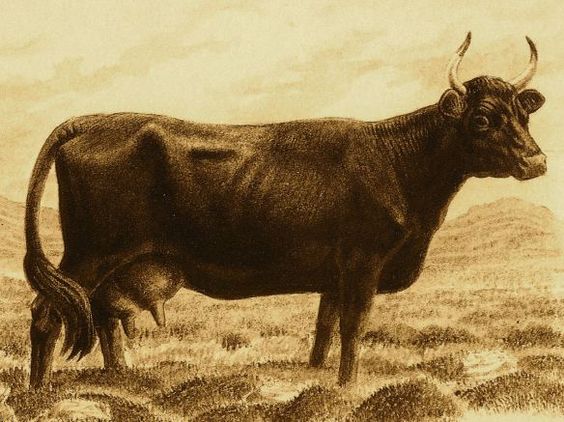
The Kerry cow is considered to be the oldest breed of cattle in Ireland.

It all started back in Ireland’s ancient times when cows were considered sacred animals. Valued for their milk and their strength over anything else, Irish cows were essential components to a working farm and were never considered a viable meat source. But England adored beef, particularly roasts, so much so that by the 1600s, England couldn’t keep up with their own country’s supply and demand.  So they went to Ireland to see about some cows.

A good revenue stream for the Emerald Isle and a can’t-live-without-it commodity for England, this cow commerce between countries was mutually beneficial for all.  That is until the Cattle Acts of the 1660s. In an instant, thanks to the Act, the sale of live cows to England was no longer allowed.  The sudden halt in commerce left Ireland scrambling for a solution and left England grumbly with hungry bellies.  This all came about at a time when salt was also an extremely expensive ingredient in England. Ireland, on the other hand, was not only flush with cattle but also abundant with coastal salt pans. The combination of these two riches formed a clever way for Ireland to package meat for export that skirted around the law. They created a new method of food preservation called corned beef – a salted meat product that could withstand time and travel to England without spoiling.

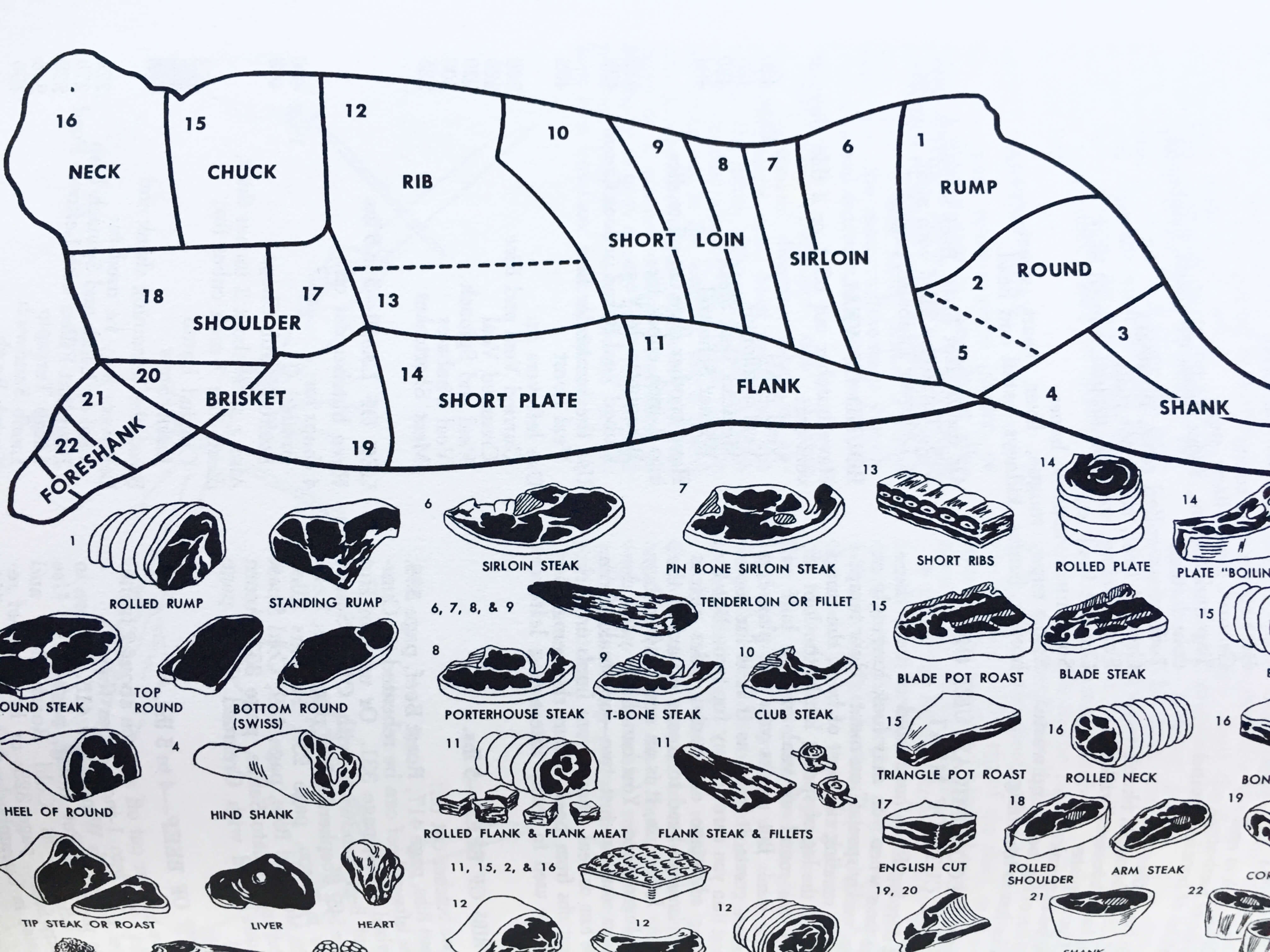
Coming from the brisket cut of the cow (located between the front knees and the shoulder area) this salt-infused food was named corned beef because of the corn kernel-sized salt crystals used in preserving it.  Generally known as a tougher piece of meat since that area of a cow’s body gets quite a lot of exercise, early corned beef was essentially just a slab of meat that was rumored to taste more like salt than beef.

Commercial Cuts of Beef chart from the Joy of Cooking by Irma S. Rombauer, 1967 edition

Because it was shelf stable, easy to prepare, and came in bigger portions, corned beef became a popular staple in the diets of 18th-century Englanders as well as sailors away at sea for long stretches of time. It even made its way into the diets of Early American colonists who were struggling to produce food for their new country. The only people who were not enjoying this salty slice of protein were the Irish, who, in a terrible twist of irony, couldn’t afford to buy the very product they were exporting.

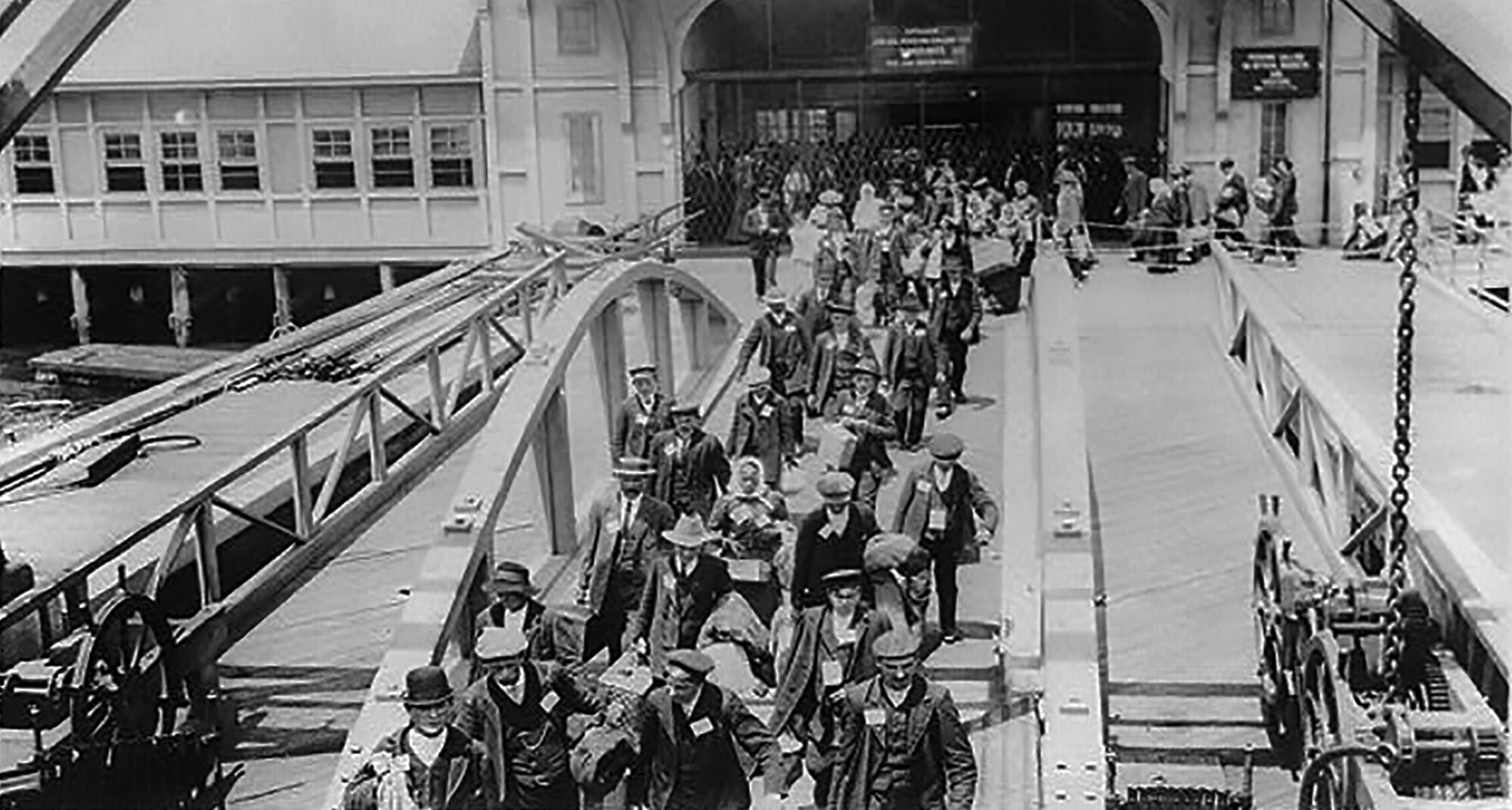
Newly arrived immigrants at Ellis Island. Photo courtesy of the Library of Congress.

It would take one more century and a move to America before Irish immigrants were able to afford and enjoy the corned beef that made their home country famous. In the mid-late 1800s, a majority of the butcher shops within the New York metropolitan area were owned and operated by Jewish immigrants.

The Lustgarten family owned a Jewish butcher shop in NYC in the late 1880s. Photo courtesy of tenement.org

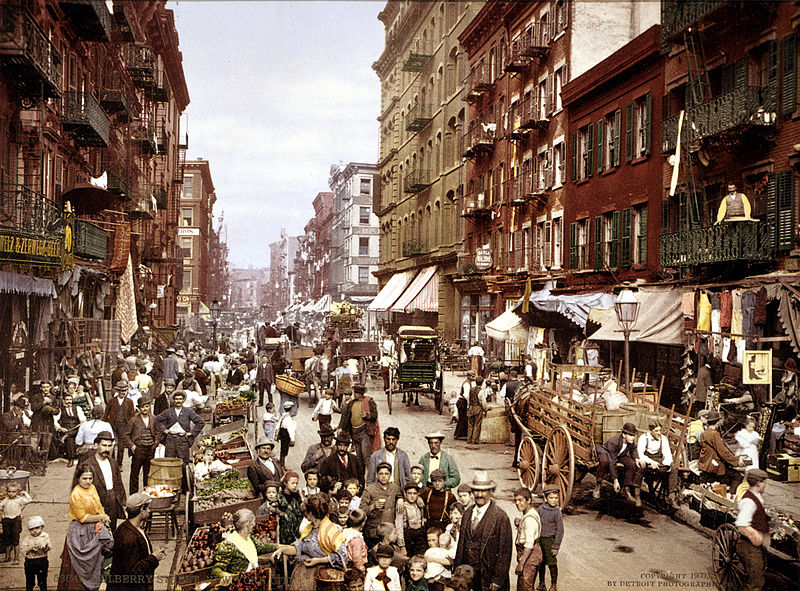
Living in close-knit communities, both Irish and Jewish transplants bonded over feelings of displacement and discrimination experienced in their new world. Financial resources were a challenge for most city dwellers, but especially for these two ethnic groups in particular, as they faced prejudices in work and social environments. Luckily, food brought them together via thrift and necessity, and novelty.

Market shopping along NYC’s Mulberry Street in 1900

Upon arriving in America, Irish immigrants were delighted to discover that corned beef was much less expensive in New York then it was back home in Ireland. Likewise,  Jewish immigrants liked brisket because it was one of the least expensive cuts in the butcher shop and could feed a crowd.  Through experimentation in their New York City kitchens,  Jewish and Irish newcomers developed the low, slow cooking methods that eventually evolved brisket from a salty slab of preserved meat into a rich and flavorful meal.  Cabbage was often paired with it since it was the least expensive vegetable. Both cultures developed their own trademark dishes – slow simmered corned beef and cabbage for the Irish and smoked pastrami and sauerkraut for the Jewish community. Each specialty stemmed from the humble brisket cut.

Beef Chart from the Culinary Arts Encyclopedic Cookbook circa 1948

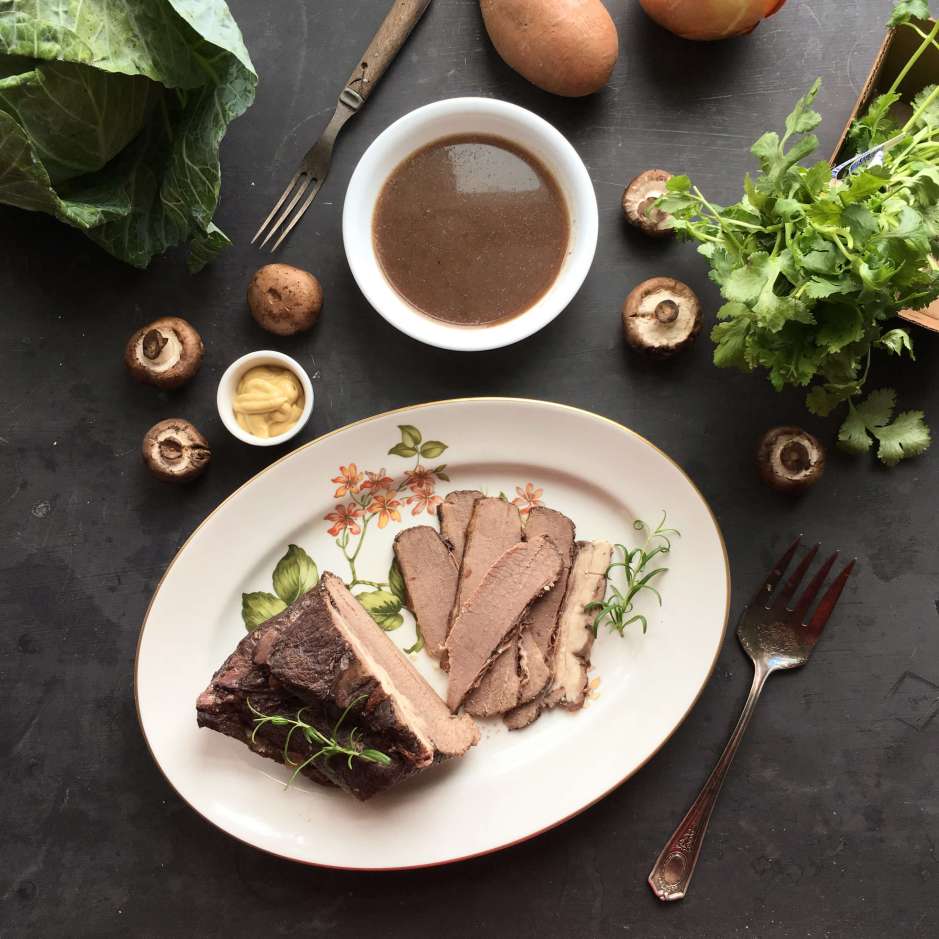
Today’s recipe focuses on the Jewish side of cooking, with a brisket that quickly browns in butter on the stovetop before heading into the oven for a slow simmer in red wine. If you are not a fan of the saltiness of traditional corned beef or are wary of the seasoning packet that comes in most store-bought brisket kits, this recipe is a great alternative, since you can control your own level of spices. It comes from Annie, an avid cook, and a world traveler who lived in New York for most of her life. A dear friend to my father, she’s proud of her Jewish heritage and is famous for many signature dishes including homemade horseradish (more on that in a future post).

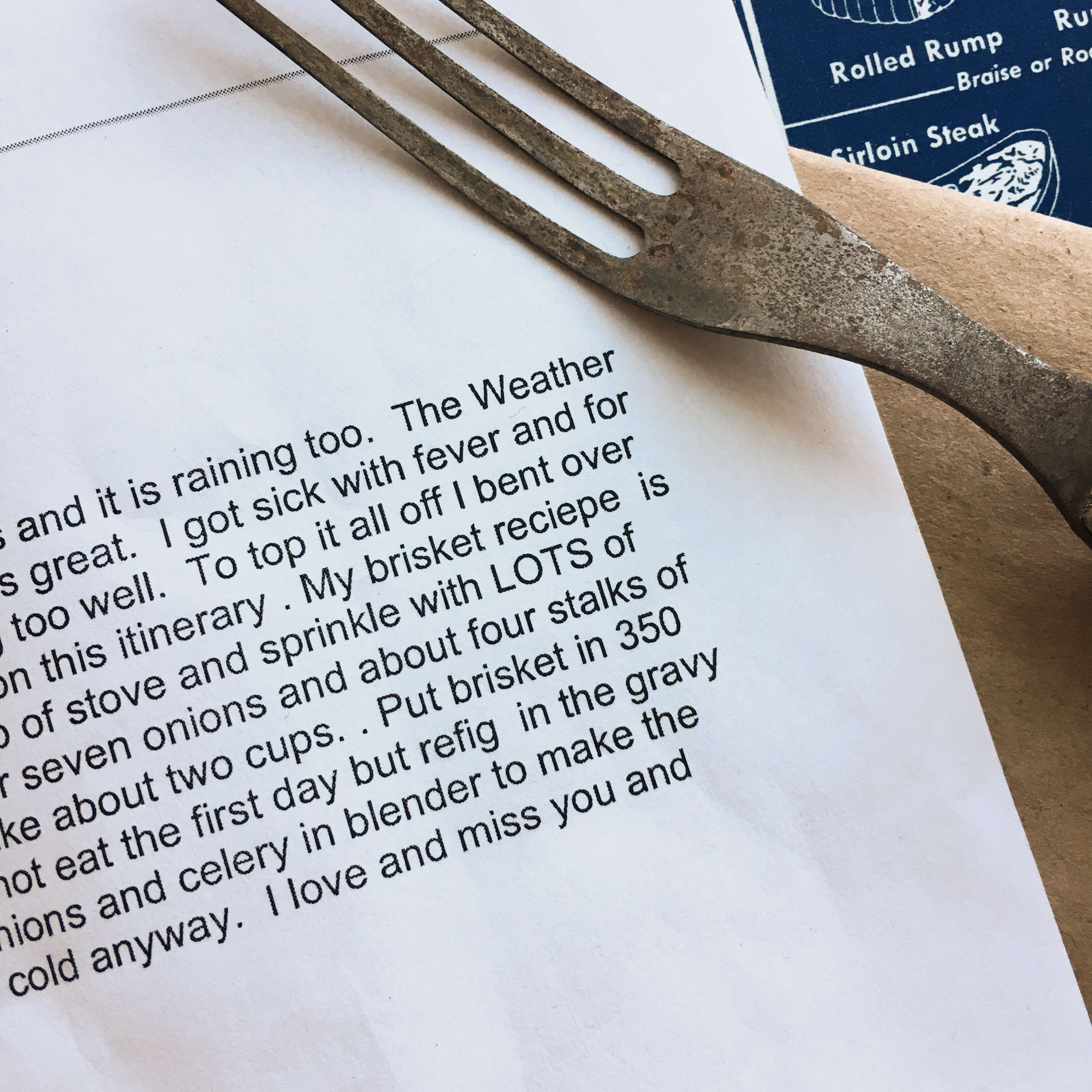
Annie sent this recipe to my dad over email 15 years ago while she was at sea traveling between Buenos Aires and Santiago.  The trip was rough with wild waves and cold temperatures but Annie was more than happy to take a few moments to share her way of making brisket. In our modern age, email letters aren’t quite as pretty as handwritten ones – but the sentiment is there nonetheless. My dad has hung onto her correspondence for over a decade and a half. I discovered it recently, tucked inside one of his favorite cookbooks.

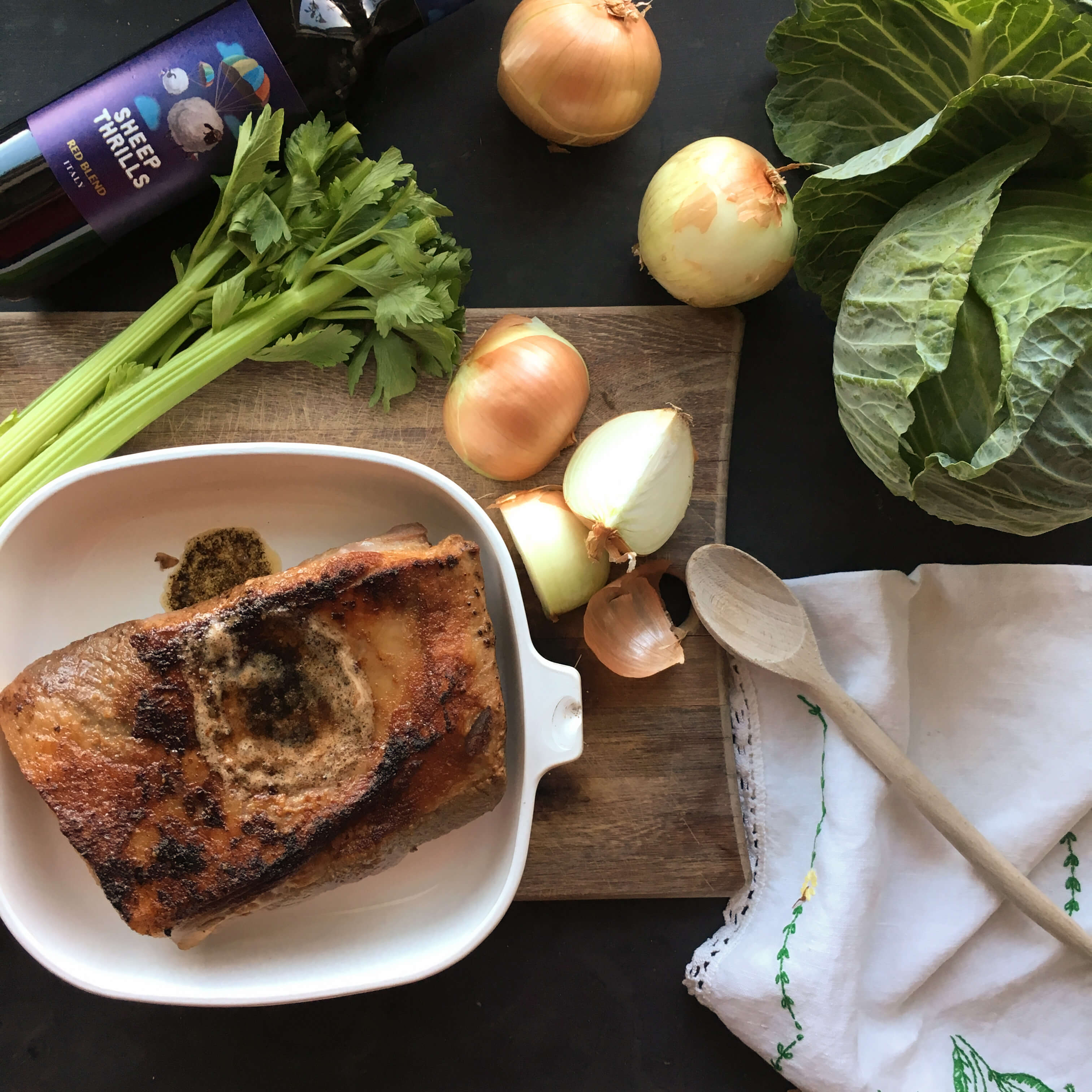
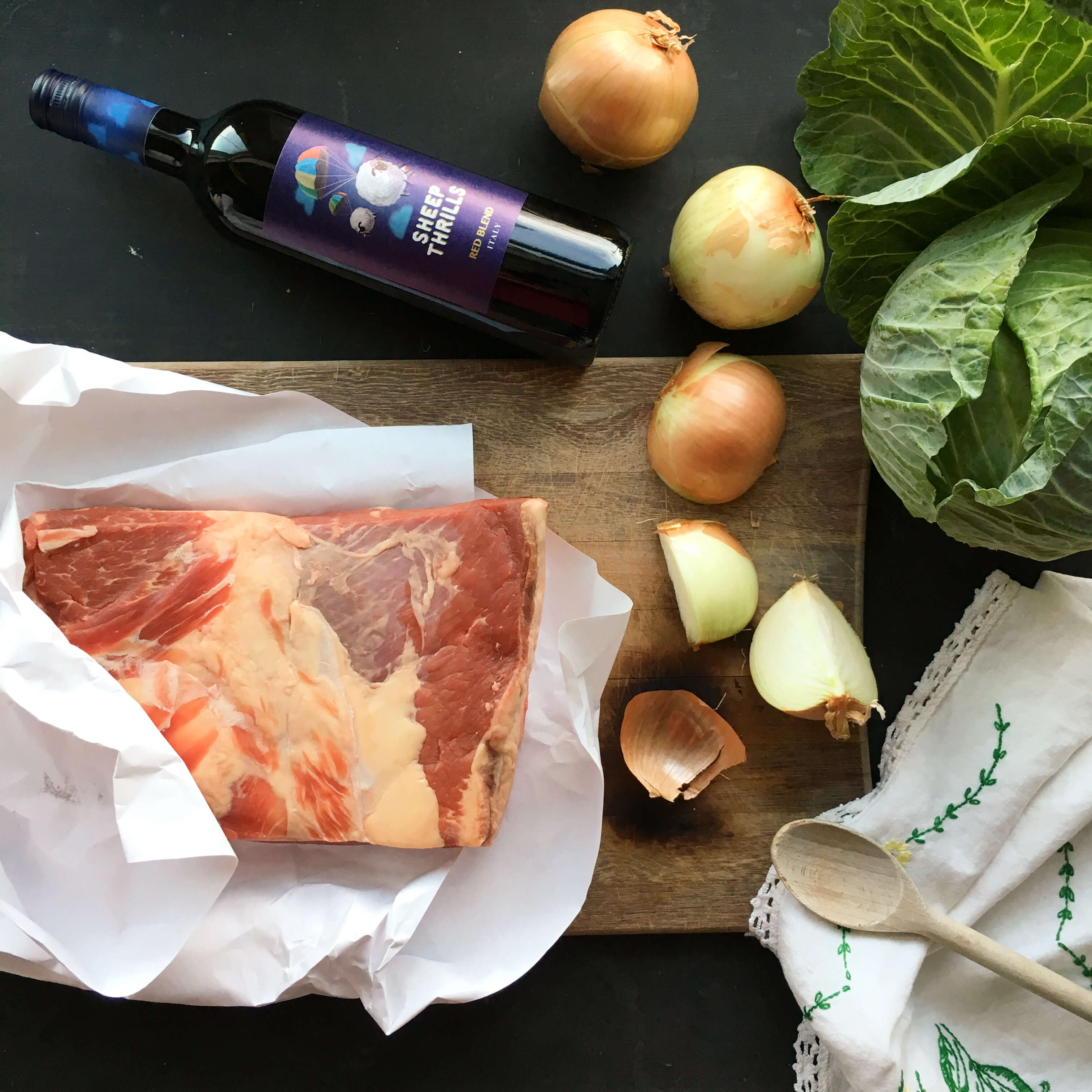
Although it requires two days to make, it is very simple and involves just a few ingredients. I used grass-fed beef from the farmers market and a red wine blend called Sheep Thrills for the fun pun. Also, Annie cooks like James Beard recommends – with your intuition – so she doesn’t specify in her recipe exactly how much seasoning to use. In the directions, I share my method, but you may want to add more or less depending on your preference.

Annie’s Wine Baked Brisket

4-5lb beef brisket ( I used a 3.5 lb grass-fed beef brisket)

4 tablespoons butter (only necessary if using grass-fed beef)

6-7 onions

4 stalks celery

2 bay leaves

2 cups red wine

Onion Powder

Garlic Powder

Celery Salt

Preheat the oven to 350 degrees.

Remove the brisket from the packaging and let rest on the counter for 45 minutes to 1 hour. If you are using frozen grass-fed beef make sure that it has completely thawed in the fridge before beginning this recipe. Do not trim the fat from the brisket.

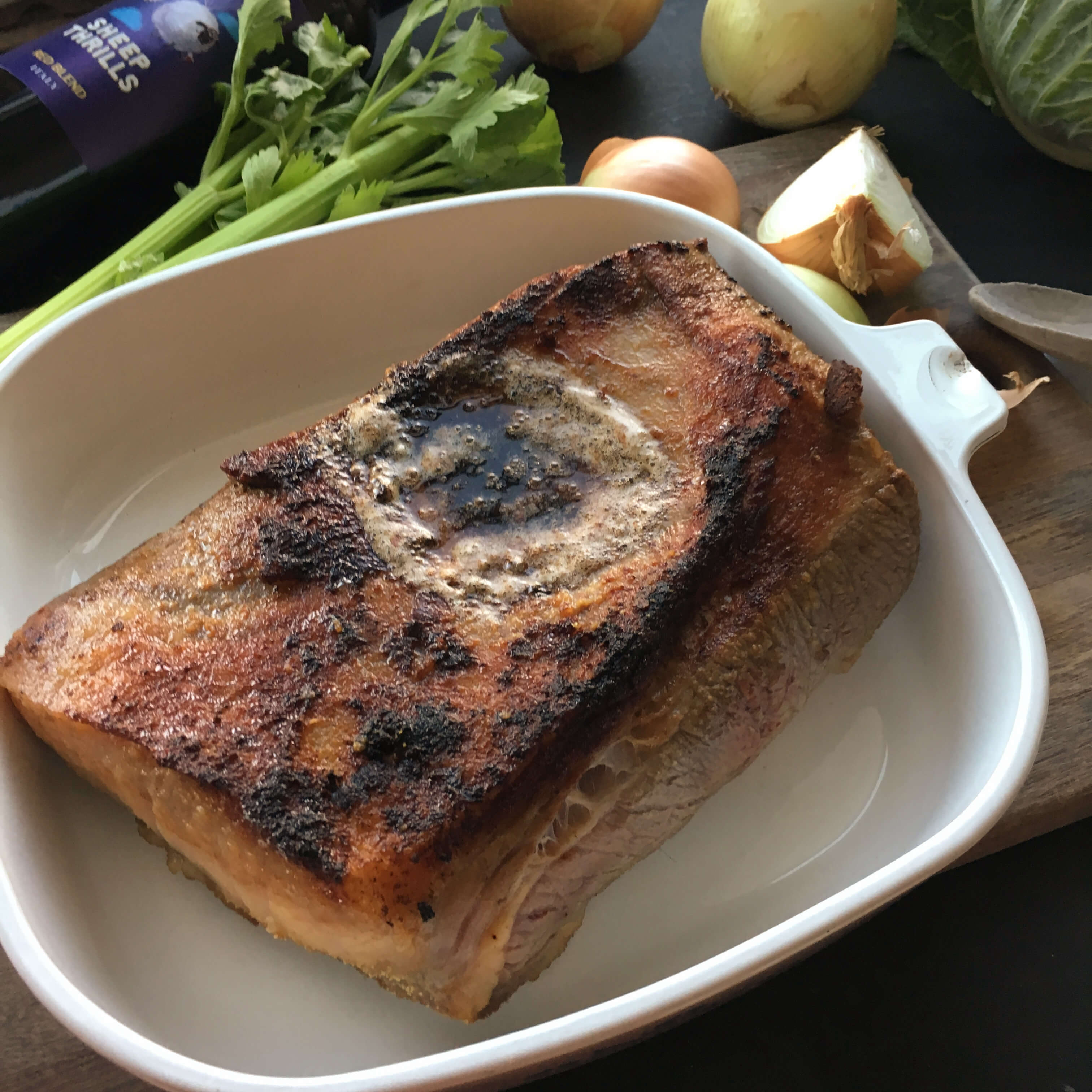
Seasonings with dots of butter on top before the flip to brown the other side.

In an ovenproof pan (preferably one that has a lid) over medium high heat, add the butter (but only if using grass-fed beef, otherwise omit the butter). Generously sprinkle each side of the meat with the onion and garlic powders and the celery salt (I did about five passes on each side with each of these seasonings). Brown the brisket, fat-side down, for 5 minutes on each side.

Roughly chop the onions and the celery and add them to the brisket pan.

Pour in the red wine and add the bay leaves. Cover and bake in the oven for 2 to 3 hours or until the brisket reaches an internal temperature of 170 degrees. (Note: Grass-fed beef cooks faster than grain-fed beef, so watch the temperature and time closely.  My 3.5 lb brisket came out exactly at the 2-hour mark.)

Let the brisket cool to room temperature and then refrigerate overnight it in the same pan that you cooked it in so that all the juices can soak back up into the meat.

The next day, remove the pan from the fridge and scoop off the top layer of fat.

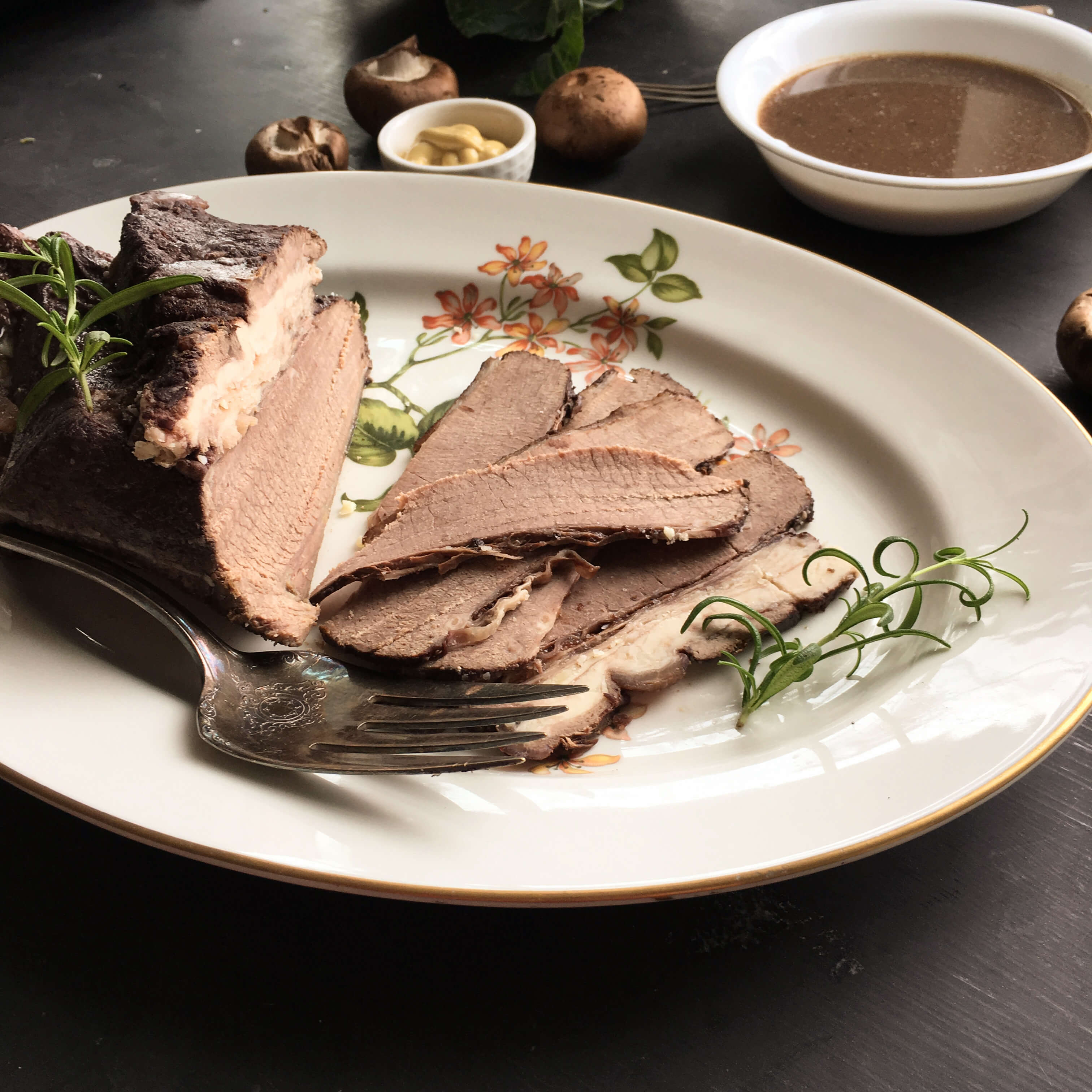
Remove the onions and celery to a blender and mix until well combined. This will form a thin au jus style gravy which is delicious for dipping.

Transfer the au jus to a small saucepan and warm over medium heat. Next, thinly slice the brisket and serve cold or at room temperature alongside the au jus and/or with your favorite condiments like mustard, mayo, or horseradish.

This style of brisket is perfect for French Dip style sandwiches served on crusty rolls. It also travels well for springtime picnics and outdoor family gatherings. In Annie’s house, it is a staple for many Jewish holiday celebrations.  Simple fare with a collaborative past, that’s the brisket in all its wonderful ways.

There is something lovely about Annie’s recipe that ties all the historical elements of the holiday into one tidy package. With its Irish and Jewish heritage,  its international transmittance, and Annie’s New York roots, it feels like this recipe really embraces the spirit of the holiday. The parallels are endless. The recipe was written on a boat in the 2000s featuring a food that was once eaten by sailors in the 1700s. Annie lived in New York during the 20th century. The immigrants who helped perfect this style of cooking lived in New York in the 19th century. Annie is Jewish. The butchers who sold brisket cuts to the Irish in NYC were Jewish. Annie uses brisket to feed her family on Jewish holidays. The Irish-American community uses brisket to celebrate their national Catholic holiday.

St. Patrick’s Day isn’t only for the Irish – it’s for everyone in America who hand a hand in building a country where people and food worked together to create new things and new traditions in a new land. Cheers to foods that continue to bring people together in surprising ways. And cheers to Annie for sharing her delicious brisket recipe.  Hope this St. Patrick’s Day is your most festive one yet!

Bacon, Montana & The Family Pie Crust: It’s Tradition Time!

If you are looking for a fun dessert to make for Easter dinner or you are heading out to someone else’s house for the holiday and want to bring something new (but old) along, we recommend the little known but amazingly delicious Rhubarb Custard Pie.  It has been an Easter tradition in my family since the 1960’s when my mom first started making it with the help of her husband’s grandfather’s homemade pie crust recipe and Betty Crocker’s 1950 Picture Cookbook.

Rhubarb in its natural state.

Rhubarb is one of those quirky vegetables. Some people call it pink celery. Understandably, it really does resemble the green hued variety with its long stalks and tufted green leaves. But rhubarb is actually part of the buckwheat family and celery is part of the parsnip family so their similarities end at face value.  Unlike the subtle soapy taste of celery, rhubarb is tart like a Granny Smith apple and more spongey in texture than a crisp stalk of celery. It’s ideal baking consistency is soft like a ripe pear with a bright white interior and a pale pink exterior. The general rule of thumb when it comes to selecting rhubarb for purchase is the firmer and redder the stalk the tarter the taste.  Ideally, you want something in-between – slightly spongy to the touch and a 40/60 ratio of stalks ranging from deep red to pale pink for dynamic flavor.

Two important factors go into making this pie a repeat favorite year after year – the filling and the pie crust.  Most people (and pie recipes) pair rhubarb with fresh strawberries, which is a good Spring combo since both are usually in season at the same time.  Sometimes though, these two put together can result in a watery pie which makes the crust soggy and each bite extra drippy. The secret addition to the rhubarb custard pie is the eggs. They act like a binder holding everything in place, so that you get all the sweet-tart taste of the filling without the thin and liquidy consistency. Betty Crocker’s 1950’s version is easy to prepare and always delicious.

The second important factor to this pie (and to all pies, really) is the homemade pie crust. It only takes about 10 minutes and four ingredients to make no-fail pie dough and it cooks beautifully and consistently every time.  Passed down through the generations, this recipe is so good it has been in active use in my family for almost 100 years thanks to this guy who taught everyone how to make it in the very beginning…

Bacon & Dolly Day in Montana circa 1950’s/1960’s

Meet Bacon Day and his wife Dolly. Bacon (yes, that’s his real name!) first moved to Montana in the 1920’s where he married his bride, Dolly, in Missoula and went straight to work in the rural mining town of Gold Creek, as the train depot clerk for Northern Pacific Railroad. The railroad was so eager to have Bacon join the team, that they gave he and Dolly two railcars to live in and set up homekeeping. Bacon was originally from St. Paul and Dolly from Seattle, so this railroad life was a whole new and exciting adventure for the newlyweds.

1930’s Northern Railroad travel poster

We don’t have any pictures of Dolly and Bacon in their rail car housing but we can imagine that it looked something like these two (now serving as luxury hotel accommodations in Montana)…

Or maybe it looked something like the rail car library built in 1926 that serviced the reading needs of Montana’s lumberjack and logging communities…

Library rail car built in 1926 to serve the literature names of logging camps in early 20th century Montana. Read more about the library car here.

Either way, it must have been a pretty unusual first home for Bacon and Dolly, and a pretty unusual life for two people new to a state that was not quite yet developed. 1920’s Montana wasn’t for the timid or the faint of heart.  Interesting but also tumultuous, it was stunning in topography, erratic in business opportunity, progressive in gender equality and rebellious when it came to law and decorum. Especially when it came to train life.

Northern Pacfic Railroad Advertising 1910-1920’s

When the railroad companies first started building tracks out west with the ultimate goal of connecting the East coast to the West coast, Montana was marketed to new settlers as a land of stunning beauty and abundant farming opportunities. Homesteaders came from the East coast with intentions of building farms, raising livestock and growing food for commerce. But when these newcomers arrived they experienced a climate far different then what they knew back home. The winters were longer, the temperatures were colder, the open prairies were vast and resources were scarce forcing everyone to be immediately self-reliant. By the early 1900’s, livestock brought in from the East (mostly cows) had arrived in such excess they depleted the natural prairie grasses and upset the delicate balance of the natural eco-system, basically reducing the landscape to bare patches. Add-in an almost decade-long drought that occurred in the 1920’s, and the typography of Montana came to look more like a dessert of death than a lush and verdant valley of promise that all the postcards had been promoting..

Butte, Montana postcard from the 1920’s

The rail companies wanted to keep tourism and homesteading moving through the state though, so they would pay local homesteaders $1000 to grow the most attractive crop they could manage from the poor soil and then took those displays back East to show people how wonderful the agriculture was in Montana.

Montana Homestead Poster

This unscrupulous marketing ploy worked, and new settlers came by the train-full to start a fresh life in green and growing Montana. Only when they got they got off the train, they could see the landscape was devasted and the dry soil virtually unmanageable.  Bacon, in his train depot office, would have been witness to all the excitement and disappointment that came through his station, especially when he worked in Gold Creek which was known for its gold mining potential.

Eventually, all this agriculture business got sorted out once the rains came and residents were properly educated on how and what to grow in this new environment. Montana began to thrive once again. Leaving Gold Creek, Dolly and Bacon moved on to settle into another rural rail town, Phillipsburg, where Bacon worked as a train conductor on a transportation line for livestock and mining equipment.

Now an abandoned track, these are recent photos of the train line running through Phillipsburg with views that Dolly and Bacon would have seen on a daily basis.  Photos courtesy of D & D Travel.

From their wedding forward, Bacon and Dolly lived in Montana and loved it. Dolly often wrote poems about the natural beauty of her surroundings. They both mastered baking – Bacon with his pies and Dolly with her bread. Stories have been passed down that tell of breakfast at their house – often fresh caught trout and a homemade loaf of bread, served possibly with a slice of pie. For over 55 years, these two watched the growth and evolution of their marriage,  their state, their family and their landscape all from the vantage point of the railroad tracks that ran through their lives and their hearts.

In some future posts, there will be more stories about Dolly and Bacon and their wild Montana life, but in the meantime, we have a holiday to celebrate and a pie to bake so it’s back to the rhubarb custard.

I recommend preparing the filling first. It can sit off to the side for a little bit while you make your pie crust.

Betty Crocker’s Rhubarb Custard Pie Filling

Makes enough filling for one 9″ inch pie

3 eggs

2 2/3 tablespoons milk

2 cups sugar  (I use cane sugar)

4 tablespoons flour

3/4 tsp. nutmeg

4 cups chopped fresh rhubarb (about 8-10 long stalks)

1 tablespoon butter

Preheat the oven to 400 degrees. Wash, dry and cut the rhubarb into small bite-size pieces.

In a medium mixing bowl, beat 3 eggs slightly. Add the milk and then mix again before adding the sugar, flour and nutmeg.

Toss in the rhubarb and mix thoroughly. Then set aside while you make the pie crust.

Great-Grandpa Bacon’s Fool-Proof Pie Crust

2 cups flour

1/2 tsp salt

3/4 cup butter or shortening ( I always use butter)

1/2 cup ice cold water

1/8 cup milk (reserved until the end)

In a bowl, mix the flour and salt. Roughly chop the butter and add to the flour mixture. With a fork press the butter into the flour until the mixture resembles course meal. If its easier, you can also do this quickly using your hands – jus don’t crumble the butter so much that it starts to melt from your body heat.

Once the butter is mixed in, add the ice-cold water (the colder the water the better). Mix until the dough clumps together and you can easily form a crumbly yet cohesive ball.

Place the dough on a lightly floured pastry cloth, board or marble slab and cut in half with a sharp knife. Place one half of the dough ball off to the side. Roll out the remaining half of the dough with a wooden roller that has been dusted with flour. If you don’t have a wooden rolling pin you can use a wine bottle, or a cylindrical jar or vase (if you use either make sure to dust it with flour). Roll the dough out as much as possible without tearing it. Makes sure it is big enough to accommodate your pie dish. Once the dough is the right size, gently fold the dough in half on the cloth.

Line the crease of the fold line up with the center of your pie dish and gently lay the crust (still folded) down so that it covers just one side of your dish, then unfold the other half to cover the other half of the dish.  There should be excess dough hanging off the sides of the dish. It should like this…

Pour the rhubarb mixture into the pie dish and set aside.

Next, in the same fashion as before, roll out the other half of the dough ball. In order to make a basket weave design for the top crust, you’ll need a sharp knife to cut strips of dough.

Place the first strip of dough vertically on the pie and the second strip of dough horizontally so that it forms a cross. Next weave the remaining strips in an over-under pattern, alternating each slice as you go.

Next, cut away the excess dough along the sides, leaving a collar of about 1 inch of extra dough all the way around the rim.  Pinch the edges of the top and bottom crust together.

When finished dot the exposed holes with the remaining tablespoon of butter and brush the top crust lightly with milk.

Bake for 50-60 minutes until the crust is golden brown and the rhubarb custard is bubbling. Let cool on a wire rack before serving. This pie is very versatile in the presentation department –  serve it warm, cold or at room temperature.

Like pecan pie it is pretty sweet as it is, so you don’t need to add whipped cream or ice cream. Its ideal companion is a hot cup of coffee. And no one would look twice if you wanted to enjoy a slice for breakfast. Sometimes that’s the best time of day for a little decadence. If he was still alive, Bacon would be right there with you, enjoying a plate of breakfast trout.

If you get a chance to try this recipe, please let us know how you liked it. And if you have any questions on how to make your pie crust please comment below and we’ll get right back to you.

In the meantime, cheers to all the recipes that turn into traditions and cheers to Bacon and Dolly for always being a part of our most delicious holiday celebrations.

2024 Update!

This 2018 blog post became the linchpin in solving a mystery in 2021 surrounding a lost heirloom, and it’s 20 year journey back home to its original owners. It’s a true story of fate, family, persistence, and the incredible kindness of strangers that seems like something straight out of a fiction novel or a film, but it’s even better because it’s real life.  Read all about it as the mystery unfolded in real time in our five part series on the blog starting here.